
KESEIMBANGAN LINI PRODUKSI PRODUCTION LINE BALANCING BAGIAN 2
KESEIMBANGAN LINI PRODUKSI / PRODUCTION LINE BALANCING (BAGIAN 2) 1
Methods of Line Balancing • They are heuristic approaches - based on logic and common sense rather than on mathematical proof. • They do not guarantee an optimal solution, but result in good solutions which approach the true optimum. 2
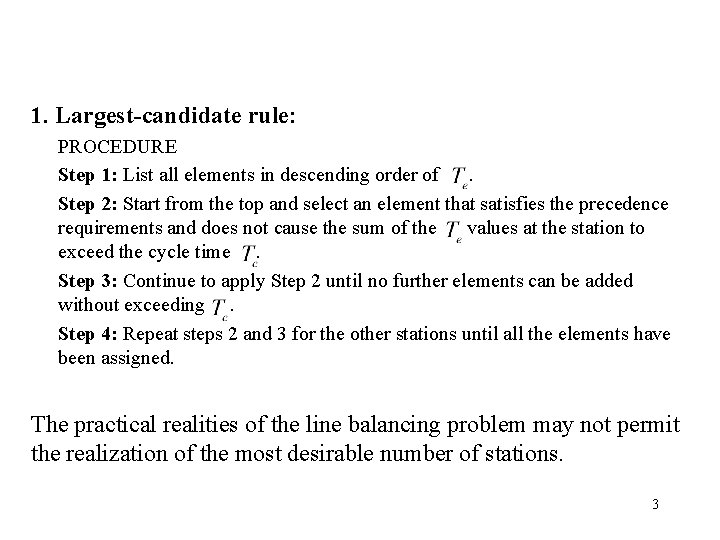
1. Largest-candidate rule: PROCEDURE Step 1: List all elements in descending order of. Step 2: Start from the top and select an element that satisfies the precedence requirements and does not cause the sum of the values at the station to exceed the cycle time. Step 3: Continue to apply Step 2 until no further elements can be added without exceeding. Step 4: Repeat steps 2 and 3 for the other stations until all the elements have been assigned. The practical realities of the line balancing problem may not permit the realization of the most desirable number of stations. 3
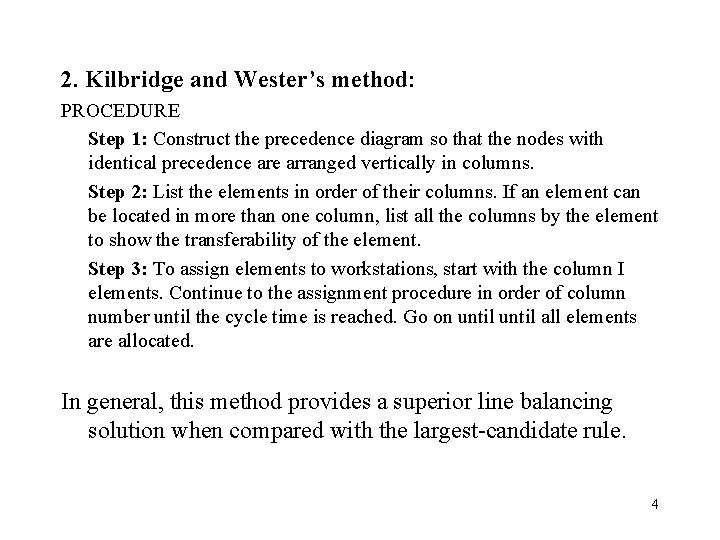
2. Kilbridge and Wester’s method: PROCEDURE Step 1: Construct the precedence diagram so that the nodes with identical precedence arranged vertically in columns. Step 2: List the elements in order of their columns. If an element can be located in more than one column, list all the columns by the element to show the transferability of the element. Step 3: To assign elements to workstations, start with the column I elements. Continue to the assignment procedure in order of column number until the cycle time is reached. Go on until all elements are allocated. In general, this method provides a superior line balancing solution when compared with the largest-candidate rule. 4

3. Ranked positional weights method: PROCEDURE Step 1: Calculate the ranked positional weight value (RPW) for each element by summing the element’s Te together with the Te values for all the elements that follow it in the arrow chain of the precedence diagram. Step 2: List the elements in descending order of their RPW. Step 3: Assign elements to stations according to RPW, avoiding precedence constraint and time-cycle violations. 4. COMSOAL - A Computerized Line Balancing Method PROCEDURE Step 1: Construct list A, showing all work elements in one column and the total number of elements that immediately precede each element in an adjacent column. Step 2: Construct list B, showing all elements from list A that have no immediate predecessors. 5
Step 3: Select at random one of the elements from list B, which must not cause the cycle time Tc to be exceeded. Step 4: Eliminate the element selected in step 3 from lists A and B and update both lists, if necessary. There may be changes in the number of immediate predecessors for certain elements in list A; and there may now be some new elements having no immediate predecessors that should be added to list B. Step 5: Select one of the elements from list B which is feasible for cycle time. Step 6: Repeat steps 4 and 5 until all elements have been allocated to stations within the Tc constraint. Step 7: Retain the current solution and repeat steps 1 through 6 to attempt to determine an improved solution. If an improved solution is obtained, it should be retained. 6
Other Ways to Improve the Line Balance • • • Dividing work elements Changing workhead speeds at automatic stations Methods analysis Preassembly of components Inventory buffers between stations Parallel stations 7
REFERENCE • IE 462 Introduction to Manufacturing Systems 8
- Slides: 8