
Kernel Methods Barnabs Pczos University of Alberta Oct
Kernel Methods Barnabás Póczos University of Alberta Oct 1, 2009
Outline • • • Quick Introduction Feature space Perceptron in the feature space Kernels Mercer’s theorem • Finite domain • Arbitrary domain Kernel families • Constructing new kernels from kernels Constructing feature maps from kernels Reproducing Kernel Hilbert Spaces (RKHS) The Representer Theorem 2
Ralf Herbrich: Learning Kernel Classifiers Chapter 2 3

Quick Overview
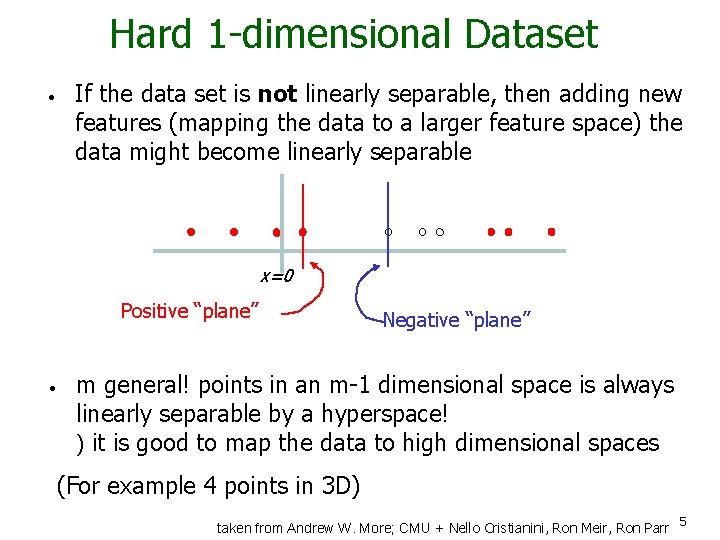
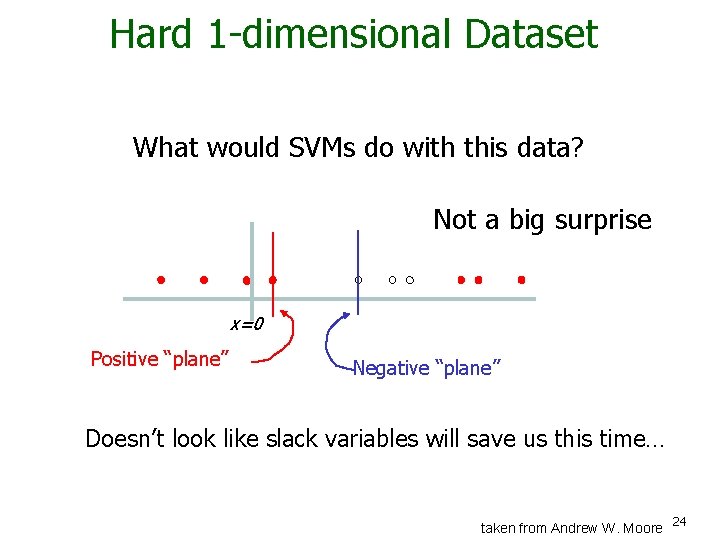
Hard 1 -dimensional Dataset • If the data set is not linearly separable, then adding new features (mapping the data to a larger feature space) the data might become linearly separable x=0 Positive “plane” • Negative “plane” m general! points in an m-1 dimensional space is always linearly separable by a hyperspace! ) it is good to map the data to high dimensional spaces (For example 4 points in 3 D) taken from Andrew W. More; CMU + Nello Cristianini, Ron Meir, Ron Parr 5
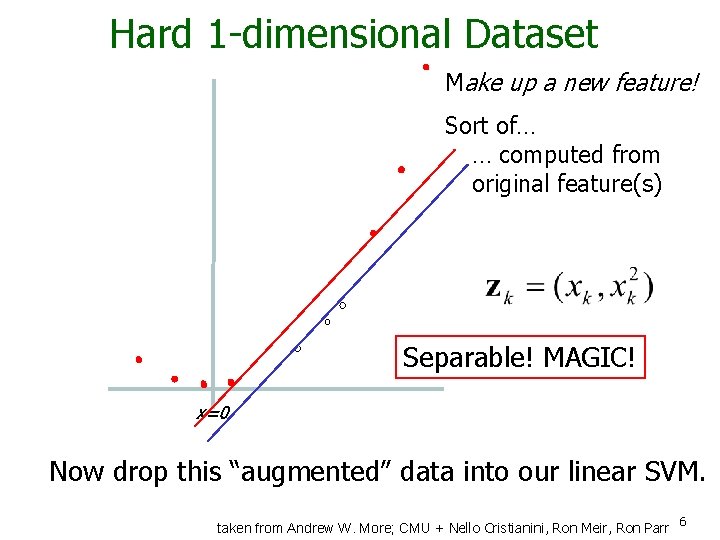
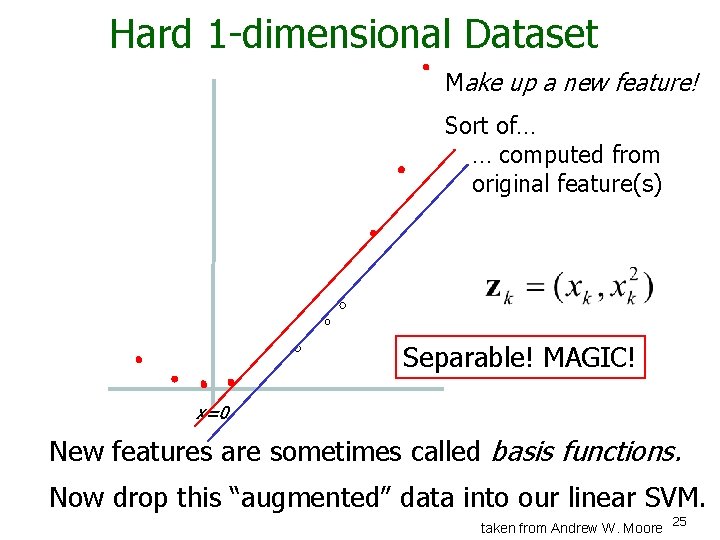
Hard 1 -dimensional Dataset Make up a new feature! Sort of… … computed from original feature(s) Separable! MAGIC! x=0 Now drop this “augmented” data into our linear SVM. taken from Andrew W. More; CMU + Nello Cristianini, Ron Meir, Ron Parr 6
Feature mapping • m general! points in an m-1 dimensional space is always linearly separable by a hyperspace! ) it is good to map the data to high dimensional spaces • Having m training data, is it always enough to map the data into a feature space with dimension m-1? Nope. . . We have to think about the test data as well! Even if we don’t know how many test data we have. . . • We might want to map our data to a huge (1) dimensional feature space • Overfitting? Generalization error? . . . We don’t care now. . . • 7
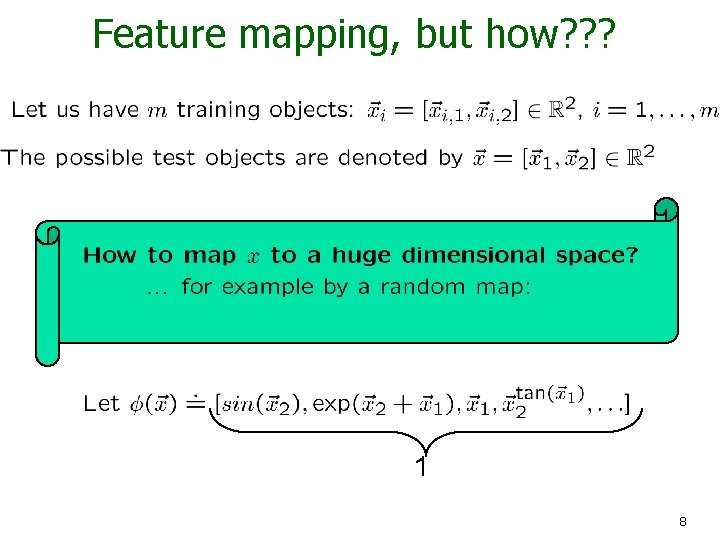
Feature mapping, but how? ? ? 1 8
Observation Several algorithms use the inner products only, but not the feature values!!! E. g. Perceptron, SVM, Gaussian Processes. . . 9
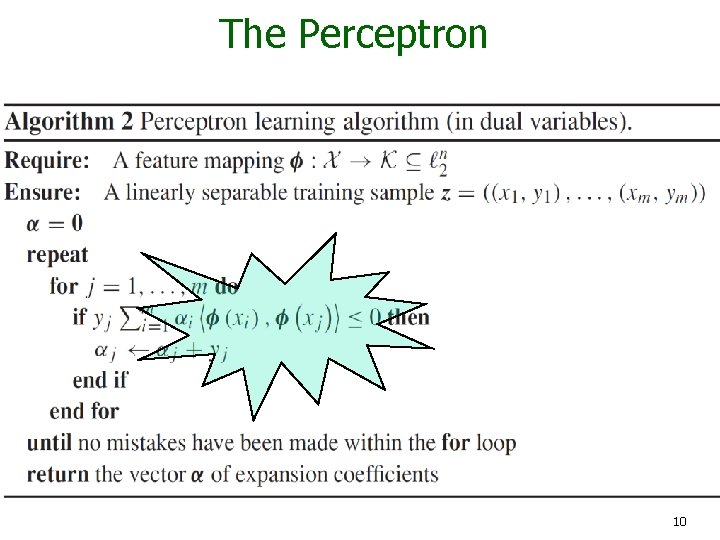
The Perceptron 10
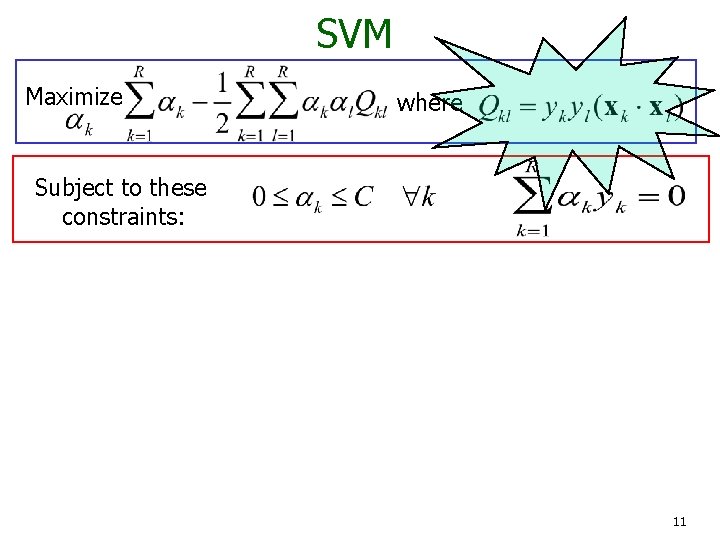
SVM Maximize where Subject to these constraints: 11
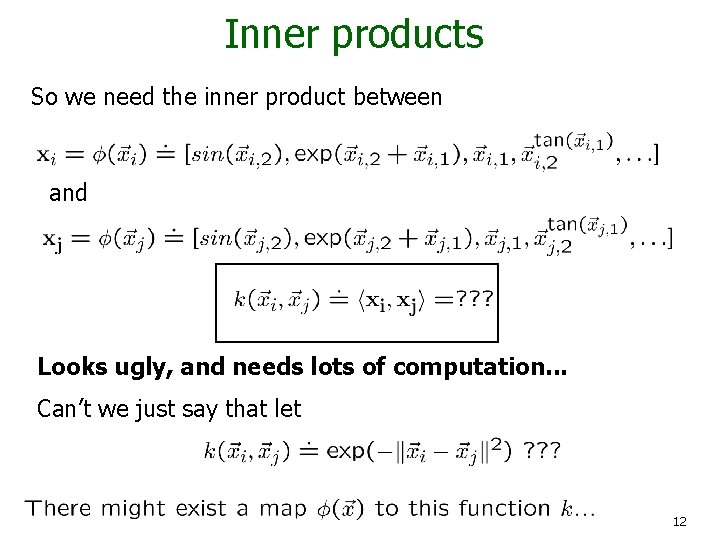
Inner products So we need the inner product between and Looks ugly, and needs lots of computation. . . Can’t we just say that let 12
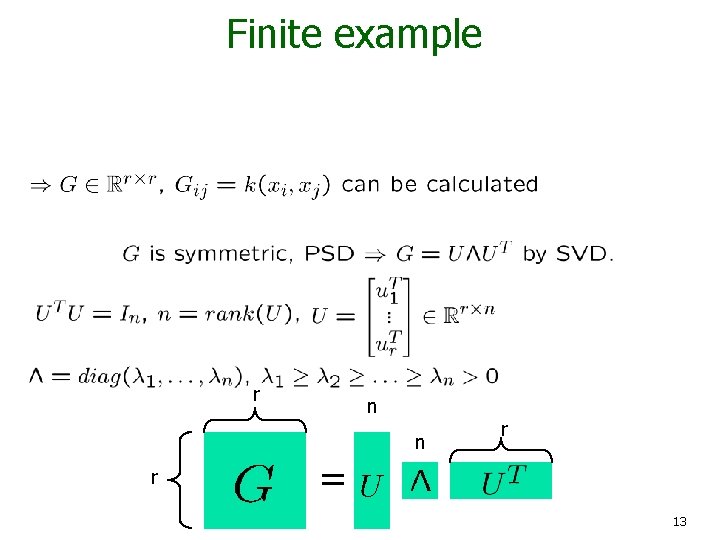
Finite example r r n = n r 13
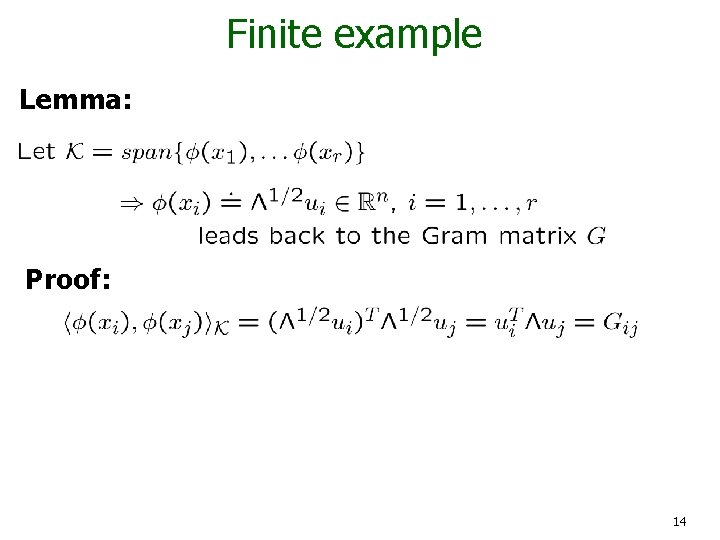
Finite example Lemma: Proof: 14
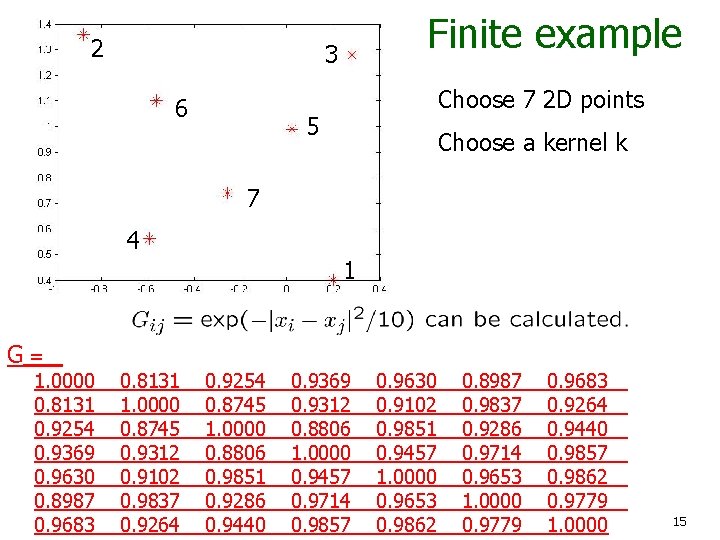
2 Finite example 3 6 Choose 7 2 D points 5 Choose a kernel k 7 4 1 G= 1. 0000 0. 8131 0. 9254 0. 9369 0. 9630 0. 8987 0. 9683 0. 8131 1. 0000 0. 8745 0. 9312 0. 9102 0. 9837 0. 9264 0. 9254 0. 8745 1. 0000 0. 8806 0. 9851 0. 9286 0. 9440 0. 9369 0. 9312 0. 8806 1. 0000 0. 9457 0. 9714 0. 9857 0. 9630 0. 9102 0. 9851 0. 9457 1. 0000 0. 9653 0. 9862 0. 8987 0. 9837 0. 9286 0. 9714 0. 9653 1. 0000 0. 9779 0. 9683 0. 9264 0. 9440 0. 9857 0. 9862 0. 9779 1. 0000 15
![[U, D]=svd(G), UDUT=G, UUT=I U= -0. 3709 0. 5499 0. 3392 0. 6302 0.](http://slidetodoc.com/presentation_image_h2/4ead81f79493213a8bc8e5cec748809e/image-16.jpg "[U, D]=svd(G), UDUT=G, UUT=I U= -0. 3709 0. 5499 0. 3392 0. 6302 0.")
[U, D]=svd(G), UDUT=G, UUT=I U= -0. 3709 0. 5499 0. 3392 0. 6302 0. 0992 -0. 1844 -0. 3670 -0. 6596 -0. 1679 0. 5164 0. 1935 0. 2972 -0. 3727 0. 3007 -0. 6704 -0. 2199 0. 4635 -0. 1529 -0. 3792 -0. 1411 0. 5603 -0. 4709 0. 4938 0. 1029 -0. 3851 0. 2036 -0. 2248 -0. 1177 -0. 4363 0. 5162 -0. 3834 -0. 3259 -0. 0477 -0. 0971 -0. 3677 -0. 7421 -0. 3870 0. 0673 0. 2016 -0. 2071 -0. 4104 0. 1628 -0. 0633 0. 0985 0. 1862 -0. 2148 -0. 5377 -0. 2217 0. 7531 D= 6. 6315 0 0 0 0. 2331 0 0 0 0. 1272 0 0 0 0. 0066 0 0 0 0. 0016 0 0 0 0. 000 16
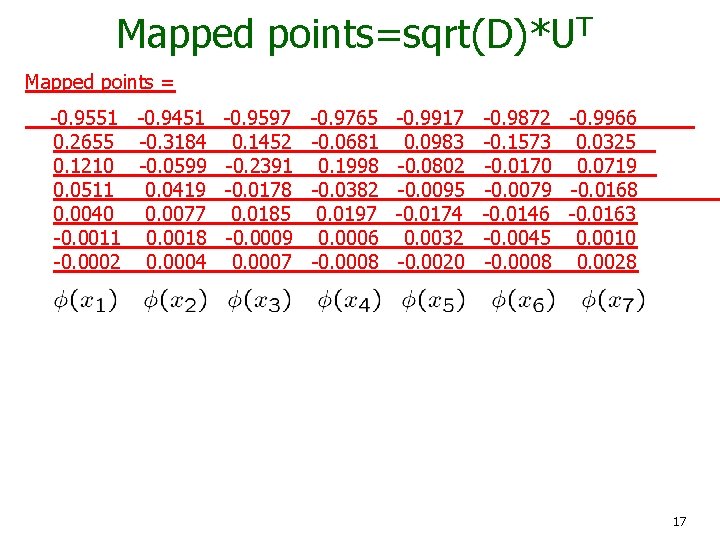
Mapped points=sqrt(D)*UT Mapped points = -0. 9551 -0. 9451 -0. 9597 -0. 9765 0. 2655 -0. 3184 0. 1452 -0. 0681 0. 1210 -0. 0599 -0. 2391 0. 1998 0. 0511 0. 0419 -0. 0178 -0. 0382 0. 0040 0. 0077 0. 0185 0. 0197 -0. 0011 0. 0018 -0. 0009 0. 0006 -0. 0002 0. 0004 0. 0007 -0. 0008 -0. 9917 0. 0983 -0. 0802 -0. 0095 -0. 0174 0. 0032 -0. 0020 -0. 9872 -0. 9966 -0. 1573 0. 0325 -0. 0170 0. 0719 -0. 0079 -0. 0168 -0. 0146 -0. 0163 -0. 0045 0. 0010 -0. 0008 0. 0028 17
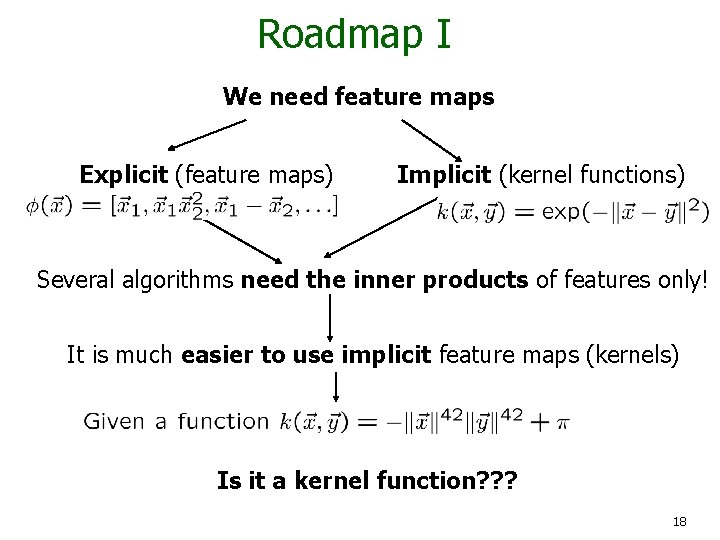
Roadmap I We need feature maps Explicit (feature maps) Implicit (kernel functions) Several algorithms need the inner products of features only! It is much easier to use implicit feature maps (kernels) Is it a kernel function? ? ? 18
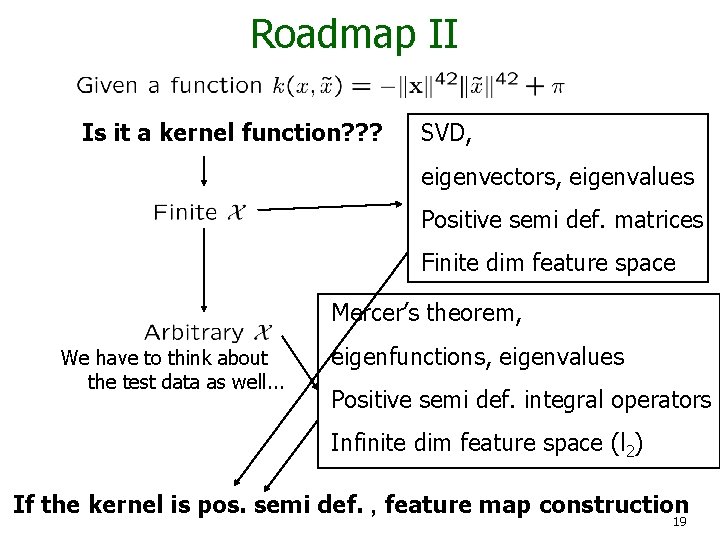
Roadmap II Is it a kernel function? ? ? SVD, eigenvectors, eigenvalues Positive semi def. matrices Finite dim feature space Mercer’s theorem, We have to think about the test data as well. . . eigenfunctions, eigenvalues Positive semi def. integral operators Infinite dim feature space (l 2) If the kernel is pos. semi def. , feature map construction 19
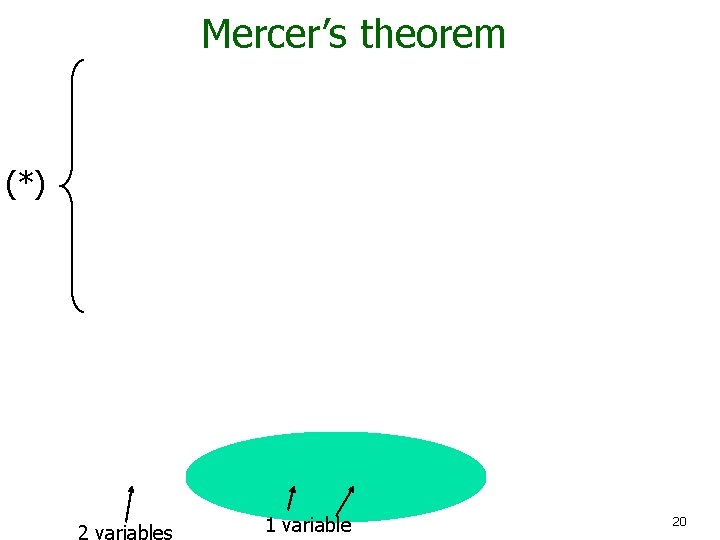
Mercer’s theorem (*) 2 variables 1 variable 20
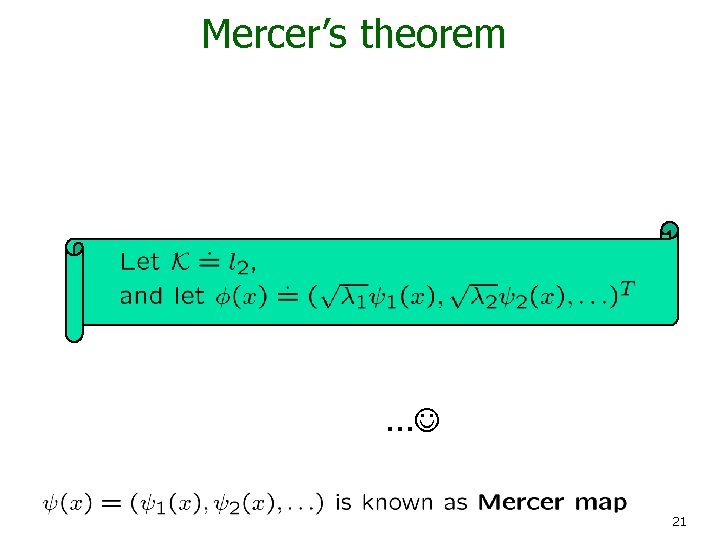
Mercer’s theorem . . . 21
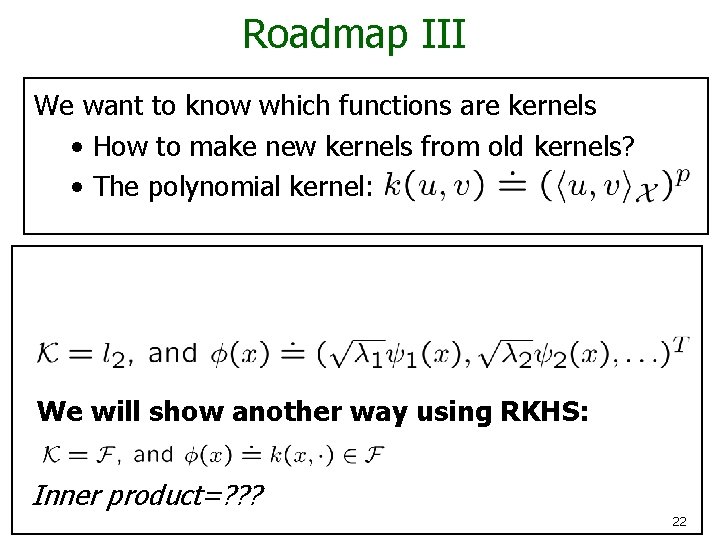
Roadmap III We want to know which functions are kernels • How to make new kernels from old kernels? • The polynomial kernel: We will show another way using RKHS: Inner product=? ? ? 22
Ready for the details? ; )
Hard 1 -dimensional Dataset What would SVMs do with this data? Not a big surprise x=0 Positive “plane” Negative “plane” Doesn’t look like slack variables will save us this time… taken from Andrew W. Moore 24
Hard 1 -dimensional Dataset Make up a new feature! Sort of… … computed from original feature(s) Separable! MAGIC! x=0 New features are sometimes called basis functions. Now drop this “augmented” data into our linear SVM. taken from Andrew W. Moore 25
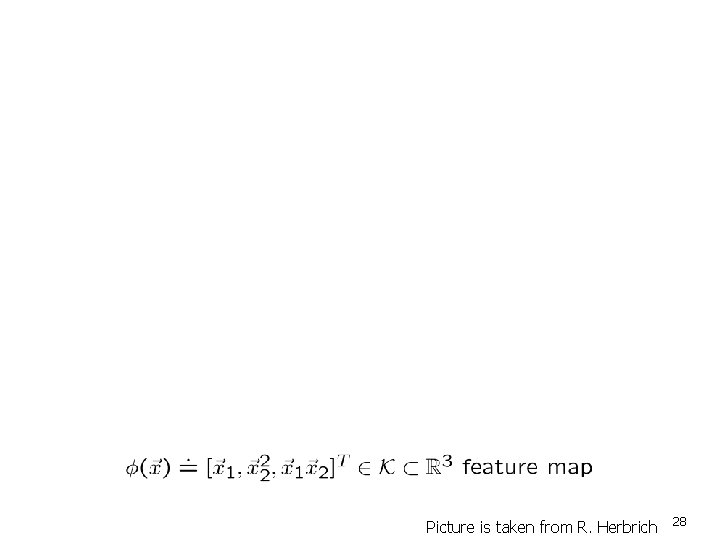
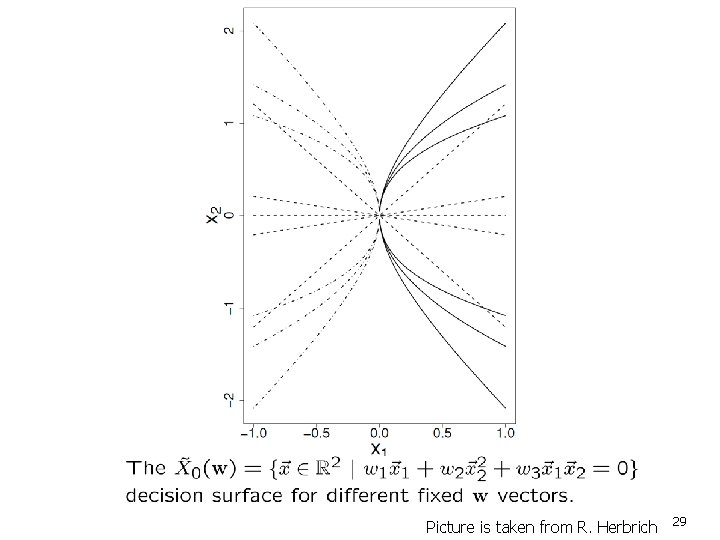
Hard 2 -dimensional Dataset O X X O Let us map this point to the 3 rd dimension. . . 26
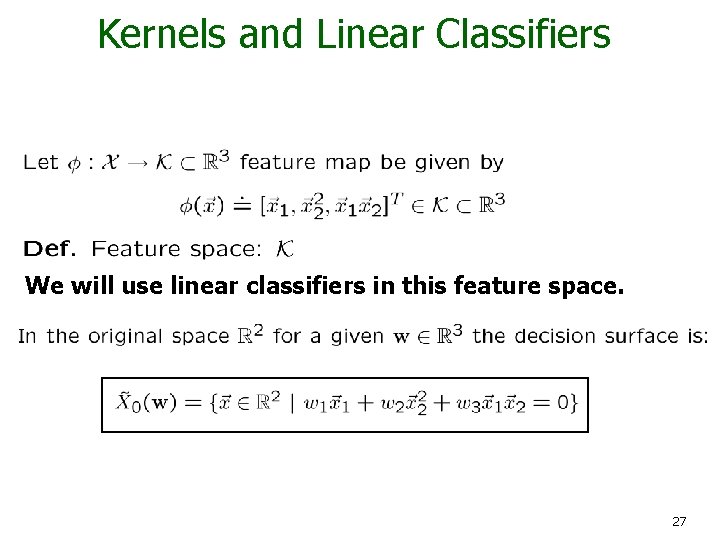
Kernels and Linear Classifiers We will use linear classifiers in this feature space. 27
Picture is taken from R. Herbrich 28
Picture is taken from R. Herbrich 29
Kernels and Linear Classifiers Feature functions 30
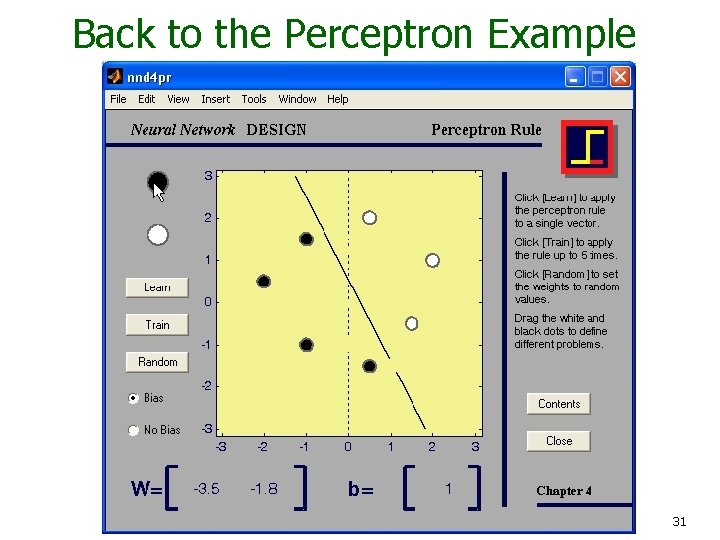
Back to the Perceptron Example 31
The Perceptron • The primal algorithm in the feature space 32
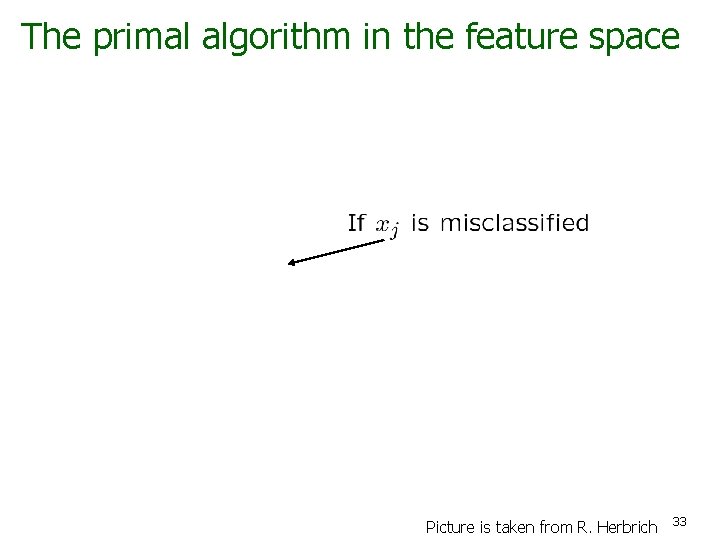
The primal algorithm in the feature space Picture is taken from R. Herbrich 33
The Perceptron 34
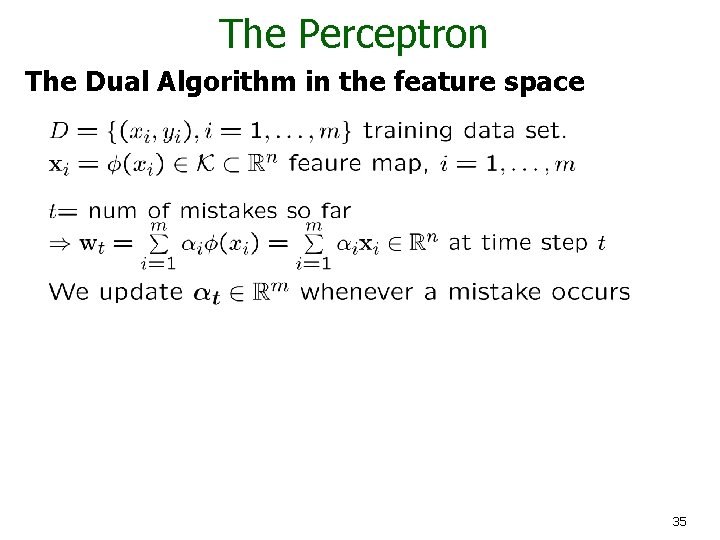
The Perceptron The Dual Algorithm in the feature space 35
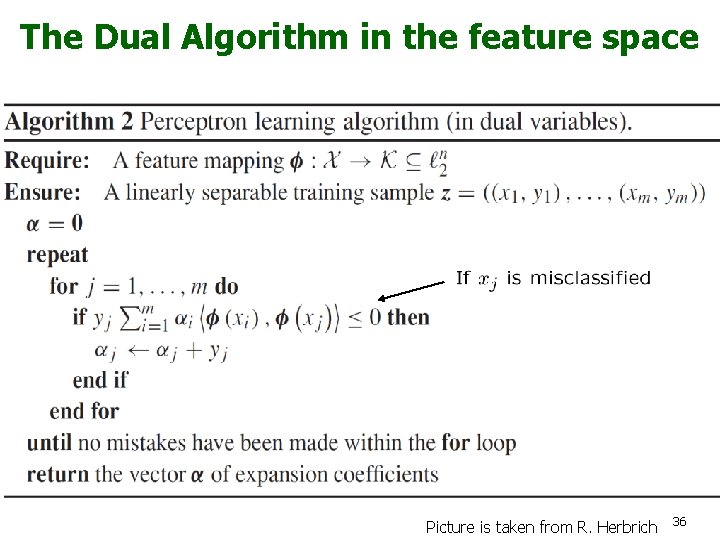
The Dual Algorithm in the feature space Picture is taken from R. Herbrich 36
The Dual Algorithm in the feature space 37
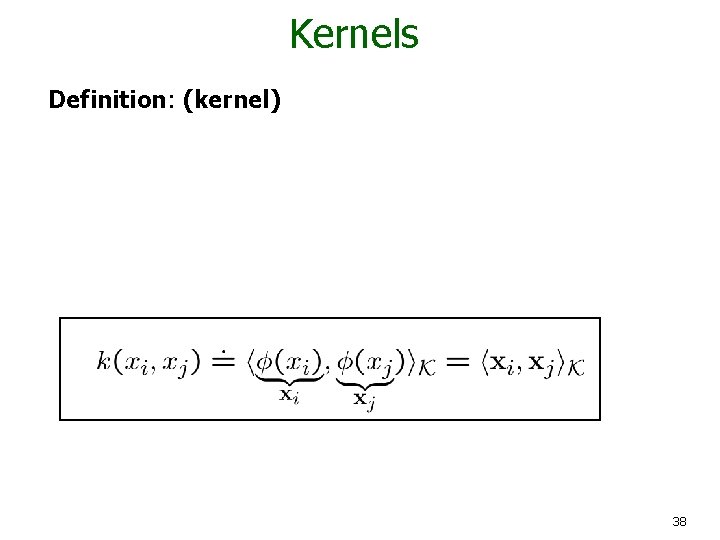
Kernels Definition: (kernel) 38
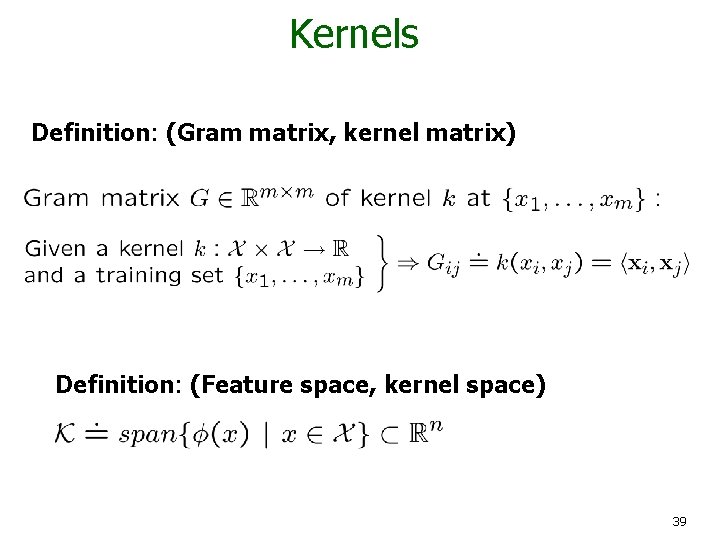
Kernels Definition: (Gram matrix, kernel matrix) Definition: (Feature space, kernel space) 39
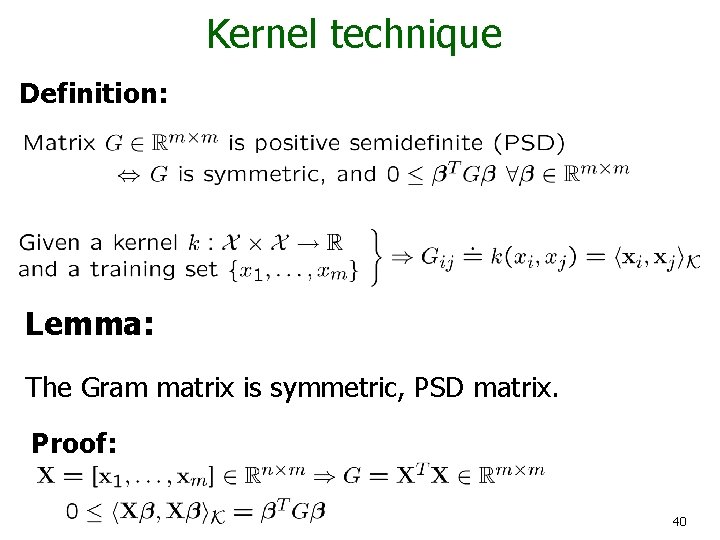
Kernel technique Definition: Lemma: The Gram matrix is symmetric, PSD matrix. Proof: 40
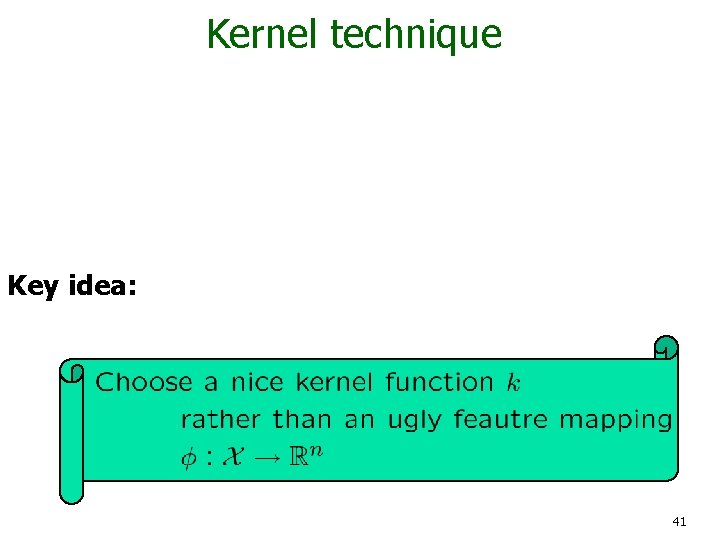
Kernel technique Key idea: 41
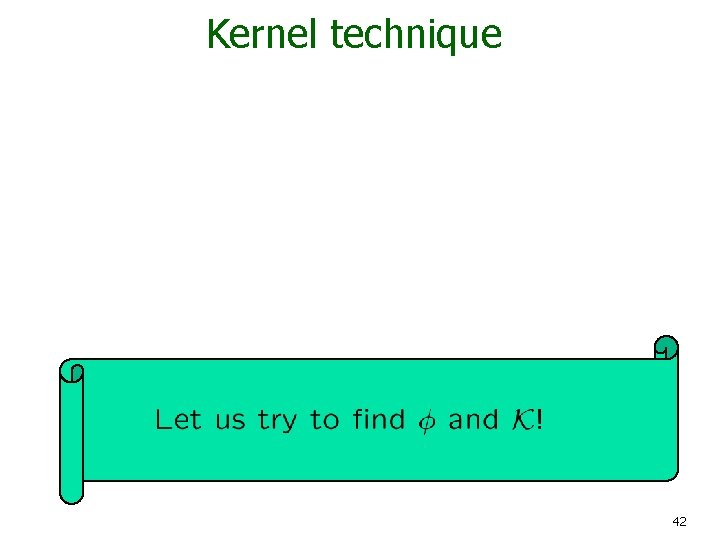
Kernel technique 42
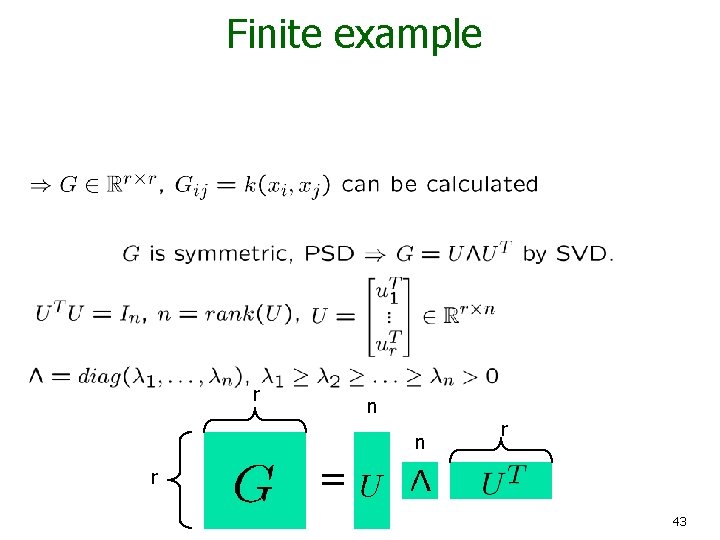
Finite example r r n = n r 43
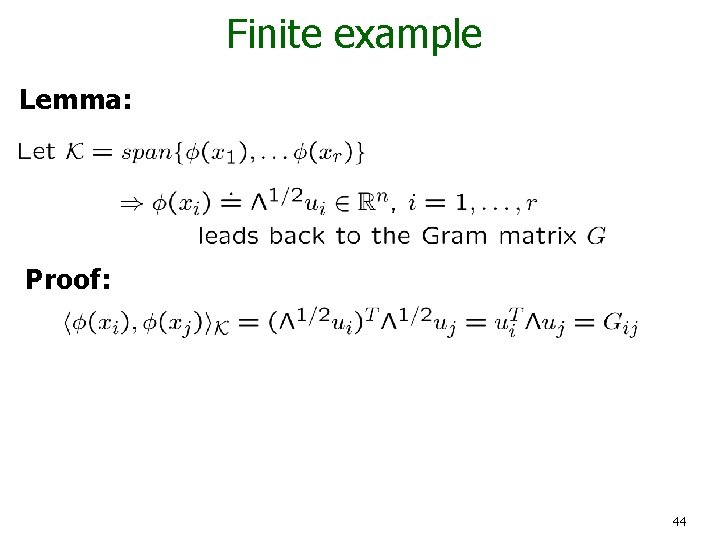
Finite example Lemma: Proof: 44
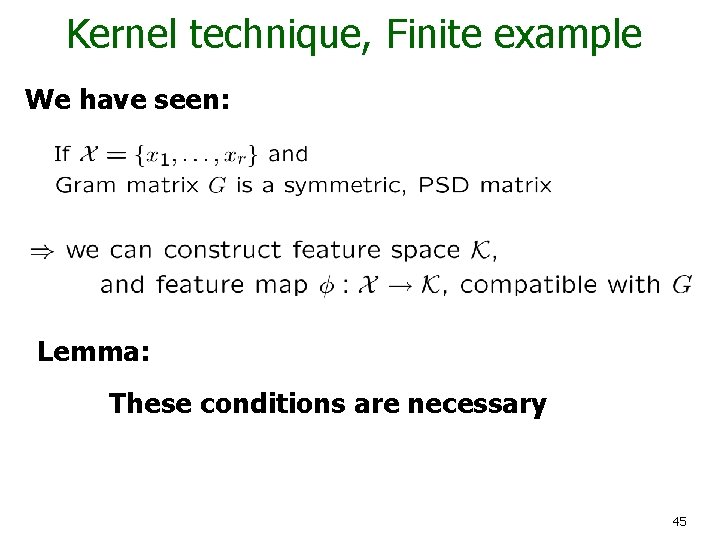
Kernel technique, Finite example We have seen: Lemma: These conditions are necessary 45
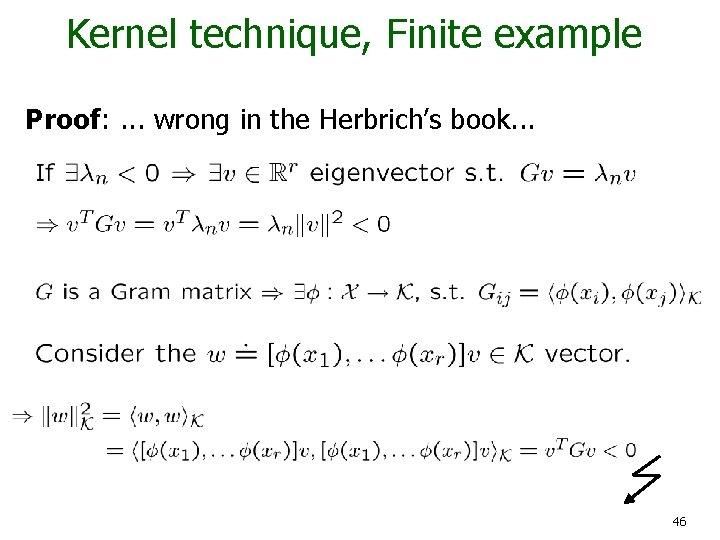
Kernel technique, Finite example Proof: . . . wrong in the Herbrich’s book. . . 46
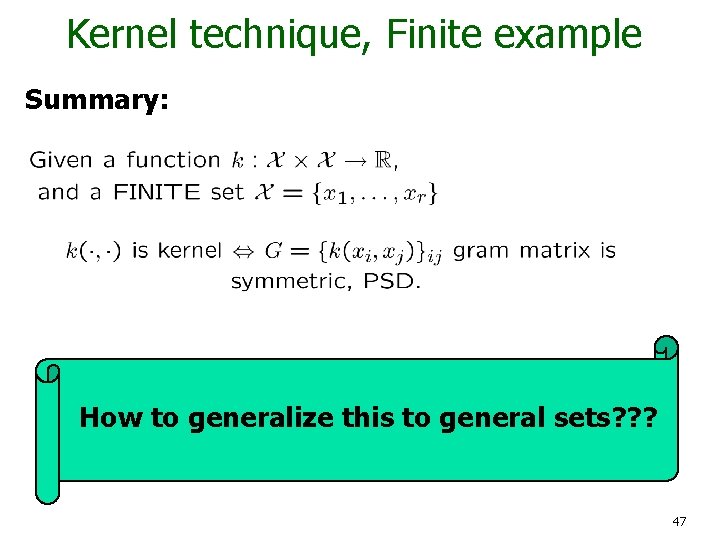
Kernel technique, Finite example Summary: How to generalize this to general sets? ? ? 47
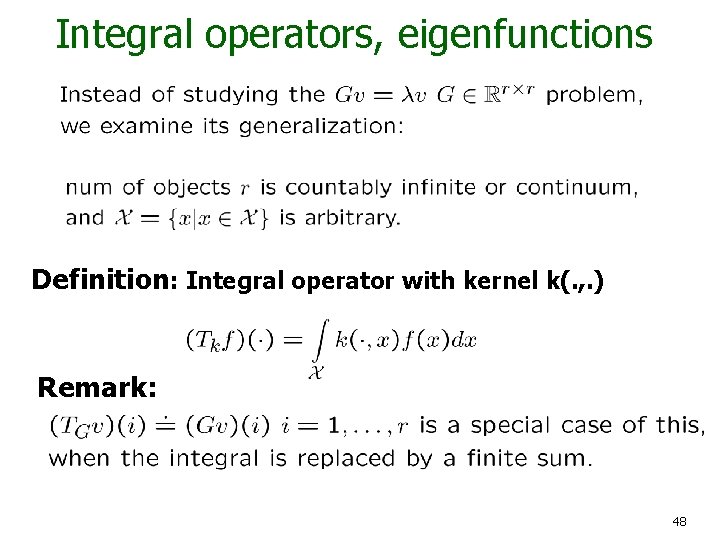
Integral operators, eigenfunctions Definition: Integral operator with kernel k(. , . ) Remark: 48
![From Vector domain to Functions • Observe that each vector v = (v[1], v[2],](http://slidetodoc.com/presentation_image_h2/4ead81f79493213a8bc8e5cec748809e/image-49.jpg "From Vector domain to Functions • Observe that each vector v = (v[1], v[2],")
From Vector domain to Functions • Observe that each vector v = (v[1], v[2], . . . , v[n]) is a mapping from the integers {1, 2, . . . , n} to < • We can generalize this easily to INFINITE domain w = (w[1], w[2], . . . , w[n], . . . ) where w is mapping from {1, 2, . . . } to < j 1 2 1 1 2 i G v 1 49
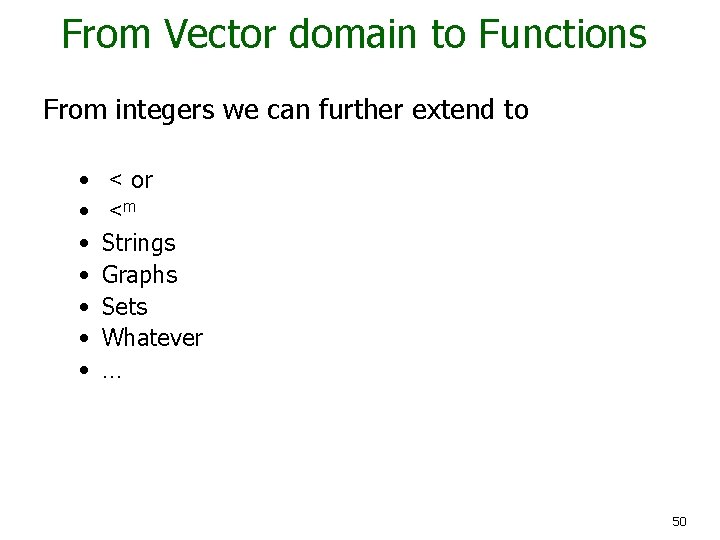
From Vector domain to Functions From integers we can further extend to • • < or <m Strings Graphs Sets Whatever … 50
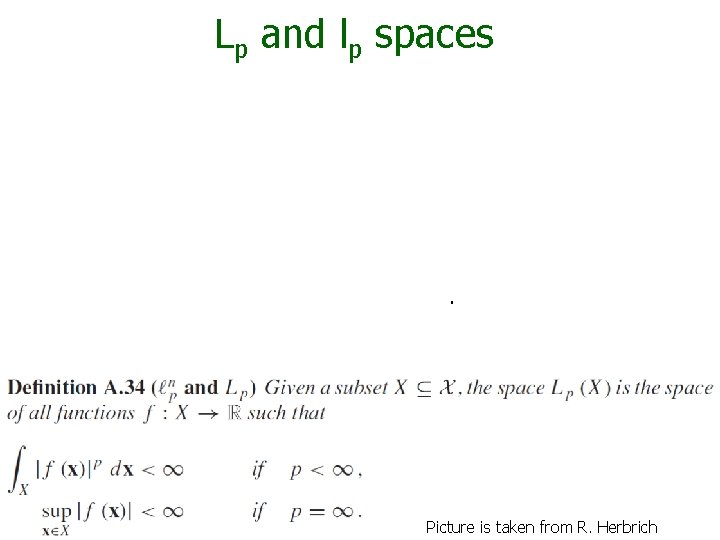
Lp and lp spaces . Picture is taken from R. Herbrich 51
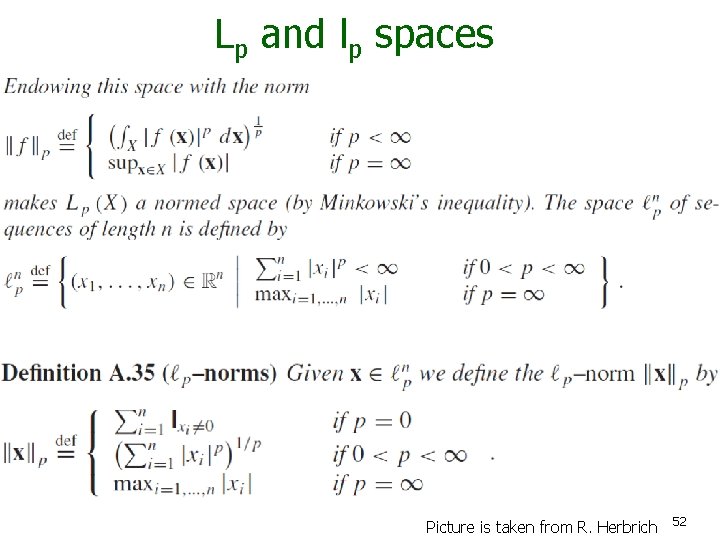
Lp and lp spaces Picture is taken from R. Herbrich 52
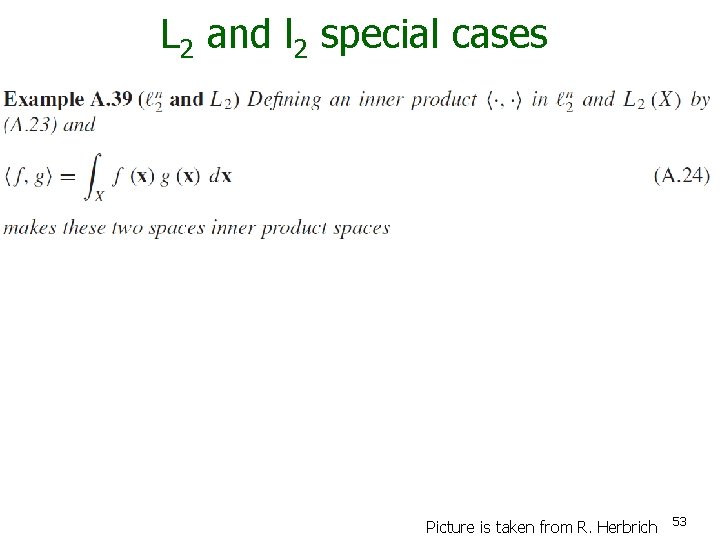
L 2 and l 2 special cases Picture is taken from R. Herbrich 53
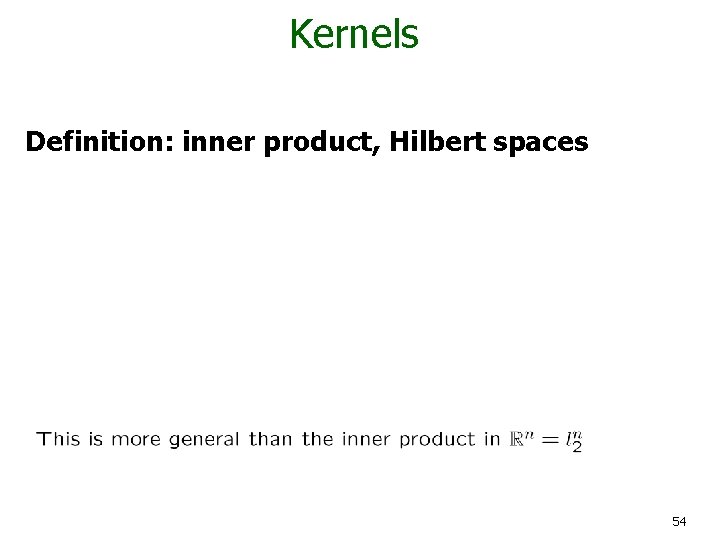
Kernels Definition: inner product, Hilbert spaces 54
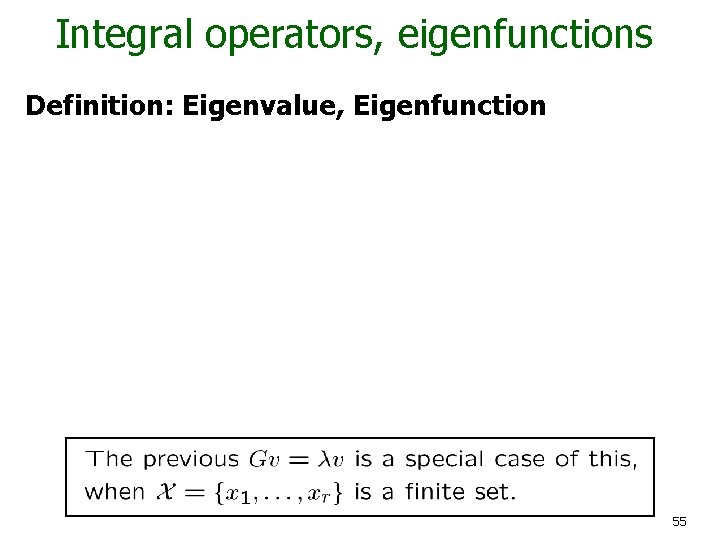
Integral operators, eigenfunctions Definition: Eigenvalue, Eigenfunction 55
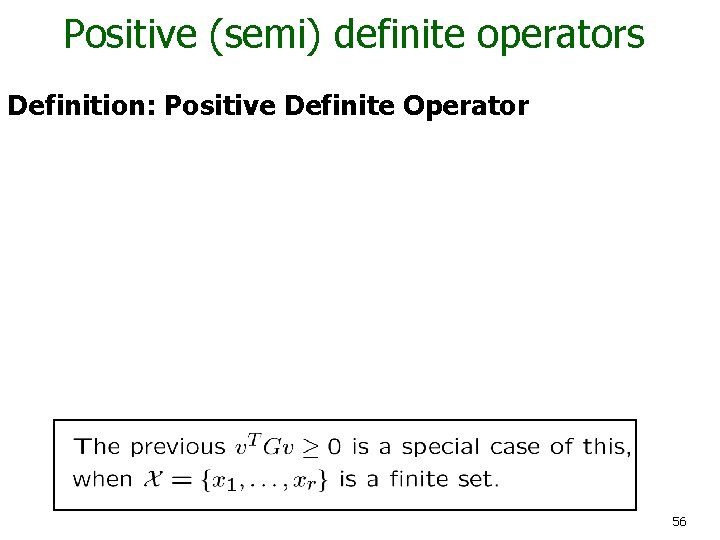
Positive (semi) definite operators Definition: Positive Definite Operator 56
Mercer’s theorem (*) 2 variables 1 variable 57
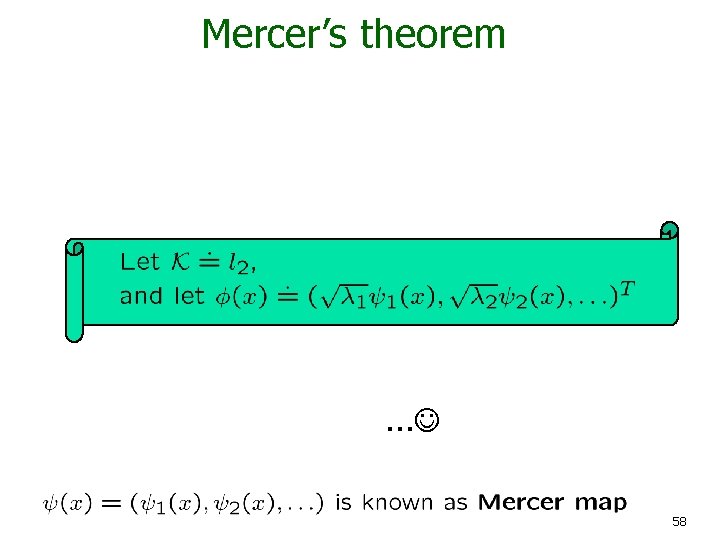
Mercer’s theorem . . . 58
A nicer characterization Theorem: nicer kernel characterization 59
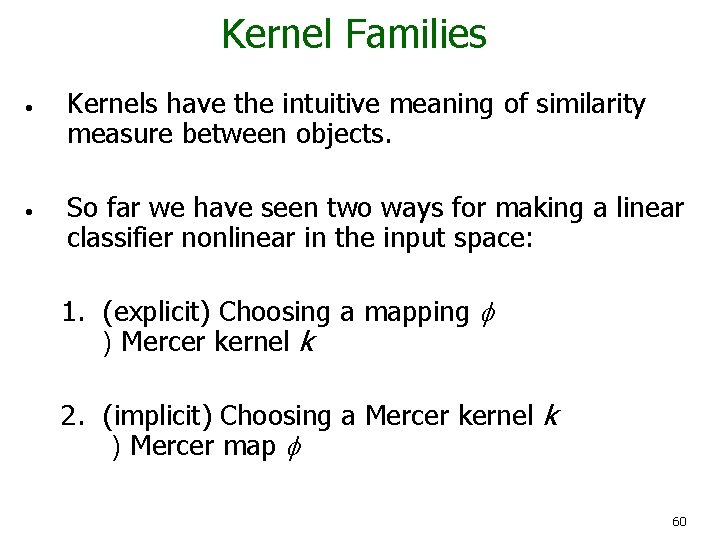
Kernel Families • • Kernels have the intuitive meaning of similarity measure between objects. So far we have seen two ways for making a linear classifier nonlinear in the input space: 1. (explicit) Choosing a mapping ) Mercer kernel k 2. (implicit) Choosing a Mercer kernel k ) Mercer map 60
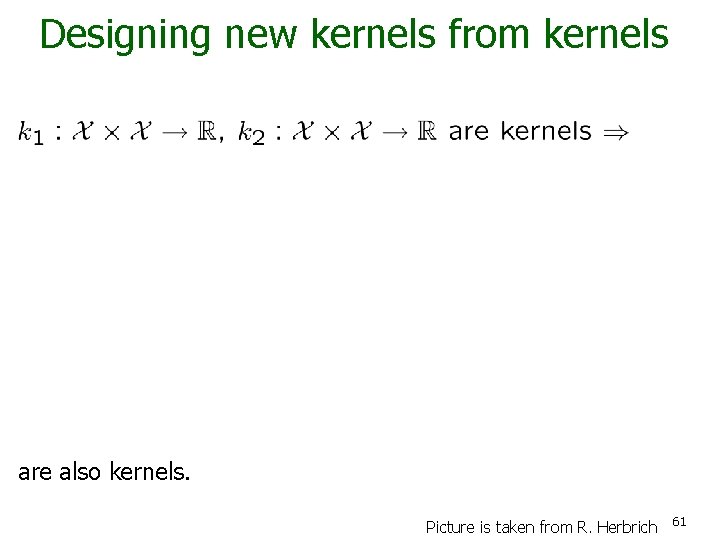
Designing new kernels from kernels are also kernels. Picture is taken from R. Herbrich 61
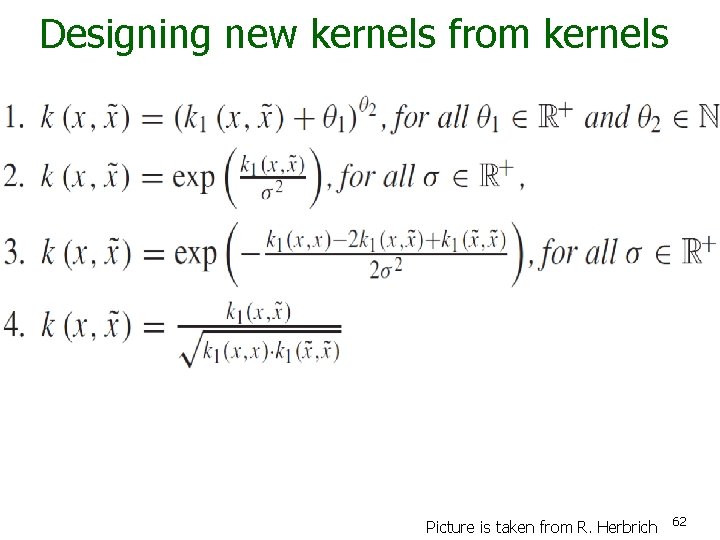
Designing new kernels from kernels Picture is taken from R. Herbrich 62
Designing new kernels from kernels 63
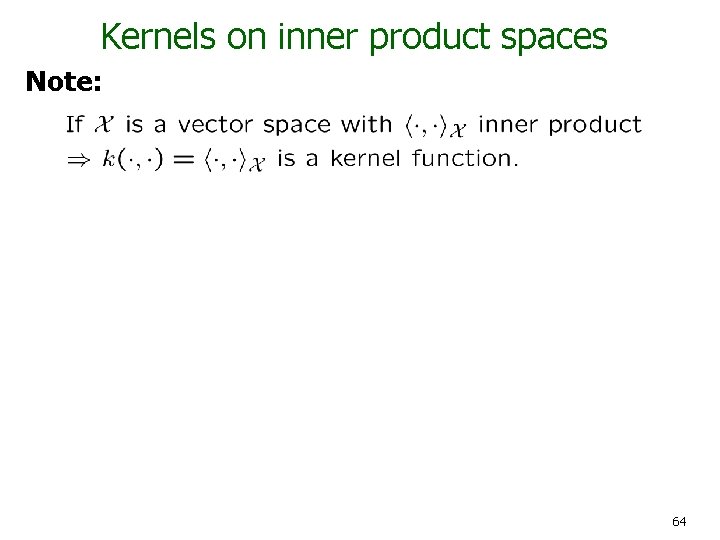
Kernels on inner product spaces Note: 64
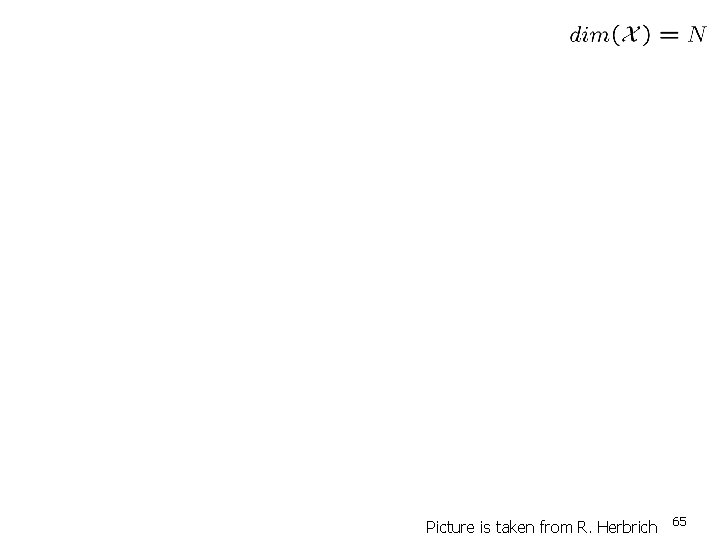
Picture is taken from R. Herbrich 65
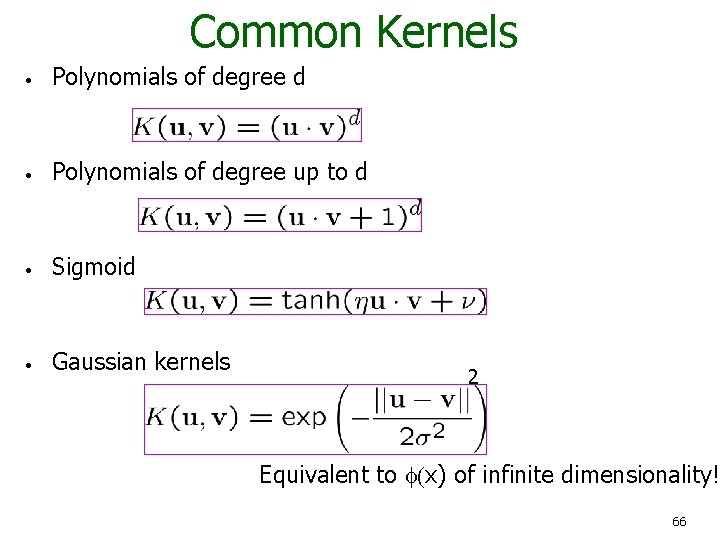
Common Kernels • Polynomials of degree d • Polynomials of degree up to d • Sigmoid • Gaussian kernels 2 Equivalent to f(x) of infinite dimensionality! 66
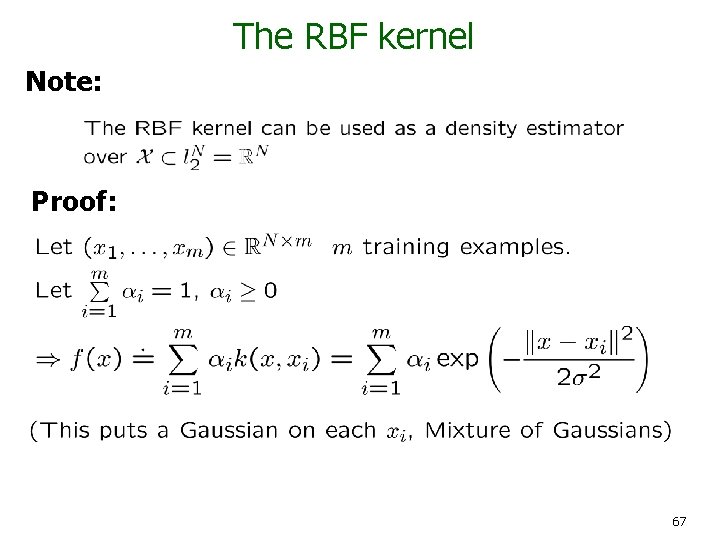
The RBF kernel Note: Proof: 67
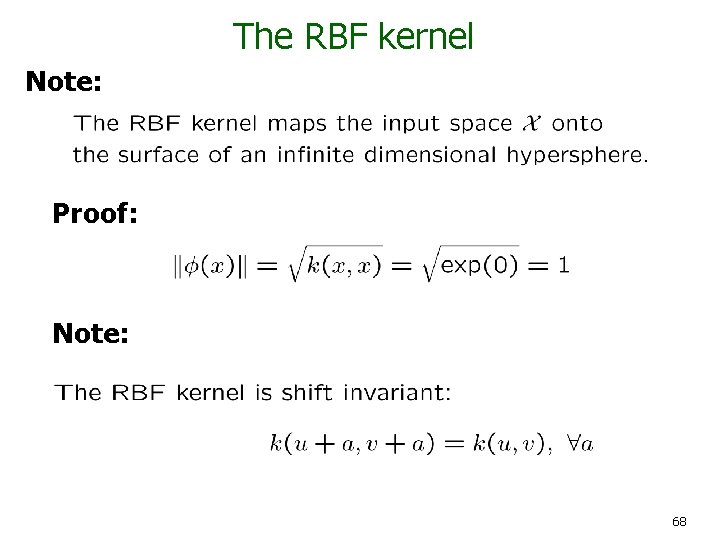
The RBF kernel Note: Proof: Note: 68
The Polynomial kernel 69
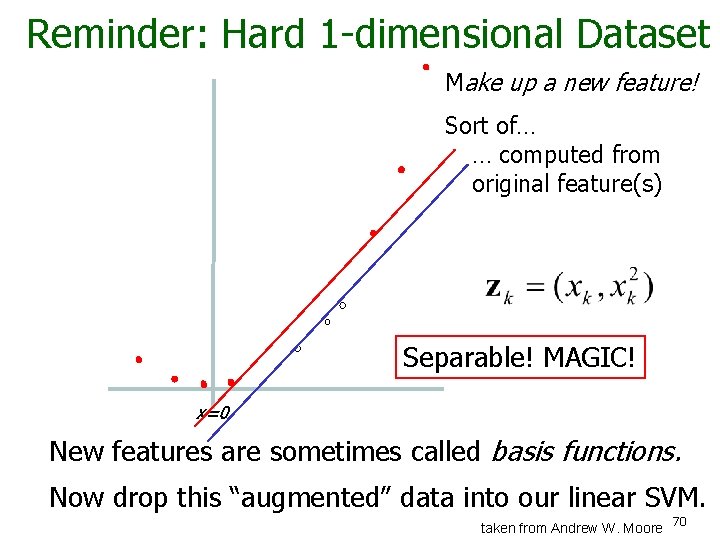
Reminder: Hard 1 -dimensional Dataset Make up a new feature! Sort of… … computed from original feature(s) Separable! MAGIC! x=0 New features are sometimes called basis functions. Now drop this “augmented” data into our linear SVM. taken from Andrew W. Moore 70
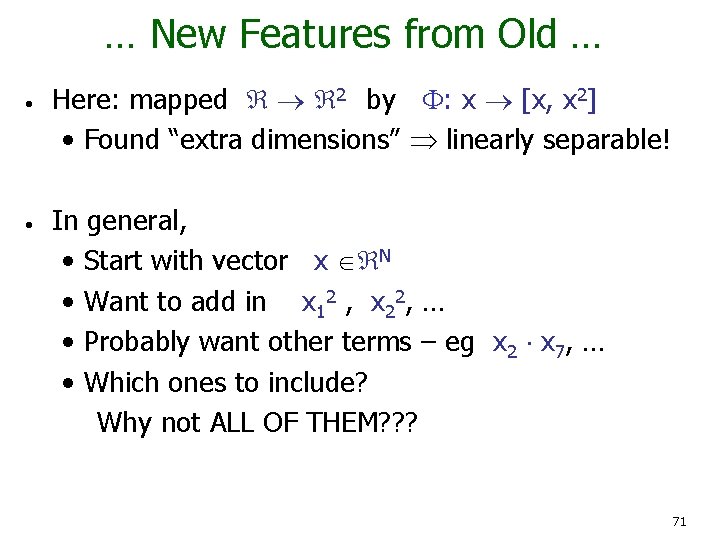
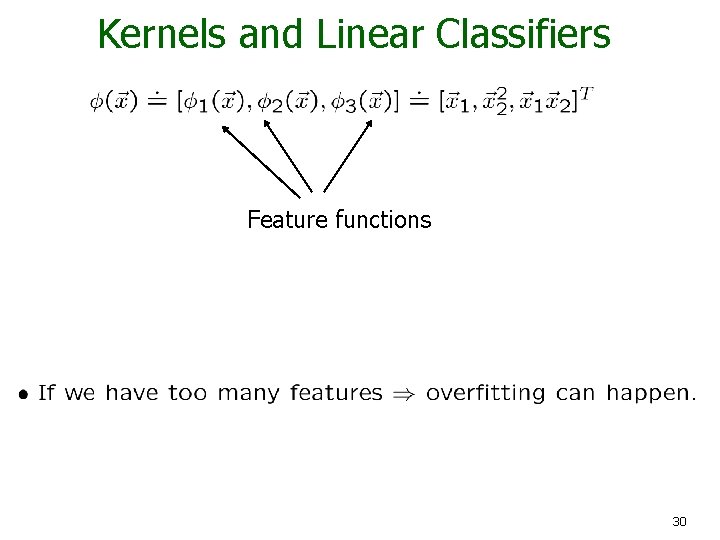
… New Features from Old … • • Here: mapped 2 by : x [x, x 2] • Found “extra dimensions” linearly separable! In general, • Start with vector x N • Want to add in x 12 , x 22, … • Probably want other terms – eg x 2 x 7, … • Which ones to include? Why not ALL OF THEM? ? ? 71
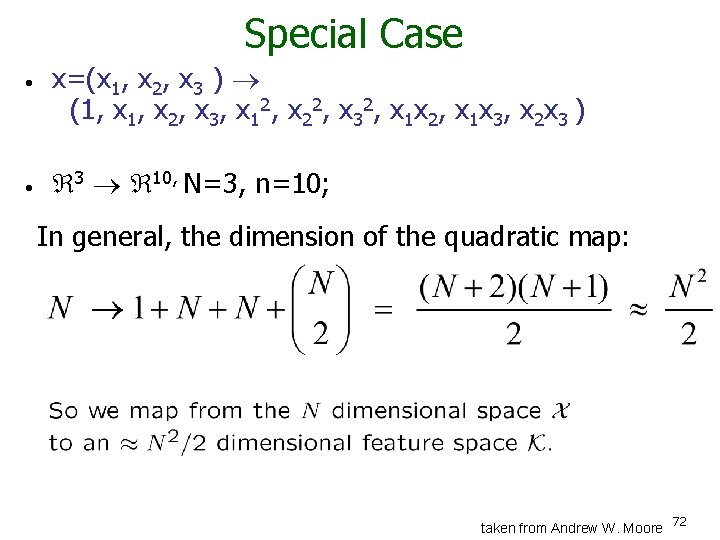
Special Case • • x=(x 1, x 2, x 3 ) (1, x 2, x 3, x 12, x 22, x 32, x 1 x 3, x 2 x 3 ) 3 10, N=3, n=10; In general, the dimension of the quadratic map: taken from Andrew W. Moore 72
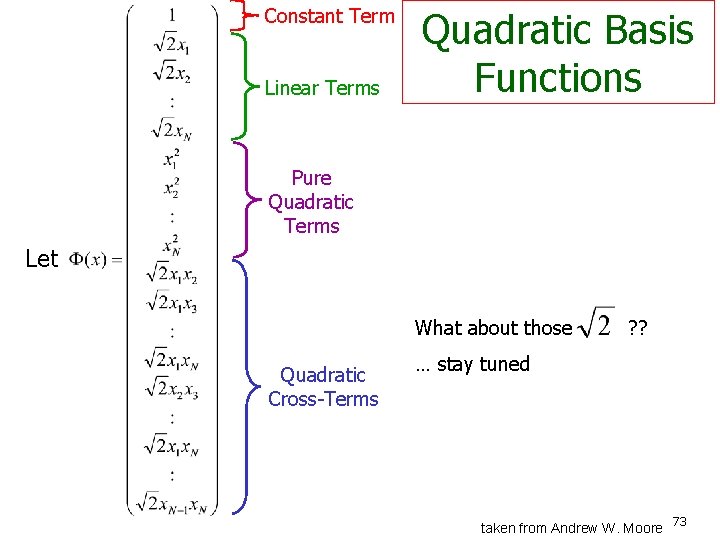
Constant Term Linear Terms Quadratic Basis Functions Pure Quadratic Terms Let What about those Quadratic Cross-Terms ? ? … stay tuned taken from Andrew W. Moore 73
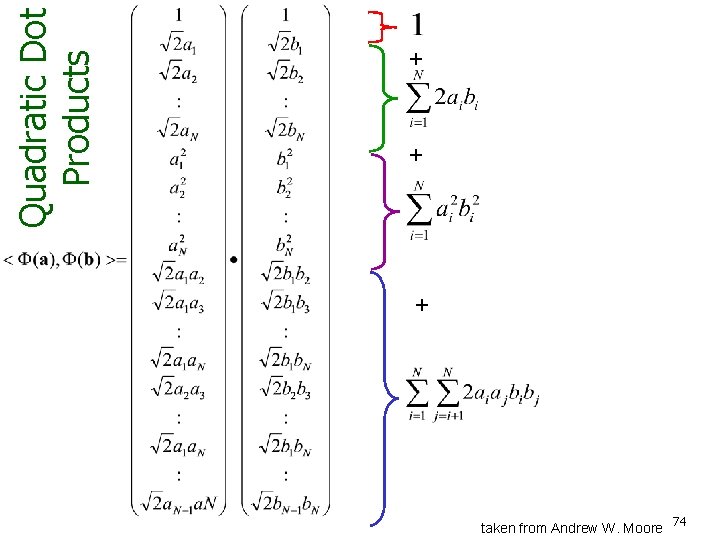
Quadratic Dot Products + + + taken from Andrew W. Moore 74
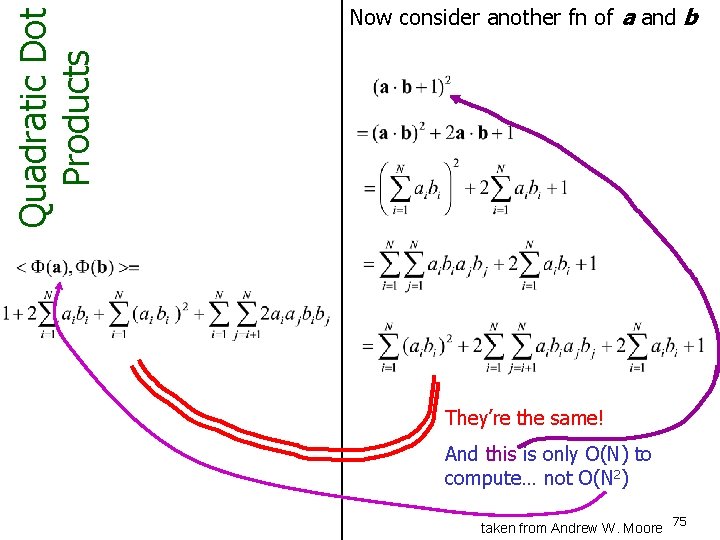
Quadratic Dot Products Now consider another fn of a and b They’re the same! And this is only O(N) to compute… not O(N 2) taken from Andrew W. Moore 75
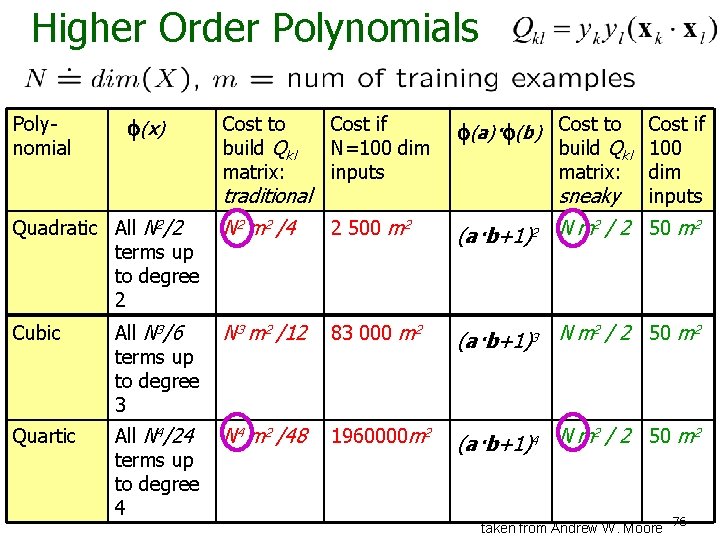
Higher Order Polynomials Polynomial f(x) Quadratic All N m 22/2 /2 terms up to degree 2 Cost to build Qkl matrix: Cost if 100 N=100 inputs dim inputs traditional N 2 500 m m 22 m R 2 /4 R 22 f(a)∙f(b) Cost to build Qkl matrix: (a∙b+1)2 Cost if 100 dim inputs sneaky N mm R 2 / 2 50 m R 22 Cubic All N 3/6 terms up to degree 3 N 3 m 2 /12 83 000 m 2 2 2 (a∙b+1)3 N m / 2 50 m Quartic All N 4/24 terms up to degree 4 N 4 m 2 /48 1960000 m 2 2 2 (a∙b+1)4 N m / 2 50 m taken from Andrew W. Moore 76
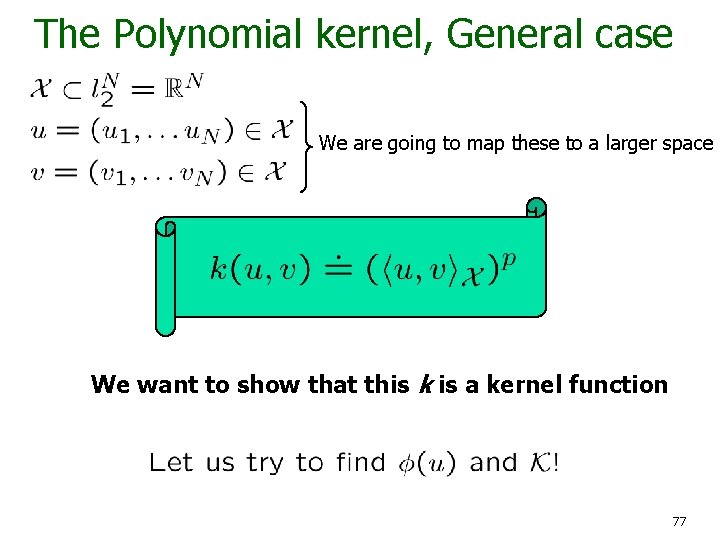
The Polynomial kernel, General case We are going to map these to a larger space We want to show that this k is a kernel function 77
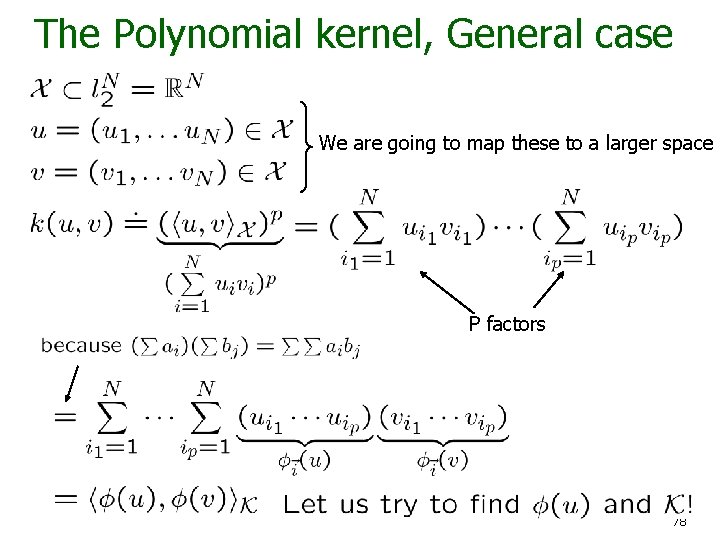
The Polynomial kernel, General case We are going to map these to a larger space P factors 78
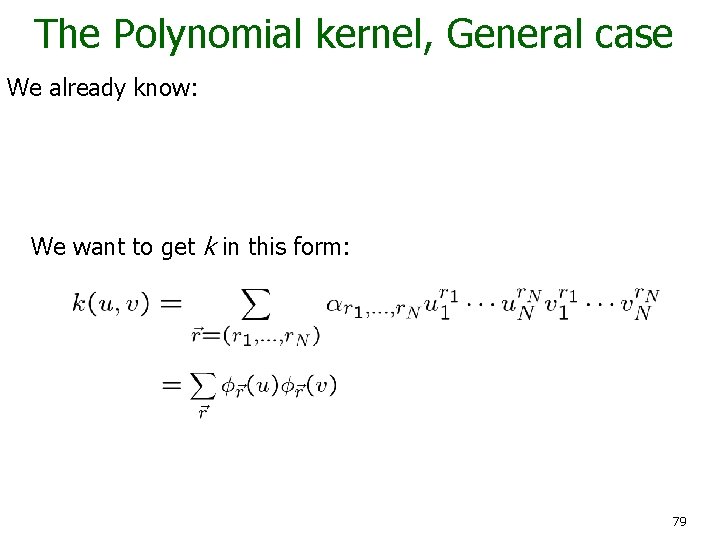
The Polynomial kernel, General case We already know: We want to get k in this form: 79
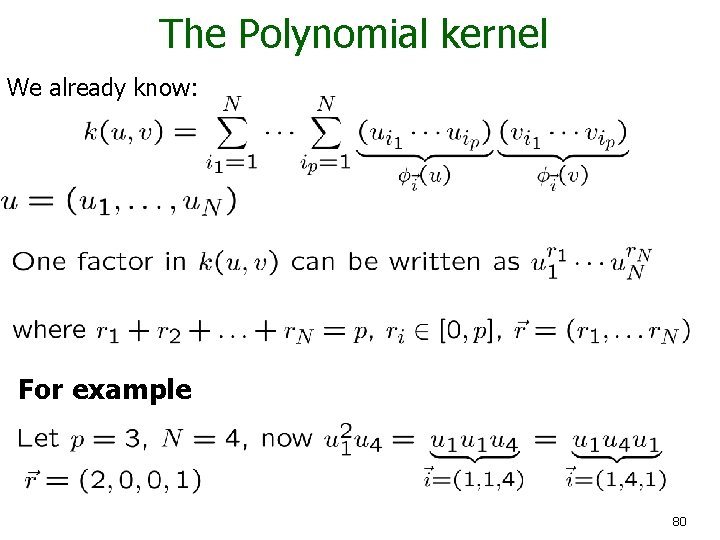
The Polynomial kernel We already know: For example 80
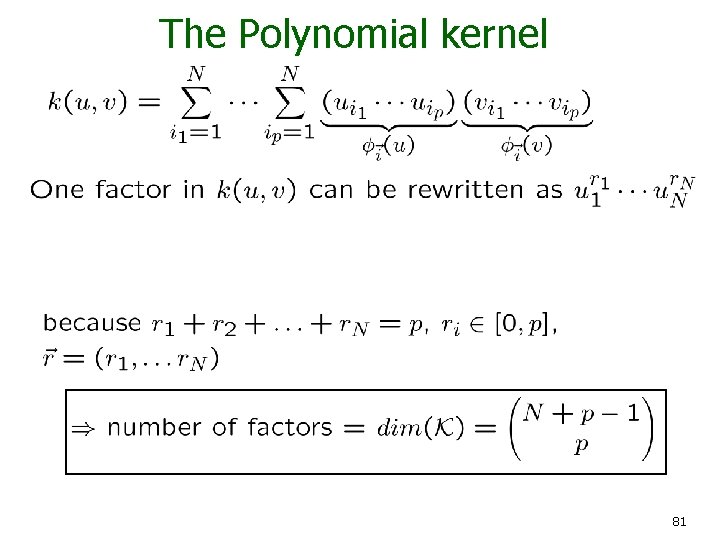
The Polynomial kernel 81
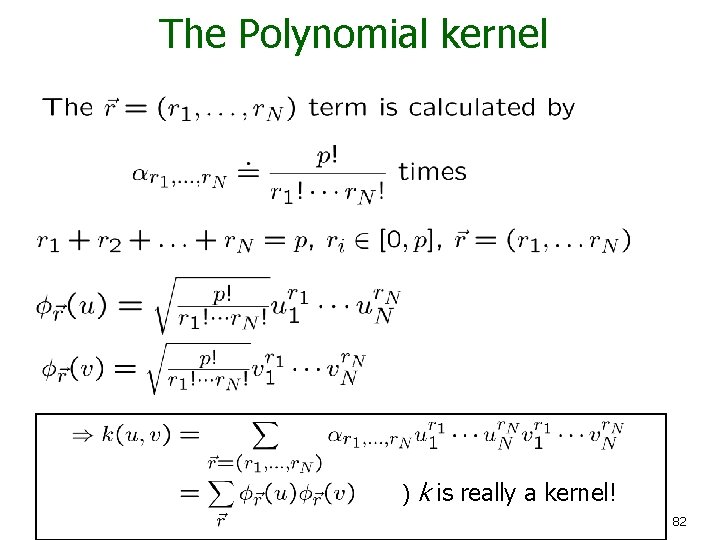
The Polynomial kernel ) k is really a kernel! 82
Reproducing Kernel Hilbert Spaces 83
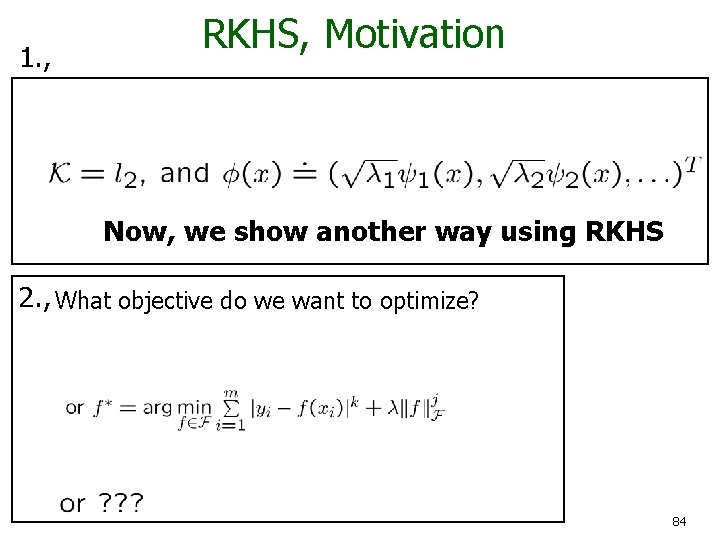
1. , RKHS, Motivation Now, we show another way using RKHS 2. , What objective do we want to optimize? 84
RKHS, Motivation 3. , How can we minimize the objective over functions? ? ? • Be PARAMETRIC!!!. . . (nope, we do not like that. . . ) • Use RKHS, and suddenly the problem will be finite dimensional optimization only (yummy. . . ) The Representer theorem will help us here 1 st term, empirical loss 2 nd term, regularization 85
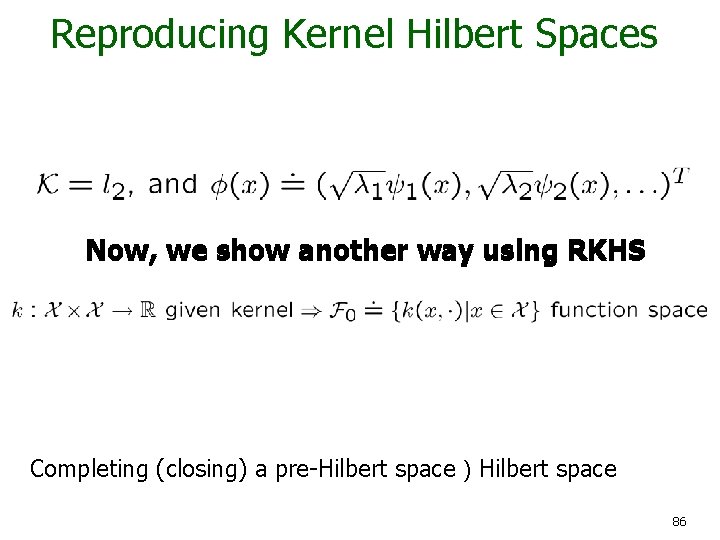
Reproducing Kernel Hilbert Spaces Now, we show another way using RKHS Completing (closing) a pre-Hilbert space ) Hilbert space 86
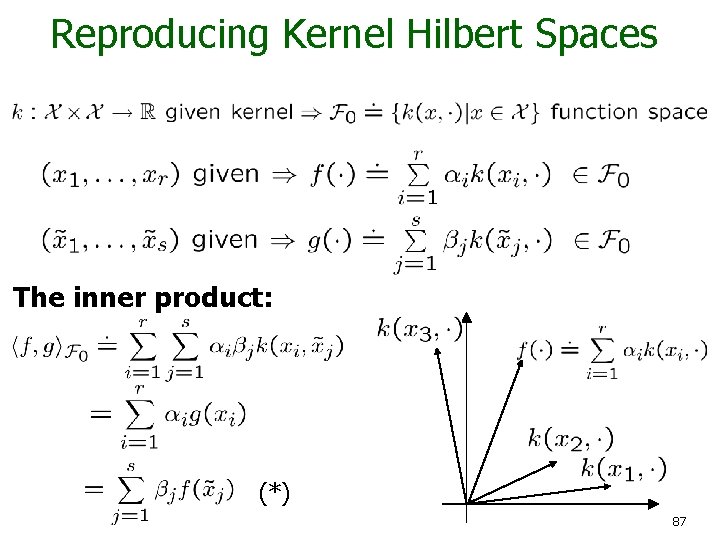
Reproducing Kernel Hilbert Spaces The inner product: (*) 87
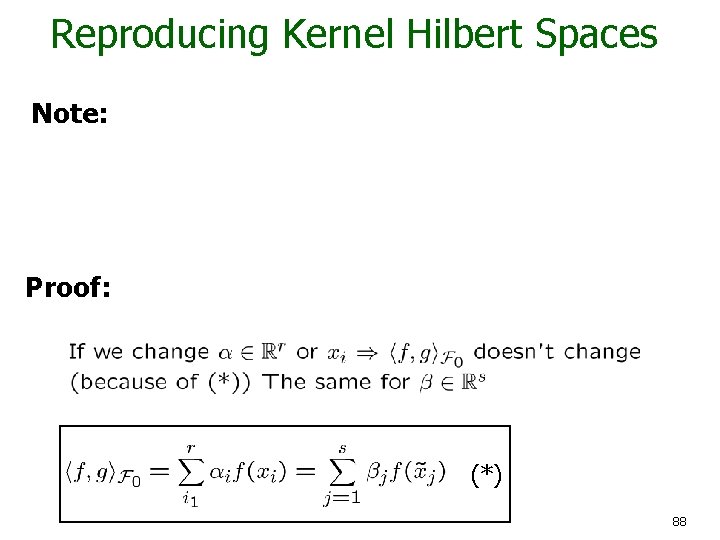
Reproducing Kernel Hilbert Spaces Note: Proof: (*) 88
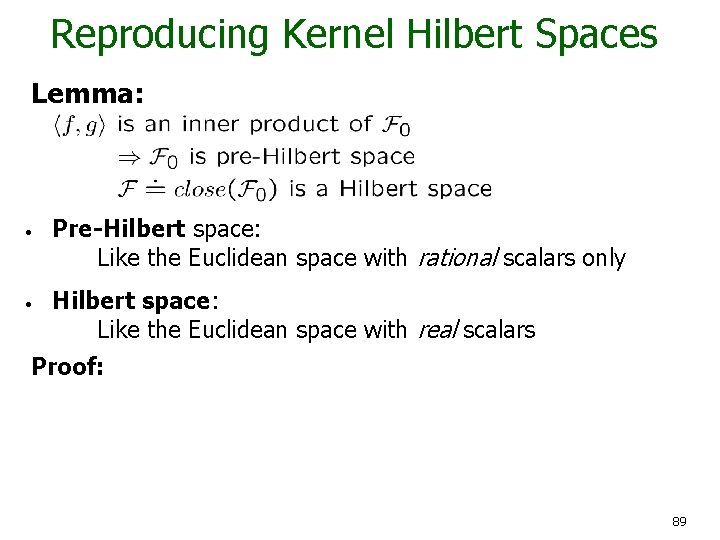
Reproducing Kernel Hilbert Spaces Lemma: • • Pre-Hilbert space: Like the Euclidean space with rational scalars only Hilbert space: Like the Euclidean space with real scalars Proof: 89
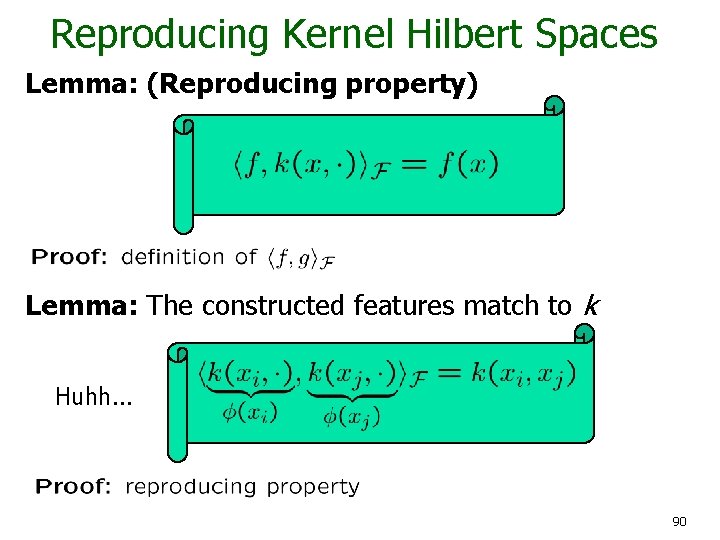
Reproducing Kernel Hilbert Spaces Lemma: (Reproducing property) Lemma: The constructed features match to k Huhh. . . 90
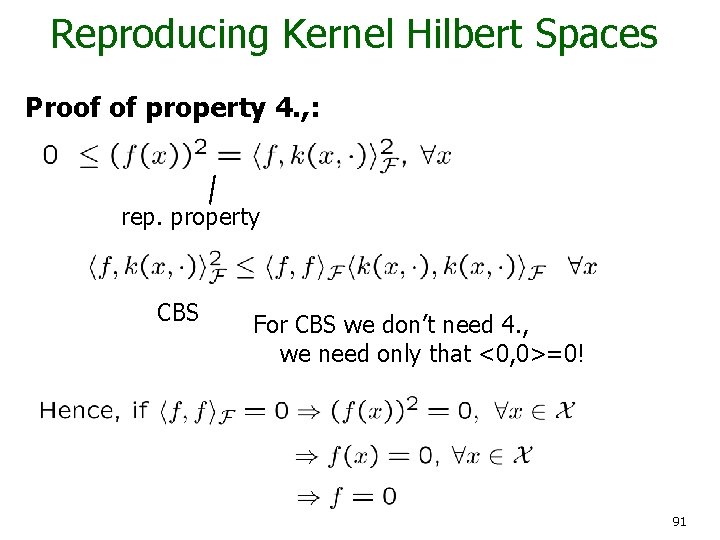
Reproducing Kernel Hilbert Spaces Proof of property 4. , : rep. property CBS For CBS we don’t need 4. , we need only that <0, 0>=0! 91
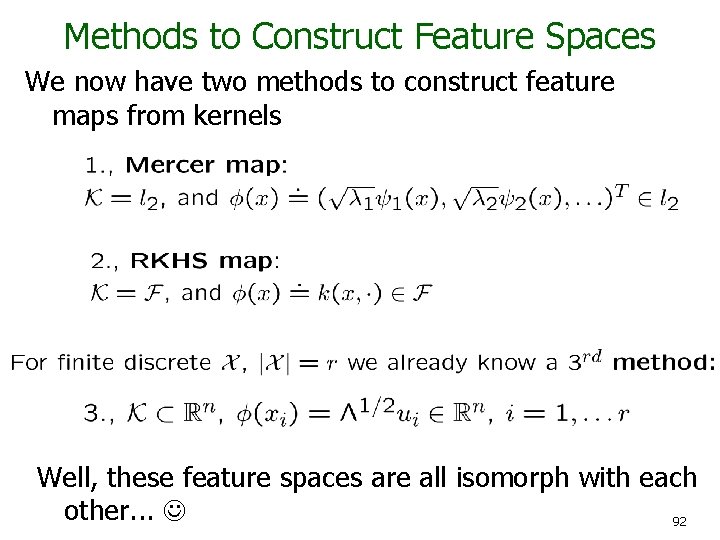
Methods to Construct Feature Spaces We now have two methods to construct feature maps from kernels Well, these feature spaces are all isomorph with each other. . . 92
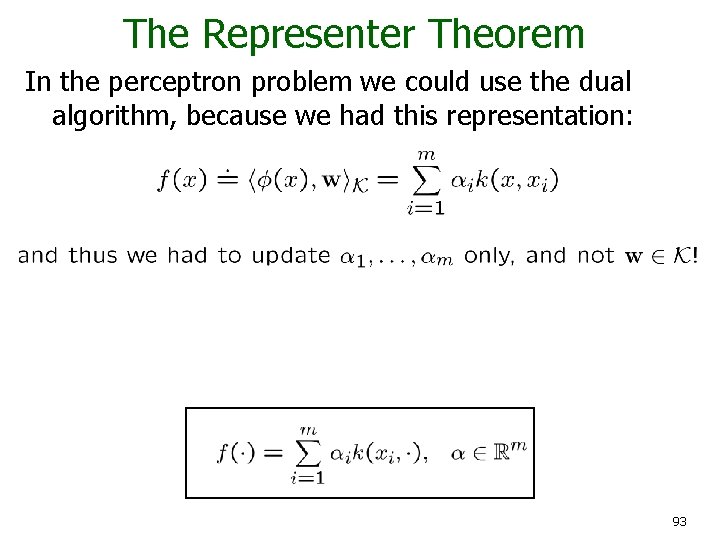
The Representer Theorem In the perceptron problem we could use the dual algorithm, because we had this representation: 93
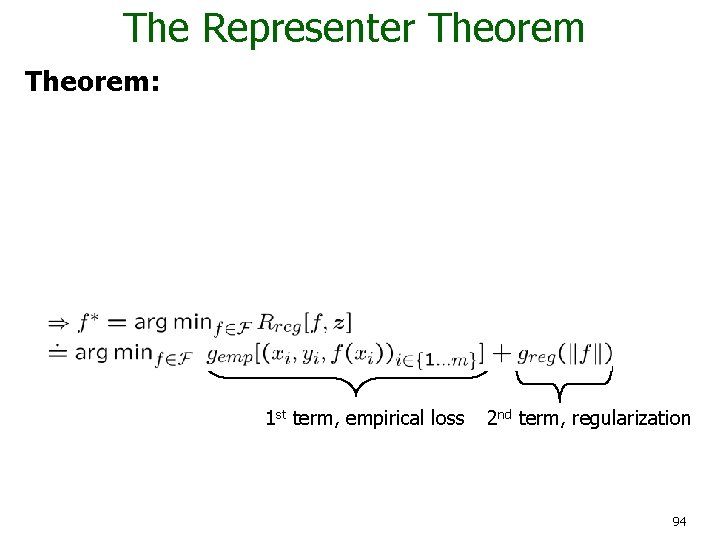
The Representer Theorem: 1 st term, empirical loss 2 nd term, regularization 94
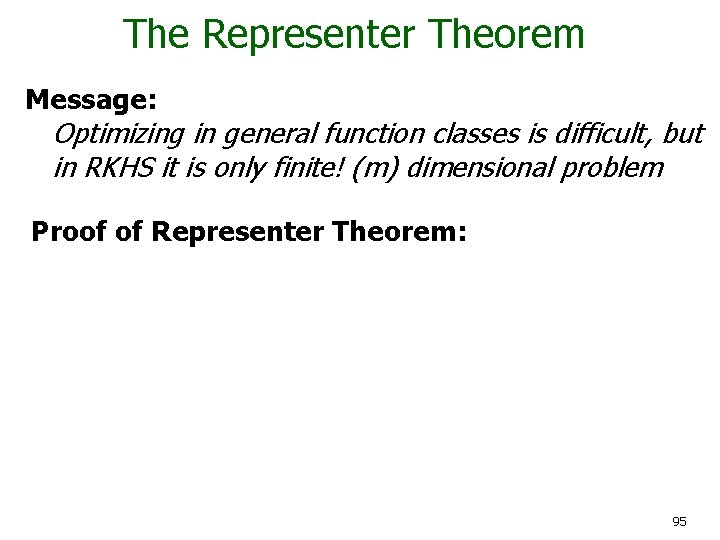
The Representer Theorem Message: Optimizing in general function classes is difficult, but in RKHS it is only finite! (m) dimensional problem Proof of Representer Theorem: 95
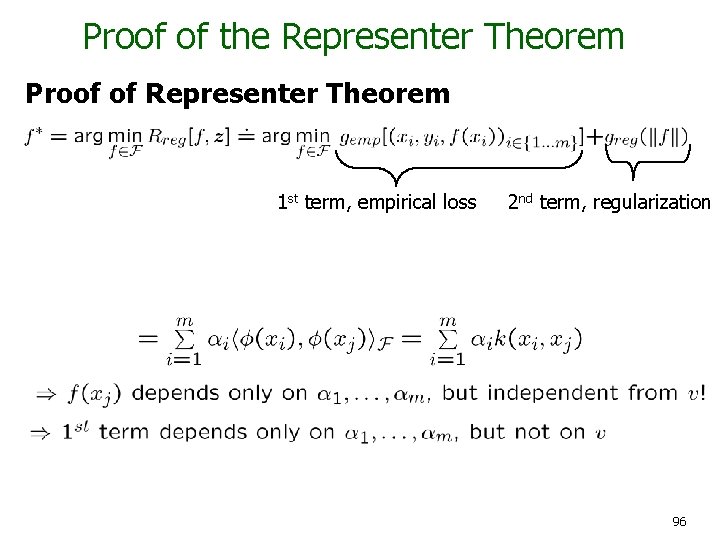
Proof of the Representer Theorem Proof of Representer Theorem 1 st term, empirical loss 2 nd term, regularization 96
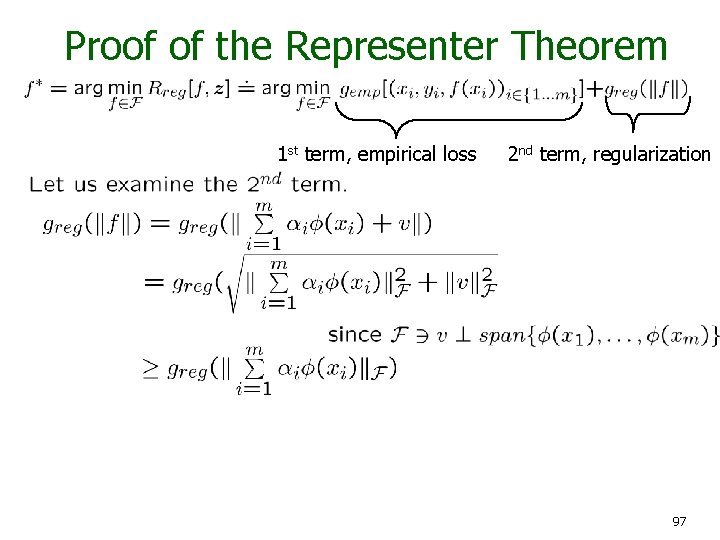
Proof of the Representer Theorem 1 st term, empirical loss 2 nd term, regularization 97
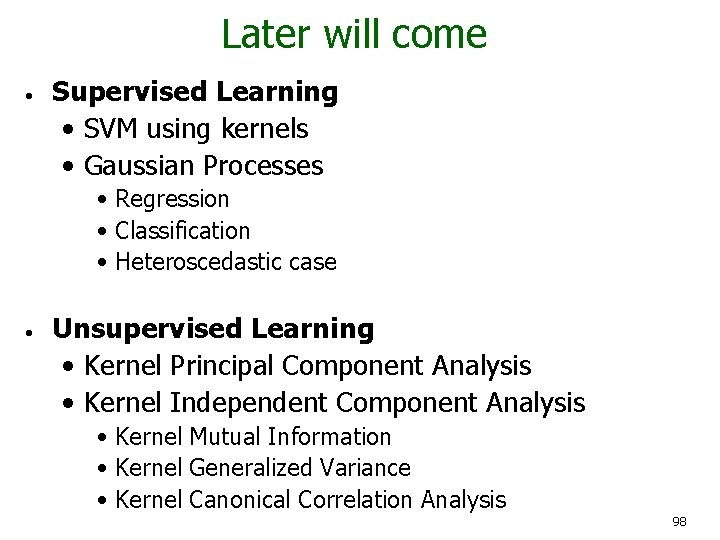
Later will come • Supervised Learning • SVM using kernels • Gaussian Processes • Regression • Classification • Heteroscedastic case • Unsupervised Learning • Kernel Principal Component Analysis • Kernel Independent Component Analysis • Kernel Mutual Information • Kernel Generalized Variance • Kernel Canonical Correlation Analysis 98
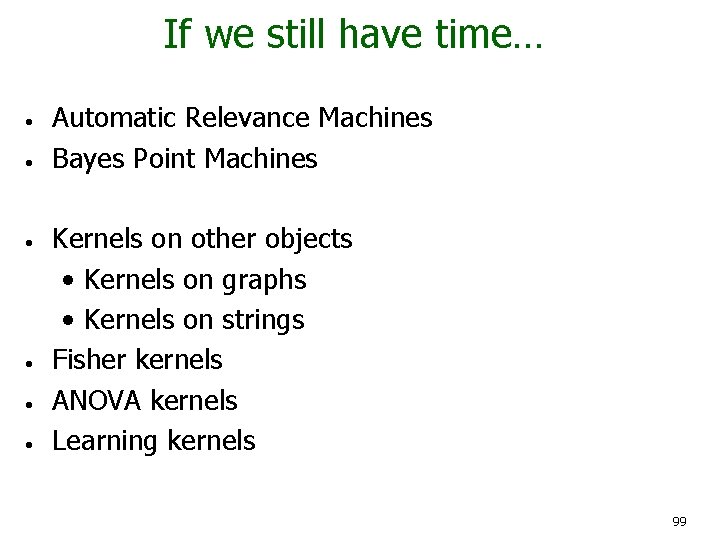
If we still have time… • • • Automatic Relevance Machines Bayes Point Machines Kernels on other objects • Kernels on graphs • Kernels on strings Fisher kernels ANOVA kernels Learning kernels 99

Thanks for the Attention! 100
- Slides: 100