
Keplers Laws of Planetary Motion Tycho Brahe Danish
Kepler’s Laws of Planetary Motion
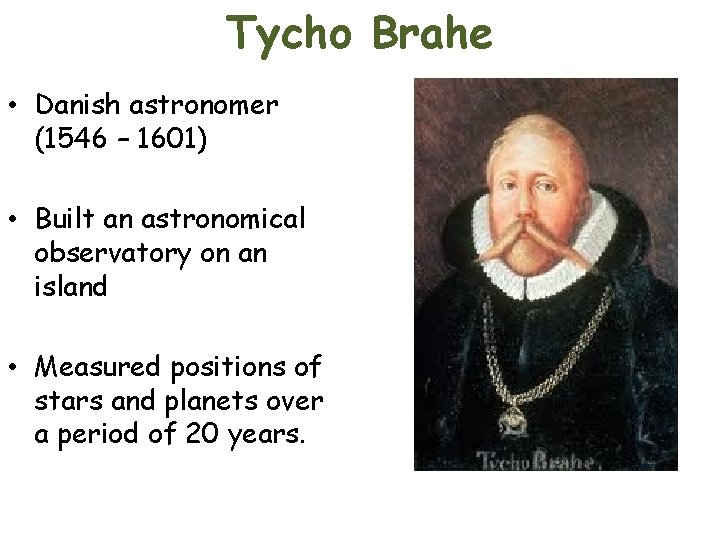
Tycho Brahe • Danish astronomer (1546 – 1601) • Built an astronomical observatory on an island • Measured positions of stars and planets over a period of 20 years.
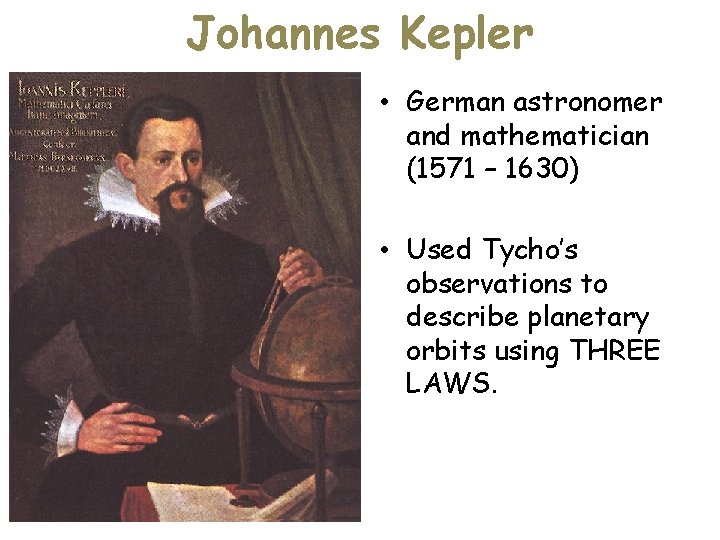
Johannes Kepler • German astronomer and mathematician (1571 – 1630) • Used Tycho’s observations to describe planetary orbits using THREE LAWS.
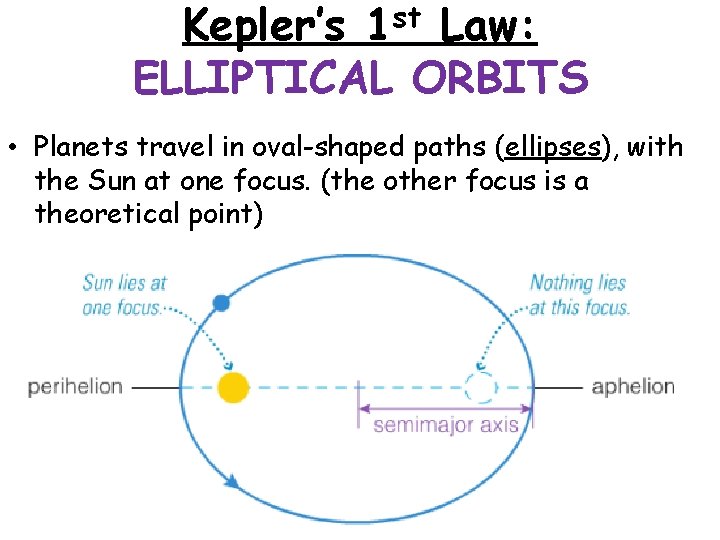
Kepler’s 1 st Law: ELLIPTICAL ORBITS • Planets travel in oval-shaped paths (ellipses), with the Sun at one focus. (the other focus is a theoretical point)
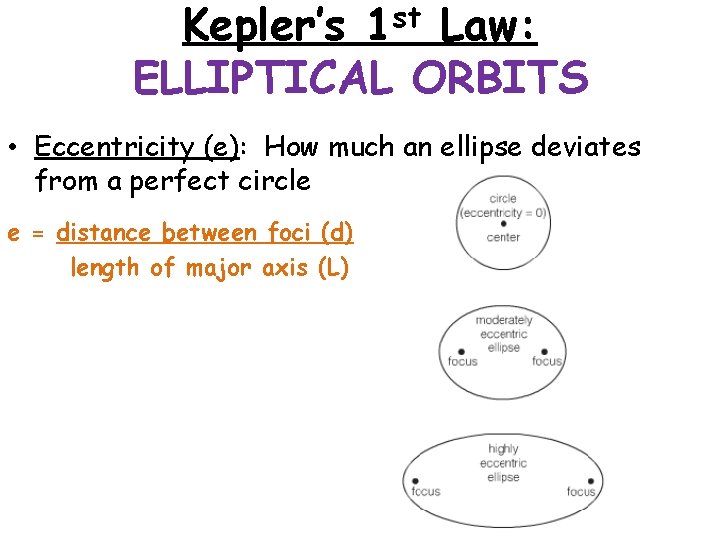
Kepler’s 1 st Law: ELLIPTICAL ORBITS • Eccentricity (e): How much an ellipse deviates from a perfect circle e = distance between foci (d) length of major axis (L)
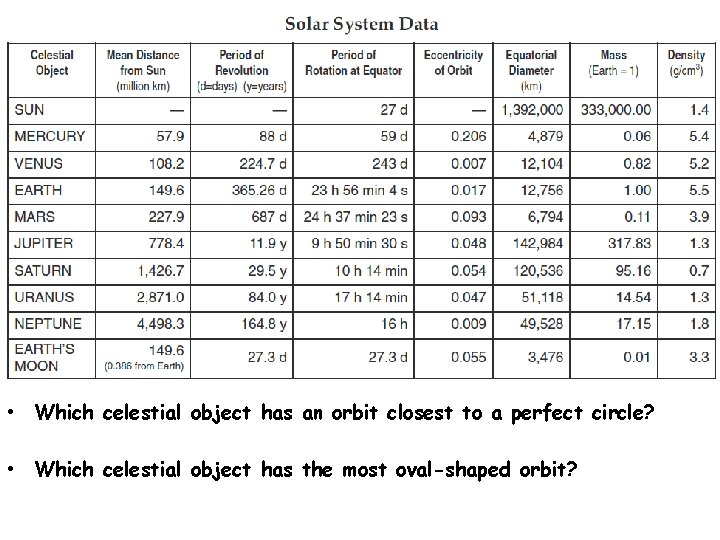
• Which celestial object has an orbit closest to a perfect circle? • Which celestial object has the most oval-shaped orbit?
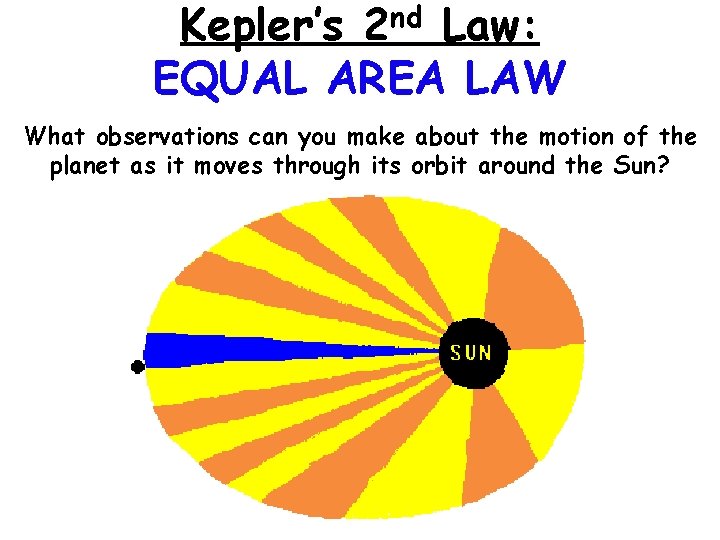
Kepler’s 2 nd Law: EQUAL AREA LAW What observations can you make about the motion of the planet as it moves through its orbit around the Sun?
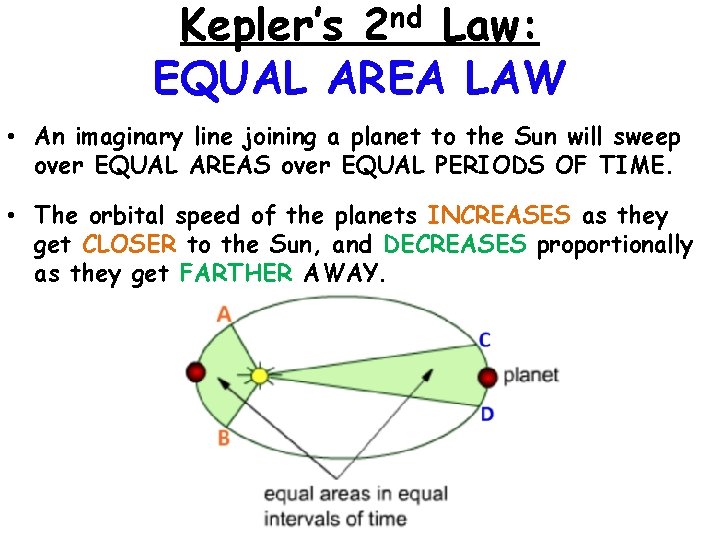
Kepler’s 2 nd Law: EQUAL AREA LAW • An imaginary line joining a planet to the Sun will sweep over EQUAL AREAS over EQUAL PERIODS OF TIME. • The orbital speed of the planets INCREASES as they get CLOSER to the Sun, and DECREASES proportionally as they get FARTHER AWAY.
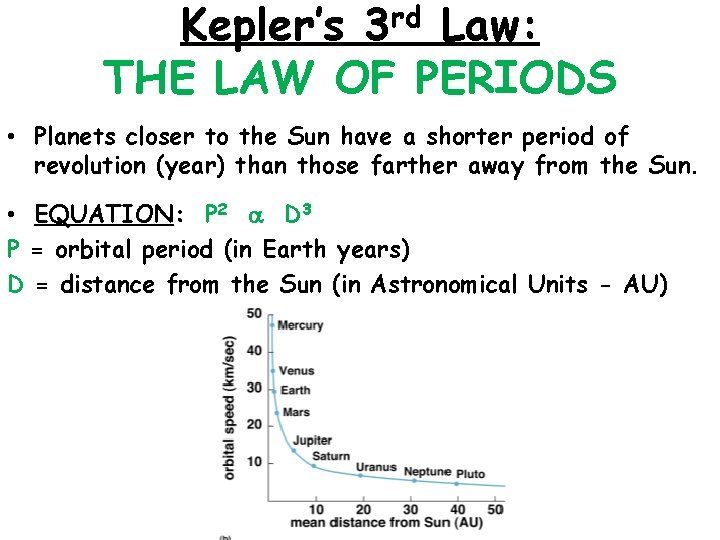
Kepler’s 3 rd Law: THE LAW OF PERIODS • Planets closer to the Sun have a shorter period of revolution (year) than those farther away from the Sun. • EQUATION: P 2 a D 3 P = orbital period (in Earth years) D = distance from the Sun (in Astronomical Units - AU)
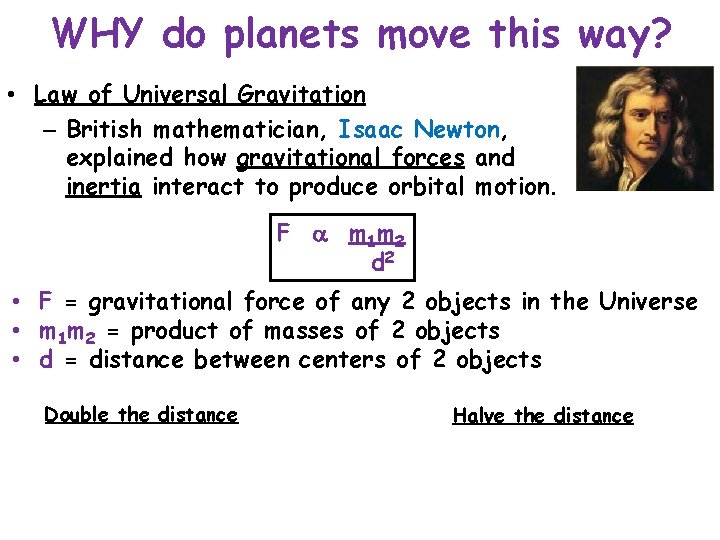
WHY do planets move this way? • Law of Universal Gravitation – British mathematician, Isaac Newton, explained how gravitational forces and inertia interact to produce orbital motion. F a m 1 m 2 d 2 • F = gravitational force of any 2 objects in the Universe • m 1 m 2 = product of masses of 2 objects • d = distance between centers of 2 objects Double the distance Halve the distance
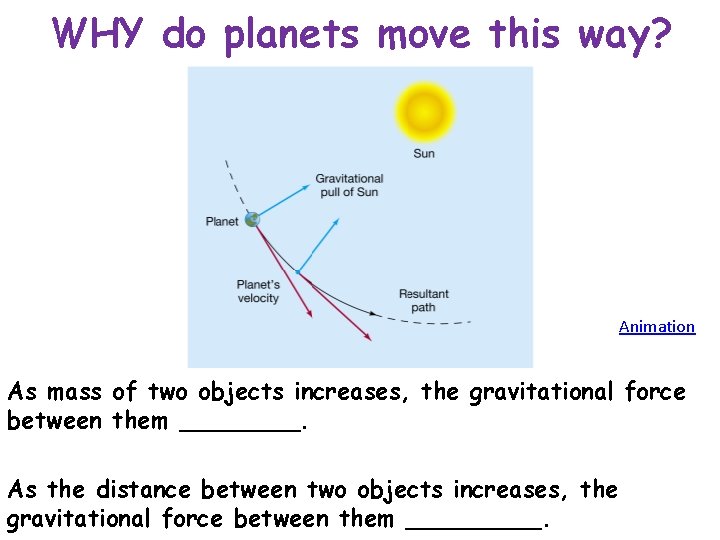
WHY do planets move this way? Animation As mass of two objects increases, the gravitational force between them ____. As the distance between two objects increases, the gravitational force between them _____.
- Slides: 11