
KENTUCKYS HIGHWAY SAFETY IMPROVEMENT PROGRAM HSIP TUESDAY DECEMBER
KENTUCKY’S HIGHWAY SAFETY IMPROVEMENT PROGRAM (HSIP) TUESDAY, DECEMBER 5 TH
Today’s Topics What is the HSIP Federal Regulations How KYTC administers the HSIP to satisfy federal requirements � HSIP Investment Plan Initiatives & Funding Levels Balancing Safety & Other Priorities Reaching out to Non-Safety Engineers
What is the HSIP 1 of 5 FHWA core federal-aid programs Purpose: achieve a significant reduction in fatal & serious injury crashes the HSIP consists of 3 main components: 1. the Strategic Highway Safety Plan (SHSP) 2. a program of HSIP funded projects 3. the Railway-Highway Crossing Program (RHCP)
HSIP Federal Regulations Legislated under Section 148 of Title 23, United States Code (23 U. S. C. 148) Regulated under Part 924 of Title 23, Code of Federal Regulations (23 CFR Part 924)
HSIP Federal Regulations For a project to be eligible for HSIP funds, there are 3 Primary Requirements : 1. Address a Strategic Highway Safety Plan (SHSP) priority 2. Be identified through a data-driven process 3. Contribute to a reduction in fatal and serious injury crashes
Administering HSIP Projects Requirement 1: address a priority in the SHSP � The HSIP Investment Plan � The Initiatives in the Investment Plan are basically roadway improvement options that we’re looking to implement � The improvement options are based on strategies within the SHSP
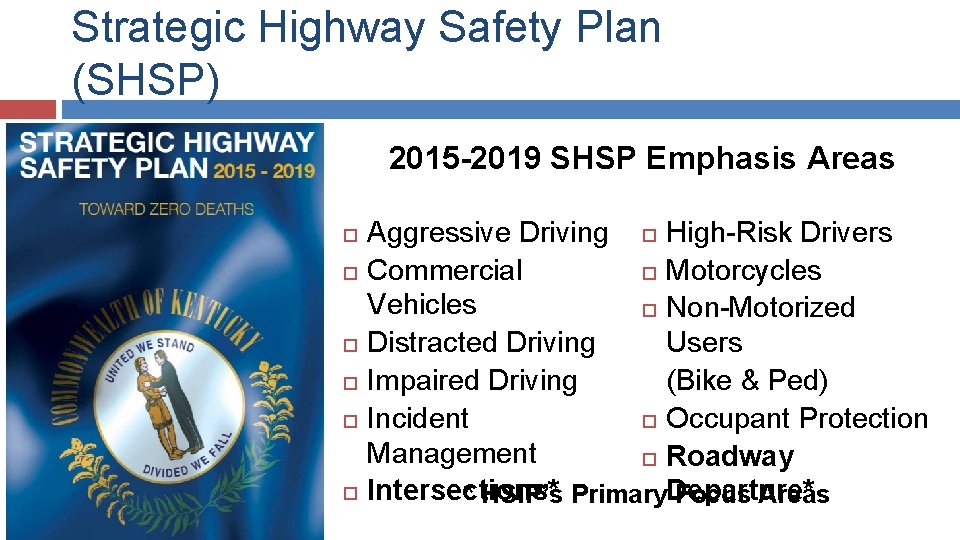
Strategic Highway Safety Plan (SHSP) 2015 -2019 SHSP Emphasis Areas Aggressive Driving High-Risk Drivers Commercial Motorcycles Vehicles Non-Motorized Distracted Driving Users Impaired Driving (Bike & Ped) Incident Occupant Protection Management Roadway Intersections* * HSIP’s Primary. Departure* Focus Areas
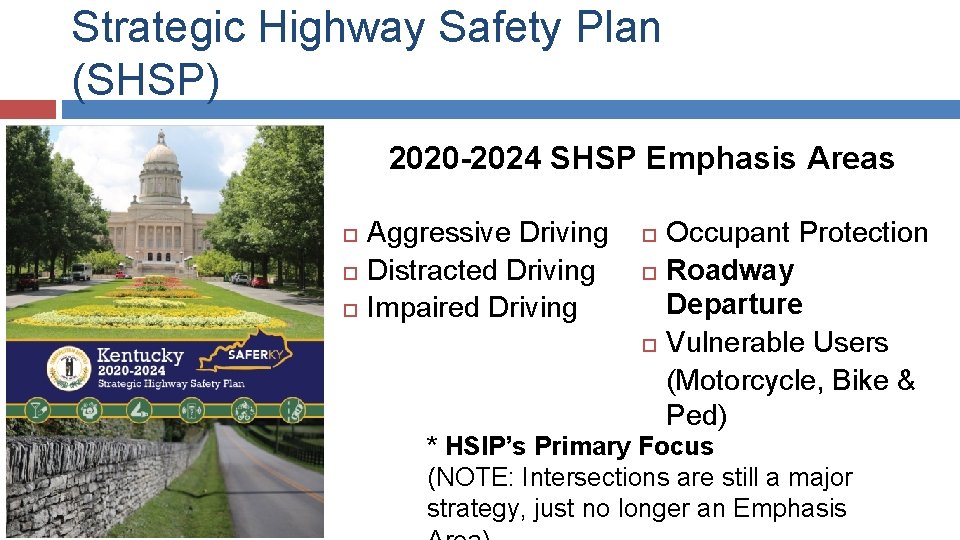
Strategic Highway Safety Plan (SHSP) 2020 -2024 SHSP Emphasis Areas Aggressive Driving Distracted Driving Impaired Driving Occupant Protection Roadway Departure Vulnerable Users (Motorcycle, Bike & Ped) * HSIP’s Primary Focus (NOTE: Intersections are still a major strategy, just no longer an Emphasis
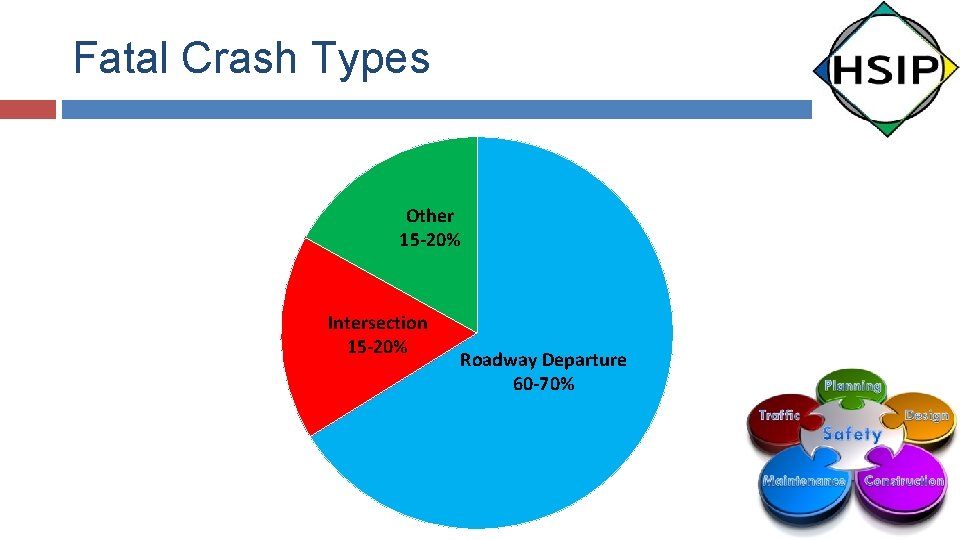
Fatal Crash Types Other 15 -20% Intersection 15 -20% Roadway Departure 60 -70%
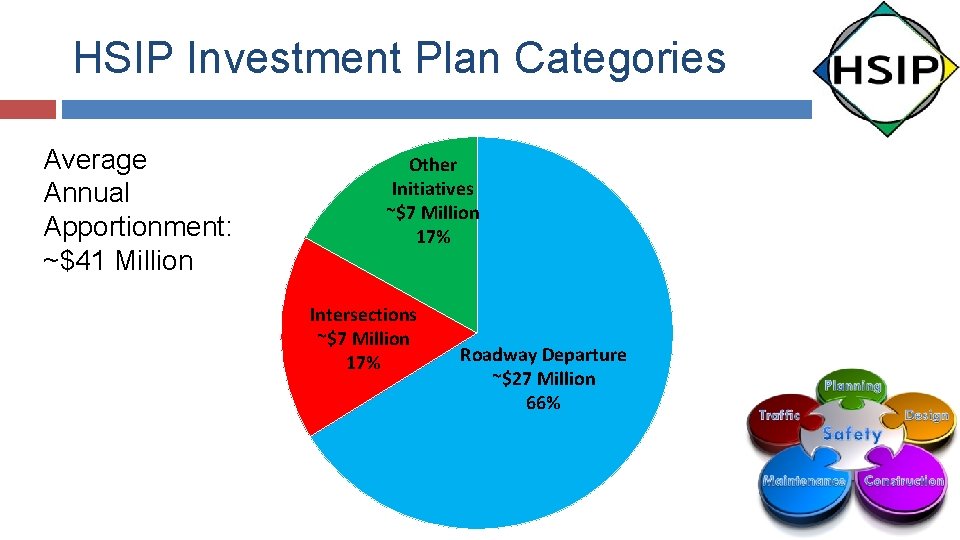
HSIP Investment Plan Categories Average Annual Apportionment: ~$41 Million Other Initiatives ~$7 Million 17% Intersections ~$7 Million 17% Roadway Departure ~$27 Million 66%
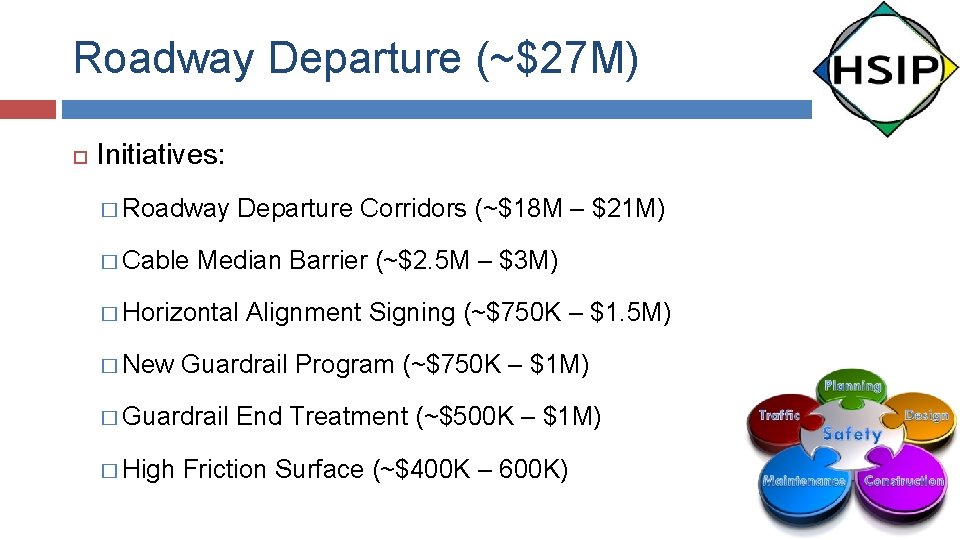
Roadway Departure (~$27 M) Initiatives: � Roadway � Cable Departure Corridors (~$18 M – $21 M) Median Barrier (~$2. 5 M – $3 M) � Horizontal � New Guardrail Program (~$750 K – $1 M) � Guardrail � High Alignment Signing (~$750 K – $1. 5 M) End Treatment (~$500 K – $1 M) Friction Surface (~$400 K – 600 K)
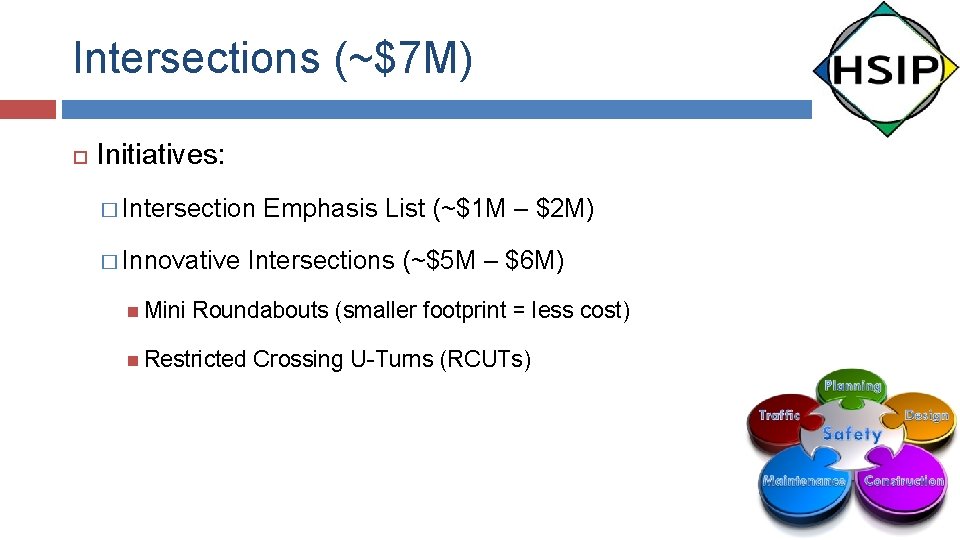
Intersections (~$7 M) Initiatives: � Intersection � Innovative Mini Emphasis List (~$1 M – $2 M) Intersections (~$5 M – $6 M) Roundabouts (smaller footprint = less cost) Restricted Crossing U-Turns (RCUTs)
Other (~$7 M) Initiatives: � Localized � Project Risk Mitigation Projects (~$5 M – $6 M) Development Funding (~$300 K – $500 K) � KTC Technical Assistance & Research (~$300 K – $400 K) � Safety Circuit Rider (~$150 – $200 K)
Administering HSIP Projects Requirement 2: identify projects through a data-driven process � Network Screening using Safety Performance Functions (SPFs) adjusted with the Empirical Bayes (EB) statistical method � SPFs w/EB produce values known as: Excess Expected Crashes (EECs) � Locations values are prioritized based on their EEC
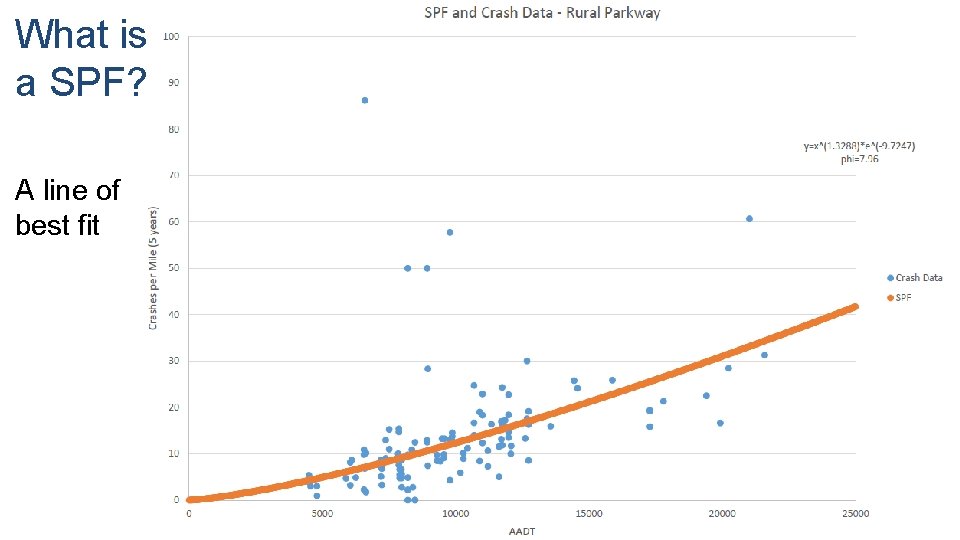
What is a SPF? A line of best fit
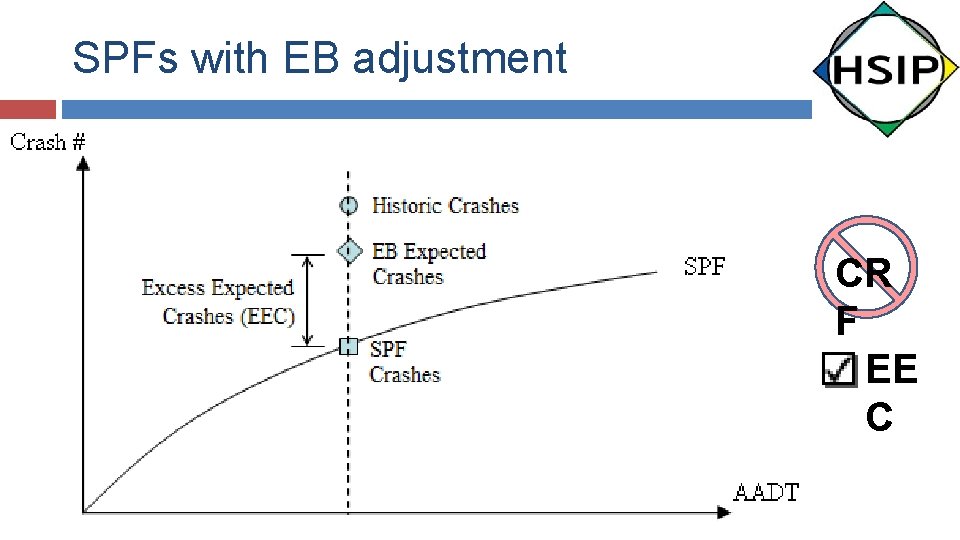
SPFs with EB adjustment CR F EE C
Administering HSIP Projects Requirement 3: contribute to a reduction in fatal and serious injury crashes � Safety Diagnosis is key! �A high EEC value indicates a site is experiencing more crashes than expected. � Must find correlations between the roadway features and crash history � Improve the roadway features that correlate to the highest risk for future crashes
Safety Diagnosis 1. Field review/Inventory existing conditions 2. Collect crash data – integrate with roadway data to create a robust, project specific database 3. Analyze crash data & roadway inventory – determine features with higher risk correlation 4. Identify potential countermeasures 5. Study countermeasures (costs, impacts, benefits)
Balancing Safety & Other Priorities What is meant by “Other Priorities”?
Balancing Safety & Other Priorities What is meant by “Other Priorities”? � Traffic Capacity / Congestion � Economic Development � Environmental, Right-of-Way, Utility Impacts � Cost
Balancing Safety & Other Priorities What is meant by “Other Priorities”? � Traffic Capacity / Congestion � Economic Development � Environmental, Right-of-Way, Utility Impacts � Cost � TIME !!
Balancing Safety & Other Priorities How do we balance Safety & Other Priorities?
Balancing Safety & Other Priorities How do we balance Safety & Other Priorities? � By comparing the following for each of the opposing priorities: Impacts Benefits Costs Time / performance measures
Balancing Safety & Other Priorities How do we balance Safety & Other Priorities? � By comparing the various: Impacts Performance measures Costs Time How do we know which priorities take precedence?
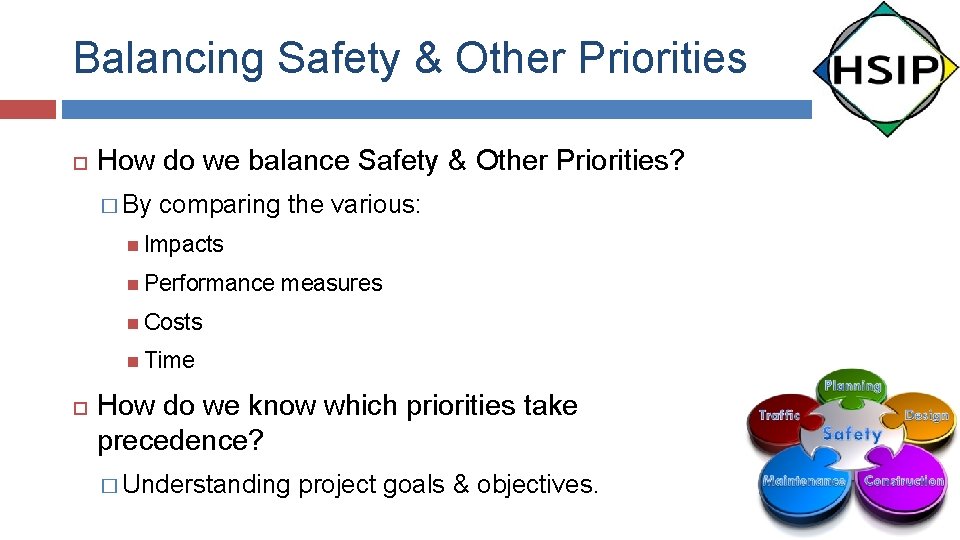
Balancing Safety & Other Priorities How do we balance Safety & Other Priorities? � By comparing the various: Impacts Performance measures Costs Time How do we know which priorities take precedence? � Understanding project goals & objectives.
Balancing Safety & Other Priorities Why evaluate and compare priorities?
Balancing Safety & Other Priorities Why evaluate and compare priorities? � To make more informed decisions � To try to find the best value � To help us deliver a roadway system that meets as many needs of the public as possible.
Safe Systems Approach Vision Zero Principles: � People make mistakes � Crashes � The are going to happen human body can only tolerate a certain amount of crash force
Safe Systems Approach Paradigm Shift: � Let’s not focus on eliminating crashes focus on eliminating fatalities and serious injuries
Safe Systems Approach How do we achieve a shift in focus? Other elements of the Safety Systems approach: � We can’t continue to blame the driver � Shared responsibility � Proven solutions � Proactive approach (treat the risk factors)
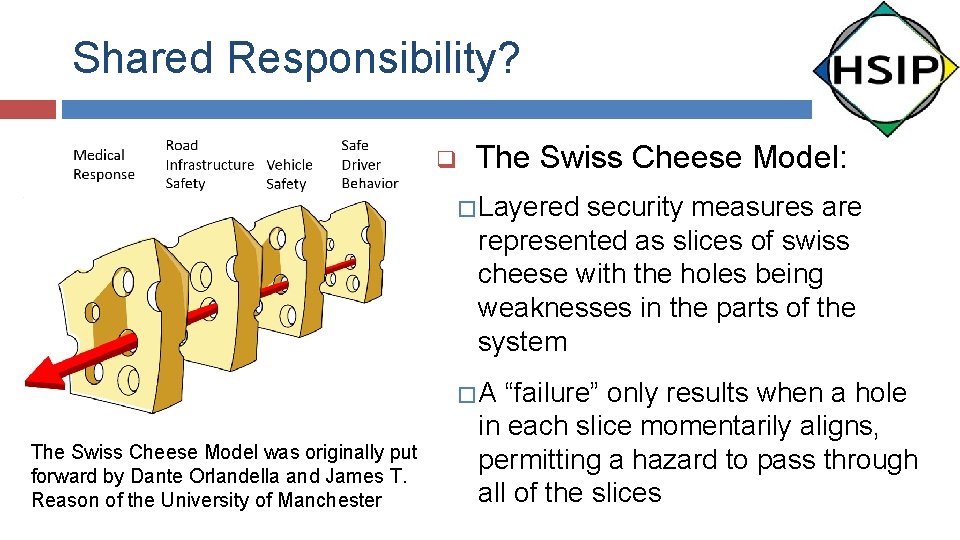
Shared Responsibility? q The Swiss Cheese Model: � Layered security measures are represented as slices of swiss cheese with the holes being weaknesses in the parts of the system �A The Swiss Cheese Model was originally put forward by Dante Orlandella and James T. Reason of the University of Manchester “failure” only results when a hole in each slice momentarily aligns, permitting a hazard to pass through all of the slices
Reaching Out to Non-Safety Engineers Communication is VERY IMPORTANT � It’s how we “sell” our ideas Biggest Challenge:
Reaching Out to Non-Safety Engineers Communication is VERY IMPORTANT � It’s how we “sell” our ideas Biggest Challenge: � Getting everyone on the same page Other Safety Engineers (not all agree on “best” safety solution Project Team Members (not all agree on project goals) Project Stakeholders (politicians want to get re-elected) Public (most people are resistant to change)
Reaching Out to Non-Safety Engineers How do we get everyone on the same page? � Start with Why Credit: Simon Sinek (https: //www. youtube. com/watch? v=IPYe. Clt. Xpxw)
Reaching Out to Non-Safety Engineers How do we get everyone on the same page? � Start with Why Credit: Simon Sinek (https: //www. youtube. com/watch? v=IPYe. Clt. Xpxw) � Key Points about “Why”
Reaching Out to Non-Safety Engineers How do we get everyone on the same page? � Start with Why Credit: Simon Sinek (https: //www. youtube. com/watch? v=IPYe. Clt. Xpxw) � Key Points about “Why” Features, benefits, facts, and figures doesn’t drive behavior People don’t “buy” What People “buy” Why Communicating “Why” appeals to the part of the brain that controls behavior
Reaching Out to Non-Safety Engineers How do we “Start with Why” for a Safety solution? � “I want to discuss a new/different/innovative safety solution I think we should implement, but first let me tell you why. The reason is we want to reduce crashes, especially serious injury and fatal crashes. ” OR � “I want to discuss a new/different/innovative safety solution I think we should implement, but first let me tell you why I think this solution works”…and then proceed to explain the link between the solution and the human behavior the solution addresses
Reaching Out to Non-Safety Engineers Example of “selling” an innovative safety solution � Implementing intersection a Restricted Crossing U-Turn
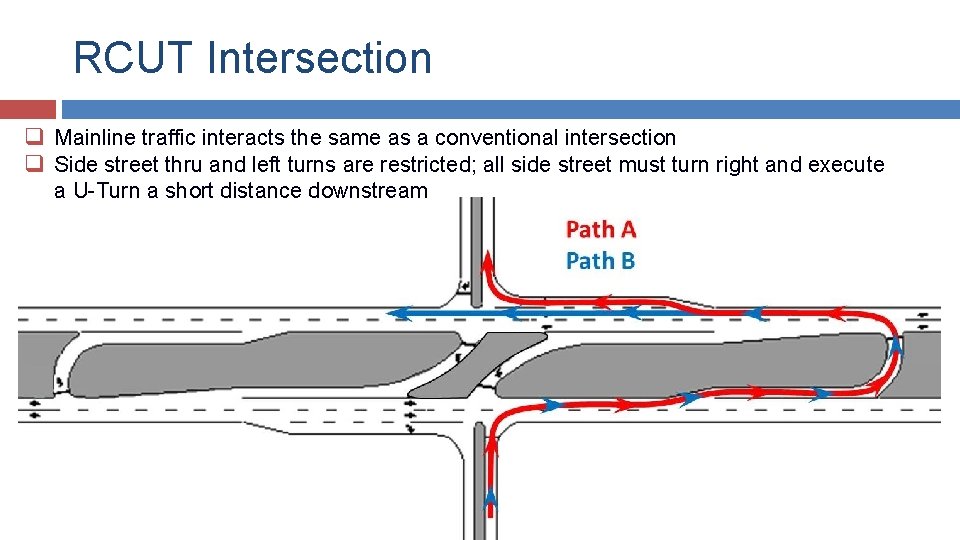
RCUT Intersection q Mainline traffic interacts the same as a conventional intersection q Side street thru and left turns are restricted; all side street must turn right and execute a U-Turn a short distance downstream
Reaching Out to Non-Safety Engineers Average Crash Reductions at Rural RCUTs � 30 -40% reduction of all crashes � 40 -60% reduction of injury crashes � 80 -100% reduction of serious injury and fatal crashes
- Slides: 40