
Kent Resilience Forum Recovery Update Kent Housing Group
- Slides: 7
Kent Resilience Forum Recovery Update Kent Housing Group, 25 th June 2020 Karla Phillips, programme manager for KRF Recovery Co-ordinating Group
KRF Recovery Co-ordinating Group (RCG): Upper-tier local authority has a statutory duty to lead the ‘recovery’ phase under the Civil Contingencies Act The KRF has established a multi-agency Recovery Coordinating Group as required by Government guidance The purpose of this Group is to co-ordinate with partners across Kent and Medway to produce an overall Recovery Strategy Undertake an impact assessment identifying the impact (both positive and negative) of the pandemic related to the cell/sub-group theme Identify critical success factors to achieving recovery Detail the actions necessary to support recovery, including the timeframe and which agency should be responsible The RCG reports into the Strategic Coordinating Group (Gold) and engages with other Regional and National Recovery Coordinating arrangements
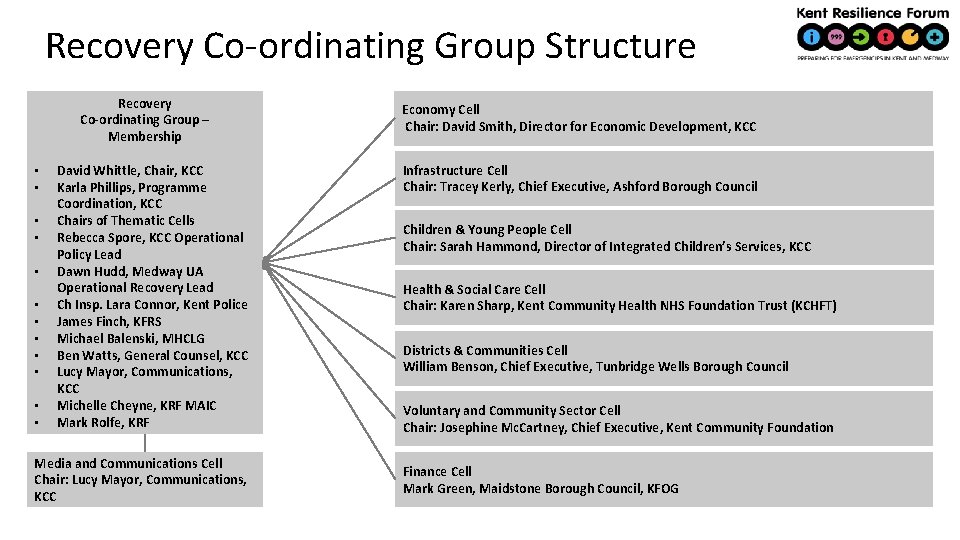
Recovery Co-ordinating Group Structure Recovery Co-ordinating Group – Membership • • • David Whittle, Chair, KCC Karla Phillips, Programme Coordination, KCC Chairs of Thematic Cells Rebecca Spore, KCC Operational Policy Lead Dawn Hudd, Medway UA Operational Recovery Lead Ch Insp. Lara Connor, Kent Police James Finch, KFRS Michael Balenski, MHCLG Ben Watts, General Counsel, KCC Lucy Mayor, Communications, KCC Michelle Cheyne, KRF MAIC Mark Rolfe, KRF Media and Communications Cell Chair: Lucy Mayor, Communications, KCC Economy Cell Chair: David Smith, Director for Economic Development, KCC Infrastructure Cell Chair: Tracey Kerly, Chief Executive, Ashford Borough Council Children & Young People Cell Chair: Sarah Hammond, Director of Integrated Children’s Services, KCC Health & Social Care Cell Chair: Karen Sharp, Kent Community Health NHS Foundation Trust (KCHFT) Districts & Communities Cell William Benson, Chief Executive, Tunbridge Wells Borough Council Voluntary and Community Sector Cell Chair: Josephine Mc. Cartney, Chief Executive, Kent Community Foundation Finance Cell Mark Green, Maidstone Borough Council, KFOG
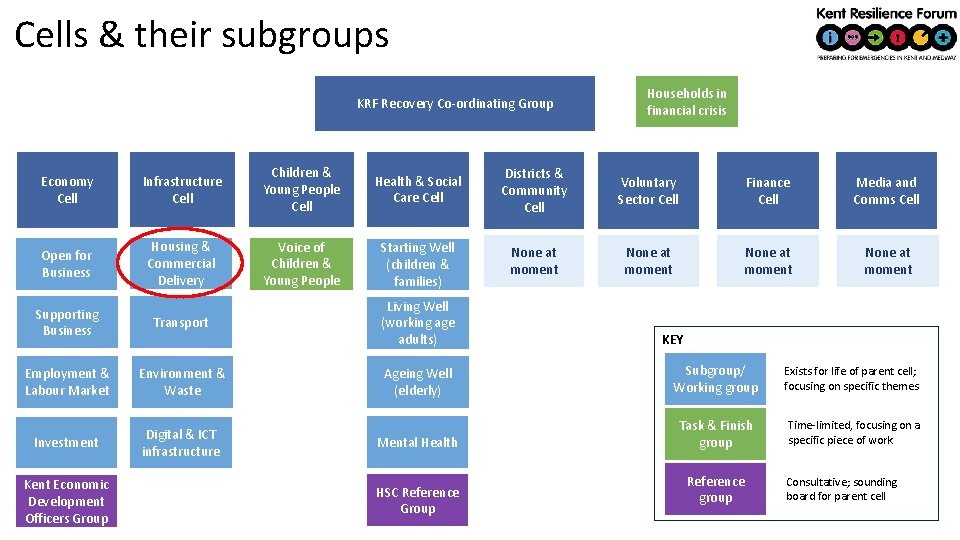
Cells & their subgroups KRF Recovery Co-ordinating Group Households in financial crisis Economy Cell Infrastructure Cell Children & Young People Cell Health & Social Care Cell Districts & Community Cell Voluntary Sector Cell Finance Cell Media and Comms Cell Open for Business Housing & Commercial Delivery Voice of Children & Young People Starting Well (children & families) None at moment Supporting Business Transport Living Well (working age adults) Employment & Labour Market Environment & Waste Ageing Well (elderly) Subgroup/ Working group Exists for life of parent cell; focusing on specific themes Investment Digital & ICT infrastructure Mental Health Task & Finish group Time-limited, focusing on a specific piece of work Kent Economic Development Officers Group HSC Reference Group KEY Reference group Consultative; sounding board for parent cell
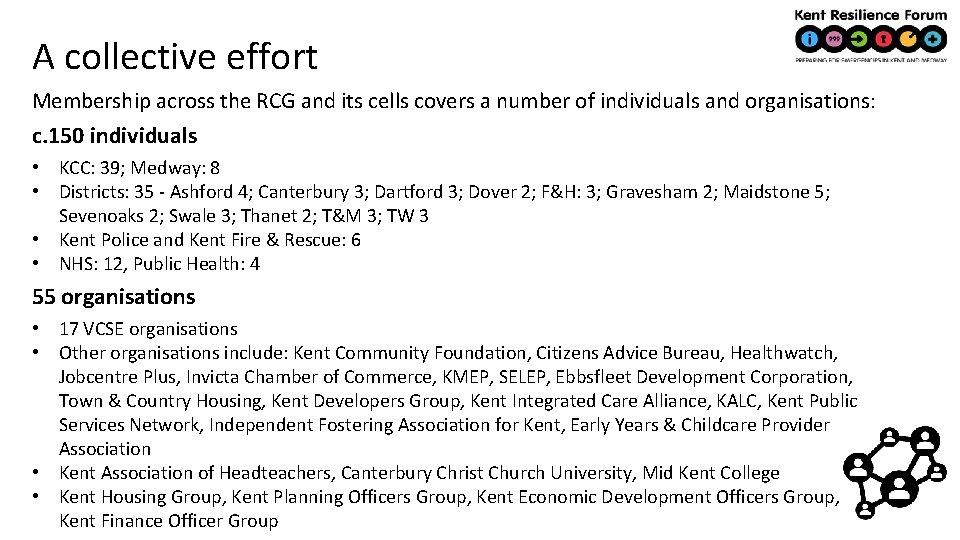
A collective effort Membership across the RCG and its cells covers a number of individuals and organisations: c. 150 individuals • KCC: 39; Medway: 8 • Districts: 35 - Ashford 4; Canterbury 3; Dartford 3; Dover 2; F&H: 3; Gravesham 2; Maidstone 5; Sevenoaks 2; Swale 3; Thanet 2; T&M 3; TW 3 • Kent Police and Kent Fire & Rescue: 6 • NHS: 12, Public Health: 4 55 organisations • 17 VCSE organisations • Other organisations include: Kent Community Foundation, Citizens Advice Bureau, Healthwatch, Jobcentre Plus, Invicta Chamber of Commerce, KMEP, SELEP, Ebbsfleet Development Corporation, Town & Country Housing, Kent Developers Group, Kent Integrated Care Alliance, KALC, Kent Public Services Network, Independent Fostering Association for Kent, Early Years & Childcare Provider Association • Kent Association of Headteachers, Canterbury Christ Church University, Mid Kent College • Kent Housing Group, Kent Planning Officers Group, Kent Economic Development Officers Group, Kent Finance Officer Group
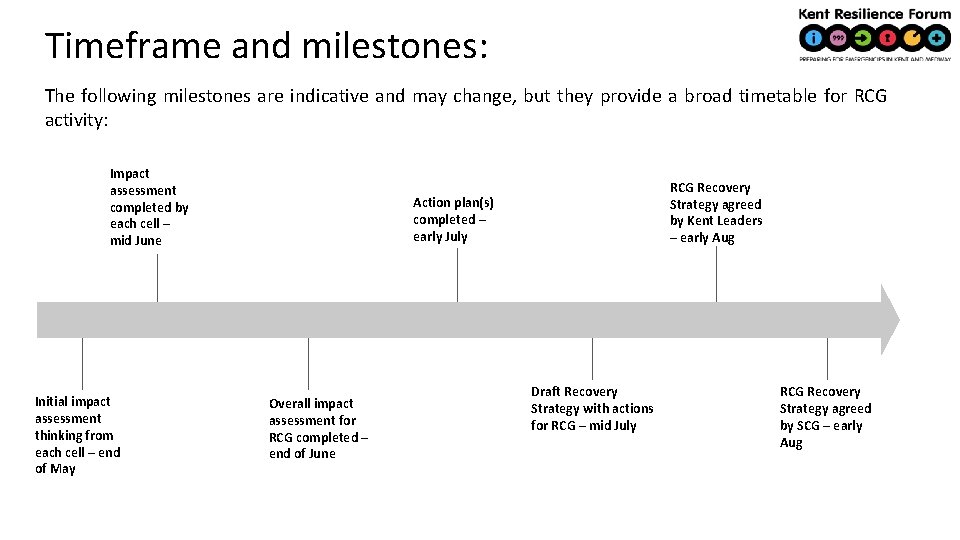
Timeframe and milestones: The following milestones are indicative and may change, but they provide a broad timetable for RCG activity: Impact assessment completed by each cell – mid June Initial impact assessment thinking from each cell – end of May RCG Recovery Strategy agreed by Kent Leaders – early Aug Action plan(s) completed – early July Overall impact assessment for RCG completed – end of June Draft Recovery Strategy with actions for RCG – mid July RCG Recovery Strategy agreed by SCG – early Aug
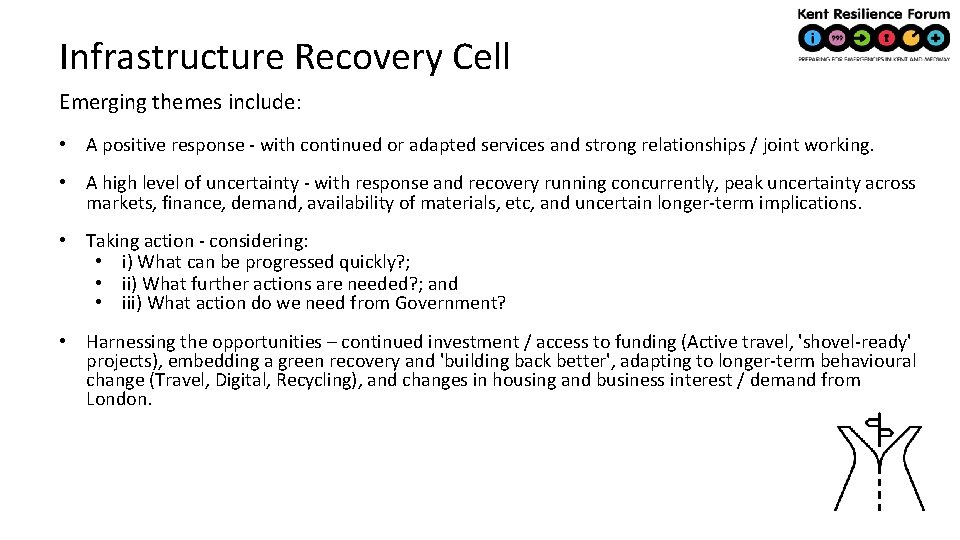
Infrastructure Recovery Cell Emerging themes include: • A positive response - with continued or adapted services and strong relationships / joint working. • A high level of uncertainty - with response and recovery running concurrently, peak uncertainty across markets, finance, demand, availability of materials, etc, and uncertain longer-term implications. • Taking action - considering: • i) What can be progressed quickly? ; • ii) What further actions are needed? ; and • iii) What action do we need from Government? • Harnessing the opportunities – continued investment / access to funding (Active travel, 'shovel-ready' projects), embedding a green recovery and 'building back better', adapting to longer-term behavioural change (Travel, Digital, Recycling), and changes in housing and business interest / demand from London.