
Kent Internet Risk Assessment Tool KIRAT Police Knowledge
- Slides: 8
Kent Internet Risk Assessment Tool (KIRAT) Police Knowledge Fund Impact of Tool Samantha Matthews, National Crime Agency Hayley Rhodes, University of Liverpool
OFFICIAL-SENSITIVE KIRAT Background What is KIRAT? - KIRAT is a risk prioritisation tool that applies to individuals suspected of possessing, making, taking and/or distributing indecent images of children (IIOC). - Allows police to prioritise the most dangerous offenders (i. e. those most likely to also commit hands-on sexual offences against children). Who developed the tool and why? - Developed by Kent Police and the University of Liverpool. - Developed in response to increasing police workloads and difficulties prioritising IIOC cases. How does it work? - Investigators must provide answers to approx. 14 questions regarding the suspect, at the end of which a risk score is provided.
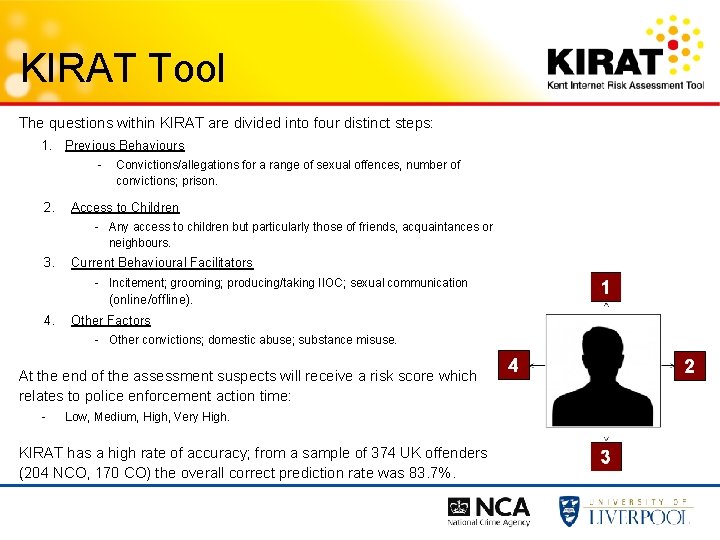
OFFICIAL-SENSITIVE KIRAT Tool The questions within KIRAT are divided into four distinct steps: s 1. Previous Behaviours - 2. Convictions/allegations for a range of sexual offences, number of convictions; prison. Access to Children - Any access to children but particularly those of friends, acquaintances or neighbours. 3. Current Behavioural Facilitators - Incitement; grooming; producing/taking IIOC; sexual communication (online/offline). 4. Other Factors - Other convictions; domestic abuse; substance misuse. At the end of the assessment suspects will receive a risk score which relates to police enforcement action time: - Low, Medium, High, Very High. KIRAT has a high rate of accuracy; from a sample of 374 UK offenders (204 NCO, 170 CO) the overall correct prediction rate was 83. 7%.
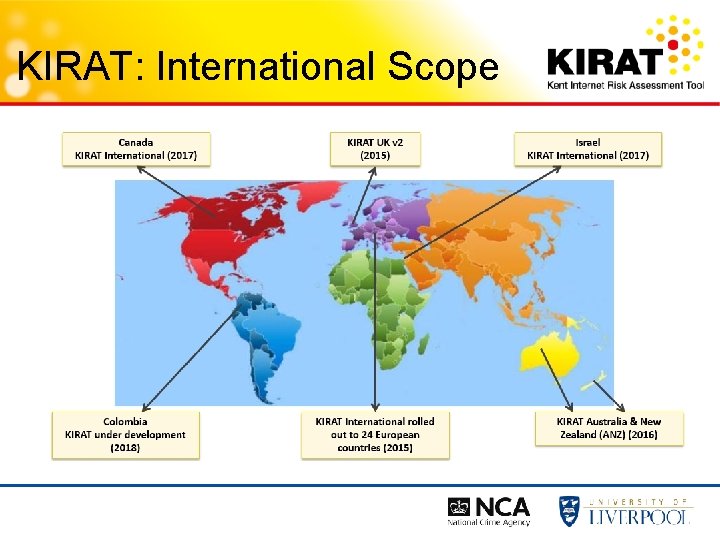
OFFICIAL-SENSITIVE KIRAT: International Scope
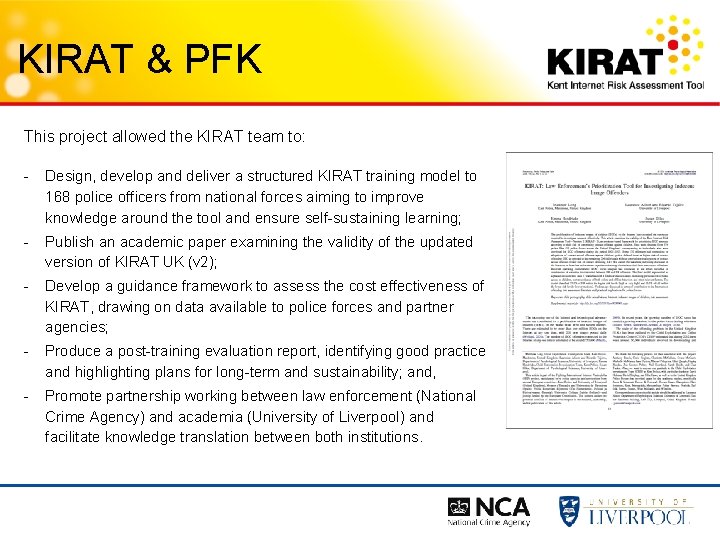
KIRAT & PFK This project allowed the KIRAT team to: - Design, develop and deliver a structured KIRAT training model to 168 police officers from national forces aiming to improve knowledge around the tool and ensure self-sustaining learning; - Publish an academic paper examining the validity of the updated version of KIRAT UK (v 2); - Develop a guidance framework to assess the cost effectiveness of KIRAT, drawing on data available to police forces and partner agencies; - Produce a post-training evaluation report, identifying good practice and highlighting plans for long-term and sustainability; and, - Promote partnership working between law enforcement (National Crime Agency) and academia (University of Liverpool) and facilitate knowledge translation between both institutions. OFFICIAL-SENSITIVE
KIRAT Impact OFFICIAL-SENSITIVE - Number of police officers & staff using KIRAT in UK now over 300; - Training enables investigators to apply prioritisation methods to large volumes of cases effectively; - Streamlined process ensures a national understanding of how to prioritise; - Ability to identify and prioritise high-risk offenders at a quicker pace results in the effective safeguarding of children; - Prioritising high-risk offenders and intervening at an early stage also means that longer term damage for victims and demands on the system can be avoided; - Effective workload/resource management results in savings in police time and resource.
Future Developments OFFICIAL-SENSITIVE - KIRAT Strategy; - Implement plans for long-term sustainability of KIRAT; - Implement training model, continued development of training and quality assurance; - Creation of a central knowledge hub for specialist teams using the KIRAT tool in order to ensure that learning and good practice are captured and disseminated effectively across the network; - Central knowledge hub to collate data regarding suspect risk prioritisation across UK to allow for further research into national trends; - Continued development of KIRAT internationally; - Research projects regarding training effectiveness, KIRAT application and continuing validation.
OFFICIAL-SENSITIVE Thank you. KIRAT@nca. x. gsi. gov. uk