
Ken Wilber b 1949 1968 Duke pre med


Ken Wilber • b. 1949 • 1968 – Duke – pre med – dropped out of grad program in biochemistry • Washed dishes and wrote Spectrum of Consciousness in 1973 • 1983 married Terry Killam who died in 1989 of breast cancer. • Ill himself since 1985 • Gap in writing from 1985 – 1991 (Grace and Grit) and again until 1995. • And again a long gap in the 2000 s.
Wilber I 1977 -79. A Jungian, Freudian approach that presumed that consciousness developed from a Ground of Being or collective unconscious and then split into dualities at every stage of growth. To attain Ultimate Consciousness, one needs to find the unifying ground between these dualities and regress into the collective unconscious state of birth. No Boundary is from this era. However, later he sees that there is a Pre-Trans fallacy (preconsciousness, trans-consciousness), so he starts with Wilber II.
Wilber II • 1980 -1983 • Evolutionary-developmental model based on Sri Aurobindo and Mahayana Buddhism and emptiness. • Involution and evolution.
Wilber III • 1983 -1987 • Levels and lines of development. • Koestler’s theory of holons.
Wilber IV • 1987 - 2001 • SES - the AQAL model of consciousness. • Adds the Big Three and the Four Quadrants

Wilber V • 2001 – now • Postmetaphysical model. • Waves and streams, kosmic habits, methodological perspectives, perspectives on perspectives and altitude, based on Sheldrake’s notion of morphogenetic fields • Revises Spiral Dynamics • Leaves the world of cosmology to work in a pragmatic world that is post-metaphysical and acutely integral.
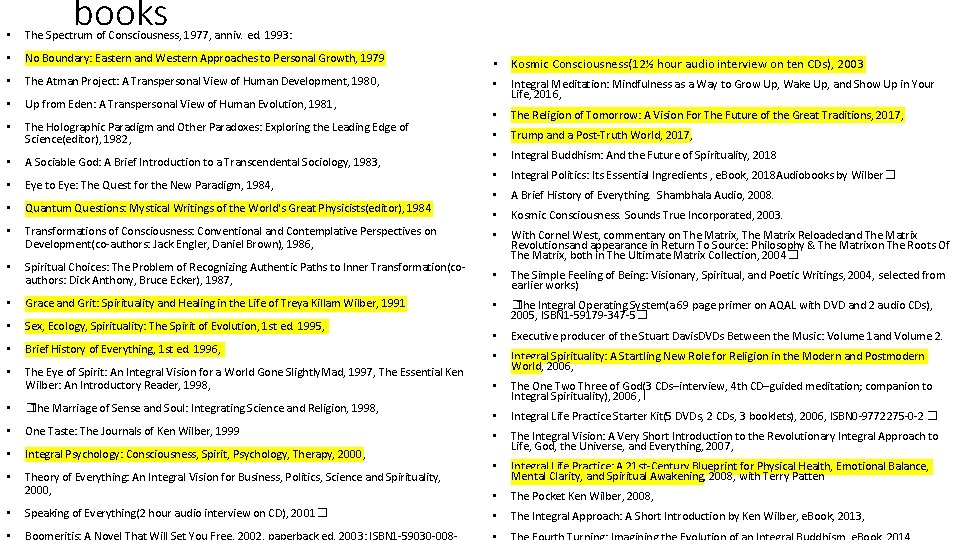
books • The Spectrum of Consciousness, 1977, anniv. ed. 1993: • No Boundary: Eastern and Western Approaches to Personal Growth, 1979 • Kosmic Consciousness(12½ hour audio interview on ten CDs), 2003 • The Atman Project: A Transpersonal View of Human Development, 1980, • • Up from Eden: A Transpersonal View of Human Evolution, 1981, Integral Meditation: Mindfulness as a Way to Grow Up, Wake Up, and Show Up in Your Life, 2016, • The Holographic Paradigm and Other Paradoxes: Exploring the Leading Edge of Science(editor), 1982, • The Religion of Tomorrow: A Vision For The Future of the Great Traditions, 2017, • Trump and a Post-Truth World, 2017, • A Sociable God: A Brief Introduction to a Transcendental Sociology, 1983, • Integral Buddhism: And the Future of Spirituality, 2018 • Eye to Eye: The Quest for the New Paradigm, 1984, • Integral Politics: Its Essential Ingredients , e. Book, 2018 Audiobooks by Wilber� • Quantum Questions: Mystical Writings of the World's Great Physicists(editor), 1984 • A Brief History of Everything. Shambhala Audio, 2008. • Kosmic Consciousness. Sounds True Incorporated, 2003. • Transformations of Consciousness: Conventional and Contemplative Perspectives on Development(co-authors: Jack Engler, Daniel Brown), 1986, • • Spiritual Choices: The Problem of Recognizing Authentic Paths to Inner Transformation(coauthors: Dick Anthony, Bruce Ecker), 1987, With Cornel West, commentary on The Matrix, The Matrix Reloadedand The Matrix Revolutionsand appearance in Return To Source: Philosophy & The Matrixon The Roots Of The Matrix, both in The Ultimate Matrix Collection, 2004� • The Simple Feeling of Being: Visionary, Spiritual, and Poetic Writings, 2004, selected from earlier works) • Grace and Grit: Spirituality and Healing in the Life of Treya Killam Wilber, 1991 • • Sex, Ecology, Spirituality: The Spirit of Evolution, 1 st ed. 1995, �The Integral Operating System(a 69 page primer on AQAL with DVD and 2 audio CDs), 2005, ISBN 1 -59179 -347 -5� • Brief History of Everything, 1 st ed. 1996, • Executive producer of the Stuart Davis. DVDs Between the Music: Volume 1 and Volume 2. • • The Eye of Spirit: An Integral Vision for a World Gone Slightly. Mad, 1997, The Essential Ken Wilber: An Introductory Reader, 1998, Integral Spirituality: A Startling New Role for Religion in the Modern and Postmodern World, 2006, • • �The Marriage of Sense and Soul: Integrating Science and Religion, 1998, The One Two Three of God(3 CDs–interview, 4 th CD–guided meditation; companion to Integral Spirituality), 2006, I • Integral Life Practice Starter Kit(5 DVDs, 2 CDs, 3 booklets), 2006, ISBN 0 -9772275 -0 -2 � • One Taste: The Journals of Ken Wilber, 1999 • • Integral Psychology: Consciousness, Spirit, Psychology, Therapy, 2000, The Integral Vision: A Very Short Introduction to the Revolutionary Integral Approach to Life, God, the Universe, and Everything, 2007, • Theory of Everything: An Integral Vision for Business, Politics, Science and Spirituality, 2000, • Integral Life Practice: A 21 st-Century Blueprint for Physical Health, Emotional Balance, Mental Clarity, and Spiritual Awakening, 2008, with Terry Patten • The Pocket Ken Wilber, 2008, • The Integral Approach: A Short Introduction by Ken Wilber, e. Book, 2013, • Speaking of Everything(2 hour audio interview on CD), 2001� • Boomeritis: A Novel That Will Set You Free, 2002, paperback ed. 2003: ISBN 1 -59030 -008 -
Place in his writings • 1979. Second book, at age 29. The first was Spectrum of Consciousness at age 23. • Enduring • About spirituality and psychology • Therapies as they relate to the map of human consciousness
Essential Thesis • “The ultimate metaphysical secret, if we dare state it so simply, is that there are no boundaries in the universe. Boundaries are illusions, products not of reality of the way we map and edit reality. And while it is fine to map out the territory it is fatal to confuse the two. ” 31 • quote p. 2
Who are you? • “Who are you? ” means “Where do you draw the boundary? ” • ”We progressively limit our world and turn from our true nature in order to embrace boundaries. ” • • Skin boundary Self/body boundary Mind/body boundary Persona/shadow boundary
Half of it • All opposites share an implicit identity - can’t exist without each other. • Two different ways of approaching the same process – the crest and trough of a wave • Gestalt – I am only aware of something except in relation to a contrasting background • Demonstrated by physics • Wave and particle • Subject and object • Time and space
Half of It • “This goal of separating the opposites and then clinging to or pursuing the positive halves seems to be a distinguishing characteristic of progressive Western civilization – its religion, science, medicine, industry. Progress, after all, is simply progress toward the positive and away from the negative. ” • Actually creates unhappiness because “the very urge to progress implies a discontent with the present state of affairs…
Line does not = boundary • Both sides share it • Only becomes an illusory boundary when we try to separate them and make them unrelated • Sort and classify • The map is not the territory
Freed from the pairs • When the opposites are realized to be one, discord melts into concord, battles become dances, and old enemies become lovers. We are then in a position to make friends with all of our universe, and not just one half of it. ” 29 • Liberation: “not good vs. evil but beyond good and evil. Not life against death but a center of awareness that transcends both. ” • Quotes p. 27 and 28 • “
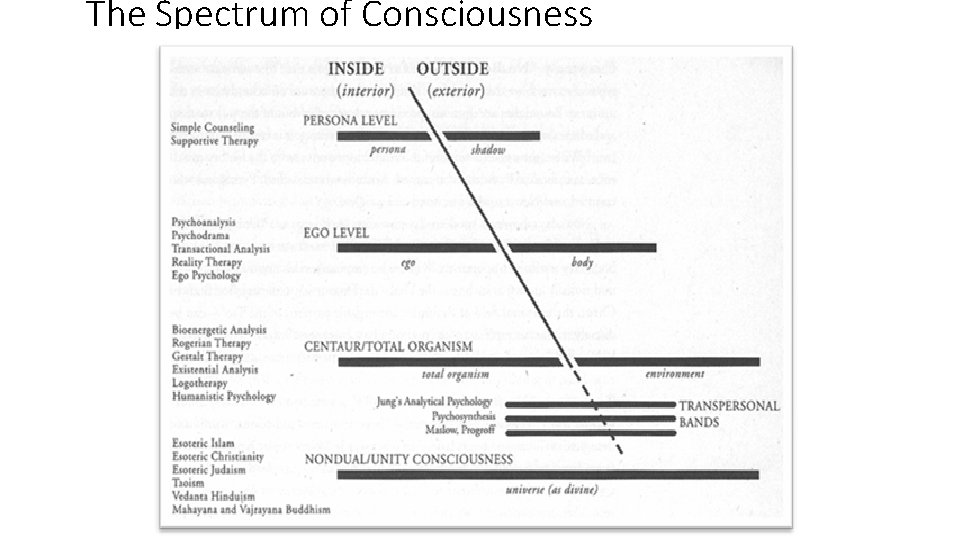
Boundary as battle line • Different therapies for different levels • Conventional psychology heals conscious/unconscious boundary (shadow) • Humanism heals body/ego boundary • Buddhism, Hinduism heals total organism/entire universe boundary
Chapter 3. No Boundary Territory • Boundaries as battle lines: when you draw a boundary to control something, you gain technological and political power but you also gain alienation, fragmentation, and conflict • Naming – Adam, Aristotle • Measuring - freed from the concrete • Meta abstraction – algebra – allows abstract relations which lead to theories, laws, and principles. • “Man gained control over nature, but only by radically separating himself from it. ” 35
Quantum mechanics • 1905 -1925 – Einstein’s relativity principle to Heisenberg’s uncertainty principles broke up the stability of physics. • Henry Stapp, “An elementary particle is not an independently existing unanalyzable entity. It is, in essence, a set of relationship that reach outward to other things. ” There is no building block. An electron couldn’t be measured. • Scientists developed laws governing separate things only to discover that separate things don’t exist. ”
But not subjective idealism • Not that the world is a product of our imaginations – only our boundaries are • Quote p. 39 • Buddhism – thinking, thinging as the same thing. The void does not mean a vacuum but a lack of boundaries. (41) • You never see a boundary, just a richly textured field. • You can concentrate and “pretend” to see one
Chapter 4. No Boundary Awareness • Unity consciousness is the state which acknowledges this reality (45) • Our language is a language of boundaries. Can’t use language to describe it. • “no boundary awareness is a direct, immediate, and non-verbal awareness. ” • In no boundary awareness, the sense of self expands to include everything once thought to be not self (the entire universe) • But we fortify a self – as distinct from nonself – and all of our other boundaries depend on that. • Don’t seek to destroy the ego self because that maintains the illusion – just look for the boundary – a separate self experiencer and feeler set apart from experiences and feelings – and then don’t find it. That is unity consciousness.
Not self • Is there ever a seer without seeing or seen? Why complicate it? • Unity consciousness is not a loss of sensibilities, or a trance, or merger. • Self-in-here will be seen to be the same sensation as “world-outthere. ” • Meditation here? P. 49 -50
The No-Boundary Moment: Time and Unity Consciousness • Reality is without time – past and future are only other boundaries. • The separate self - little man within - is composed entirely of memories. Memory is only a present experience. • Nunc fluens – short present moment – bounded. • Nunc stans – eternal present – everything resides in it – one is not bound by the past or future – not pushed or pulled – this is unity consciousness • Meister Eckhart: “There is no greater obstacle to God [unity consciousness] than time. • Wittgenstein: “Eternal life belongs to those who live in the present. ”
Time, cont. • Not everlasting time, but totally without time. It can only be found now. Removes past guilt and future anxiety – there is no present problem – it is all tied up with the past or the future. And memory is the reason. • Be totally absorbed in the present moment. It has no beginning and no end. The Unborn and the Undying. • Not just in this moment – don’t “try” to contact it because that assumes it in the future • Meditation – p. 66
The Spectrum of Consciousness
The Growth of Boundaries • The restricted self is the unnatural self. • The primary boundary is between seer and seen, knower and known, subject and object, organism vs. environment • We no longer are the world, we face it. And with that comes the fear of death and a refusal to live without a future which generates an intense sensation of time. • We have now restricted ourselves to the total organism (centaur) in the graph
Further boundaries • Now the centaur pushes away everything that might remind us of death such as the body because it is impermanent. • Concepts, symbols, and ideas seem permanent and fixed, so we begin to center our identity around an “idea” of ourselves - the ego. We lose touch with the unity of mind and body. • Now we have body vs. soul • But that is still a loose self image. It knows its strengths and weaknesses, its emotions. It has a conscience (superego) and a philosophy. A healthy ego harmonizes these.
Persona • But next a fear of certain parts arises and we project them outside (all the negatives) • Now we don’t have an accurate self-image, but a persona. • All unacceptable aspects of our ego now appear external, foreign and not-self. They are projected as the shadow. • The menacing “not-self” grows. • However, doing shadow work “converts enemies into friends, wars into dances, battles into plays. ”
Reclaiming the Self • We can work our way back by dissolving the boundaries and reowning the projections • The reclamation arises with a conscious dissatisfaction with life. “Suffering is the first grace” – we are beginning to awaken to deeper truer realities. • To confront and understand our suffering, depending on whom we ask, we are advised to contact God, contact our unconscious, contact our bodies, transcend our bodies, etc. Soul doctors are in disagreement. • But they are not approaching it from different angles, but from different levels.
Reclaiming the Self, cont. • Each chapter gives • • Understanding of the level An experiential taste of the level An introduction to the types of therapies available to address that level. At end of each chapter are recommended books and therapies (note they are all from 1979 or earlier)
Persona + Shadow = Healthy Ego • Items that bother us, upset us, repulse us, or at the other extreme, attract us, compel us, obsess us – these are usually reflections of the shadow. We loathe or obsess over in others those things that we loathe in ourselves. This leads to witch hunting. • The dark side does not mean the bad side. There is “a little bit of larceny in every heart. ” Hebrew tradition: “God himself placed this wayward, whimsical or perverse tendency in all people at the very beginning, presumably to prevent mankind from perishing from boredom. • To reclaim it • allow yourself to feel depressed, anxious, rejected, bored, hurt, embarrassed. • translate it to its original meaning (e. g. anger may be covering fear). • confront opposites in you - they are only separated by selective in attention. • Transactional analysis is helpful in uniting the ego.
Ego + Body = Centaur • Ego consciousness is head consciousness • The body contains rejected emotions and feelings and is the abode of death. • The body is not a deeper reality than the mental-ego (in fact, less deep) but the integration of the two is a deeper level than either. • Need to give up rigidity of ego control and let deep body sensations reach the surface • Noticing body and breathing exercises. Notice where numbness, tension – is a muscular holding of some taboo impulse or feelings • Try to increase the tension (each level – notice the resistance)
Centaur, cont. • Now you can accept even what you can’t control about yourself • Leads to delight from within, the spontaneity of the centaur, to selfactualization, autonomy, and meaning in life. • “To find egoic meaning in life is to do something …. To find centauric meaning in life – fundamental meaning – is to find that the very processes of life itself generate joy” 119 • Accept impermanence, release into emptiness, accept death. Suggests, Gestalt, hatha yoga, bioenergetic analysis (but without shunning mental-egoic insight and verbalization).
The Self in Transcendence: the Transpersonal Bands • West has repressed the transcendent. Now erupting – meditation, psychic phenomena, yoga, Oriental religions, biofeedback, etc. • Freud limited his work to ego, persona, shadow. But Jung pushed to the transpersonal. • Archetypes, basic symbolic forms are housed in the collective unconscious • We need to live mythologically, open ourselves to a no boundary world, not ignoring conventional world but re-enlivening it. Look at the world from a universal perspective not a personal one. • The soul then becomes saturated with depth, lets go of personal problems and dramas, …finds, haltingly at first but then with an ever-increasing certainty, a quiet source of inner strength that persists unperturbed like the depths of the ocean, even though the surface waves of consciousness are swept with torrents of pain, anxiety or despair. ” 128
Self in Transcendence, cont • Recognizing archetypes is not the only path to the transcendent • E. g. the exercise of via negativa – takes us to the witness, the “jumping off” place for unity consciousness • Personal self tends to go transparent and drop away. • We die to the personal self so as to awaken to the transcendent self. • Still have access to but discretionary - body, persona, shadow - all now work in harmony • We begin to treat all of the environment as if it were our self. • Our usual sense of I-ness is dependent upon memories and mind and body. But true sense of I-ness is in everyone. Same sense. • Quote p 137 • Recommends Jung, Maslow, Assagioli, Grof.
The Ultimate State of Consciousness • This ”loss” of unity consciousness throws us into a world of boundaries, space, time, suffering, and mortality. • There is no path to it – it already is present • Looking away from present experience to something else is what takes us away – unity consciousness is the present • Every level has resistance. Here, we won’t concentrate in the present (we use thought instead of presence). Spiritual practice brings this resistance to the surface. • But how to stop moving away? That is just another movement. Dark Night ensues once see there is nothing you can do. • You realize that everything you do is you doing it. The separate self is the resistance. • Certain conditions are expressive of unity consciousness. By assuming the characteristics of the deeper level as your present practice (joyfulness, gratefulness, etc. ), you undermine the resistance to look upon everything, as it is, now.
- Slides: 35