
KELARUTAN Gula larut dalam air ini berarti bahwa
KELARUTAN Ø Gula larut dalam air – ini berarti bahwa kita boleh melarutkan gula dalam jumlah yang banyak dalam air. Berapa banyak kuanti “yang banyak” ? Ø Dalam sains, kita menggunakan istilah “kelarutan” (solubility) untuk menentukaan kuantiti bahan larut yang boleh dilarutkan dalam satu kuantitas pelarut pada suhu yang tertentu. Ø Kelarutan Na. Cl, garam dapur/meja, adalah 36 g pada setiap 100 g air pada suhu 20 o. C. 1
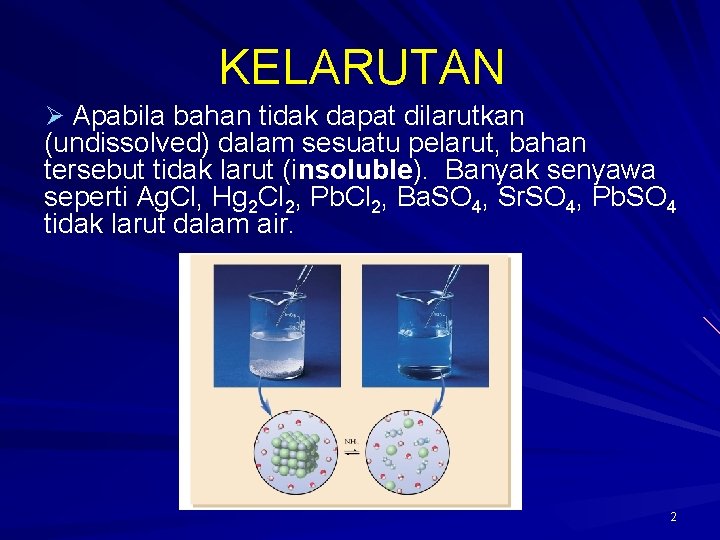
KELARUTAN Ø Apabila bahan tidak dapat dilarutkan (undissolved) dalam sesuatu pelarut, bahan tersebut tidak larut (insoluble). Banyak senyawa seperti Ag. Cl, Hg 2 Cl 2, Pb. Cl 2, Ba. SO 4, Sr. SO 4, Pb. SO 4 tidak larut dalam air. 2
JENUH ATAU TIDAK JENUH Apabila larutan yang mengandungi bahan larut yang terlarut (dissolved solute) sebanyak sesuai jumlahnya pada suhu tertentu dan juga bahan larut yang tidak larut (undissolved solute) larutan tadi disebut sebagai larutan JENUH. CONTOH : Bila Na. Cl dimasukan dalam Beaker glass berisi air sebanyak 100 gram air. Diketahui kelarutan Na. Cl adalah 36 gram/100 gram air pada suhu 20 o. C. Namun apabila kita masukan sebanyak 40 gram Na. Cl dalam 100 gram air pada suhu pada 20 o. C, maka 36 gram akan larut dalam air tersebut. Yang selebihnya masih dalam keadaan yang tidak larut. Larutan ini adalah larutan JENUH. Kelarutan akan meningkat dengan kenaikan suhu. 3
JENUH ATAU TIDAK JENUH Oleh karena itu, ini berarti bahwa pada suhu yang lebih tinggi, kelarutan Na. Cl adalah meningkat melebihi 36 gram/100 gram. Jika kita tingkatkan suhu kepada 30 o. C, maka 4 gram Na. Cl yang tinggal akan melarut dalam larutan. Oleh karena itu pada 30 o. C, larutan ini menjadi larutan TIDAK JENUH 4
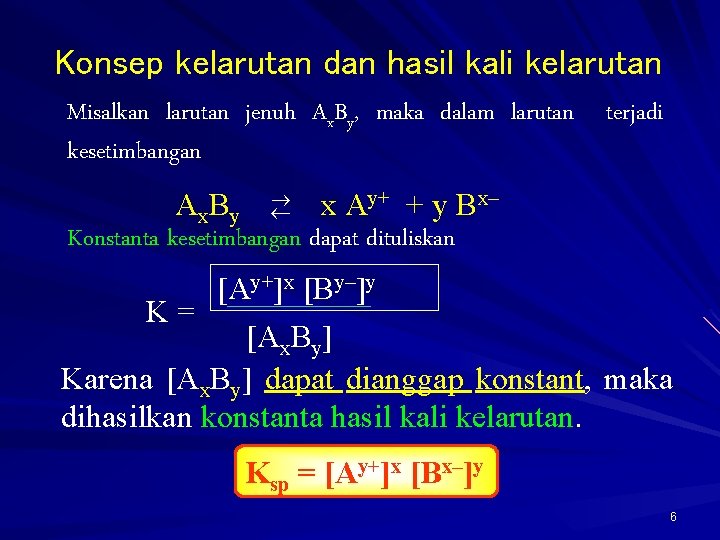
Konsep kelarutan dan hasil kali kelarutan Misalkan larutan jenuh Ax. By, maka dalam larutan kesetimbangan terjadi y+ + y Bx– Ax. By x A Konstanta kesetimbangan dapat dituliskan y+]x [By–]y [A ______ K= [Ax. By] Karena [Ax. By] dapat dianggap konstant, maka dihasilkan konstanta hasil kali kelarutan. Ksp = [Ay+]x [Bx–]y 6
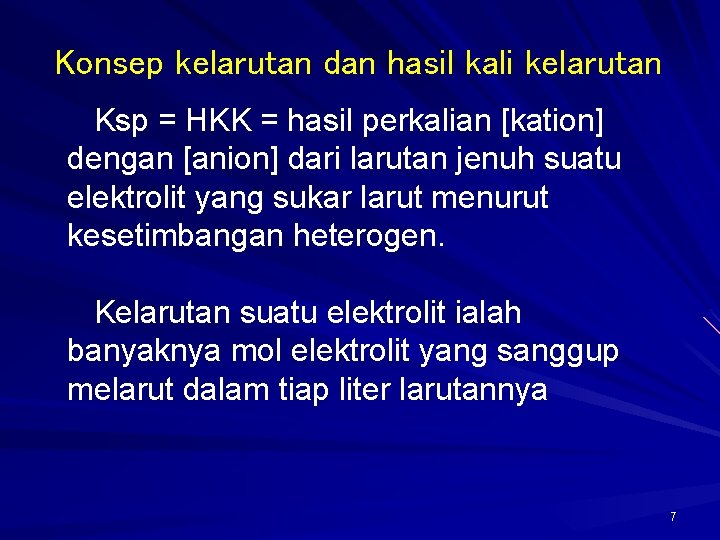
Konsep kelarutan dan hasil kali kelarutan Ksp = HKK = hasil perkalian [kation] dengan [anion] dari larutan jenuh suatu elektrolit yang sukar larut menurut kesetimbangan heterogen. Kelarutan suatu elektrolit ialah banyaknya mol elektrolit yang sanggup melarut dalam tiap liter larutannya 7
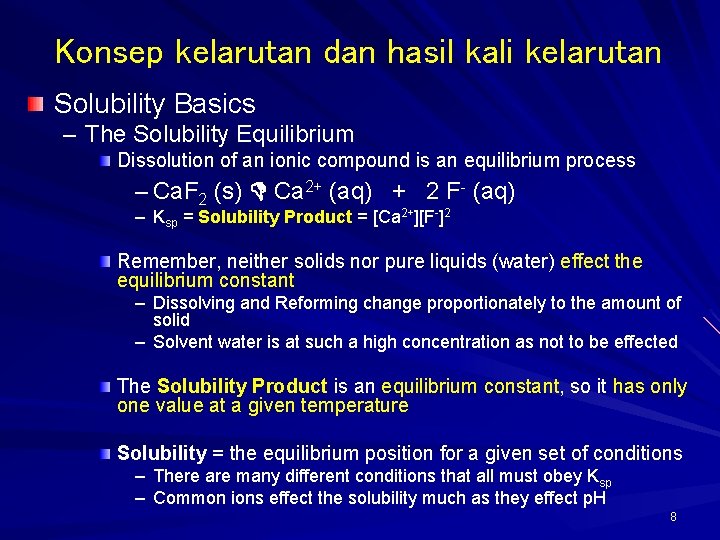
Konsep kelarutan dan hasil kali kelarutan Solubility Basics – The Solubility Equilibrium Dissolution of an ionic compound is an equilibrium process – Ca. F 2 (s) Ca 2+ (aq) + 2 F- (aq) – Ksp = Solubility Product = [Ca 2+][F-]2 Remember, neither solids nor pure liquids (water) effect the equilibrium constant – Dissolving and Reforming change proportionately to the amount of solid – Solvent water is at such a high concentration as not to be effected The Solubility Product is an equilibrium constant, so it has only one value at a given temperature Solubility = the equilibrium position for a given set of conditions – There are many different conditions that all must obey Ksp – Common ions effect the solubility much as they effect p. H 8
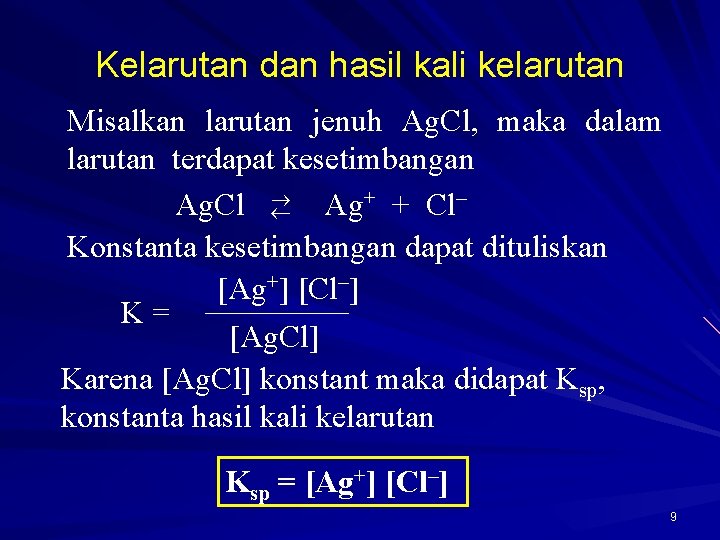
Kelarutan dan hasil kali kelarutan Misalkan larutan jenuh Ag. Cl, maka dalam larutan terdapat kesetimbangan Ag. Cl Ag+ + Cl– Konstanta kesetimbangan dapat dituliskan +] [Cl–] [Ag K = ______ [Ag. Cl] Karena [Ag. Cl] konstant maka didapat Ksp, konstanta hasil kali kelarutan Ksp = [Ag+] [Cl–] 9
![Kelarutan dan hasil kali kelarutan Contoh: +(aq) + Cl-(aq) Ag. Cl(s) Ag +] [Cl-]](http://slidetodoc.com/presentation_image_h/044f78af62dc0f2012e5ae9708d74588/image-9.jpg "Kelarutan dan hasil kali kelarutan Contoh: +(aq) + Cl-(aq) Ag. Cl(s) Ag +] [Cl-]")
Kelarutan dan hasil kali kelarutan Contoh: +(aq) + Cl-(aq) Ag. Cl(s) Ag +] [Cl-] K = [Ag ________ [Ag. Cl] K x [Ag. Cl] = [Ag+][Cl-] Ksp. Ag. Cl = [Ag+] [Cl-] Bila Ksp Ag. Cl = 10 -10 , maka berarti larutan jenuh Ag. Cl dalam air pada suhu 25 o. C, Mempunyai nilai [Ag+] [Cl-] = 10 -10 10
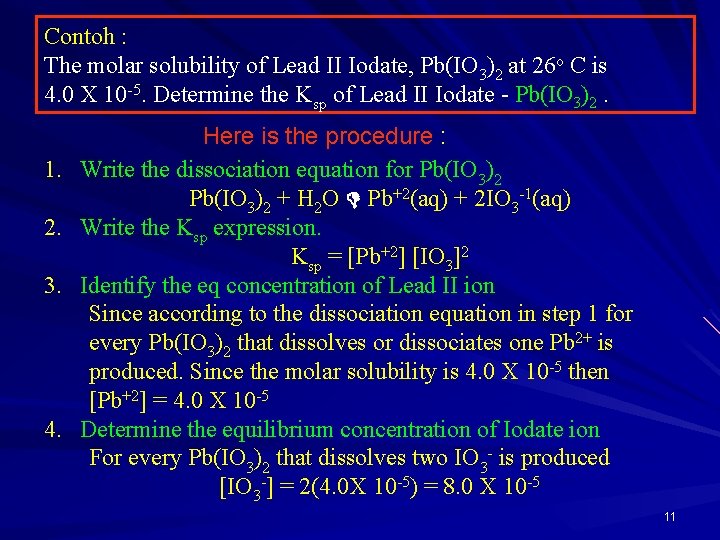
Contoh : The molar solubility of Lead II Iodate, Pb(IO 3)2 at 26 o C is 4. 0 X 10 -5. Determine the Ksp of Lead II Iodate - Pb(IO 3)2. 1. 2. 3. 4. Here is the procedure : Write the dissociation equation for Pb(IO 3)2 + H 2 O Pb+2(aq) + 2 IO 3 -1(aq) Write the Ksp expression. Ksp = [Pb+2] [IO 3]2 Identify the eq concentration of Lead II ion Since according to the dissociation equation in step 1 for every Pb(IO 3)2 that dissolves or dissociates one Pb 2+ is produced. Since the molar solubility is 4. 0 X 10 -5 then [Pb+2] = 4. 0 X 10 -5 Determine the equilibrium concentration of Iodate ion For every Pb(IO 3)2 that dissolves two IO 3 - is produced [IO 3 -] = 2(4. 0 X 10 -5) = 8. 0 X 10 -5 11
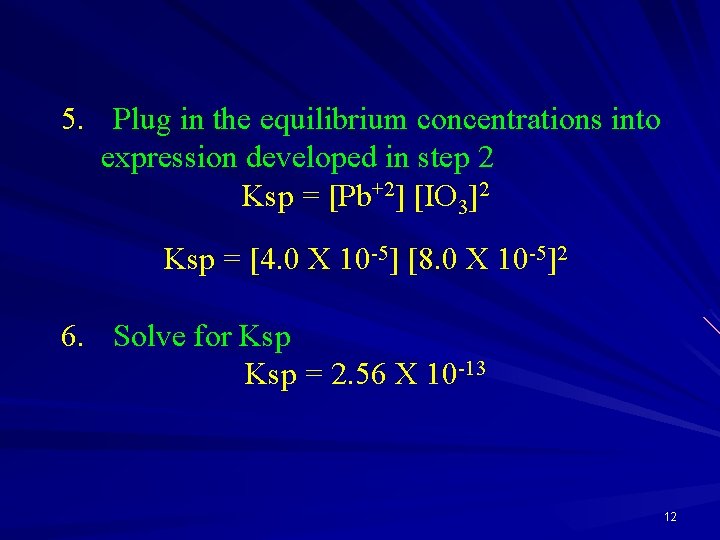
5. Plug in the equilibrium concentrations into expression developed in step 2 Ksp = [Pb+2] [IO 3]2 Ksp = [4. 0 X 10 -5] [8. 0 X 10 -5]2 6. Solve for Ksp = 2. 56 X 10 -13 12
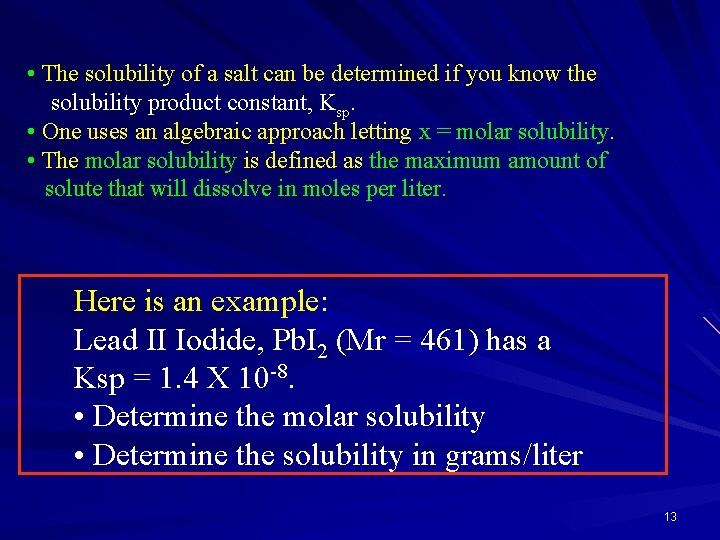
• The solubility of a salt can be determined if you know the solubility product constant, Ksp. • One uses an algebraic approach letting x = molar solubility. • The molar solubility is defined as the maximum amount of solute that will dissolve in moles per liter. Here is an example: Lead II Iodide, Pb. I 2 (Mr = 461) has a Ksp = 1. 4 X 10 -8. • Determine the molar solubility • Determine the solubility in grams/liter 13
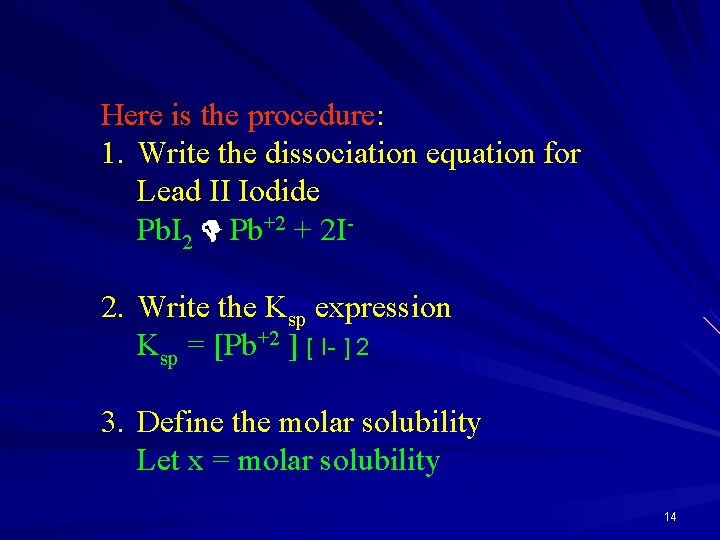
Here is the procedure: 1. Write the dissociation equation for Lead II Iodide Pb. I 2 Pb+2 + 2 I- 2. Write the Ksp expression Ksp = [Pb+2 ] [ I- ] 2 3. Define the molar solubility Let x = molar solubility 14
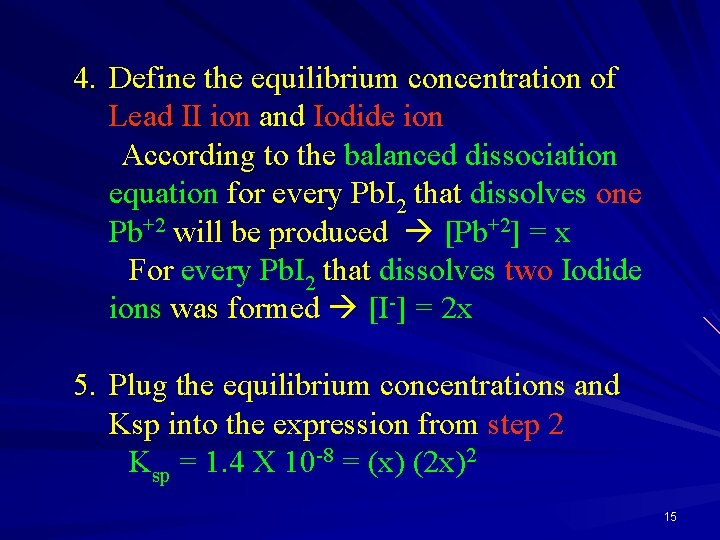
4. Define the equilibrium concentration of Lead II ion and Iodide ion According to the balanced dissociation equation for every Pb. I 2 that dissolves one Pb+2 will be produced [Pb+2] = x For every Pb. I 2 that dissolves two Iodide ions was formed [I-] = 2 x 5. Plug the equilibrium concentrations and Ksp into the expression from step 2 Ksp = 1. 4 X 10 -8 = (x) (2 x)2 15
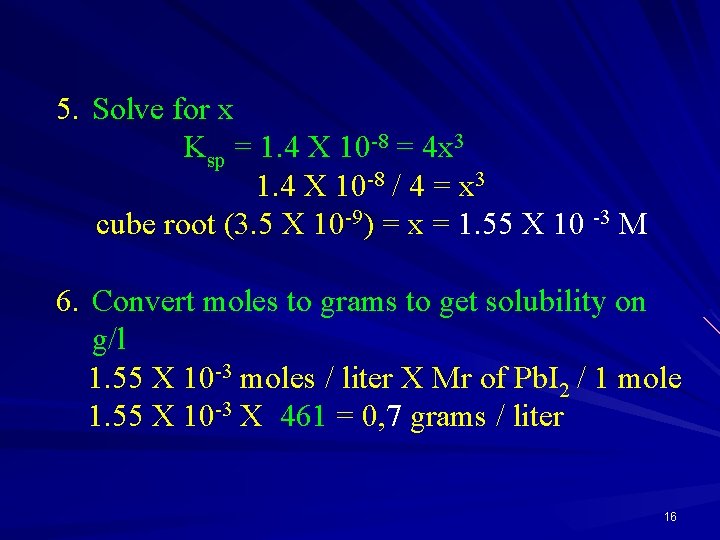
5. Solve for x Ksp = 1. 4 X 10 -8 = 4 x 3 1. 4 X 10 -8 / 4 = x 3 cube root (3. 5 X 10 -9) = x = 1. 55 X 10 -3 M 6. Convert moles to grams to get solubility on g/l 1. 55 X 10 -3 moles / liter X Mr of Pb. I 2 / 1 mole 1. 55 X 10 -3 X 461 = 0, 7 grams / liter 16
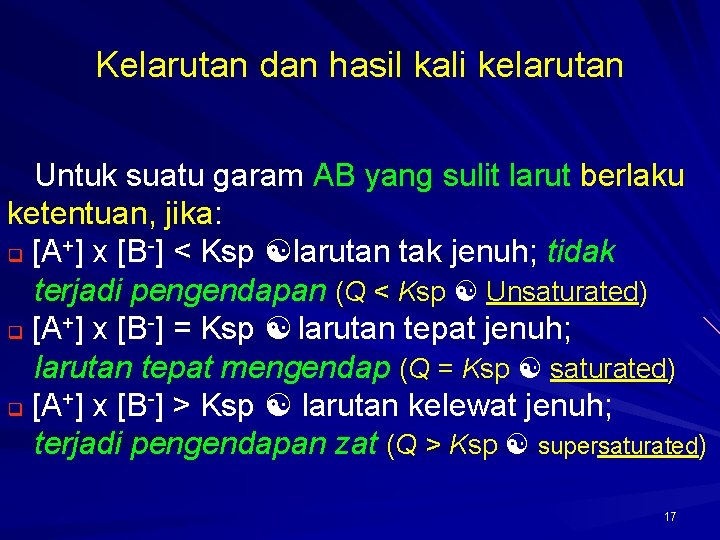
Kelarutan dan hasil kali kelarutan Untuk suatu garam AB yang sulit larut berlaku ketentuan, jika: + q [A ] x [B ] < Ksp larutan tak jenuh; tidak terjadi pengendapan (Q < Ksp Unsaturated) + q [A ] x [B ] = Ksp larutan tepat jenuh; larutan tepat mengendap (Q = Ksp saturated) + q [A ] x [B ] > Ksp larutan kelewat jenuh; terjadi pengendapan zat (Q > Ksp supersaturated) 17
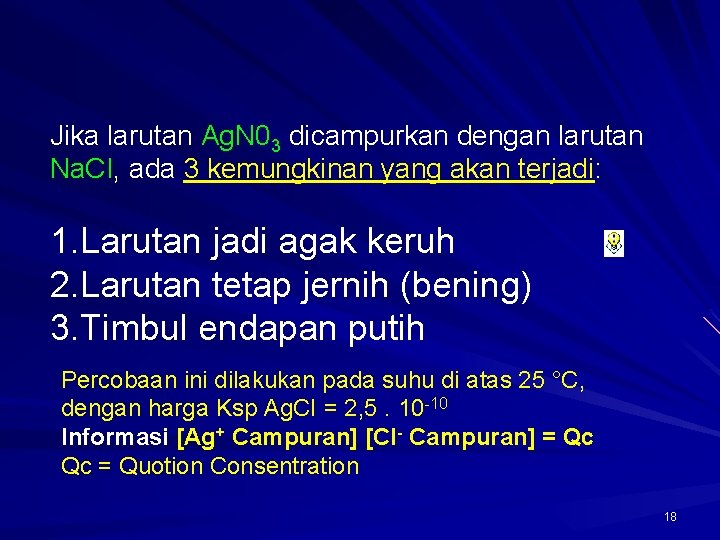
Jika larutan Ag. N 03 dicampurkan dengan larutan Na. CI, ada 3 kemungkinan yang akan terjadi: 1. Larutan jadi agak keruh 2. Larutan tetap jernih (bening) 3. Timbul endapan putih Percobaan ini dilakukan pada suhu di atas 25 °C, dengan harga Ksp Ag. CI = 2, 5. 10 -10 Informasi [Ag+ Campuran] [Cl- Campuran] = Qc = Quotion Consentration 18
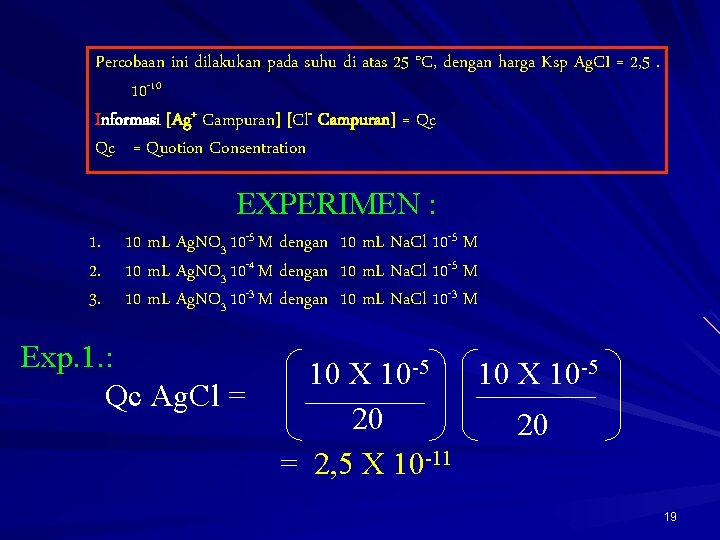
Percobaan ini dilakukan pada suhu di atas 25 °C, dengan harga Ksp Ag. CI = 2, 5. 10 -10 Informasi [Ag+ Campuran] [Cl- Campuran] = Qc Qc = Quotion Consentration EXPERIMEN : 1. 10 m. L Ag. NO 3 10 -5 M dengan 10 m. L Na. Cl 10 -5 M 2. 10 m. L Ag. NO 3 10 -4 M dengan 10 m. L Na. Cl 10 -5 M 3. 10 m. L Ag. NO 3 10 -3 M dengan 10 m. L Na. Cl 10 -3 M Exp. 1. : Qc Ag. Cl = -5 -5 10 X 10 __________ 20 20 = 2, 5 X 10 -11 19
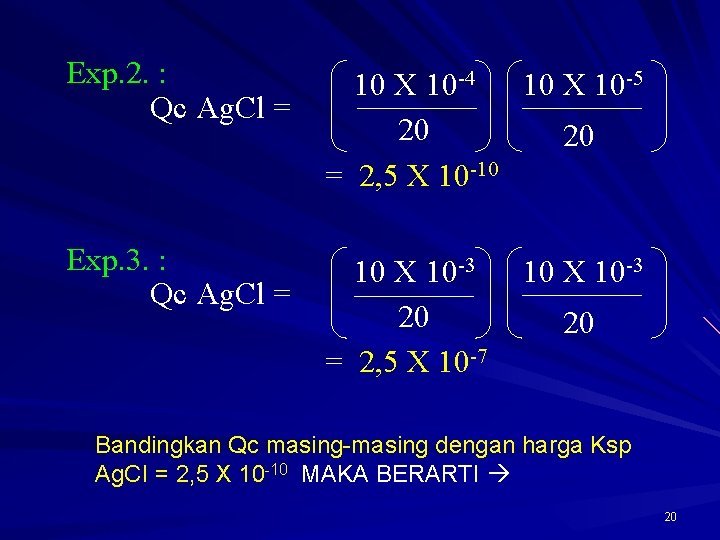
Exp. 2. : Qc Ag. Cl = Exp. 3. : Qc Ag. Cl = -4 -5 10 X 10 __________ 20 20 = 2, 5 X 10 -10 -3 10 X 10 _____ 20 = 2, 5 X 10 -7 -3 10 X 10 _____ 20 Bandingkan Qc masing-masing dengan harga Ksp Ag. CI = 2, 5 X 10 -10 MAKA BERARTI 20
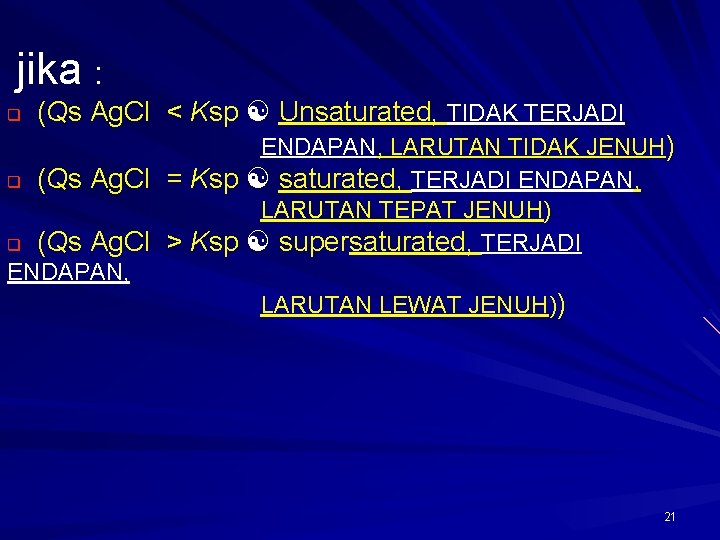
jika : q (Qs Ag. Cl < Ksp Unsaturated, TIDAK TERJADI ENDAPAN, LARUTAN TIDAK JENUH) q (Qs Ag. Cl = Ksp saturated, TERJADI ENDAPAN, LARUTAN TEPAT JENUH) q (Qs Ag. Cl > Ksp supersaturated, TERJADI ENDAPAN, LARUTAN LEWAT JENUH)) 21
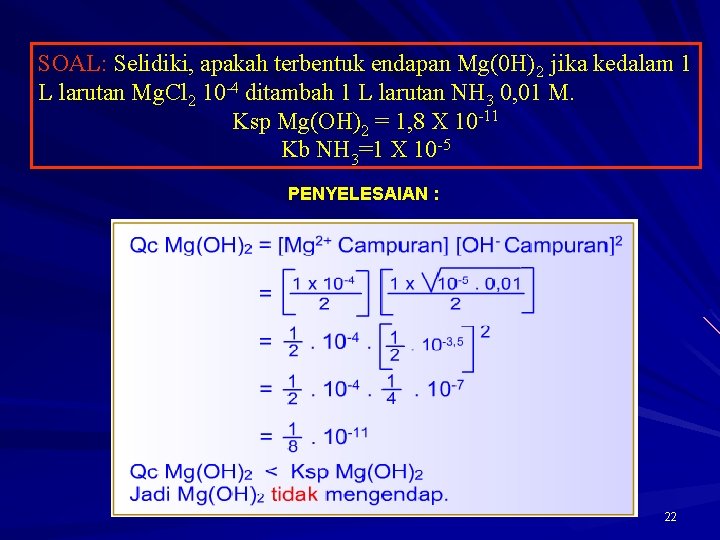
SOAL: Selidiki, apakah terbentuk endapan Mg(0 H)2 jika kedalam 1 L larutan Mg. Cl 2 10 -4 ditambah 1 L larutan NH 3 0, 01 M. Ksp Mg(OH)2 = 1, 8 X 10 -11 Kb NH 3=1 X 10 -5 PENYELESAIAN : 22
Contoh SOAL : Ke dalam 100 m. L larutan Ag. NO 3 0, 1 M ditambahkan 1 tetes Na. Cl 0, 1 M. Apakah yang terjadi pada percobaan ini? (Ksp Ag. Cl = 1 x 10 -10; 1 tetes = 0, 05 m. L) a. Ag. Cl mengendap karena Qc > KSD b. Ag. Cl mengendap karena Qc < Ksp c. Ag. Cl tidak mengendap karena Qc < Ksp d. Ag. Cl tidak mengendap karena Qc > Ks. P e. larutan tepat jenuh karena Qc = Ksp 23
Analisis masalah Ditentukan volume dan konsentrasi dua jenis larutan yang mengandung ion-ion yang dapat membentuk endapan, yaitu Ag+dan Cl-, kemudian diminta untuk menentukan terbentuktidaknya endapan. Perlu diingat bahwa endapan akan terjadi jika Qsp campuran melampaui nilai Ksp. Jadi, yang harus dilakukan adalah: q Menentukan nilai [Ag+] dan [Cl-] dalam campuran. q Menentukan nilai Qsp q Membandingkan nilai Qsp dengan Ksp untuk menentukan terbentuk-tidaknya endapan. 24
Contoh soal: Larutan jenuh Ag. Cl (Mr=143, 5) mengandung 0, 0015 g/L zat tersebut. Hitung kelarutan dan konstanta hasil kali kelarutan! Penyelesaian: Kesetimbangan dalam larutan + + Cl– Ag. Cl Ag Kelarutan Ag. Cl = 0, 0015 g/L x 1 mol/143, 5 g = 0, 0015/143, 5 mol/L = 1, 05 x 10 -5 mol/L [Ag+] = 1, 05 x 10 -5 mol/L; [Cl-] = 1, 05 x 10 -5 mol/L Harga Ksp = [Ag+] [Cl–] = (1, 05 x 10 -5) x (1, 05 x 10 -5) = 1, 09 x 10 -10 (harga Ksp tanpa satuan) 25
2) Example: Ag. Cl(s) Ag+(aq) + Cl-(aq) Ksp = [Ag+] [Cl-] What is the Ksp for Ag. Cl if 1. 88 X 10 -3 g of Ag. Cl (Mr=143, 5) dissolves to make 1. 0 L of solution? Ksp = [Ag+] [Cl-] 26
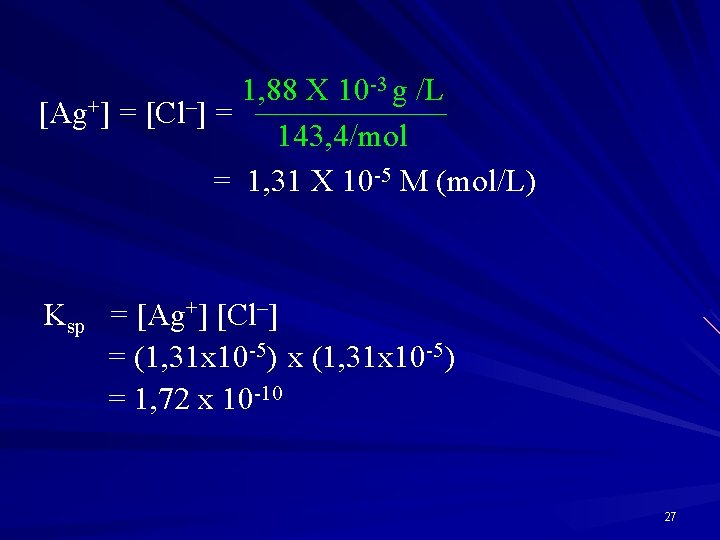
-3 g /L 1, 88 X 10 [Ag+] = [Cl–] = ________ 143, 4/mol = 1, 31 X 10 -5 M (mol/L) Ksp = [Ag+] [Cl–] = (1, 31 x 10 -5) x (1, 31 x 10 -5) = 1, 72 x 10 -10 27
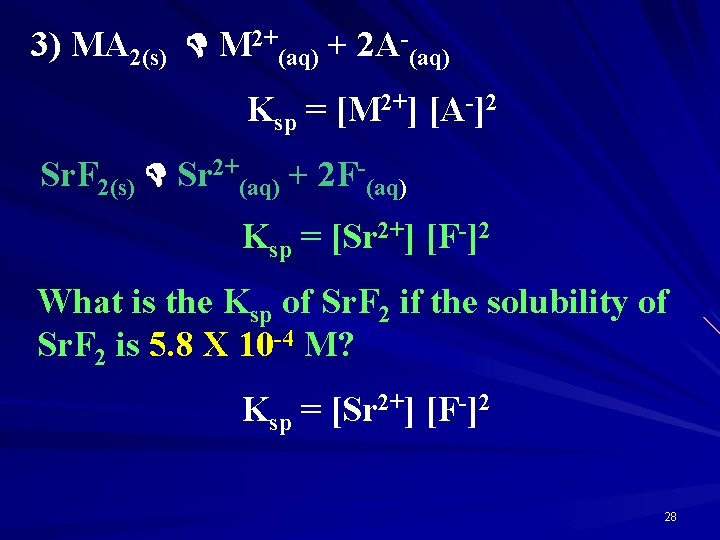
3) MA 2(s) M 2+(aq) + 2 A-(aq) Ksp = [M 2+] [A-]2 Sr. F 2(s) Sr 2+(aq) + 2 F-(aq) Ksp = [Sr 2+] [F-]2 What is the Ksp of Sr. F 2 if the solubility of Sr. F 2 is 5. 8 X 10 -4 M? Ksp = [Sr 2+] [F-]2 28
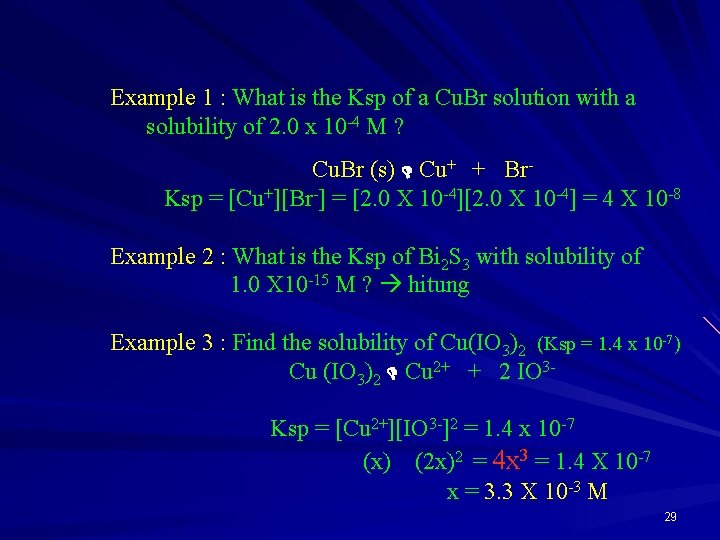
Example 1 : What is the Ksp of a Cu. Br solution with a solubility of 2. 0 x 10 -4 M ? Cu. Br (s) Cu+ + Br. Ksp = [Cu+][Br-] = [2. 0 X 10 -4] = 4 X 10 -8 Example 2 : What is the Ksp of Bi 2 S 3 with solubility of 1. 0 X 10 -15 M ? hitung Example 3 : Find the solubility of Cu(IO 3)2 (Ksp = 1. 4 x 10 -7) Cu (IO 3)2 Cu 2+ + 2 IO 3 Ksp = [Cu 2+][IO 3 -]2 = 1. 4 x 10 -7 (x) (2 x)2 = 4 x 3 = 1. 4 X 10 -7 x = 3. 3 X 10 -3 M 29
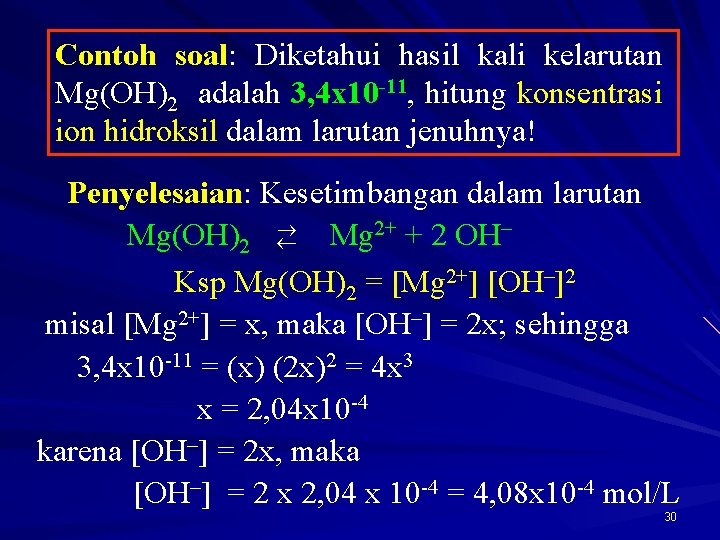
Contoh soal: Diketahui hasil kali kelarutan Mg(OH)2 adalah 3, 4 x 10 -11, hitung konsentrasi ion hidroksil dalam larutan jenuhnya! Penyelesaian: Kesetimbangan dalam larutan 2+ + 2 OH– Mg(OH)2 Mg Ksp Mg(OH)2 = [Mg 2+] [OH–]2 misal [Mg 2+] = x, maka [OH–] = 2 x; sehingga 3, 4 x 10 -11 = (x) (2 x)2 = 4 x 3 x = 2, 04 x 10 -4 karena [OH–] = 2 x, maka [OH–] = 2 x 2, 04 x 10 -4 = 4, 08 x 10 -4 mol/L 30
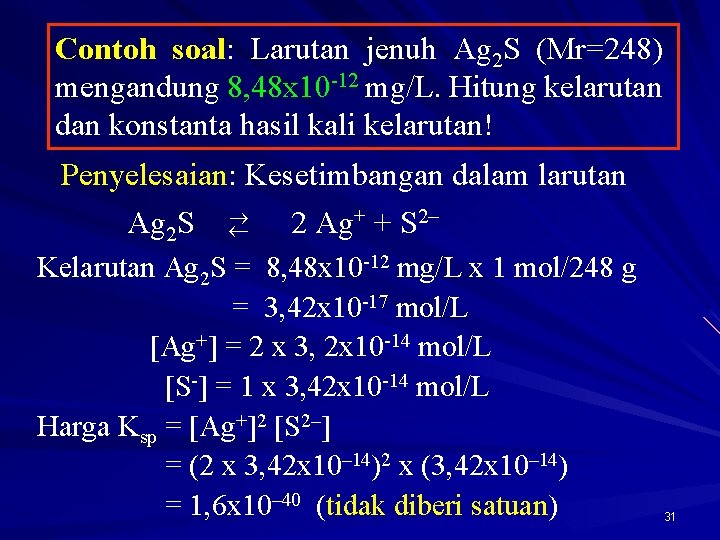
Contoh soal: Larutan jenuh Ag 2 S (Mr=248) mengandung 8, 48 x 10 -12 mg/L. Hitung kelarutan dan konstanta hasil kali kelarutan! Penyelesaian: Kesetimbangan dalam larutan + + S 2– Ag 2 S 2 Ag Kelarutan Ag 2 S = 8, 48 x 10 -12 mg/L x 1 mol/248 g = 3, 42 x 10 -17 mol/L [Ag+] = 2 x 3, 2 x 10 -14 mol/L [S-] = 1 x 3, 42 x 10 -14 mol/L Harga Ksp = [Ag+]2 [S 2–] = (2 x 3, 42 x 10– 14)2 x (3, 42 x 10– 14) = 1, 6 x 10– 40 (tidak diberi satuan) 31
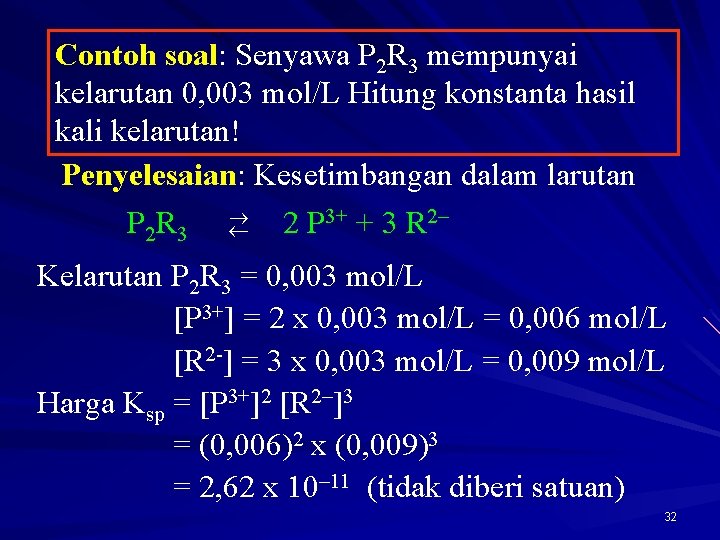
Contoh soal: Senyawa P 2 R 3 mempunyai kelarutan 0, 003 mol/L Hitung konstanta hasil kali kelarutan! Penyelesaian: Kesetimbangan dalam larutan 3+ + 3 R 2– P 2 R 3 2 P Kelarutan P 2 R 3 = 0, 003 mol/L [P 3+] = 2 x 0, 003 mol/L = 0, 006 mol/L [R 2 -] = 3 x 0, 003 mol/L = 0, 009 mol/L Harga Ksp = [P 3+]2 [R 2–]3 = (0, 006)2 x (0, 009)3 = 2, 62 x 10– 11 (tidak diberi satuan) 32
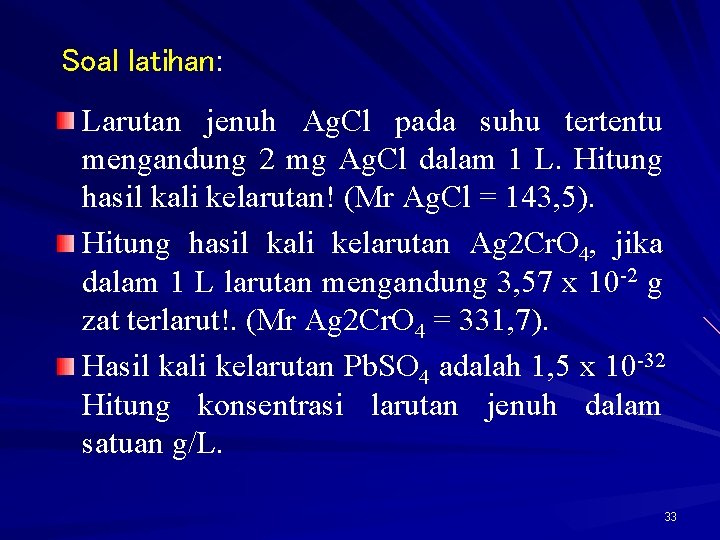
Soal latihan: Larutan jenuh Ag. Cl pada suhu tertentu mengandung 2 mg Ag. Cl dalam 1 L. Hitung hasil kali kelarutan! (Mr Ag. Cl = 143, 5). Hitung hasil kali kelarutan Ag 2 Cr. O 4, jika dalam 1 L larutan mengandung 3, 57 x 10 -2 g zat terlarut!. (Mr Ag 2 Cr. O 4 = 331, 7). Hasil kali kelarutan Pb. SO 4 adalah 1, 5 x 10 -32 Hitung konsentrasi larutan jenuh dalam satuan g/L. 33
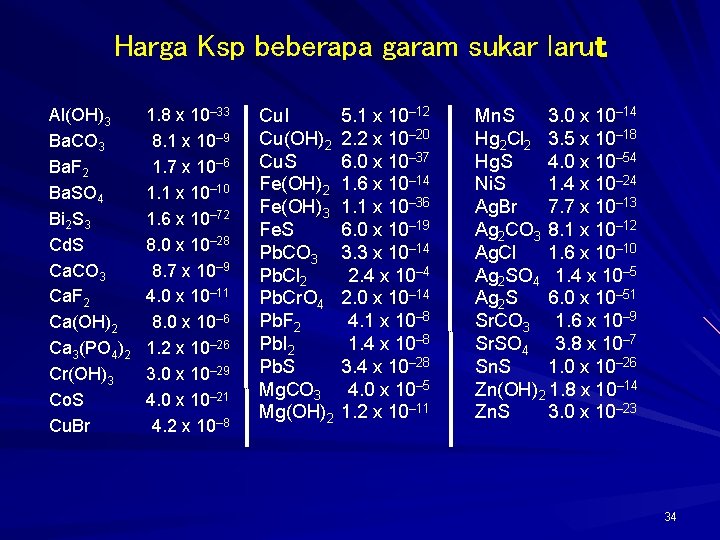
Harga Ksp beberapa garam sukar larut Al(OH)3 Ba. CO 3 Ba. F 2 Ba. SO 4 Bi 2 S 3 Cd. S Ca. CO 3 Ca. F 2 Ca(OH)2 Ca 3(PO 4)2 Cr(OH)3 Co. S Cu. Br 1. 8 x 10– 33 8. 1 x 10– 9 1. 7 x 10– 6 1. 1 x 10– 10 1. 6 x 10– 72 8. 0 x 10– 28 8. 7 x 10– 9 4. 0 x 10– 11 8. 0 x 10– 6 1. 2 x 10– 26 3. 0 x 10– 29 4. 0 x 10– 21 4. 2 x 10– 8 Cu. I 5. 1 x 10– 12 Cu(OH)2 2. 2 x 10– 20 Cu. S 6. 0 x 10– 37 Fe(OH)2 1. 6 x 10– 14 Fe(OH)3 1. 1 x 10– 36 Fe. S 6. 0 x 10– 19 Pb. CO 3 3. 3 x 10– 14 Pb. Cl 2 2. 4 x 10– 4 Pb. Cr. O 4 2. 0 x 10– 14 Pb. F 2 4. 1 x 10– 8 Pb. I 2 1. 4 x 10– 8 Pb. S 3. 4 x 10– 28 Mg. CO 3 4. 0 x 10– 5 Mg(OH)2 1. 2 x 10– 11 Mn. S 3. 0 x 10– 14 Hg 2 Cl 2 3. 5 x 10– 18 Hg. S 4. 0 x 10– 54 Ni. S 1. 4 x 10– 24 Ag. Br 7. 7 x 10– 13 Ag 2 CO 3 8. 1 x 10– 12 Ag. Cl 1. 6 x 10– 10 Ag 2 SO 4 1. 4 x 10– 5 Ag 2 S 6. 0 x 10– 51 Sr. CO 3 1. 6 x 10– 9 Sr. SO 4 3. 8 x 10– 7 Sn. S 1. 0 x 10– 26 Zn(OH)2 1. 8 x 10– 14 Zn. S 3. 0 x 10– 23 34
FAKTOR YANG MEMPENGARUHI KELARUTAN ION SEJENIS ION TIDAK SEJENIS p. H PEMBENTUKAN KOMPLEK PELARUT SUHU UKURAN PARTIKEL TEKANAN. 35
Efek ion sejenis The common ion effect affects solubility equilibria as it does other aqueous equilibria. The solubility of a slightly soluble ionic compound is lowered when a second solute that furnishes a common is added to the solution. 36
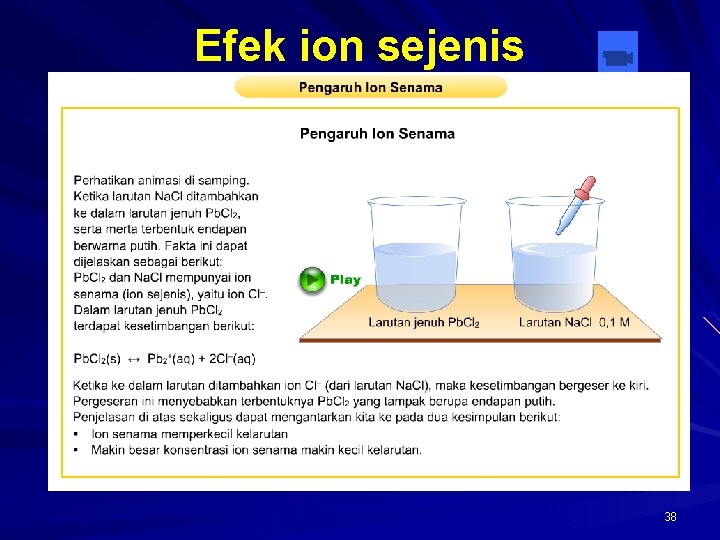
Efek ion sejenis Jika Larutan encer Na. Cl dimasukkan kedalam larutan Ag. NO 3 maka akan terbentuk endapan/kekeruhan karena : – Dengan adanya Cl- dari Na. CI, menyebabkan sebagian Ag+ yang larut bereaksi membentuk endapan Ag. CI, jadi dengan adanya ion sejenis, Cl- dari Ag. CI dan Cl- dari Na. CI, maka terjadi pergeseran kesetimbangan ke arah Ag. CI(s), sehingga kelarutan Ag. CI makin kecil. – Kelarutan Ag. CI dalam larutan Na. CI, atau dalam larutan Ag. NO 3, lebih sedikit, jika dibandingkan dengan kelarutannya dalam air. 37
Efek ion sejenis 38
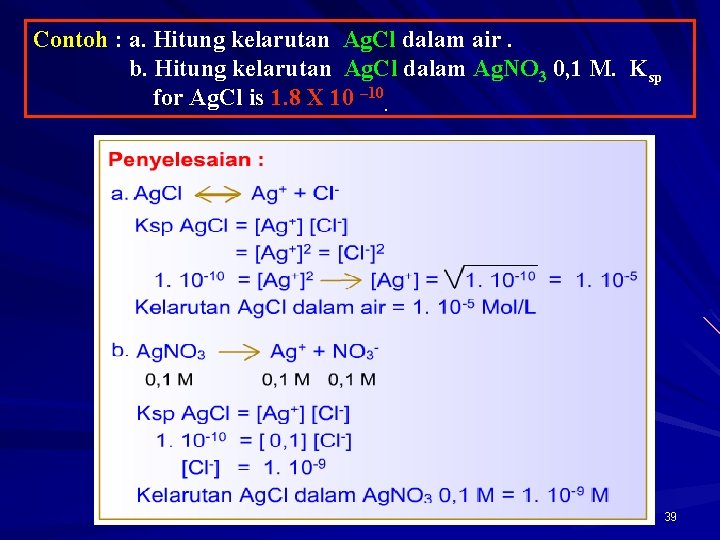
Contoh : a. Hitung kelarutan Ag. Cl dalam air. b. Hitung kelarutan Ag. Cl dalam Ag. NO 3 0, 1 M. Ksp for Ag. Cl is 1. 8 X 10 – 10. 39
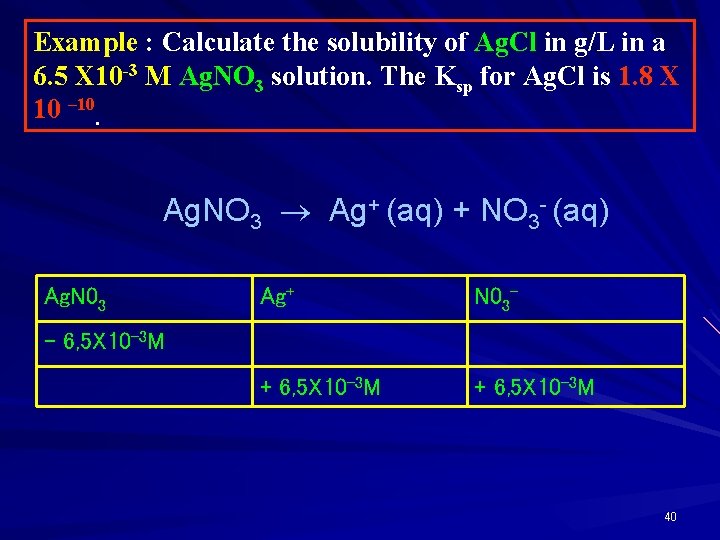
Example : Calculate the solubility of Ag. Cl in g/L in a 6. 5 X 10 -3 M Ag. NO 3 solution. The Ksp for Ag. Cl is 1. 8 X 10 – 10. Ag. NO 3 Ag+ (aq) + NO 3 - (aq) Ag. N 03 Ag+ N 03 - + 6, 5 X 10 -3 M - 6, 5 X 10 -3 M 40
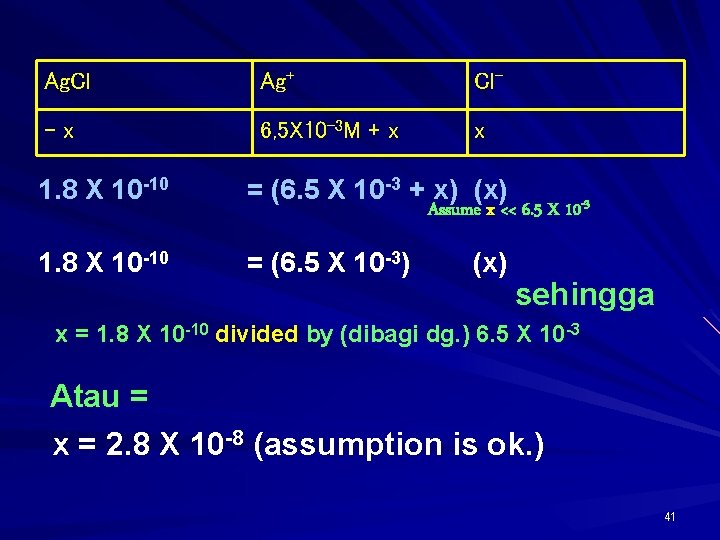
Ag. Cl Ag+ Cl- -x 6, 5 X 10 -3 M + x x 1. 8 X 10 -10 = (6. 5 X 10 -3 + x) (x) 1. 8 X 10 -10 = (6. 5 X 10 -3) Assume x << 6. 5 X 10 -3 (x) sehingga x = 1. 8 X 10 -10 divided by (dibagi dg. ) 6. 5 X 10 -3 Atau = x = 2. 8 X 10 -8 (assumption is ok. ) 41
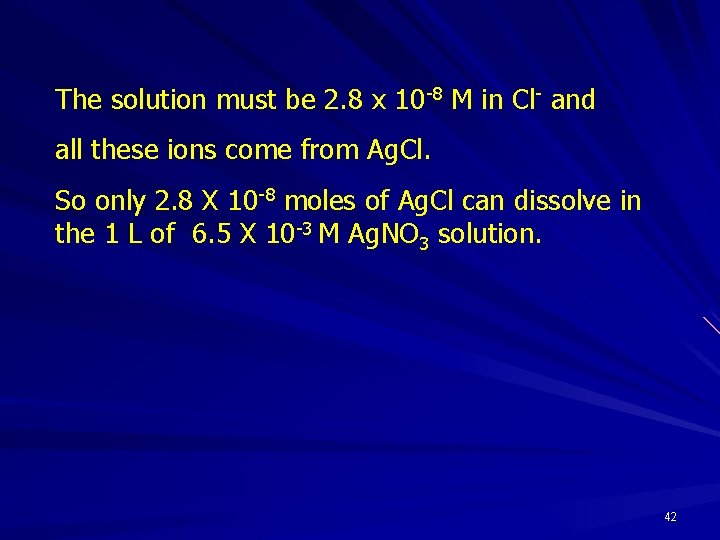
The solution must be 2. 8 x 10 -8 M in Cl- and all these ions come from Ag. Cl. So only 2. 8 X 10 -8 moles of Ag. Cl can dissolve in the 1 L of 6. 5 X 10 -3 M Ag. NO 3 solution. 42
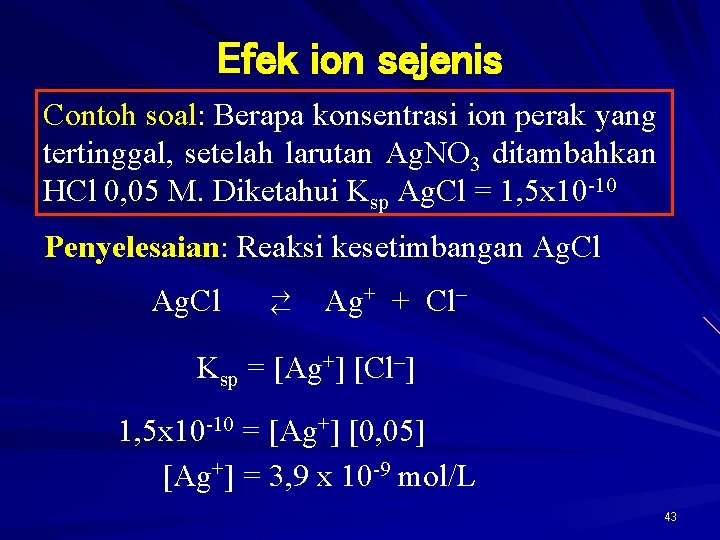
Efek ion sejenis Contoh soal: Berapa konsentrasi ion perak yang tertinggal, setelah larutan Ag. NO 3 ditambahkan HCl 0, 05 M. Diketahui Ksp Ag. Cl = 1, 5 x 10 -10 Penyelesaian: Reaksi kesetimbangan Ag. Cl Ag+ + Cl– Ksp = [Ag+] [Cl–] 1, 5 x 10 -10 = [Ag+] [0, 05] [Ag+] = 3, 9 x 10 -9 mol/L 43
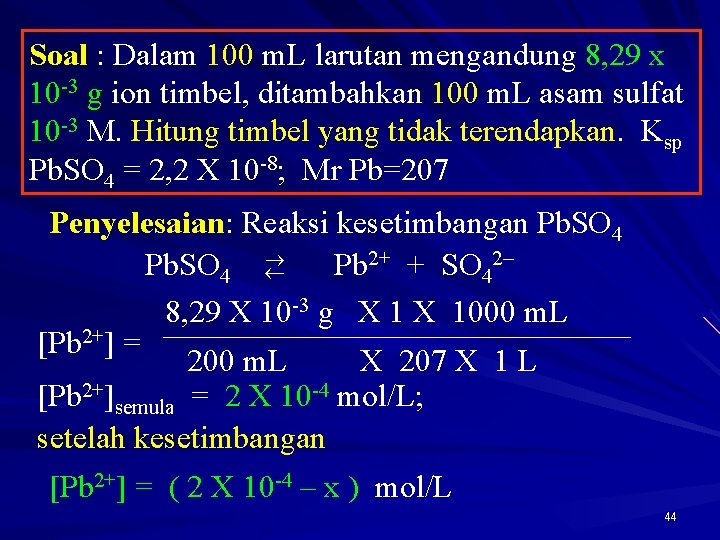
Soal : Dalam 100 m. L larutan mengandung 8, 29 x 10 -3 g ion timbel, ditambahkan 100 m. L asam sulfat 10 -3 M. Hitung timbel yang tidak terendapkan. Ksp Pb. SO 4 = 2, 2 X 10 -8; Mr Pb=207 Penyelesaian: Reaksi kesetimbangan Pb. SO 4 Pb 2+ + SO 42– -3 g X 1000 m. L 8, 29 X 10 ____________________ 2+ [Pb ] = 200 m. L X 207 X 1 L [Pb 2+]semula = 2 X 10 -4 mol/L; setelah kesetimbangan [Pb 2+] = ( 2 X 10 -4 – x ) mol/L 44
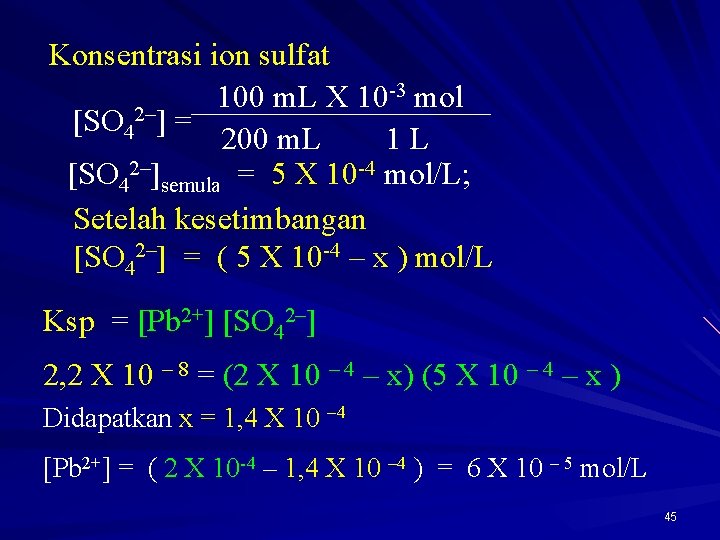
Konsentrasi ion sulfat -3 mol 100 m. L X 10 _____________ [SO 42–] = 200 m. L 1 L [SO 42–]semula = 5 X 10 -4 mol/L; Setelah kesetimbangan [SO 42–] = ( 5 X 10 -4 – x ) mol/L Ksp = [Pb 2+] [SO 42–] 2, 2 X 10 – 8 = (2 X 10 – 4 – x) (5 X 10 – 4 – x ) Didapatkan x = 1, 4 X 10 – 4 [Pb 2+] = ( 2 X 10 -4 – 1, 4 X 10 – 4 ) = 6 X 10 – 5 mol/L 45
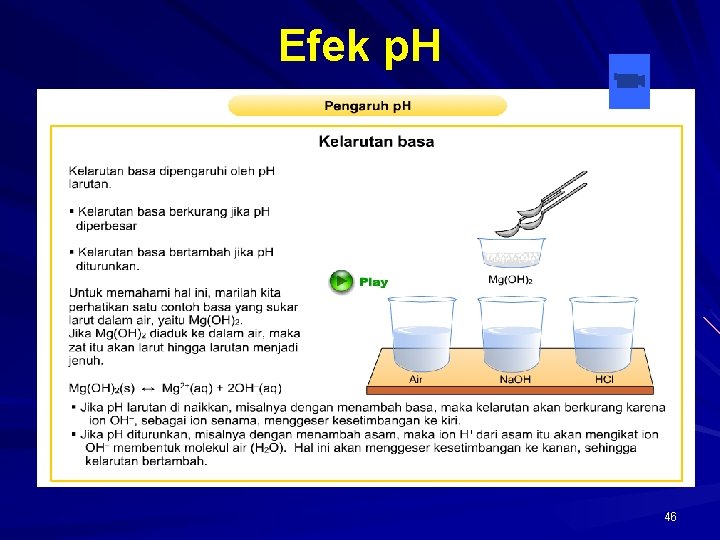
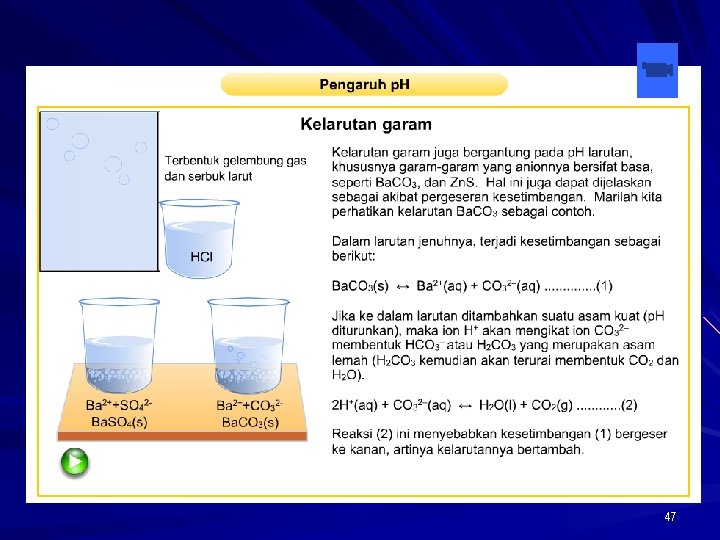
Efek p. H 46
47
48
- Slides: 47