
KEKB lattice Taken from LATTICE DESIGN FOR KEKB

KEKB lattice Taken from LATTICE DESIGN FOR KEKB COLLIDING RINGS By H. Koiso and K. Oide
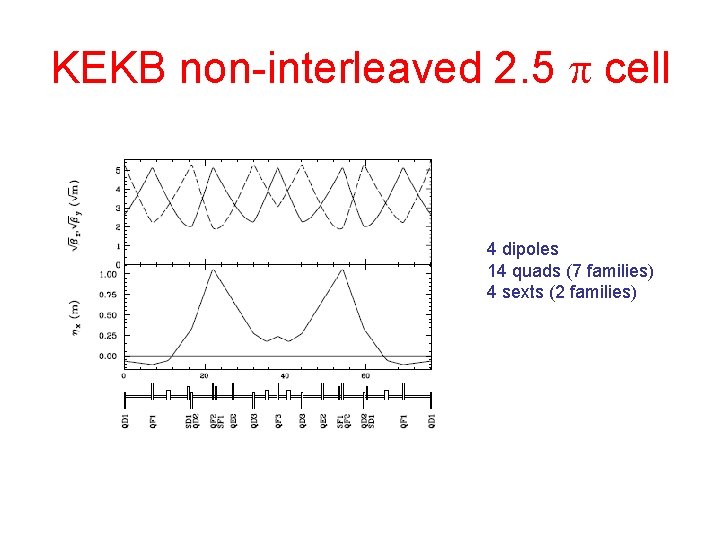
KEKB non-interleaved 2. 5 p cell 4 dipoles 14 quads (7 families) 4 sexts (2 families)
Features • A unit cell structure with 2. 5 p phase advance is created by combining five p/2 FODO cells and by merging ten dipoles into four. • In this cell, dipoles are placed to form two dispersion bumps so that to keep hx small at dipoles, similar to the p cell case. • By adjusting the positions of dipoles and hx at the dipoles, required values of ex and ac at the same time can be obtained. • The 2. 5 p cell enables to install non-interleaved sextupole pairs effectively. Successive SF (SD) pairs are distributed changing the relative phase of 3 p/2. Then chromatic kicks at Np and (N +1/2)p phases in both horizontal and vertical planes can be corrected efficiently.
Features (cont. ) • Dynamic aperture of the 2. 5 p cell is significantly improved to satisfy all of the requirements. • Higher order chromaticities still remains because the sextupoles are not sufficiently close to the main chromaticity sources in the interaction region (IR). We can achieve further improvements by localized chromaticity correction in the IR (not for ILCDR!). • Tunability of ex and ac: in the 2. 5 p cell non-interleaved there are sextupoles connected with a 4 x 4 pseudo -I transformer which has not vanishing m 21 and m 43 but basically cancels nonlinear kicks by sextupoles. • This pseudo -I transformer brings about as a large dynamic aperture as the perfect -I. By allowing not vanishing m 21 and m 43 two new free parameters become available for tuning.
Features (cont. ) • These parameters are utilized by placing two families of quadrupoles (QF 2 and QD 2) outside the sextupole pairs so that they can be changed afterwards to tune ac keeping the pseudo -I transformation. ac in the range 1 x 10 -4 < ac < 4 x 10 -4 can be tuned by changing the strengths of QF 2’s and QD 2’s by a few percent. During this time ex is kept nearly constant. • On the other hand, it is rather difficult to change ex widely only by adjusting the two families of quadrupoles. To cure this restriction, a new family of quadrupoles QE 2 inside the SF pair was introduced. By adjusting hx at dipoles using five free parameters (QF 2, QF 3, QD 2, QD 3, and QE 2), we can obtain the required tunability, 10 nm < ex < 36 nm, while keeping ac constant and maintaining the pseudo -I condition between the SF’s.
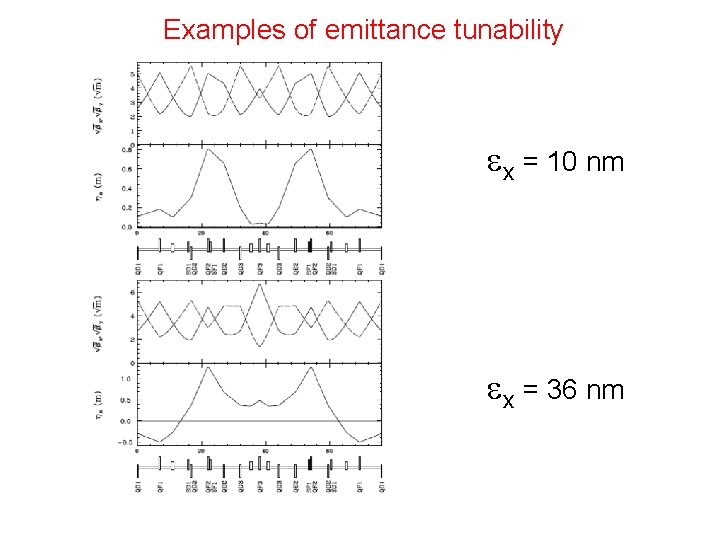
Examples of emittance tunability ex = 10 nm ex = 36 nm
- Slides: 6