
KEK High Energy Accelerator Research Organization EUprojects View
- Slides: 21
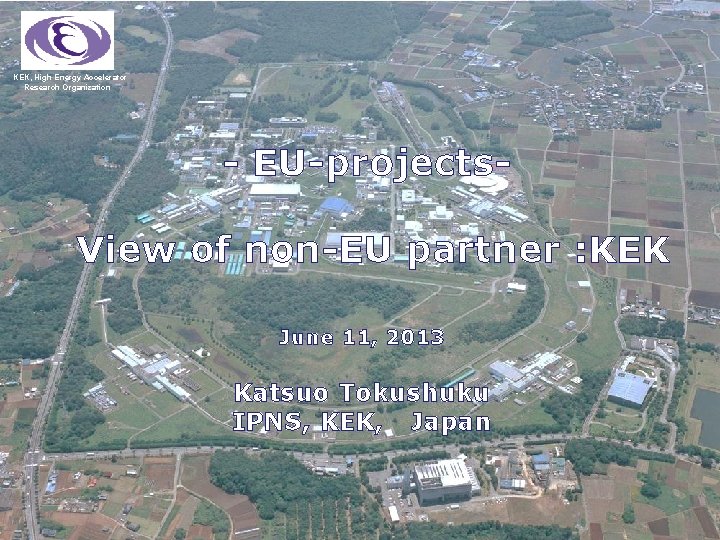
KEK, High Energy Accelerator Research Organization - EU-projects. View of non-EU partner : KEK June 11, 2013 Katsuo Tokushuku IPNS, KEK, Japan
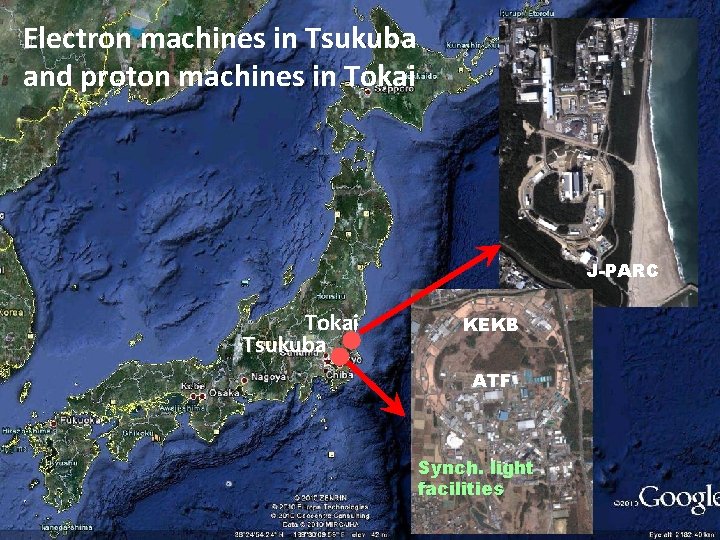
Electron machines in Tsukuba and proton machines in Tokai J-PARC Tokai Tsukuba KEKB ATF Synch. light facilities
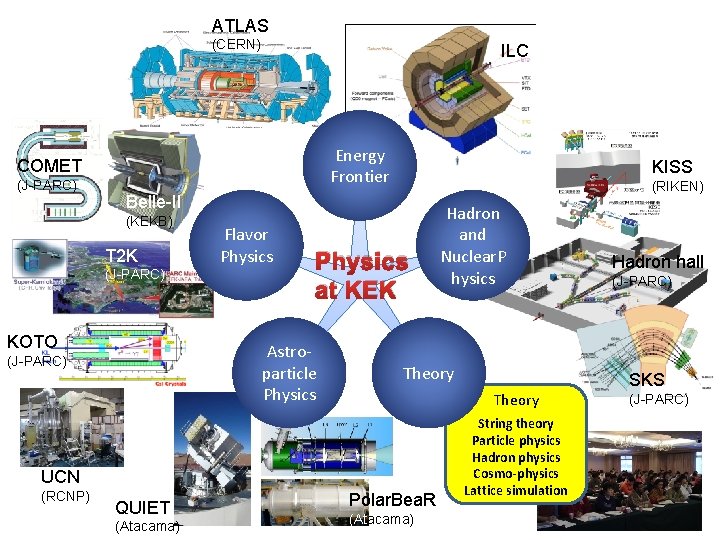
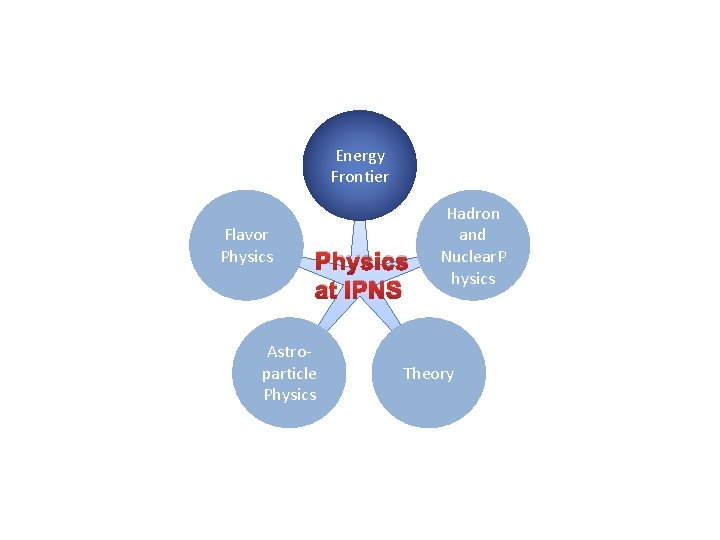
ATLAS (CERN) ILC Energy Frontier COMET (J-PARC) KISS (RIKEN) Belle-II (KEKB) T 2 K (J-PARC) KOTO Flavor Physics at KEK Astroparticle Physics (J-PARC) Theory UCN (RCNP) QUIET (Atacama) Hadron and Nuclear. P hysics Polar. Bea. R (Atacama) String theory Particle physics Hadron physics Cosmo-physics Lattice simulation Hadron hall (J-PARC) SKS (J-PARC)
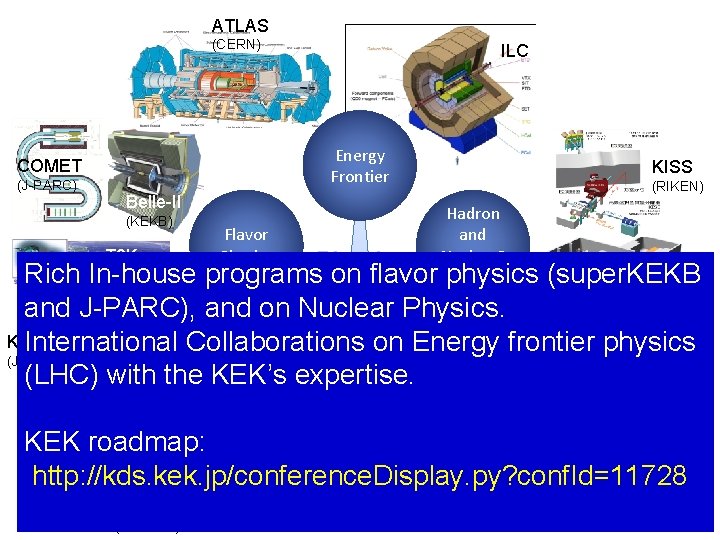
ATLAS (CERN) ILC Energy Frontier COMET (J-PARC) Belle-II (KEKB) T 2 K KISS (RIKEN) Hadron Flavor and Physics Nuclear. P programs on flavor physics Hadron hall (J-PARC) Rich In-house (super. KEKB (J-PARC) at KEK and J-PARC), and on Nuclear Physics. KOTO International Collaborations on Energy frontier physics Astro(J-PARC) particle (LHC) with the KEK’s expertise. Theory SKS Physics Theory String theory Particle physics Hadron physics Cosmo-physics Lattice simulation (J-PARC) KEK roadmap: UCN http: //kds. kek. jp/conference. Display. py? conf. Id=11728 (RCNP) QUIET (Atacama) Polar. Bea. R (Atacama)
Energy Frontier Flavor Physics at IPNS Astroparticle Physics Hadron and Nuclear. P hysics Theory
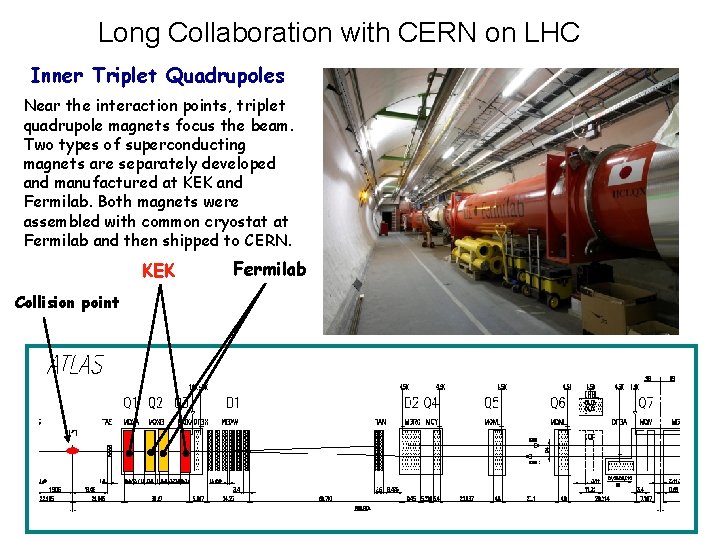
Long Collaboration with CERN on LHC Inner Triplet Quadrupoles Near the interaction points, triplet quadrupole magnets focus the beam. Two types of superconducting magnets are separately developed and manufactured at KEK and Fermilab. Both magnets were assembled with common cryostat at Fermilab and then shipped to CERN. KEK Fermilab Collision point 2007. 3. 1 6
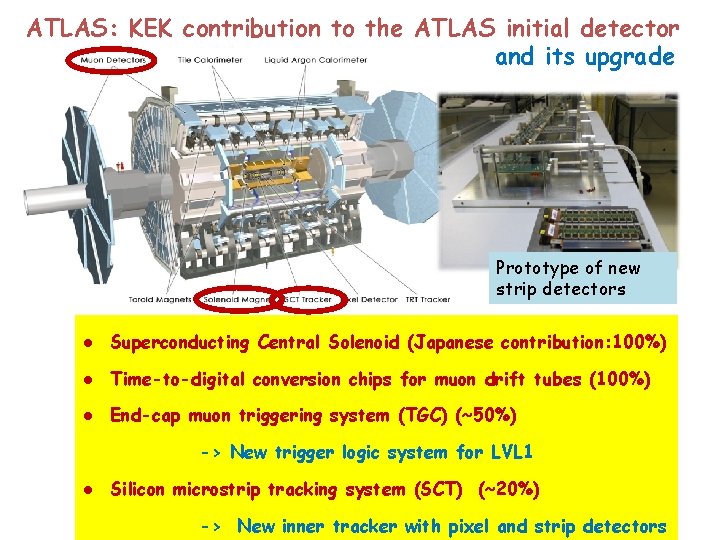
ATLAS: KEK contribution to the ATLAS initial detector and its upgrade Prototype of new strip detectors l Superconducting Central Solenoid (Japanese contribution: 100%) l Time-to-digital conversion • Tracking (| |<2. 5, B(solenoid)=2 T) : Si pixels and strips l -End-cap muon triggering chips for muon drift tubes (100%) system (TGC) (~50%) Length : ~ 46 m -- Transition Radiation Detector (e/ separation) • Calorimetry (| |<5) : Radius : ~ 12 m -- EM : Pb-LAr -> New trigger logic system for LVL 1 Weight : ~ 7000 tons -- HAD: Fe/scintillator (central), Cu/W-LAr (fwd) ~ 108 electronic channels • Muon Spectrometer (| |<2. 7) : l Silicon microstrip tracking system (SCT) (~20%) air-core toroids with muon chambers ~ 3000 km of cables -> New inner tracker with pixel and strip detectors
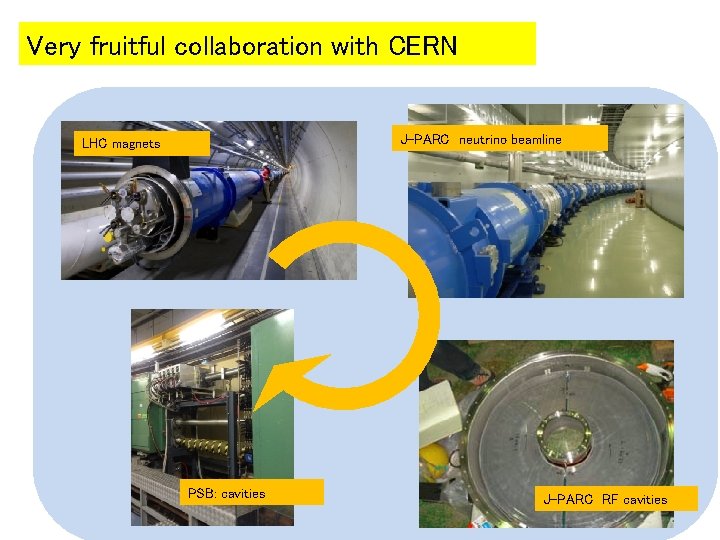
Very fruitful collaboration with CERN J-PARC neutrino beamline LHC magnets PSB: cavities J-PARC RF cavities 8
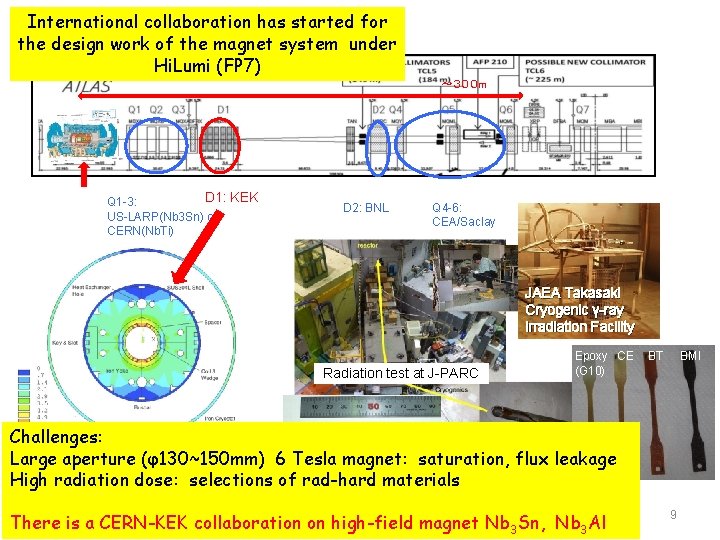
International collaboration has started for the design work of the magnet system under Hi. Lumi (FP 7) ~300 m D 1: KEK Q 1 -3: US-LARP(Nb 3 Sn) or CERN(Nb. Ti) D 2: BNL Q 4 -6: CEA/Saclay JAEA Takasaki Cryogenic γ-ray irradiation Facility Radiation test at J-PARC Epoxy CE (G 10) BT BMI Challenges: 9 Large aperture (φ130~150 mm) 6 Tesla magnet: saturation, flux leakage High radiation dose: selections of rad-hard materials There is a CERN-KEK collaboration on high-field magnet Nb 3 Sn, Nb 3 Al 9
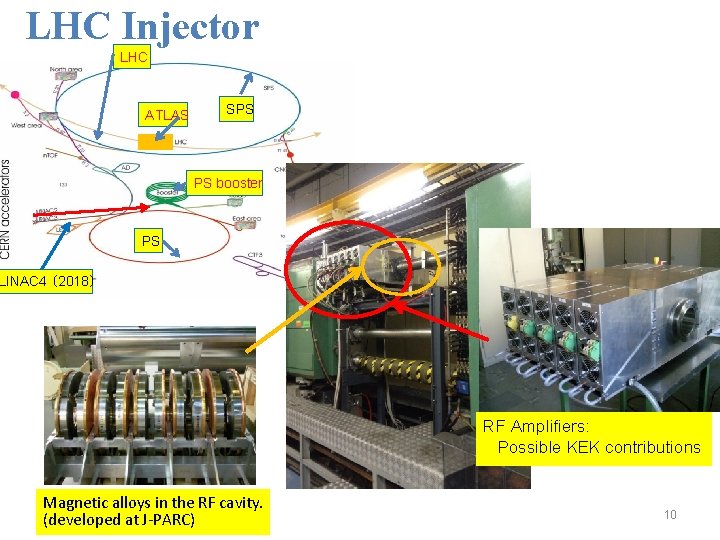
LHC Injector LHC ATLAS SPS PS booster PS LINAC 4 (2018) RF Amplifiers: Possible KEK contributions Magnetic alloys in the RF cavity. (developed at J-PARC) 10
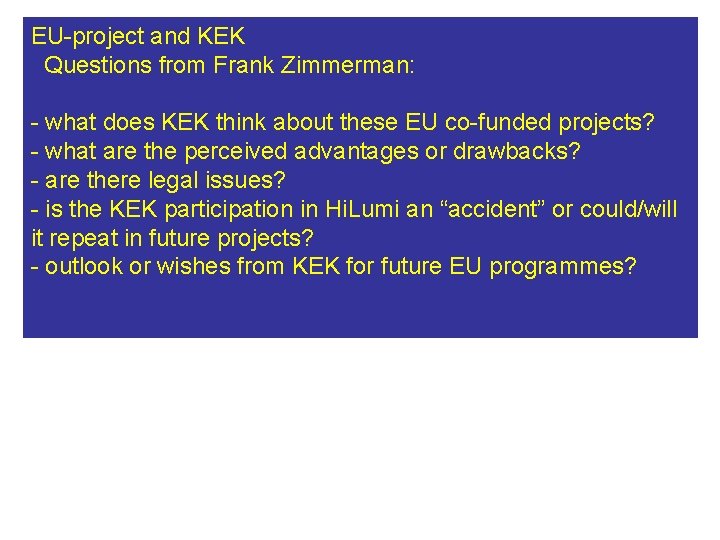
EU-project and KEK Questions from Frank Zimmerman: - what does KEK think about these EU co-funded projects? - what are the perceived advantages or drawbacks? - are there legal issues? - is the KEK participation in Hi. Lumi an “accident” or could/will it repeat in future projects? - outlook or wishes from KEK for future EU programmes?
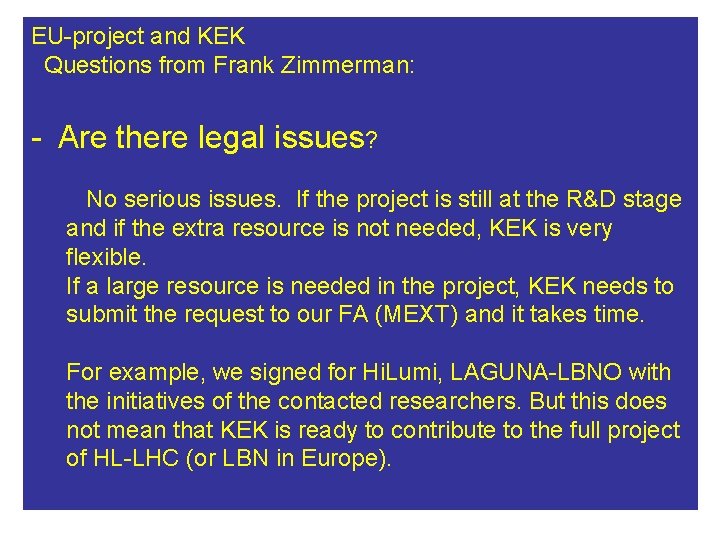
EU-project and KEK Questions from Frank Zimmerman: - Are there legal issues? No serious issues. If the project is still at the R&D stage and if the extra resource is not needed, KEK is very flexible. If a large resource is needed in the project, KEK needs to submit the request to our FA (MEXT) and it takes time. For example, we signed for Hi. Lumi, LAGUNA-LBNO with the initiatives of the contacted researchers. But this does not mean that KEK is ready to contribute to the full project of HL-LHC (or LBN in Europe).
EU-project and KEK Questions from Frank Zimmerman: - Is the KEK participation in Hi. Lumi an “accident” or could/will it repeat in future projects? It was easy to participate to Hi. Lumi because we have been long working collaboration between CERN and KEK on the LHC. If there is other good projects which attracts KEK people, it can happen. But there is no direct connection to the funding in Japan to the EU-projects so either we need to collaborate with the existing resources or with a new funding request to the mext (which is not easy).
EU-project and KEK Questions from Frank Zimmerman: - What does KEK think about these EU cofunded projects? - What are the perceived advantages or drawbacks? At this stage, there is no coherent strategy to react on the EU-projects. It heavily depends on individual researchers. There is no clear preference between KEK-EU collaboration and bi- or multi-lateral KEK-EU lab(s) collaboration. Situation may change if there is a Japanese fund linked to EU-programs. There is a EU-Japan science and technology agreement (started March 2011). Some discussions are going on.
EU-project and KEK Questions from Frank Zimmerman: - Outlook or wishes from KEK for future EU programmes In general, the closer collaborations between world wide accelerator laboratories are more and more important for on-going and future accelerator R&Ds. KEK is willing to participate to the network.
Extra Slides related to KEK activities
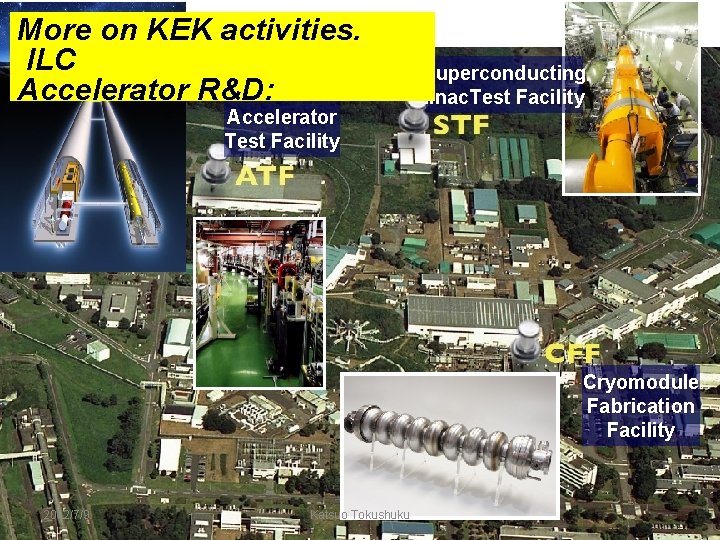
More on KEK activities. ILC Accelerator R&D: Accelerator Test Facility Superconducting linac. Test Facility Cryomodule Fabrication Facility 2012/7/9 Katsuo Tokushuku 17
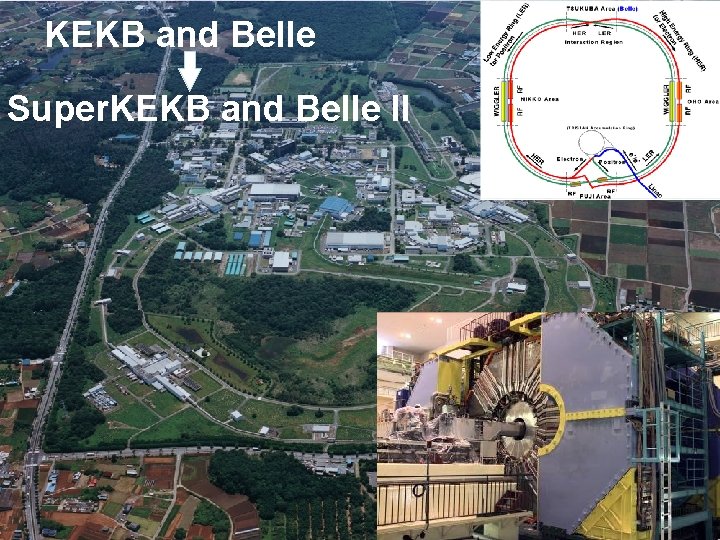
KEKB and Belle Super. KEKB and Belle II
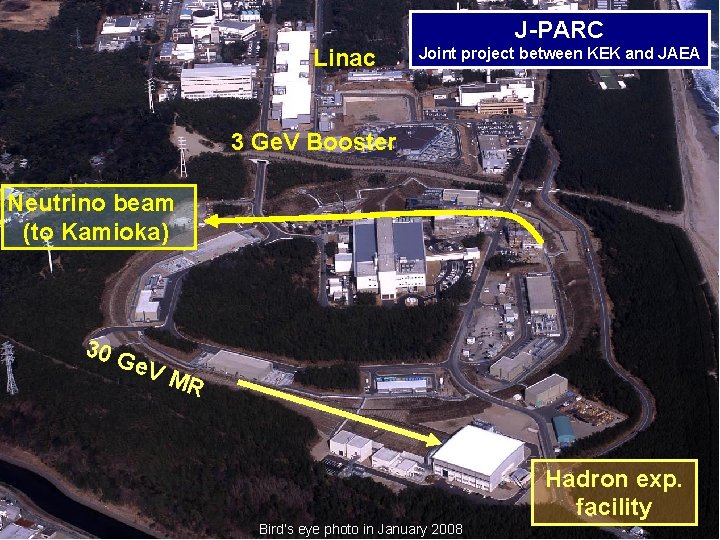
J-PARC Linac Joint project between KEK and JAEA 3 Ge. V Booster Neutrino beam (to Kamioka) 30 G e. V MR Hadron exp. facility Bird’s eye photo in January 2008
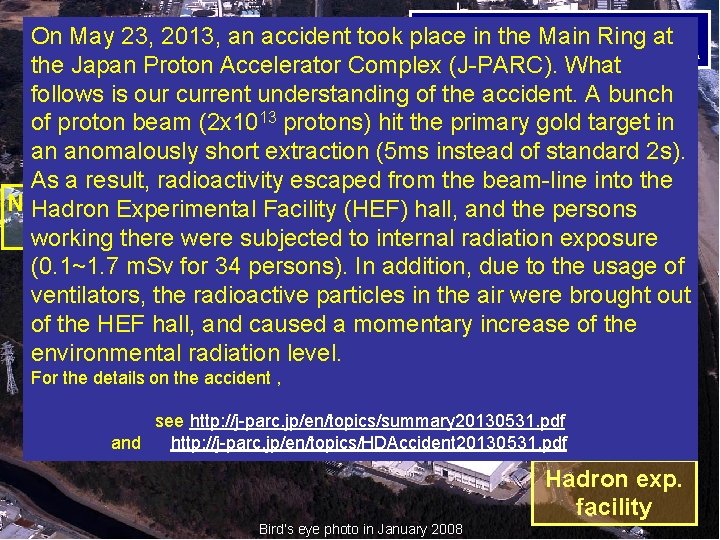
J-PARC On May 23, 2013, an accident took place in the Main Ring at Joint project between KEK and JAEA Linac the Japan Proton Accelerator Complex (J-PARC). What follows is our current understanding of the accident. A bunch of proton beam (2 x 10¹³ protons) hit the primary gold target in 3 Ge. V Booster an anomalously short extraction (5 ms instead of standard 2 s). As a result, radioactivity escaped from the beam-line into the Neutrino Hadron beam Experimental Facility (HEF) hall, and the persons (to Kamioka) working there were subjected to internal radiation exposure (0. 1~1. 7 m. Sv for 34 persons). In addition, due to the usage of ventilators, the radioactive particles in the air were brought out of the HEF hall, and caused a momentary increase of the 30 G environmental radiation level. e For the details V on. M the R accident , see http: //j-parc. jp/en/topics/summary 20130531. pdf and http: //j-parc. jp/en/topics/HDAccident 20130531. pdf Hadron exp. facility Bird’s eye photo in January 2008
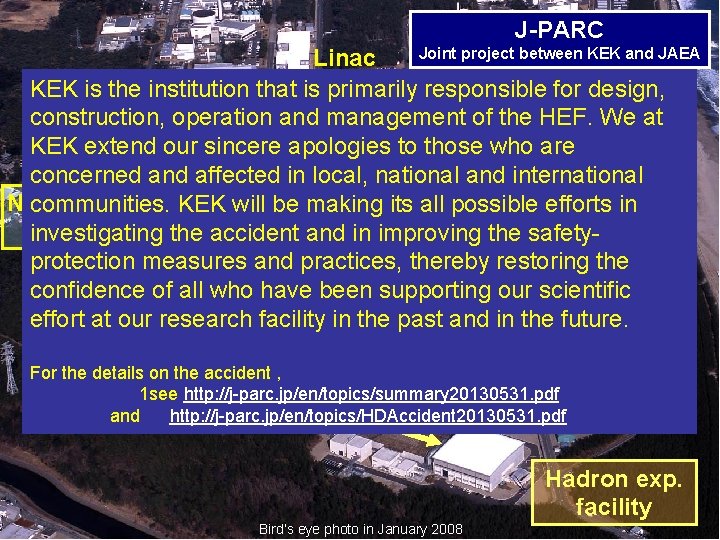
J-PARC Joint project between KEK and JAEA Linac KEK is the institution that is primarily responsible for design, construction, operation and management of the HEF. We at 3 Ge. Vapologies Booster to those who are KEK extend our sincere concerned and affected in local, national and international Neutrino beam KEK will be making its all possible efforts in communities. (to Kamioka) the accident and in improving the safetyinvestigating protection measures and practices, thereby restoring the confidence of all who have been supporting our scientific effort at our research facility in the past and in the future. 30 G e. Von the accident , For the details MR 1 see http: //j-parc. jp/en/topics/summary 20130531. pdf and http: //j-parc. jp/en/topics/HDAccident 20130531. pdf Hadron exp. facility Bird’s eye photo in January 2008