
Keeping The People Who Keep You in Business

Keeping The People Who Keep You in Business by F. Leigh Branham Summary Slides
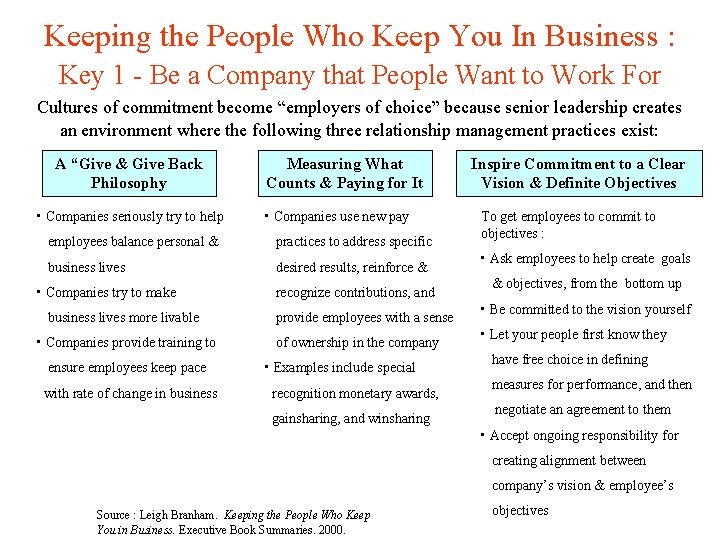
Keeping the People Who Keep You In Business : Key 1 - Be a Company that People Want to Work For Cultures of commitment become “employers of choice” because senior leadership creates an environment where the following three relationship management practices exist: A “Give & Give Back Philosophy • Companies seriously try to help Measuring What Counts & Paying for It • Companies use new pay employees balance personal & practices to address specific business lives desired results, reinforce & • Companies try to make business lives more livable • Companies provide training to ensure employees keep pace with rate of change in business recognize contributions, and provide employees with a sense of ownership in the company • Examples include special recognition monetary awards, gainsharing, and winsharing Inspire Commitment to a Clear Vision & Definite Objectives To get employees to commit to objectives : • Ask employees to help create goals & objectives, from the bottom up • Be committed to the vision yourself • Let your people first know they have free choice in defining measures for performance, and then negotiate an agreement to them • Accept ongoing responsibility for creating alignment between company’s vision & employee’s Source : Leigh Branham. Keeping the People Who Keep You in Business. Executive Book Summaries. 2000. objectives
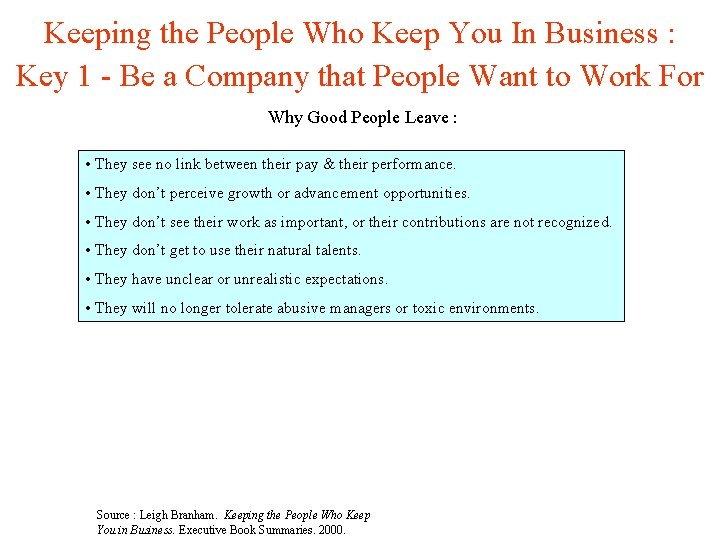
Keeping the People Who Keep You In Business : Key 1 - Be a Company that People Want to Work For Why Good People Leave : • They see no link between their pay & their performance. • They don’t perceive growth or advancement opportunities. • They don’t see their work as important, or their contributions are not recognized. • They don’t get to use their natural talents. • They have unclear or unrealistic expectations. • They will no longer tolerate abusive managers or toxic environments. Source : Leigh Branham. Keeping the People Who Keep You in Business. Executive Book Summaries. 2000.
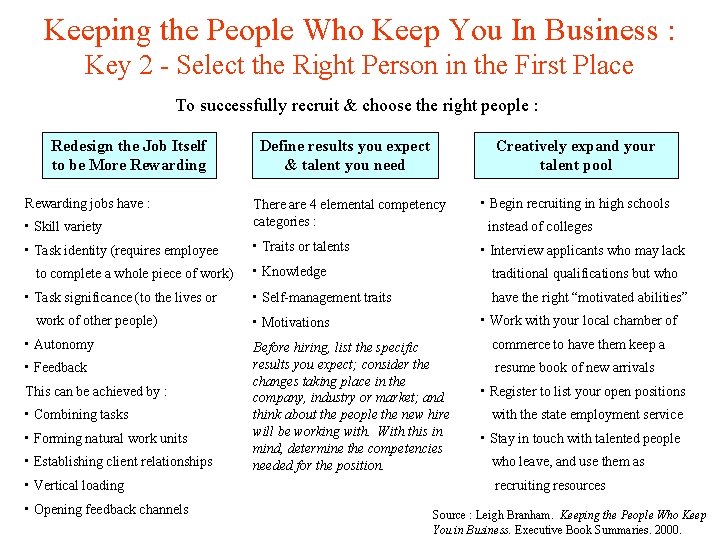
Keeping the People Who Keep You In Business : Key 2 - Select the Right Person in the First Place To successfully recruit & choose the right people : Redesign the Job Itself to be More Rewarding Define results you expect & talent you need Creatively expand your talent pool • Begin recruiting in high schools • Skill variety There are 4 elemental competency categories : • Task identity (requires employee • Traits or talents • Interview applicants who may lack Rewarding jobs have : to complete a whole piece of work) • Task significance (to the lives or work of other people) • Autonomy • Feedback This can be achieved by : • Combining tasks • Forming natural work units • Establishing client relationships • Vertical loading • Opening feedback channels instead of colleges • Knowledge traditional qualifications but who • Self-management traits have the right “motivated abilities” • Work with your local chamber of • Motivations Before hiring, list the specific results you expect; consider the changes taking place in the company, industry or market; and think about the people the new hire will be working with. With this in mind, determine the competencies needed for the position. commerce to have them keep a resume book of new arrivals • Register to list your open positions with the state employment service • Stay in touch with talented people who leave, and use them as recruiting resources Source : Leigh Branham. Keeping the People Who Keep You in Business. Executive Book Summaries. 2000.
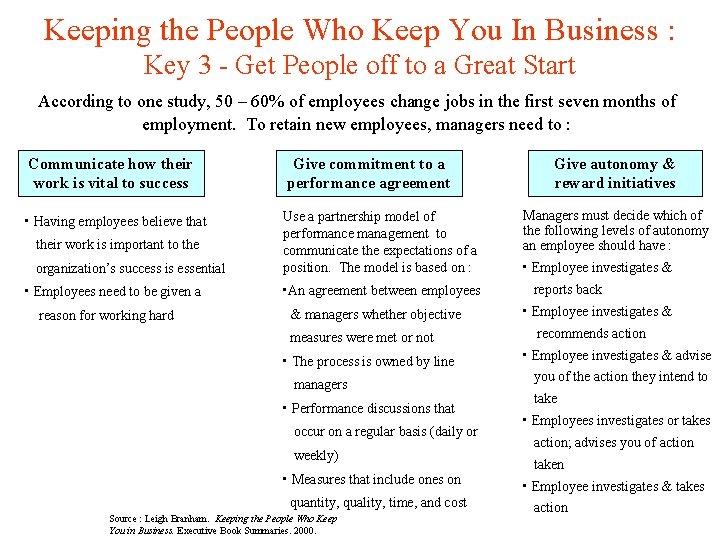
Keeping the People Who Keep You In Business : Key 3 - Get People off to a Great Start According to one study, 50 – 60% of employees change jobs in the first seven months of employment. To retain new employees, managers need to : Communicate how their work is vital to success Give commitment to a performance agreement • Having employees believe that Use a partnership model of performance management to communicate the expectations of a position. The model is based on : their work is important to the organization’s success is essential • Employees need to be given a reason for working hard • An agreement between employees & managers whether objective measures were met or not • The process is owned by line managers • Performance discussions that occur on a regular basis (daily or weekly) • Measures that include ones on quantity, quality, time, and cost Source : Leigh Branham. Keeping the People Who Keep You in Business. Executive Book Summaries. 2000. Give autonomy & reward initiatives Managers must decide which of the following levels of autonomy an employee should have : • Employee investigates & reports back • Employee investigates & recommends action • Employee investigates & advise you of the action they intend to take • Employees investigates or takes action; advises you of action taken • Employee investigates & takes action

Keeping the People Who Keep You In Business : Key 3 - Get People off to a Great Start To craft a mutually acceptable, motivational and indisputable performance agreement, use the following formula in the setting of objectives. Those objectives should be SMART : • Specific • Measurable • Achievable • Results-oriented • Time-bound Source : Leigh Branham. Keeping the People Who Keep You in Business. Executive Book Summaries. 2000.
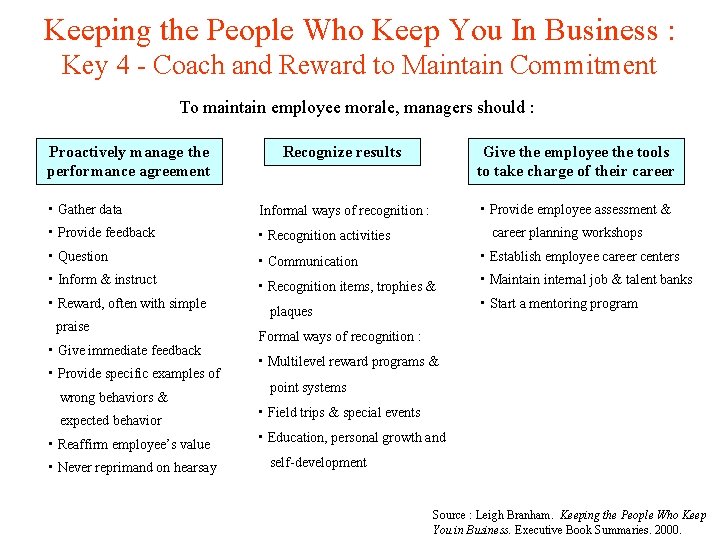
Keeping the People Who Keep You In Business : Key 4 - Coach and Reward to Maintain Commitment To maintain employee morale, managers should : Proactively manage the performance agreement Recognize results Give the employee the tools to take charge of their career • Gather data Informal ways of recognition : • Provide employee assessment & • Provide feedback • Recognition activities • Question • Communication • Establish employee career centers • Inform & instruct • Recognition items, trophies & • Maintain internal job & talent banks • Reward, often with simple praise • Give immediate feedback • Provide specific examples of wrong behaviors & expected behavior • Reaffirm employee’s value • Never reprimand on hearsay career planning workshops • Start a mentoring program plaques Formal ways of recognition : • Multilevel reward programs & point systems • Field trips & special events • Education, personal growth and self-development Source : Leigh Branham. Keeping the People Who Keep You in Business. Executive Book Summaries. 2000.
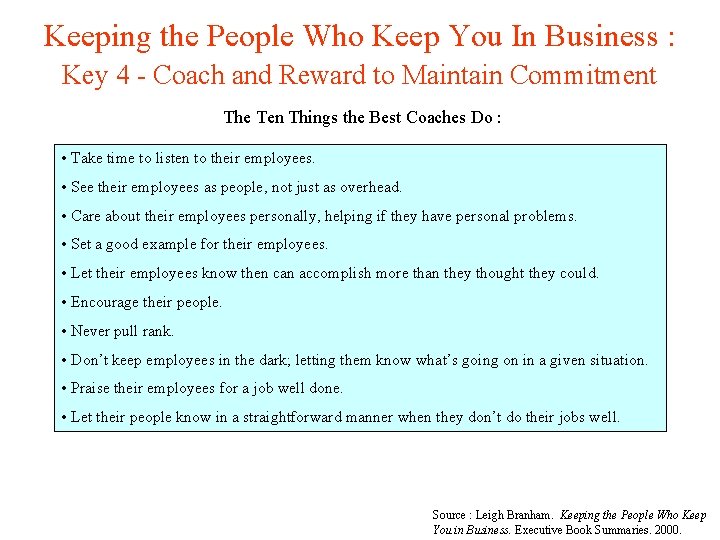
Keeping the People Who Keep You In Business : Key 4 - Coach and Reward to Maintain Commitment The Ten Things the Best Coaches Do : • Take time to listen to their employees. • See their employees as people, not just as overhead. • Care about their employees personally, helping if they have personal problems. • Set a good example for their employees. • Let their employees know then can accomplish more than they thought they could. • Encourage their people. • Never pull rank. • Don’t keep employees in the dark; letting them know what’s going on in a given situation. • Praise their employees for a job well done. • Let their people know in a straightforward manner when they don’t do their jobs well. Source : Leigh Branham. Keeping the People Who Keep You in Business. Executive Book Summaries. 2000.
- Slides: 8