
Keeping Community at the Heart of Service Planning

- Slides: 21
Keeping Community at the Heart of Service Planning – a culturally secure approach Wendy Casey A/Director Aboriginal Health Tuesday 30 September 2014
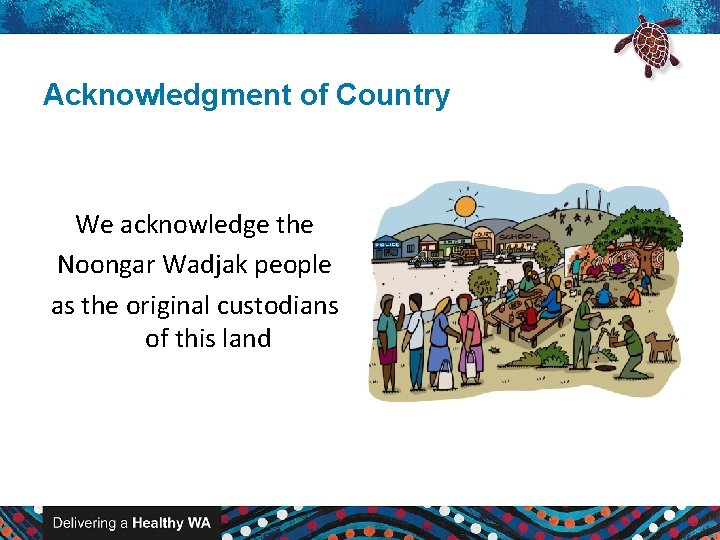
Acknowledgment of Country We acknowledge the Noongar Wadjak people as the original custodians of this land
Aboriginal Health - who are we? Aboriginal Health is a division of WA Health responsible for strategic system policy and planning: • Provides strategic leadership and advice internally/externally • Supports all areas to consider and respond to the needs of Aboriginal people and communities • Seeks opportunities to support the development of innovation and culturally secure best practice across Health • Focuses on Aboriginal workforce, cultural learning and leadership.
WA Aboriginal Health and Wellbeing Framework • WA Health has been without a state-wide strategic framework in WA for many years • Time to develop a set of WA specific strategic directions that can shape responses to Aboriginal health and wellbeing • A long term framework that will align health and wellbeing activities towards achieving better health outcomes for Aboriginal people and a reduction in the burden on the health system
Cultural security is key to consultation • WA Health is strongly committed to ensure Aboriginal cultural security in the development of new and revised health strategies • Recognises the importance of consulting with Aboriginal people and organisations to inform Aboriginal cultural understanding and ownership of solutions Cultural Security Means to respect the legitimate cultural rights, values, beliefs and expectations of Aboriginal people and that this approach is central in the development of programs, services, policies and strategies
The WA Aboriginal Health and Wellbeing Framework will focus on: • Culture as an important determinant to the health and wellbeing of Aboriginal people • Aboriginal people’s view of health is more than just physical health, a holistic approach is required ‘Health is that state of being in which a person’s body mind and spirit are in balance, functioning with a high level of wellness and in tune with the natural and social environments, as well as the spiritual environment’ AR Peile, 1997
Framework purpose • New ways of working to improve the health and wellbeing of Aboriginal people, family and communities • The Framework is not funded, however provides opportunities for progressing action with existing resources as well as provide direction for new or future funding opportunities.
What did we do? • Establish a Aboriginal Expert Reference Group (AERG) to guide the development of the Framework • AERG members selected for their range of related professional expertise, knowledge and experience to provide • high level strategic guidance • cultural knowledge and wisdom • content expertise • community linkages
What did we do? • A comprehensive state-wide consultation program which included: • Visits to all regions • Meeting with Regional Health Planning Forums • Key health stakeholders (health, mental health, AOD) including ACCHO’s, govt and non-govt organisations • Remote community visit – Warmun • Convened a state-wide consultation Forum in Perth
What did we do? • Talked with Aboriginal and non-Aboriginal professionals & community members on Aboriginal health and wellbeing agenda, future directions and priority areas • Introduced the Framework concept and its proposed principles and strategic directions • Build community and sector networks to support the sharing of knowledge, project awareness and Framework implementation
Reframing health - considerations • stronger focus on community health and wellbeing • more care in the community and a higher standard of primary health • returning care to the home • targeted engagement across the whole life-course • an emphasis on prevention • individual, family and community empowerment • managing illness better • reducing duplication of services
Proposed guiding principles & strategic directions shaped to guide consultation & Framework development Guiding principles: • Cultural security • Aboriginal community control & engagement • Aboriginal health and wellbeing is everybody's business • Partnership • Access & equality • Accountability Strategic directions: • Prevention • Support good health across the life course • A culturally respectful & nondiscriminatory health system • Individual family and community wellbeing • Addressing the social determinants • Workforce development
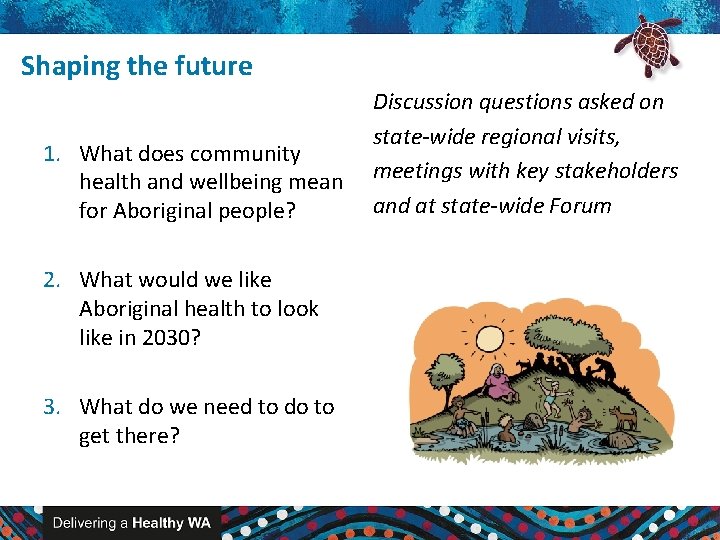
Shaping the future 1. What does community health and wellbeing mean for Aboriginal people? 2. What would we like Aboriginal health to look like in 2030? 3. What do we need to do to get there? Discussion questions asked on state-wide regional visits, meetings with key stakeholders and at state-wide Forum
What are people saying? • • • culture is important to improving health address the social determinants prevention is important to helping our people stay healthy cultural healing embedded into service delivery care, control and responsibility health and wellbeing agenda very well received care closer to home Framework is timely and required to move forward partnership important Aboriginal workforce critical
Workshop focus groups – state-wide forum • Presentations provided to set the scene prior to each workshop and included: • evidence-based information • examples of what works • Participants were allocated to tables based on their relevant area of expertise • WA Health Senior Aboriginal Leadership Group and Aboriginal Health team members chaired, facilitated and scribed for groups to keep people on time, on task and to adequately capture feedback.
Prevention workshop questions 1. If we want to engage community to raise awareness and effect behaviour change: • What types of health and wellbeing messages have meaning in Aboriginal community? • How might this differ from the non-Aboriginal population? 2. How would we get our health and wellbeing message across to people across the state, including those in metro, regional and remote areas? 3. What sort of prevention and early intervention activities and services are needed across the life course? At what points?
Priority areas workshop questions 1. What are the areas of greatest need? 2. Where can we make the most impact? 3. How can we do things differently?
Evaluation – Forum • 103 participants attended and 83 evaluations received • More than 91% of participants reported that the forum was ‘extremely’ (54%) of ‘a lot’ (37%) valuable in networking and sharing information • 78% of participants found the forum to be ‘extremely’ (20%) to ‘a lot’ (58%) useful in relation to their work • 80% of participants reported that the forum provided them ‘extremely’ to ‘a lot’ of opportunity to provide input and feedback during the workshops • 73% reported the consultation process and the workshops to be ‘extremely’ and ‘a lot’ culturally secure
Going forward • The Consultation Report will be circulated to stakeholders • A set of themes have been formulated on the basis of information and feedback collated from the statewide consultation program and the Consultation Forum • This will guide the priority areas of the Framework • The Framework will be drafted based on results of the consultation program and distributed to participants and other key stakeholders in draft format to enable their feedback
Summary of themes • Importance of culture • Community health and wellbeing • Holistic approaches to health and wellbeing • Self-determination • Increased life expectancy • Addressing social determinants • Culturally secure health system • • Prevention and early intervention • Access to health services • Collaborative partnerships • Aboriginal workforce development • Support good health across the life Course • Addressing risk factors
Thank you