
Keep It Safe Welcome 1 Agenda 2 Ground
- Slides: 48
Keep It Safe
Welcome 1. Agenda 2. Ground Rules 3. Introductions Keep It Safe 2
Objectives • Recognize how federal deposit insurance protects deposits • Recognize how to guard against identity theft • Recognize how to prevent elder financial abuse Keep It Safe 3
Objectives • Recognize how the various types of insurance will help you manage risks • Recognize the need to plan for unexpected death or disability • Describe the ways you need to be financially prepared for disasters Keep It Safe 4
What Do You Know? What do you know or want to learn about consumer protection laws and regulations? Keep It Safe 5
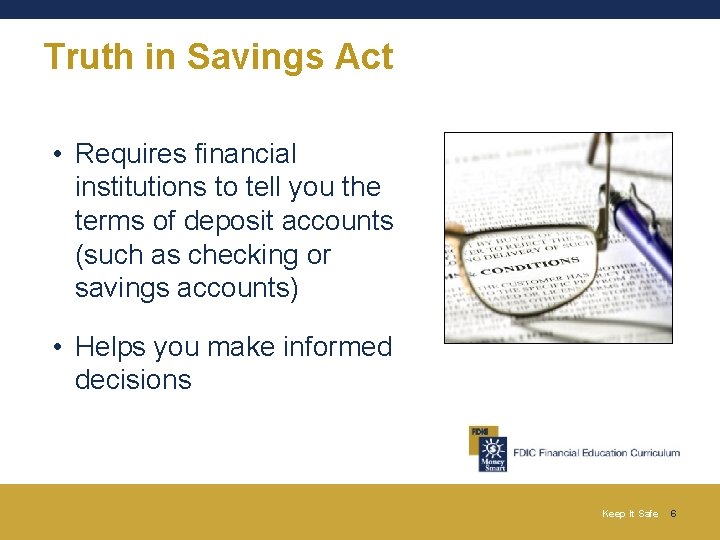
Truth in Savings Act • Requires financial institutions to tell you the terms of deposit accounts (such as checking or savings accounts) • Helps you make informed decisions Keep It Safe 6
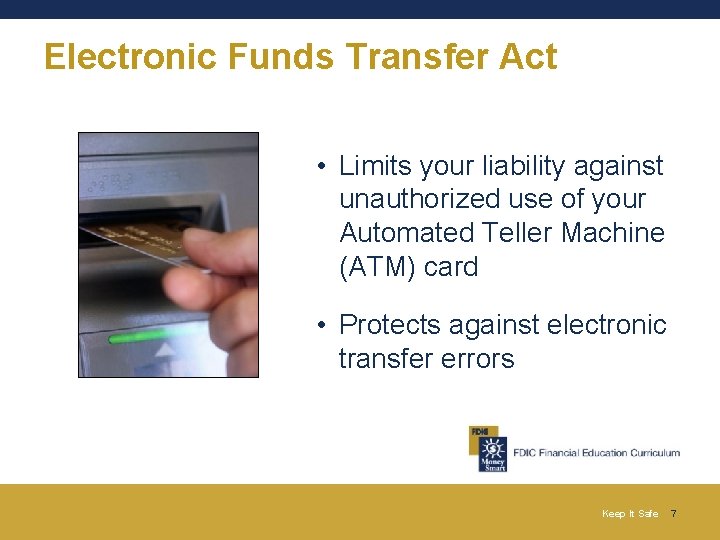
Electronic Funds Transfer Act • Limits your liability against unauthorized use of your Automated Teller Machine (ATM) card • Protects against electronic transfer errors Keep It Safe 7
Other Regulations • Expedited Funds Availability Act • Limits the time a bank can a check deposited into your checking account • FDIC Deposit Insurance Regulations • Insures the funds in your deposit accounts Keep It Safe 8
Activity 1: Deposit Accounts Laws and Regulations Complete Activity 1 in the Participant Guide. 1. Read each scenario. 2. Answer the questions. 3. Be prepared to explain your answer. Keep It Safe 9
Protecting Deposit Accounts • FDIC insures funds in deposit accounts, including: • Checking • Savings • Money Market Deposit Accounts (MMDAs) • Certificates of Deposit (CDs) Keep It Safe 10
Insurance Coverage • Coverage is based on: • Ownership category: – Single accounts – Joint accounts – Revocable trust accounts – Certain retirement accounts • Standard Maximum Deposit Insurance Amount (SMDIA), currently $250, 000 Keep It Safe 11
Additional Insurance Coverage Information • Visit: www. fdic. gov/deposits • Call: 1 -877 -ASK-FDIC • Talk to your bank representative • Use the Electronic Deposit Insurance Estimator: www. myfdicinsurance. gov Keep It Safe 12
Single Account • Owned by one person and titled in that person’s name only • Insured up to the SMDIA Keep It Safe 13
Joint Account • Owned by two or more people • Titled jointly in the co-owners’ names • Insured up to the SMDIA for each coowner Keep It Safe 14
Certain Retirement Accounts • Only the following are insured in this ownership category: • Individual Retirement Accounts (IRAs) • Section 457 deferred compensation plan accounts • Self-directed, defined contribution plan accounts • Self-directed Keogh plan (or HR 10 plan) accounts Keep It Safe 15
Revocable Trust Account • A deposit account: • Held as a payable on death (POD) or in trust for (ITF) account • Established in the name of a formal revocable trust (living or family trust account) Keep It Safe 16
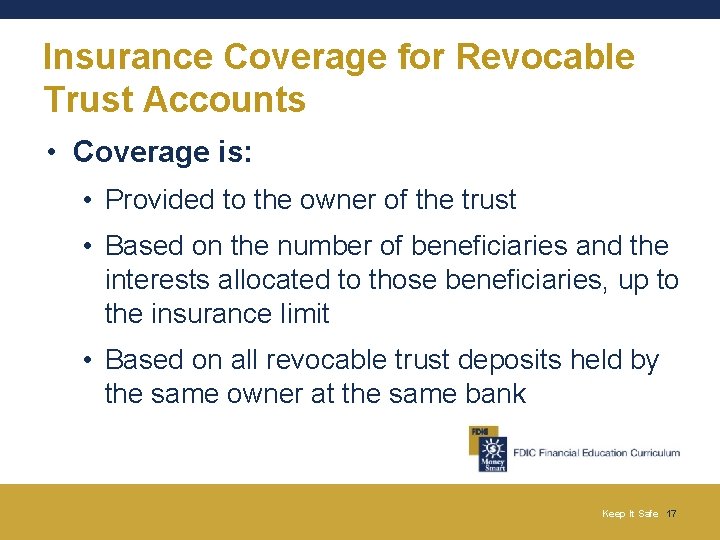
Insurance Coverage for Revocable Trust Accounts • Coverage is: • Provided to the owner of the trust • Based on the number of beneficiaries and the interests allocated to those beneficiaries, up to the insurance limit • Based on all revocable trust deposits held by the same owner at the same bank Keep It Safe 17
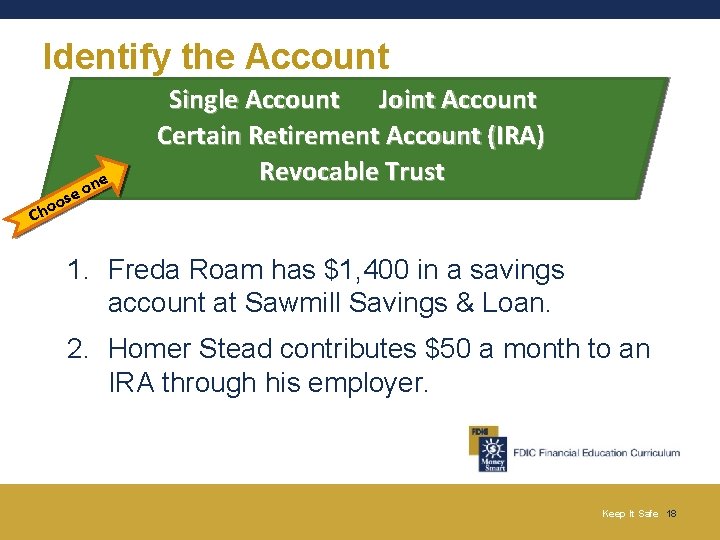
Identify the Account os Cho ne o e Single Account Joint Account Certain Retirement Account (IRA) Revocable Trust 1. Freda Roam has $1, 400 in a savings account at Sawmill Savings & Loan. 2. Homer Stead contributes $50 a month to an IRA through his employer. Keep It Safe 18
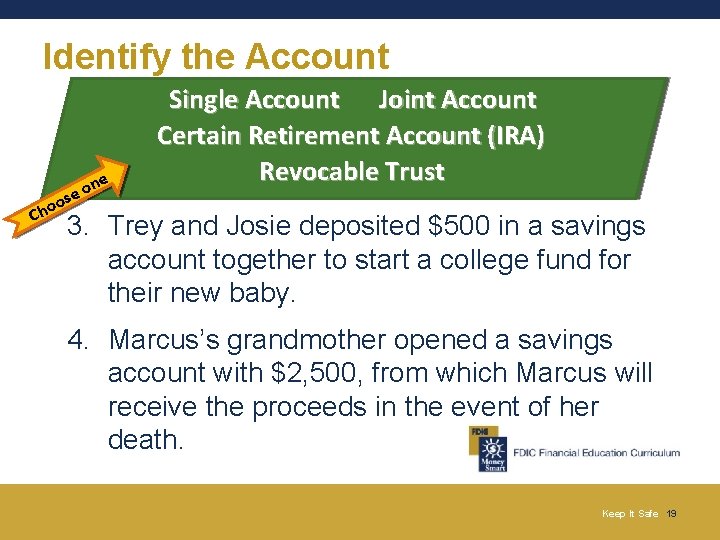
Identify the Account os Cho ne o e Single Account Joint Account Certain Retirement Account (IRA) Revocable Trust 3. Trey and Josie deposited $500 in a savings account together to start a college fund for their new baby. 4. Marcus’s grandmother opened a savings account with $2, 500, from which Marcus will receive the proceeds in the event of her death. Keep It Safe 19
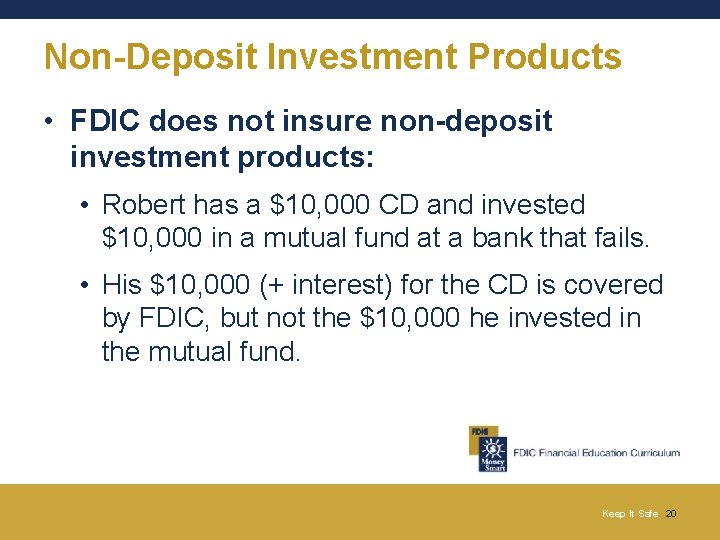
Non-Deposit Investment Products • FDIC does not insure non-deposit investment products: • Robert has a $10, 000 CD and invested $10, 000 in a mutual fund at a bank that fails. • His $10, 000 (+ interest) for the CD is covered by FDIC, but not the $10, 000 he invested in the mutual fund. Keep It Safe 20
Privacy Notices • Required by law to explain how the company handles and shares your personal financial information. • Types of notices: • Initial Privacy Notice • Annual Privacy Notice • Notice of Changes in Privacy Policies Keep It Safe 21
Opting Out • You have the right to stop or “opt out” of some sharing of your personal financial information. • To opt out: • Call 1 -888 -5 -OPTOUT (567 -8688) • Visit www. optoutprescreen. com Keep It Safe 22
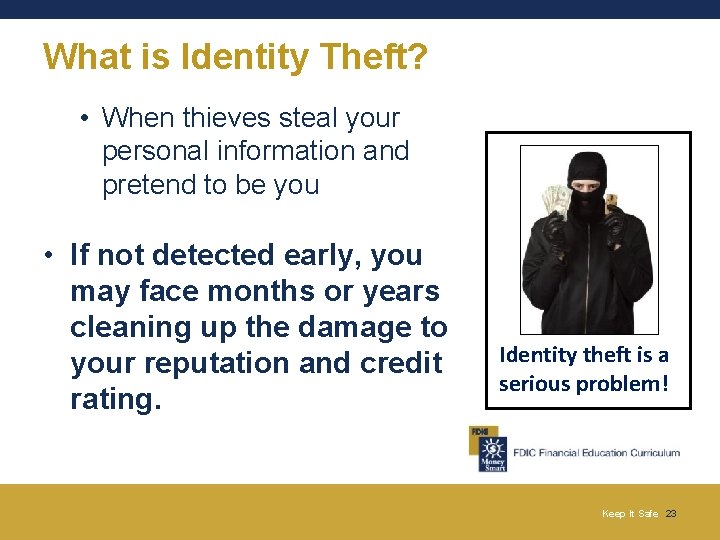
What is Identity Theft? • When thieves steal your personal information and pretend to be you • If not detected early, you may face months or years cleaning up the damage to your reputation and credit rating. Identity theft is a serious problem! Keep It Safe 23
Common Forms of Identity Theft • Phishing • Unsolicited emails that appear to be from a legitimate source • Pharming • Fake websites seeking personal or private information by appearing legitimate • Skimming • Special storage device used to obtain credit/debit card numbers Keep It Safe 24
Identity Theft Information Federal Trade Commission (FTC): • www. ftc. gov/idtheft • 1 -877 -IDTHEFT (438 -4338) Keep It Safe 25
Activity 2: Identity Theft Self-Check Complete Activity 2 in the Participant Guide. 1. Respond to each statement. 2. Tally your score. Keep It Safe 26
Victims of Identity Theft • Take action immediately: • File a police report • Contact your creditors • Follow up in writing • Use the ID Theft Affidavit at www. ftc. gov/idtheft • File a complaint with the FTC • Ask for verification that disputed accounts have been closed and fraudulent debts discharged Keep It Safe 27
Fraud Alert • Initial fraud alert – 90 days • Extended fraud alert – 7 years • Prospective lenders must contact you to authorize any new account in your name. • Security freeze • You must authorize any access to your credit report. Keep It Safe 28
If Your Wallet/Purse is Lost or Stolen: • File a police report • Cancel your credit cards immediately • Place a fraud alert on your credit report • Report the loss to your bank • Contact major check verification companies • Get a new ATM card with a new number and password Keep It Safe 29
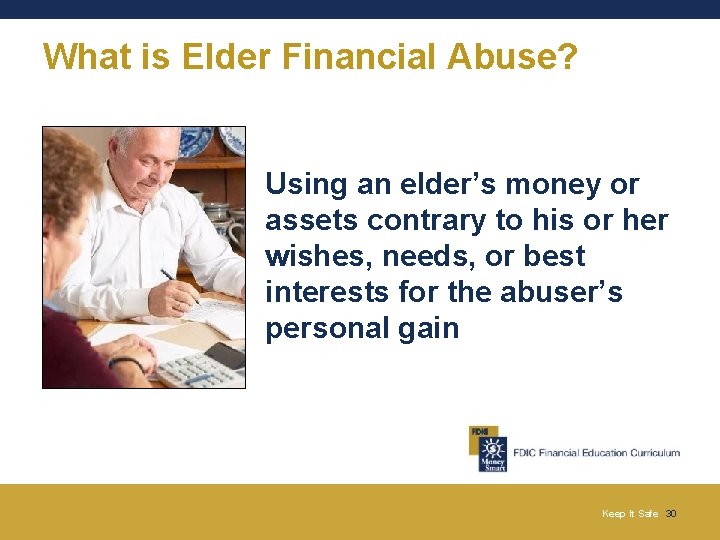
What is Elder Financial Abuse? Using an elder’s money or assets contrary to his or her wishes, needs, or best interests for the abuser’s personal gain Keep It Safe 30
Examples of Elder Financial Abuse • Taking money or property • Forging a signature or using deception to get the elderly to sign legal documents • Using property or possessions without permission • Promising care in exchange for money or property, and not following through • Using telemarketing to commit scams against older people Keep It Safe 31
Potential Perpetrators • Family members that may: • Have substance abuse, gambling, or other problems • Stand to inherit money • Fear inheritance will be used up • Have had a negative relationship with the elder • Have negative feelings towards other beneficiaries • Telemarketers Keep It Safe 32
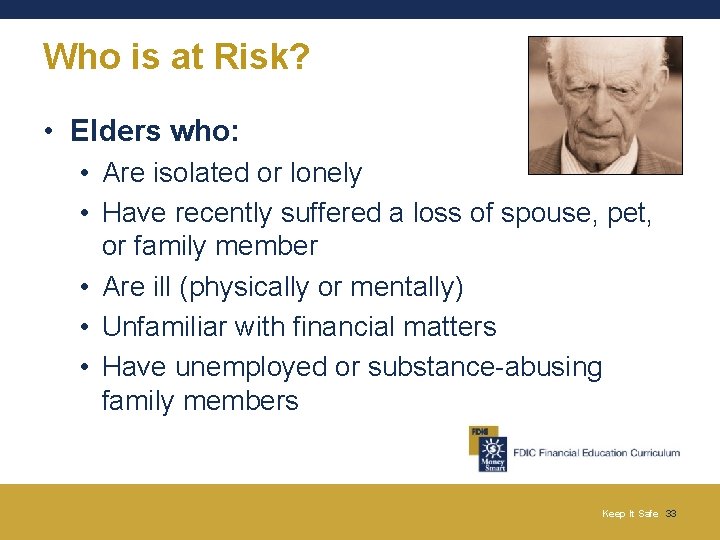
Who is at Risk? • Elders who: • Are isolated or lonely • Have recently suffered a loss of spouse, pet, or family member • Are ill (physically or mentally) • Unfamiliar with financial matters • Have unemployed or substance-abusing family members Keep It Safe 33
How Can Elders Be Made Less of a Target? • Examine their lifestyle and protect them where needed: • Ask questions to determine their vulnerability • Take steps to protect them Keep It Safe 34
How Can I Be More Careful in Employing Elderly Caregivers? • Ensure: • The employment agency is reputable • The caregiver’s references/background have been checked • The elder’s checks, credit cards, etc. are secure • There is a written service agreement and log of workers, hours, salary payments, and caregiver expenses Keep It Safe 35
Information About Elder Financial Abuse • Contact: • Your state’s Adult Protective Services department • The U. S. Department of Health and Human Services’ Elder Care Locator: www. eldercare. gov 1 -800 -677 -1116 Keep It Safe 36
Insurance: Why the Need? • Insurance: • Protects you (and your family) from financial loss if the unexpected happens • Prevents you from having to use funds set aside for other financial goals or emergencies • Prevents you from going further into debt by having to borrow money Keep It Safe 37
Types of Insurance Life insurance Health insurance Homeowner’s/renter’s insurance Auto insurance Disability insurance Liability insurance Keep It Safe 38
Determining Your Needs • Coverage depends on your circumstances. • Insurance may be required in some circumstances. • Service members and their family: • Ask how the company handles deployment • Shop around Keep It Safe 39
Why Plan for Unexpected Life Events? • Planning ahead: • Gives you control • Relieves stress of decision making • Saves money and helps you avoid financial disaster or setback Keep It Safe 40
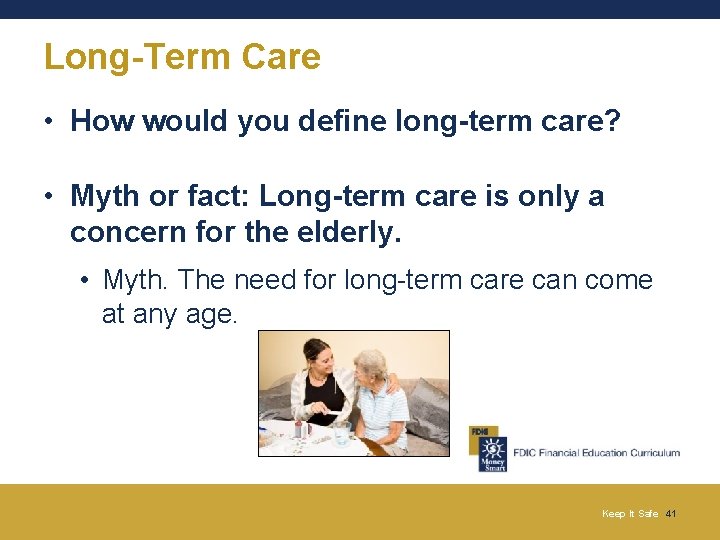
Long-Term Care • How would you define long-term care? • Myth or fact: Long-term care is only a concern for the elderly. • Myth. The need for long-term care can come at any age. Keep It Safe 41
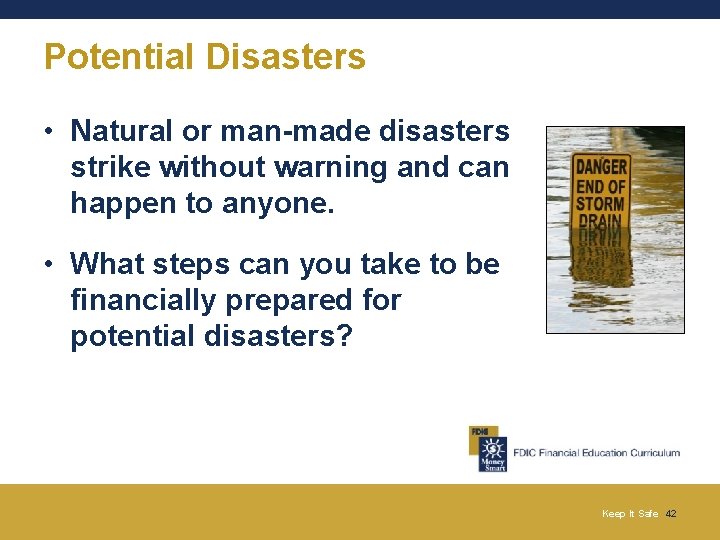
Potential Disasters • Natural or man-made disasters strike without warning and can happen to anyone. • What steps can you take to be financially prepared for potential disasters? Keep It Safe 42
What To Have Ready • Forms of identification • Your checkbook with blank checks and deposit slips to last at least a month • ATM, debit and credit cards, and cash • Phone numbers for financial institutions • Account numbers • Key to your safe deposit box Keep It Safe 43
What To Keep and Where To Keep It • Make copies of important documents • Determine what to keep at home and what to store in a safe deposit box • Seal important documents in airtight and waterproof plastic bags/containers Keep It Safe 44
What Else To Consider • Sign up for direct deposit • Arrange for automatic bill payments • Sign up for Internet banking services • Review your insurance coverage Keep It Safe 45
Activity 3: How Financially Prepared Are You? Complete Activity 3 in the Participant Guide. 1. Consider your situation. 2. Answer the question. Keep It Safe 46
Summary • What final questions do you have? • What have you learned? • How would you evaluate the training? Keep It Safe 47
Conclusion • You learned about: • Laws and regulations that protect your deposits • Identity theft • Elder financial abuse • Types of insurance to help you manage risks • Financial preparedness Keep It Safe 48