
KDII8 Final Meeting Solps DEMO Simulations F Subba

KDII#8 Final Meeting Solps DEMO Simulations F. Subba
Outline • • Task specification/status Low/density attached case Scans towards high density/detachment Current status: target loads, sputtering, pumping • Future developments F. Subba| KDII#8 Final Meeting | Remote | 2020 -07 -01 | Page 2
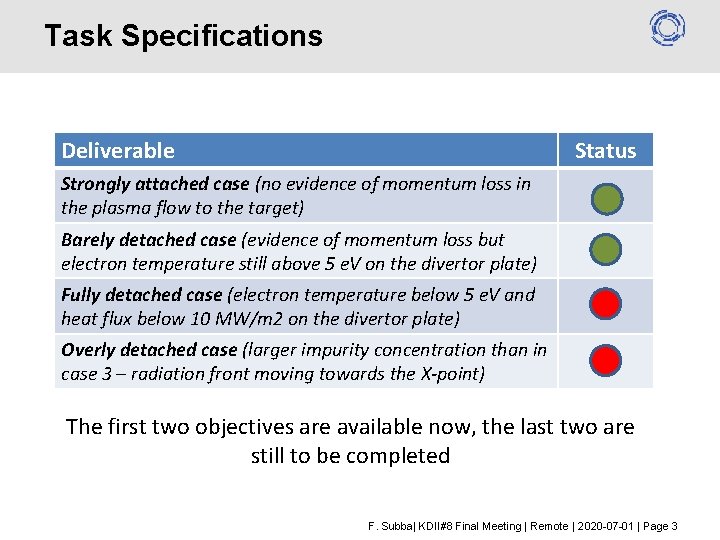
Task Specifications Deliverable Status Strongly attached case (no evidence of momentum loss in the plasma flow to the target) Barely detached case (evidence of momentum loss but electron temperature still above 5 e. V on the divertor plate) Fully detached case (electron temperature below 5 e. V and heat flux below 10 MW/m 2 on the divertor plate) Overly detached case (larger impurity concentration than in case 3 – radiation front moving towards the X-point) The first two objectives are available now, the last two are still to be completed F. Subba| KDII#8 Final Meeting | Remote | 2020 -07 -01 | Page 3
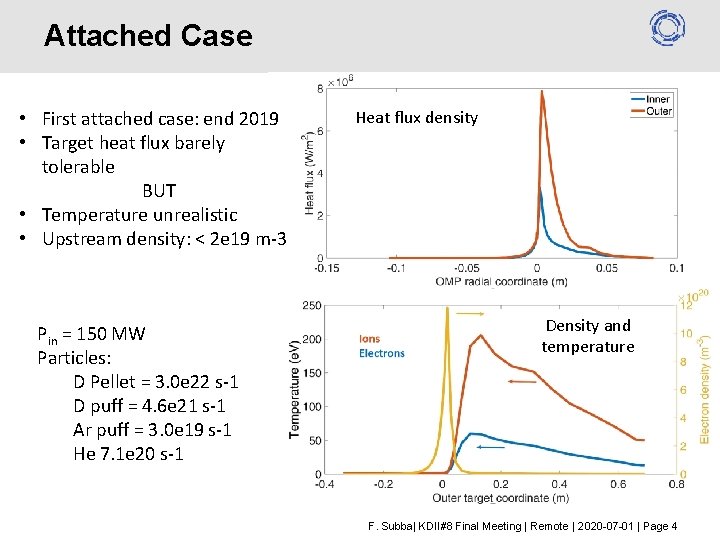
Attached Case • First attached case: end 2019 • Target heat flux barely tolerable BUT • Temperature unrealistic • Upstream density: < 2 e 19 m-3 Pin = 150 MW Particles: D Pellet = 3. 0 e 22 s-1 D puff = 4. 6 e 21 s-1 Ar puff = 3. 0 e 19 s-1 He 7. 1 e 20 s-1 Heat flux density Density and temperature F. Subba| KDII#8 Final Meeting | Remote | 2020 -07 -01 | Page 4
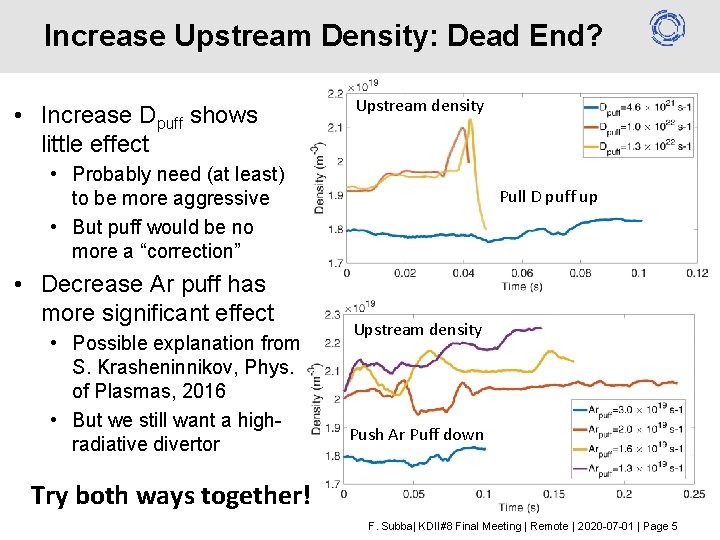
Increase Upstream Density: Dead End? • Increase Dpuff shows little effect Upstream density • Probably need (at least) to be more aggressive • But puff would be no more a “correction” • Decrease Ar puff has more significant effect • Possible explanation from S. Krasheninnikov, Phys. of Plasmas, 2016 • But we still want a highradiative divertor Pull D puff up Upstream density Push Ar Puff down Try both ways together! F. Subba| KDII#8 Final Meeting | Remote | 2020 -07 -01 | Page 5
Explore a Different Setup (Pilot Case) • Change substantially the setup • Particle fuelling: • Dpuff: 1 e 23 s-1 • Pellets: 7 e 21 s-1 • Arpuff: 1. 5 e 19 s-1 • Pcore: 150 MW (unchanged) • Consequences: • Worsen the T burn-up • Put more stress on the fuel recycle system • Still doable F. Subba| KDII#8 Final Meeting | Remote | 2020 -07 -01 | Page 6
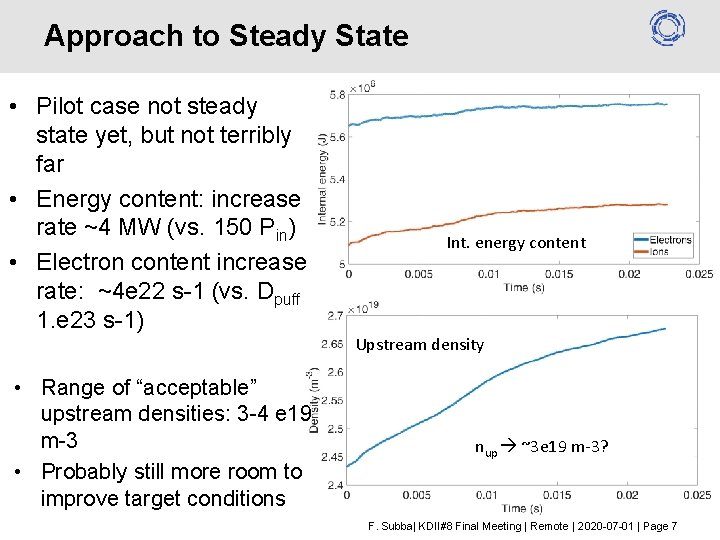
Approach to Steady State • Pilot case not steady state yet, but not terribly far • Energy content: increase rate ~4 MW (vs. 150 Pin) • Electron content increase rate: ~4 e 22 s-1 (vs. Dpuff 1. e 23 s-1) Int. energy content Upstream density • Range of “acceptable” upstream densities: 3 -4 e 19 m-3 • Probably still more room to improve target conditions nup ~3 e 19 m-3? F. Subba| KDII#8 Final Meeting | Remote | 2020 -07 -01 | Page 7
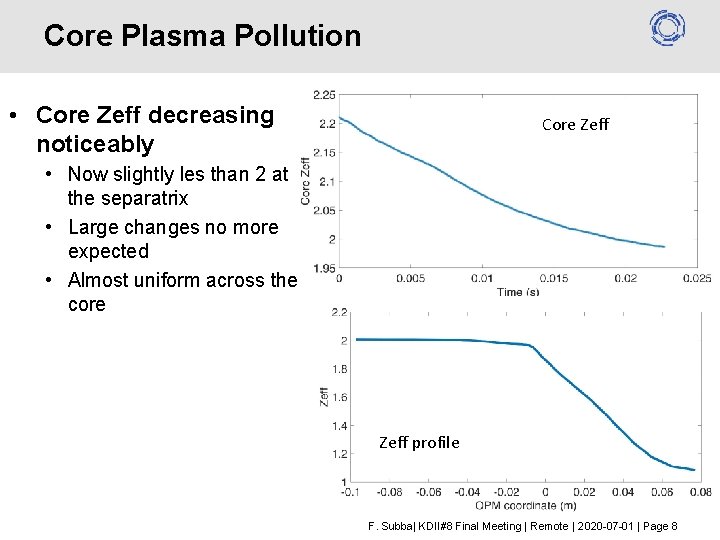
Core Plasma Pollution • Core Zeff decreasing noticeably Core Zeff • Now slightly les than 2 at the separatrix • Large changes no more expected • Almost uniform across the core Zeff profile F. Subba| KDII#8 Final Meeting | Remote | 2020 -07 -01 | Page 8
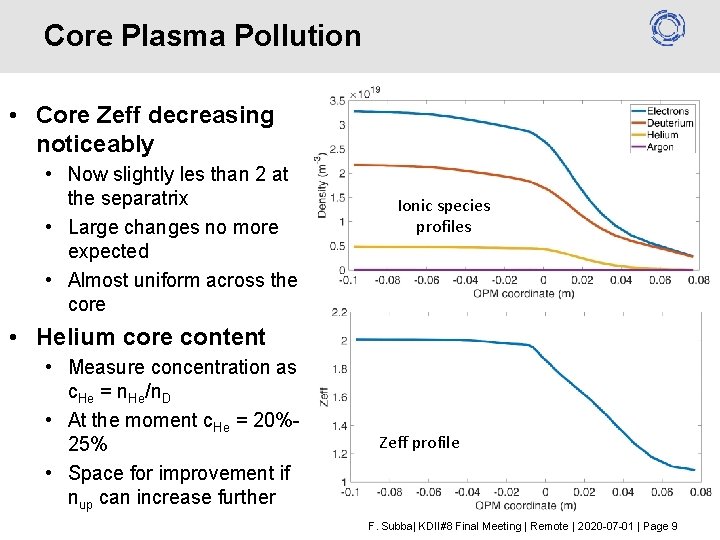
Core Plasma Pollution • Core Zeff decreasing noticeably • Now slightly les than 2 at the separatrix • Large changes no more expected • Almost uniform across the core Ionic species profiles • Helium core content • Measure concentration as c. He = n. He/n. D • At the moment c. He = 20%25% • Space for improvement if nup can increase further Zeff profile F. Subba| KDII#8 Final Meeting | Remote | 2020 -07 -01 | Page 9
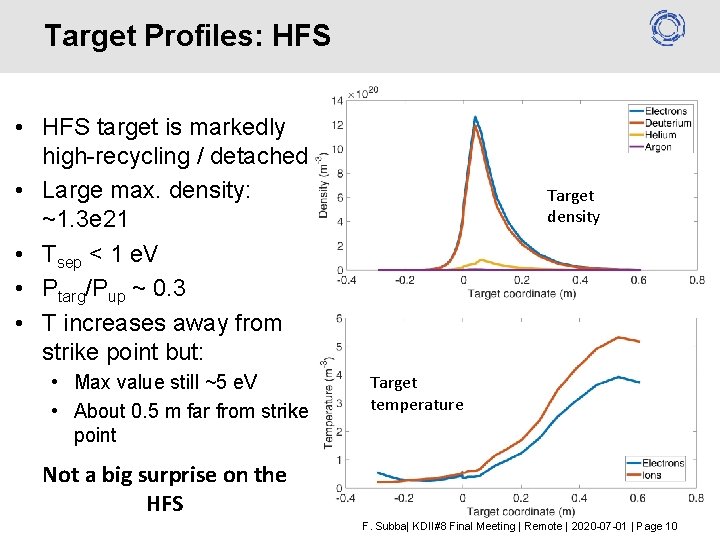
Target Profiles: HFS • HFS target is markedly high-recycling / detached • Large max. density: ~1. 3 e 21 • Tsep < 1 e. V • Ptarg/Pup ~ 0. 3 • T increases away from strike point but: • Max value still ~5 e. V • About 0. 5 m far from strike point Target density Target temperature Not a big surprise on the HFS F. Subba| KDII#8 Final Meeting | Remote | 2020 -07 -01 | Page 10
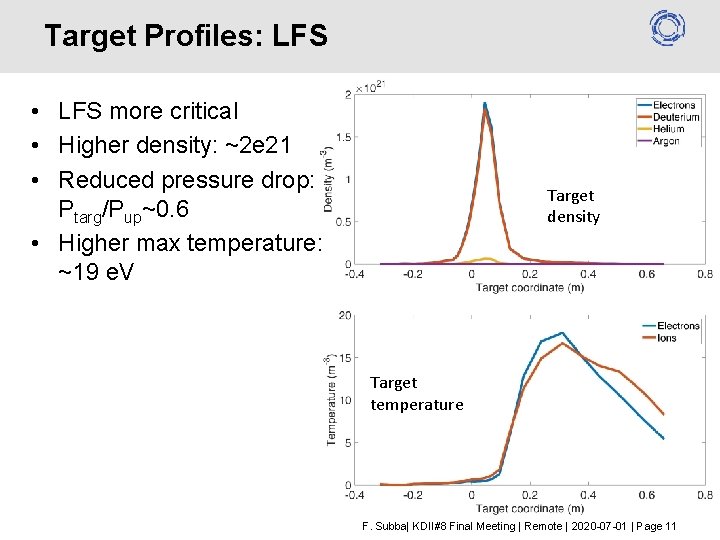
Target Profiles: LFS • LFS more critical • Higher density: ~2 e 21 • Reduced pressure drop: Ptarg/Pup~0. 6 • Higher max temperature: ~19 e. V Target density Target temperature F. Subba| KDII#8 Final Meeting | Remote | 2020 -07 -01 | Page 11
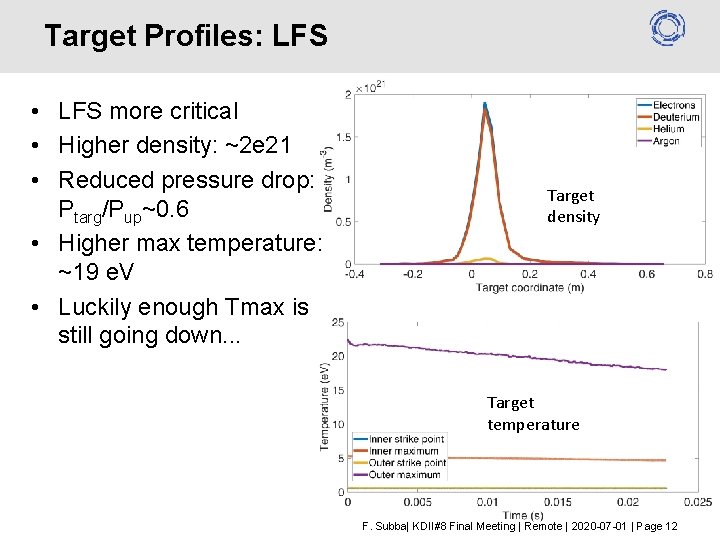
Target Profiles: LFS • LFS more critical • Higher density: ~2 e 21 • Reduced pressure drop: Ptarg/Pup~0. 6 • Higher max temperature: ~19 e. V • Luckily enough Tmax is still going down. . . Target density Target temperature F. Subba| KDII#8 Final Meeting | Remote | 2020 -07 -01 | Page 12
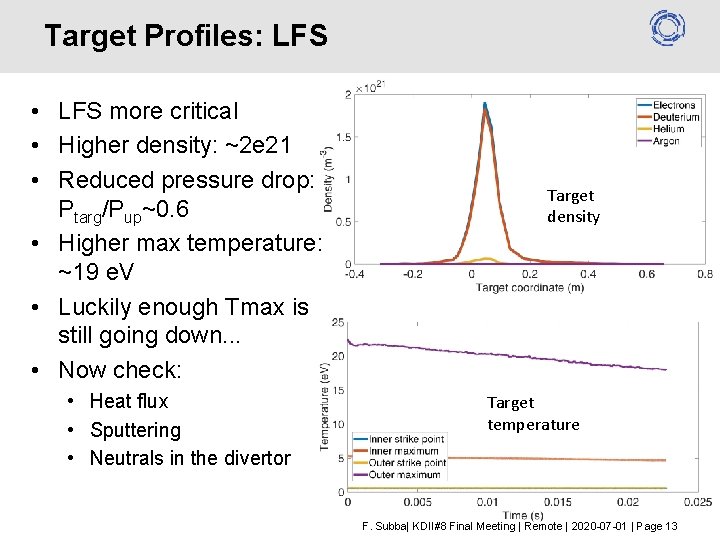
Target Profiles: LFS • LFS more critical • Higher density: ~2 e 21 • Reduced pressure drop: Ptarg/Pup~0. 6 • Higher max temperature: ~19 e. V • Luckily enough Tmax is still going down. . . • Now check: • Heat flux • Sputtering • Neutrals in the divertor Target density Target temperature F. Subba| KDII#8 Final Meeting | Remote | 2020 -07 -01 | Page 13
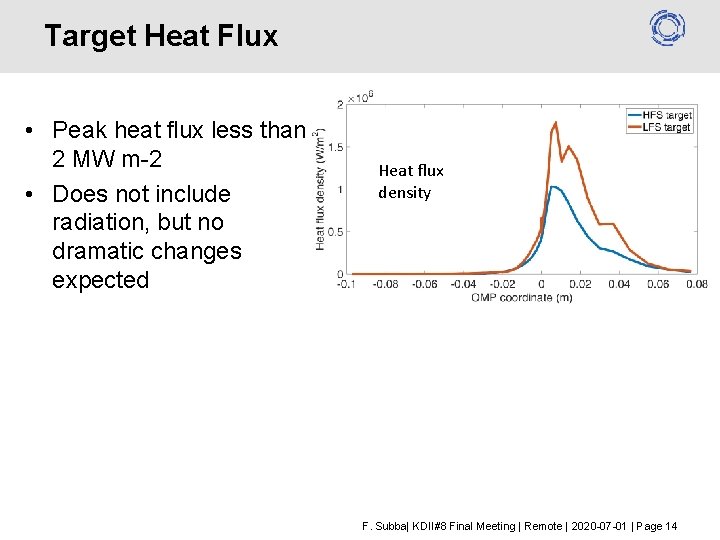
Target Heat Flux • Peak heat flux less than 2 MW m-2 • Does not include radiation, but no dramatic changes expected Heat flux density F. Subba| KDII#8 Final Meeting | Remote | 2020 -07 -01 | Page 14
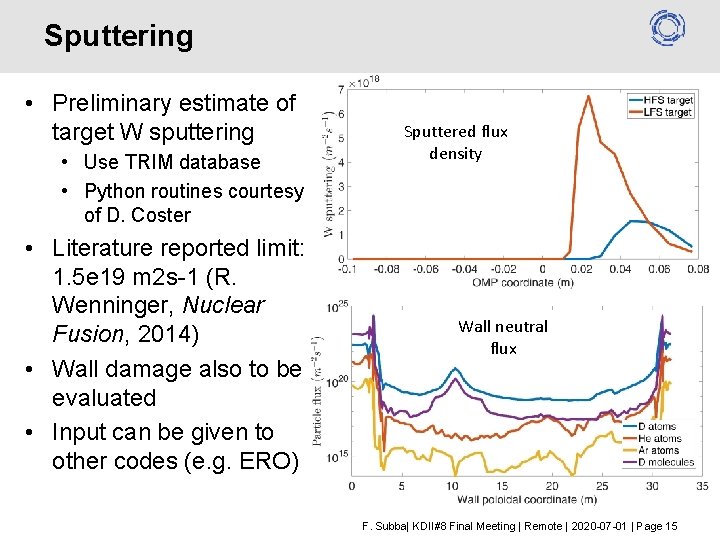
Sputtering • Preliminary estimate of target W sputtering • Use TRIM database • Python routines courtesy of D. Coster • Literature reported limit: 1. 5 e 19 m 2 s-1 (R. Wenninger, Nuclear Fusion, 2014) • Wall damage also to be evaluated • Input can be given to other codes (e. g. ERO) Sputtered flux density Wall neutral flux F. Subba| KDII#8 Final Meeting | Remote | 2020 -07 -01 | Page 15
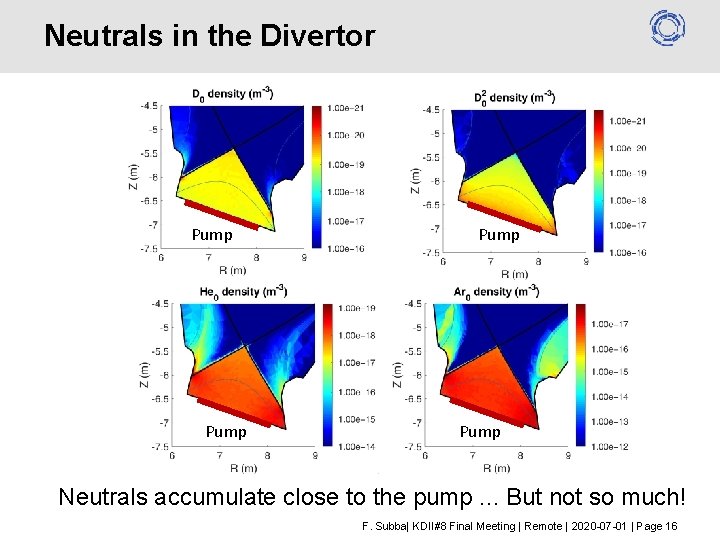
Neutrals in the Divertor Pump Neutrals accumulate close to the pump. . . But not so much! F. Subba| KDII#8 Final Meeting | Remote | 2020 -07 -01 | Page 16
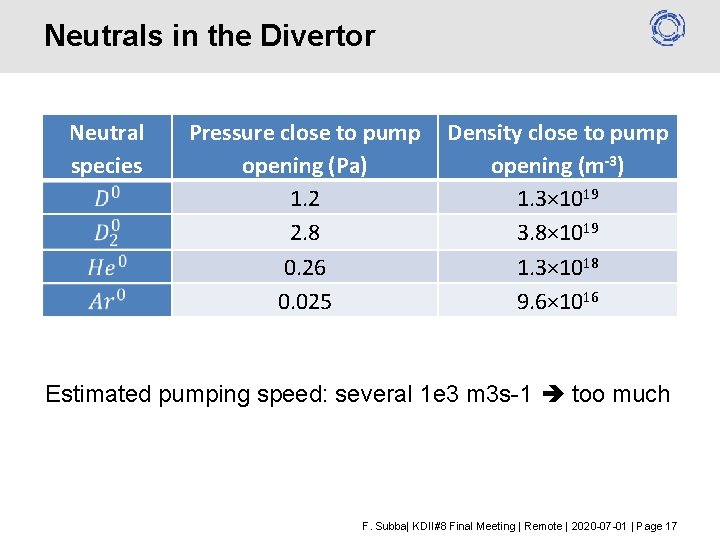
Neutrals in the Divertor Neutral species Pressure close to pump opening (Pa) 1. 2 2. 8 0. 26 0. 025 Density close to pump opening (m-3) 1. 3× 10¹⁹ 3. 8× 10¹⁹ 1. 3× 10¹⁸ 9. 6× 10¹⁶ Estimated pumping speed: several 1 e 3 m 3 s-1 too much F. Subba| KDII#8 Final Meeting | Remote | 2020 -07 -01 | Page 17
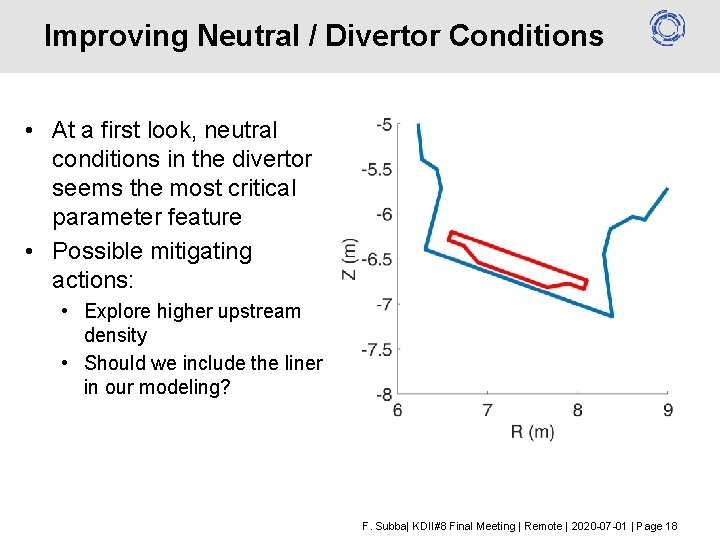
Improving Neutral / Divertor Conditions • At a first look, neutral conditions in the divertor seems the most critical parameter feature • Possible mitigating actions: • Explore higher upstream density • Should we include the liner in our modeling? F. Subba| KDII#8 Final Meeting | Remote | 2020 -07 -01 | Page 18
Future Developments (Proposal) • Higher upstream density • Always beneficial • Complete the desired detachment scan • Include the liner in simulations • More accurate divertor description • Hope for better pumping conditions • Consider species-dependent albedos • Not sure if a major difference might arise • But it could improve the simulation accuracy/reliability • Code upgrade: from 3. 0. 6 to 3. 0. 7 • New version just released • Second half of 2020 seems a reasonable time to upgrade F. Subba| KDII#8 Final Meeting | Remote | 2020 -07 -01 | Page 19
Thank you For Attention F. Subba| KDII#8 Final Meeting | Remote | 2020 -07 -01 | Page 20
- Slides: 20