
Kcentra Inservice Adam M Spaulding Emergency Medicine Pharmacist
![References 1. 2. 3. 4. 5. 6. 7. 8. Kcentra [package insert]. King of](https://slidetodoc.com/presentation_image_h/9caa0384632c239bd3fee33bf9369826/image-22.jpg "References 1. 2. 3. 4. 5. 6. 7. 8. Kcentra [package insert]. King of")
- Slides: 23
Kcentra In-service Adam M. Spaulding Emergency Medicine Pharmacist Waterbury Hospital
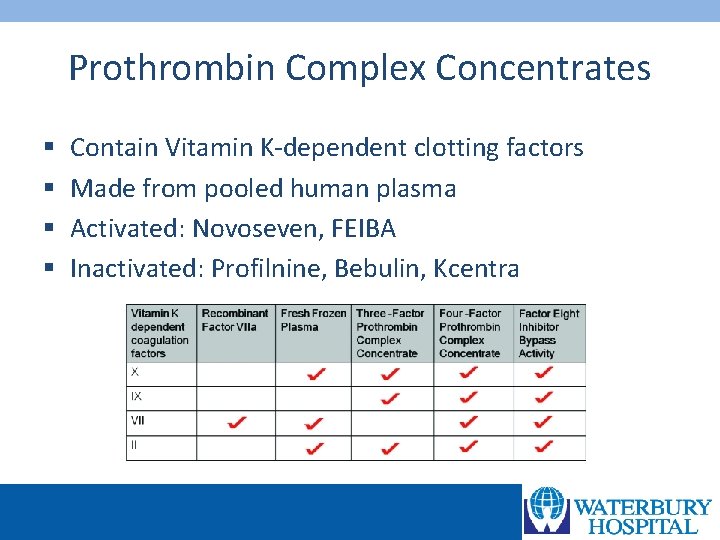
Prothrombin Complex Concentrates § § Contain Vitamin K-dependent clotting factors Made from pooled human plasma Activated: Novoseven, FEIBA Inactivated: Profilnine, Bebulin, Kcentra
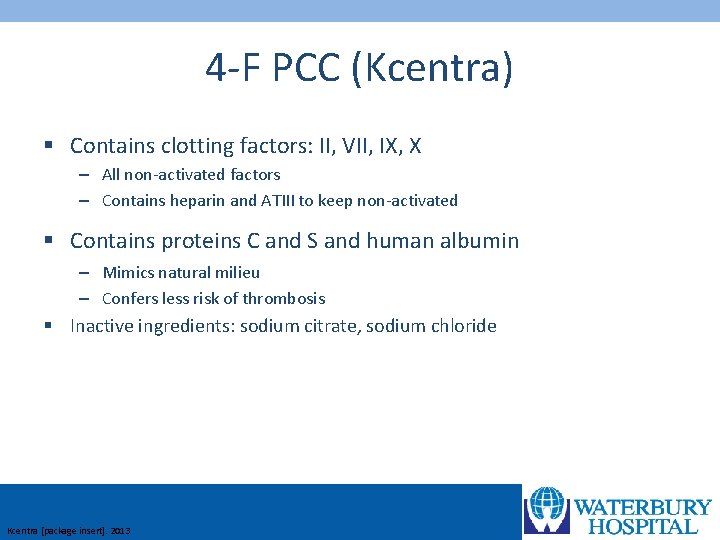
4 -F PCC (Kcentra) § Contains clotting factors: II, VII, IX, X – All non-activated factors – Contains heparin and ATIII to keep non-activated § Contains proteins C and S and human albumin – Mimics natural milieu – Confers less risk of thrombosis § Inactive ingredients: sodium citrate, sodium chloride Kcentra [package insert]. 2013
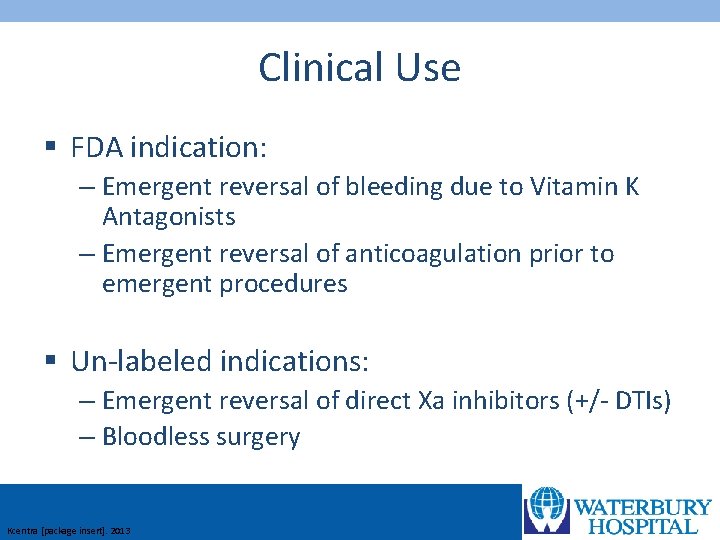
Clinical Use § FDA indication: – Emergent reversal of bleeding due to Vitamin K Antagonists – Emergent reversal of anticoagulation prior to emergent procedures § Un-labeled indications: – Emergent reversal of direct Xa inhibitors (+/- DTIs) – Bloodless surgery Kcentra [package insert]. 2013
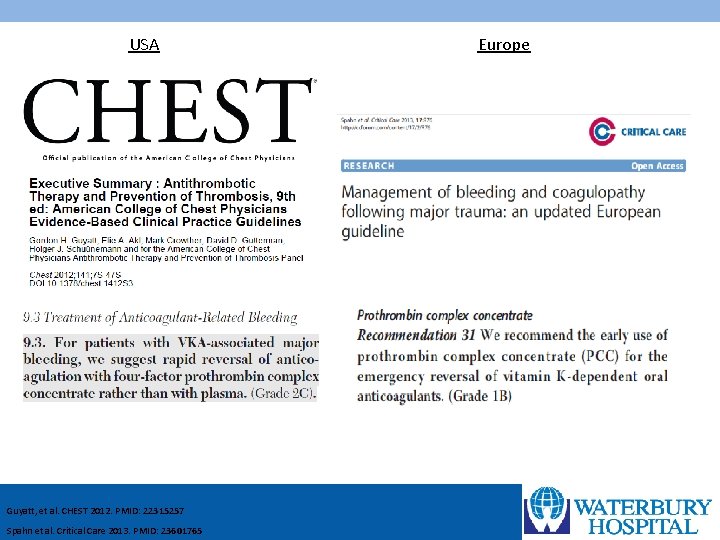
USA Guyatt, et al. CHEST 2012. PMID: 22315257 Spahn et al. Critical Care 2013. PMID: 23601765 Europe
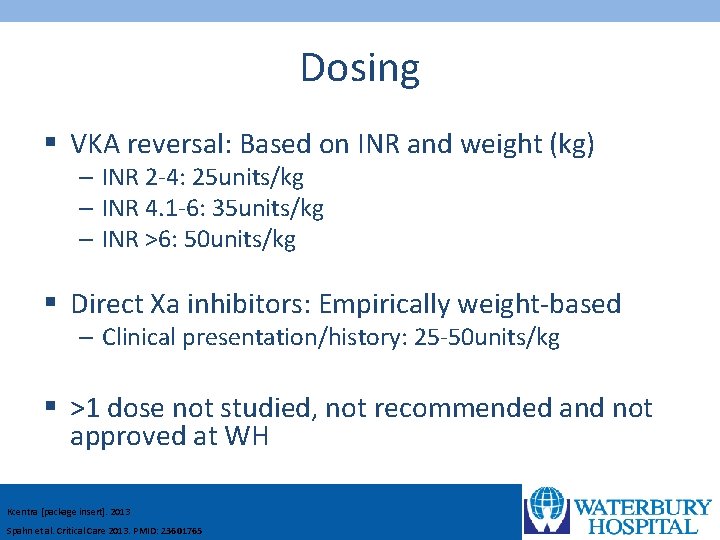
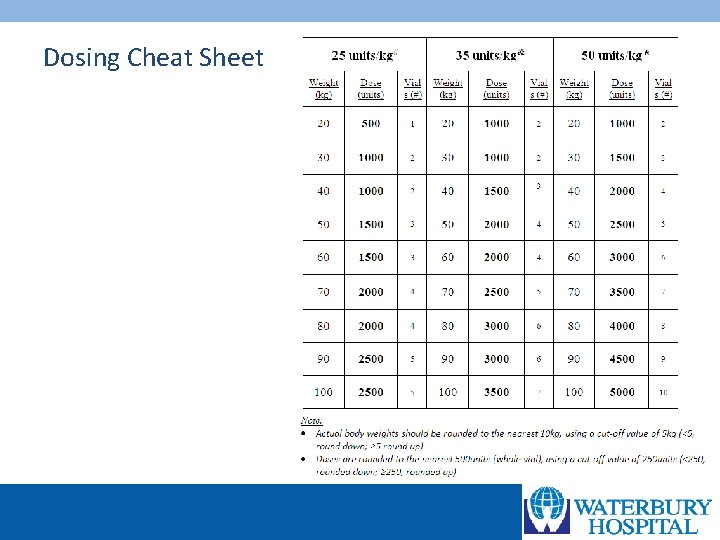
Dosing § VKA reversal: Based on INR and weight (kg) – INR 2 -4: 25 units/kg – INR 4. 1 -6: 35 units/kg – INR >6: 50 units/kg § Direct Xa inhibitors: Empirically weight-based – Clinical presentation/history: 25 -50 units/kg § >1 dose not studied, not recommended and not approved at WH Kcentra [package insert]. 2013 Spahn et al. Critical Care 2013. PMID: 23601765
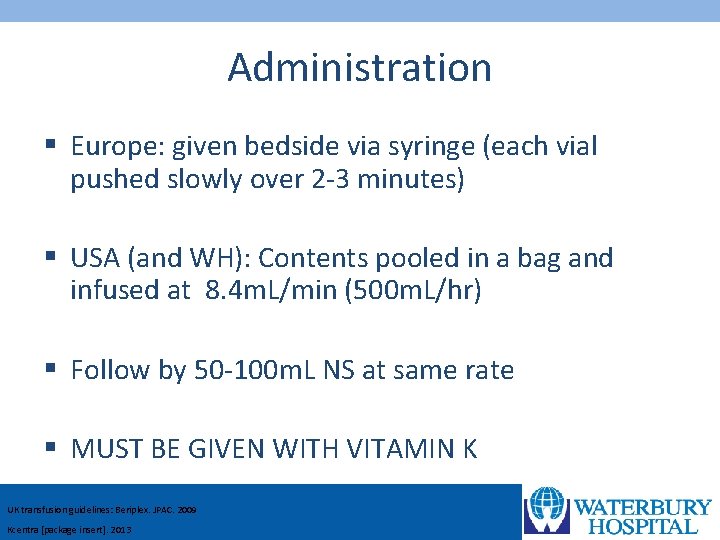
Administration § Europe: given bedside via syringe (each vial pushed slowly over 2 -3 minutes) § USA (and WH): Contents pooled in a bag and infused at 8. 4 m. L/min (500 m. L/hr) § Follow by 50 -100 m. L NS at same rate § MUST BE GIVEN WITH VITAMIN K UK transfusion guidelines: Beriplex. JPAC. 2009 Kcentra [package insert]. 2013
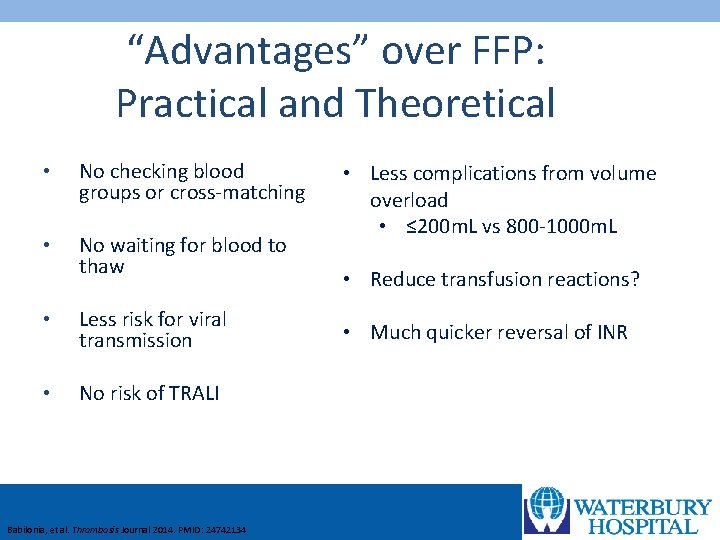
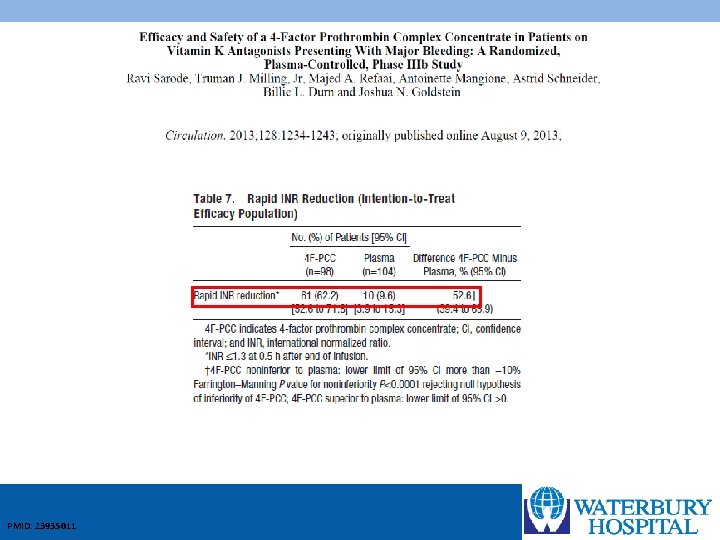
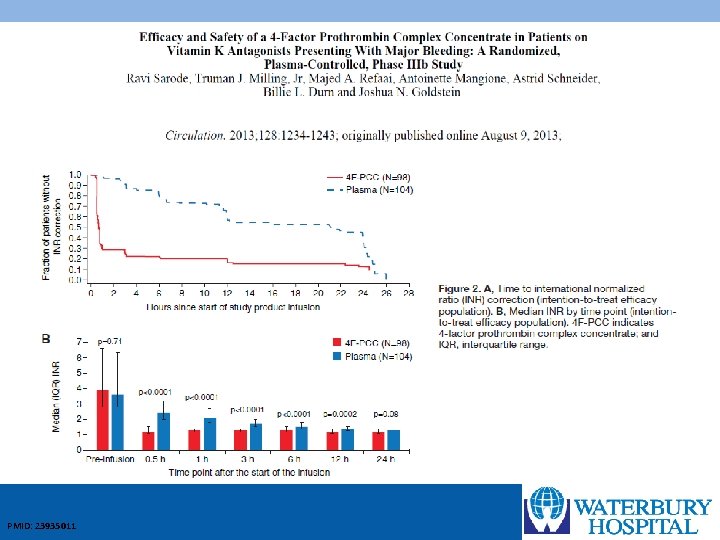
“Advantages” over FFP: Practical and Theoretical • No checking blood groups or cross-matching • No waiting for blood to thaw • Less risk for viral transmission • No risk of TRALI Babilonia, et al. Thrombosis Journal 2014. PMID: 24742134 • Less complications from volume overload • ≤ 200 m. L vs 800 -1000 m. L • Reduce transfusion reactions? • Much quicker reversal of INR
PMID: 23935011
PMID: 23935011
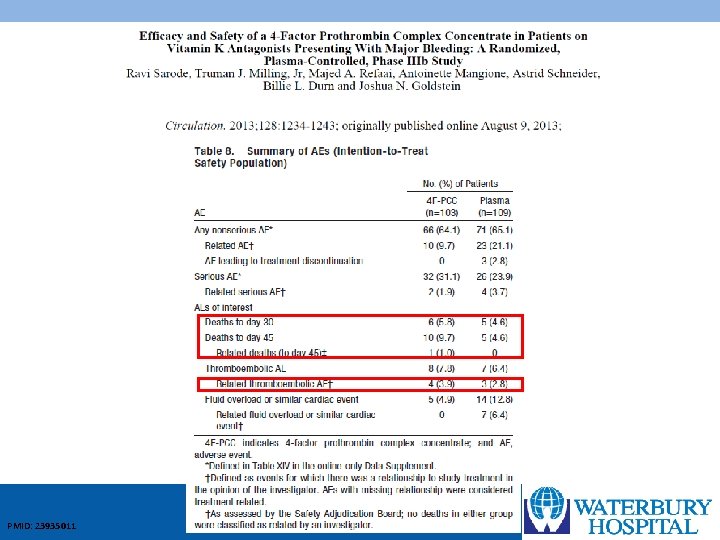
PMID: 23935011
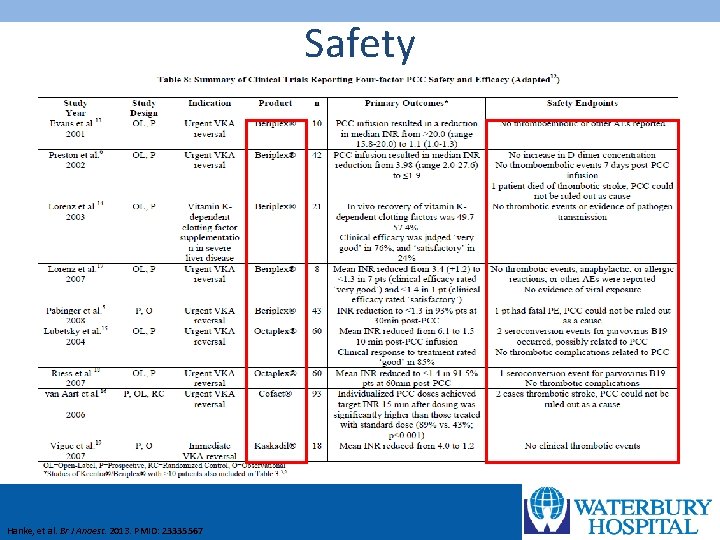
Safety Hanke, et al. Br J Anaest. 2013. PMID: 23335567
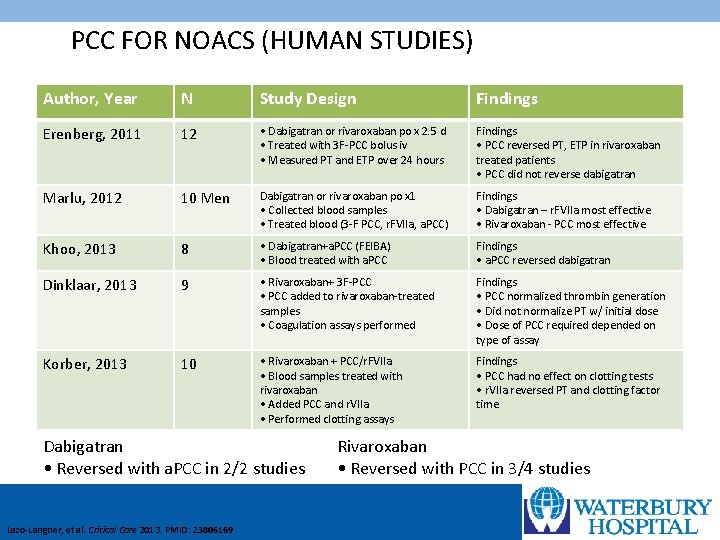
PCC FOR NOACS (HUMAN STUDIES) Author, Year N Study Design Findings Erenberg, 2011 12 • Dabigatran or rivaroxaban po x 2. 5 d • Treated with 3 F-PCC bolus iv • Measured PT and ETP over 24 hours Findings • PCC reversed PT, ETP in rivaroxaban treated patients • PCC did not reverse dabigatran Marlu, 2012 10 Men Dabigatran or rivaroxaban po x 1 • Collected blood samples • Treated blood (3 -F PCC, r. FVIIa, a. PCC) Findings • Dabigatran – r. FVIIa most effective • Rivaroxaban - PCC most effective Khoo, 2013 8 • Dabigatran+a. PCC (FEIBA) • Blood treated with a. PCC Findings • a. PCC reversed dabigatran Dinklaar, 2013 9 • Rivaroxaban+ 3 F-PCC • PCC added to rivaroxaban-treated samples • Coagulation assays performed Findings • PCC normalized thrombin generation • Did not normalize PT w/ initial dose • Dose of PCC required depended on type of assay Korber, 2013 10 • Rivaroxaban + PCC/r. FVIIa • Blood samples treated with rivaroxaban • Added PCC and r. VIIa • Performed clotting assays Findings • PCC had no effect on clotting tests • r. VIIa reversed PT and clotting factor time Dabigatran • Reversed with a. PCC in 2/2 studies Lazo-Langner, et al. Critical Care 2013. PMID: 23806169 Rivaroxaban • Reversed with PCC in 3/4 studies
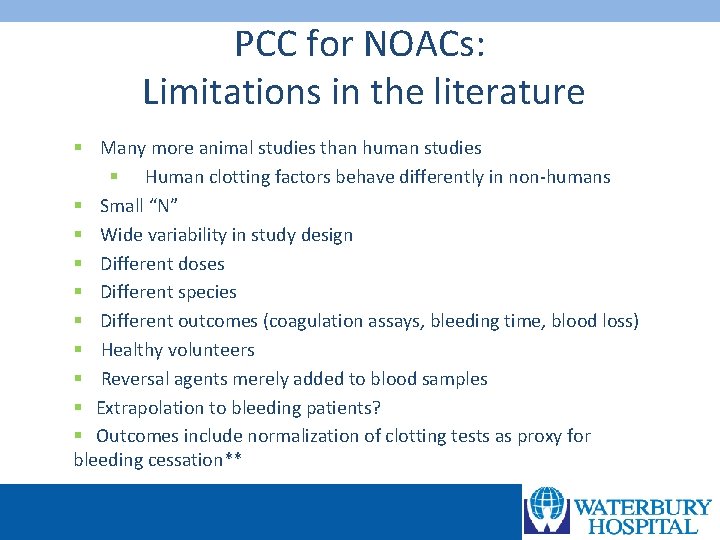
PCC for NOACs: Limitations in the literature § Many more animal studies than human studies § Human clotting factors behave differently in non-humans § Small “N” § Wide variability in study design § Different doses § Different species § Different outcomes (coagulation assays, bleeding time, blood loss) § Healthy volunteers § Reversal agents merely added to blood samples § Extrapolation to bleeding patients? § Outcomes include normalization of clotting tests as proxy for bleeding cessation**
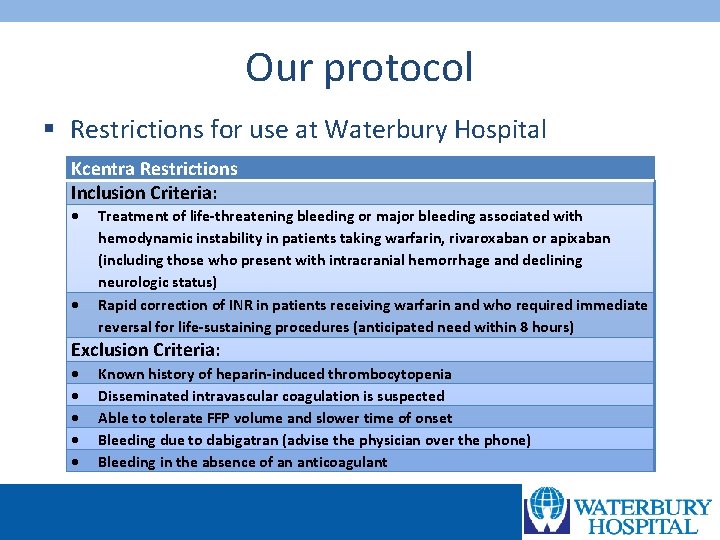
Our protocol § Restrictions for use at Waterbury Hospital Kcentra Restrictions Inclusion Criteria: Treatment of life-threatening bleeding or major bleeding associated with hemodynamic instability in patients taking warfarin, rivaroxaban or apixaban (including those who present with intracranial hemorrhage and declining neurologic status) Rapid correction of INR in patients receiving warfarin and who required immediate reversal for life-sustaining procedures (anticipated need within 8 hours) Exclusion Criteria: Known history of heparin-induced thrombocytopenia Disseminated intravascular coagulation is suspected Able to tolerate FFP volume and slower time of onset Bleeding due to dabigatran (advise the physician over the phone) Bleeding in the absence of an anticoagulant
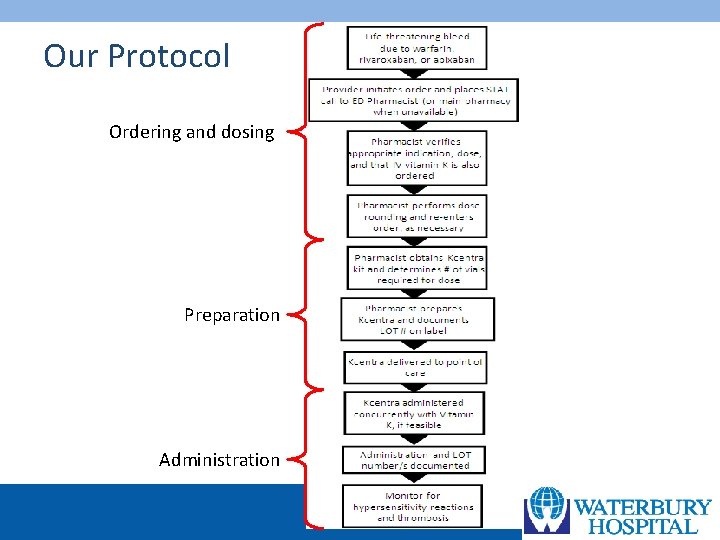
Our Protocol Ordering and dosing Preparation Administration
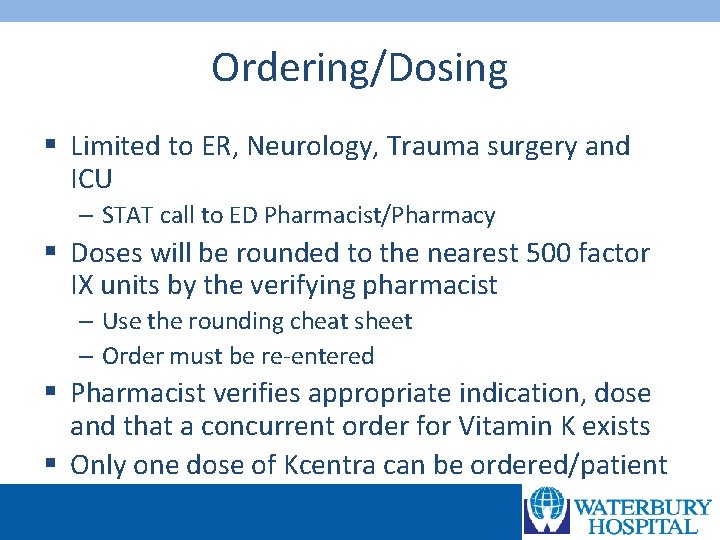
Ordering/Dosing § Limited to ER, Neurology, Trauma surgery and ICU – STAT call to ED Pharmacist/Pharmacy § Doses will be rounded to the nearest 500 factor IX units by the verifying pharmacist – Use the rounding cheat sheet – Order must be re-entered § Pharmacist verifies appropriate indication, dose and that a concurrent order for Vitamin K exists § Only one dose of Kcentra can be ordered/patient
Dosing Cheat Sheet
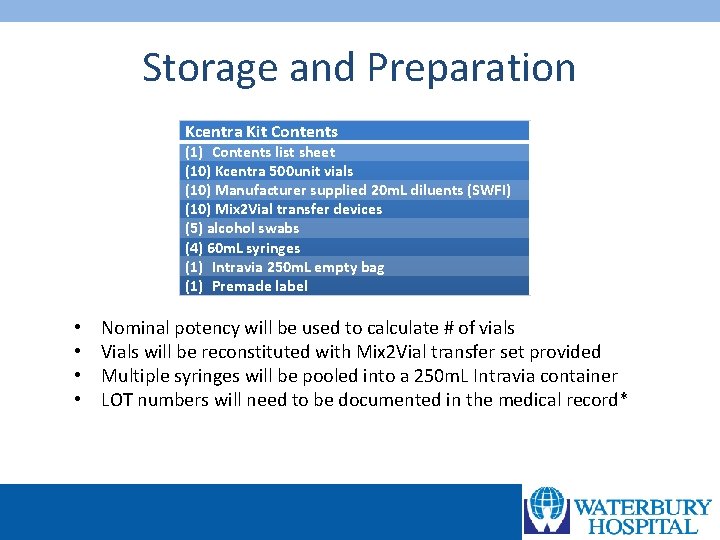
Storage and Preparation Kcentra Kit Contents (1) Contents list sheet (10) Kcentra 500 unit vials (10) Manufacturer supplied 20 m. L diluents (SWFI) (10) Mix 2 Vial transfer devices (5) alcohol swabs (4) 60 m. L syringes (1) Intravia 250 m. L empty bag (1) Premade label • • Nominal potency will be used to calculate # of vials Vials will be reconstituted with Mix 2 Vial transfer set provided Multiple syringes will be pooled into a 250 m. L Intravia container LOT numbers will need to be documented in the medical record*
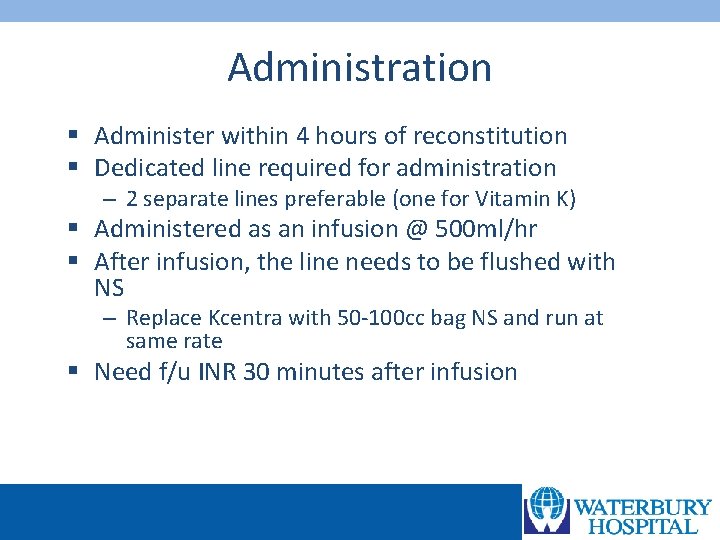
Administration § Administer within 4 hours of reconstitution § Dedicated line required for administration – 2 separate lines preferable (one for Vitamin K) § Administered as an infusion @ 500 ml/hr § After infusion, the line needs to be flushed with NS – Replace Kcentra with 50 -100 cc bag NS and run at same rate § Need f/u INR 30 minutes after infusion
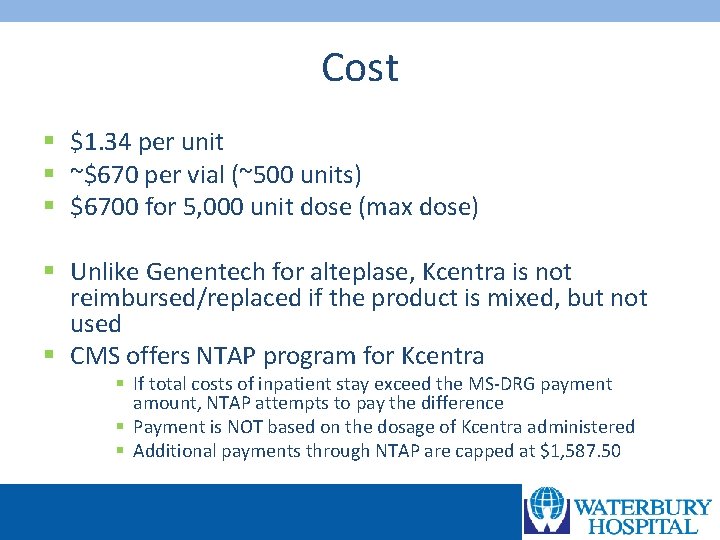
Cost § $1. 34 per unit § ~$670 per vial (~500 units) § $6700 for 5, 000 unit dose (max dose) § Unlike Genentech for alteplase, Kcentra is not reimbursed/replaced if the product is mixed, but not used § CMS offers NTAP program for Kcentra § If total costs of inpatient stay exceed the MS-DRG payment amount, NTAP attempts to pay the difference § Payment is NOT based on the dosage of Kcentra administered § Additional payments through NTAP are capped at $1, 587. 50
References 1. 2. 3. 4. 5. 6. 7. 8. Kcentra [package insert]. King of Prussia, PA: CSL Behring; 2013. Guyatt GH, Aki EA, Crowther M, et al. Executive Summary: Antithrombotic therapy and prevention of thrombosis, 9 th ed: American College of Chest Physicians Evidence-Based Clinical Practice Guidelines. Chest 2012; 141: 7 S-47 S. PMID: 22315257 Spahn DR, Bouillon B, Cerny V, et al. Management of bleeding and coagulopathy following major trauma: an updated European guidelines. Crit Care 2013; 17(2): R 76. PMID: 23601765 Joint United Kingdom (UK) Blood Transfusion and Tissue Transplantation Services Professional Advisory Committee (JPAC). UK Transfusion Guidelines: Beriplex. 2009. URL: http: //www. transfusionguidelines. org. uk/document-library/documents/prothrombin-complexconcentrate-beriplex-oxford-radcliffe-hospitals-2009 Babilonia K, Trujillo T. The role of prothrombin complex concentrates in reversal of target specific anticoagulants. Thrombosis Journal 2014; 12: 8. PMID: 24742134 Sarode R, Milling TJ, Refaai MA, et al. Efficacy and safety of a 4 -factor prothrombin complex concentrate in patients on vitamin K antagonists presenting with major bleeding: a randomized, plasma-controlled, phase IIIb study. Circulation 2013; 128: 1234 -1243. PMID: 23935011 Hanke AA, Joch C, and Gorlinger K. Long-term safety and efficacy of a pasteurized nanofiltrated prothrombin complex concentrate (Beriplex® P/N): a pharmacovigilance study. Br J Anaest. 2013; 1 -9. PMID: 23335567 Lazo-Langner A, Lang ES, Douketis J. Clinical review: clinical management of new oral anticoagulants: a structured review with emphasis on the reversal of bleeding complications. Critical Care 2013; 17: 230. PMID: 23806169
Questions?