
Katies Trunk n Author Ann Turner n Illustrator

- Slides: 33
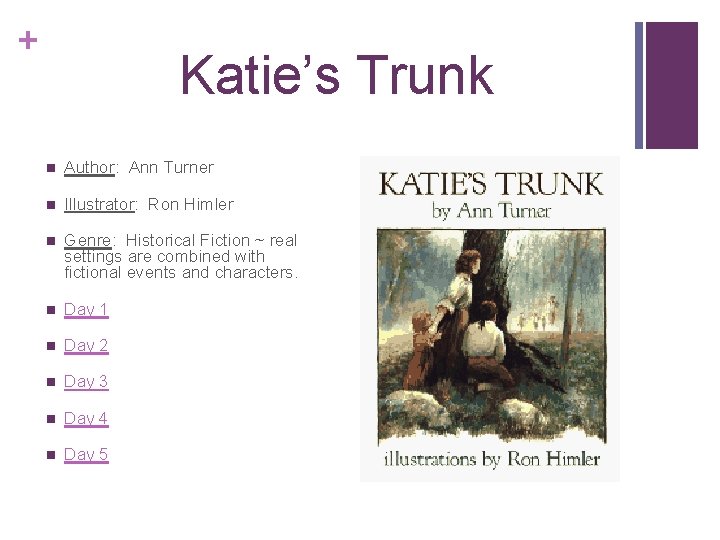
+ Katie’s Trunk n Author: Ann Turner n Illustrator: Ron Himler n Genre: Historical Fiction ~ real settings are combined with fictional events and characters. n Day 1 n Day 2 n Day 3 n Day 4 n Day 5
+ Day 1 Schedule n n Reading n Writing and Language n Vocabulary n Daily Language Practice n Cause and Effect n Verb Phrases n Read Segment 1 (293 -299) Word Work n Spelling pretest (309 g) Back to Katie’s Trunk
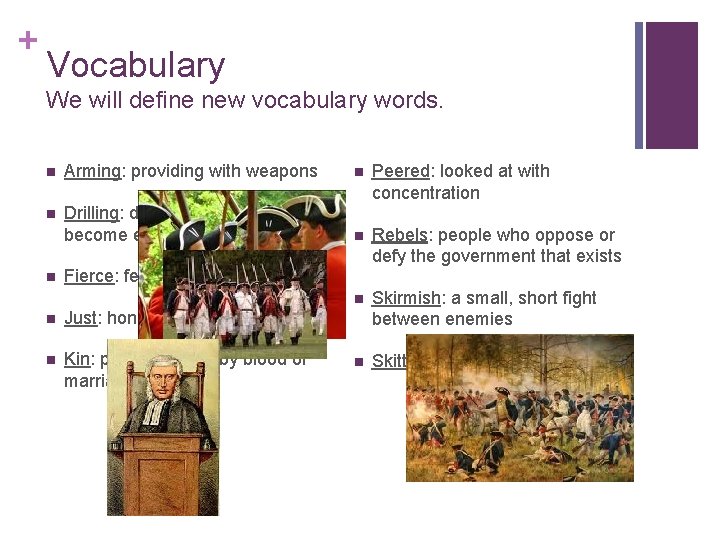
+ Vocabulary We will define new vocabulary words. n Arming: providing with weapons n n Drilling: doing exercises to become efficient Peered: looked at with concentration n Rebels: people who oppose or defy the government that exists n Skirmish: a small, short fight between enemies n Skittish: nervous and jumpy n Fierce: ferocious n Just: honorable and fair n Kin: people related by blood or marriage
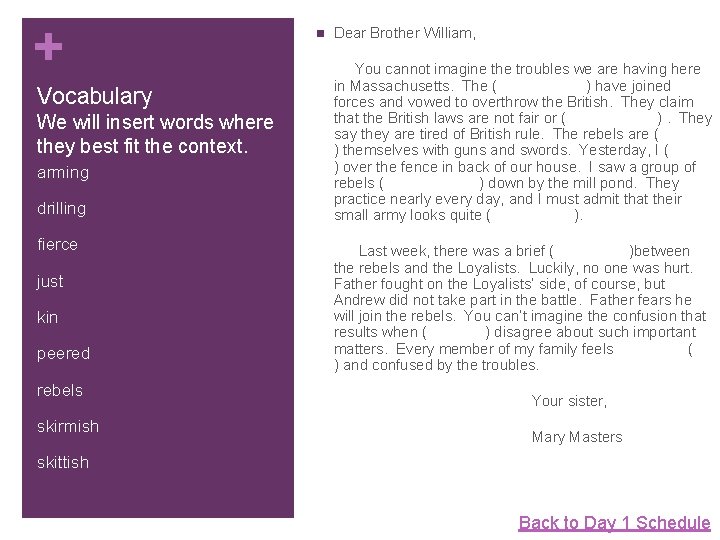
+ Vocabulary We will insert words where they best fit the context. arming drilling fierce just kin peered rebels skirmish n Dear Brother William, You cannot imagine the troubles we are having here in Massachusetts. The ( ) have joined forces and vowed to overthrow the British. They claim that the British laws are not fair or ( ). They say they are tired of British rule. The rebels are ( ) themselves with guns and swords. Yesterday, I ( ) over the fence in back of our house. I saw a group of rebels ( ) down by the mill pond. They practice nearly every day, and I must admit that their small army looks quite ( ). Last week, there was a brief ( )between the rebels and the Loyalists. Luckily, no one was hurt. Father fought on the Loyalists’ side, of course, but Andrew did not take part in the battle. Father fears he will join the rebels. You can’t imagine the confusion that results when ( ) disagree about such important matters. Every member of my family feels ( ) and confused by the troubles. Your sister, Mary Masters skittish Back to Day 1 Schedule
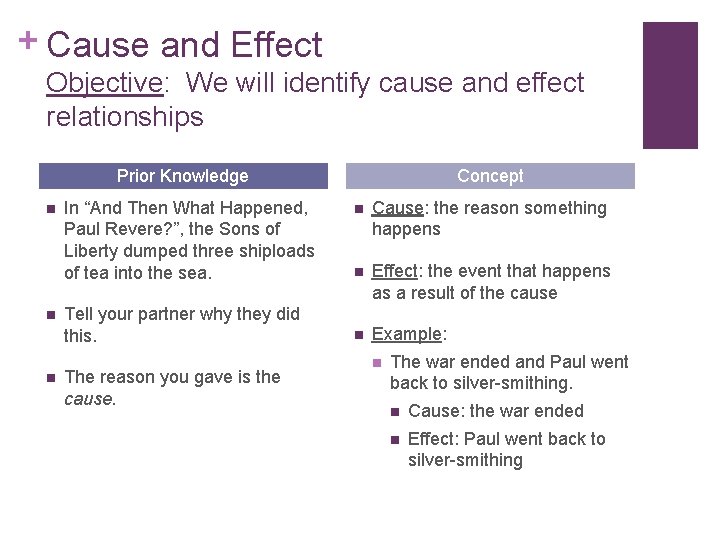
+ Cause and Effect Objective: We will identify cause and effect relationships Prior Knowledge n n n In “And Then What Happened, Paul Revere? ”, the Sons of Liberty dumped three shiploads of tea into the sea. Tell your partner why they did this. The reason you gave is the cause. Concept n Cause: the reason something happens n Effect: the event that happens as a result of the cause n Example: n The war ended and Paul went back to silver-smithing. n Cause: the war ended n Effect: Paul went back to silver-smithing
+ Skill: We will identify cause and effect relationships 1. To determine cause, ask “Why did this event happen? ” 2. To determine effect, ask “What just happened? ” n We do n Because I forgot my homework I was not allowed to go to recess. n Cause: I forgot my homework n Effect: I missed my recess n I do n I was late getting to school today, so I missed my first class. n Cause: I was late getting to school n Effect: I missed my first class n You do n Benny broke his arm so he went to the hospital to be treated. n Cause: Benny broke his arm n Effect: he went to the hospital
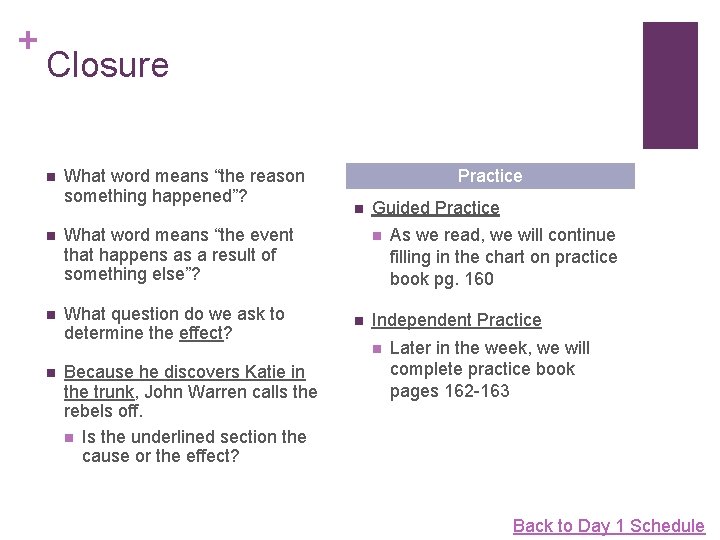
+ Closure n What word means “the reason something happened”? n What word means “the event that happens as a result of something else”? n What question do we ask to determine the effect? n Because he discovers Katie in the trunk, John Warren calls the rebels off. n Is the underlined section the cause or the effect? Practice n Guided Practice n n As we read, we will continue filling in the chart on practice book pg. 160 Independent Practice n Later in the week, we will complete practice book pages 162 -163 Back to Day 1 Schedule
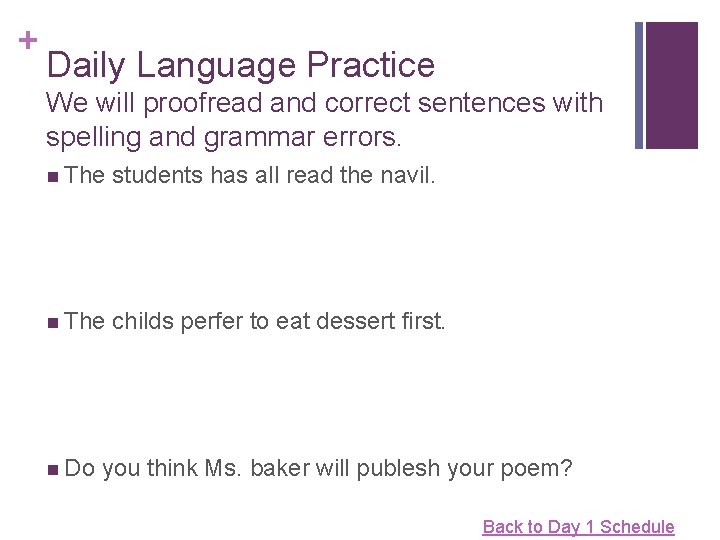
+ Daily Language Practice We will proofread and correct sentences with spelling and grammar errors. n The students has all read the navil. n The childs perfer to eat dessert first. n Do you think Ms. baker will publesh your poem? Back to Day 1 Schedule
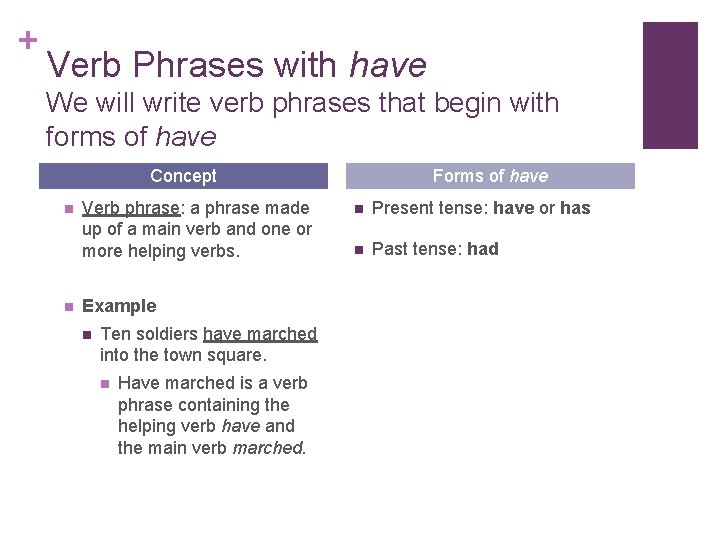
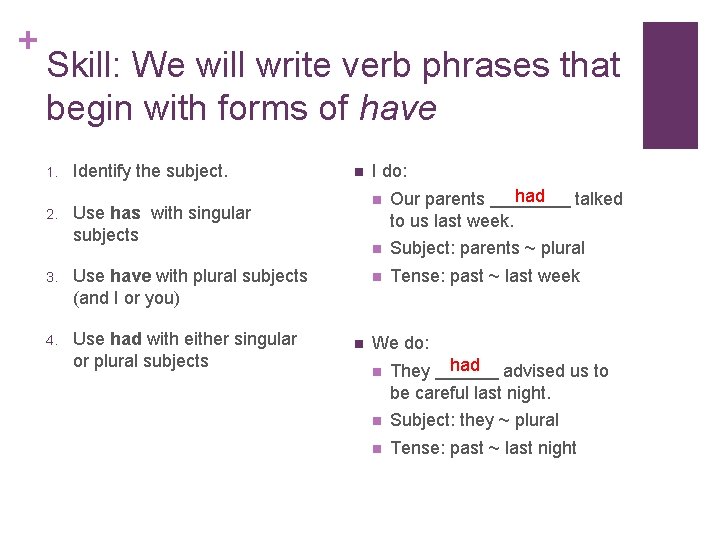
+ Verb Phrases with have We will write verb phrases that begin with forms of have Concept n n Verb phrase: a phrase made up of a main verb and one or more helping verbs. Example n Ten soldiers have marched into the town square. n Have marched is a verb phrase containing the helping verb have and the main verb marched. Forms of have n Present tense: have or has n Past tense: had
+ Skill: We will write verb phrases that begin with forms of have 1. 2. Identify the subject. n n Use has with singular subjects 3. Use have with plural subjects (and I or you) 4. Use had with either singular or plural subjects I do: n had Our parents to us last week. talked n Subject: parents ~ plural n Tense: past ~ last week We do: n They had advised us to be careful last night. n Subject: they ~ plural n Tense: past ~ last night
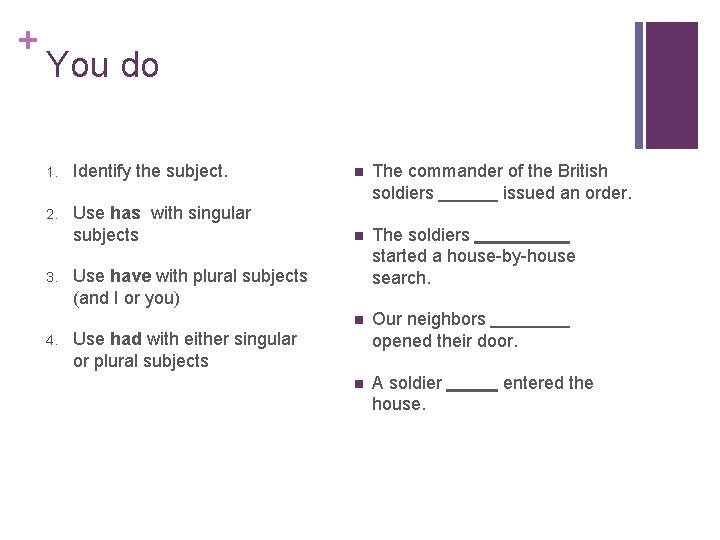
+ You do 1. Identify the subject. n 2. Use has with singular subjects The commander of the British soldiers issued an order. n The soldiers started a house-by-house search. n Our neighbors opened their door. n A soldier house. 3. 4. Use have with plural subjects (and I or you) Use had with either singular or plural subjects entered the
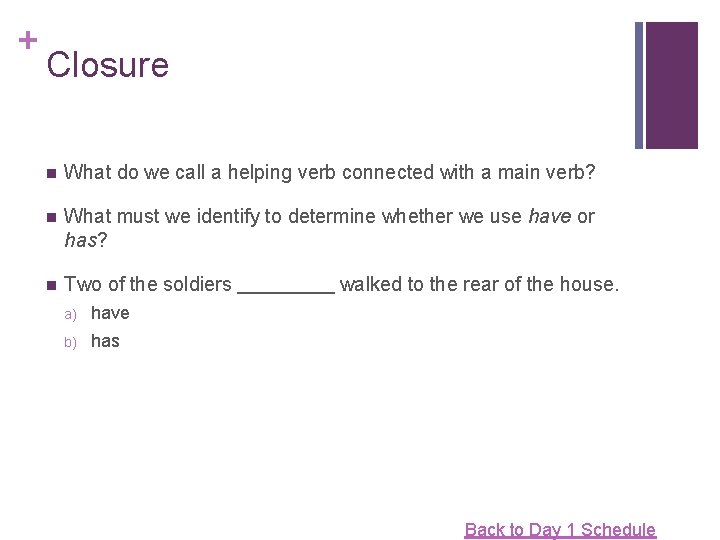
+ Closure n What do we call a helping verb connected with a main verb? n What must we identify to determine whether we use have or has? n Two of the soldiers a) have b) has walked to the rear of the house. Back to Day 1 Schedule
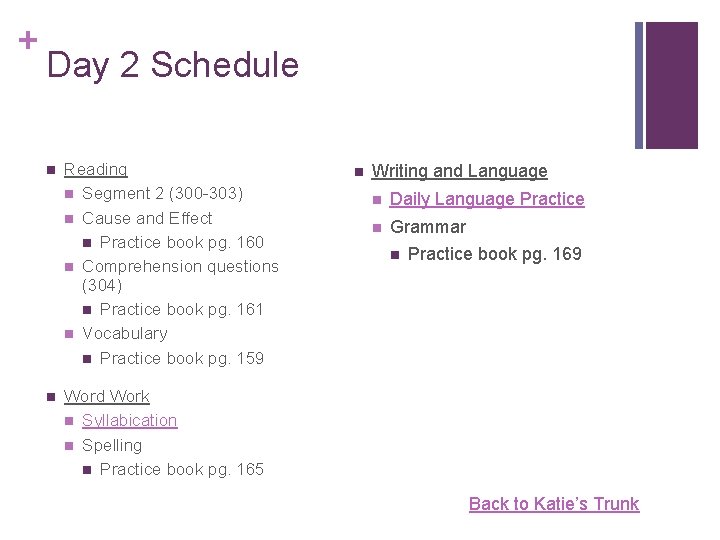
+ Day 2 Schedule n n Reading n Segment 2 (300 -303) n Cause and Effect n Practice book pg. 160 n Comprehension questions (304) n Practice book pg. 161 n Vocabulary n Practice book pg. 159 n Writing and Language n Daily Language Practice n Grammar n Practice book pg. 169 Word Work n Syllabication n Spelling n Practice book pg. 165 Back to Katie’s Trunk
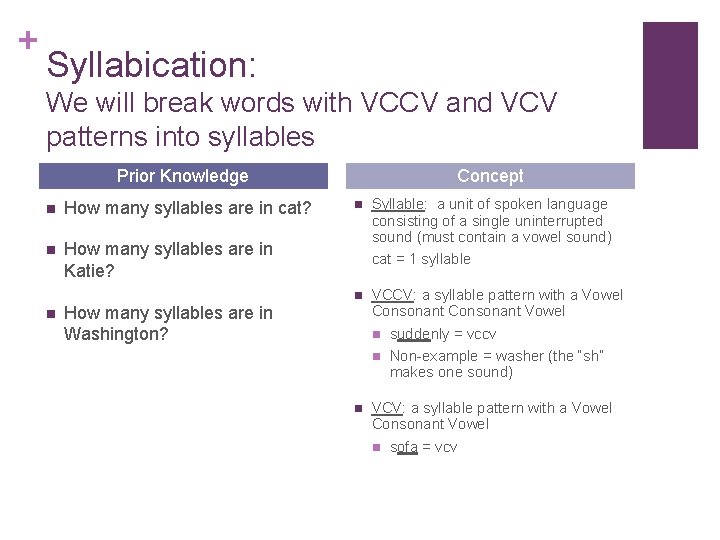
+ Syllabication: We will break words with VCCV and VCV patterns into syllables Prior Knowledge n How many syllables are in cat? n How many syllables are in Katie? n How many syllables are in Washington? Concept n Syllable: a unit of spoken language consisting of a single uninterrupted sound (must contain a vowel sound) cat = 1 syllable n VCCV: a syllable pattern with a Vowel Consonant Vowel n suddenly = vccv n Non-example = washer (the “sh” makes one sound) n VCV: a syllable pattern with a Vowel Consonant Vowel n sofa = vcv
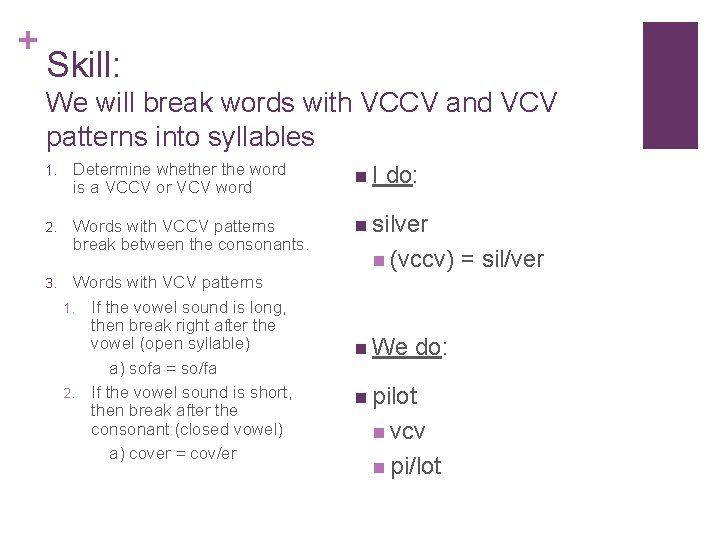
+ Skill: We will break words with VCCV and VCV patterns into syllables 1. Determine whether the word is a VCCV or VCV word n. I 2. Words with VCCV patterns break between the consonants. n silver 3. Words with VCV patterns 1. If the vowel sound is long, then break right after the vowel (open syllable) a) sofa = so/fa 2. If the vowel sound is short, then break after the consonant (closed vowel) a) cover = cov/er do: n (vccv) n We do: n pilot n vcv n pi/lot = sil/ver
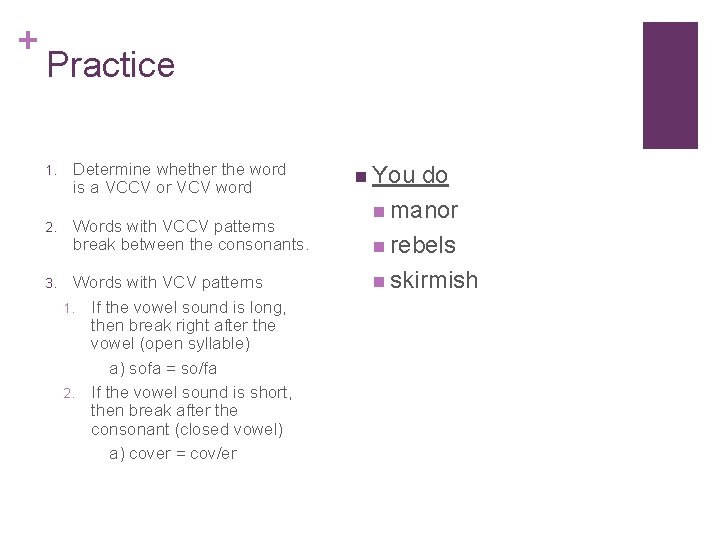
+ Practice 1. Determine whether the word is a VCCV or VCV word 2. Words with VCCV patterns break between the consonants. 3. Words with VCV patterns 1. If the vowel sound is long, then break right after the vowel (open syllable) a) sofa = so/fa 2. If the vowel sound is short, then break after the consonant (closed vowel) a) cover = cov/er n You do n manor n rebels n skirmish
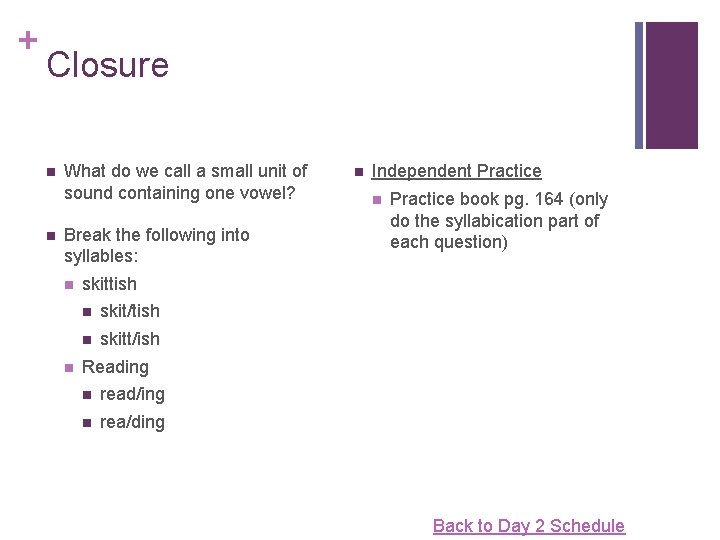
+ Closure n n What do we call a small unit of sound containing one vowel? Break the following into syllables: n n n Independent Practice n Practice book pg. 164 (only do the syllabication part of each question) skittish n skit/tish n skitt/ish Reading n read/ing n rea/ding Back to Day 2 Schedule
+ Daily Language Practice We will proofread and correct sentences with grammar and spelling errors. n Prehaps we could take a walk in the rain n When did Jan learn you how to draw a toolip? Back to Day 2 Schedule
+ Day 3 Schedule n Reading Writing and Language n Partner Read n Daily Language Practice n Cause and Effect n Grammar (309 L) n n n Practice book pg. 162 -163 Word work n Greek root geo n Spelling n Practice book pg. 166 Back to Katie’s Trunk
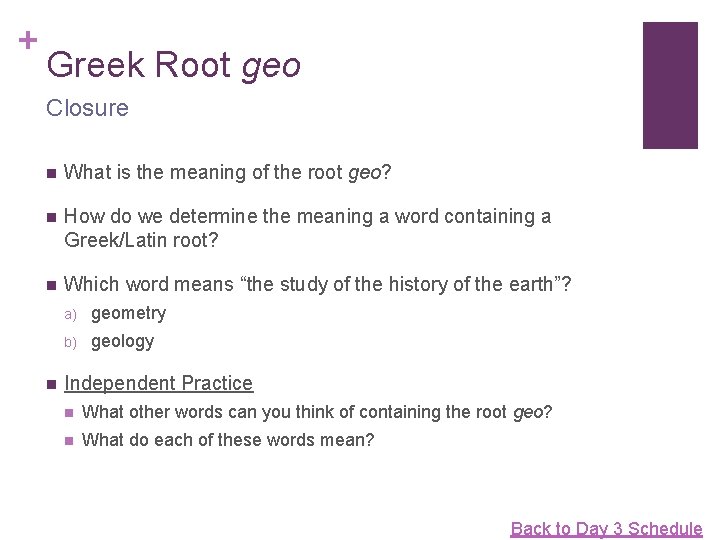
+ Greek Root ~ geo Objective: We will analyze the meaning of geo, and generate a list of words with this root. Concept n Geo: a Greek root meaning “earth” n Example: n I love to look at pictures of our country’s geography. n Geography means “study of the earth” Importance n Recognizing word roots can help you figure out the meaning of words you do not recognize.
+ Greek Root geo Skill n Highlight the word root n Look at the remainder of the word n n What does the prefix mean n What does the suffix mean Use context clues to help define the word. Practice n I do n The professor identified the geographical location of the enormous volcano. n We do n The geologist tried to determine the age of the skeleton by studying the rocks around it. n You do n Yesterday a geographer discovered a new type of plant.
+ Greek Root geo Closure n What is the meaning of the root geo? n How do we determine the meaning a word containing a Greek/Latin root? n Which word means “the study of the history of the earth”? n a) geometry b) geology Independent Practice n What other words can you think of containing the root geo? n What do each of these words mean? Back to Day 3 Schedule
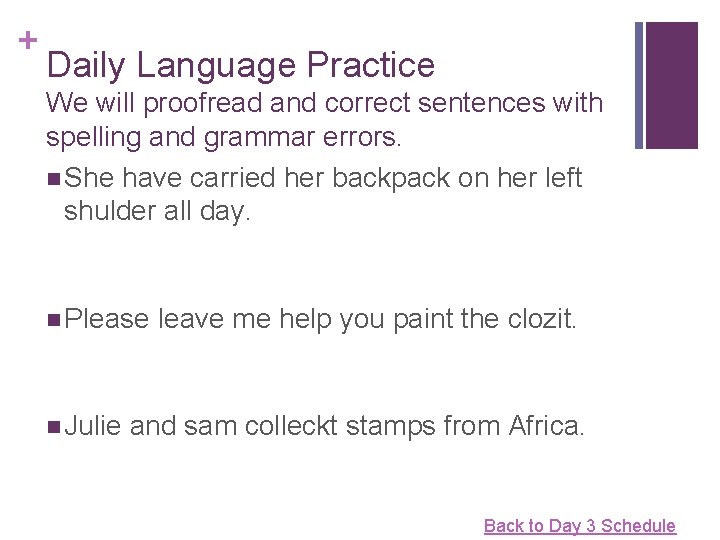
+ Daily Language Practice We will proofread and correct sentences with spelling and grammar errors. n She have carried her backpack on her left shulder all day. n Please n Julie leave me help you paint the clozit. and sam colleckt stamps from Africa. Back to Day 3 Schedule
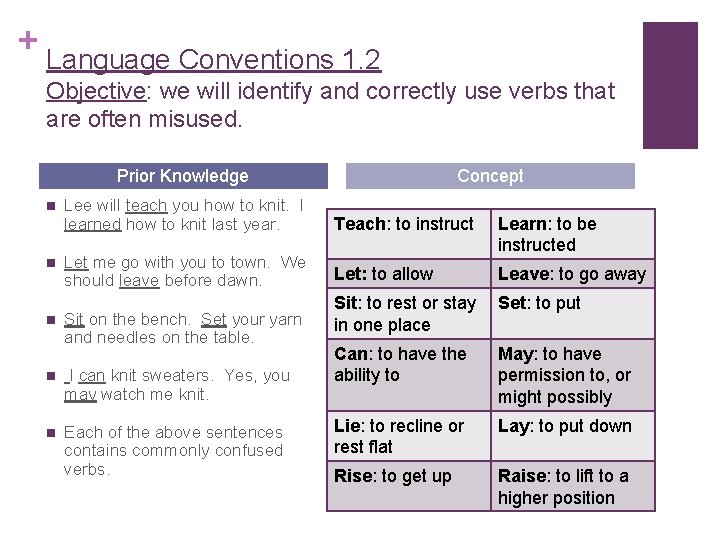
+ Language Conventions 1. 2 Objective: we will identify and correctly use verbs that are often misused. Prior Knowledge Concept n Lee will teach you how to knit. I learned how to knit last year. Teach: to instruct n Let me go with you to town. We should leave before dawn. Learn: to be instructed Let: to allow Leave: to go away Sit: to rest or stay in one place Set: to put Can: to have the ability to May: to have permission to, or might possibly Lie: to recline or rest flat Lay: to put down Rise: to get up Raise: to lift to a higher position n Sit on the bench. Set your yarn and needles on the table. n I can knit sweaters. Yes, you may watch me knit. n Each of the above sentences contains commonly confused verbs.
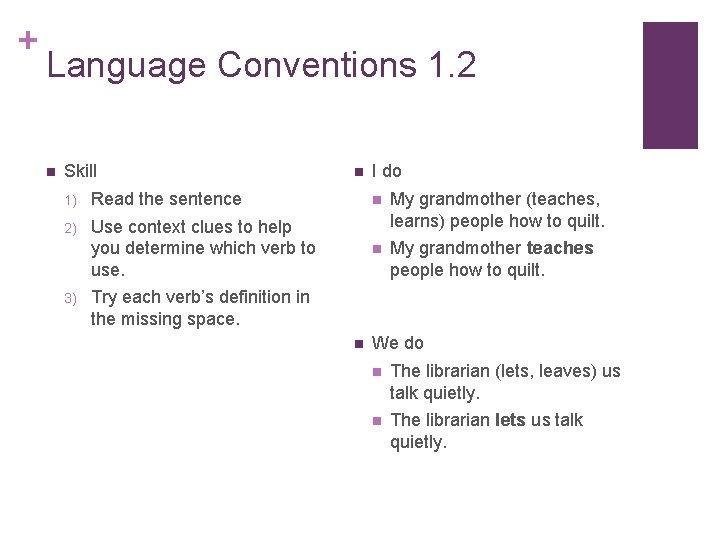
+ Language Conventions 1. 2 n Skill n I do 1) Read the sentence n 2) Use context clues to help you determine which verb to use. My grandmother (teaches, learns) people how to quilt. n My grandmother teaches people how to quilt. 3) Try each verb’s definition in the missing space. n We do n The librarian (lets, leaves) us talk quietly. n The librarian lets us talk quietly.
+ Language Conventions 1. 2 n Skill n You do: 1) Read the sentence n 2) Use context clues to help you determine which verb to use. We usually (sit, set) in the chairs by the window. n Who (can, may) reach the jar on the top shelf for me? n Pat (teaches, learns) by reading books. n When we talk too loudly, she asks us to (let, leave). n Sometimes we help her (sit, set) books on display stands. 3) Try each verb’s definition in the missing space.
+ Language Conventions 1. 2 n What word means to instruct? n Learn n teach n What word means to go away? n Let n leave n What word means to put? n Set n Sit n How do you know which verb to use? n You (can, may) borrow my binoculars if you promise to keep them dry. n Independent practice n Practice book pg. 170 Back to Day 3 Schedule
+ Day 4 Schedule n n Reading n Using Text Features n “In Their Own Words” (306309) n Writing and Language n Daily Language Practice Word Work n Spelling n Practice book pg. 167 Back to Katie’s Trunk
+ Using text features Prior Knowledge Concept n What do we know about the Tories and the Patriots from reading Katie’s Trunk? n Primary sources: writing done by the person experiencing the event n Objective: We will analyze text features to determine how people felt about the conflict in the colonies n Example: a letter written by someone during the American Revolution
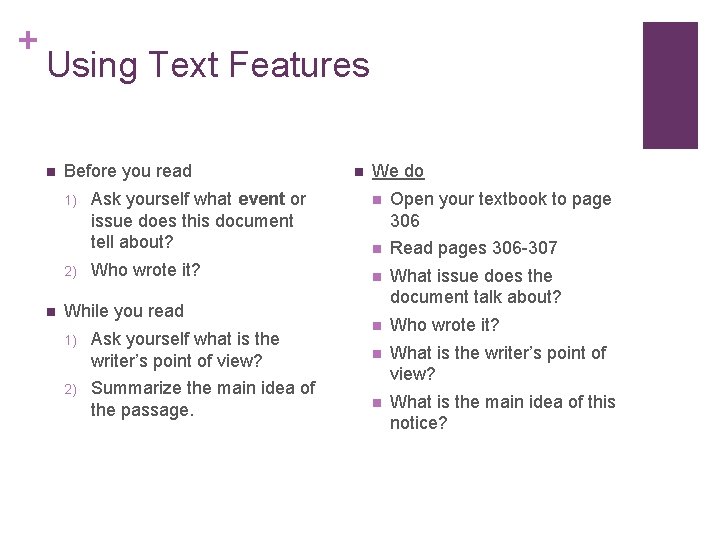
+ Using Text Features n Before you read 1) 2) n Ask yourself what event or issue does this document tell about? Who wrote it? While you read 1) Ask yourself what is the writer’s point of view? 2) Summarize the main idea of the passage. n We do n Open your textbook to page 306 n Read pages 306 -307 n What issue does the document talk about? n Who wrote it? n What is the writer’s point of view? n What is the main idea of this notice?
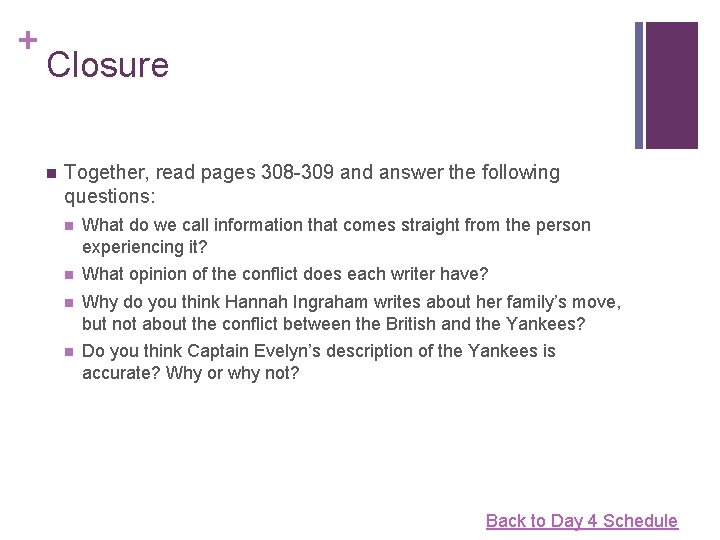
+ Closure n Together, read pages 308 -309 and answer the following questions: n What do we call information that comes straight from the person experiencing it? n What opinion of the conflict does each writer have? n Why do you think Hannah Ingraham writes about her family’s move, but not about the conflict between the British and the Yankees? n Do you think Captain Evelyn’s description of the Yankees is accurate? Why or why not? Back to Day 4 Schedule
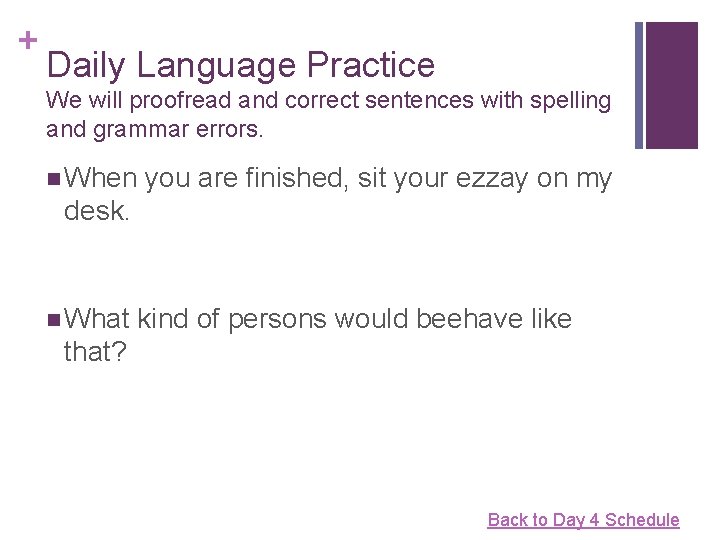
+ Daily Language Practice We will proofread and correct sentences with spelling and grammar errors. n When you are finished, sit your ezzay on my desk. n What kind of persons would beehave like that? Back to Day 4 Schedule
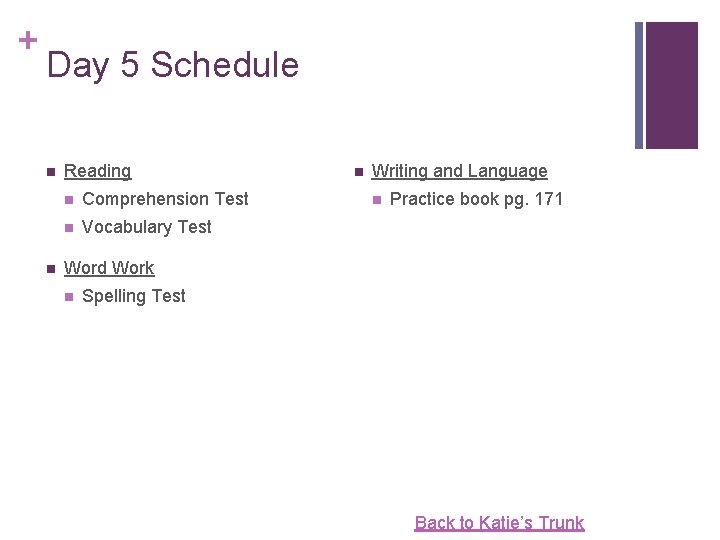
+ Day 5 Schedule n n Reading n Comprehension Test n Vocabulary Test n Writing and Language n Practice book pg. 171 Word Work n Spelling Test Back to Katie’s Trunk