
Kata Kolok A Villagebased Sign Language of Northern

Kata Kolok: A Village-based Sign Language of Northern Bali Connie de Vos, Max Planck Institute for Psycholinguistics, Nijmegen, the Netherlands at International Symposium On The Languages Of Java 15 th - 17 th August 2007, Semarang, Java, Indonesia Connie. de. Vos@mpi. nl
Sign Linguistics Some misconceptions on sign languages: • Sign language is an artificial signed version of the spoken language • Sign language is like pantomime or gesture • There is one universal sign language
Sign Linguistics Started half a century ago with research on: • Sign Language of the Netherlands (Tervoort, 1953) • American Sign Language (Stokoe, 1960) Sign languages are natural languages which parallel the structures and acquisition of spoken languages in many ways. (Meier, Cormier, & Quinto-Pozos, 2002)
Sign Linguistics Most of what we know on the structure of sign languages is based on research in Western sign languages. Non-Western sign languages and so-called village-based sign languages were not included in typological studies until recently

Desa Kolok: a deaf village • • Clan culture Hindu 2, 200 people : 47 deaf (2%) Deafness has been in the village for 12 generations • Two thirds of hearing people use the local sign language: Kata Kolok • Deaf are well integrated into the community
Sociolinguistic settings Deaf villages • Social and/or geographic isolation of village • High incidence of deafness, for long periods of time • Sign language used by both deaf and hearing • Integration of deaf in community life Urban signing communities • Most deaf children are born to hearing parents (late L 1 acquisition) • Deafness causes isolation from hearing majority • Institutionalized – Mouthings, fingerspelling – Standardization of vocabulary

Deaf villages across the globe Martha’s Vineyard SL USA Kajana SL Suriname Providence Island – Colombia Country Sign - Jamaica Ban Khor SL - Thailand Kata Kolok - Indonesia Yucatan Mayan Sign - Mexico Urubu-Kaapor SL - Brasil Adamorobe SL – Ghana Al-Sayyid Bedouin SL Israel

Why village-based sign languages are interesting • Time depth: relationship between age and language structure • First language acquistion: deaf children growing up in rich signing environment • Sign language typology: village-based sign languages seem to lack structures found in larger national sign languages • Bilingualisme: two languages from different modalities

Village-based sign languages • Understudied, underdocumented • Endangered by the use of dominant national sign languages in government institutions for the deaf (Nonaka, 2004)

Current project • Building a corpus including data from: – elicited material to compare to other sign languages – (semi)spontaneous conversations – deaf and hearing signers (of varying proficiences) – child signing • 1 hearing baby of deaf parents (4 months) • 2 deaf toddlers • 2 6 -year-olds, one hearing, one deaf
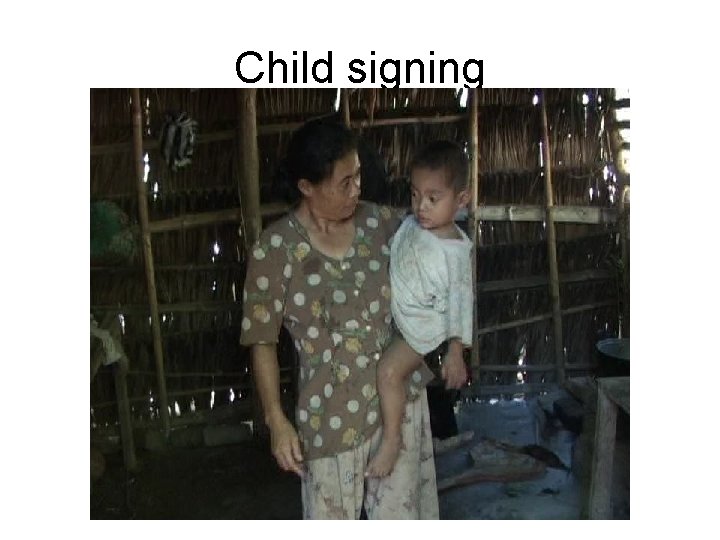
Child signing
Current project • Building a corpus • Setting up deaf school in cooperation with one of the elementary schools providing edcation with Kata Kolok as language of instruction

Kata Kolok & Balinese Shared elements • emblems (lexical signs), • negation markers (headshake, handwave)

Kata Kolok & Balinese (Marsaja, forthcoming) Kata Kolok is not based on the surrounding languages spoken Indonesian or spoken Balinese, nor on Indonesian Sign Language. However, some gestural aspects of spoken Balinese have entered Kata Kolok. No language-internal (linguistic) aspects based entered Kata Kolok, and this may be due to lack of institutionalization.
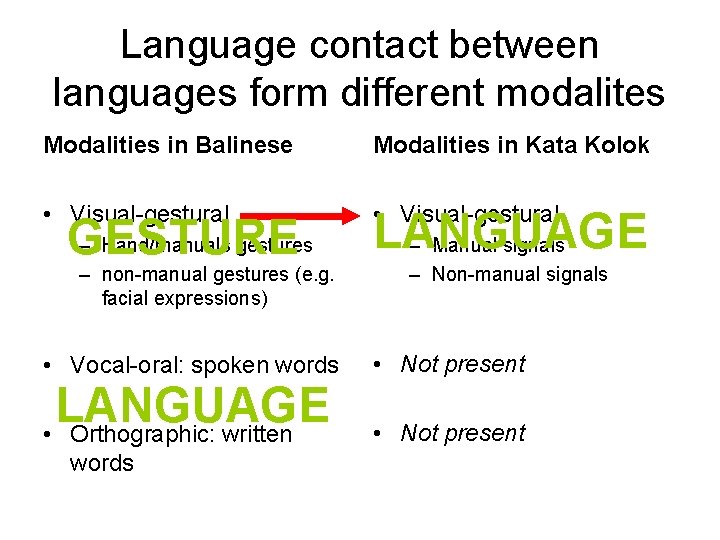
Language contact between languages form different modalites Modalities in Balinese Modalities in Kata Kolok • Visual-gestural – Hand/manuals gestures GESTURE – non-manual gestures (e. g. facial expressions) LANGUAGE – Manual signals – Non-manual signals • Vocal-oral: spoken words • Not present LANGUAGE • Orthographic: written • Not present words
Research question • What is gestural and what is linguistic in a signed language? • How do gestural elements from Balinese get incorporated into Kata Kolok?
Pointing • Pointing is one of the primordial forms of language (Kita, 2003) • However, it is considered gestural in spoken languages. • One in every 5. 7 signs in Kata Kolok is an index finger point
Pointing debate (in sign language literature) • Some (Engberg-Pedersen, Lillo-Martin a. o. ) have analyzed pointing signs in sign languages linguistically as: – – Pronouns Determiners Verbs of movement and location Auxiliaries These forms are directed to grammatical (spatial) loci
Pointing debate • Others (Liddell a. o. ) give a non-linguistic account: – Loci cannot be implemented phonologically. – Pointing signs (and agreement verbs) behave differently if the referent is not present. – Infinite number of pronouns is inconceivable in a language Pointing signs are directed to (mental) entities, not loci. Pointing and related phenomena are a process of association.
Pointing debate • Middle position: Although pointing signs may have originated from co-speech pointing gestures, they have been grammatized in sign language structure. In some cases they may still be gesture-like.
Gesture versus language Okrent (2002) A modality-free notion of gesture How do meaning and form relate? – Conventionalisation – Gradual, continuous meaning
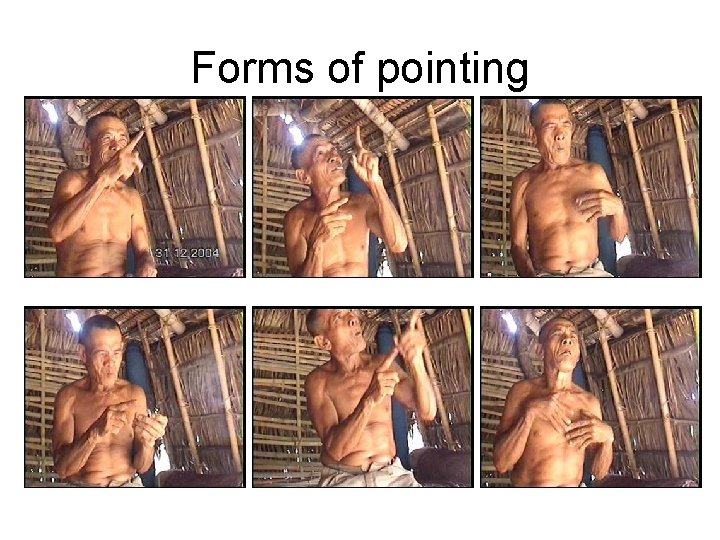
Forms of pointing
Approach • Annotation of form of pointing: – Index finger, full hand, lips pointing – Palm orientation – Shape of finger (bend, straight, lax) – Movement – Eye gaze • Indentify the way the form of pointing correlations with the type of referent
Conclusions • Village-based sign languages provide valuable input for linguistic theory • In order to know what is gestural and linguistic in signed and spoken languages we should compare face-to-face interactions in both cases • Linguistic theory needs a definition of gesture which not based on modality alone
References Engberg-Pedersen, E. (2003). From pointing to Reference and Predication: Pointing Sgns, Eyegaze, and Head and Body Orientation in Danish Sign Language. In S. Kita (Ed. ), Pointing: Where Language, Culture, and Cognition meet (pp. 269 -292). Mahwah, New Jersey: Lawrence Erlbaum. Kita, S. (Ed. ). (2003). Pointing: Where Language, Culture, and Cognition Meet. Mahwah, New Jersey, London: Lawrence Erlbaum Associates, Publishers. Liddell, S. (2000). Blended spaces and deixis in sign language discourse. In D. Mc. Neill (Ed. ), Language and Gesture (pp. 331 -357). Cambridge: Cambridge University Press. Marsaja, I. G. (forthcoming). Desa Kolok - A deaf village and its sign language in Bali, Indonesia. Nijmegen: Ishara Press. Okrent, A. (2000). A modality free notion of gesture and how it can help us with the morpheme vs. gesture question in sign language linguistics (or at least give us some criteria to work with). In R. P. Meier, K. Cormier & D. Quintos. Pozos (Eds. ), Modality and structure in signed and spoken languages (pp. 175– 198). Cambridge, UK: Cambridge University Press.
- Slides: 25