
Karyotype analysis I Learning objectives At the end
Karyotype analysis I
Learning objectives • At the end of the session you should be able to • Describe the karyotype analysis procedure, karyotype and clinical features of chromosomal abnormalities (numerical) • Polyploidy: • Triploidy (69, XXX or 69, XXY) • Tetraploidy (92, XXXX or 92, XXYY) • Aneuploidy: sex chromosome • monosomy – 45, X (Turner syndrome) • Trisomy – 47, XXY (Klinefelter syndrome)

Karyotype analysis: Introduction • Karyotyping: the process of pairing and ordering all the chromosome of an individual -> pictorial /photographic representation <- size order • Example: 46, XX; 46, XY; 104, Carp; 8, Fruit fly Tang, Q. , Chen, Q. , Lai, X. & Lui, S. , 2013. Malignant Transformation Potentials of Human Umbilical Cord Mesenchymal Stem Cells Both Spontaneously and via 3 -Methycholanthrene Induction. PLo. S ONE, 8(12), p. e 81844.
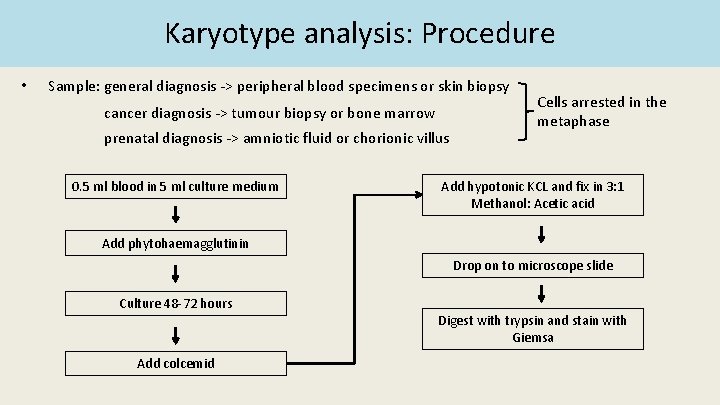
Karyotype analysis: Procedure • Sample: general diagnosis -> peripheral blood specimens or skin biopsy cancer diagnosis -> tumour biopsy or bone marrow prenatal diagnosis -> amniotic fluid or chorionic villus 0. 5 ml blood in 5 ml culture medium Cells arrested in the metaphase Add hypotonic KCL and fix in 3: 1 Methanol: Acetic acid Add phytohaemagglutinin Drop on to microscope slide Culture 48 -72 hours Add colcemid Digest with trypsin and stain with Giemsa
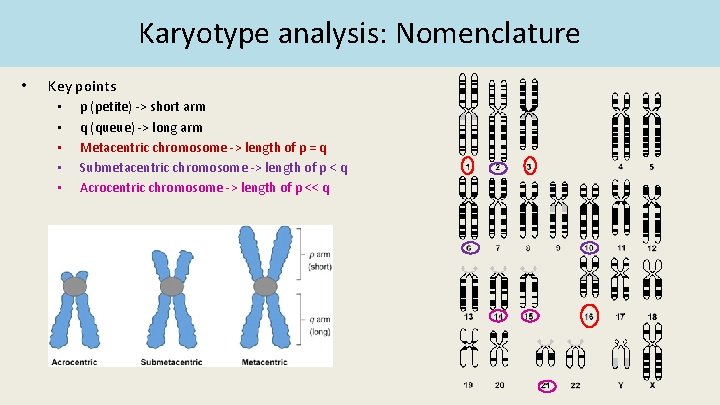
Karyotype analysis: Nomenclature • Key points • • • p (petite) -> short arm q (queue) -> long arm Metacentric chromosome -> length of p = q Submetacentric chromosome -> length of p < q Acrocentric chromosome -> length of p << q
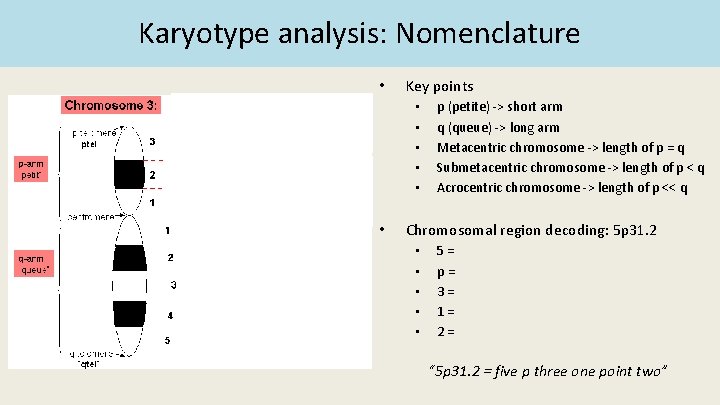
Karyotype analysis: Nomenclature • Key points • • • p (petite) -> short arm q (queue) -> long arm Metacentric chromosome -> length of p = q Submetacentric chromosome -> length of p < q Acrocentric chromosome -> length of p << q Chromosomal region decoding: 5 p 31. 2 • • • 5= p= 3= 1= 2= “ 5 p 31. 2 = five p three one point two”
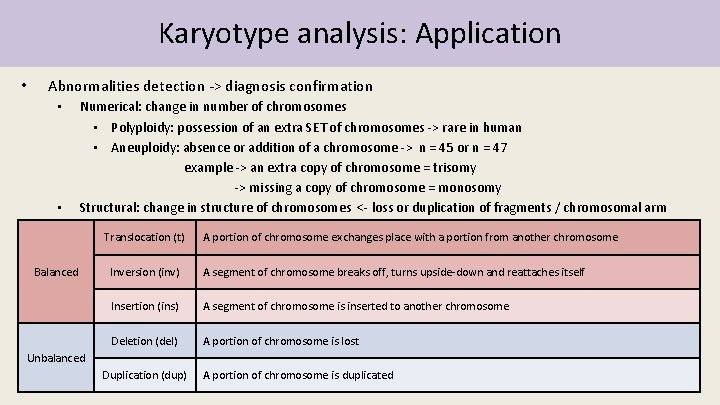
Karyotype analysis: Application • Abnormalities detection -> diagnosis confirmation • • Numerical: change in number of chromosomes • Polyploidy: possession of an extra SET of chromosomes -> rare in human • Aneuploidy: absence or addition of a chromosome -> n = 45 or n = 47 example -> an extra copy of chromosome = trisomy -> missing a copy of chromosome = monosomy Structural: change in structure of chromosomes <- loss or duplication of fragments / chromosomal arm Translocation (t) Balanced A portion of chromosome exchanges place with a portion from another chromosome Inversion (inv) A segment of chromosome breaks off, turns upside-down and reattaches itself Insertion (ins) A segment of chromosome is inserted to another chromosome Deletion (del) A portion of chromosome is lost Unbalanced Duplication (dup) A portion of chromosome is duplicated
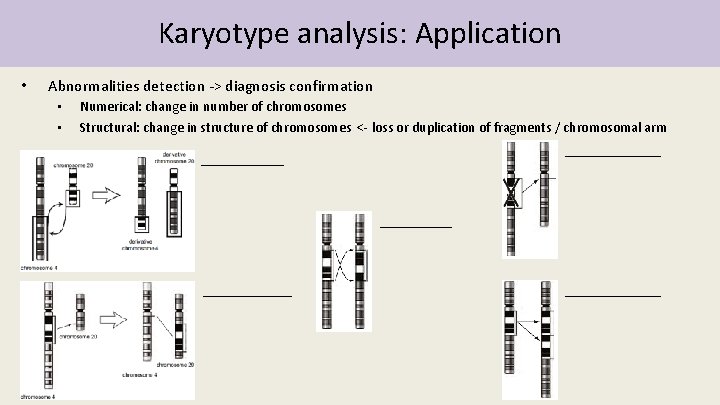
Karyotype analysis: Application • Abnormalities detection -> diagnosis confirmation • • Numerical: change in number of chromosomes Structural: change in structure of chromosomes <- loss or duplication of fragments / chromosomal arm ________ _______________
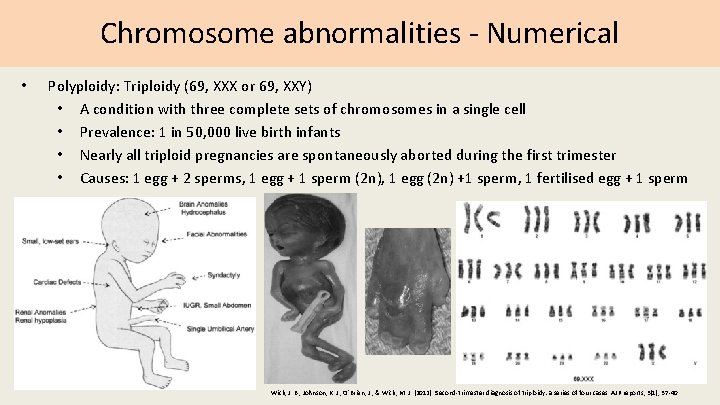
Chromosome abnormalities - Numerical • Polyploidy: Triploidy (69, XXX or 69, XXY) • A condition with three complete sets of chromosomes in a single cell • Prevalence: 1 in 50, 000 live birth infants • Nearly all triploid pregnancies are spontaneously aborted during the first trimester • Causes: 1 egg + 2 sperms, 1 egg + 1 sperm (2 n), 1 egg (2 n) +1 sperm, 1 fertilised egg + 1 sperm Wick, J. B. , Johnson, K. J. , O'Brien, J. , & Wick, M. J. (2012). Second-trimester diagnosis of triploidy: a series of four cases. AJP reports, 3(1), 37 -40.
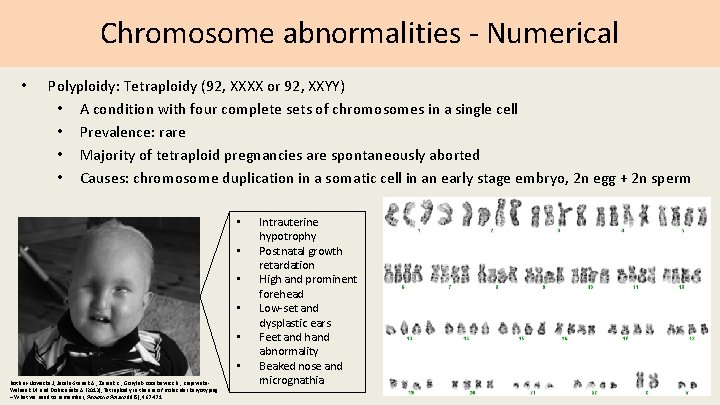
Chromosome abnormalities - Numerical • Polyploidy: Tetraploidy (92, XXXX or 92, XXYY) • A condition with four complete sets of chromosomes in a single cell • Prevalence: rare • Majority of tetraploid pregnancies are spontaneously aborted • Causes: chromosome duplication in a somatic cell in an early stage embryo, 2 n egg + 2 n sperm • • • Bothur-Nowacka J, Jezela-Stanek A. , Zaniuk K. , Goryluk-Kozakiewicz B. , Krajewska. Walasek M. and Dobrzańska A (2013), Tetraploidy in the era of molecular karyotyping – What we need to remember, Pediatria Polska 88(5), 467 -471 Intrauterine hypotrophy Postnatal growth retardation High and prominent forehead Low-set and dysplastic ears Feet and hand abnormality Beaked nose and micrognathia
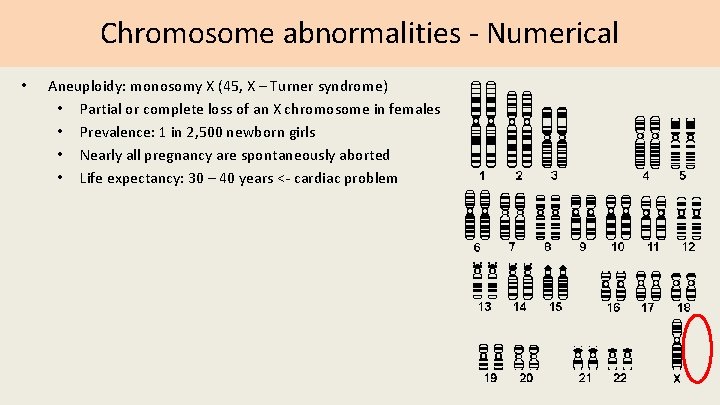
Chromosome abnormalities - Numerical • Aneuploidy: monosomy X (45, X – Turner syndrome) • Partial or complete loss of an X chromosome in females • Prevalence: 1 in 2, 500 newborn girls • Nearly all pregnancy are spontaneously aborted • Life expectancy: 30 – 40 years <- cardiac problem
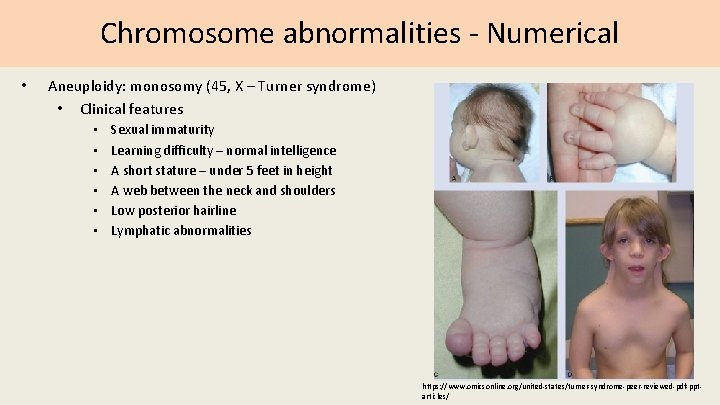
Chromosome abnormalities - Numerical • Aneuploidy: monosomy (45, X – Turner syndrome) • Clinical features • • • Sexual immaturity Learning difficulty – normal intelligence A short stature – under 5 feet in height A web between the neck and shoulders Low posterior hairline Lymphatic abnormalities https: //www. omicsonline. org/united-states/turner-syndrome-peer-reviewed-pdf-pptarticles/
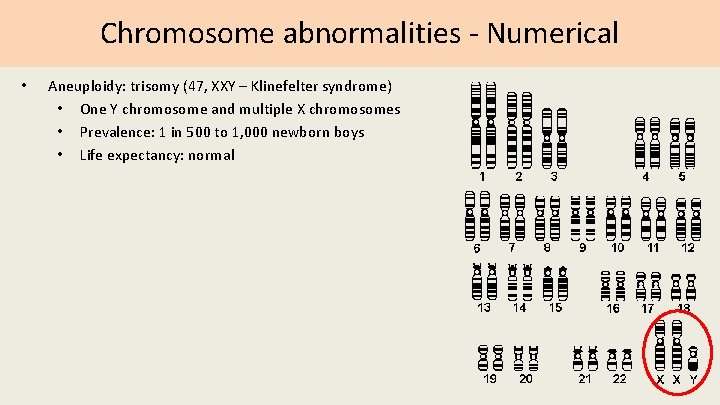
Chromosome abnormalities - Numerical • Aneuploidy: trisomy (47, XXY – Klinefelter syndrome) • One Y chromosome and multiple X chromosomes • Prevalence: 1 in 500 to 1, 000 newborn boys • Life expectancy: normal
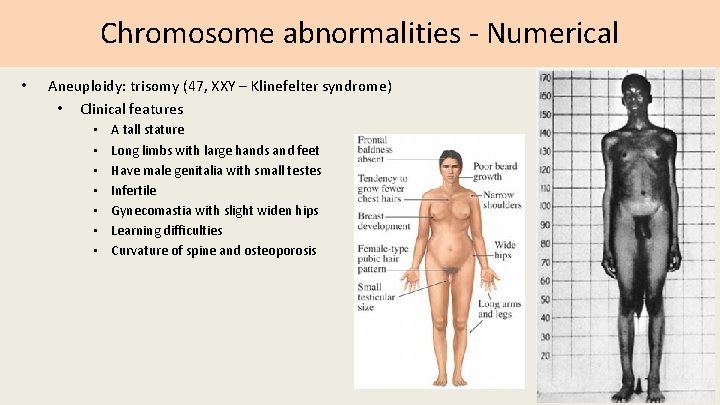
Chromosome abnormalities - Numerical • Aneuploidy: trisomy (47, XXY – Klinefelter syndrome) • Clinical features • • A tall stature Long limbs with large hands and feet Have male genitalia with small testes Infertile Gynecomastia with slight widen hips Learning difficulties Curvature of spine and osteoporosis
Learning objectives • At the end of the session you should be able to • Describe the karyotype analysis procedure, karyotype and clinical features of chromosomal abnormalities (numerical) • Polyploidy: • Triploidy (69, XXX or 69, XXY) • Tetraploidy (92, XXXX or 92, XXYY) • Aneuploidy: sex chromosome • monosomy – 45, X (Turner syndrome) • Trisomy – 47, XXY (Klinefelter syndrome)
- Slides: 15