
Karthik Sundaramoorthy Zach Purser Eric Rotenberg North Carolina
Karthik Sundaramoorthy Zach Purser Eric Rotenberg North Carolina State University Michael Keller Improving both Performance and Fault Tolerance 5/21/2021 Slipstream Processor: Department of Electrical and Computer Engineering Graduate Research Center, Campus Box 7914, Raleigh, NC 27695 {ksundar, zrpurser, ericro}@ece. ncsu. edu, www. tinker. ncsu. edu/ericro/slipstream ASPLOS 2000 Presented by Michael Keller 1

5/21/2021 Michael Keller BACKGROUND, PROBLEM & GOAL 2
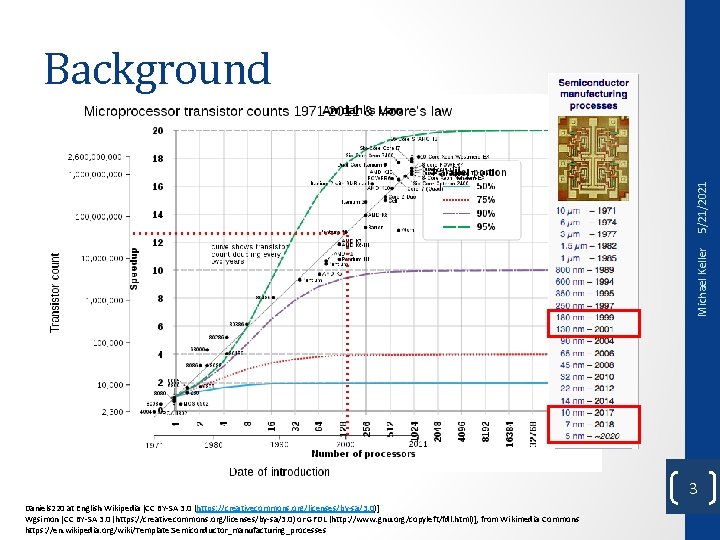
Michael Keller 5/21/2021 Background 3 Daniels 220 at English Wikipedia [CC BY-SA 3. 0 (https: //creativecommons. org/licenses/by-sa/3. 0)] Wgsimon [CC BY-SA 3. 0 (https: //creativecommons. org/licenses/by-sa/3. 0) or GFDL (http: //www. gnu. org/copyleft/fdl. html)], from Wikimedia Commons https: //en. wikipedia. org/wiki/Template: Semiconductor_manufacturing_processes
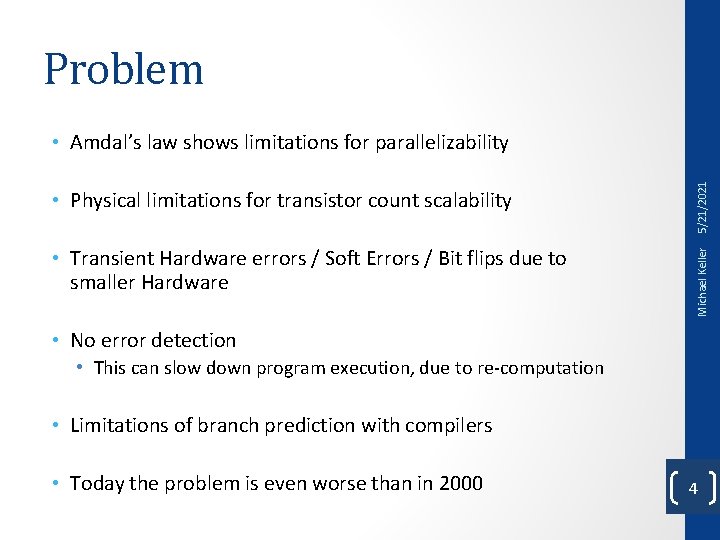
Problem • Transient Hardware errors / Soft Errors / Bit flips due to smaller Hardware Michael Keller • Physical limitations for transistor count scalability 5/21/2021 • Amdal’s law shows limitations for parallelizability • No error detection • This can slow down program execution, due to re-computation • Limitations of branch prediction with compilers • Today the problem is even worse than in 2000 4
• Use multiple hardware context to speed up single thread execution by prefetching a perfect program prediction • Improve fault tolerance • Comparison of different hardware context to detect and adjust incorrect executions Michael Keller • Improve performance 5/21/2021 Goal 5

KEY IDEA 6 Michael Keller 5/21/2021
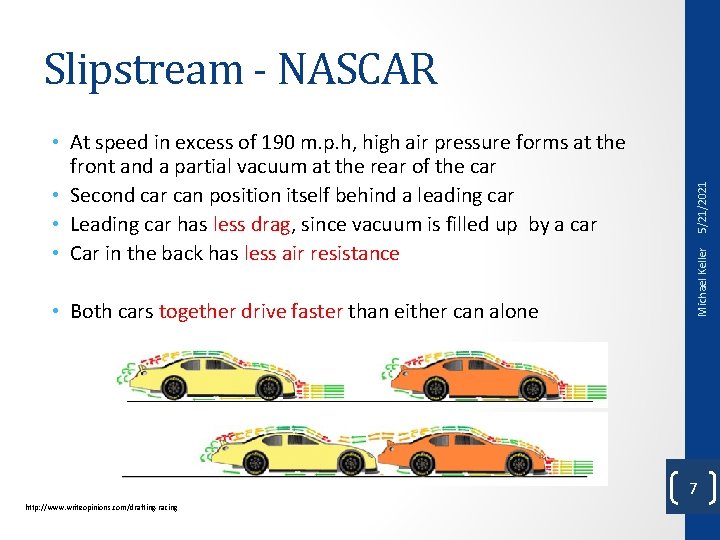
• Both cars together drive faster than either can alone Michael Keller • At speed in excess of 190 m. p. h, high air pressure forms at the front and a partial vacuum at the rear of the car • Second car can position itself behind a leading car • Leading car has less drag, since vacuum is filled up by a car • Car in the back has less air resistance 5/21/2021 Slipstream - NASCAR 7 http: //www. writeopinions. com/drafting-racing
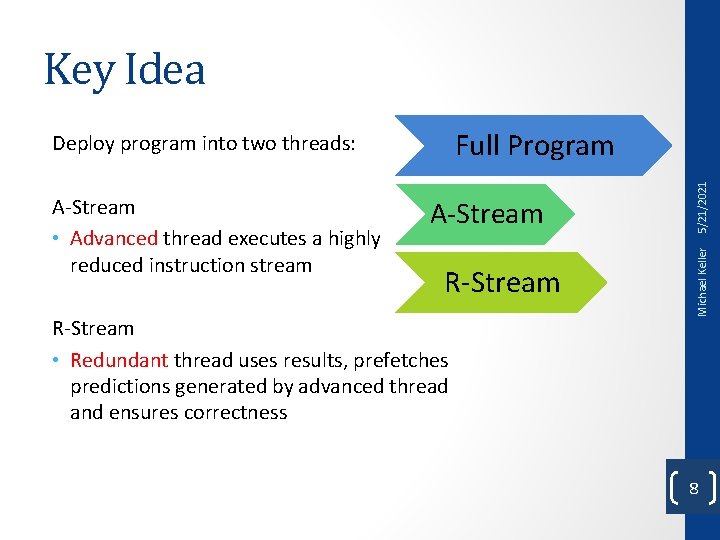
Key Idea A-Stream R-Stream • Redundant thread uses results, prefetches predictions generated by advanced thread and ensures correctness Michael Keller A-Stream • Advanced thread executes a highly reduced instruction stream 5/21/2021 Full Program Deploy program into two threads: 8
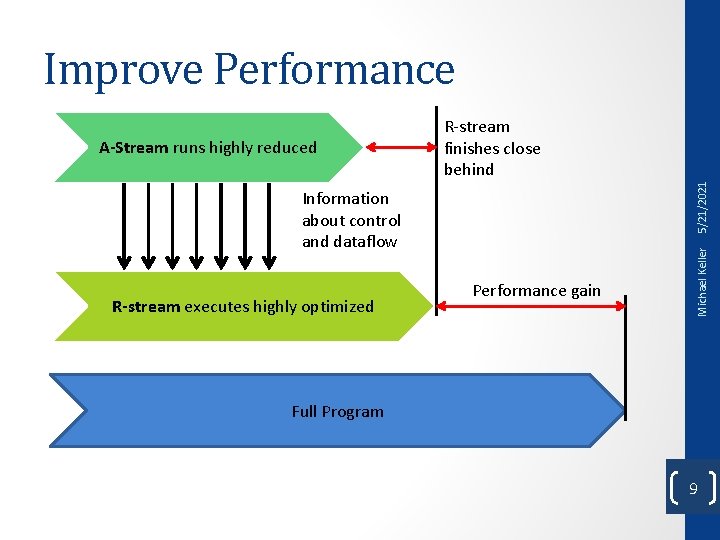
Improve Performance 5/21/2021 Information about control and dataflow R-stream executes highly optimized Performance gain Michael Keller A-Stream runs highly reduced R-stream finishes close behind Full Program 9
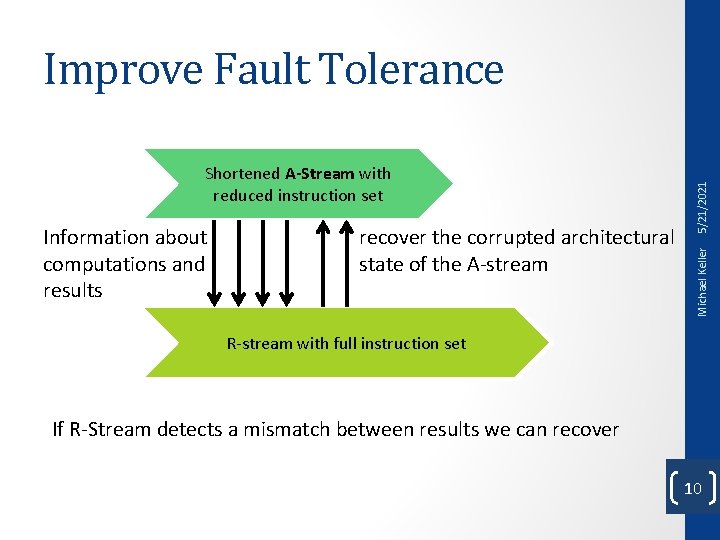
Information about computations and results recover the corrupted architectural state of the A-stream Michael Keller Shortened A-Stream with reduced instruction set 5/21/2021 Improve Fault Tolerance R-stream with full instruction set If R-Stream detects a mismatch between results we can recover 10

MECHANISMS 11 Michael Keller 5/21/2021
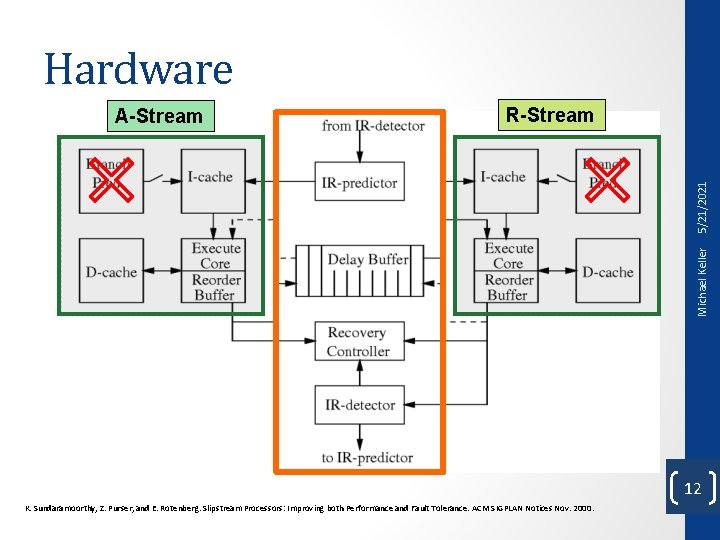
Hardware R-Stream Michael Keller 5/21/2021 A-Stream 12 K. Sundaramoorthy, Z. Purser, and E. Rotenberg. Slipstream Processors: Improving both Performance and Fault Tolerance. ACM SIGPLAN Notices Nov. 2000.
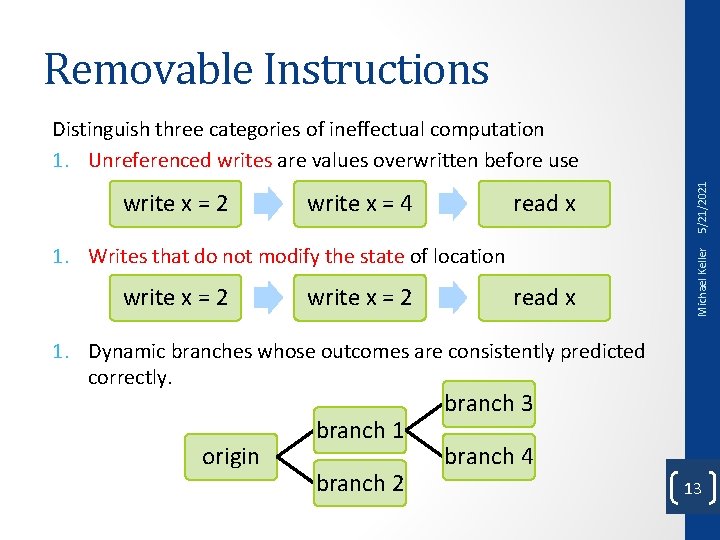
Removable Instructions write x = 4 read x 1. Writes that do not modify the state of location write x = 2 read x Michael Keller write x = 2 5/21/2021 Distinguish three categories of ineffectual computation 1. Unreferenced writes are values overwritten before use 1. Dynamic branches whose outcomes are consistently predicted correctly. origin branch 1 branch 2 branch 3 branch 4 13
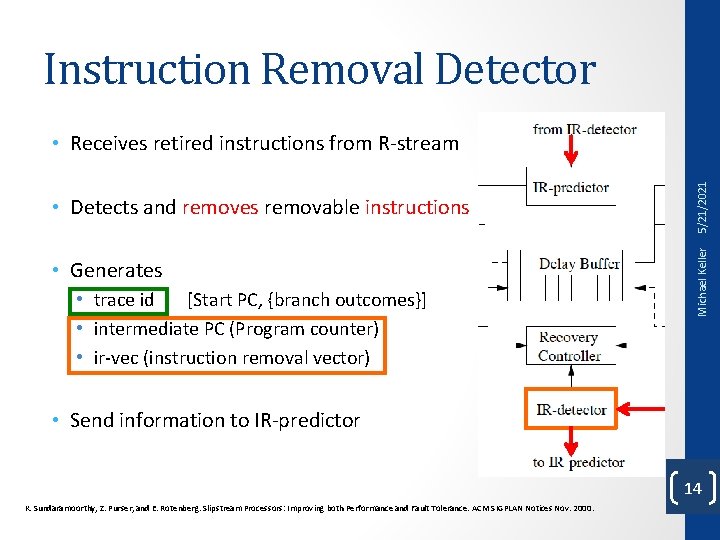
Instruction Removal Detector • Generates • trace id [Start PC, {branch outcomes}] • intermediate PC (Program counter) • ir-vec (instruction removal vector) Michael Keller • Detects and removes removable instructions 5/21/2021 • Receives retired instructions from R-stream • Send information to IR-predictor 14 K. Sundaramoorthy, Z. Purser, and E. Rotenberg. Slipstream Processors: Improving both Performance and Fault Tolerance. ACM SIGPLAN Notices Nov. 2000.
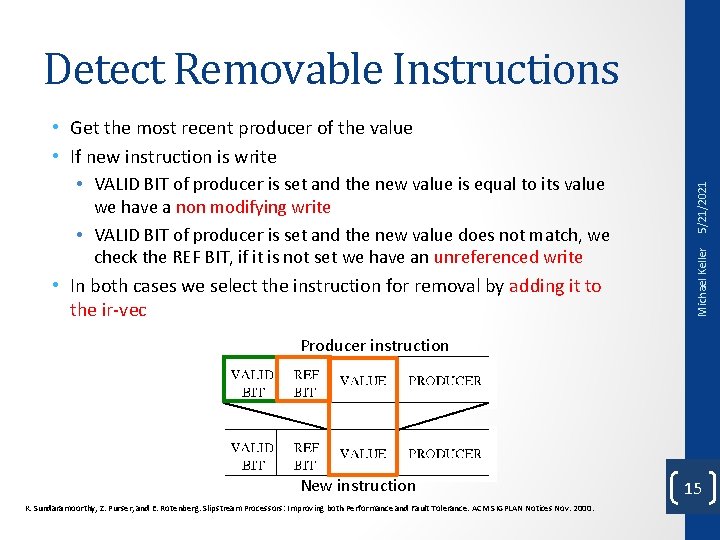
we have a non modifying write • VALID BIT of producer is set and the new value does not match, we check the REF BIT, if it is not set we have an unreferenced write • In both cases we select the instruction for removal by adding it to the ir-vec Michael Keller • Get the most recent producer of the value • If new instruction is write • VALID BIT of producer is set and the new value is equal to its value 5/21/2021 Detect Removable Instructions Producer instruction New instruction K. Sundaramoorthy, Z. Purser, and E. Rotenberg. Slipstream Processors: Improving both Performance and Fault Tolerance. ACM SIGPLAN Notices Nov. 2000. 15
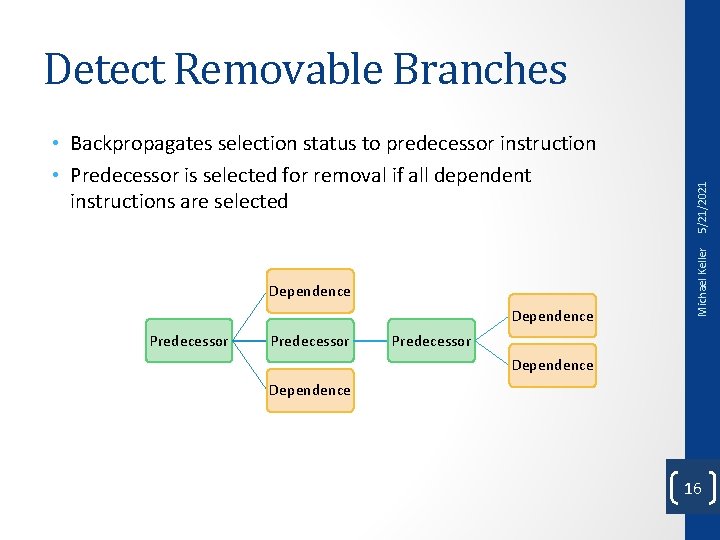
Dependence Predecessor Michael Keller • Backpropagates selection status to predecessor instruction • Predecessor is selected for removal if all dependent instructions are selected 5/21/2021 Detect Removable Branches Predecessor Dependence 16
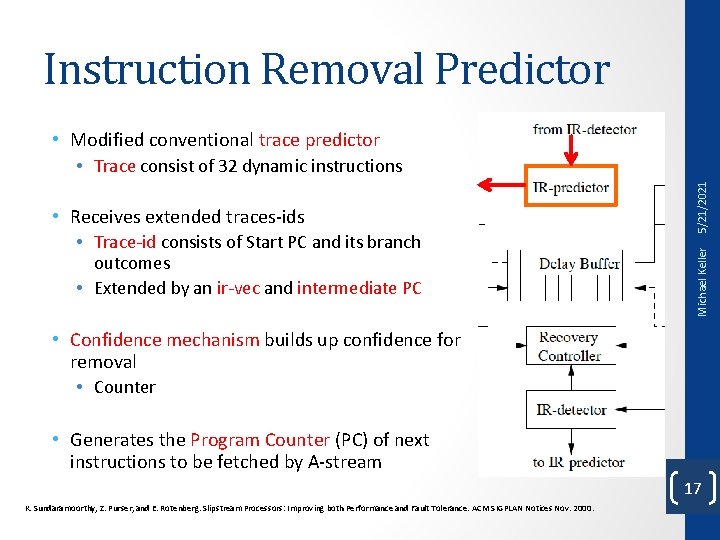
Instruction Removal Predictor outcomes • Extended by an ir-vec and intermediate PC Michael Keller • Receives extended traces-ids • Trace-id consists of Start PC and its branch 5/21/2021 • Modified conventional trace predictor • Trace consist of 32 dynamic instructions • Confidence mechanism builds up confidence for removal • Counter • Generates the Program Counter (PC) of next instructions to be fetched by A-stream 17 K. Sundaramoorthy, Z. Purser, and E. Rotenberg. Slipstream Processors: Improving both Performance and Fault Tolerance. ACM SIGPLAN Notices Nov. 2000.
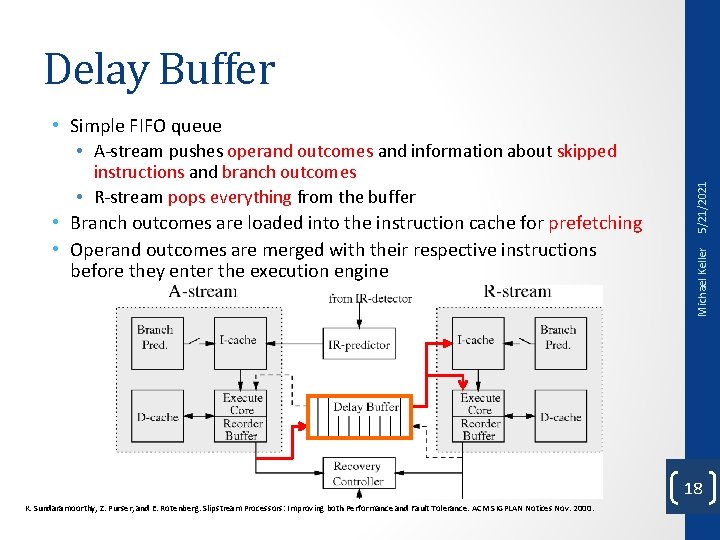
Delay Buffer • Branch outcomes are loaded into the instruction cache for prefetching • Operand outcomes are merged with their respective instructions before they enter the execution engine Michael Keller instructions and branch outcomes • R-stream pops everything from the buffer 5/21/2021 • Simple FIFO queue • A-stream pushes operand outcomes and information about skipped 18 K. Sundaramoorthy, Z. Purser, and E. Rotenberg. Slipstream Processors: Improving both Performance and Fault Tolerance. ACM SIGPLAN Notices Nov. 2000.
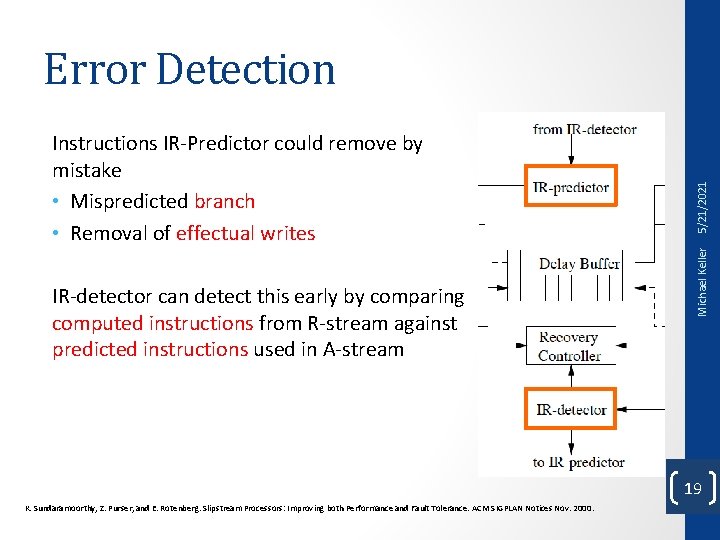
IR-detector can detect this early by comparing computed instructions from R-stream against predicted instructions used in A-stream Michael Keller Instructions IR-Predictor could remove by mistake • Mispredicted branch • Removal of effectual writes 5/21/2021 Error Detection 19 K. Sundaramoorthy, Z. Purser, and E. Rotenberg. Slipstream Processors: Improving both Performance and Fault Tolerance. ACM SIGPLAN Notices Nov. 2000.
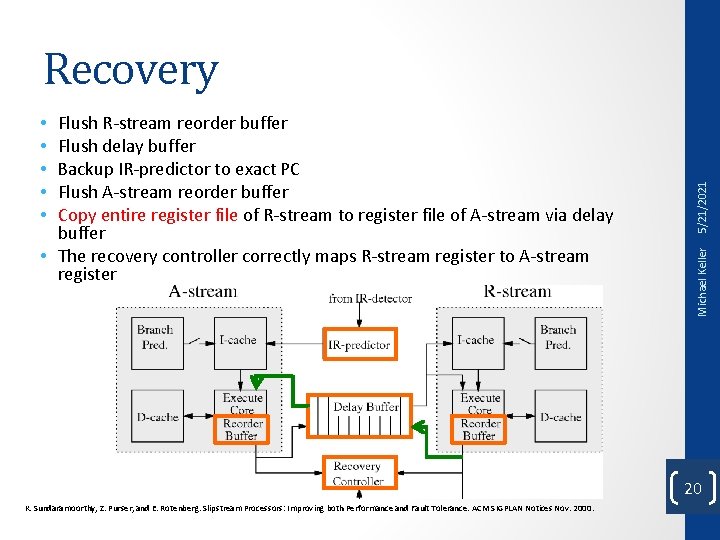
Michael Keller Flush R-stream reorder buffer Flush delay buffer Backup IR-predictor to exact PC Flush A-stream reorder buffer Copy entire register file of R-stream to register file of A-stream via delay buffer • The recovery controller correctly maps R-stream register to A-stream register • • • 5/21/2021 Recovery 20 K. Sundaramoorthy, Z. Purser, and E. Rotenberg. Slipstream Processors: Improving both Performance and Fault Tolerance. ACM SIGPLAN Notices Nov. 2000.

KEY RESULTS 21 Michael Keller 5/21/2021
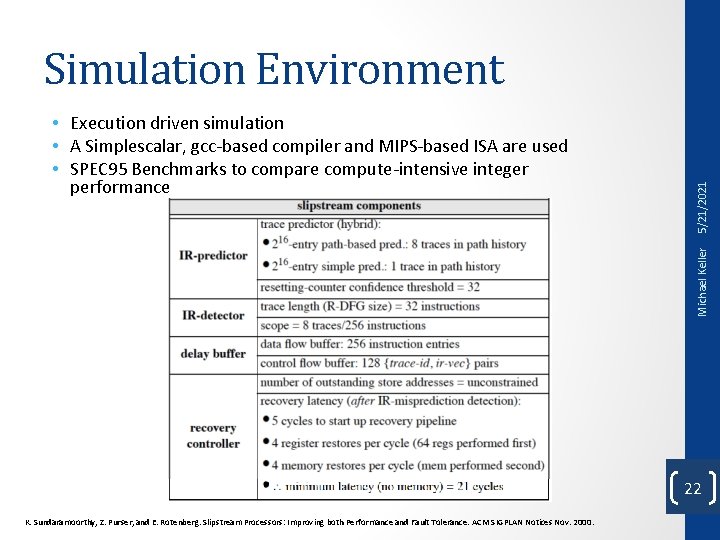
Michael Keller • Execution driven simulation • A Simplescalar, gcc-based compiler and MIPS-based ISA are used • SPEC 95 Benchmarks to compare compute-intensive integer performance 5/21/2021 Simulation Environment 22 K. Sundaramoorthy, Z. Purser, and E. Rotenberg. Slipstream Processors: Improving both Performance and Fault Tolerance. ACM SIGPLAN Notices Nov. 2000.
Michael Keller Performance of three models are compared • SS(64 x 4) - A single copy of the program is run on one conventional 4 -way superscalar processor with 64 ROB entries • SS(128 x 8) - A single copy of the program is run on one conventional 8 -way superscalar processor with 128 ROB entries • CMP(2 x 64 x 4) - Slipstream processor using a CMP composed of two SS(64 x 4) cores 5/21/2021 Reference Models • Same trace predictor is used • Performance measured in retired R-stream instructions divided by the number of cycles for both the A-stream and Rstream 23
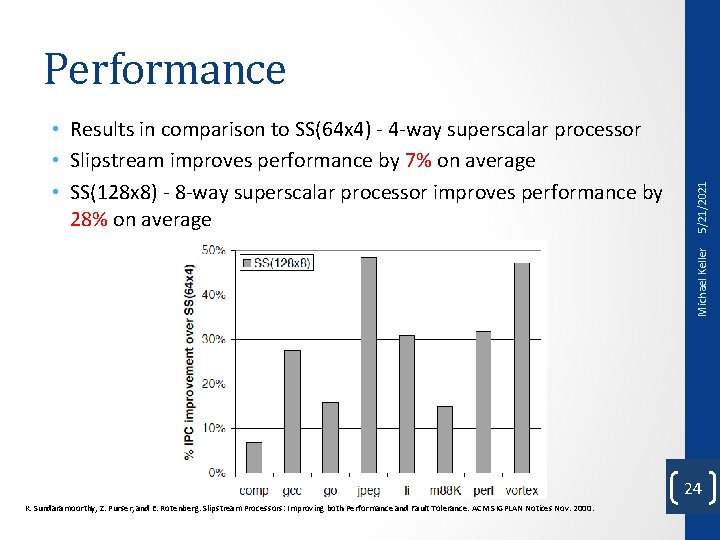
Michael Keller • Results in comparison to SS(64 x 4) - 4 -way superscalar processor • Slipstream improves performance by 7% on average • SS(128 x 8) - 8 -way superscalar processor improves performance by 28% on average 5/21/2021 Performance 24 K. Sundaramoorthy, Z. Purser, and E. Rotenberg. Slipstream Processors: Improving both Performance and Fault Tolerance. ACM SIGPLAN Notices Nov. 2000.
2. More functionality and flexibility than a single super scalar processor Michael Keller Even without surpassing the 8 -way superscalar it has competitive potential 1. With much less complexity we achieved ¼ of the performance increase 5/21/2021 Performance 3. More potential if extended to an implementation on a 8 wide SMT, left for further work 25
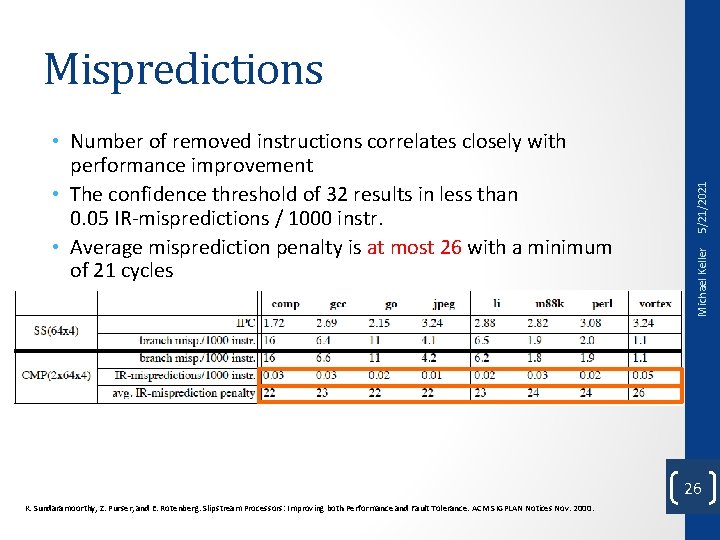
Michael Keller • Number of removed instructions correlates closely with performance improvement • The confidence threshold of 32 results in less than 0. 05 IR-mispredictions / 1000 instr. • Average misprediction penalty is at most 26 with a minimum of 21 cycles 5/21/2021 Mispredictions 26 K. Sundaramoorthy, Z. Purser, and E. Rotenberg. Slipstream Processors: Improving both Performance and Fault Tolerance. ACM SIGPLAN Notices Nov. 2000.
• limits of parallelism • physical limits in processor design Ø Today, these problems are even more important, as they were in 2000 Michael Keller • The paper is ahead of its time, because it addresses multiple very fundamental problems 5/21/2021 Strengths • Idea is different and innovative with the attempt of utilizing idle processors for improving single thread performance • Looking for simplicity by not redesigning whole systems, instead it attempts to make minor changes to improve performance 27
Weaknesses • No insight about power consumption • Many informal speculations and conclusions Michael Keller • Error detection is not solved with two redundant executions • Only little evaluation about performance 5/21/2021 • Only touches surface of the underlying problem • The whole evaluation of fault tolerance is informal • Speculations about other predictors and implementations with very little reasoning • Hard to read and understand, of course also because it is outdated 28
• “Two programs combined finish sooner than either would alone” • Problem of transient hardware faults not properly addressed Michael Keller • Idea deserves attention and might be a nice base for further improvements 5/21/2021 Takeaways 29

DISCUSSION 30 Michael Keller 5/21/2021
• How can we really address the fault tolerance improvement? • What happens if the A-stream is too fast? Michael Keller • What changes do you think have the most potential for additional performance increase? 5/21/2021 Discussion Starters • Can you think about improvements in todays heavily parallelized architectures with the slipstream paradigm 31

5/21/2021 Michael Keller FURTHER/RELATED WORKS 32
• Nandita Vijaykumar, Gennady Pekhimenko, Adwait Jogt, Abhishek Bhowmick, Rachata Ausavarungnirun, Chita Dast, Mahmut Kandemirt, Todd C. Mowry, Onur Mutlu: A case for Core-Assisted Bottleneck Acceleration in GPUs: Enabling flexible data compression with assist warps, 2015 ACM/IEEE International Symposium on Computer Architecture (ISCA) Michael Keller • Zach Purser, Karthik Sundaramoorthy, Eric Rotenberg: A study of Slipstream processors, MICRO 33 Proceedings of the 33 rd annual ACM/IEEE international symposium on Microarchitecture Dec. 2000 5/21/2021 Further Works 34

BACKUP SLIDES 35 Michael Keller 5/21/2021
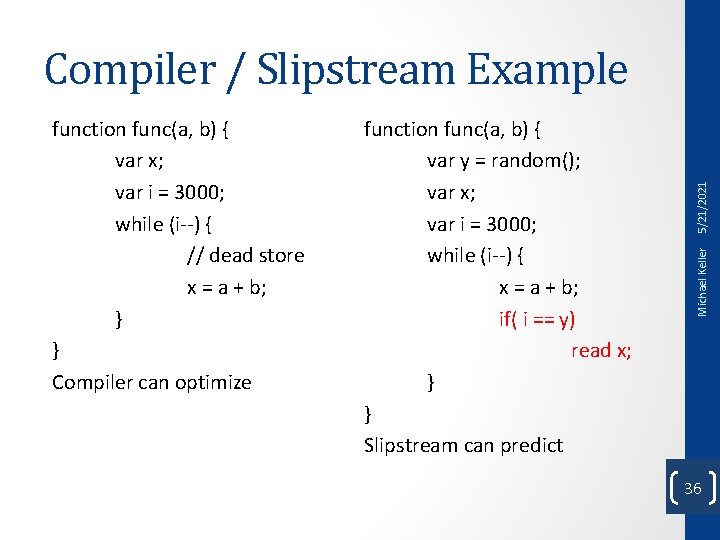
function func(a, b) { var y = random(); var x; var i = 3000; while (i--) { x = a + b; if( i == y) read x; } } Slipstream can predict Michael Keller function func(a, b) { var x; var i = 3000; while (i--) { // dead store x = a + b; } } Compiler can optimize 5/21/2021 Compiler / Slipstream Example 36
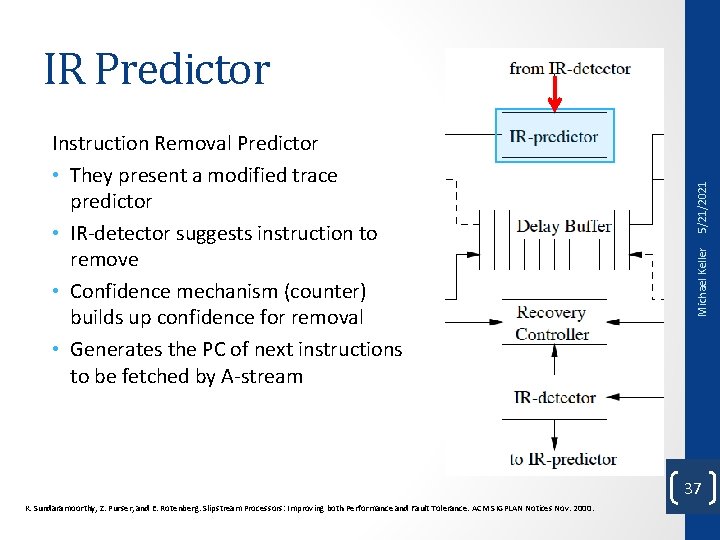
Michael Keller Instruction Removal Predictor • They present a modified trace predictor • IR-detector suggests instruction to remove • Confidence mechanism (counter) builds up confidence for removal • Generates the PC of next instructions to be fetched by A-stream 5/21/2021 IR Predictor 37 K. Sundaramoorthy, Z. Purser, and E. Rotenberg. Slipstream Processors: Improving both Performance and Fault Tolerance. ACM SIGPLAN Notices Nov. 2000.
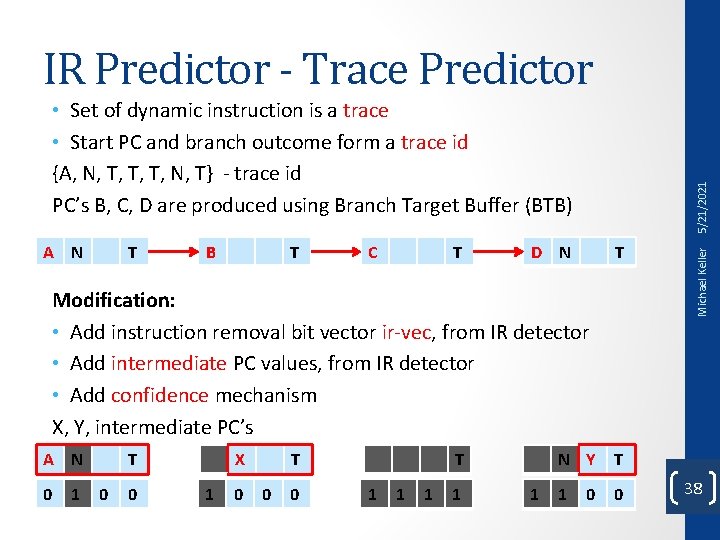
IR Predictor - Trace Predictor T B T C T D N T Modification: • Add instruction removal bit vector ir-vec, from IR detector • Add intermediate PC values, from IR detector • Add confidence mechanism X, Y, intermediate PC’s A N 0 1 T 0 0 X 1 0 T 0 0 T 1 1 1 N Y T 1 0 0 Michael Keller A N 5/21/2021 • Set of dynamic instruction is a trace • Start PC and branch outcome form a trace id {A, N, T, T, T, N, T} - trace id PC’s B, C, D are produced using Branch Target Buffer (BTB) 38
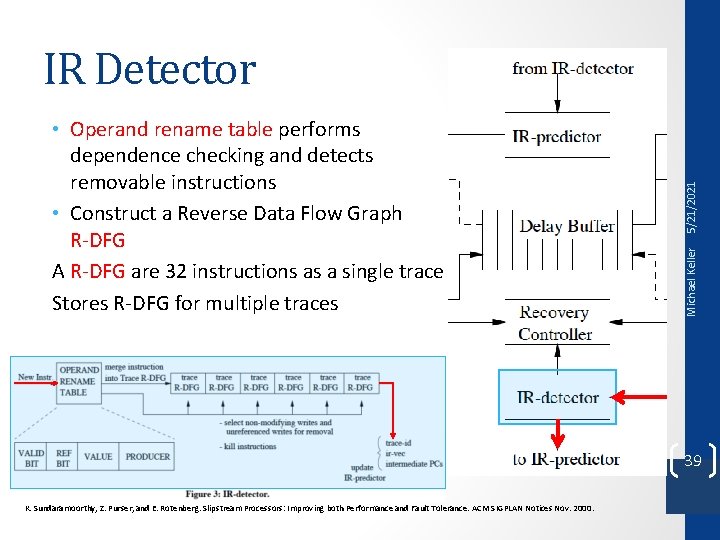
Michael Keller • Operand rename table performs dependence checking and detects removable instructions • Construct a Reverse Data Flow Graph R-DFG A R-DFG are 32 instructions as a single trace Stores R-DFG for multiple traces 5/21/2021 IR Detector 39 K. Sundaramoorthy, Z. Purser, and E. Rotenberg. Slipstream Processors: Improving both Performance and Fault Tolerance. ACM SIGPLAN Notices Nov. 2000.
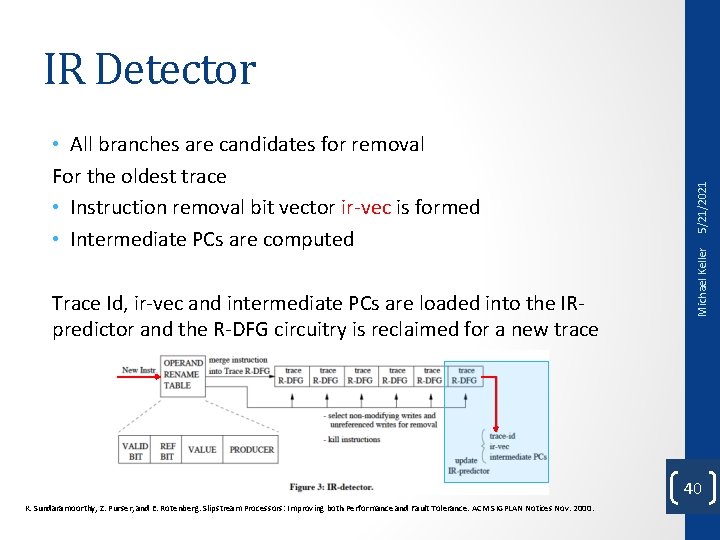
Trace Id, ir-vec and intermediate PCs are loaded into the IRpredictor and the R-DFG circuitry is reclaimed for a new trace Michael Keller • All branches are candidates for removal For the oldest trace • Instruction removal bit vector ir-vec is formed • Intermediate PCs are computed 5/21/2021 IR Detector 40 K. Sundaramoorthy, Z. Purser, and E. Rotenberg. Slipstream Processors: Improving both Performance and Fault Tolerance. ACM SIGPLAN Notices Nov. 2000.
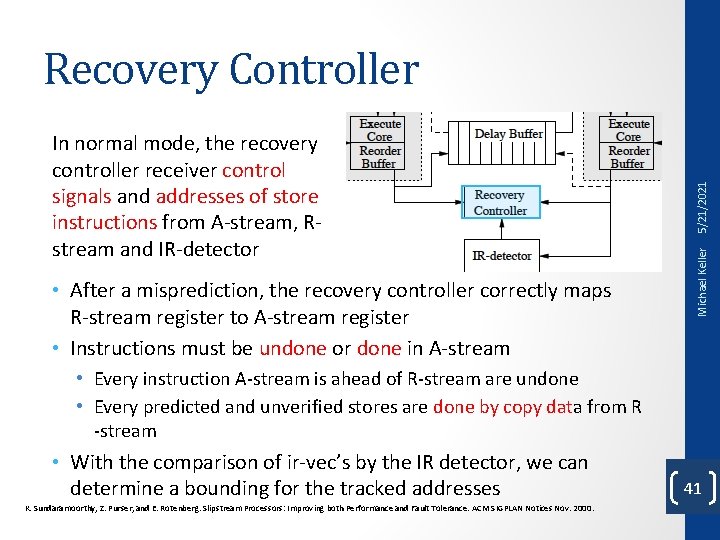
• After a misprediction, the recovery controller correctly maps R-stream register to A-stream register • Instructions must be undone or done in A-stream Michael Keller In normal mode, the recovery controller receiver control signals and addresses of store instructions from A-stream, Rstream and IR-detector 5/21/2021 Recovery Controller • Every instruction A-stream is ahead of R-stream are undone • Every predicted and unverified stores are done by copy data from R -stream • With the comparison of ir-vec’s by the IR detector, we can determine a bounding for the tracked addresses K. Sundaramoorthy, Z. Purser, and E. Rotenberg. Slipstream Processors: Improving both Performance and Fault Tolerance. ACM SIGPLAN Notices Nov. 2000. 41
- Slides: 40