
Karl Marx Value Price and Profit 1865 Economic


- Slides: 13
Karl Marx Value, Price and Profit (1865) Economic and Philosophic Manuscripts of 1844 1
Karl Marx Born: May 5, 1818 (Trier, Germany) Died: March 17, 1883 (London, England) 2
Karl Marx 3
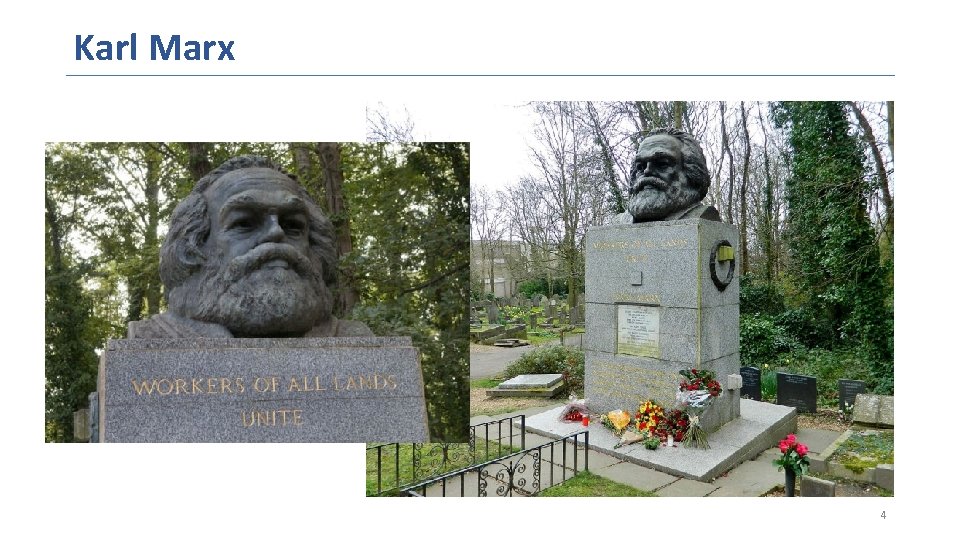
Karl Marx 4
Karl Marx Labor theory of value What is the basic unit of value? • “Commodity has a value because it is a crystallization of social labor. ” (VPP 729) (This is loosely similar to Adam Smith. ) • Labor is “the common social substance of all commodities. ” (VPP 728) • Thus, the value is: the quantity of labor • Note: this is not the same as the wages paid for that labor – the quantity of labor refers to the average time (not actual time) it generally takes across society to engage in that labor. 5
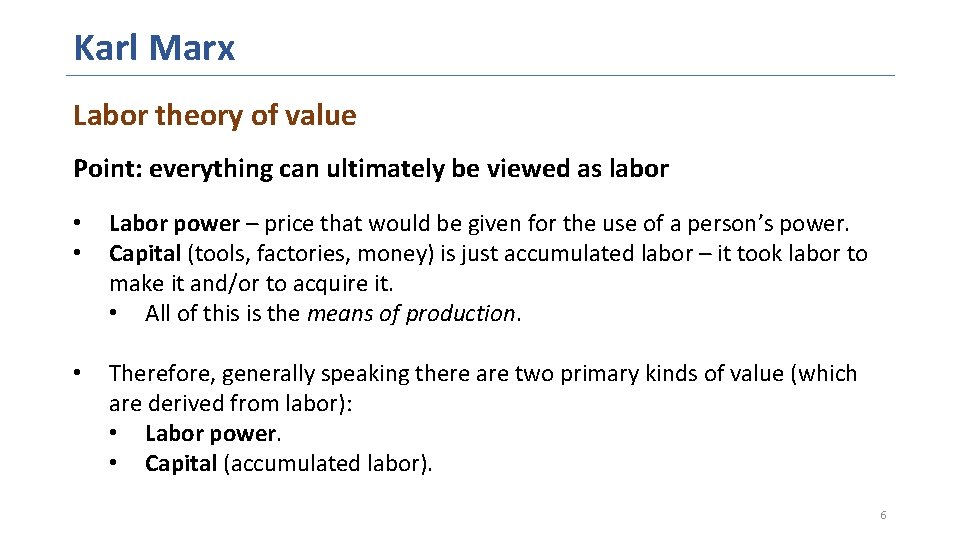
Karl Marx Labor theory of value Point: everything can ultimately be viewed as labor • • Labor power – price that would be given for the use of a person’s power. Capital (tools, factories, money) is just accumulated labor – it took labor to make it and/or to acquire it. • All of this is the means of production. • Therefore, generally speaking there are two primary kinds of value (which are derived from labor): • Labor power. • Capital (accumulated labor). 6
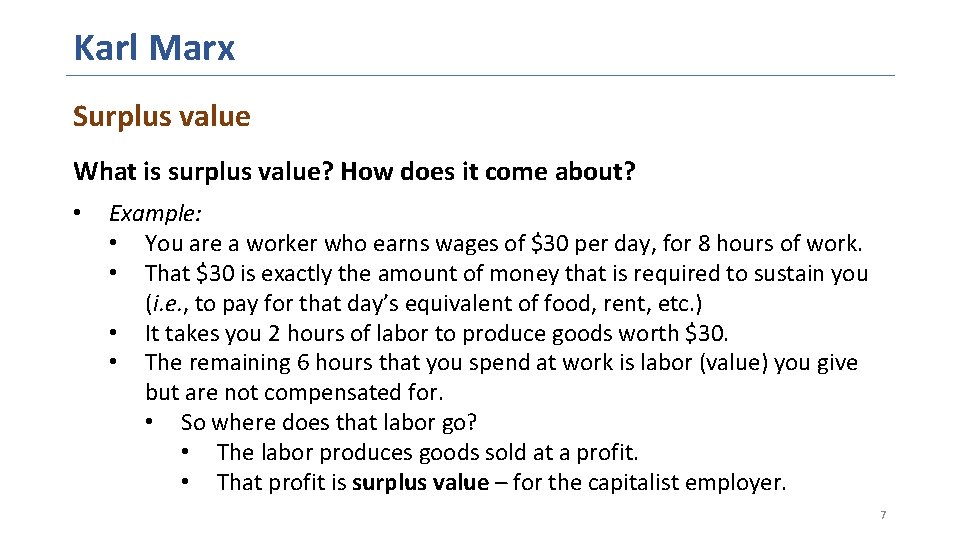
Karl Marx Surplus value What is surplus value? How does it come about? • Example: • You are a worker who earns wages of $30 per day, for 8 hours of work. • That $30 is exactly the amount of money that is required to sustain you (i. e. , to pay for that day’s equivalent of food, rent, etc. ) • It takes you 2 hours of labor to produce goods worth $30. • The remaining 6 hours that you spend at work is labor (value) you give but are not compensated for. • So where does that labor go? • The labor produces goods sold at a profit. • That profit is surplus value – for the capitalist employer. 7
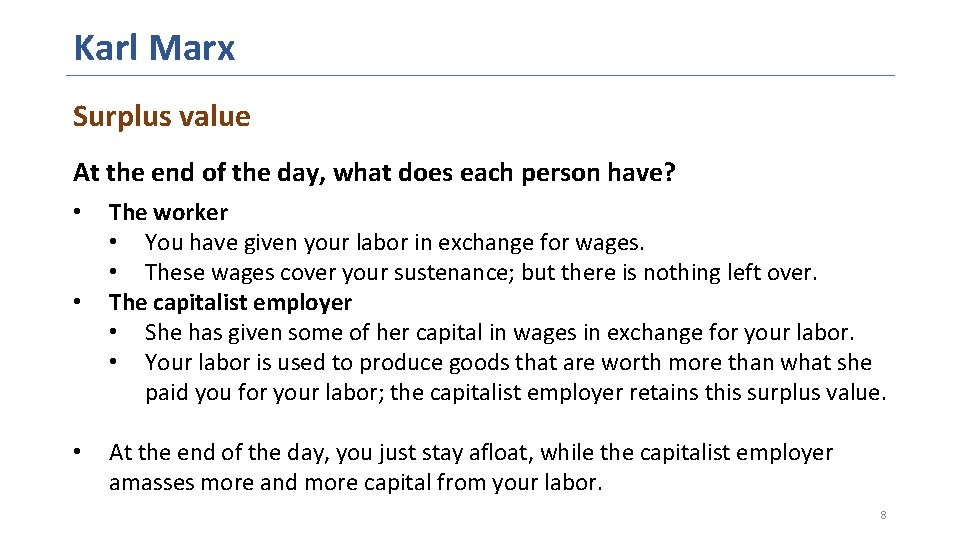
Karl Marx Surplus value At the end of the day, what does each person have? • • • The worker • You have given your labor in exchange for wages. • These wages cover your sustenance; but there is nothing left over. The capitalist employer • She has given some of her capital in wages in exchange for your labor. • Your labor is used to produce goods that are worth more than what she paid you for your labor; the capitalist employer retains this surplus value. At the end of the day, you just stay afloat, while the capitalist employer amasses more and more capital from your labor. 8
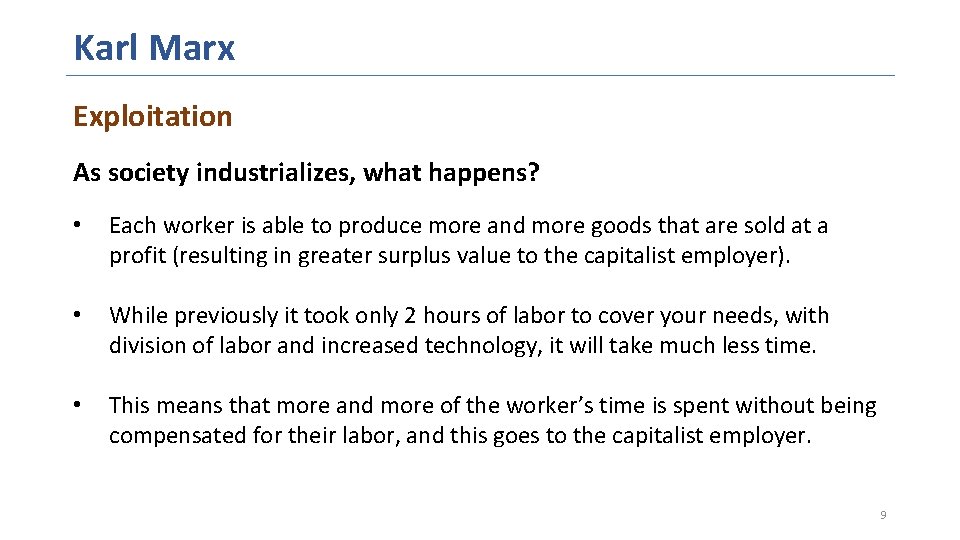
Karl Marx Exploitation As society industrializes, what happens? • Each worker is able to produce more and more goods that are sold at a profit (resulting in greater surplus value to the capitalist employer). • While previously it took only 2 hours of labor to cover your needs, with division of labor and increased technology, it will take much less time. • This means that more and more of the worker’s time is spent without being compensated for their labor, and this goes to the capitalist employer. 9
Karl Marx Exploitation As society industrializes, what happens? • Over time, the capitalist employer’s capital continually increases, while the worker still only covers his needs and is unable to amass any capital. • Class conflict: This creates two distinct social (economic, political) classes: • The bourgeoisie • The few who possess the means of production. • The proletariat • The masses who possess only their labor power. 10
Karl Marx Exploitation As society industrializes, what happens? • What happens to the capitalist employer? • What happens to the worker? • What happens to society? 11
Karl Marx The Edukators (2004) Characters: • Jan • Jule • Peter • Hardenberg https: //youtu. be/QXxi. BAi_q 54 12
Karl Marxism is not just a political and economic philosophy… It is also a sociological theory – a “conflict theory” • Primarily about social class conflict – the conflict that arises from power and domination, from the bourgeoisie over the proletariat. • Social relations are forged out of class struggles – they reflect the different positions of power people hold in society. (You can look beyond an apparent social reality to find a deeper reality. ) • This perspective can be applied to numerous fields: education, political science, anthropology, literary criticism, art, media studies, psychology, etc. END 13