
Karl Marx Russia The Soviet Union How does
- Slides: 6
Karl Marx: Russia & The Soviet Union How does Marx Inspire Russia? Do the Revolutionaries stay true to Marxist Ideas?
§ Section I: History of Economic Struggle § First line: “A spectre is haunting Europe– the spectre of communism. All the old powers of Europe have entered into a holy alliance to exorcise this spectre. ” Karl Marx: Communist Manifesto (1848) § Section II: Proletarians (workers, working class) § Views on: private property? Capital? Labour? Culture? Family? Education? Women? Nationality? Religion? Political power? § Revolution 10 item check list § Final line: “Let the ruling classes tremble at a communistic revolution. The proletarians have nothing to lose but their chains. The have the world to win. Working men of all countries, UNITE!”
1. Peasants lives: Emancipation Manifesto (1861) freed 23 million serfs, no change 2. Working conditions: average 11 hr days, harsh, unsafe 3. Bloody Sunday (January 22, 1905): 150, 000 signed for Russian Revolution: Causes shorter work hours, increased wages & conditions– fired on, 100+ dead (led to 1905 Revolution) 4. Tsar’s corruption: influence of Rasputin, distrusted 5. Military losses: vs Japan, & WWI (4 million casualties) desertions, starvation, low supplies– wanted it to end 6. March Revolution (1917): city-wide strike, 200, 000 workers, Tsar abdicates, creates provisional Duma 7. Urban workers: growth of Soviets (workers councils)
§ Not one, but two separate events § February (March) the other, October (November) § Duma struggles to lead, competing forces § Lenin (Bolsheviks) leads bloodless coup, Revolution(s) supported by peasants, urban workers, soldiers: § “Peace, Land & Bread. ” § 1. Sign Peace treaty with Germany § 2. Worked to transform into first Communist country– land to peasants § 3. Government supplied food § New Economic Policy (mixed economy)
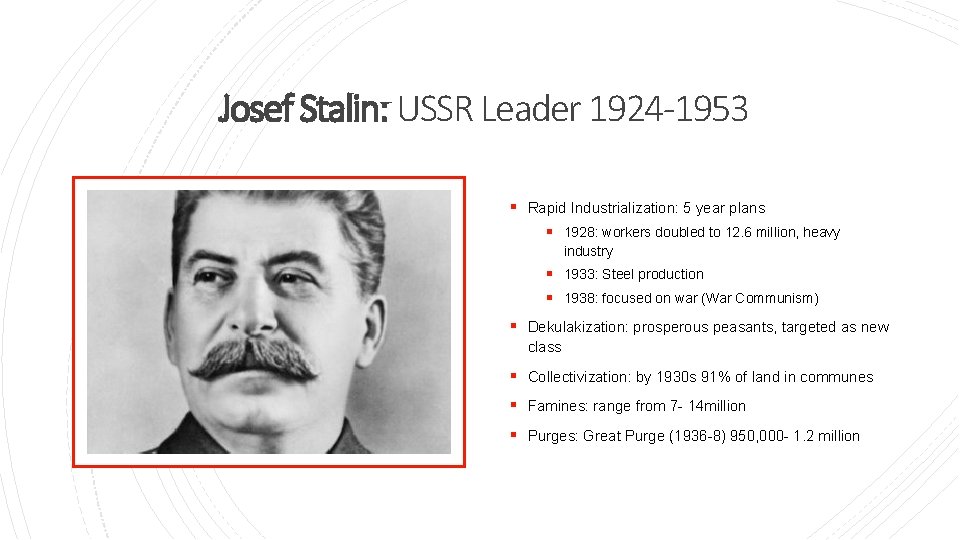
Josef Stalin: USSR Leader 1924 -1953 § Rapid Industrialization: 5 year plans § 1928: workers doubled to 12. 6 million, heavy industry § 1933: Steel production § 1938: focused on war (War Communism) § Dekulakization: prosperous peasants, targeted as new class § Collectivization: by 1930 s 91% of land in communes § Famines: range from 7 - 14 million § Purges: Great Purge (1936 -8) 950, 000 - 1. 2 million
Lenin (and/or/vs) Stalin Do Lenin & Stalin stay true to Marx ideals? Complete your grid! § Society without Classes § Private Property Eliminated § Equality between Genders § Social ownership of production § Role of government