
Karl Friedrich May February 25 1842 March 30
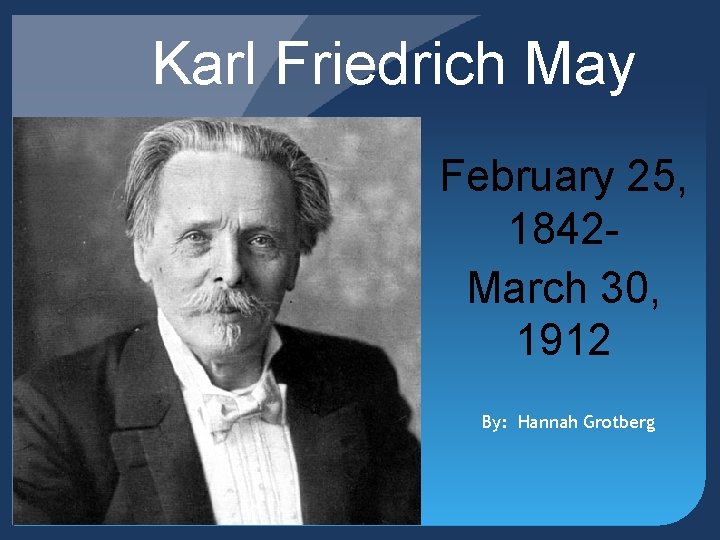
Karl Friedrich May February 25, 1842 March 30, 1912 By: Hannah Grotberg
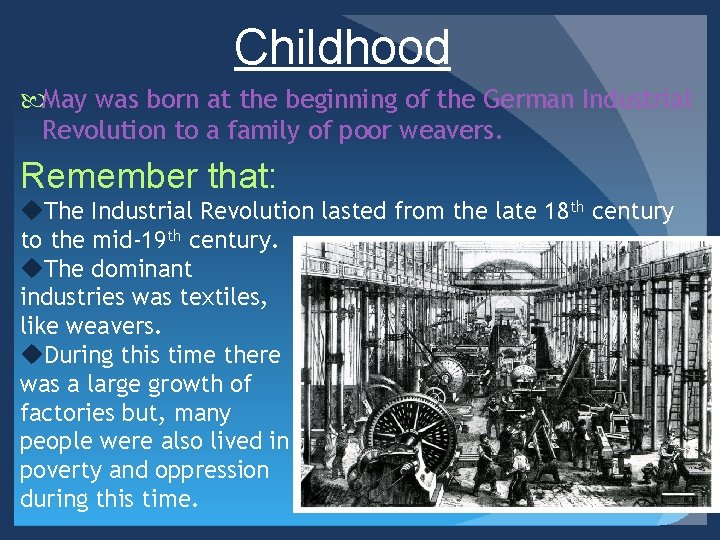
Childhood May was born at the beginning of the German Industrial Revolution to a family of poor weavers. Remember that: u. The Industrial Revolution lasted from the late 18 th century to the mid-19 th century. u. The dominant industries was textiles, like weavers. u. During this time there was a large growth of factories but, many people were also lived in poverty and oppression during this time.
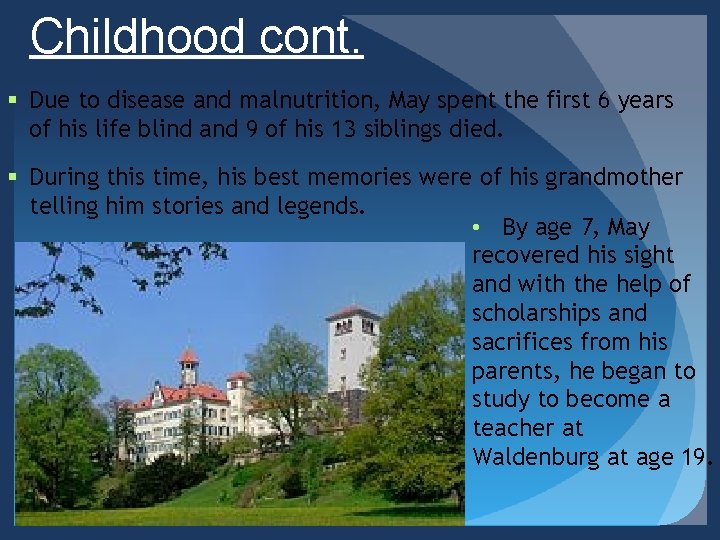
Childhood cont. § Due to disease and malnutrition, May spent the first 6 years of his life blind and 9 of his 13 siblings died. § During this time, his best memories were of his grandmother telling him stories and legends. • By age 7, May recovered his sight and with the help of scholarships and sacrifices from his parents, he began to study to become a teacher at Waldenburg at age 19.
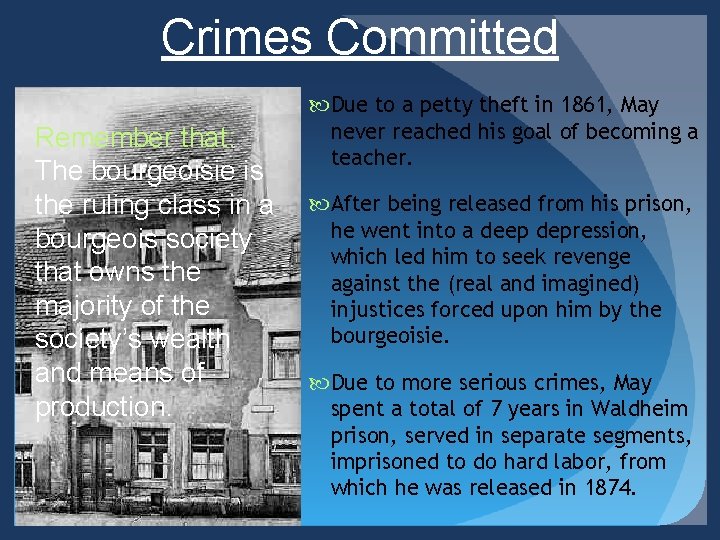
Crimes Committed Remember that: The bourgeoisie is the ruling class in a bourgeois society that owns the majority of the society’s wealth and means of production. Due to a petty theft in 1861, May never reached his goal of becoming a teacher. After being released from his prison, he went into a deep depression, which led him to seek revenge against the (real and imagined) injustices forced upon him by the bourgeoisie. Due to more serious crimes, May spent a total of 7 years in Waldheim prison, served in separate segments, imprisoned to do hard labor, from which he was released in 1874.
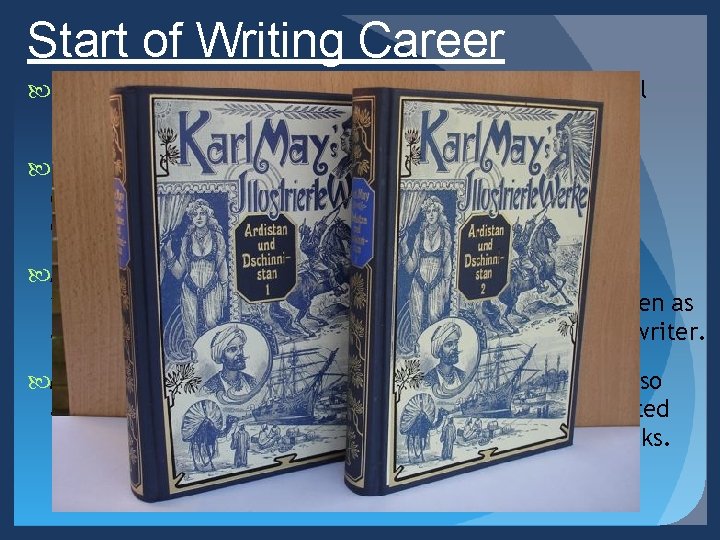
Start of Writing Career During his imprisonment, May read many popular travel memoirs as well as reference books. He used these references to gain enough knowledge of distant countries such that he could write about many different lands and groups of people very realistically. After his release, he sent in several of his writings to various magazines. He eventually found work in Dresden as a journalist. This is when he developed his skills as a writer. May gained fame in the 1890’s and his writing seemed so authentic that some readers even believed he had visited these places or lived through the adventures in his books.
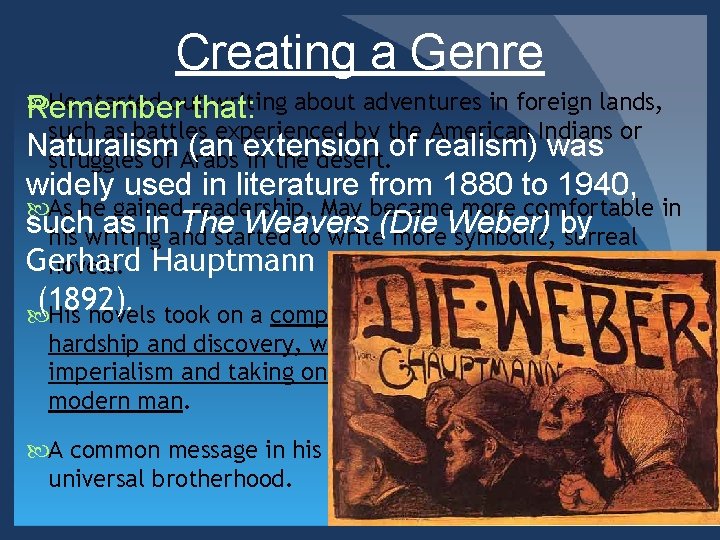
Creating a Genre He started outthat: writing about adventures in foreign lands, Remember such as battles experienced by the American Indians or Naturalism (an extension struggles of Arabs in the desert. of realism) was widely used in literature from 1880 to 1940, As he gained readership, May became more comfortable in such as in The Weavers (Die Weber) by his writing and started to write more symbolic, surreal Gerhard novels. Hauptmann (1892). His novels took on a completely new genre that told of hardship and discovery, while reversing 19 th century imperialism and taking on a search for the lost soul of modern man. A common message in his writings was peace through universal brotherhood.
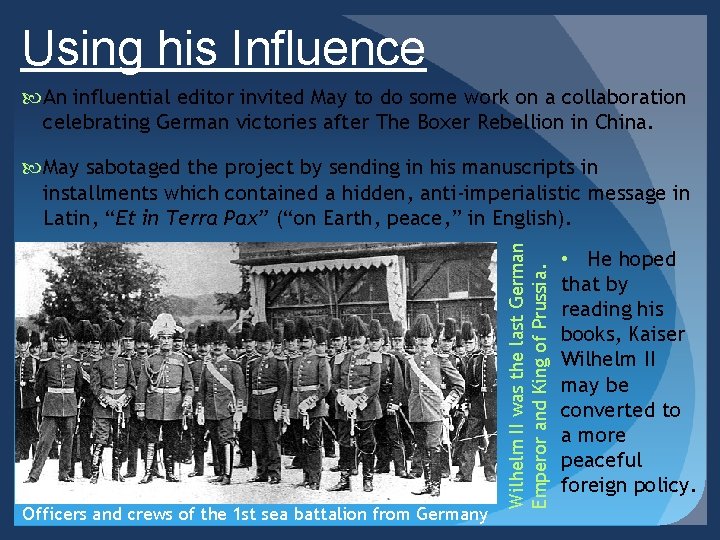
Using his Influence An influential editor invited May to do some work on a collaboration celebrating German victories after The Boxer Rebellion in China. Officers and crews of the 1 st sea battalion from Germany Wilhelm II was the last German Emperor and King of Prussia. May sabotaged the project by sending in his manuscripts in installments which contained a hidden, anti-imperialistic message in Latin, “Et in Terra Pax” (“on Earth, peace, ” in English). • He hoped that by reading his books, Kaiser Wilhelm II may be converted to a more peaceful foreign policy.
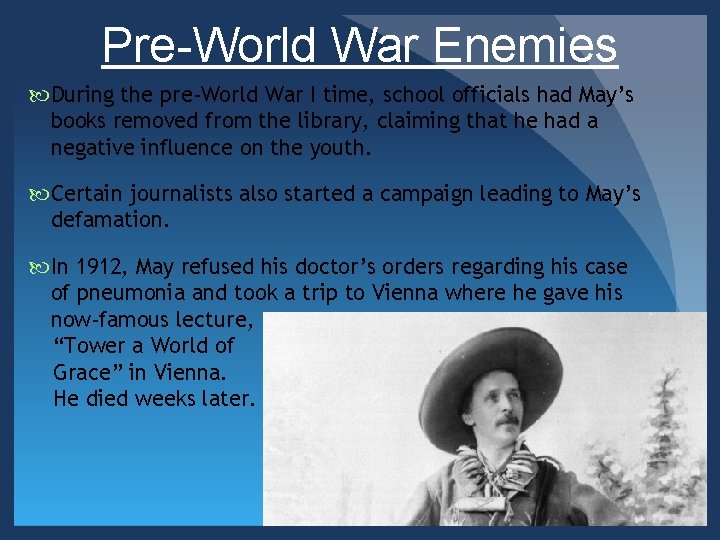
Pre-World War Enemies During the pre-World War I time, school officials had May’s books removed from the library, claiming that he had a negative influence on the youth. Certain journalists also started a campaign leading to May’s defamation. In 1912, May refused his doctor’s orders regarding his case of pneumonia and took a trip to Vienna where he gave his now-famous lecture, “Tower a World of Grace” in Vienna. He died weeks later.
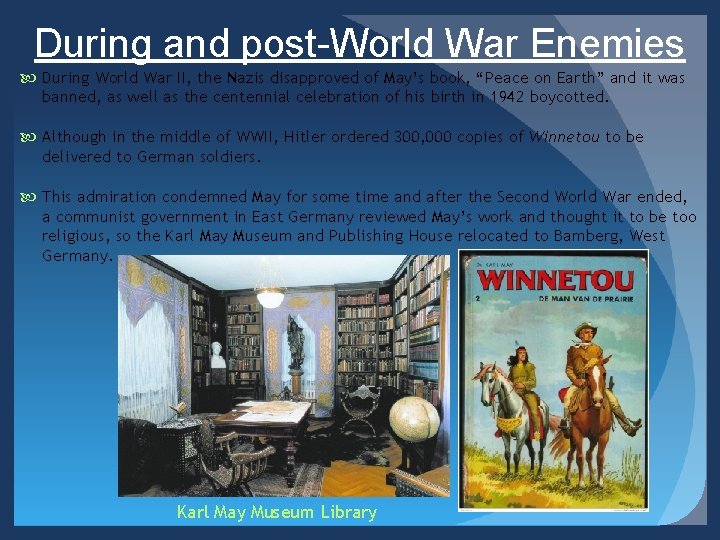
During and post-World War Enemies During World War II, the Nazis disapproved of May’s book, “Peace on Earth” and it was banned, as well as the centennial celebration of his birth in 1942 boycotted. Although in the middle of WWII, Hitler ordered 300, 000 copies of Winnetou to be delivered to German soldiers. This admiration condemned May for some time and after the Second World War ended, a communist government in East Germany reviewed May’s work and thought it to be too religious, so the Karl May Museum and Publishing House relocated to Bamberg, West Germany. Karl May Museum Library
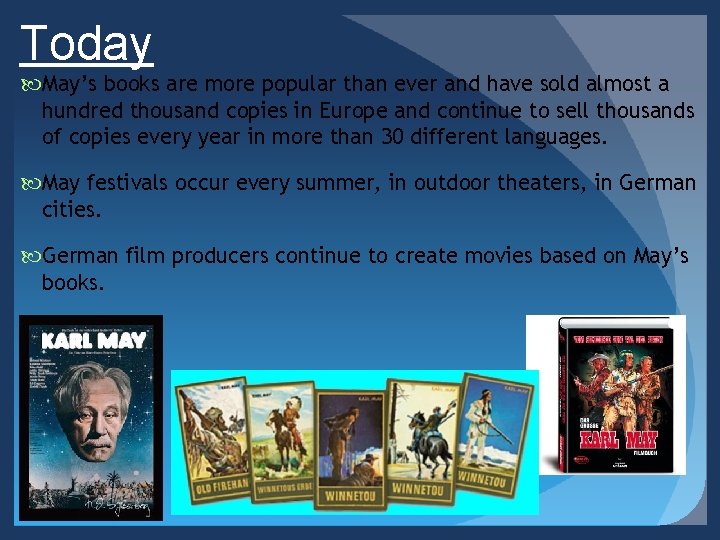
Today May’s books are more popular than ever and have sold almost a hundred thousand copies in Europe and continue to sell thousands of copies every year in more than 30 different languages. May festivals occur every summer, in outdoor theaters, in German cities. German film producers continue to create movies based on May’s books.
Karl May Quotes “As a child, I promised my grandmother: “I will be a hakawati. I will tell of the ‘Djinnistan; ’ therefore, I must escape from the Ardistan. ” And I have become a hakawati – a teller of legends, stories, and fables – because I want to clothe truth of the future, which is now being turned away unrecognized from nearly every door, with the garment of fairy tales, so that it may be received everywhere with an open heart. I have made mistakes, big mistakes in my life. But who can truly judge me? Only artists, musicians, sculptors, poets, writers, and critics – princes in the realm of the spirit. This kind of criticism can find fault with me, but it will not regard me as the enemy. ”
Sources http: //www. karlmayusa. com/ http: //www. karl-may-gesellschaft. de/ http: //www. kirjasto. sci. fi/karlmay. htm http: //www. delcampe. net/page/item/id, 124 366104, var, winnetou-de-man-van-prairie-drkarl-may-kaft-is-slecht, language, D. html http: //4. bp. blogspot. com/sy 1 Gh. JOy. WKc/Uf 5 Oa. CE 4 Ny. I/AAAAA 1 Q/P JI 35 USxo. Tg/s 1600/Karl+May+9. jpg http: //www. google. com/imgres? imgurl=http: //upload. wikimedia. org/wikipedia/commons/ http: //unseenfilms. blogspot. com/2012/10/ka c/c 3/Hartmann_Maschinenhalle_1868_(01) rl-may-1976. html http: //en. wikipedia. org/wiki/Waldenburg, _S http: //westernsallitaliana. blogspot. com/2012 axony /06/new-winnetou-book. html http: //www. karl-maystiftung. de/engl/biograph. html http: //www. zvab. com/buchsuchen/titel/ardistan-unddschinnistan/autor/may http: //upload. wikimedia. org/wikipedia/com mons/7/79/Die_Weber_1897_by_Emil_Orlik. j peg http: //www. dailymail. co. uk/news/article 2518111/China-demand-David-Cameronreturn-Boxer-Rebellion-artefacts. html
- Slides: 12