
Kaplans Depth and Complexity Icons By Kaprina Goodwin
Kaplan’s Depth and Complexity Icons By Kaprina Goodwin
Language of the Discipline Key Questions: What terms or words are specific to the topic? System? Concept? What it might look like in science: Photosynthesischloroplast, carbon dioxide, oxygen, glucose Thinking Skills: Categorize, identify What it might look like in science: Definition Where Inputs Outputs
Details Key Questions: What specific elements define this? What distinguishes this form other things? What it might look like in science: Photosynthesisoccurs only in plants, produces oxygen for the planet. Thinking Skills: Identify traits, describe, differentiate, compare/contrast What it might look like in science: How is photosynthesis different from respiration? How are they the same?
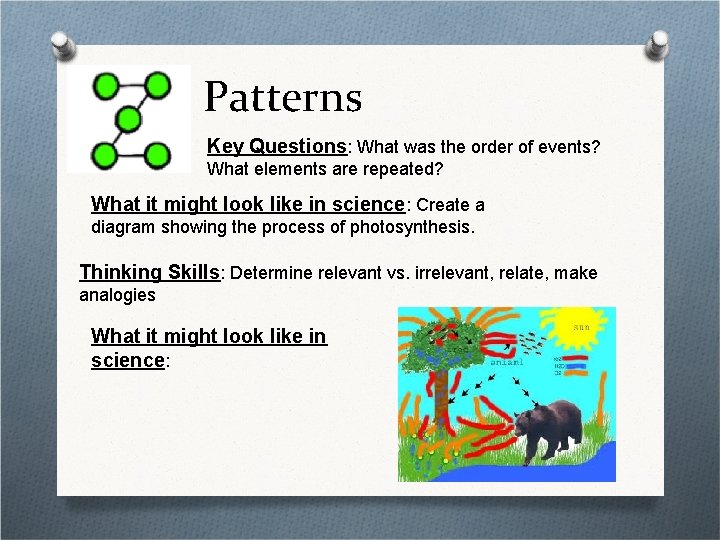
Patterns Key Questions: What was the order of events? What elements are repeated? What it might look like in science: Create a diagram showing the process of photosynthesis. Thinking Skills: Determine relevant vs. irrelevant, relate, make analogies What it might look like in science:
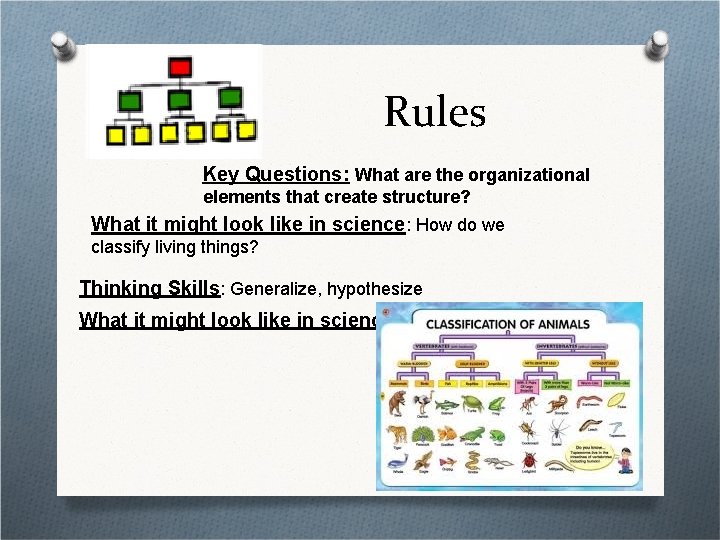
Rules Key Questions: What are the organizational elements that create structure? What it might look like in science: How do we classify living things? Thinking Skills: Generalize, hypothesize What it might look like in science:
Big Idea Key Questions: What is the main idea of what is being studied? What it might look like in science: What was the purpose of today’s lesson? Unit? Thinking Skills: Prove with evidence, generalize What it might look like in science: The big idea behind today’s lesson/unit/chapter is…. (depending on concept covered: Photosynthesis) that carbon dioxide and oxygen are never created, but recycled over and over again.
Ethics Key Questions: What are some controversies involved in the concept? What it might look like in science: What are ways gene mapping could help us plan our future? Good? Bad? Thinking Skills: Determine bias What it might look like in science: Concern Finding genetic disease Pros Knowing about it before it can take affect. Make plans Cons Possibly living differently knowing what will happen.
Unanswered Questions Key Questions: What is not understood about this topic? What might I want more information about? What it might look like in science: When a project/lab experiment goes wrong, or incorrect results. Thinking Skills: Problem solve, test assumptions What it might look like in science: Once a failure has been reached (which is often) students go back, determine what might have gone wrong, or misunderstanding and fix the problem.
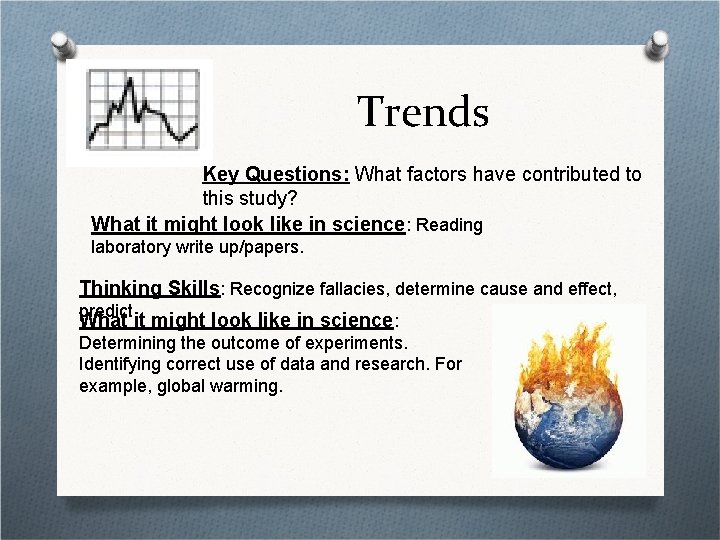
Trends Key Questions: What factors have contributed to this study? What it might look like in science: Reading laboratory write up/papers. Thinking Skills: Recognize fallacies, determine cause and effect, predict What it might look like in science: Determining the outcome of experiments. Identifying correct use of data and research. For example, global warming.
References O Kaplan, S. (2014). Layering differentiated curricula for the gifted and talented. In F. Karnes, & S. Bean (Eds. ), Methods and materials for teaching the gifted (4 th ed. , pp. 107 -135). Waco, TX: Prufrock Press. Griffith, M. (n. d. ). Understanding Depth and Complexity. Retrieved April 9, 2015, from http: //envisiongifted. com/understanding-depthand-complexity. html O Kaplan, S. (1997, October 29). Facilitating and Understanding Depth and Complexity. Retrieved April 9, 2015, from https: //urbaneducationstrategies. files. wordpress. com/2010/08/fa cilitating-the-understanding-of-depth-complexity-gate. pdf
- Slides: 10