
KALMIA LATIFOLIA Dr P R SAIJI ASSOCIATE PROFESSOR


- Slides: 31
KALMIA LATIFOLIA Dr. P. R. SAIJI ASSOCIATE PROFESSOR DEPT OF MATERIA MEDICA
Scientific classification �Kingdom: Plantae �(unranked): Angiosperms �(unranked): Eudicots �(unranked): Asterids �Order: Ericales �Family: Ericaceae �Genus: Kalmia �Species: K. latifolia �Preparation: Tincture of the mature leaves. �Prover: Dr. Hering
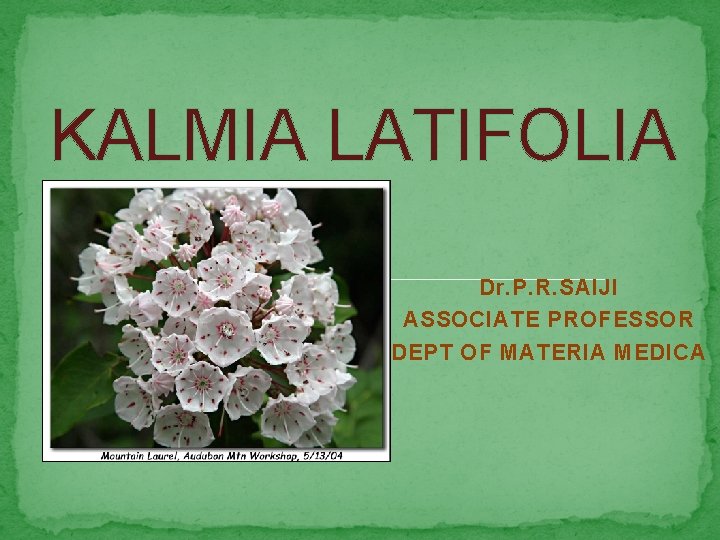
�Kalmia latifolia, commonly called mountain- laurel, calico-bush, or spoon wood, �Is a species of flowering plant in the heather family, Ericaceae, that is native to the eastern United States. Its range stretches from southern Maine south to northern Florida, and west to Indiana and Louisiana �Mountain-laurel is the state flower of Connecticut and Pennsylvania. �It is the namesake of the city of Laurel, Mississippi (founded 1882).
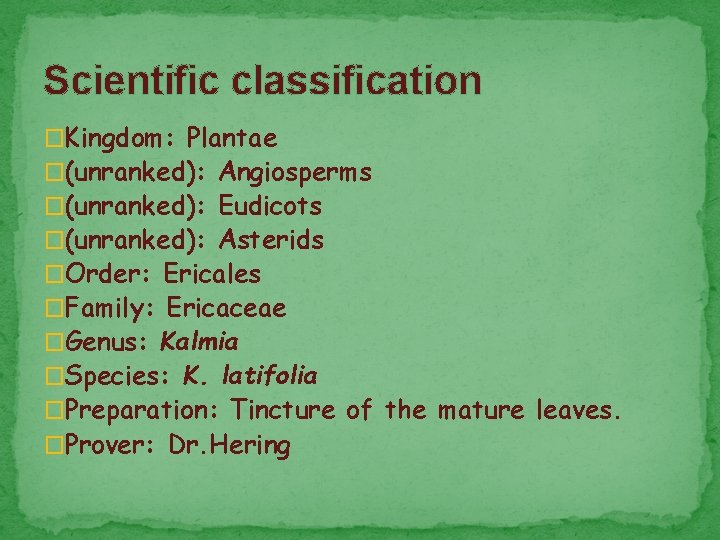
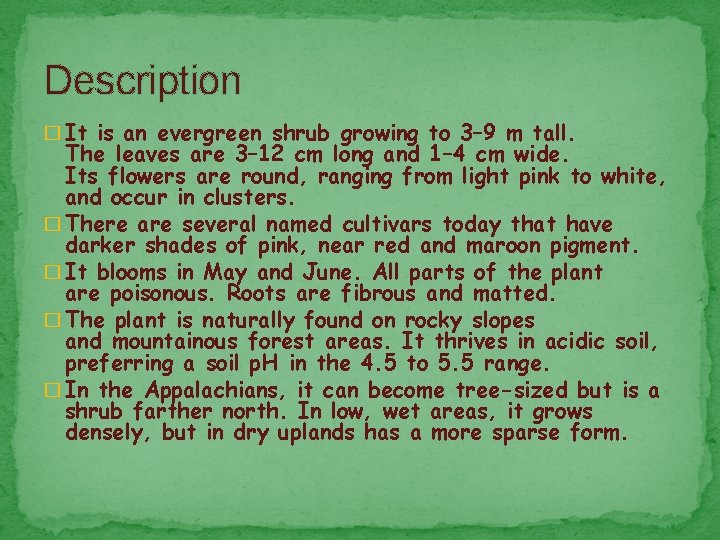
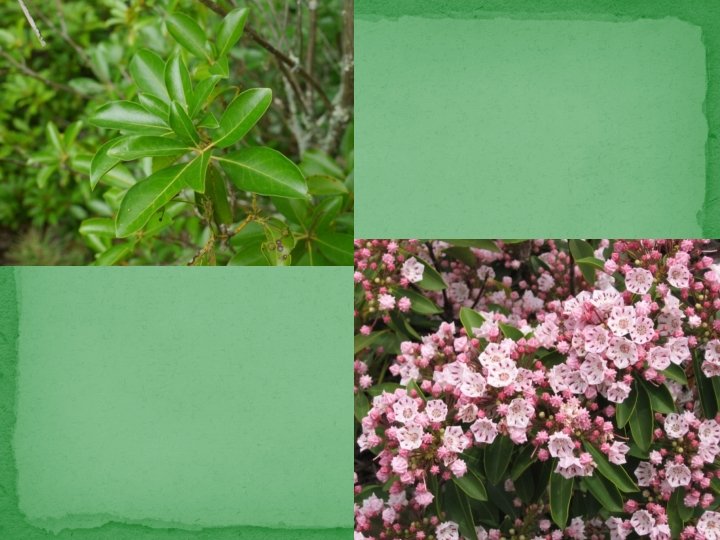
Description � It is an evergreen shrub growing to 3– 9 m tall. The leaves are 3– 12 cm long and 1– 4 cm wide. Its flowers are round, ranging from light pink to white, and occur in clusters. � There are several named cultivars today that have darker shades of pink, near red and maroon pigment. � It blooms in May and June. All parts of the plant are poisonous. Roots are fibrous and matted. � The plant is naturally found on rocky slopes and mountainous forest areas. It thrives in acidic soil, preferring a soil p. H in the 4. 5 to 5. 5 range. � In the Appalachians, it can become tree-sized but is a shrub farther north. In low, wet areas, it grows densely, but in dry uplands has a more sparse form.
Toxicity � Mountain laurel is poisonous to several different animals, including horses, goats, cattle, deer, monkeys, and humans, due to andromedotoxin, grayanotoxin and arbutin. � The green parts of the plant, flowers, twigs, and pollen are all toxic, including food products made from them, such as toxic honey that may produce neurotoxic and gastrointestinal symptoms in humans eating more than a modest amount. � Honey made from the flowers can cause heart arrhythmia and convulsions and has been known throughout history as "mad honey". � Fortunately the honey is sufficiently bitter to discourage most people from eating it, whereas it does not harm bees sufficiently to prevent its use as winter bee fodder.
�Symptoms of toxicity begin to appear about 6 hours following ingestion. Symptoms include irregular or difficulty breathing, anorexia, repeated swallowing, profuse salivation, watering of the eyes and nose, cardiac distress, in coordination, depression, vomiting, frequent defecation, weakness, convulsions, paralysis, coma, and eventually death. �Necropsy of animals who have died from spoon wood poisoning show gastrointestinal hemorrhage.
Use by Native Americans � The Cherokee use the plant as an analgesic, placing an infusion of leaves put on scratches made over location of the pain. They also rub the bristly edges of ten to twelve leaves" over the skin for rheumatism, crush the leaves to rub brier scratches, use an infusion as a wash "to get rid of pests", use a compound as a liniment, rub leaf ooze into the scratched skin of ball players to prevent cramps, and use a leaf salve for healing. They also use the wood for carving. � The Hudson Bay Cree use a decoction of the leaves for diarrhea, but consider the plant to be poisonous. � The Mahuna consider the plant to be poisonous, but regard it as forage for deer and use it as body deodorizer.
� Indians are said to use the expressed juice of the leaves or a strong decoction of them to commit suicide. � The leaves are the official part; powdered leaves are used as a local remedy in some forms of skin diseases, and are a most efficient agent in syphilis, fevers, jaundice, neuralgia and inflammation, but great care should be exercised in their use. � Whisky is the best antidote to poisoning from this plant. � An ointment for skin diseases is made by stewing the leaves in pure lard in an earthenware vessel in a hot oven. � Taken internally it is a sedative and astringent in active haemorrhages, diarrhoea and flux. � It has a splendid effect and will be found useful in overcoming obstinate chronic irritation of the mucous surface.
General action �This remarkable drug causes tingling and numbness in various parts, neuralgic (or rheumatic) pains, which wander and cause restlessness, and, most marked of all, a slow, weak pulse. �A rheumatic remedy. �Pains shift rapidly. �Nausea and slow pulse frequently accompanying.
General action �Has also a prominent action on the heart. �In small doses, it accelerates the heart's action; in larger it moderates it greatly. �Neuralgia; pains shoot downwards, with numbness. Fulgurating pains of locomotor ataxia. �Protracted and continuous fevers, with tympanites. �Paralytic sensations; pains and aching in limbs accompany nearly every group of symptoms. �Albuminuria.
Mind �Anxiety. �Irritability towards evening and next morning. �Dislike to be spoken to, do not feel like going to the office, take up a book, but cannot collect my thoughts. �Do not want to study. �Cannot study, restless.
Head �Confusion of brain. �Pain in front and temporal region from head to nape and to temple �Vertigo; worse stooping and looking downward (from 8 to 9 a. m. , and from 3 to 6 p. m. ); on getting up after studying; agg. towards noon; with pain in limbs; with nausea and pain in head and limbs; with fugitive glow in different parts of surface and increase of sweat. �Forehead: Shooting, extending into eye-teeth.
Eyes � Vision impaired. Dim so that he could not read without spectacles agg. during paroxysms of vomiting. Vision affected, especially by darkness, coming before eyes every three or four minutes, and afterwards if in an erect position. � Rheumatic iritis. � Scleritis, pain increased by moving the eye. � Stiffness of muscles around eyes and of eyelids. � Sensation in ball as if the orbit were pressing it out of its socket. � Retinitis albuminuria, especially during pregnancy, paralysis of the upper lid, with feeling of stiffness.
Face � Neuralgia; worse right side. � Stitches in tongue. � Stitches and tearing in bones of jaw and face. � Flushed. � Pale. � Darting pain in jaw. � Pain between right eye and right side of nose in afternoon; in malar-bone, extending into right molars and bicuspids; under angles of jaw. � Lips swollen, dry and stiff in morning.
Ears � Stitches; at 4 p. m. ; in right at night; in right and behind it. � Darting pains through them. � Pain in right; behind right Ringing in afternoon. � Cracking. � Buzzing. Nose � Pain deep in left side. � Pressure on bridge, with frequent sneezing. � Tickling; as before coryza. � Sensation of coryza. � Obstruction, agg. evening; O. of one nostril. � Fluent coryza, with frequent sneezing and increased sense of smell.
Stomach �Warm, glowing sensation in epigastrium. �Nausea; vomiting. �Pain in pit of stomach; worse by bending forward; relieved by sitting erect. �Pain as if something were tearing the walls from their connections. �Bilious attacks, with nausea, vertigo, and headache. �Sensation of something being pressed under the epigastrium. �Gastralgia in sudden paroxysms.
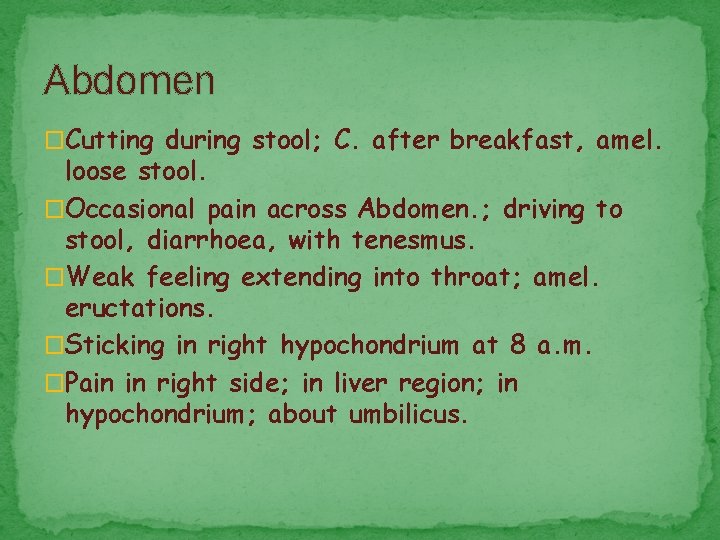
Abdomen �Cutting during stool; C. after breakfast, amel. loose stool. �Occasional pain across Abdomen. ; driving to stool, diarrhoea, with tenesmus. �Weak feeling extending into throat; amel. eructations. �Sticking in right hypochondrium at 8 a. m. �Pain in right side; in liver region; in hypochondrium; about umbilicus.
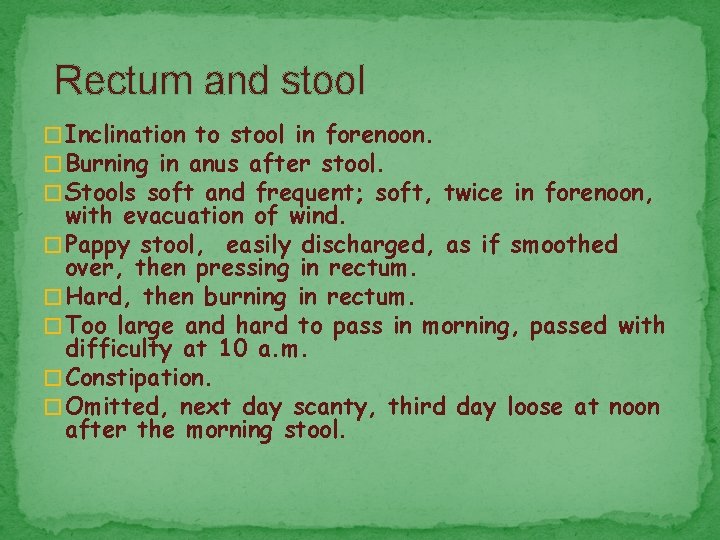
Rectum and stool � Inclination to stool in forenoon. � Burning in anus after stool. � Stools soft and frequent; soft, twice in forenoon, with evacuation of wind. � Pappy stool, easily discharged, as if smoothed over, then pressing in rectum. � Hard, then burning in rectum. � Too large and hard to pass in morning, passed with difficulty at 10 a. m. � Constipation. � Omitted, next day scanty, third day loose at noon after the morning stool.
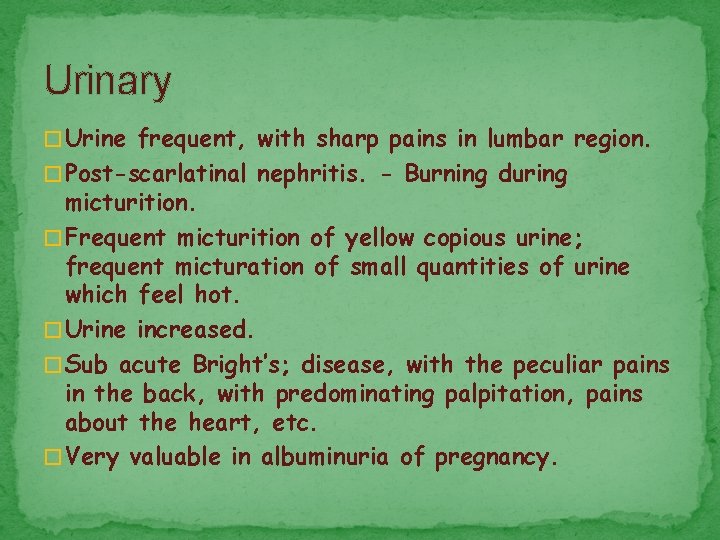
Urinary � Urine frequent, with sharp pains in lumbar region. � Post-scarlatinal nephritis. - Burning during micturition. � Frequent micturition of yellow copious urine; frequent micturation of small quantities of urine which feel hot. � Urine increased. � Sub acute Bright’s; disease, with the peculiar pains in the back, with predominating palpitation, pains about the heart, etc. � Very valuable in albuminuria of pregnancy.
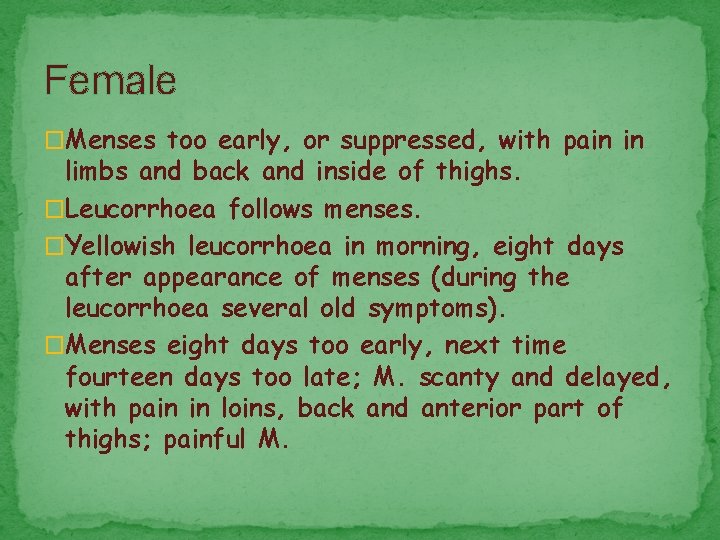
Female �Menses too early, or suppressed, with pain in limbs and back and inside of thighs. �Leucorrhoea follows menses. �Yellowish leucorrhoea in morning, eight days after appearance of menses (during the leucorrhoea several old symptoms). �Menses eight days too early, next time fourteen days too late; M. scanty and delayed, with pain in loins, back and anterior part of thighs; painful M.
Respiratory organs � Tickling in trachea. � Cough day and night; in evening, with mucous expectoration; Cough with expectoration of grey, smooth, unctuous matter, of a putrid, salt taste, which on being spread out separates into small pieces. � Peculiar noise when breathing, as from spasmodic affection of glottis. � Oppressed breathing; with palpitation and anxiety; and short. Chest � Sticking in lower part; in right lung, under third and fourth ribs, causing dyspnoea; below breast. � Tearing in whole left side. � Pressure in right side. � Sensation as if strained by lifting. � Oppression.
Back � Pain from neck down arm; in upper three dorsal vertebrae extending to shoulder-blade. � Pain down back, as if it would break; in localized regions of spine; through shoulders. � Lumbar pains, of nervous origin. � Pain; at night in bed; during menses; down back; in spine, sometimes agg. lumbar region, with heat; extending through shoulders. � Sensation as if spine would break, with anterior convexity. � Sticking in lower part of left scapula at night. � Sharp pain in loins; across loins, agg. evening; paralytic, in loins at 10 p. m. in bed, with dullness and pain in head. � Lameness of loins in evening in bed.
Extremities �Deltoid rheumatism especially right. �Pains from hips to knees and feet. �Pains affect a large part of a limb, or several joints, and pass through quickly. �Weakness, numbness, pricking, and sense of coldness in limbs. �Pains along ulnar nerve, index finger. �Joints red, hot, swollen. �Tingling and numbness of left arm.
Heart � Weak, slow pulse. [Dig. ; Apoc. can. ] � Fluttering of heart, with anxiety. � Palpitation; worse leaning forward. � Pulse irregular; agg. mental effort and leaning over to write. � Gouty and rheumatic metastasis of heart. � Tachycardia, with pain. [Thyroid. ] � Tobacco heart. � Dyspnoea and pressure from epigastrium toward the heart. � Sharp pains take away the breath.
Heart � Shooting through chest above heart into shoulder- blades. � Frequent pulse. � Heart's action tumultuous, rapid and visible. � Paroxysms of anguish around heart. � Angina pectoris. � Cardiac disease of an organic nature, rheumatic endocarditis, valvular insufficiency, hypertrophy and degeneration, slow pulse, paroxysms of extreme anguish about the heart and dyspnoea, wandering pains about the heart; extending down left arm.
Sleep � Sleepless, wakes very early in morning. Sleepiness; at 3 p. m. ; preventing study. � Sleeplessness for two hours, with tossing about and feeling as if I had worked too hard; with restlessness, woke at 4, could sleep only a few minutes at a time, would wake out of annoying dreams. � Restless sleep, unpleasant dream, woke at 4. 30 a. m. with dull headache, then could sleep only a few minutes at a time, waking from frightful dreams. � Talking in sleep. � Getting up and walking in sleep. � Dreams fantastic; and busy. � Unpleasant dreams; and wild, all night.
Fever � Rapid alternations of chill and heat (Acon. ). � Shivering, without coldness; at 10 p. m. in bed, passing from vertex to neck, under scalp, with cracking noise and alarm, a sensation as if the body were surcharged with electricity, repeated four times in half an hour, and the whole ended with sound of a horn before ears. � Cold limbs. � Creeping over back; with weariness of limbs. � Heat; with pain in loins; with flushed face. � Hot head and flushed face; H. head in morning. � Heat in left shoulder, extending to forearm and then to fingertips. � Sweat; cold. � Dry skin; and cracked lips.
Skin � Erysipelatous eruption; and itching, similar to Rhus tox, on hand, then spreading, with dangerous respiratory troubles, afterwards every year at the same time roughness of cheeks. � Red itching spot on left, burning pain, then a second spot on outside of leg close to knee, next morning on right knee. � Red, inflamed spots in different parts like beginning of blood-boils, painful. � Prickling; (such as he often felt in the spring), to be compared with nothing but the effect on mouth from peppermint, which is a coolness with pricking by minute points, agg. scalp, with increased tendency to sweat. � Itching; in bend of right knee in afternoon; on face at night; all over body, with burning, as if bitten by mosquitoes.
Modalities �Worse, leaning forward [opposite, Kali carb. ]; looking down; motion, open air. Relationship �Compare : Kalmia contains Arbutin. , Derris pinuta (of great service in neuralgic headaches of rheumatic origin). �Compare : Spigelia; Pulsat. �Complementary : Benz. acid.
Thank you…