
Kalmans Beautiful Filter an introduction George Kantor presented
Kalman’s Beautiful Filter (an introduction) George Kantor presented to Sensor Based Planning Lab Carnegie Mellon University December 8, 2000
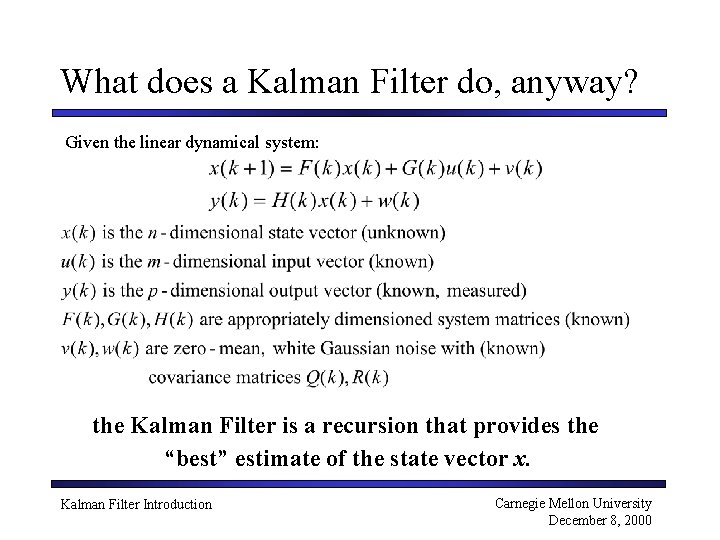
What does a Kalman Filter do, anyway? Given the linear dynamical system: the Kalman Filter is a recursion that provides the “best” estimate of the state vector x. Kalman Filter Introduction Carnegie Mellon University December 8, 2000

What’s so great about that? • noise smoothing (improve noisy measurements) • state estimation (for state feedback) • recursive (computes next estimate using only most recent measurement) Kalman Filter Introduction Carnegie Mellon University December 8, 2000
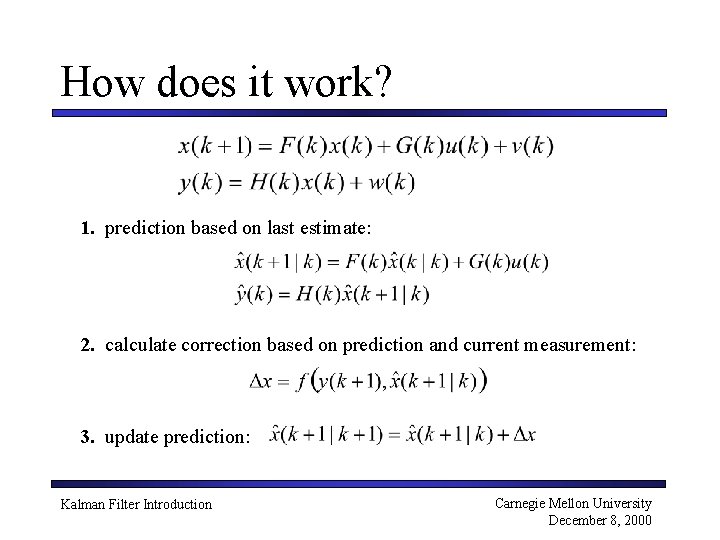
How does it work? 1. prediction based on last estimate: 2. calculate correction based on prediction and current measurement: 3. update prediction: Kalman Filter Introduction Carnegie Mellon University December 8, 2000
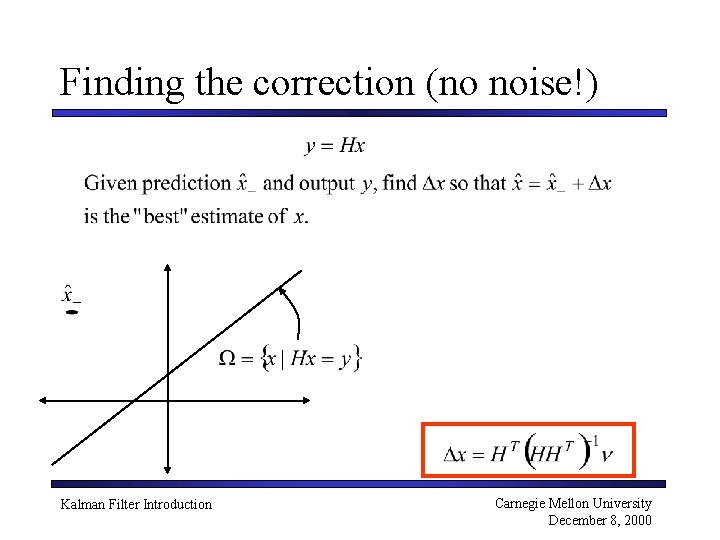
Finding the correction (no noise!) Kalman Filter Introduction Carnegie Mellon University December 8, 2000
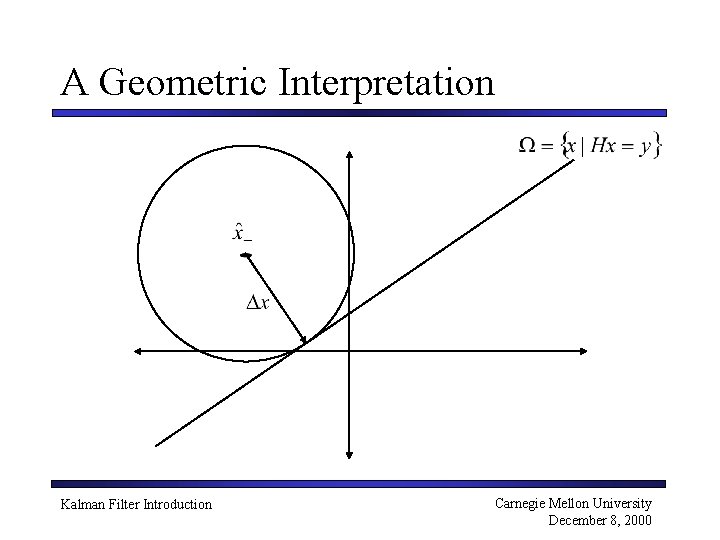
A Geometric Interpretation Kalman Filter Introduction Carnegie Mellon University December 8, 2000
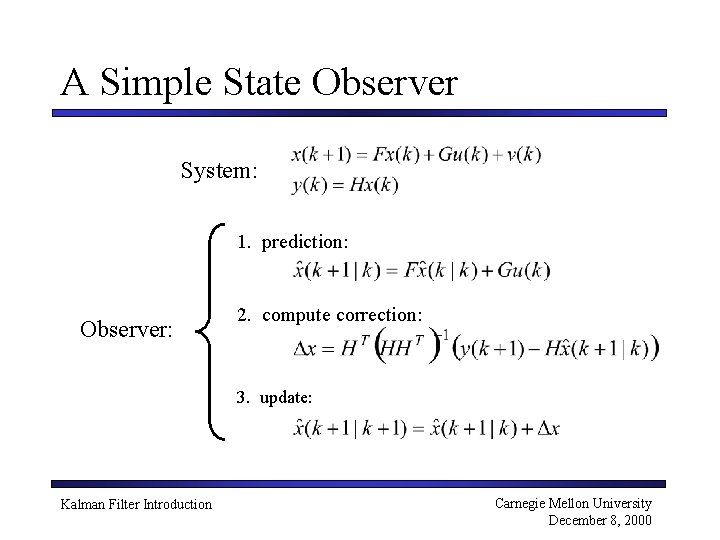
A Simple State Observer System: 1. prediction: Observer: 2. compute correction: 3. update: Kalman Filter Introduction Carnegie Mellon University December 8, 2000
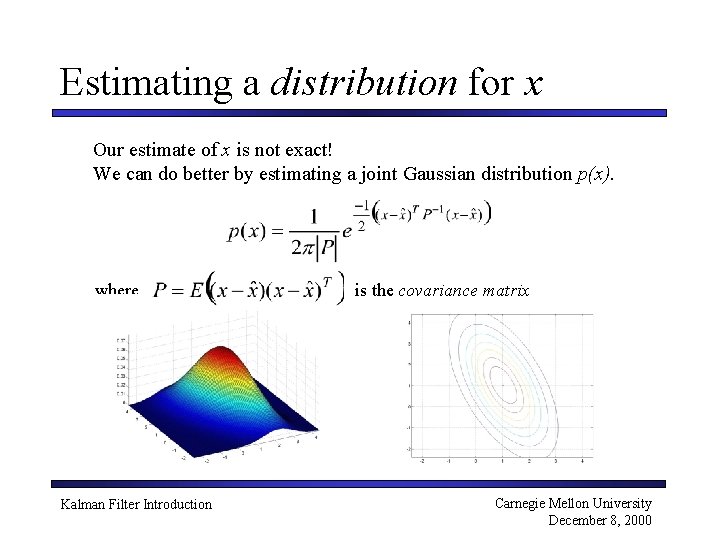
Estimating a distribution for x Our estimate of x is not exact! We can do better by estimating a joint Gaussian distribution p(x). where Kalman Filter Introduction is the covariance matrix Carnegie Mellon University December 8, 2000
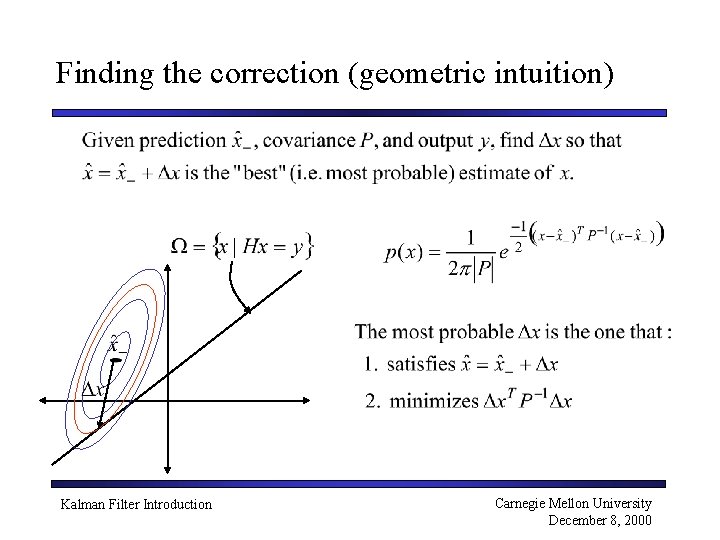
Finding the correction (geometric intuition) Kalman Filter Introduction Carnegie Mellon University December 8, 2000
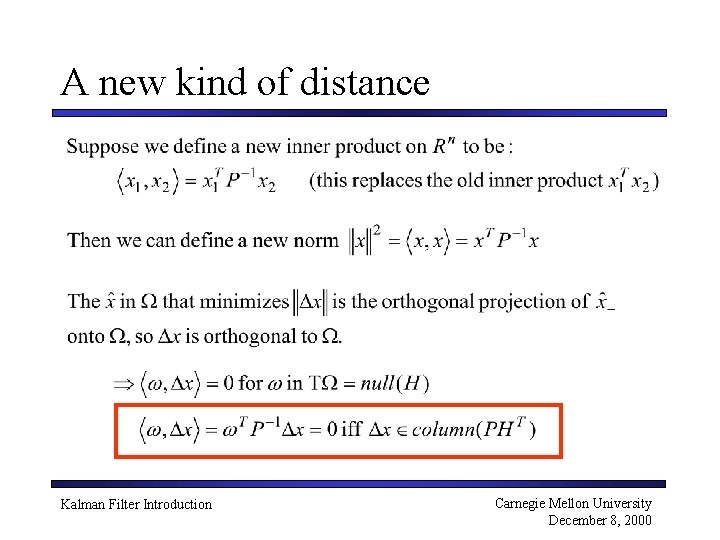
A new kind of distance Kalman Filter Introduction Carnegie Mellon University December 8, 2000
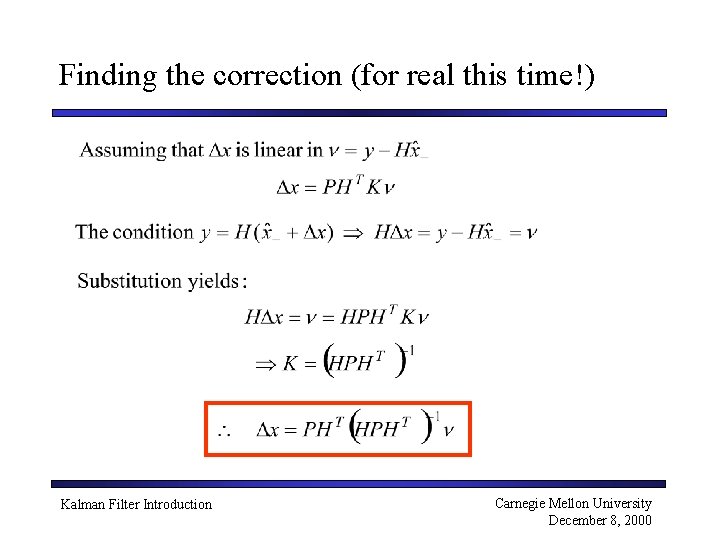
Finding the correction (for real this time!) Kalman Filter Introduction Carnegie Mellon University December 8, 2000
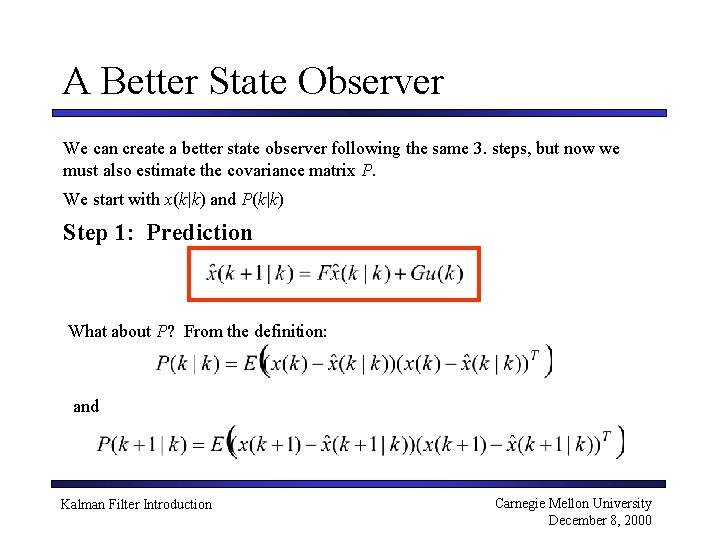
A Better State Observer We can create a better state observer following the same 3. steps, but now we must also estimate the covariance matrix P. We start with x(k|k) and P(k|k) Step 1: Prediction What about P? From the definition: and Kalman Filter Introduction Carnegie Mellon University December 8, 2000
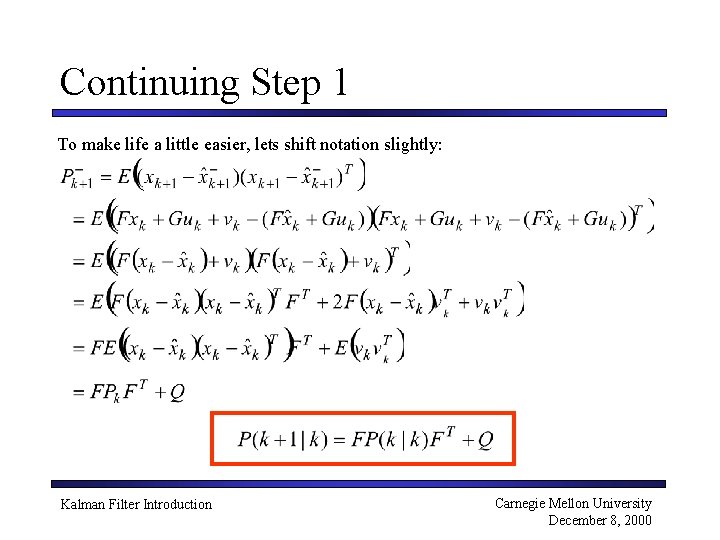
Continuing Step 1 To make life a little easier, lets shift notation slightly: Kalman Filter Introduction Carnegie Mellon University December 8, 2000
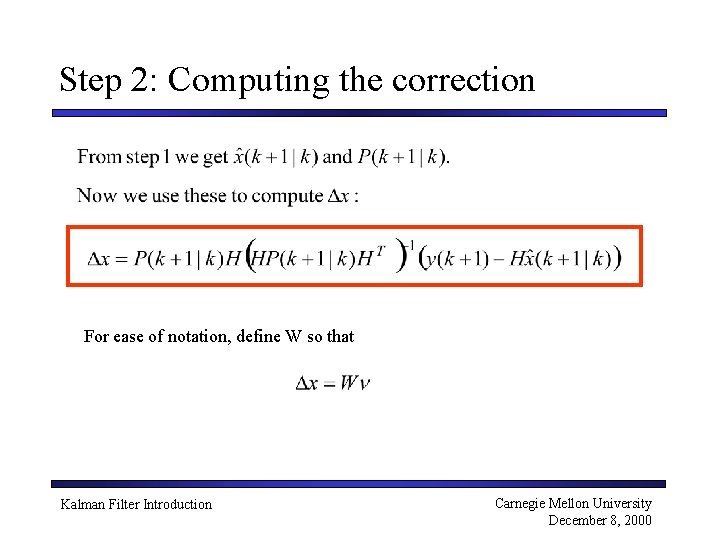
Step 2: Computing the correction For ease of notation, define W so that Kalman Filter Introduction Carnegie Mellon University December 8, 2000
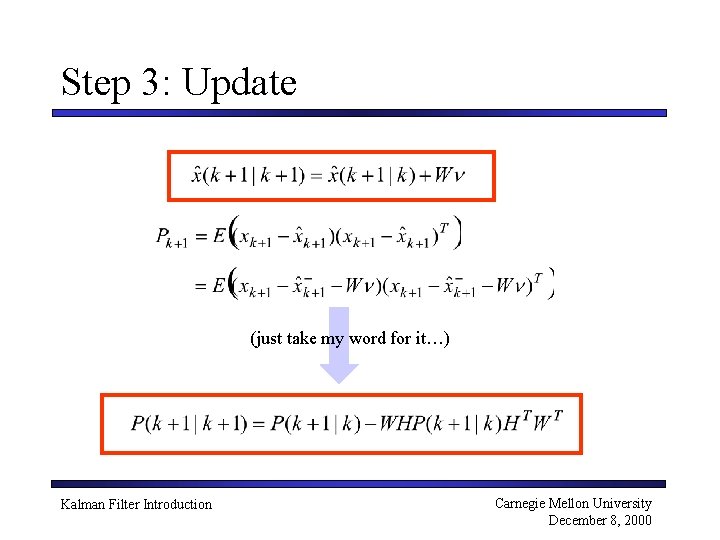
Step 3: Update (just take my word for it…) Kalman Filter Introduction Carnegie Mellon University December 8, 2000
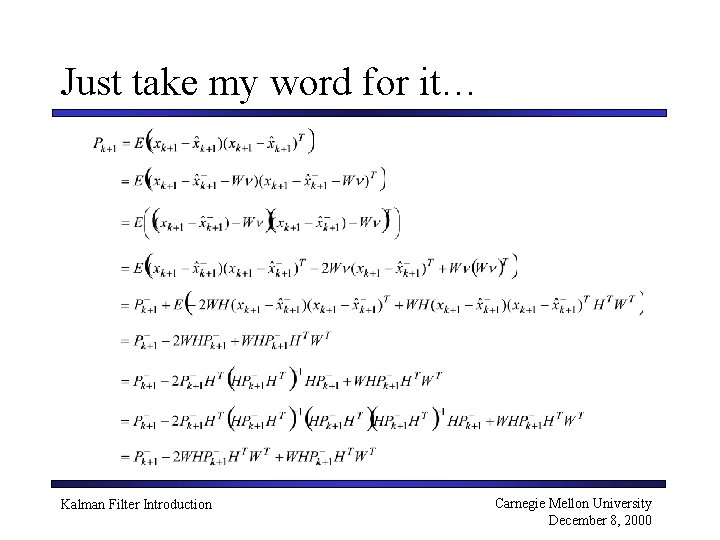
Just take my word for it… Kalman Filter Introduction Carnegie Mellon University December 8, 2000
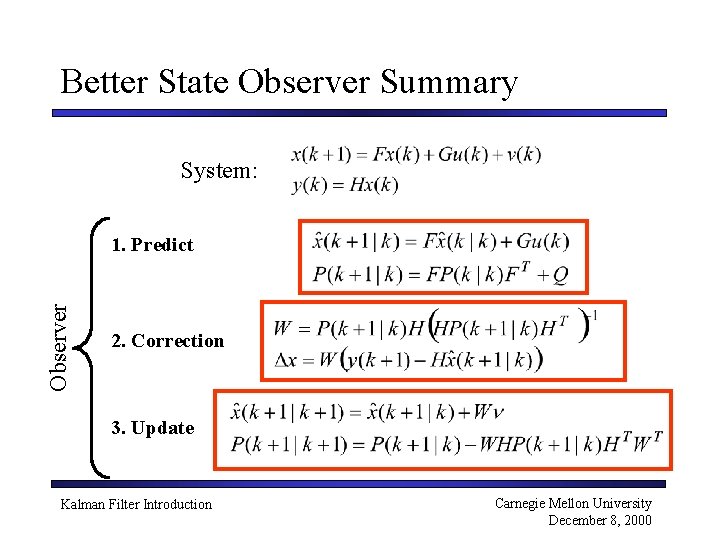
Better State Observer Summary System: Observer 1. Predict 2. Correction 3. Update Kalman Filter Introduction Carnegie Mellon University December 8, 2000
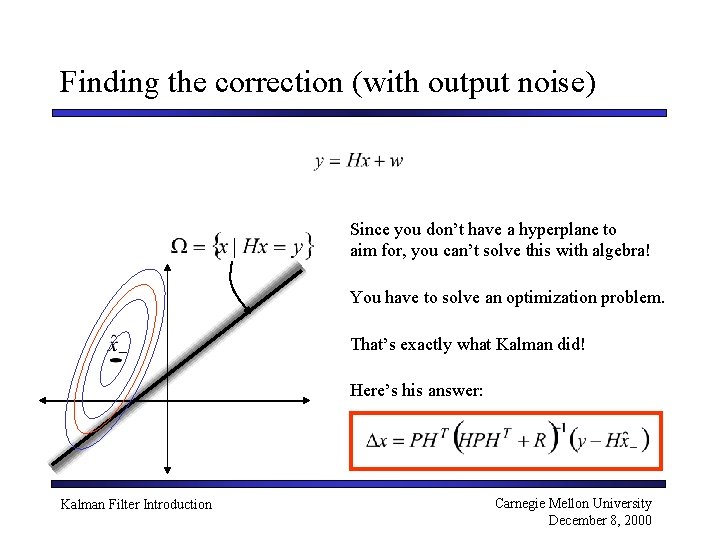
Finding the correction (with output noise) Since you don’t have a hyperplane to aim for, you can’t solve this with algebra! You have to solve an optimization problem. That’s exactly what Kalman did! Here’s his answer: Kalman Filter Introduction Carnegie Mellon University December 8, 2000
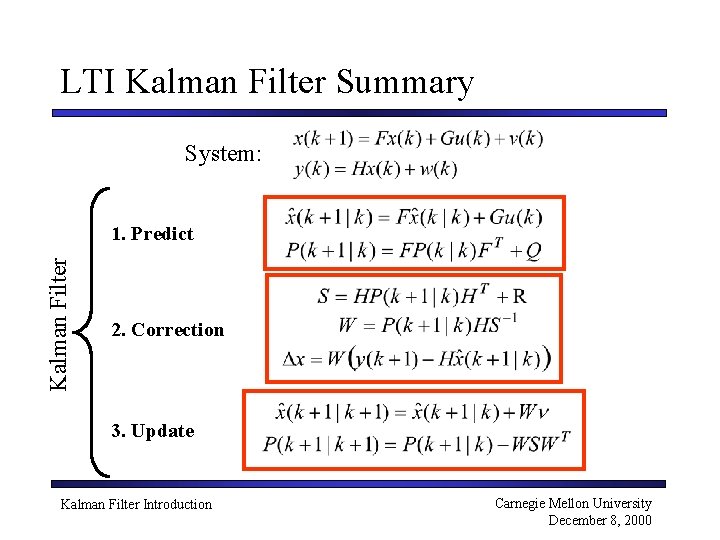
LTI Kalman Filter Summary System: Kalman Filter 1. Predict 2. Correction 3. Update Kalman Filter Introduction Carnegie Mellon University December 8, 2000
- Slides: 19