
Kalman Smoothing Jur van den Berg Kalman Filtering
Kalman Smoothing Jur van den Berg
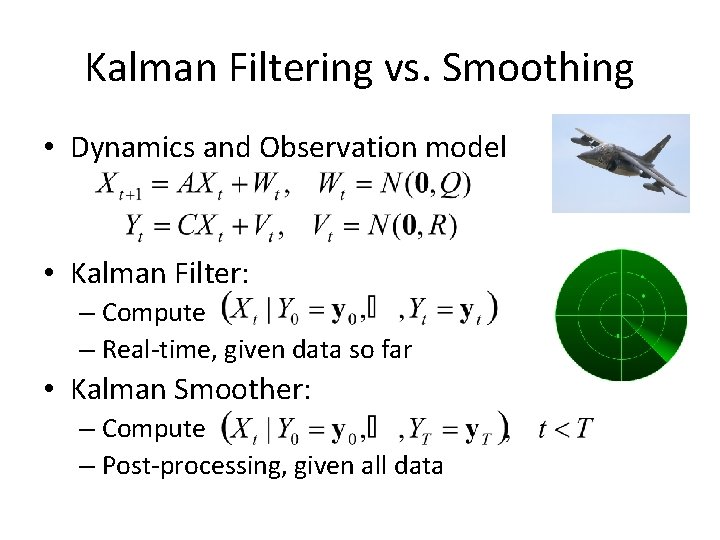
Kalman Filtering vs. Smoothing • Dynamics and Observation model • Kalman Filter: – Compute – Real-time, given data so far • Kalman Smoother: – Compute – Post-processing, given all data
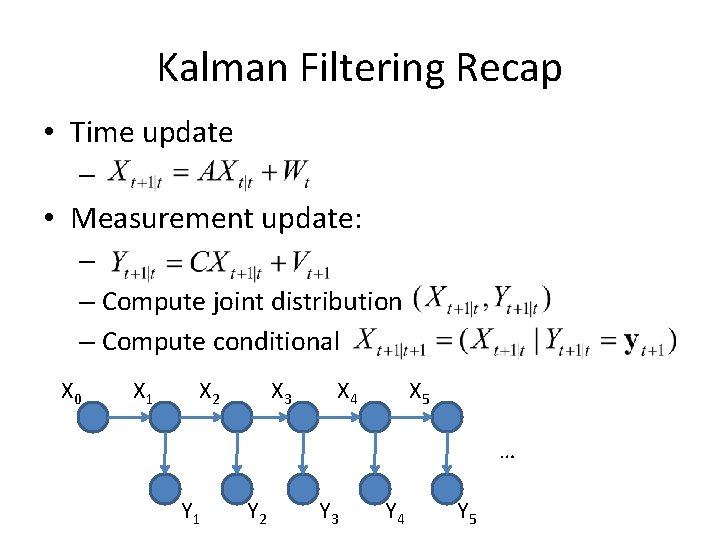
Kalman Filtering Recap • Time update – • Measurement update: – – Compute joint distribution – Compute conditional X 0 X 1 X 2 X 3 X 4 X 5 … Y 1 Y 2 Y 3 Y 4 Y 5
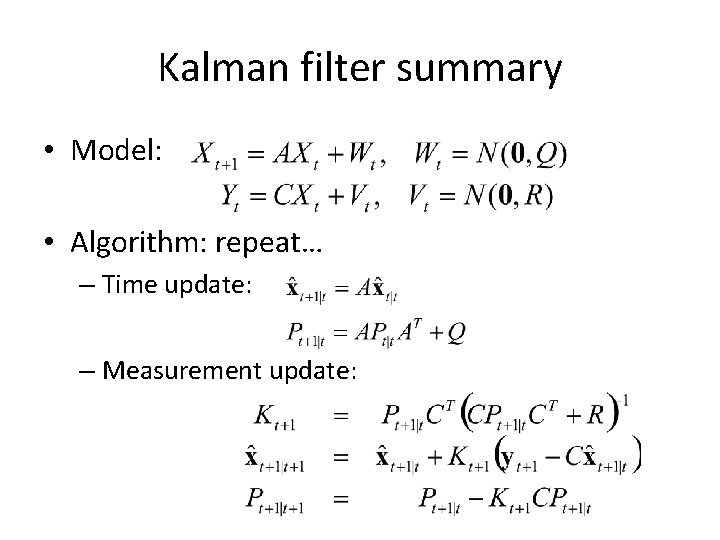
Kalman filter summary • Model: • Algorithm: repeat… – Time update: – Measurement update:
Kalman Smoothing • Input: initial distribution X 0 and data y 1, …, y. T • Algorithm: forward-backward pass (Rauch-Tung-Striebel algorithm) • Forward pass: – Kalman filter: compute Xt+1|t and Xt+1|t+1 for 0 ≤ t < T • Backward pass: – Compute Xt|T for 0 ≤ t < T – Reverse “horizontal” arrow in graph
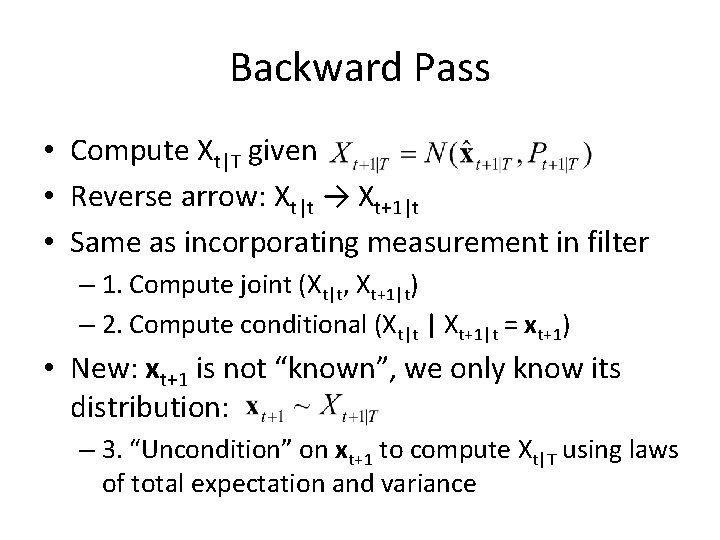
Backward Pass • Compute Xt|T given • Reverse arrow: Xt|t → Xt+1|t • Same as incorporating measurement in filter – 1. Compute joint (Xt|t, Xt+1|t) – 2. Compute conditional (Xt|t | Xt+1|t = xt+1) • New: xt+1 is not “known”, we only know its distribution: – 3. “Uncondition” on xt+1 to compute Xt|T using laws of total expectation and variance
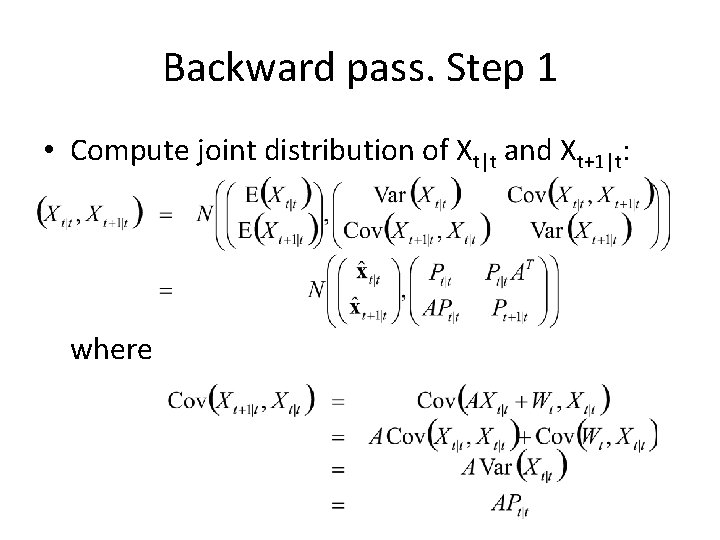
Backward pass. Step 1 • Compute joint distribution of Xt|t and Xt+1|t: where
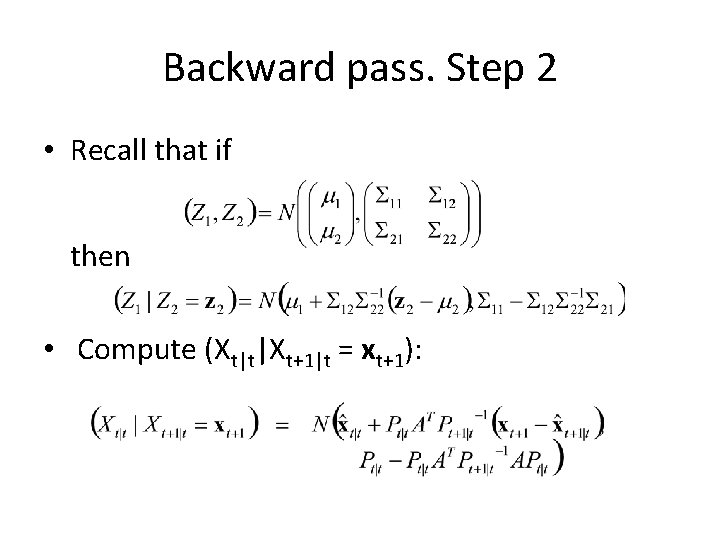
Backward pass. Step 2 • Recall that if then • Compute (Xt|t|Xt+1|t = xt+1):
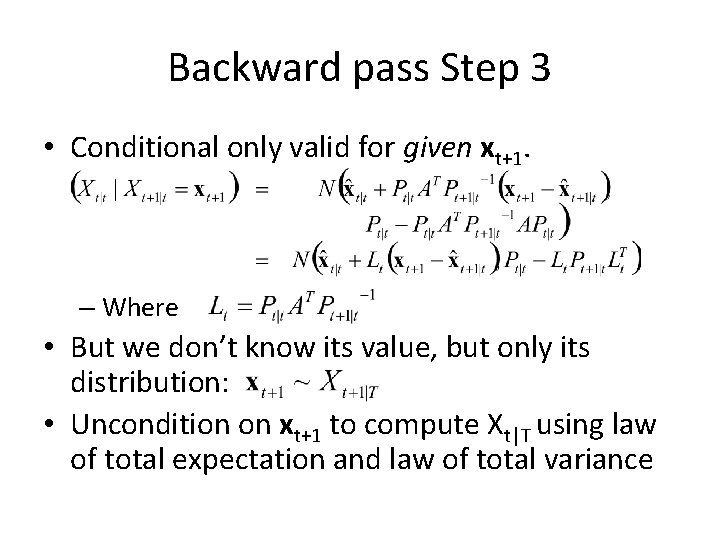
Backward pass Step 3 • Conditional only valid for given xt+1. – Where • But we don’t know its value, but only its distribution: • Uncondition on xt+1 to compute Xt|T using law of total expectation and law of total variance
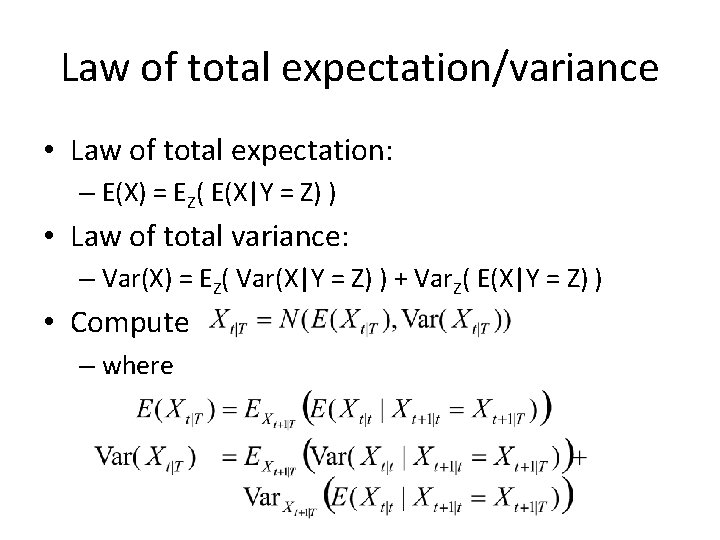
Law of total expectation/variance • Law of total expectation: – E(X) = EZ( E(X|Y = Z) ) • Law of total variance: – Var(X) = EZ( Var(X|Y = Z) ) + Var. Z( E(X|Y = Z) ) • Compute – where
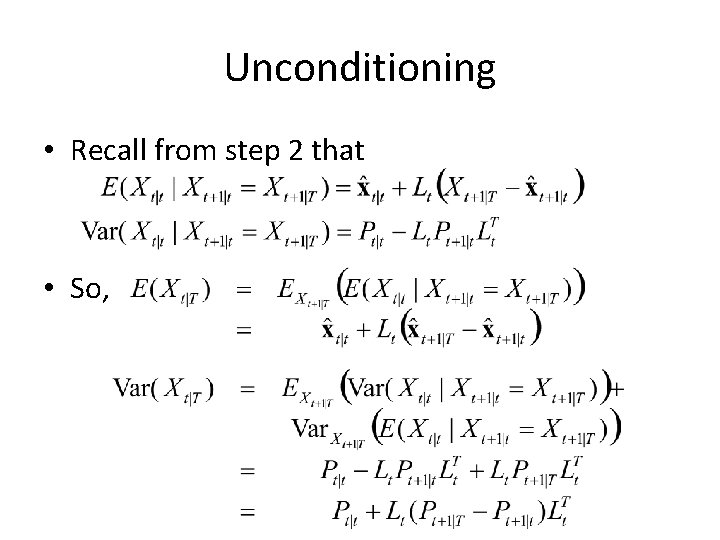
Unconditioning • Recall from step 2 that • So,

Backward pass • Summary:
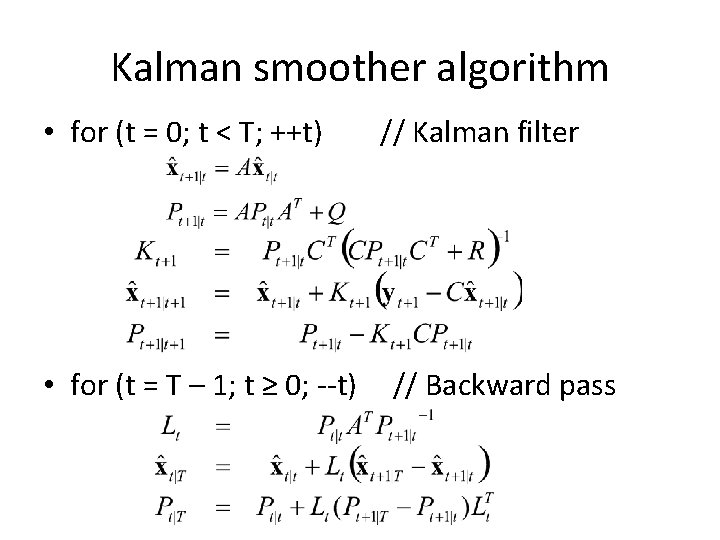
Kalman smoother algorithm • for (t = 0; t < T; ++t) • for (t = T – 1; t ≥ 0; --t) // Kalman filter // Backward pass
Conclusion • Kalman smoother can in used a post-processing • Use xt|T’s as optimal estimate of state at time t, and use Pt|T as a measure of uncertainty.
Extensions • Automatic parameter (Q and R) fitting using EM-algorithm – Use Kalman Smoother on “training data” to learn Q and R (and A and C)
- Slides: 15