
Kaipara District Council Mangawhai Wastewater Strategy and Options




- Slides: 32
Kaipara District Council Mangawhai Wastewater Strategy and Options 7 August 2017
Mangawhai Wastewater (MWW) • Objectives & Background • Part 1 – System, Options, Growth & Demand • Part 2 – Connection policies, Anomalies & Alternative funding options • Decisions required • MCWWS Advisory Panel recommendations • Conclusion
Objectives of MWW scheme & extension • Need to protect the Mangawhai Harbour • Support growth (Mangawhai Community Plan) • Honour commitments • Purpose of Local Government
Background • • • Past Ground zero Phase 1 Phase 2 Phase 3 2012 2014 2015 now
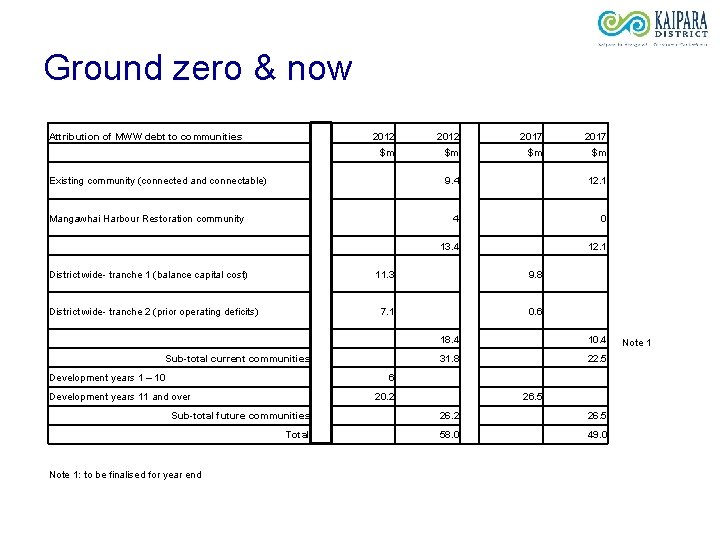
Ground zero & now Attribution of MWW debt to communities 2012 2017 $m $m Existing community (connected and connectable) 12. 1 0 12. 1 9. 8 0. 6 9. 4 Mangawhai Harbour Restoration community 4 District wide- tranche 1 (balance capital cost) 11. 3 13. 4 District wide- tranche 2 (prior operating deficits) 7. 1 18. 4 10. 4 Note 1 Sub-total current communities 31. 8 22. 5 Development years 1 – 10 6 Development years 11 and over 20. 2 26. 5 Sub-total future communities 26. 2 26. 5 Total 58. 0 49. 0 Note 1: to be finalised for year end
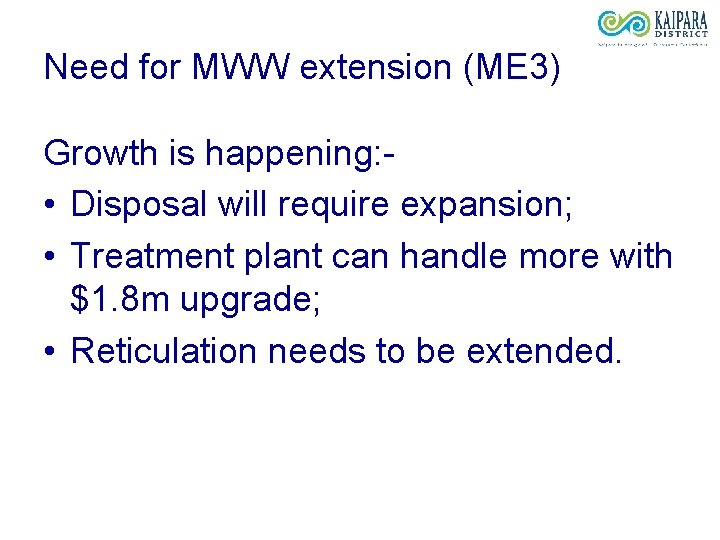
Need for MWW extension (ME 3) Growth is happening: • Disposal will require expansion; • Treatment plant can handle more with $1. 8 m upgrade; • Reticulation needs to be extended.
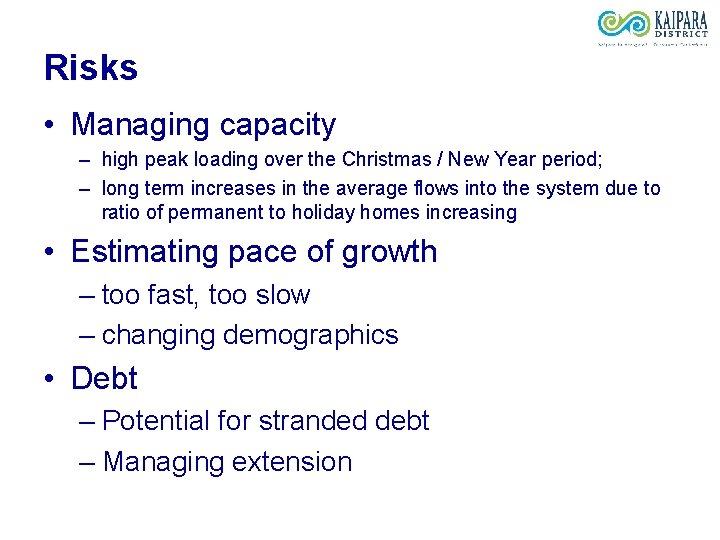
Risks • Managing capacity – high peak loading over the Christmas / New Year period; – long term increases in the average flows into the system due to ratio of permanent to holiday homes increasing • Estimating pace of growth – too fast, too slow – changing demographics • Debt – Potential for stranded debt – Managing extension
Part 1 ME 3 • System components & capacity • Options, costs & funding • Growth and demand
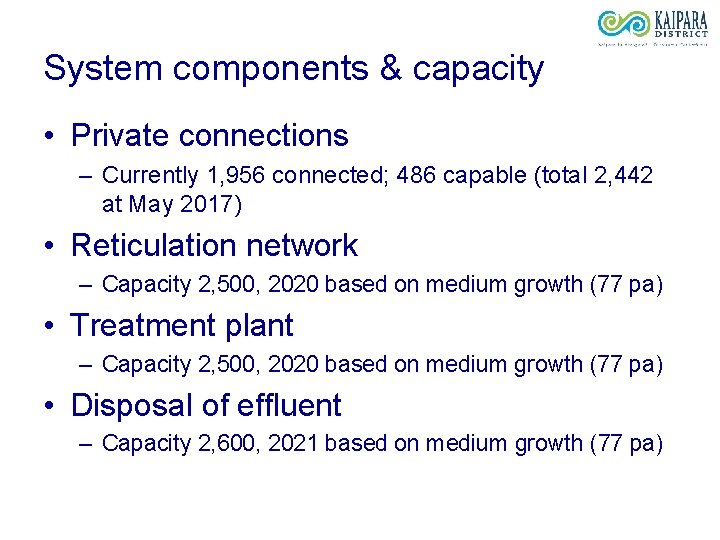
System components & capacity • Private connections – Currently 1, 956 connected; 486 capable (total 2, 442 at May 2017) • Reticulation network – Capacity 2, 500, 2020 based on medium growth (77 pa) • Treatment plant – Capacity 2, 500, 2020 based on medium growth (77 pa) • Disposal of effluent – Capacity 2, 600, 2021 based on medium growth (77 pa)
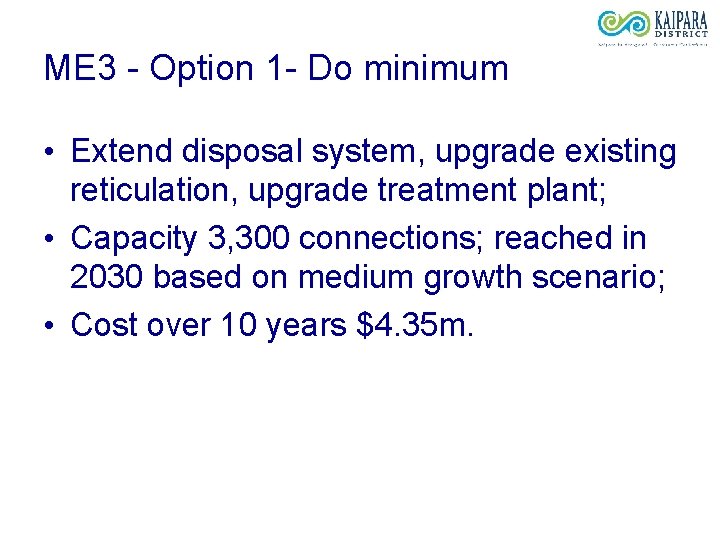
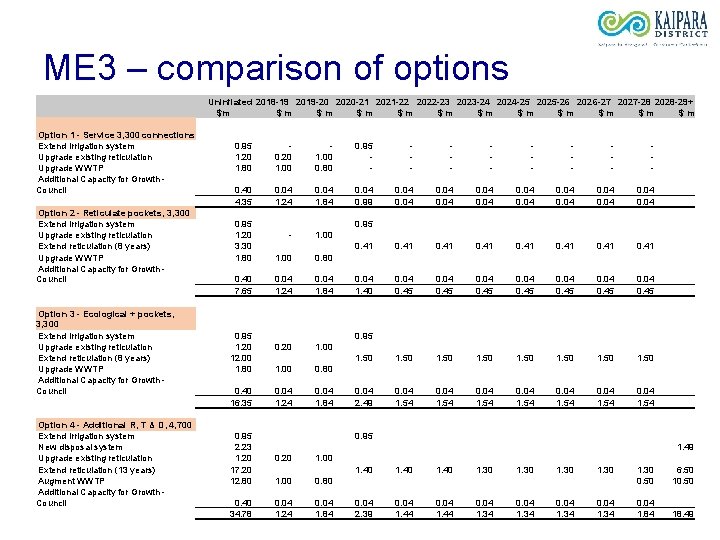
ME 3 - Option 1 - Do minimum • Extend disposal system, upgrade existing reticulation, upgrade treatment plant; • Capacity 3, 300 connections; reached in 2030 based on medium growth scenario; • Cost over 10 years $4. 35 m.
ME 3 - Option 2 - Reticulate Pockets • Extend disposal system, upgrade existing & extend reticulation, upgrade treatment plant; • Includes $3. 7 m to extend the reticulation; • Capacity 3, 300 connections - reached in 2030 based on medium growth scenario; • Cost over 10 years $7. 65 m.
ME 3 - Option 3 - Ecological plus pockets • Extend disposal system, upgrade existing & extend reticulation, upgrade treatment plant; • Includes $12. 4 m to extend the reticulation; • Capacity 3, 300 connections - reached in 2030 based on medium growth scenario; • Cost over 10 years $16. 35 m.
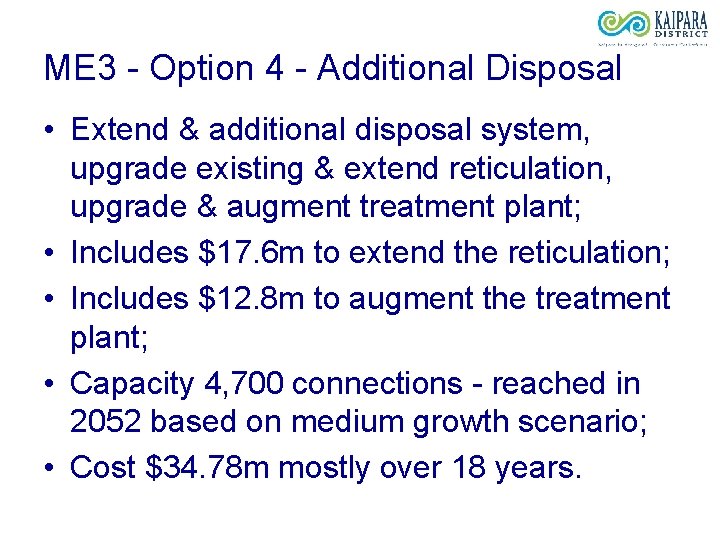
ME 3 - Option 4 - Additional Disposal • Extend & additional disposal system, upgrade existing & extend reticulation, upgrade & augment treatment plant; • Includes $17. 6 m to extend the reticulation; • Includes $12. 8 m to augment the treatment plant; • Capacity 4, 700 connections - reached in 2052 based on medium growth scenario; • Cost $34. 78 m mostly over 18 years.
ME 3 – comparison of options Option 1 - Service 3, 300 connections Extend irrigation system Upgrade existing reticulation Upgrade WWTP Additional Capacity for Growth - Council Option 2 - Reticulate pockets, 3, 300 Extend irrigation system Upgrade existing reticulation Extend reticulation (8 years) Upgrade WWTP Additional Capacity for Growth - Council Option 3 - Ecological + pockets, 3, 300 Extend irrigation system Upgrade existing reticulation Extend reticulation (8 years) Upgrade WWTP Additional Capacity for Growth - Council Option 4 - Additional R, T & D, 4, 700 Extend irrigation system New disposal system Upgrade existing reticulation Extend reticulation (13 years) Augment WWTP Additional Capacity for Growth - Council Uninflated 2018 -19 2019 -20 2020 -21 2021 -22 2022 -23 2023 -24 2024 -25 2025 -26 2026 -27 2027 -28 2028 -29+ $m $ m $ m $ m 0. 95 - - - 1. 20 0. 20 1. 00 - - 1. 80 1. 00 0. 80 - - 0. 40 0. 04 0. 04 4. 35 1. 24 1. 84 0. 99 0. 04 0. 04 0. 95 1. 20 - 1. 00 3. 30 0. 41 0. 41 1. 80 1. 00 0. 80 0. 40 0. 04 0. 04 7. 65 1. 24 1. 84 1. 40 0. 45 0. 45 0. 95 1. 20 0. 20 1. 00 12. 00 1. 50 1. 50 1. 80 1. 00 0. 80 0. 40 0. 04 0. 04 16. 35 1. 24 1. 84 2. 49 1. 54 1. 54 0. 95 2. 23 1. 49 1. 20 0. 20 1. 00 17. 20 1. 40 1. 30 6. 50 12. 80 1. 00 0. 80 0. 50 10. 50 0. 40 0. 04 0. 04 34. 78 1. 24 1. 84 2. 39 1. 44 1. 34 1. 84 18. 49
Growth & Demand • Growth – Using the medium growth scenario (77 dwellings pa) – Same basis as for the Mangawhai Community Plan • Demand – Determines where reticulation should go – Ecological option may divert away from demand areas
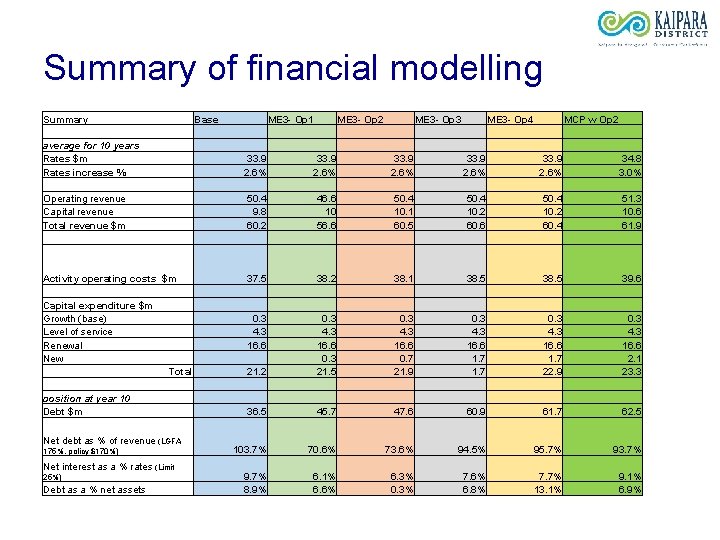
Summary of financial modelling Summary average for 10 years Rates $m Rates increase % Operating revenue Capital revenue Total revenue $m Activity operating costs $m Capital expenditure $m Growth (base) Level of service Renewal New Total position at year 10 Debt $m Net debt as % of revenue (LGFA 175%, policy $170%) Net interest as a % rates (Limit 25%) Debt as a % net assets Base ME 3 - Op 1 ME 3 - Op 2 ME 3 - Op 3 ME 3 - Op 4 33. 9 2. 6% 50. 4 46. 6 50. 4 9. 8 10 10. 1 10. 2 60. 2 56. 6 60. 5 60. 6 37. 5 0. 3 4. 3 16. 6 21. 2 36. 5 38. 2 0. 3 4. 3 16. 6 0. 3 21. 5 45. 7 38. 1 38. 5 0. 3 4. 3 16. 6 0. 7 21. 9 MCP w Op 2 33. 9 2. 6% 50. 4 10. 2 60. 4 51. 3 10. 6 61. 9 38. 5 0. 3 4. 3 16. 6 1. 7 34. 8 3. 0% 39. 6 0. 3 4. 3 16. 6 1. 7 22. 9 0. 3 4. 3 16. 6 2. 1 23. 3 47. 6 60. 9 61. 7 62. 5 103. 7% 70. 6% 73. 6% 94. 5% 95. 7% 93. 7% 9. 7% 8. 9% 6. 1% 6. 6% 6. 3% 0. 3% 7. 6% 6. 8% 7. 7% 13. 1% 9. 1% 6. 9%
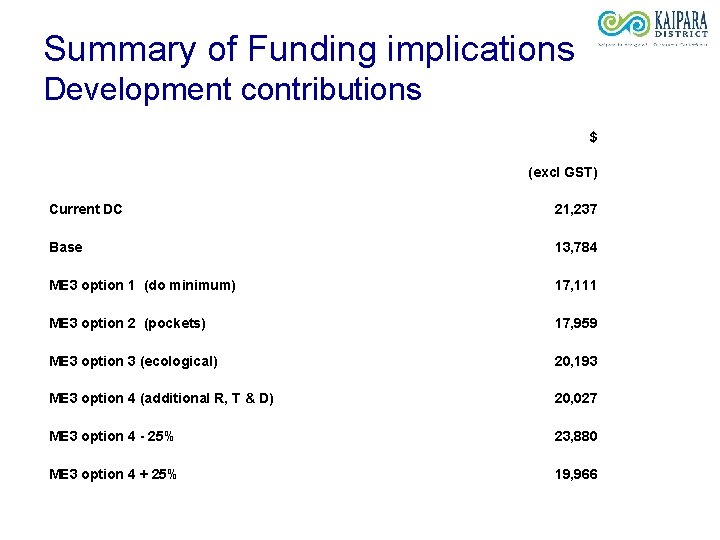
Summary of Funding implications Development contributions $ (excl GST) Current DC 21, 237 Base 13, 784 ME 3 option 1 (do minimum) 17, 111 ME 3 option 2 (pockets) 17, 959 ME 3 option 3 (ecological) 20, 193 ME 3 option 4 (additional R, T & D) 20, 027 ME 3 option 4 - 25% 23, 880 ME 3 option 4 + 25% 19, 966
Summary of Funding implications Rates
Part 2 ME 3 • Connection policies • Anomalies • Alternative funding options
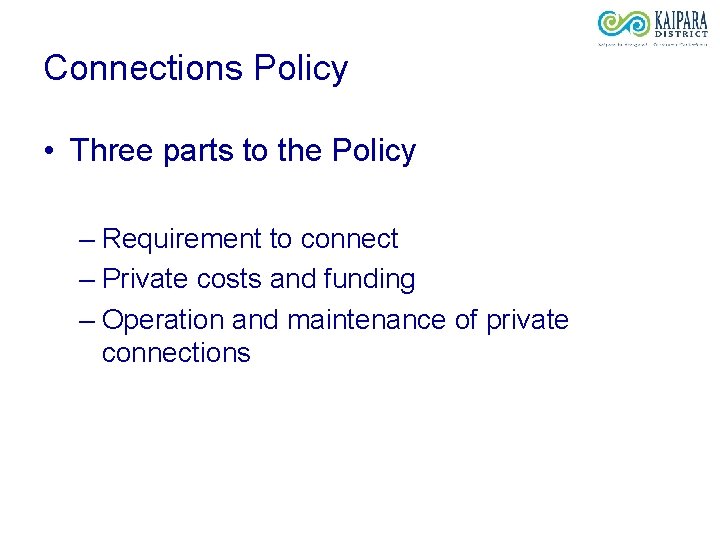
Connections Policy • Three parts to the Policy – Requirement to connect – Private costs and funding – Operation and maintenance of private connections
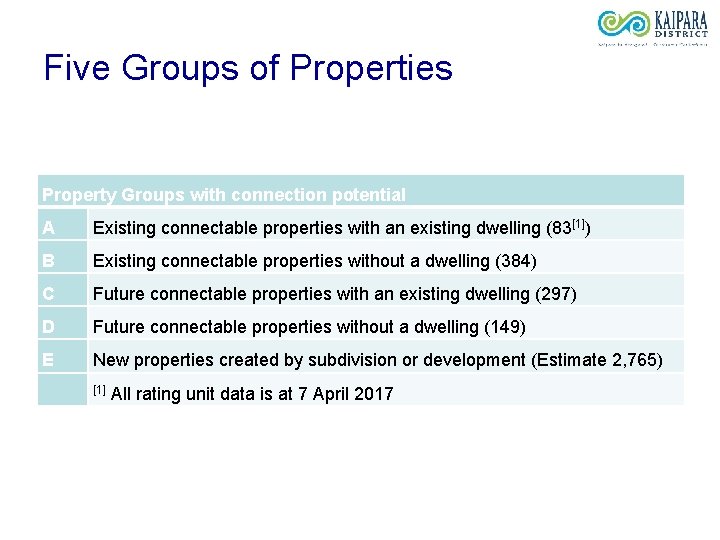
Five Groups of Properties Property Groups with connection potential A Existing connectable properties with an existing dwelling (83[1]) B Existing connectable properties without a dwelling (384) C Future connectable properties with an existing dwelling (297) D Future connectable properties without a dwelling (149) E New properties created by subdivision or development (Estimate 2, 765) [1] All rating unit data is at 7 April 2017
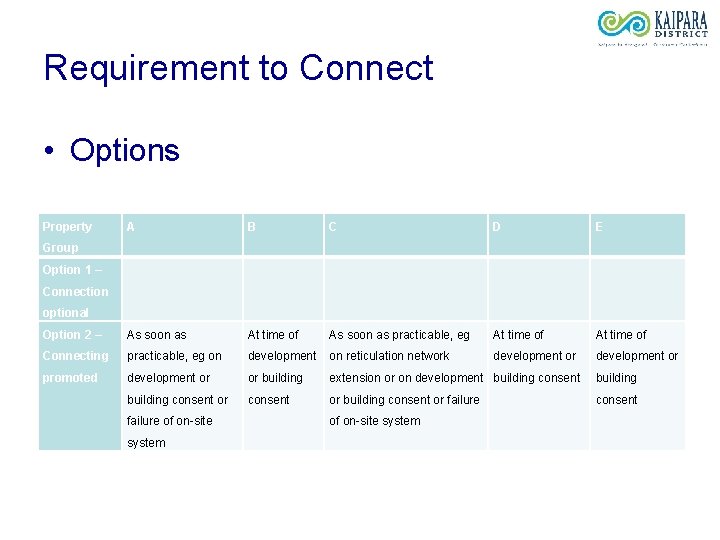
Requirement to Connect • Options Property A B C D E Option 2 – As soon as At time of As soon as practicable, eg At time of Connecting practicable, eg on development on reticulation network development or promoted development or building extension or on development building consent or consent or building consent or failure consent Group Option 1 – Connection optional failure of on-site system
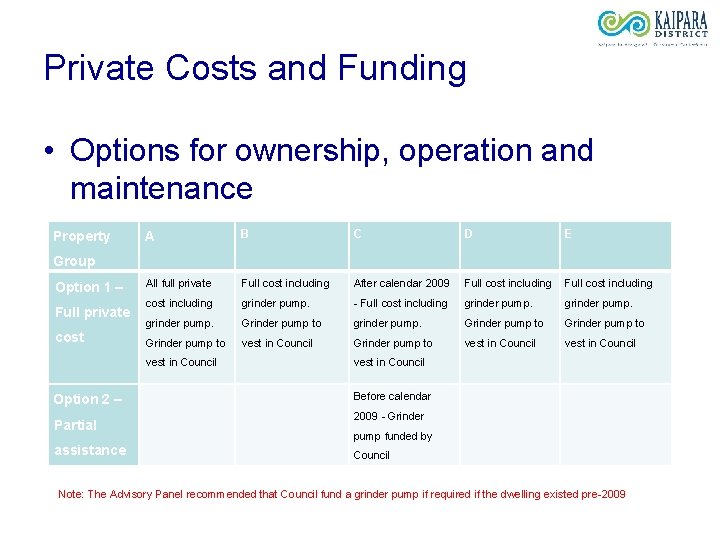
Private Costs and Funding • Options for ownership, operation and maintenance Property A B C D E All full private Full cost including After calendar 2009 Full cost including grinder pump. - Full cost including grinder pump. Grinder pump to grinder pump. Grinder pump to vest in Council Group Option 1 – Full private cost vest in Council Option 2 – Partial assistance vest in Council Before calendar 2009 - Grinder pump funded by Council Note: The Advisory Panel recommended that Council fund a grinder pump if required if the dwelling existed pre-2009
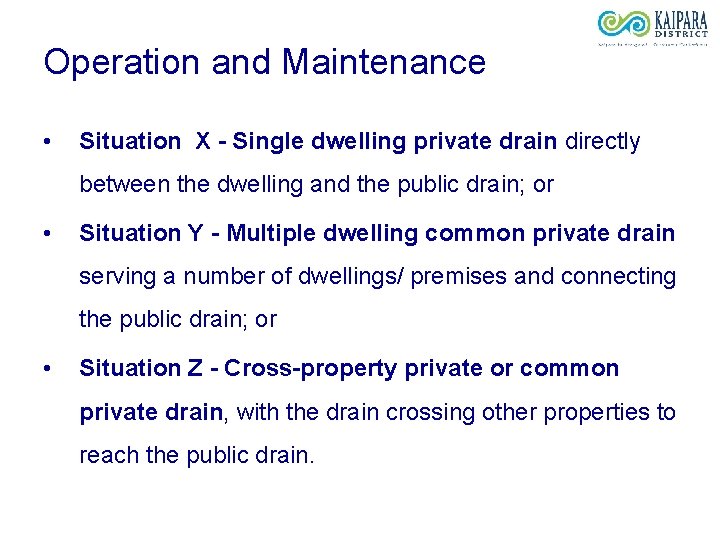
Operation and Maintenance • Situation X - Single dwelling private drain directly between the dwelling and the public drain; or • Situation Y - Multiple dwelling common private drain serving a number of dwellings/ premises and connecting the public drain; or • Situation Z - Cross-property private or common private drain, with the drain crossing other properties to reach the public drain.
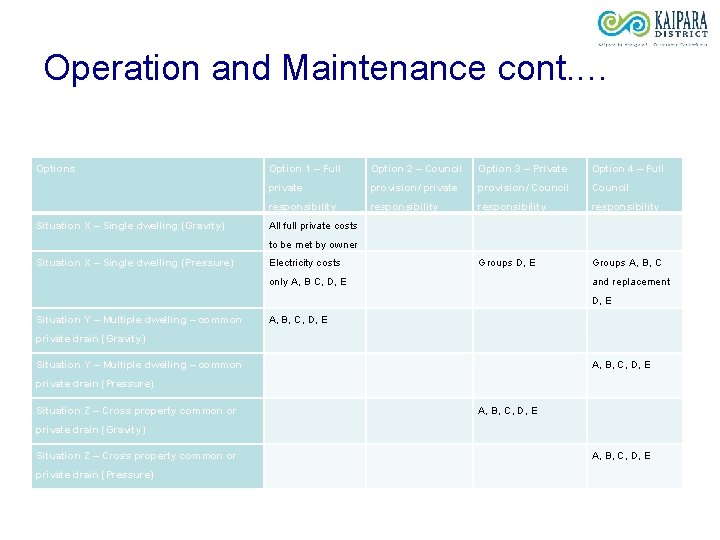
Operation and Maintenance cont. … Options Situation X – Single dwelling (Gravity) Option 1 – Full Option 2 – Council Option 3 – Private Option 4 – Full private provision/ Council responsibility All full private costs to be met by owner Situation X – Single dwelling (Pressure) Electricity costs Groups D, E only A, B C, D, E and replacement Situation Y – Multiple dwelling – common A, B, C, D, E Groups A, B, C D, E A, B, C, D, E private drain (Gravity) Situation Y – Multiple dwelling – common private drain (Pressure) Situation Z – Cross property common or private drain (Gravity) Situation Z – Cross property common or private drain (Pressure)
Anomalies • Property “C”s • Historical exemption from paying “capable to connect”
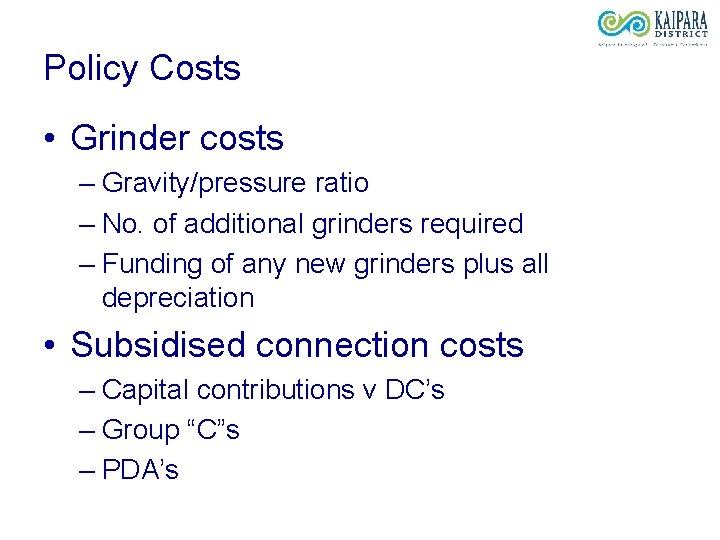
Policy Costs • Grinder costs – Gravity/pressure ratio – No. of additional grinders required – Funding of any new grinders plus all depreciation • Subsidised connection costs – Capital contributions v DC’s – Group “C”s – PDA’s
Alternative funding options • Additional targeted rates for – Undeveloped land, and/or – Mangawhai harbour restoration or some other area The purpose would be to manage – Debt & timing (financial exposure risk) issues, and/or – Reduce per unit DC’s, and/or – Reduce per SUIP network charges, and/or – Fairness & equity issues.
Decisions Required • Provide for current requirements – Option 2 recommended • Plan for the future – Option 4 recommended • Policy decisions – Council policy stance – Connections policy – Financial & funding policies
MCWWS Advisory Panel recommendations Material: • Advisory Panel Report - July 2015 • Draft update on MCWWS Advisory Panel Recommendations - August 2017
Conclusion • • Must go forward Growth - but what pace? The past is always with us Significant policy & financial considerations – Debt management – Affordability – Distribution of costs – Fairness
Questions?