
Kaan Ycel M D Ph D 16 December
Kaan Yücel M. D. , Ph. D 16. December. 2011 Friday
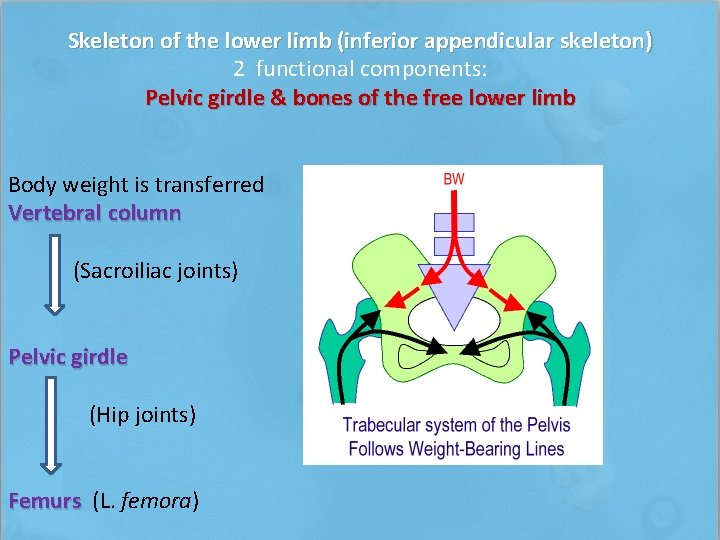
Skeleton of the lower limb (inferior appendicular skeleton) 2 functional components: Pelvic girdle & bones of the free lower limb Body weight is transferred Vertebral column (Sacroiliac joints) Pelvic girdle (Hip joints) Femurs (L. Femurs femora)
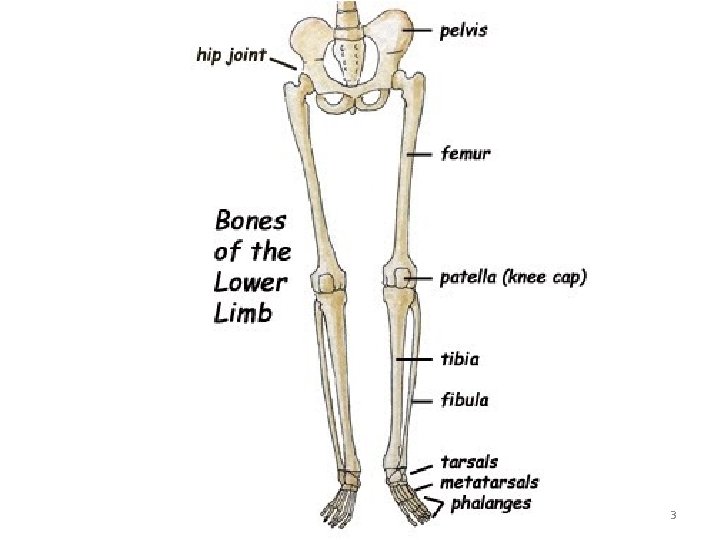
3
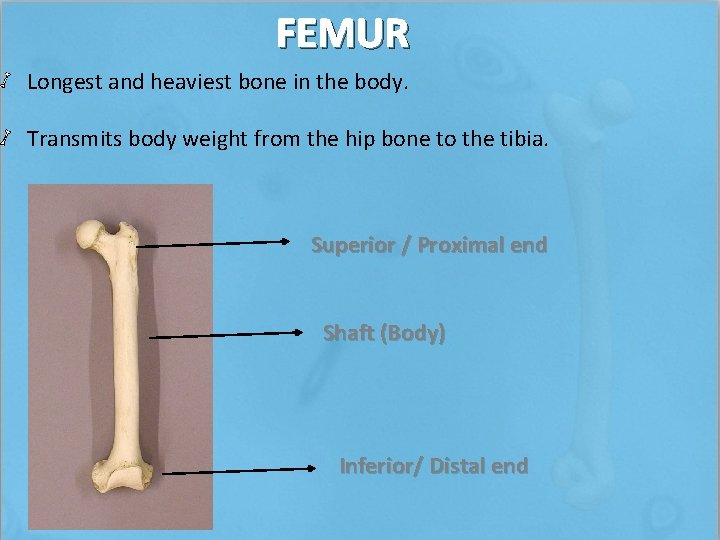
FEMUR Longest and heaviest bone in the body. Transmits body weight from the hip bone to the tibia. Superior / Proximal end Shaft (Body) Inferior/ Distal end
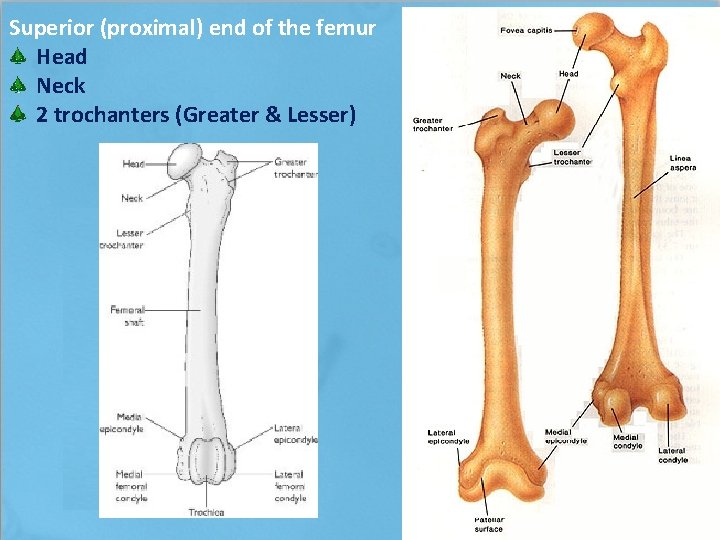
Superior (proximal) end of the femur Head Neck 2 trochanters (Greater & Lesser)
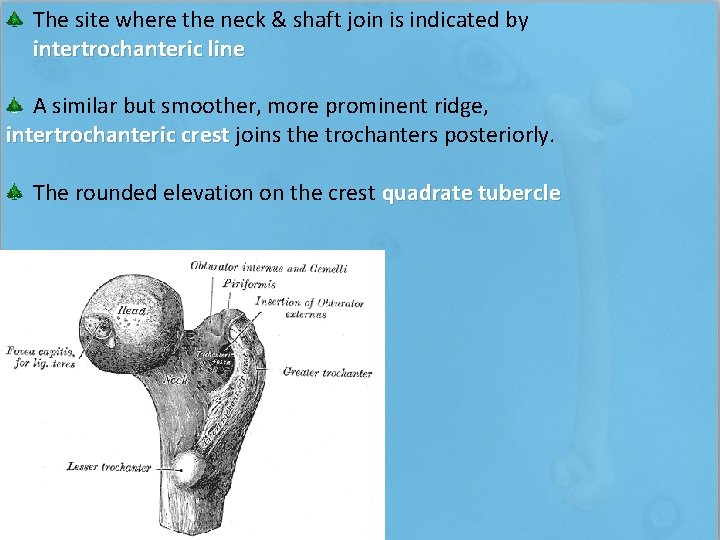
The site where the neck & shaft join is indicated by intertrochanteric line A similar but smoother, more prominent ridge, intertrochanteric crest joins the trochanters posteriorly. intertrochanteric crest The rounded elevation on the crest quadrate tubercle
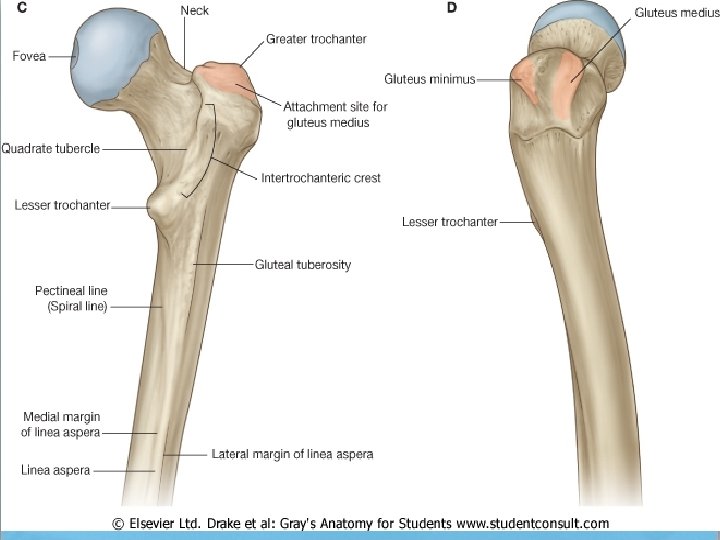
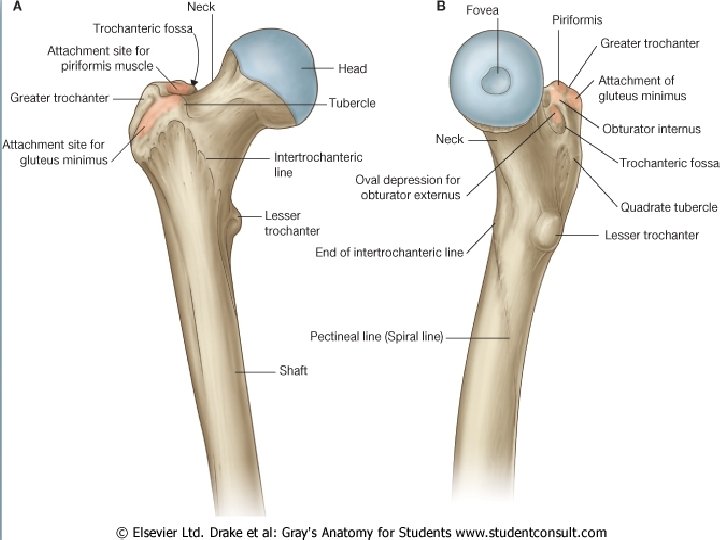
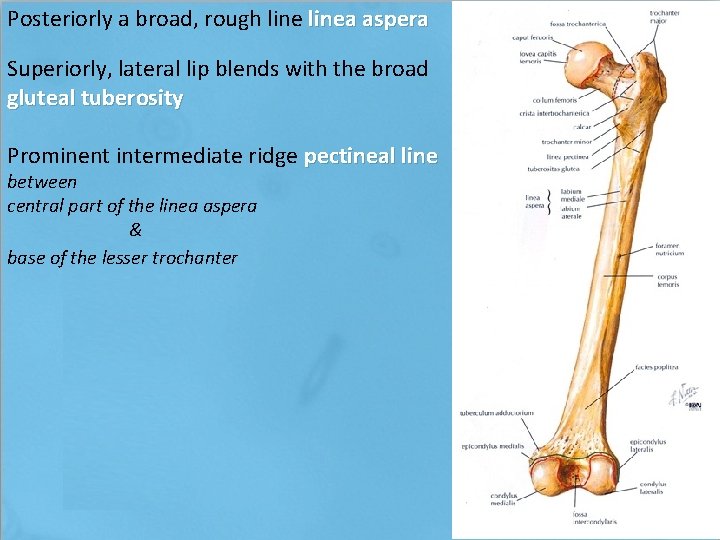
Posteriorly a broad, rough linea aspera Superiorly, lateral lip blends with the broad gluteal tuberosity Prominent intermediate ridge pectineal line between central part of the linea aspera & base of the lesser trochanter
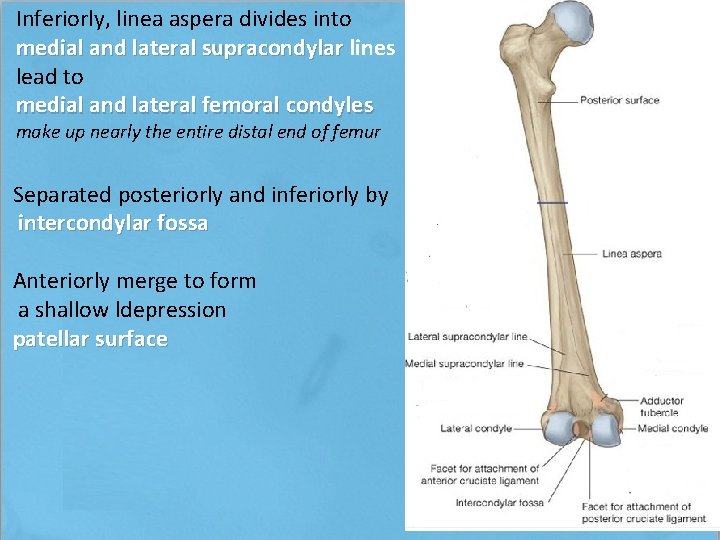
Inferiorly, linea aspera divides into medial and lateral supracondylar lines and lateral supracondylar lead to medial and lateral femoral condyles make up nearly the entire distal end of femur Separated posteriorly and inferiorly by intercondylar fossa Anteriorly merge to form a shallow ldepression patellar surface
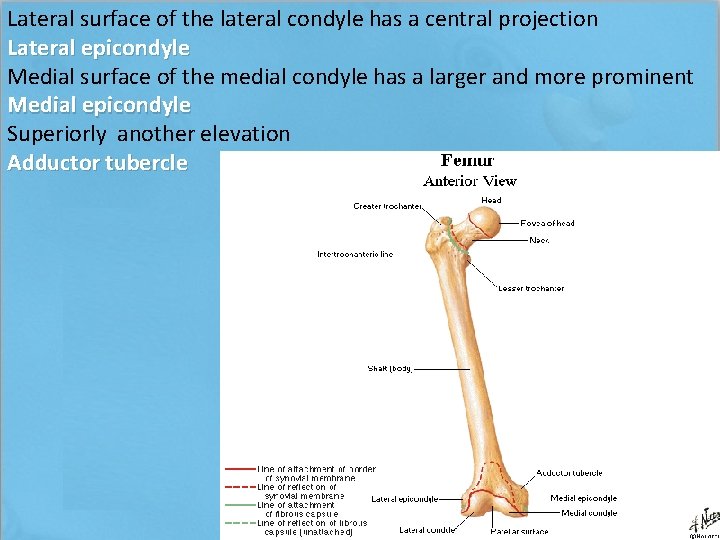
Lateral surface of the lateral condyle has a central projection Lateral epicondyle Medial surface of the medial condyle has a larger and more prominent Medial epicondyle Superiorly another elevation Adductor tubercle
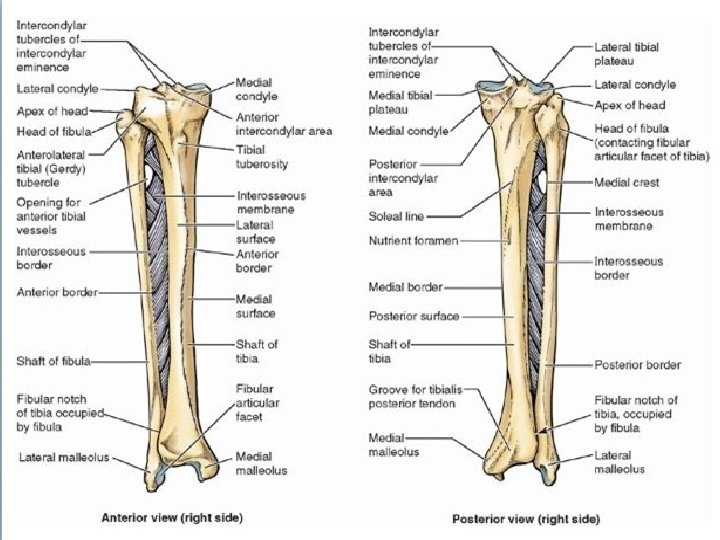
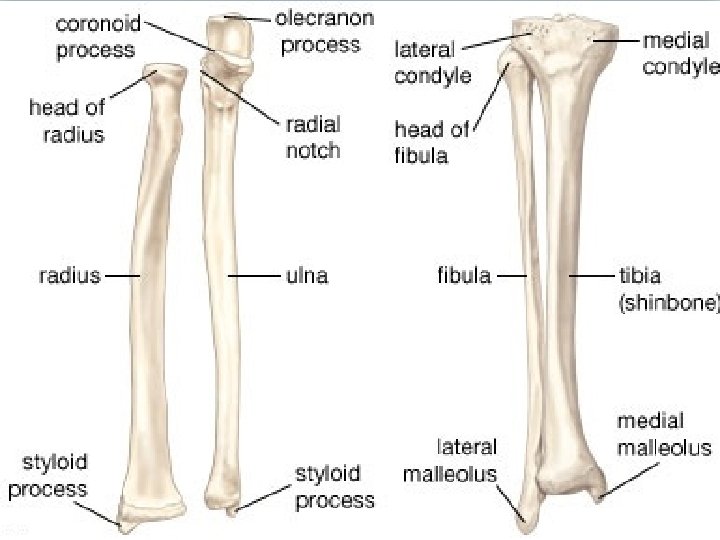
TIBIA (Shin bone; Schenkel) Located on the anteromedial side of the leg Nearly parallel to the fibula, Second largest bone in the body It flares outward at both ends to provide an increased area for articulation and weight transfer.
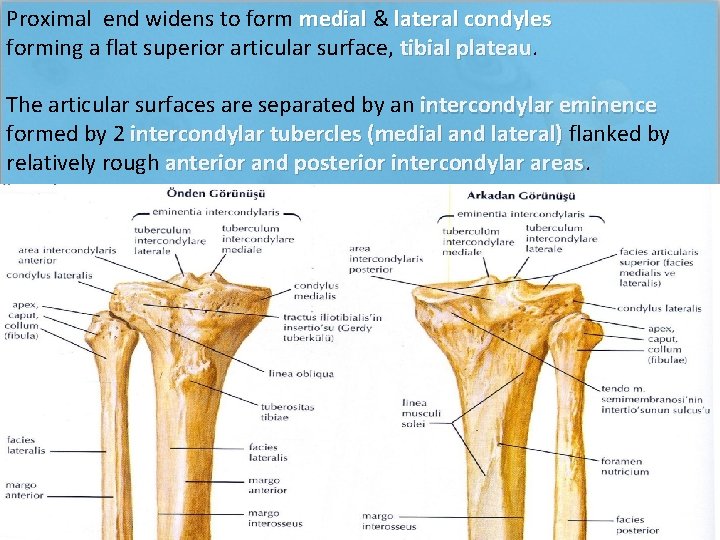
Proximal end widens to form medial & medial lateral condyles forming a flat superior articular surface, tibial plateau The articular surfaces are separated by an intercondylar eminence formed by 2 intercondylar tubercles (medial and lateral) flanked by intercondylar tubercles (medial and lateral) relatively rough anterior and posterior intercondylar areas
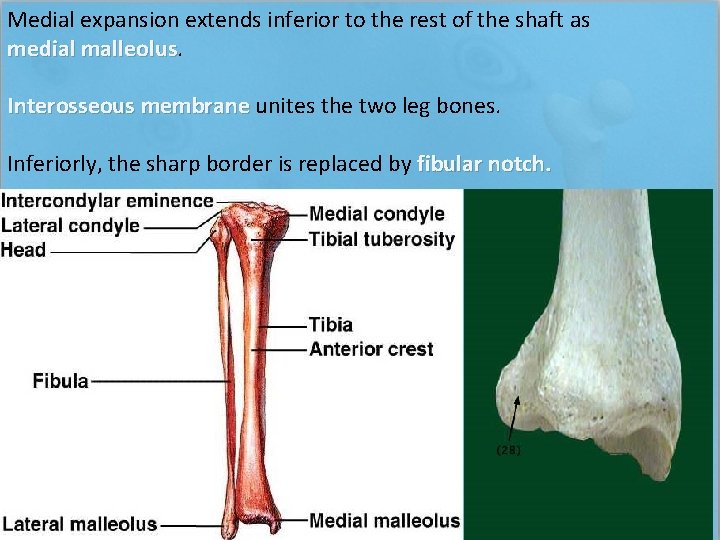
Medial expansion extends inferior to the rest of the shaft as medial malleolus Interosseous membrane unites the two leg bones. membrane Inferiorly, the sharp border is replaced by fibular notch.
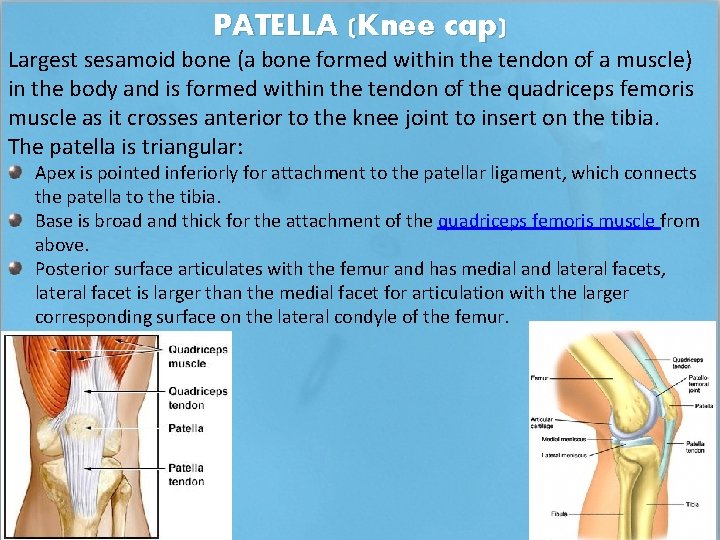
PATELLA (Knee cap) Largest sesamoid bone (a bone formed within the tendon of a muscle) in the body and is formed within the tendon of the quadriceps femoris muscle as it crosses anterior to the knee joint to insert on the tibia. The patella is triangular: Apex is pointed inferiorly for attachment to the patellar ligament, which connects the patella to the tibia. Base is broad and thick for the attachment of the quadriceps femoris muscle from above. Posterior surface articulates with the femur and has medial and lateral facets, lateral facet is larger than the medial facet for articulation with the larger corresponding surface on the lateral condyle of the femur.
FIBULA Slender, lies posterolateral to the tibia No function in weight-bearing. Serves mainly for muscle attachment Distal end enlarges, projects laterally & inferiorly lateral malleolus The lateral malleolus is more prominent and posterior than the medial malleolus and extends approximately 1 cm more distally.
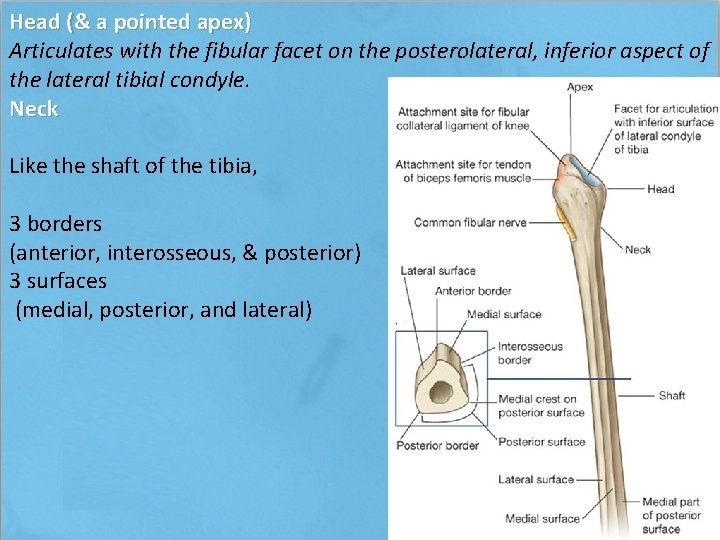
Head (& a pointed apex) Articulates with the fibular facet on the posterolateral, inferior aspect of the lateral tibial condyle. Neck Like the shaft of the tibia, 3 borders (anterior, interosseous, & posterior) 3 surfaces (medial, posterior, and lateral)
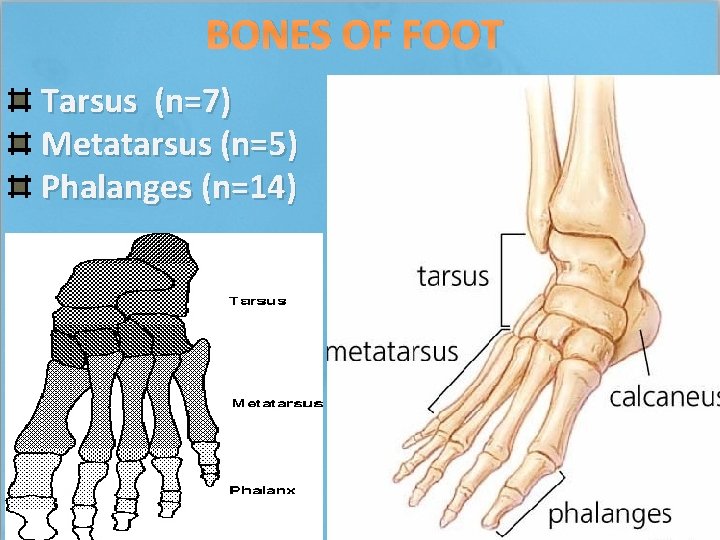
BONES OF FOOT Tarsus (n=7) Metatarsus (n=5) Phalanges (n=14)
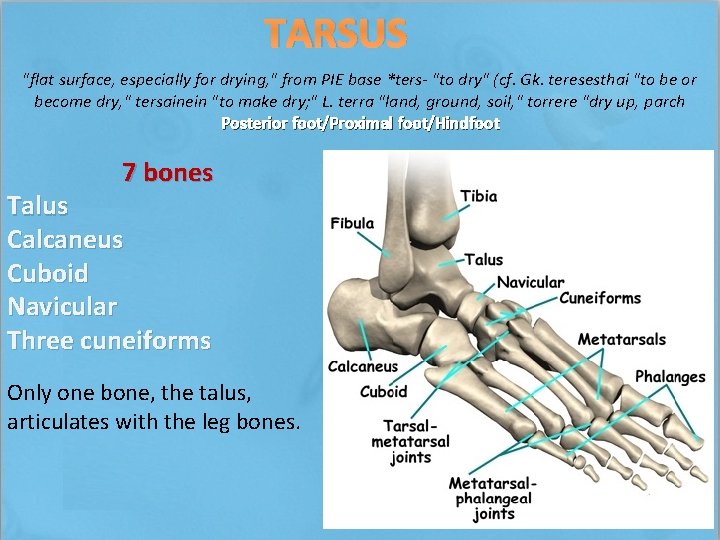
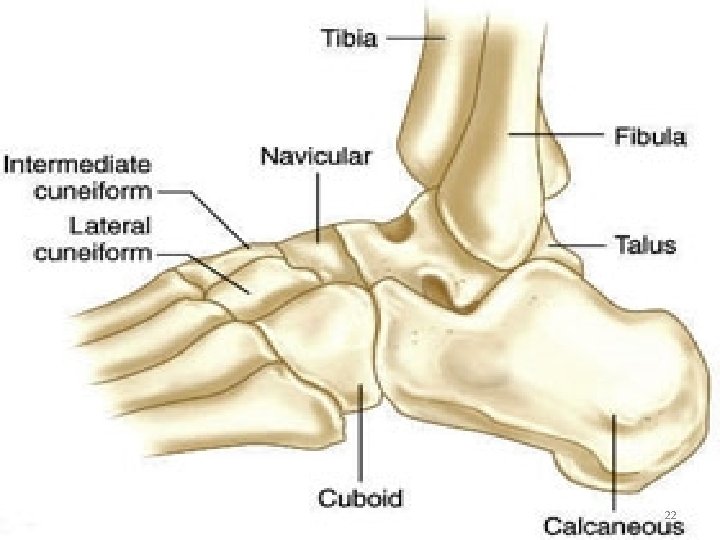
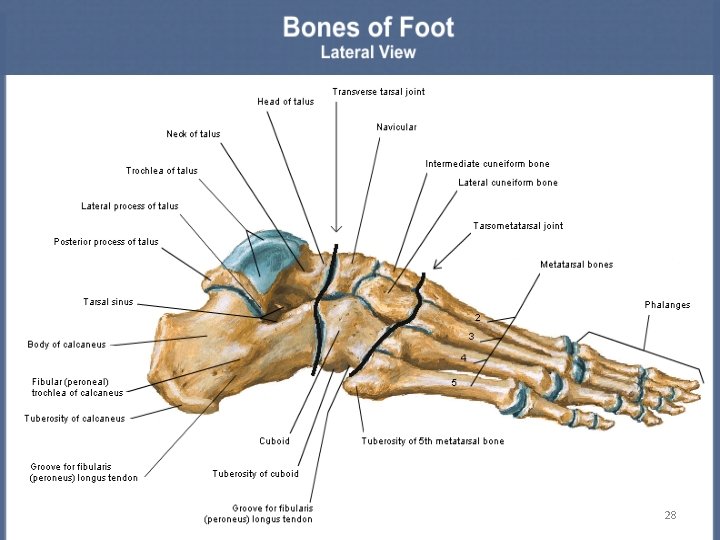
TARSUS "flat surface, especially for drying, " from PIE base *ters- "to dry" (cf. Gk. teresesthai "to be or become dry, " tersainein "to make dry; " L. terra "land, ground, soil, " torrere "dry up, parch Posterior foot/Proximal foot/Hindfoot 7 bones Talus Calcaneus Cuboid Navicular Three cuneiforms Only one bone, the talus, articulates with the leg bones.
22
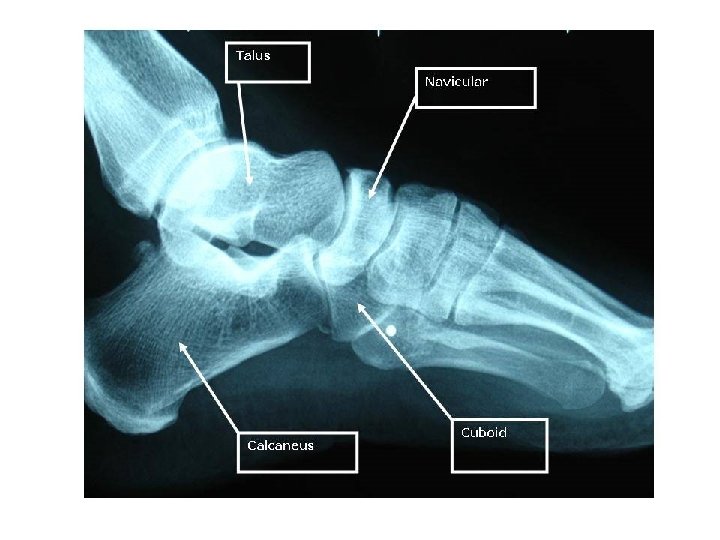
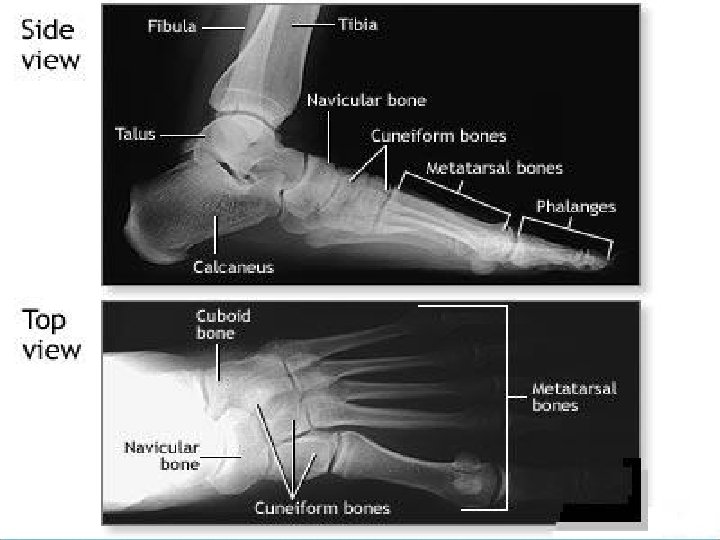
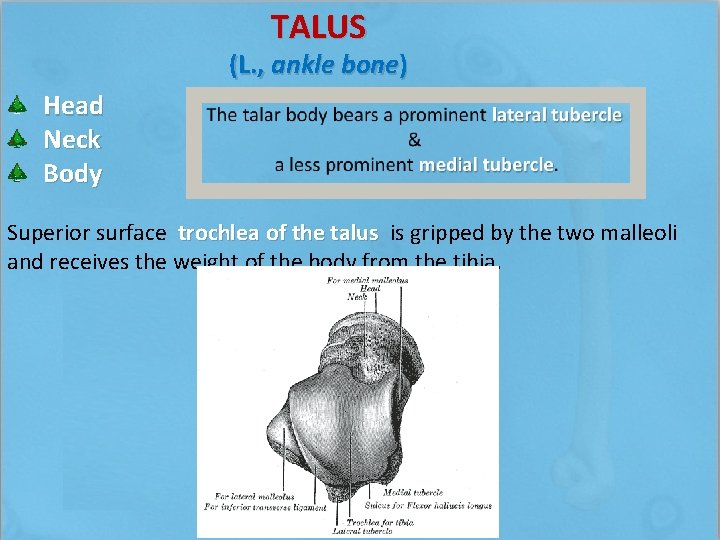
TALUS (L. , ankle bone) Head Neck Body Superior surface trochlea of the talus is talus gripped by the two malleoli and receives the weight of the body from the tibia.
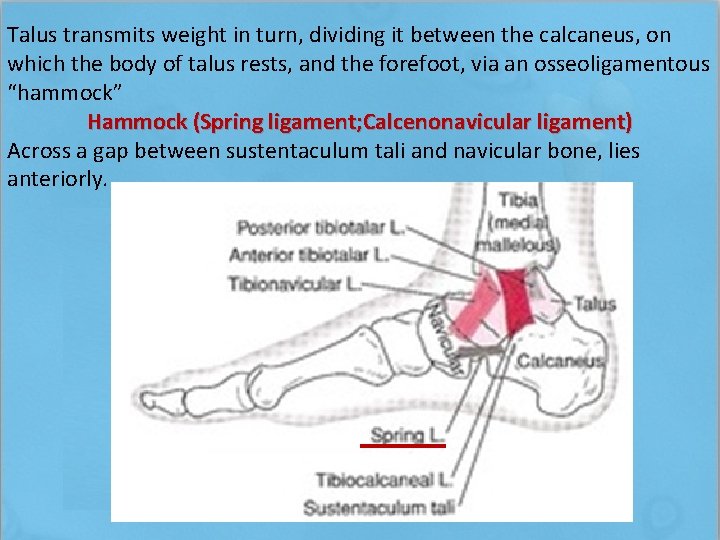
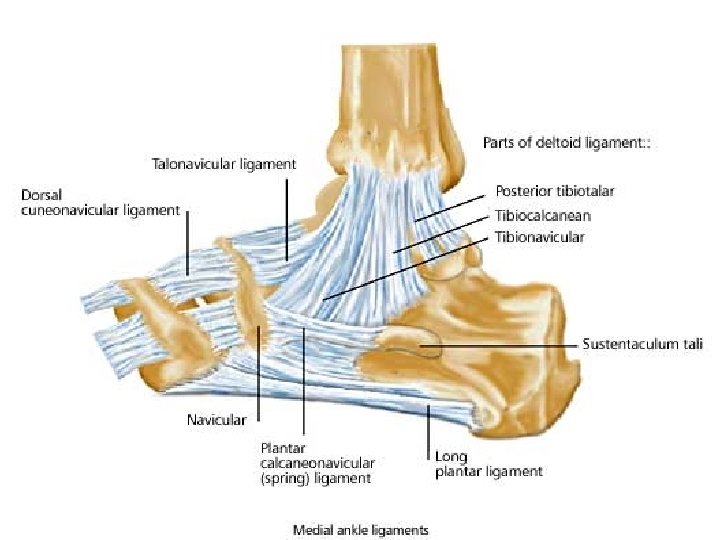
Talus transmits weight in turn, dividing it between the calcaneus, on which the body of talus rests, and the forefoot, via an osseoligamentous “hammock” Hammock (Spring ligament; Calcenonavicular ligament) Across a gap between sustentaculum tali and navicular bone, lies anteriorly.
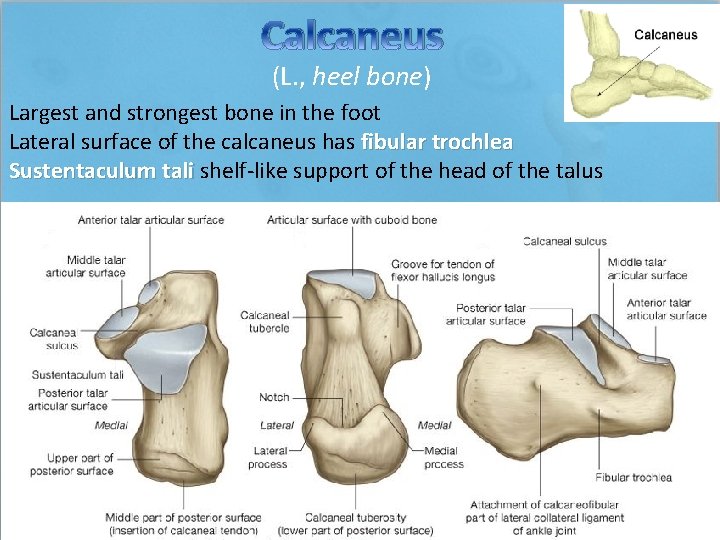
Calcaneus (L. , heel bone) Largest and strongest bone in the foot Lateral surface of the calcaneus has fibular trochlea Sustentaculum tali shelf-like support of the head of the talus tali
28
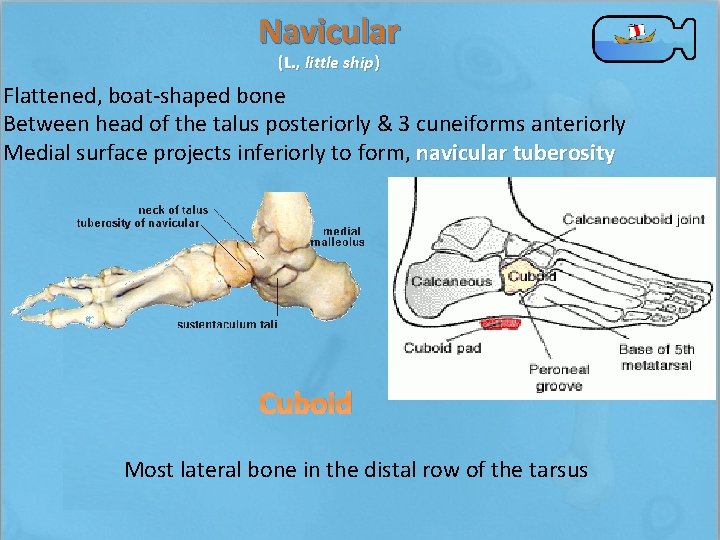
Navicular (L. , little ship) Flattened, boat-shaped bone Between head of the talus posteriorly & 3 cuneiforms anteriorly Medial surface projects inferiorly to form, navicular tuberosity Cuboid Most lateral bone in the distal row of the tarsus
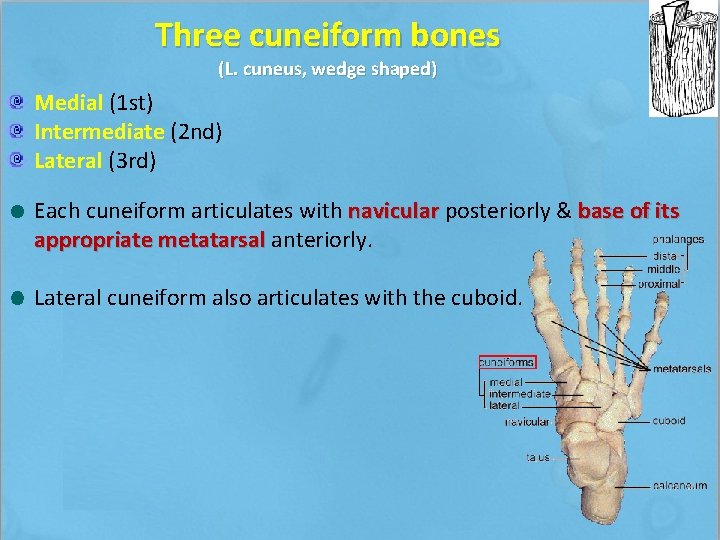
Three cuneiform bones (L. cuneus, wedge shaped) Medial (1 st) Intermediate (2 nd) Lateral (3 rd) Each cuneiform articulates with navicular posteriorly & base of its navicular appropriate metatarsal anteriorly. appropriate metatarsal Lateral cuneiform also articulates with the cuboid.
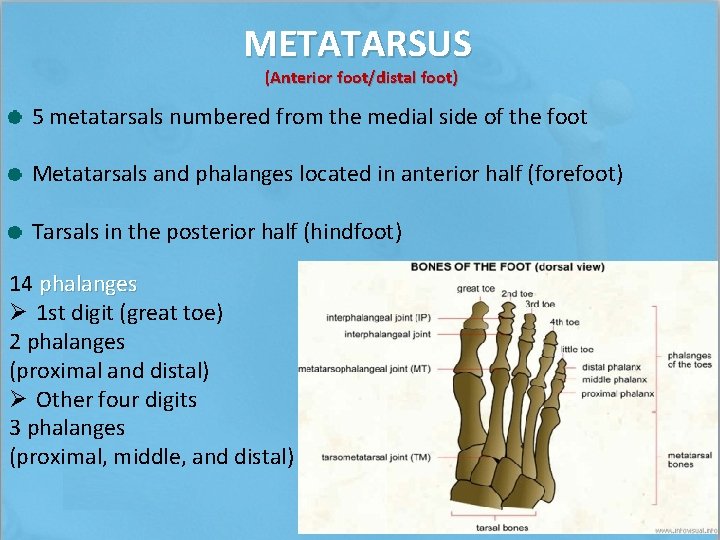
METATARSUS (Anterior foot/distal foot) 5 metatarsals numbered from the medial side of the foot Metatarsals and phalanges located in anterior half (forefoot) Tarsals in the posterior half (hindfoot) 14 phalanges Ø 1 st digit (great toe) 2 phalanges (proximal and distal) Ø Other four digits 3 phalanges (proximal, middle, and distal)
JOINTS OF LOWER LIMB Articulations of the pelvic girdle Lumbosacral joints, sacroiliac joints & pubic symphysis The remaining joints of the lower limb Hip joint Knee joint Tibiofibular joints Ankle joint Foot joints
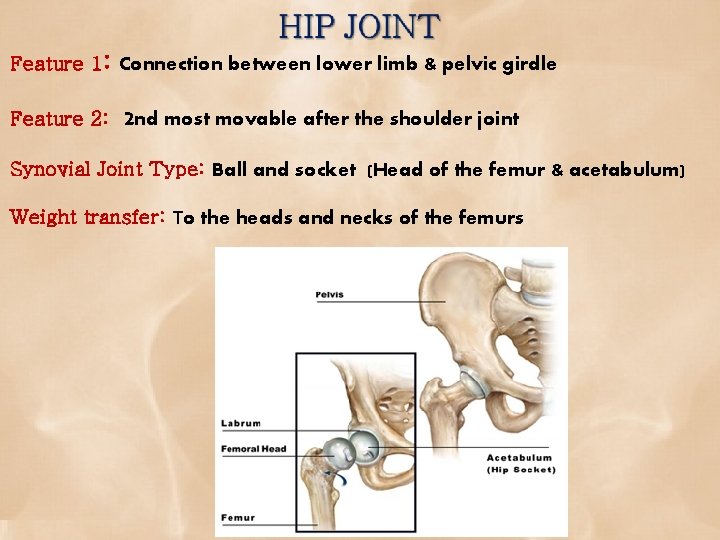
Feature 1: Connection between lower limb & pelvic girdle Feature 2: 2 nd most movable after the shoulder joint Synovial Joint Type: Ball and socket (Head of the femur & acetabulum) Weight transfer: To the heads and necks of the femurs
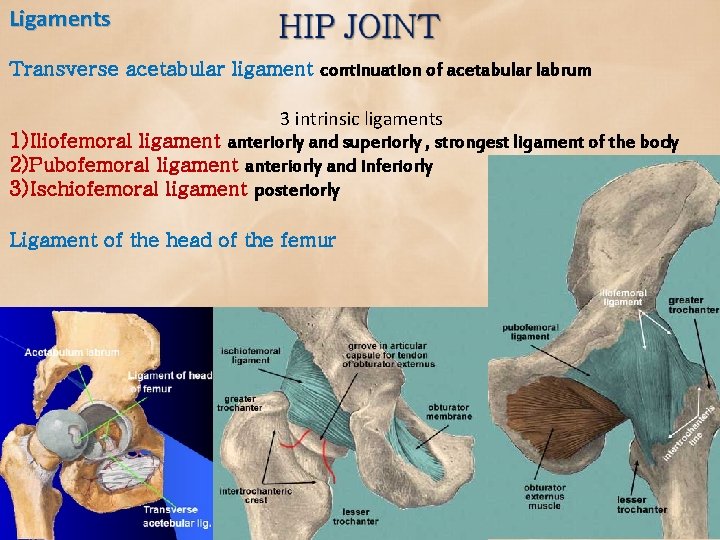
Ligaments Transverse acetabular ligament continuation of acetabular labrum 3 intrinsic ligaments 1) Iliofemoral ligament anteriorly and superiorly , strongest ligament of the body 2) Pubofemoral ligament anteriorly and inferiorly 3) Ischiofemoral ligament posteriorly Ligament of the head of the femur
MOVEMENTS OF HIP JOINT ü ü Flexion-extension Abduction-adduction Medial-lateral rotation Circumduction
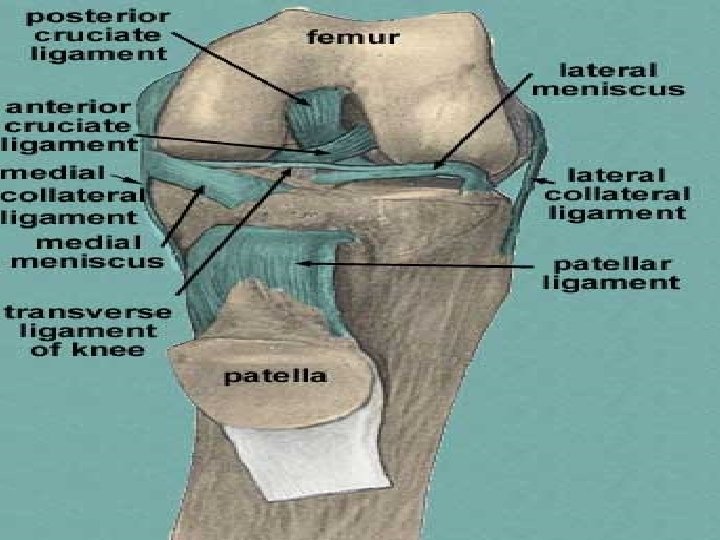
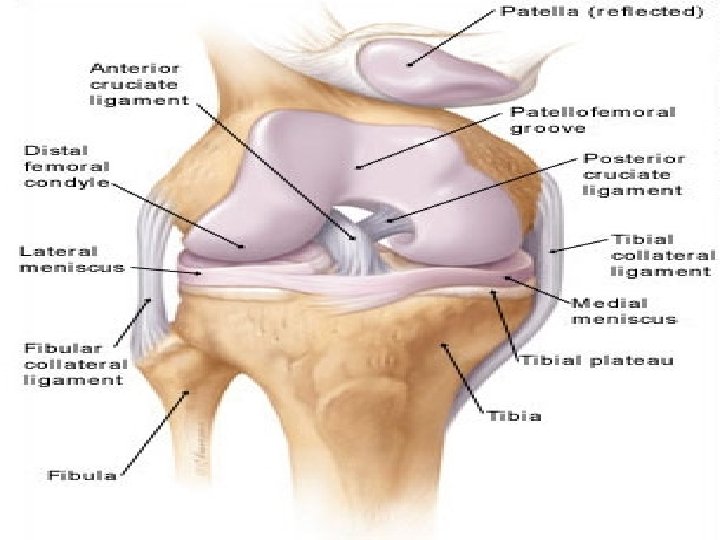
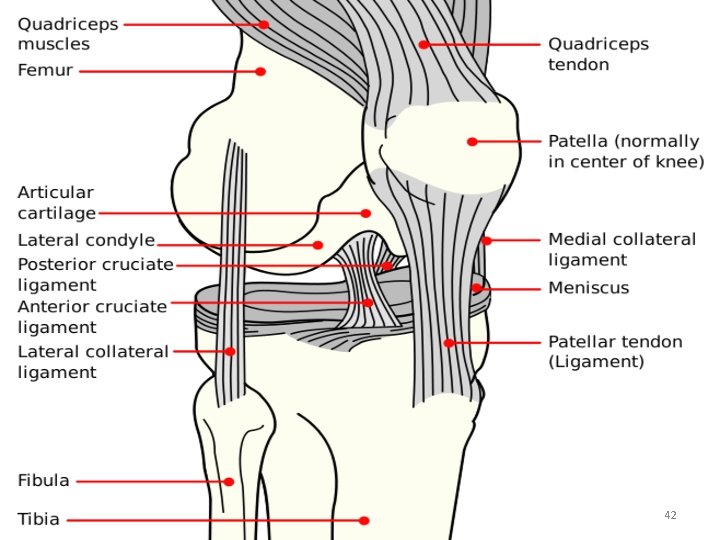
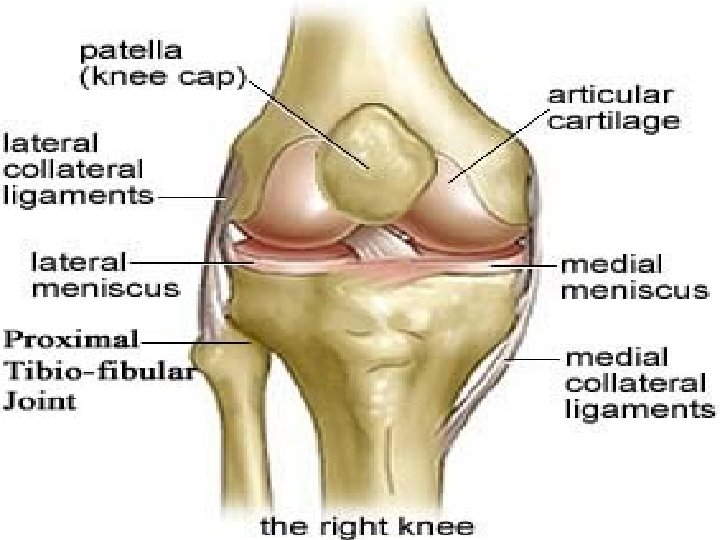
KNEE JOINT Feature 1: Largest & most superficial joint Feature 2: Hing movements (Ext/Flex) combined with gliding & rotation Synovial Joint Type: Hinge The knee joint consists of three articulations: 2 femorotibial articulations (lateral and medial) femorotibial articulations between lateral & medial femoral and tibial condyles One intermediate femoropatellar articulation between patella & femur No fibula involvment in the knee joint.
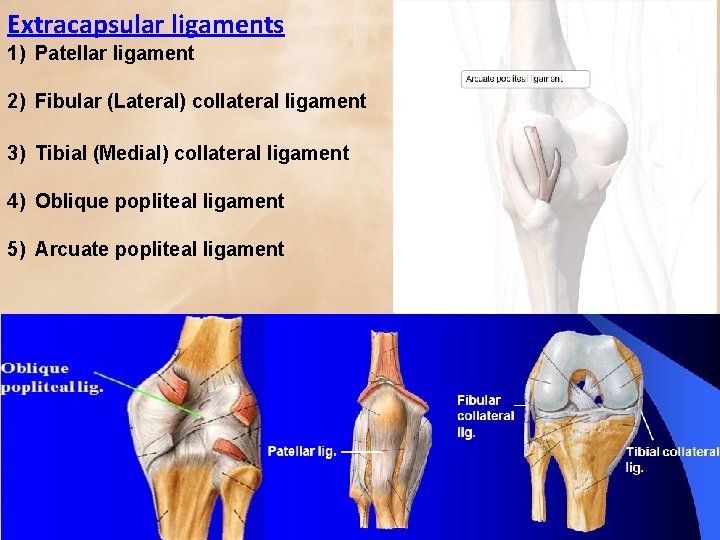
Extracapsular ligaments 1) Patellar ligament 2) Fibular (Lateral) collateral ligament 3) Tibial (Medial) collateral ligament 4) Oblique popliteal ligament 5) Arcuate popliteal ligament
38
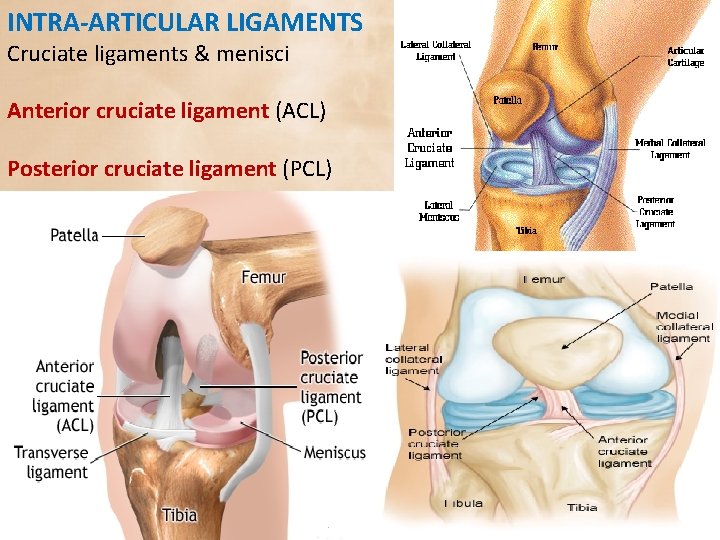
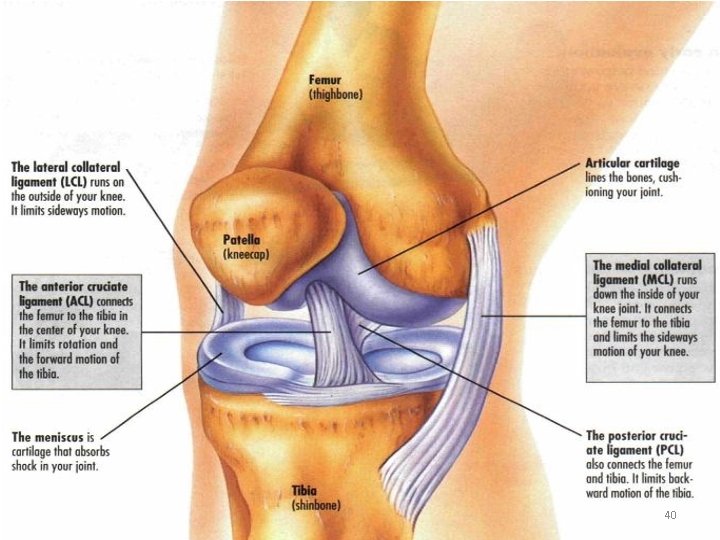
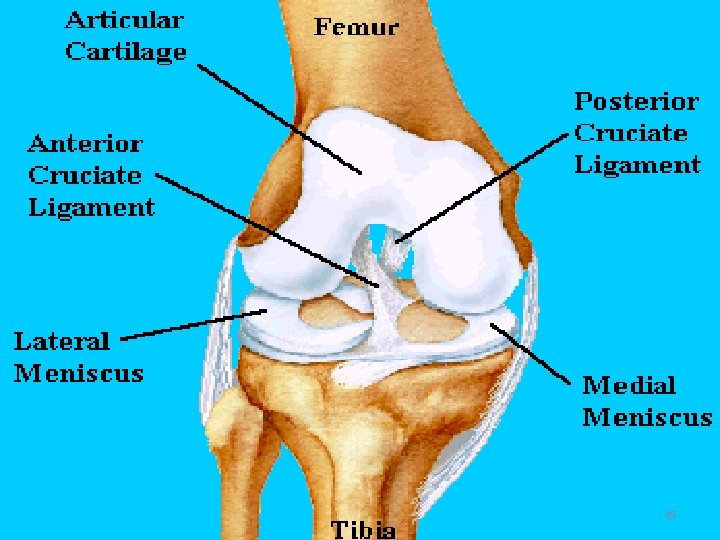
INTRA-ARTICULAR LIGAMENTS Cruciate ligaments & menisci Anterior cruciate ligament (ACL) Posterior cruciate ligament (PCL)
40
41
42
43
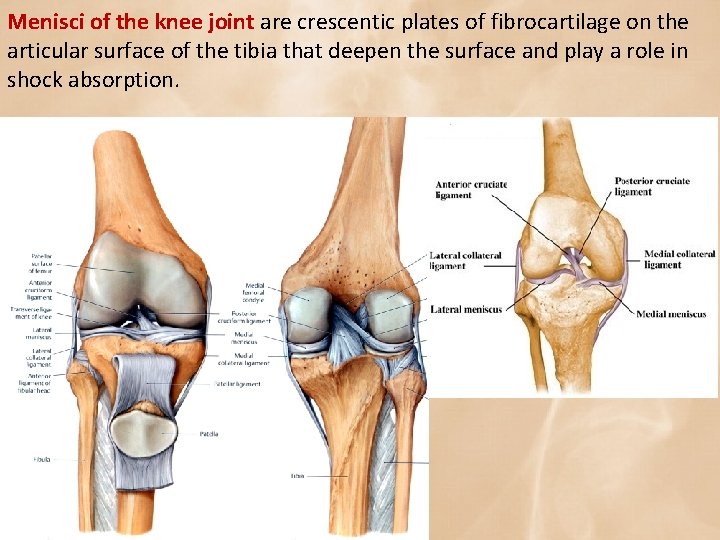
Menisci of the knee joint are crescentic plates of fibrocartilage on the articular surface of the tibia that deepen the surface and play a role in shock absorption.
45
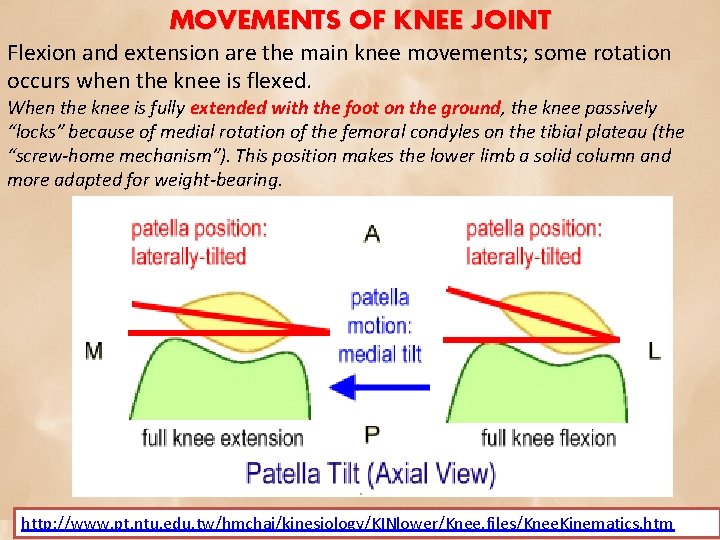
MOVEMENTS OF KNEE JOINT Flexion and extension are the main knee movements; some rotation occurs when the knee is flexed. When the knee is fully extended with the foot on the ground, the knee passively “locks” because of medial rotation of the femoral condyles on the tibial plateau (the “screw-home mechanism”). This position makes the lower limb a solid column and more adapted for weight-bearing. http: //www. pt. ntu. edu. tw/hmchai/kinesiology/KINlower/Knee. files/Knee. Kinematics. htm
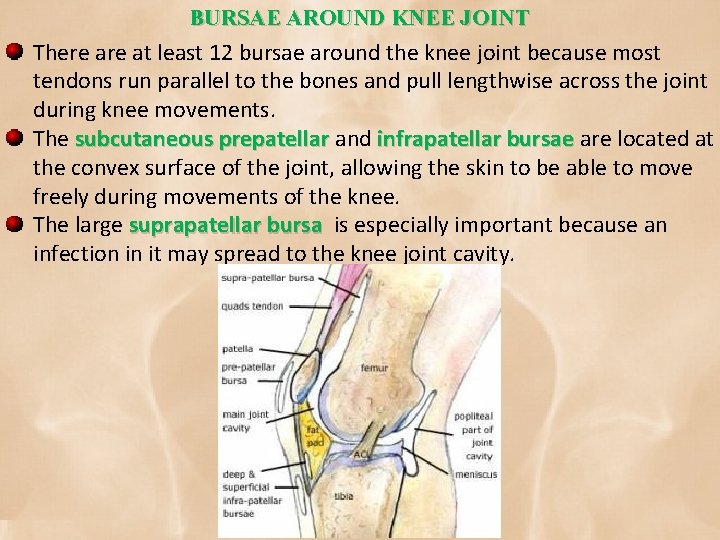
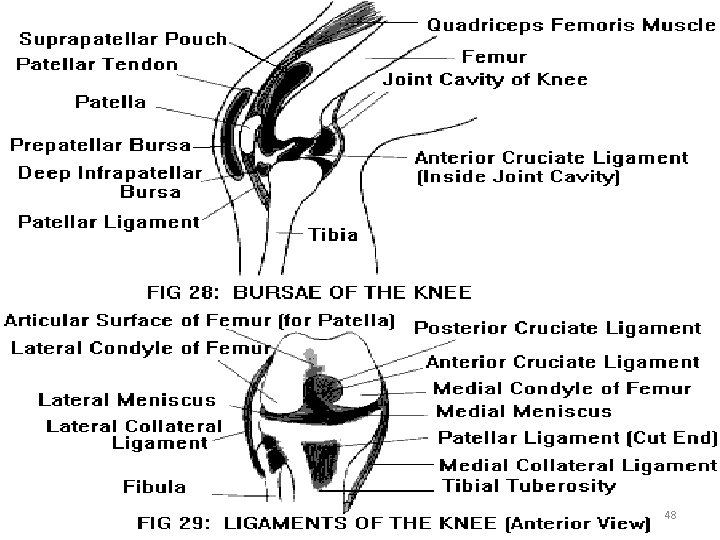
BURSAE AROUND KNEE JOINT There at least 12 bursae around the knee joint because most tendons run parallel to the bones and pull lengthwise across the joint during knee movements. The subcutaneous prepatellar and infrapatellar bursae are located at subcutaneous prepatellar infrapatellar bursae the convex surface of the joint, allowing the skin to be able to move freely during movements of the knee. The large suprapatellar bursa is suprapatellar bursa especially important because an infection in it may spread to the knee joint cavity.
48
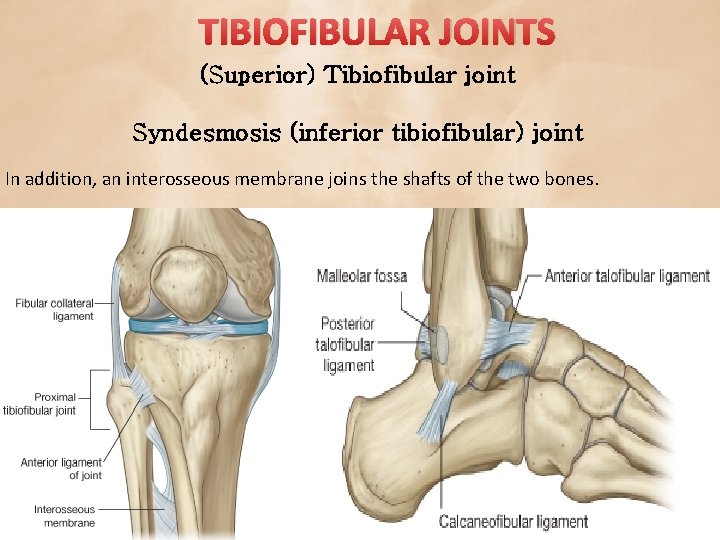
TIBIOFIBULAR JOINTS (Superior) Tibiofibular joint Syndesmosis (inferior tibiofibular) joint In addition, an interosseous membrane joins the shafts of the two bones.
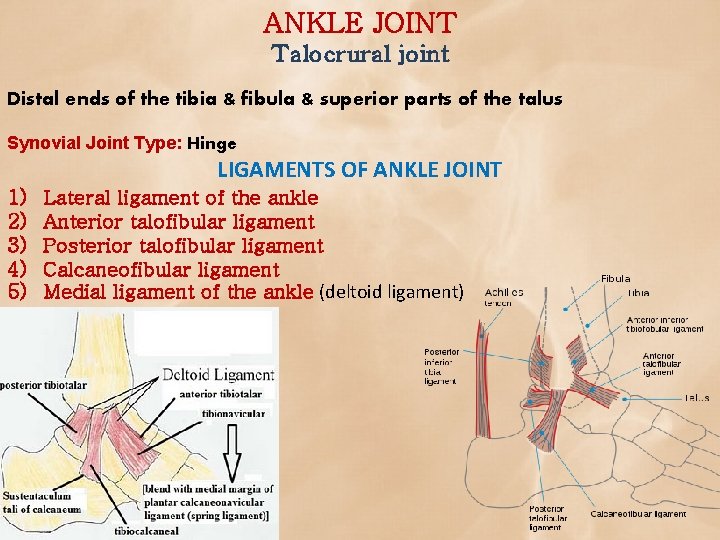
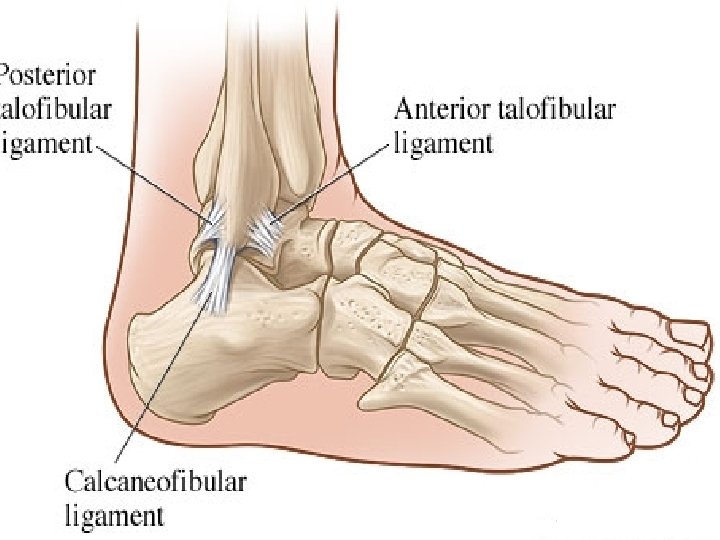
ANKLE JOINT Talocrural joint Distal ends of the tibia & fibula & superior parts of the talus Synovial Joint Type: Hinge LIGAMENTS OF ANKLE JOINT 1) 2) 3) 4) 5) Lateral ligament of the ankle Anterior talofibular ligament Posterior talofibular ligament Calcaneofibular ligament Medial ligament of the ankle (deltoid ligament)
51
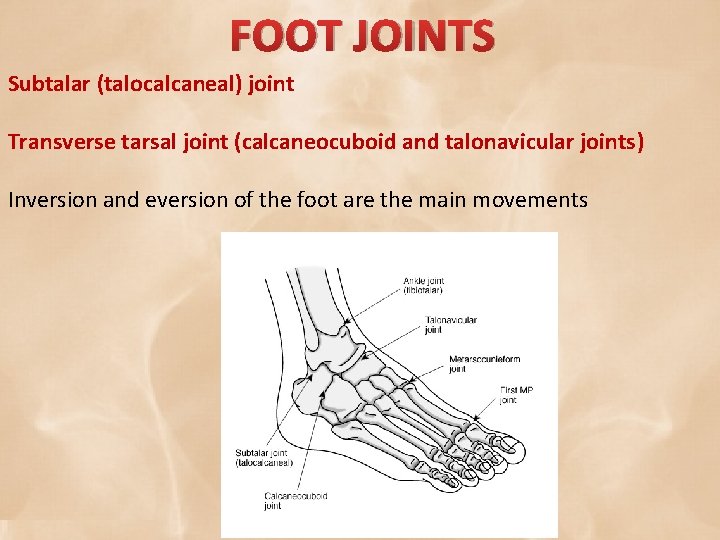
FOOT JOINTS Subtalar (talocalcaneal) joint Transverse tarsal joint (calcaneocuboid and talonavicular joints) Inversion and eversion of the foot are the main movements
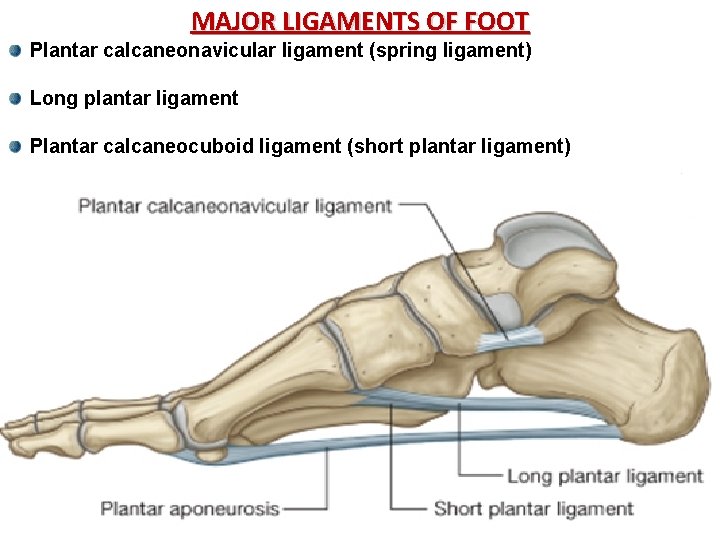
MAJOR LIGAMENTS OF FOOT Plantar calcaneonavicular ligament (spring ligament) Long plantar ligament Plantar calcaneocuboid ligament (short plantar ligament) 53
54
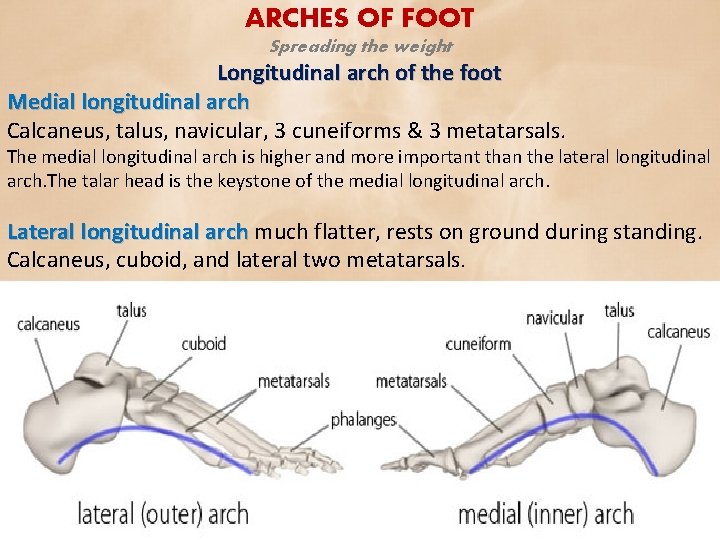
ARCHES OF FOOT Spreading the weight Longitudinal arch of the foot Medial longitudinal arch Calcaneus, talus, navicular, 3 cuneiforms & 3 metatarsals. The medial longitudinal arch is higher and more important than the lateral longitudinal arch. The talar head is the keystone of the medial longitudinal arch. Lateral longitudinal arch much flatter, rests on ground during standing. Lateral longitudinal arch Calcaneus, cuboid, and lateral two metatarsals.
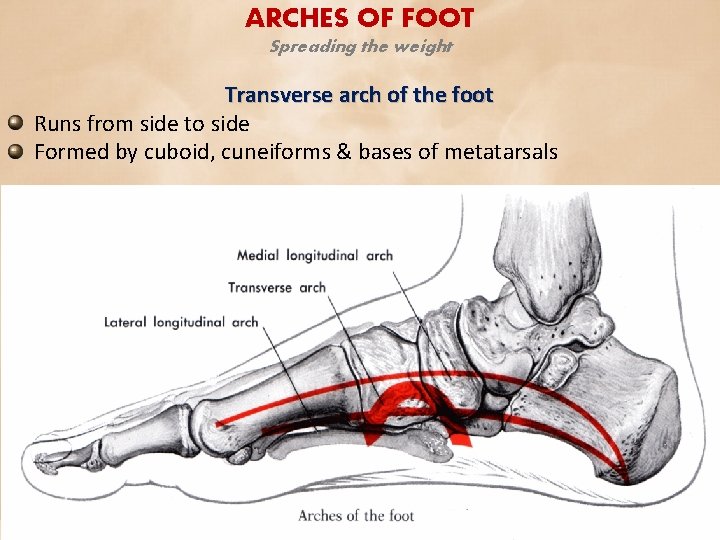
ARCHES OF FOOT Spreading the weight Transverse arch of the foot Runs from side to side Formed by cuboid, cuneiforms & bases of metatarsals
- Slides: 56