
K12 DEPARTMENT HEADTEACHER LEADER WORKSHOPS IN VISUAL ARTS
- Slides: 21
K-12 DEPARTMENT HEAD/TEACHER LEADER WORKSHOPS IN VISUAL ARTS, MUSIC, DRAMA AND DANCE Ilikai Hotel, Pacific Ballroom December 1, 2005
STANDARDS-BASED EDUCATION
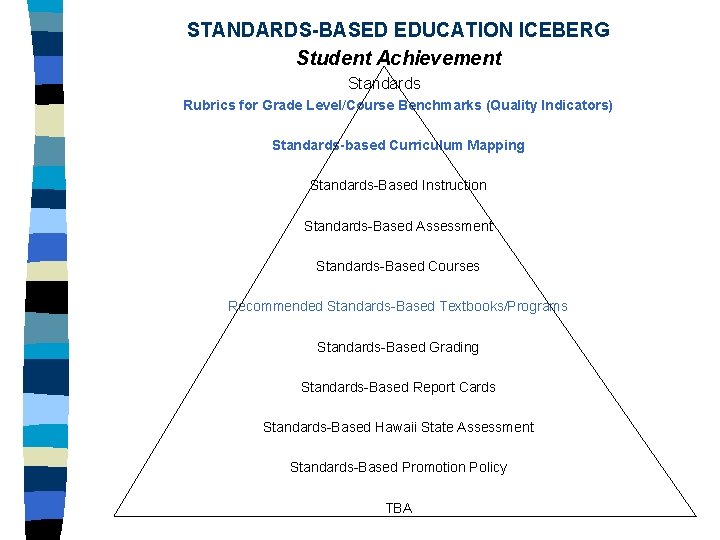
STANDARDS-BASED EDUCATION ICEBERG Student Achievement Standards Rubrics for Grade Level/Course Benchmarks (Quality Indicators) Standards-based Curriculum Mapping Standards-Based Instruction Standards-Based Assessment Standards-Based Courses Recommended Standards-Based Textbooks/Programs Standards-Based Grading Standards-Based Report Cards Standards-Based Hawaii State Assessment Standards-Based Promotion Policy TBA
When we started the Standards-Based Education journey in 1994, we did not realize that this initiative would catalyze a revolutionary change in how we teach, assess and grade - in short, causing a systemic change in education.
Most important, the implementation of standards-based education requires that the following beliefs be translated into practice in every classroom: n n Quality education for ALL children can and want to learn.
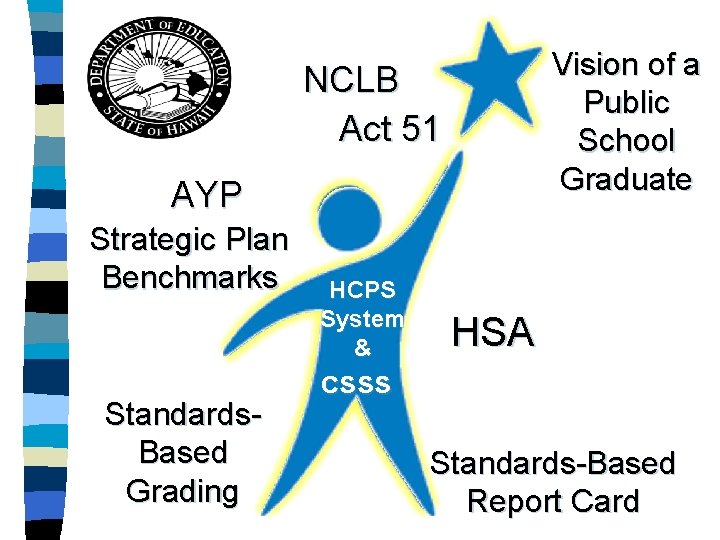
Vision of a Public School Graduate NCLB Act 51 AYP Strategic Plan Benchmarks Standards. Based Grading HCPS System & HSA csss Standards-Based Report Card
Hawaii’s Standards-Based Education and Comprehensive Student Support Systems
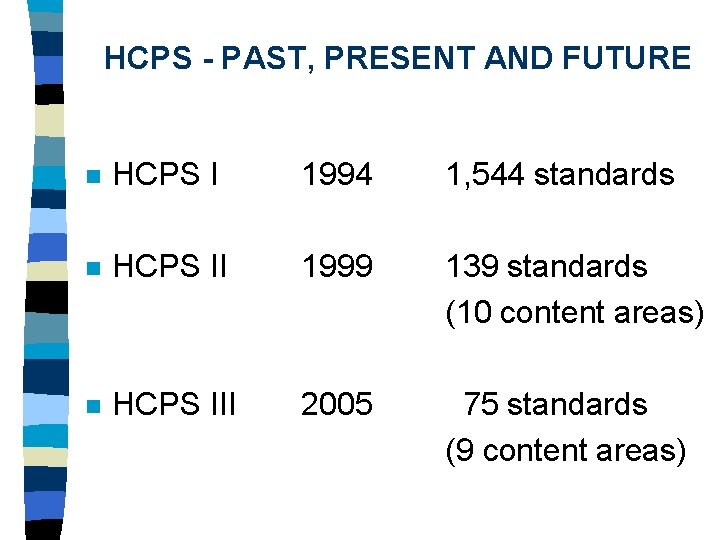
HCPS - PAST, PRESENT AND FUTURE n HCPS I 1994 1, 544 standards n HCPS II 1999 139 standards (10 content areas) n HCPS III 2005 75 standards (9 content areas)
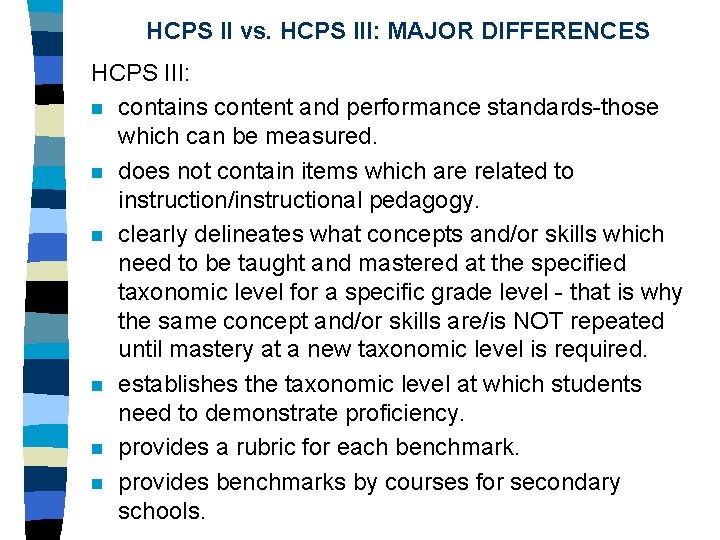
HCPS II vs. HCPS III: MAJOR DIFFERENCES HCPS III: n contains content and performance standards-those which can be measured. n does not contain items which are related to instruction/instructional pedagogy. n clearly delineates what concepts and/or skills which need to be taught and mastered at the specified taxonomic level for a specific grade level - that is why the same concept and/or skills are/is NOT repeated until mastery at a new taxonomic level is required. n establishes the taxonomic level at which students need to demonstrate proficiency. n provides a rubric for each benchmark. n provides benchmarks by courses for secondary schools.
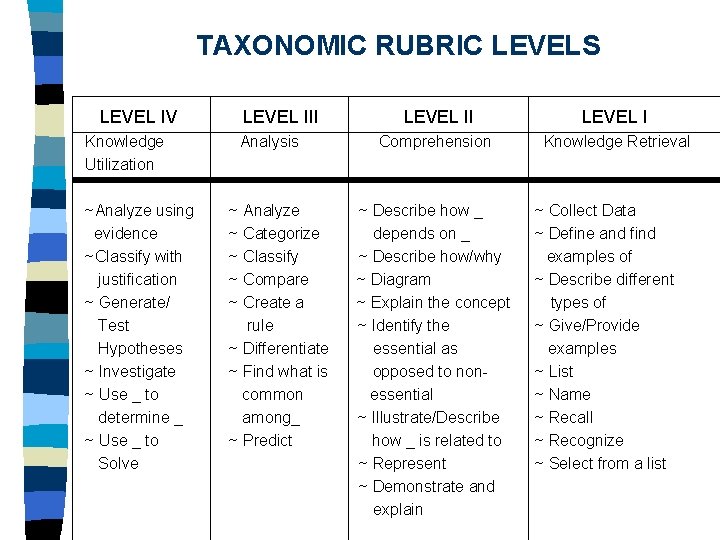
TAXONOMIC RUBRIC LEVELS LEVEL IV Knowledge Utilization ~Analyze using evidence ~Classify with justification ~ Generate/ Test Hypotheses ~ Investigate ~ Use _ to determine _ ~ Use _ to Solve LEVEL III Analysis ~ Analyze ~ Categorize ~ Classify ~ Compare ~ Create a rule ~ Differentiate ~ Find what is common among_ ~ Predict LEVEL II LEVEL I Comprehension Knowledge Retrieval ~ Describe how _ depends on _ ~ Describe how/why ~ Diagram ~ Explain the concept ~ Identify the essential as opposed to nonessential ~ Illustrate/Describe how _ is related to ~ Represent ~ Demonstrate and explain ~ Collect Data ~ Define and find examples of ~ Describe different types of ~ Give/Provide examples ~ List ~ Name ~ Recall ~ Recognize ~ Select from a list
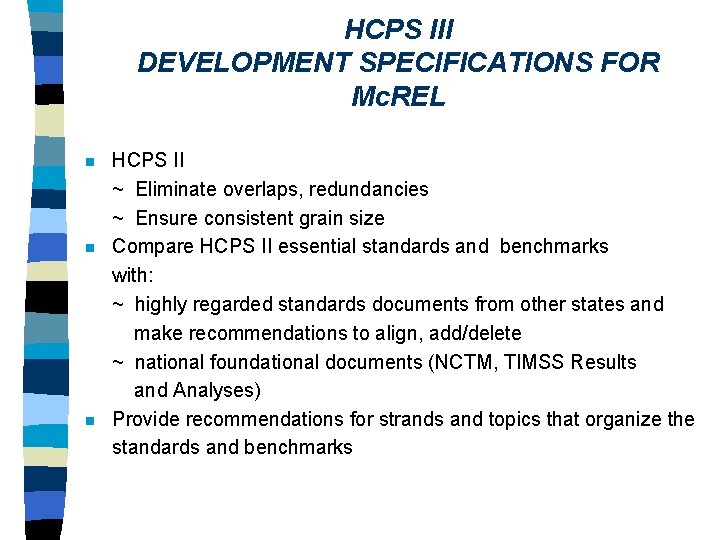
HCPS III DEVELOPMENT SPECIFICATIONS FOR Mc. REL n n n HCPS II ~ Eliminate overlaps, redundancies ~ Ensure consistent grain size Compare HCPS II essential standards and benchmarks with: ~ highly regarded standards documents from other states and make recommendations to align, add/delete ~ national foundational documents (NCTM, TIMSS Results and Analyses) Provide recommendations for strands and topics that organize the standards and benchmarks
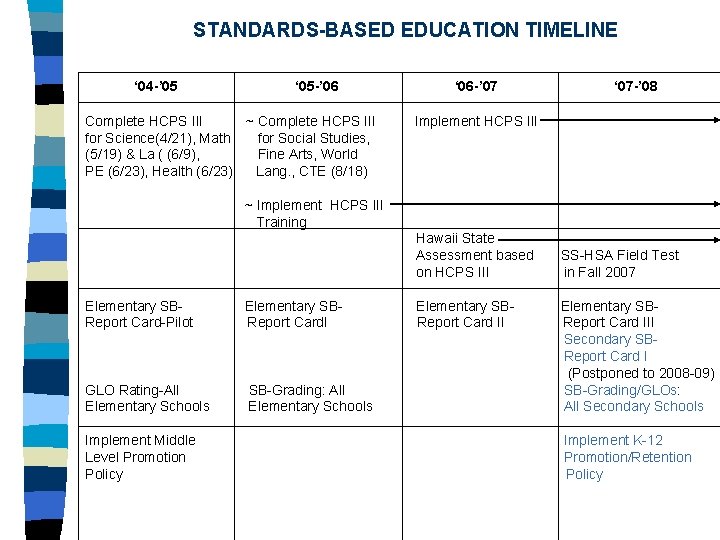
STANDARDS-BASED EDUCATION TIMELINE ‘ 04 -’ 05 ‘ 05 -’ 06 Complete HCPS III ~ Complete HCPS III for Science(4/21), Math for Social Studies, (5/19) & La ( (6/9), Fine Arts, World PE (6/23), Health (6/23) Lang. , CTE (8/18) ‘ 06 -’ 07 ‘ 07 -’ 08 Implement HCPS III ~ Implement HCPS III Training Hawaii State Assessment based on HCPS III Elementary SBReport Card-Pilot Elementary SBReport Card. I GLO Rating-All Elementary Schools SB-Grading: All Elementary Schools Implement Middle Level Promotion Policy Elementary SBReport Card II SS-HSA Field Test in Fall 2007 Elementary SBReport Card III Secondary SBReport Card I (Postponed to 2008 -09) SB-Grading/GLOs: All Secondary Schools Implement K-12 Promotion/Retention Policy
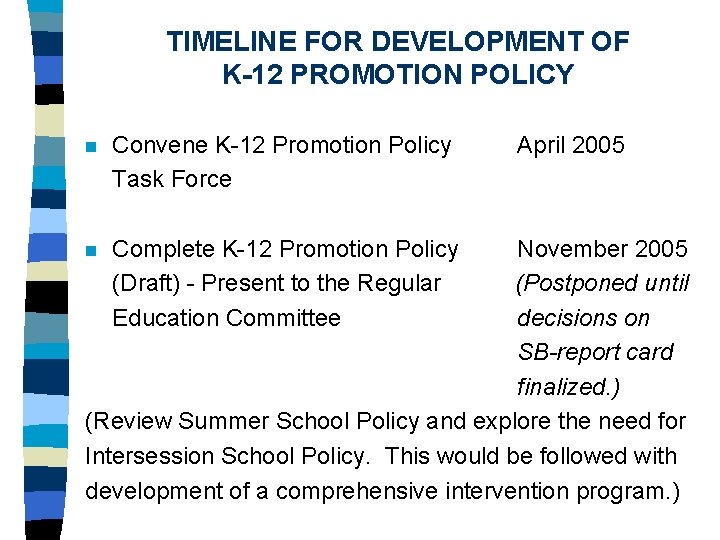
TIMELINE FOR DEVELOPMENT OF K-12 PROMOTION POLICY n Convene K-12 Promotion Policy Task Force November 2005 (Postponed until decisions on SB-report card finalized. ) (Review Summer School Policy and explore the need for Intersession School Policy. This would be followed with development of a comprehensive intervention program. ) n Complete K-12 Promotion Policy (Draft) - Present to the Regular Education Committee April 2005
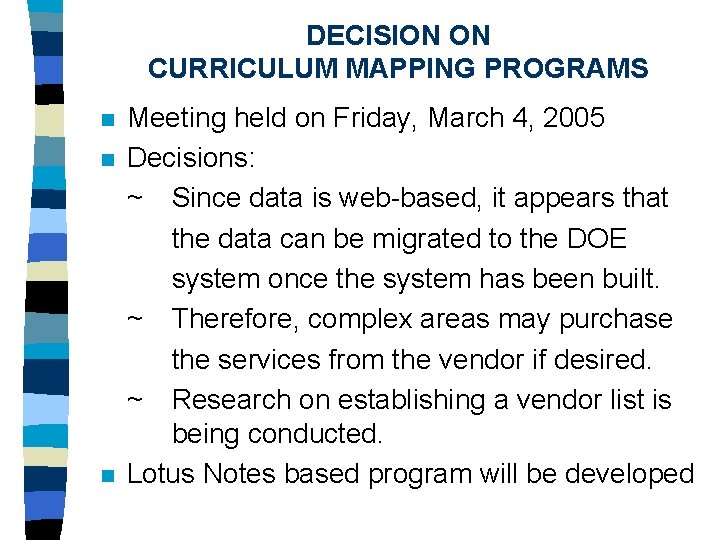
DECISION ON CURRICULUM MAPPING PROGRAMS n n n Meeting held on Friday, March 4, 2005 Decisions: ~ Since data is web-based, it appears that the data can be migrated to the DOE system once the system has been built. ~ Therefore, complex areas may purchase the services from the vendor if desired. ~ Research on establishing a vendor list is being conducted. Lotus Notes based program will be developed
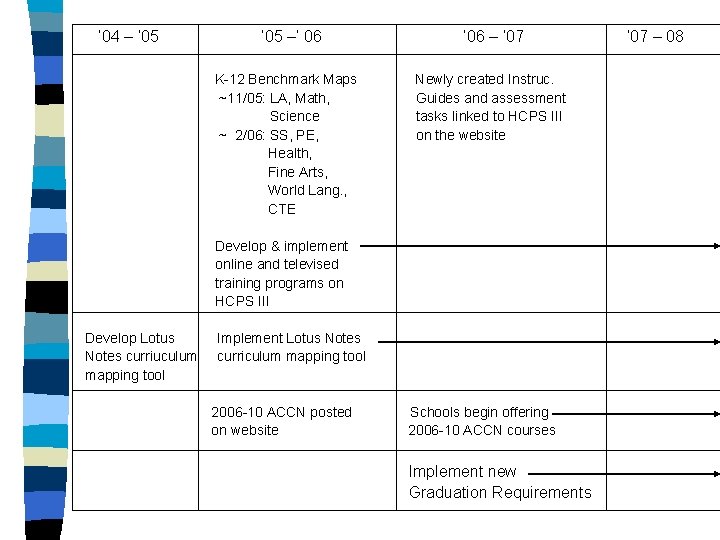
’ 04 – ’ 05 –’ 06 K-12 Benchmark Maps ~11/05: LA, Math, Science ~ 2/06: SS, PE, Health, Fine Arts, World Lang. , CTE ’ 06 – ’ 07 Newly created Instruc. Guides and assessment tasks linked to HCPS III on the website Develop & implement online and televised training programs on HCPS III Develop Lotus Notes curriuculum mapping tool Implement Lotus Notes curriculum mapping tool 2006 -10 ACCN posted on website Schools begin offering 2006 -10 ACCN courses Implement new Graduation Requirements ’ 07 – 08
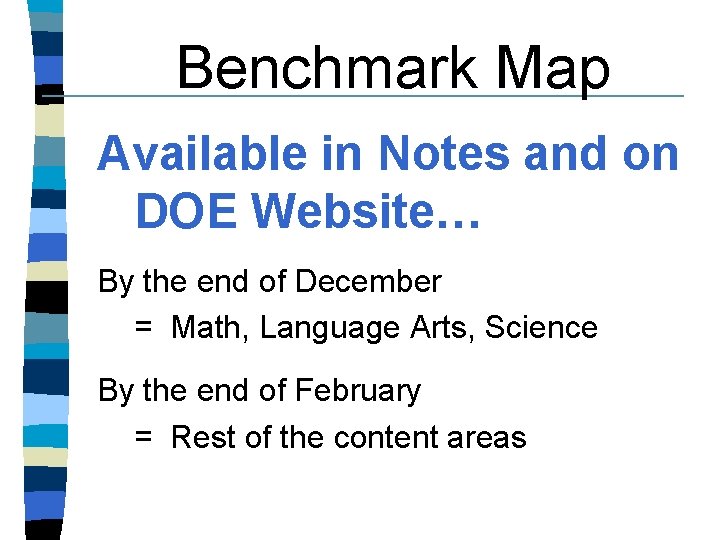
Benchmark Map Available in Notes and on DOE Website… By the end of December = Math, Language Arts, Science By the end of February = Rest of the content areas
Curriculum Map n Developed by teachers/schools n Includes elements of Benchmark Map, PLUS content, skills, essential questions, assessments, instruction
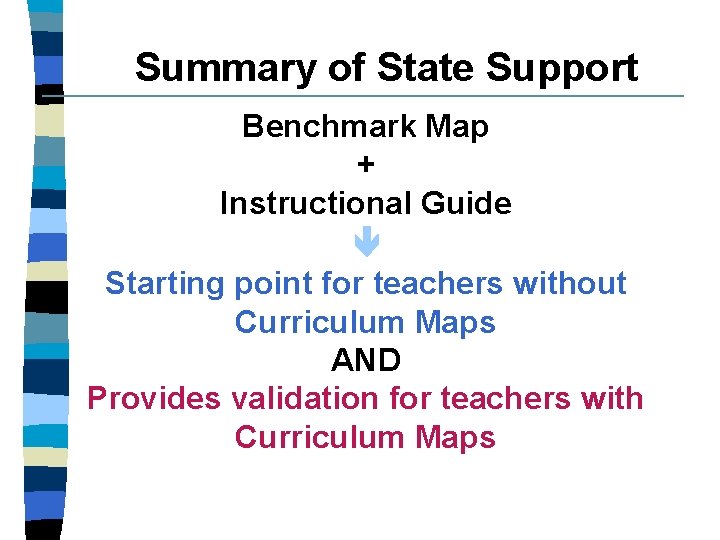
Summary of State Support Benchmark Map + Instructional Guide Starting point for teachers without Curriculum Maps AND Provides validation for teachers with Curriculum Maps
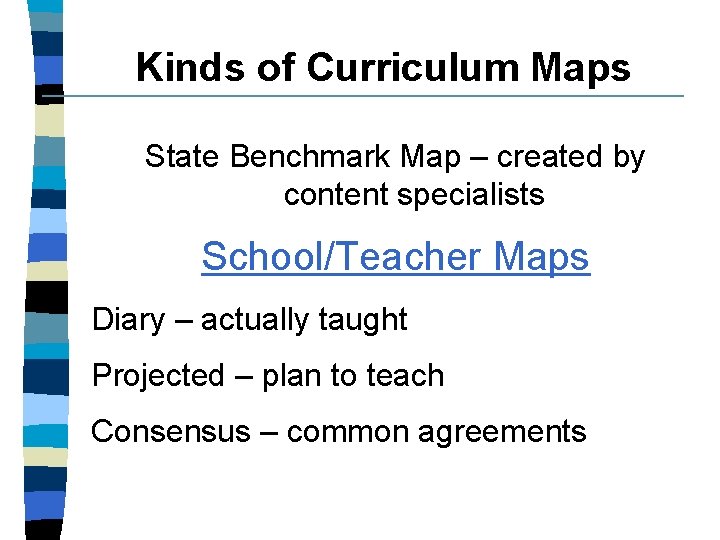
Kinds of Curriculum Maps State Benchmark Map – created by content specialists School/Teacher Maps Diary – actually taught Projected – plan to teach Consensus – common agreements
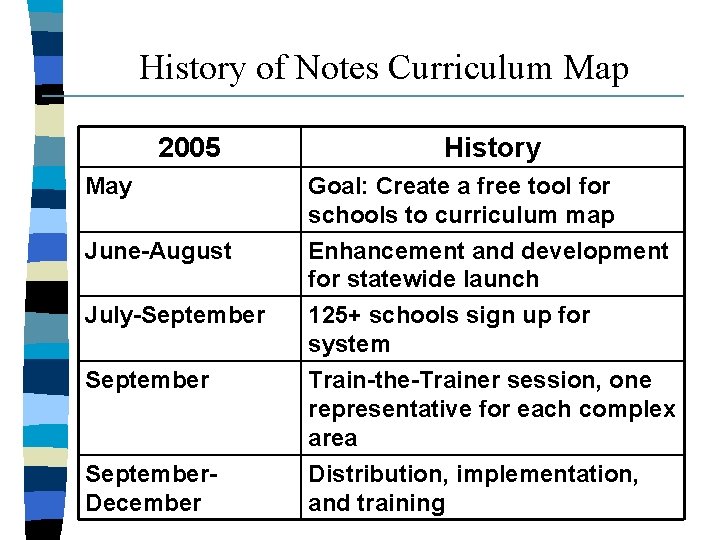
History of Notes Curriculum Map 2005 History May Goal: Create a free tool for schools to curriculum map June-August Enhancement and development for statewide launch July-September 125+ schools sign up for system Train-the-Trainer session, one representative for each complex area September. December Distribution, implementation, and training
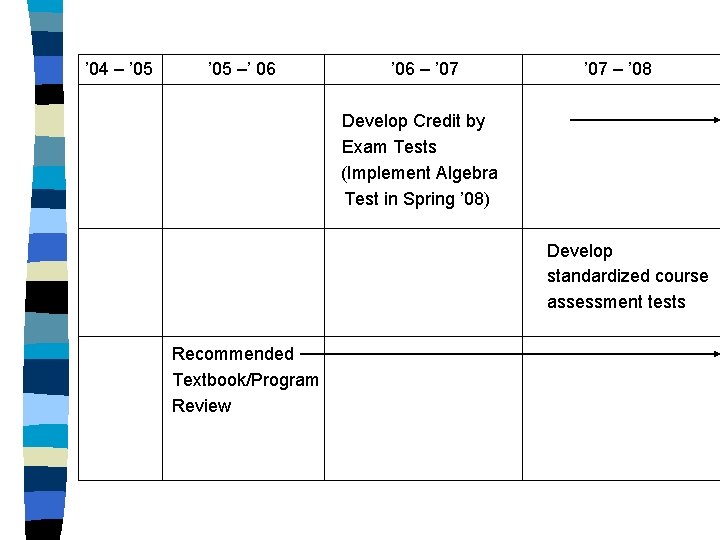
’ 04 – ’ 05 –’ 06 – ’ 07 – ’ 08 Develop Credit by Exam Tests (Implement Algebra Test in Spring ’ 08) Develop standardized course assessment tests Recommended Textbook/Program Review