
K swave System from D Meson Decays to
- Slides: 28
K- + s-wave System from D+ Meson Decays to K- + + in E 791 Brian Meadows University of Cincinnati Moriond, La. Thuile, Mar 14, 2005 Brian Meadows, U. Cincinnati.
Outline q What is known about s-wave K- + scattering q Results from D+ ! K- + + Decays q Model Independent Partial Wave Analysis q Comparison with the Watson theorem q Summary and Discussion Moriond, La. Thuile, Mar 14 2005 Brian Meadows, U. Cincinnati
K Scattering in Heavy Quark Decays q q Understanding the structure of the s-wave K system is important to many analyses, and of vital interest to an understanding of the spectroscopy of scalar mesons. It may be possible to learn more from the large amounts of data on D and B decays now available. The applicability of the Watson theorem can be tested. E 791 is the first to try this by making a Model Independent Partial Wave Analysis of the s-wave in the decay D+ ! K- + + (and cc). Moriond, La. Thuile, Mar 14 2005 Brian Meadows, U. Cincinnati
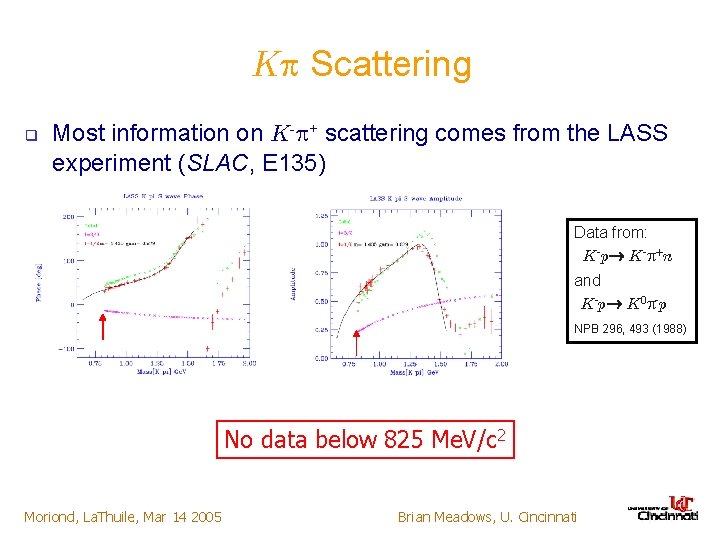
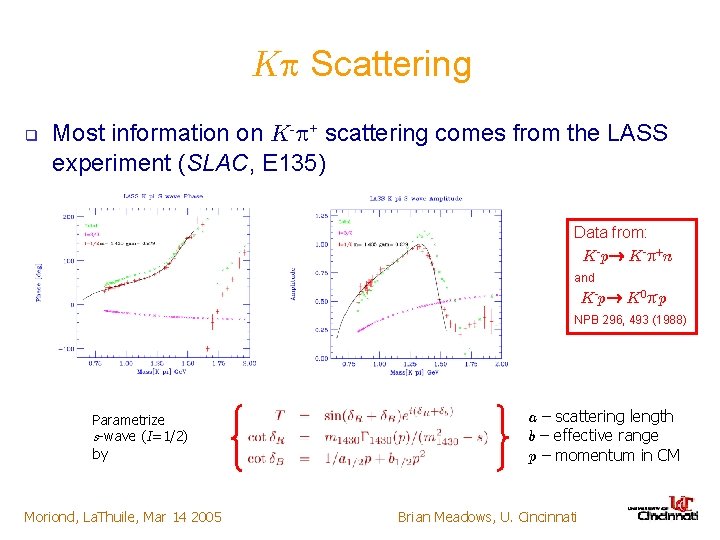
K Scattering q Most information on K- + scattering comes from the LASS experiment (SLAC, E 135) Data from: K-p! K- +n and K-p! K 0 -p NPB 296, 493 (1988) No data below 825 Me. V/c 2 Moriond, La. Thuile, Mar 14 2005 Brian Meadows, U. Cincinnati
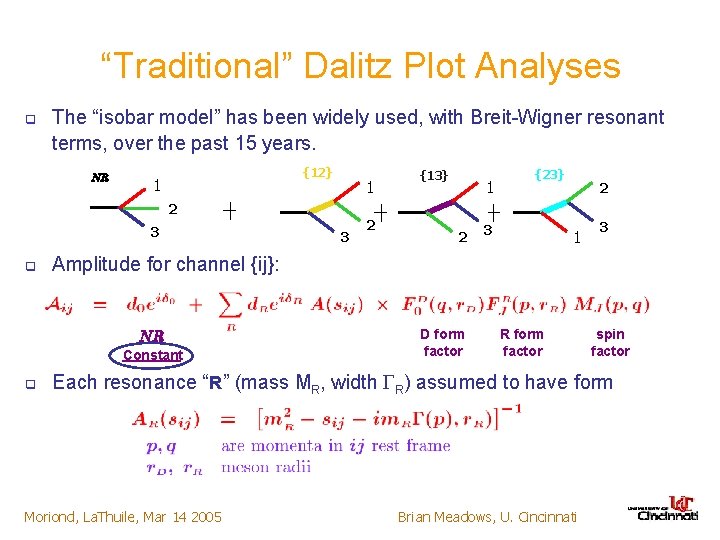
“Traditional” Dalitz Plot Analyses q The “isobar model” has been widely used, with Breit-Wigner resonant terms, over the past 15 years. NR {12} 1 1 2 3 q 2 1 2 {23} 3 2 1 3 Amplitude for channel {ij}: NR Constant q 3 {13} D form factor R form factor spin factor Each resonance “R” (mass MR, width R) assumed to have form Moriond, La. Thuile, Mar 14 2005 Brian Meadows, U. Cincinnati
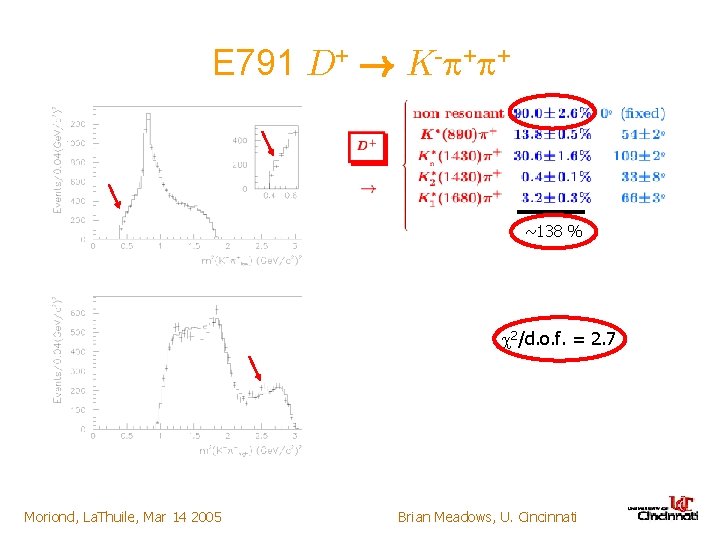
E 791 D+ ! K- + + ~138 % 2/d. o. f. = 2. 7 Moriond, La. Thuile, Mar 14 2005 Brian Meadows, U. Cincinnati
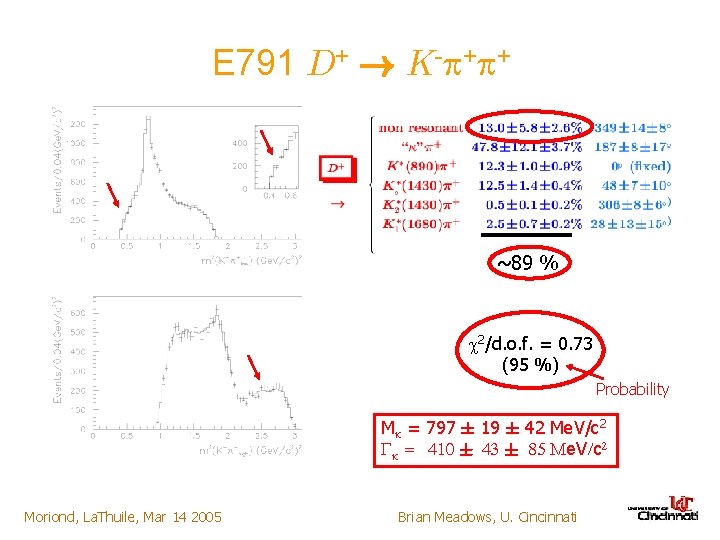
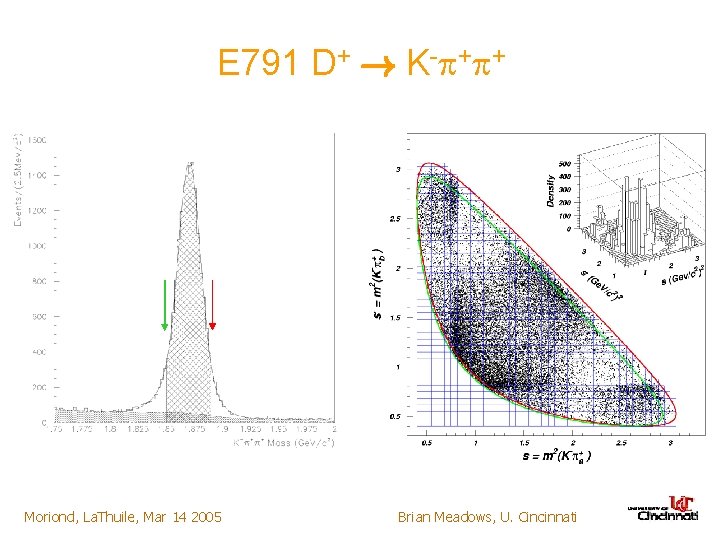
E 791 D+ ! K- + + ~89 % 2/d. o. f. = 0. 73 (95 %) Probability M = 797 § 19 § 42 Me. V/c 2 = 410 § 43 § 85 Me. V/c 2 Moriond, La. Thuile, Mar 14 2005 Brian Meadows, U. Cincinnati
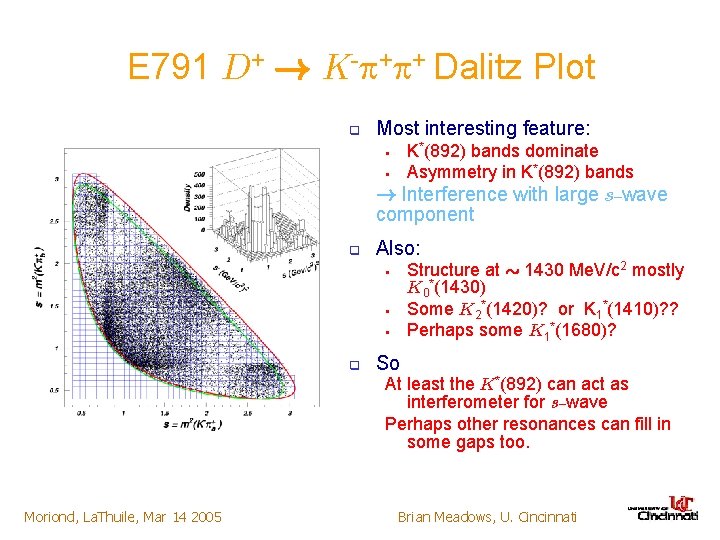
E 791 D+ ! K- + + Dalitz Plot q Most interesting feature: K*(892) bands dominate Asymmetry in K*(892) bands § § ! Interference with large s–wave component q Also: Structure at » 1430 Me. V/c 2 mostly K 0*(1430) Some K 2*(1420)? or K 1*(1410)? ? Perhaps some K 1*(1680)? § § § q So At least the K*(892) can act as interferometer for s–wave Perhaps other resonances can fill in some gaps too. Moriond, La. Thuile, Mar 14 2005 Brian Meadows, U. Cincinnati
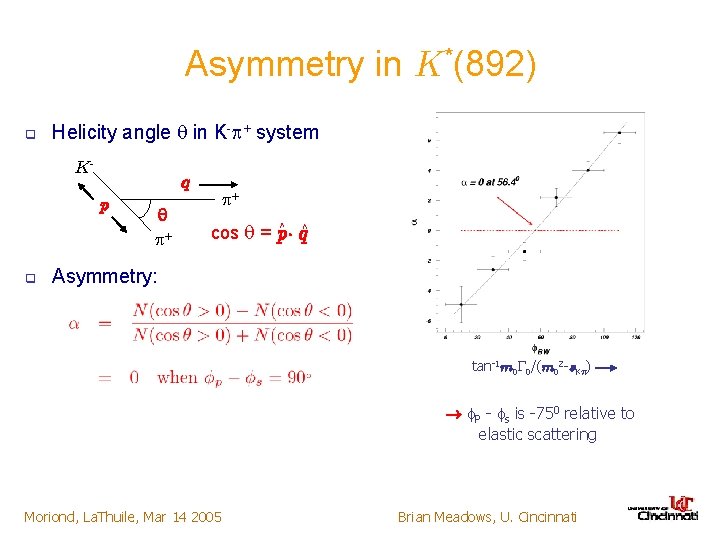
Asymmetry in K*(892) q Helicity angle q in K- + system K- q p q q + + cos q = p¢ q Asymmetry: tan-1 m 0 0/(m 02 -s. K ) ! P - s is -750 relative to elastic scattering Moriond, La. Thuile, Mar 14 2005 Brian Meadows, U. Cincinnati
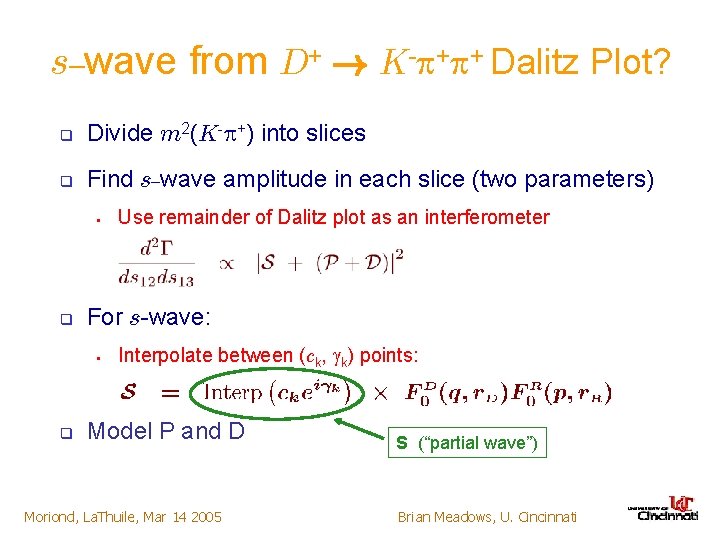
s–wave from D+ ! K- + + Dalitz Plot? q Divide m 2(K- +) into slices q Find s–wave amplitude in each slice (two parameters) § q For s-wave: § q Use remainder of Dalitz plot as an interferometer Interpolate between (ck, k) points: Model P and D Moriond, La. Thuile, Mar 14 2005 S (“partial wave”) Brian Meadows, U. Cincinnati
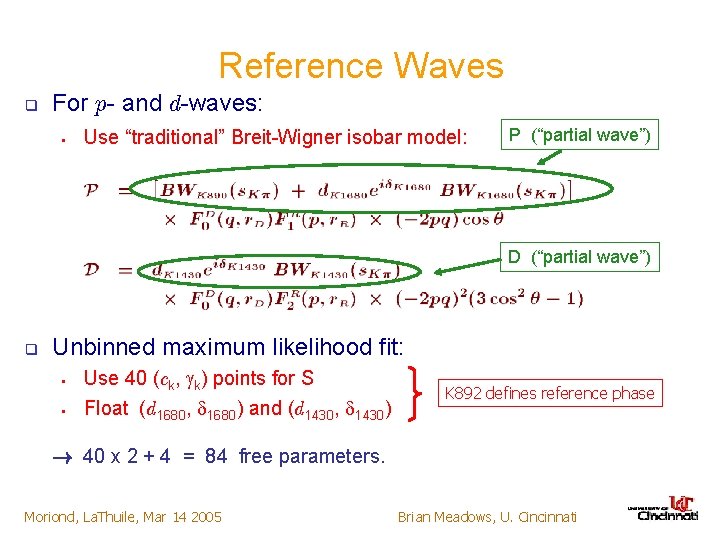
Reference Waves q For p- and d-waves: § Use “traditional” Breit-Wigner isobar model: P (“partial wave”) D (“partial wave”) q Unbinned maximum likelihood fit: § § Use 40 (ck, k) points for S Float (d 1680, 1680) and (d 1430, 1430) K 892 defines reference phase ! 40 x 2 + 4 = 84 free parameters. Moriond, La. Thuile, Mar 14 2005 Brian Meadows, U. Cincinnati
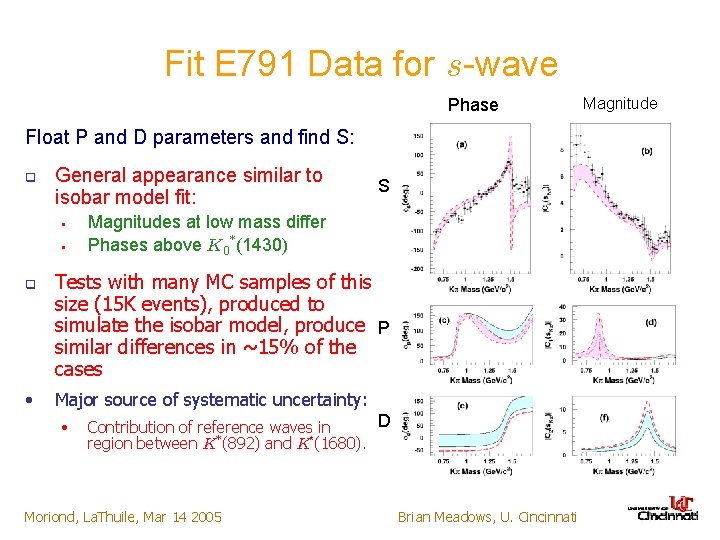
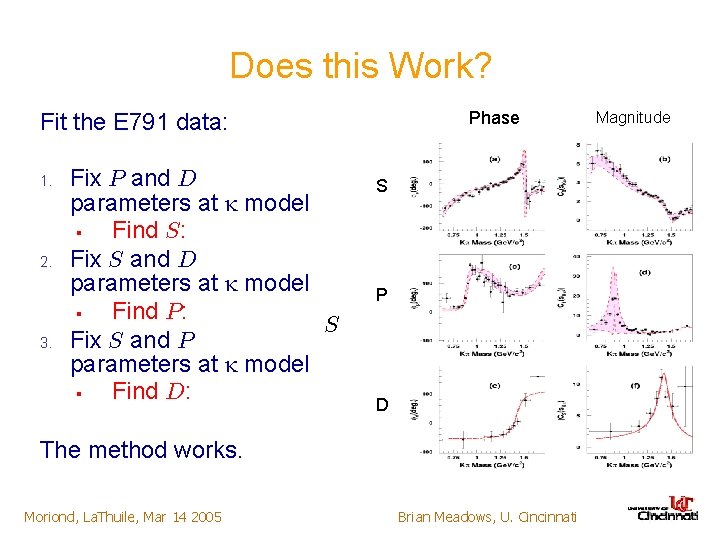
Fit E 791 Data for s-wave Phase Float P and D parameters and find S: q General appearance similar to isobar model fit: § § q • S Magnitudes at low mass differ Phases above K 0*(1430) Tests with many MC samples of this size (15 K events), produced to simulate the isobar model, produce P similar differences in ~15% of the cases Major source of systematic uncertainty: • D Contribution of reference waves in region between K*(892) and K*(1680). Moriond, La. Thuile, Mar 14 2005 Brian Meadows, U. Cincinnati Magnitude
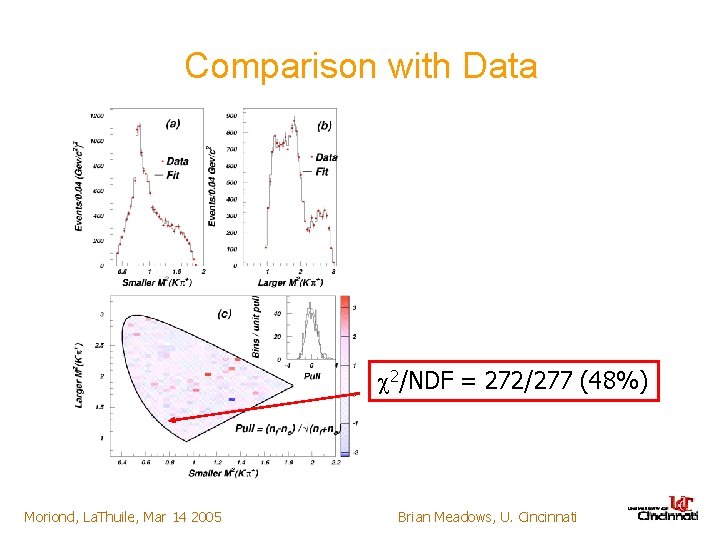
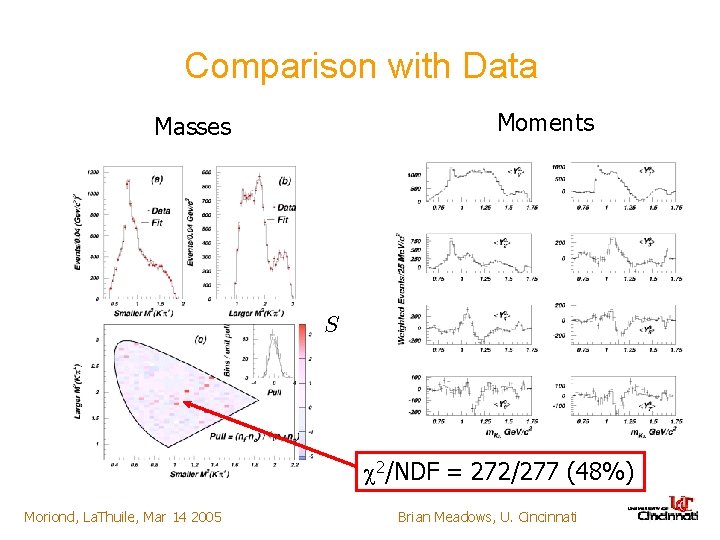
Comparison with Data S 2/NDF = 272/277 (48%) Moriond, La. Thuile, Mar 14 2005 Brian Meadows, U. Cincinnati
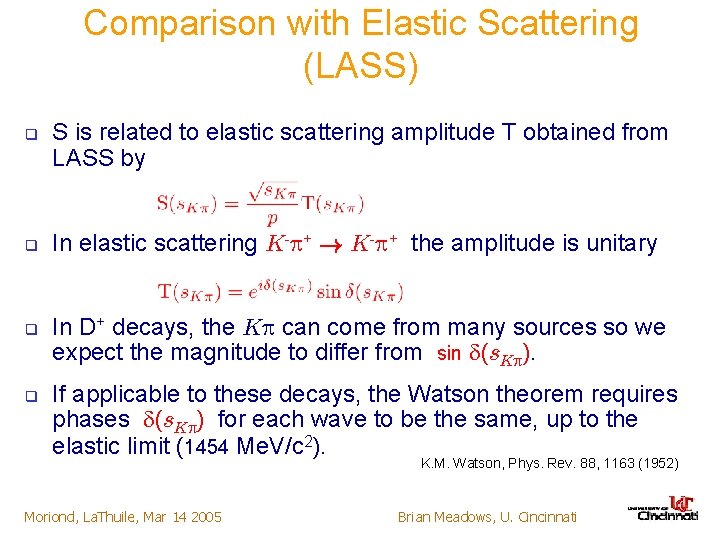
Comparison with Elastic Scattering (LASS) q q S is related to elastic scattering amplitude T obtained from LASS by In elastic scattering K- + ! K- + the amplitude is unitary In D+ decays, the K can come from many sources so we expect the magnitude to differ from sin (s. K ). If applicable to these decays, the Watson theorem requires phases (s. K ) for each wave to be the same, up to the elastic limit (1454 Me. V/c 2). K. M. Watson, Phys. Rev. 88, 1163 (1952) Moriond, La. Thuile, Mar 14 2005 Brian Meadows, U. Cincinnati
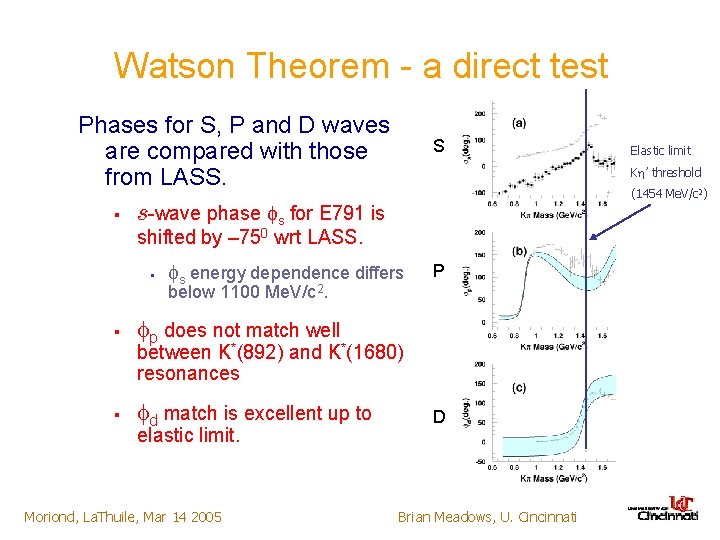
Watson Theorem - a direct test Phases for S, P and D waves are compared with those from LASS. § s-wave phase s for E 791 is S Kh’ threshold (1454 Me. V/c 2) shifted by – 750 wrt LASS. § s energy dependence differs P below 1100 Me. V/c 2. § p does not match well between K*(892) and K*(1680) resonances § d match is excellent up to elastic limit. Moriond, La. Thuile, Mar 14 2005 Elastic limit D Brian Meadows, U. Cincinnati
Summary q q q A new technique is used to fit the amplitude describing a Dalitz plot distribution It can provide model independent measurements of the complex amplitude of the K- + s-wave system, provided a good model for the p- and d-waves is used. Such measurements are possible at masses below the limit of existing ones. The Watson theorem does not apply to D+! K- + + decays. This technique will play a role in analyses of the large samples of heavy meson decays becoming available from B factories, CLEO-c and the Te. Vatron collider. Moriond, La. Thuile, Mar 14 2005 Brian Meadows, U. Cincinnati
Back up Slides Moriond, La. Thuile, Mar 14 2005 Brian Meadows, U. Cincinnati
A Different Approach q q Instead of expanding the Dalitz plot amplitude in BW’s (or pole terms in a K matrix) for each resonance, expand in partial waves. For a D decay, barrier factors preclude all but s-, p- and dwaves. Treat the s-wave, at least, as having completely unknown dependence on invariant mass. p- and d-waves can be expanded as resonances of appropriate spin Moriond, La. Thuile, Mar 14 2005 Brian Meadows, U. Cincinnati
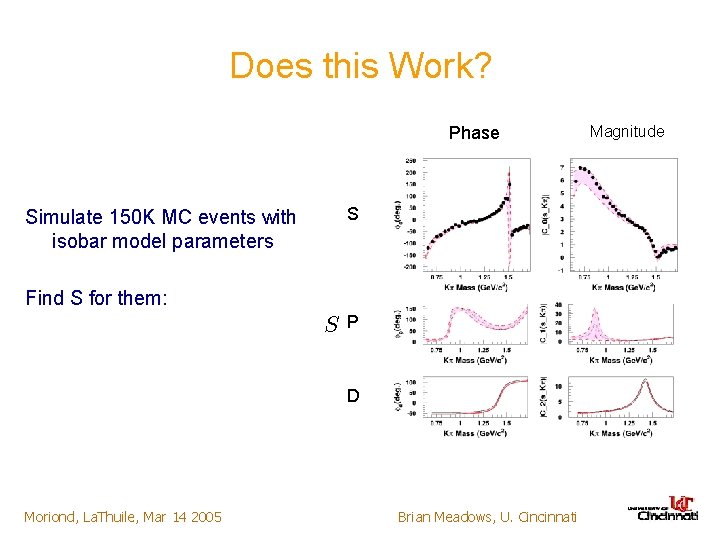
Does this Work? Phase S Simulate 150 K MC events with isobar model parameters Find S for them: S P D Moriond, La. Thuile, Mar 14 2005 Brian Meadows, U. Cincinnati Magnitude
Milestones in Dalitz Plot Analyses 1993 -7: E 691/687 find large non-resonant (NR) fraction in Decays D+ ! - + + and D+ ! K- + + 2001: E 791 find that broad, low mass scalar isobars can soak up most of the NR contribution ! NR is not constant 2004: Focus collaboration use data from K-matrix fit to large number of hadron interactions involving + - production in analysis of D+ ! - + +. ! No new broad scalars required? Moriond, La. Thuile, Mar 14 2005 Brian Meadows, U. Cincinnati
Milestones in Dalitz Plot Analyses 2005: Lots more data is on the way Clearly, we may be able to learn which scalar resonances really exist Other information is required from the data We need new, less model-dependent ways to analyze it. ! One possibility is Energy Independent Partial Wave Analysis (EIPWA). E 791 is the first to try. Moriond, La. Thuile, Mar 14 2005 Brian Meadows, U. Cincinnati
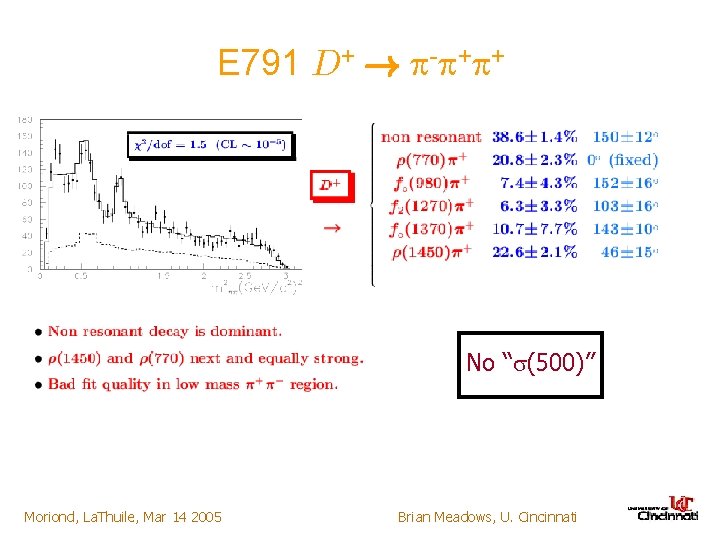
E 791 D+ ! - + + No “s(500)” Moriond, La. Thuile, Mar 14 2005 Brian Meadows, U. Cincinnati
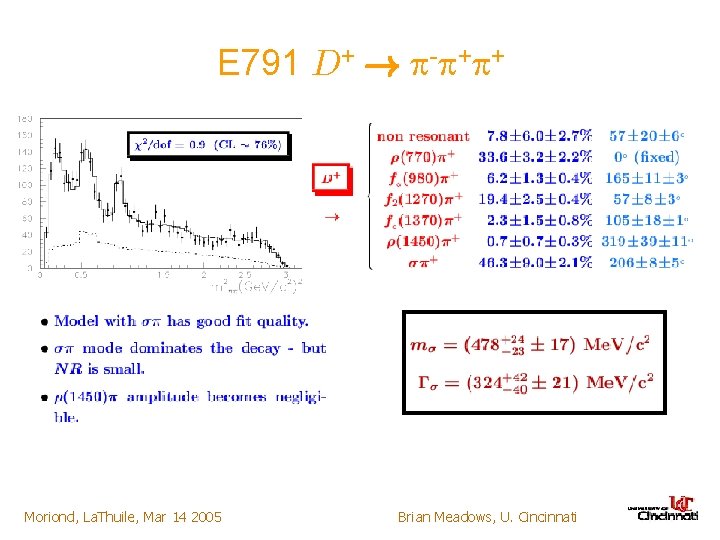
E 791 D+ ! - + + Moriond, La. Thuile, Mar 14 2005 Brian Meadows, U. Cincinnati
K Scattering q Most information on K- + scattering comes from the LASS experiment (SLAC, E 135) Data from: K-p! K- +n and K-p! K 0 -p NPB 296, 493 (1988) Parametrize s-wave (I=1/2) by Moriond, La. Thuile, Mar 14 2005 a – scattering length b – effective range p – momentum in CM Brian Meadows, U. Cincinnati
E 791 D+ ! K- + + Moriond, La. Thuile, Mar 14 2005 Brian Meadows, U. Cincinnati
Does this Work? Phase Fit the E 791 data: 1. 2. 3. Fix P and D parameters at model § Find S: Fix S and D parameters at model § Find P: S Fix S and P parameters at model § Find D: S P D The method works. Moriond, La. Thuile, Mar 14 2005 Brian Meadows, U. Cincinnati Magnitude
Comparison with Data Moments Masses S 2/NDF = 272/277 (48%) Moriond, La. Thuile, Mar 14 2005 Brian Meadows, U. Cincinnati
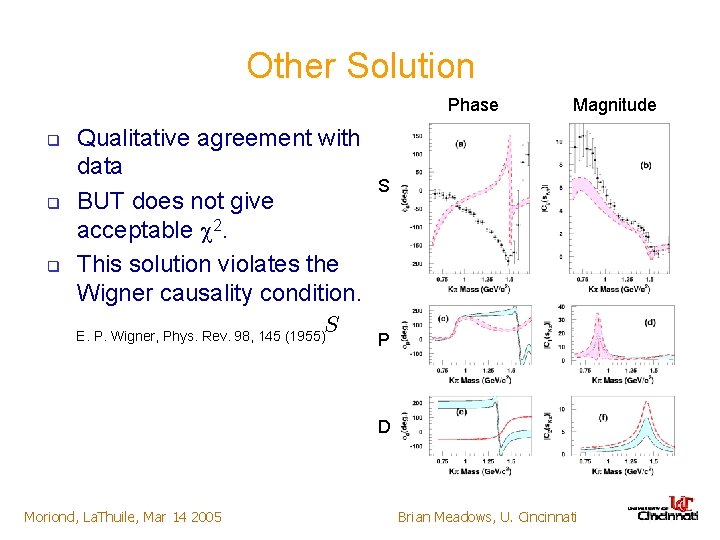
Other Solution Phase q q q Qualitative agreement with data BUT does not give acceptable 2. This solution violates the Wigner causality condition. S E. P. Wigner, Phys. Rev. 98, 145 (1955) Magnitude S P D Moriond, La. Thuile, Mar 14 2005 Brian Meadows, U. Cincinnati