
K Factor of Transformer PRESENTED BY PROF VG
K Factor of Transformer PRESENTED BY PROF. VG PATEL
TRANSFORMER ENCYCLOPAEDIA K - FACTOR OF TRANSFORMER Modern industrial and commercial networks are increasingly influenced by significant amounts of harmonic currents produced by ever increasing applications of power electronic devices, i. e. a variety of nonlinear loads like variable speed drives, electric and induction furnaces, fluorescent lighting, static power converters, uninterruptible power supplies and massive numbers of home entertaining devices including personal computers. All of these currents are sourced through service transformers. A particular aspect of transformers is that, under saturation conditions, they become a source of harmonics. In general, harmonics losses occur from increased heat dissipation in the windings and skin effect; both are a function of the square of the RMS current, as well as from eddy currents and core losses. This extra heat can have a significant impact in reducing the operating life of the transformer insulation. Friday, September 3, 2021 PROF. V. G. PATEL 2
TRANSFORMER ENCYCLOPAEDIA K - FACTOR OF TRANSFORMER Transformers are a particular case of power equipment that has experienced an evolution that allows them to operate in electrical environments with considerable harmonic distortion. In industry applications in which transformers are primarily loaded with nonlinear loads, continuous operation at or above rated power can impose a high operating temperature, which can have a significant impact on their lifetime. The K-Factor rating assigned to a transformer and marked on the transformer case in accordance with the listing of Underwriters Laboratories, is an index of the transformer's ability to supply harmonic content in its load current while remaining within its operating temperature limits. A specific K-factor rating indicates that a transformer can supply its rated KVA load output to a load of specified amount of harmonic content. Friday, September 3, 2021 PROF. V. G. PATEL 3
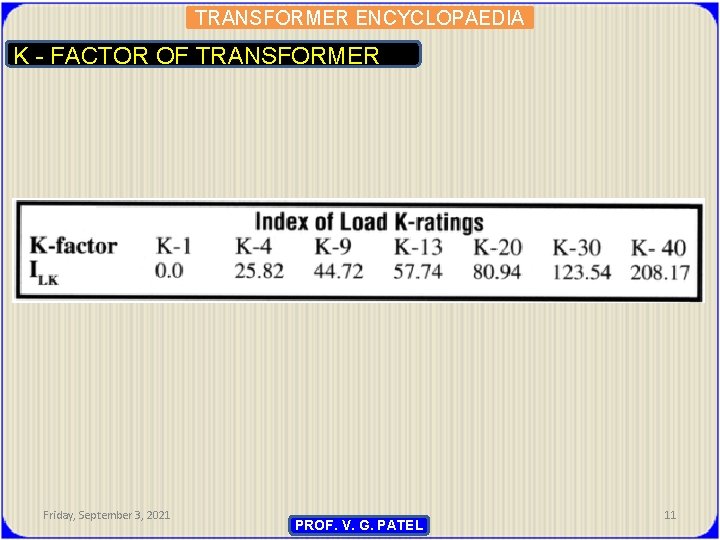
TRANSFORMER ENCYCLOPAEDIA K - FACTOR OF TRANSFORMER At present, industry literature and commentary refers to a limited number of K-factor ratings: K-1, K-4, K-9, K-13, K-20, K-30, K-40. In theory, a transformer could be designed for other K-factor ratings in-between those values, as well as for higher values. The commonly referenced ratings calculated according to ANSI/IEEE C 57. 110 -1986 are as follows: K-1: This is the rating of any conventional transformer that has been designed to handle only the heating effects of eddy currents and other losses resulting from 50 Hertz, sine-wave current loading on the transformer. Such a unit may or may not be designed to handle the increased heating of harmonics in its load current. Friday, September 3, 2021 PROF. V. G. PATEL 4
TRANSFORMER ENCYCLOPAEDIA K - FACTOR OF TRANSFORMER K-4: A transformer with this rating has been designed to supply rated KVA, without overheating, to a load made-up of 100% of the normal 50 Hertz, sine-wave, fundamental current plus: 16% of the fundamental as 3 rd harmonic current; 10% of the fundamental as 5 th; 7% of the fundamental as 7 th; 5. 5% of the fundamental as 9 th; and smaller percentages through the 25 th harmonic. The "4" indicates its ability to accommodate four times the eddy current losses of a K-1 transformer. K-9: A K-9 transformer can accommodate 163% of the harmonic loading of a K-4 rated transformer. K-13: A K-13 transformer can accommodate 200% of the harmonic loading of a K-4 rated transformer. K-20, K-30, K-40: The higher number of each of these K-factor ratings indicates ability to handle successively larger amounts of harmonic load content without overheating. Friday, September 3, 2021 PROF. V. G. PATEL 5

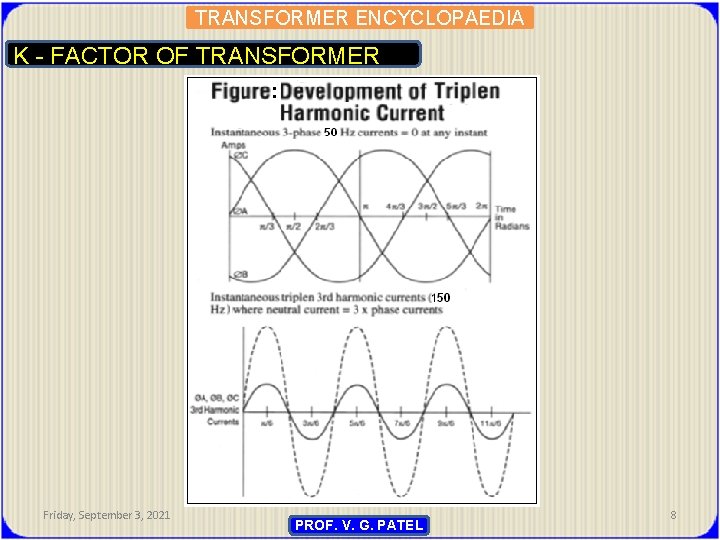
TRANSFORMER ENCYCLOPAEDIA K - FACTOR OF TRANSFORMER Triplen harmonic currents are phase currents which flow from each of the phases into the fourth wire neutral and have frequencies in integer multiples of three times the 50 hertz base frequency (150 Hz, 300 Hz, 450 Hz, etc). At each of these third multiple triplen frequencies, these triplen phase currents are in phase with each other and when flowing in the neutral as zero sequence currents, are equal to three times their RMS phase values. See figure. In a 3 -phase, 4 -wire system, single-phase line-to-neutral currents flow in each phase conductor and return in the common neutral. Since three 50 hertz currents are separated by 1200, when balanced they cancel each other. The measured resultant current is equal to zero. See figure. Friday, September 3, 2021 PROF. V. G. PATEL 6
TRANSFORMER ENCYCLOPAEDIA K - FACTOR OF TRANSFORMER Theory also states that for even harmonics, starting with the second order, when balanced the even harmonic will cancel in the common neutral. Other odd harmonics add in the common neutral, but their magnitude is considerably less than triplens. The RMS value of the total current is the square root of the RMS value of the individual currents squared. At any given instant, the 50 Hertz currents on the three-phase legs have a vector resultant of zero and cancel in the neutral. But, the third (and other odd triplen harmonics) on the phase legs are in phase and become additive in the neutral. Friday, September 3, 2021 PROF. V. G. PATEL 7
TRANSFORMER ENCYCLOPAEDIA K - FACTOR OF TRANSFORMER Friday, September 3, 2021 PROF. V. G. PATEL 8
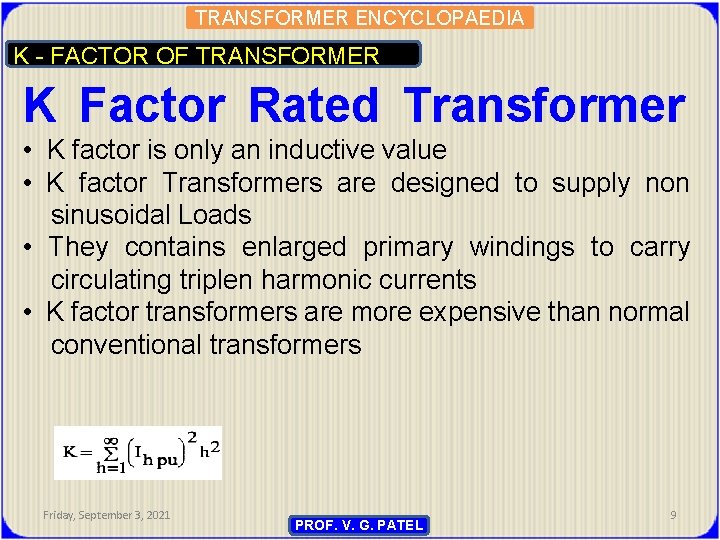
TRANSFORMER ENCYCLOPAEDIA K - FACTOR OF TRANSFORMER K Factor Rated Transformer • K factor is only an inductive value • K factor Transformers are designed to supply non sinusoidal Loads • They contains enlarged primary windings to carry circulating triplen harmonic currents • K factor transformers are more expensive than normal conventional transformers Friday, September 3, 2021 PROF. V. G. PATEL 9
TRANSFORMER ENCYCLOPAEDIA K - FACTOR OF TRANSFORMER K Factor Rated Transformer • i. e. it is the rating applied to the transformer which indicates its stability to use with loads that draws non sinusoidal current. • The K factor can be measure with K-factor meter. • For pure linear load, which draws pure sinusoidal current, K factor will be Unity. • Higher K factor value indicates the loss in transformer will be K times the value of fundamental • i. e. K 4 rated transformer has four times the eddy current tolerance as K 1 transformer • Similarly, K 13 rated transformer has approximately twice the tolerance of K 4 transformer Friday, September 3, 2021 PROF. V. G. PATEL 10
TRANSFORMER ENCYCLOPAEDIA K - FACTOR OF TRANSFORMER Friday, September 3, 2021 PROF. V. G. PATEL 11
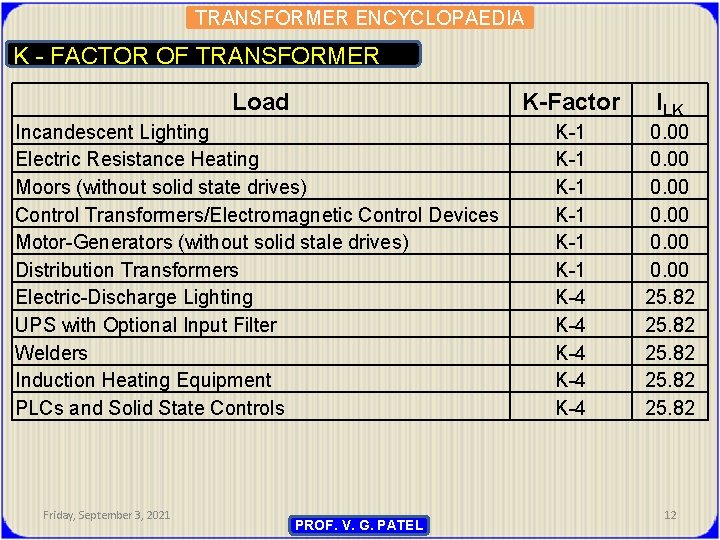
TRANSFORMER ENCYCLOPAEDIA K - FACTOR OF TRANSFORMER Load K-Factor ILK Incandescent Lighting Electric Resistance Heating Moors (without solid state drives) Control Transformers/Electromagnetic Control Devices Motor-Generators (without solid stale drives) Distribution Transformers Electric-Discharge Lighting UPS with Optional Input Filter Welders Induction Heating Equipment PLCs and Solid State Controls K-1 K-1 K-1 K-4 K-4 K-4 0. 00 25. 82 Friday, September 3, 2021 PROF. V. G. PATEL 12
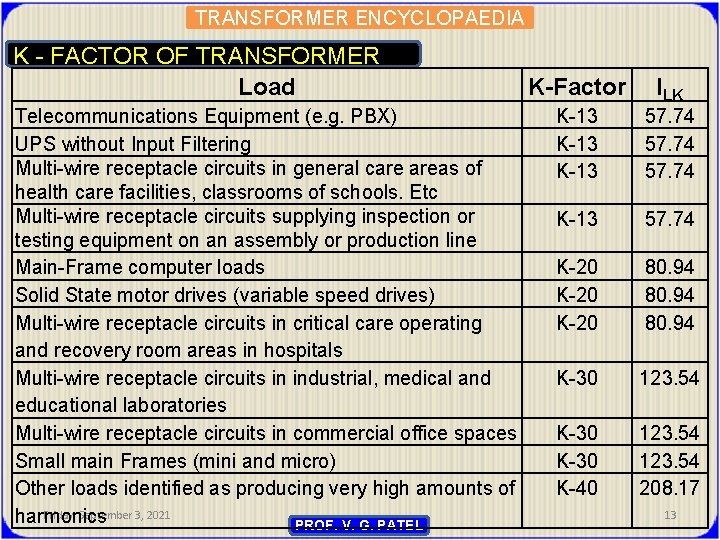
TRANSFORMER ENCYCLOPAEDIA K - FACTOR OF TRANSFORMER Load Telecommunications Equipment (e. g. PBX) UPS without Input Filtering Multi-wire receptacle circuits in general care areas of health care facilities, classrooms of schools. Etc Multi-wire receptacle circuits supplying inspection or testing equipment on an assembly or production line Main-Frame computer loads Solid State motor drives (variable speed drives) Multi-wire receptacle circuits in critical care operating and recovery room areas in hospitals Multi-wire receptacle circuits in industrial, medical and educational laboratories Multi-wire receptacle circuits in commercial office spaces Small main Frames (mini and micro) Other loads identified as producing very high amounts of Friday, September 3, 2021 harmonics PROF. V. G. PATEL K-Factor ILK K-13 57. 74 K-13 57. 74 K-20 80. 94 K-30 123. 54 K-30 K-40 123. 54 208. 17 13
TRANSFORMER ENCYCLOPAEDIA OPEN FORUM Friday, September 3, 2021 14
TRANSFORMER ENCYCLOPAEDIA THANQ Friday, September 3, 2021 15
- Slides: 15