
JWST IFS Summary Talk Luis Colina Santiago Arribas
JWST IFS Summary Talk Luis Colina & Santiago Arribas (Centro de Astrobiología, CAB, Madrid)
JWST IFUs SUMMARY. OUTLINE • SCIENCE CAPABILITES (in an extragalactic context) – Angular resolution – Spectral coverage – Sensitivity • OBSERVING STRATEGIES. COMMONALITIES & DIFFERENCES – – Pointing and target acquisition Spectral coverage Sampling / Background Dithering / Nodding
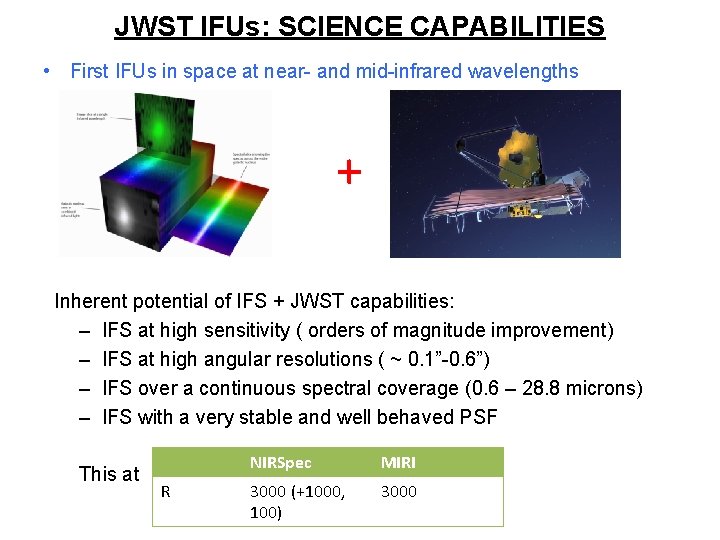
JWST IFUs: SCIENCE CAPABILITIES • First IFUs in space at near- and mid-infrared wavelengths + Inherent potential of IFS + JWST capabilities: – IFS at high sensitivity ( orders of magnitude improvement) – IFS at high angular resolutions ( ~ 0. 1”-0. 6”) – IFS over a continuous spectral coverage (0. 6 – 28. 8 microns) – IFS with a very stable and well behaved PSF This at R NIRSpec MIRI 3000 (+1000, 100) 3000
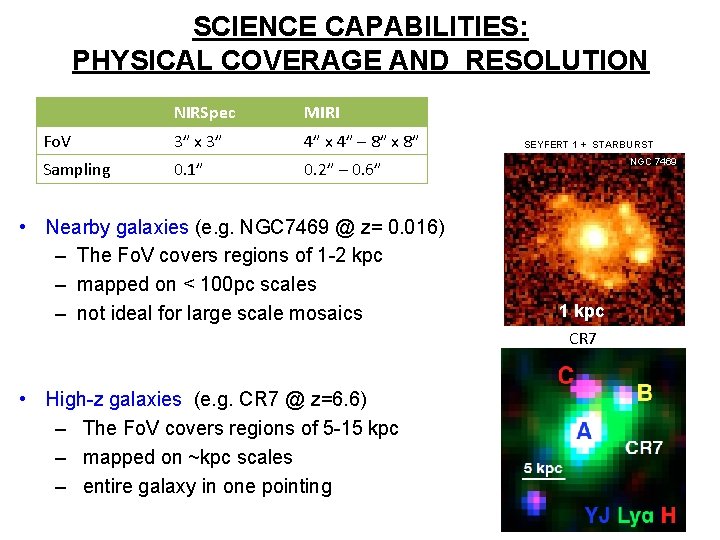
SCIENCE CAPABILITIES: PHYSICAL COVERAGE AND RESOLUTION NIRSpec MIRI Fo. V 3” x 3” 4” x 4” – 8” x 8” Sampling 0. 1” 0. 2” – 0. 6” • Nearby galaxies (e. g. NGC 7469 @ z= 0. 016) – The Fo. V covers regions of 1 -2 kpc – mapped on < 100 pc scales – not ideal for large scale mosaics NGC 7469 SEYFERT 1 + STARBURST NGC 7469 1 kpc CR 7 • High-z galaxies (e. g. CR 7 @ z=6. 6) – The Fo. V covers regions of 5 -15 kpc – mapped on ~kpc scales – entire galaxy in one pointing 4
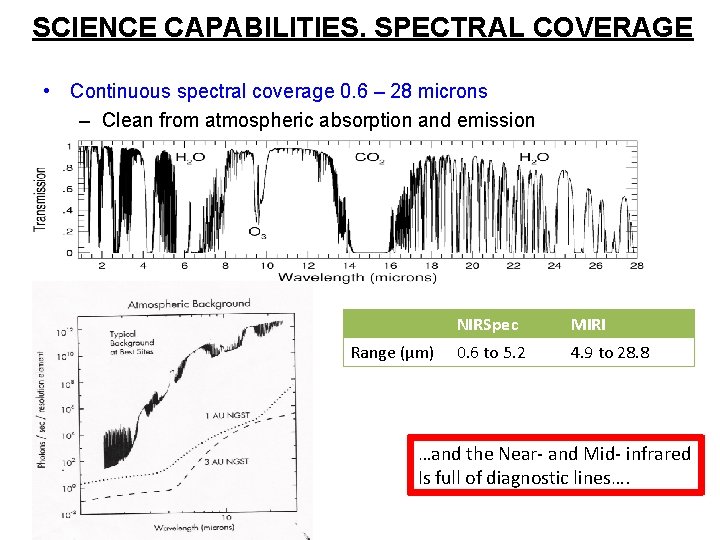
SCIENCE CAPABILITIES. SPECTRAL COVERAGE • Continuous spectral coverage 0. 6 – 28 microns – Clean from atmospheric absorption and emission Range (μm) NIRSpec MIRI 0. 6 to 5. 2 4. 9 to 28. 8 …and the Near- and Mid- infrared Is full of diagnostic lines….
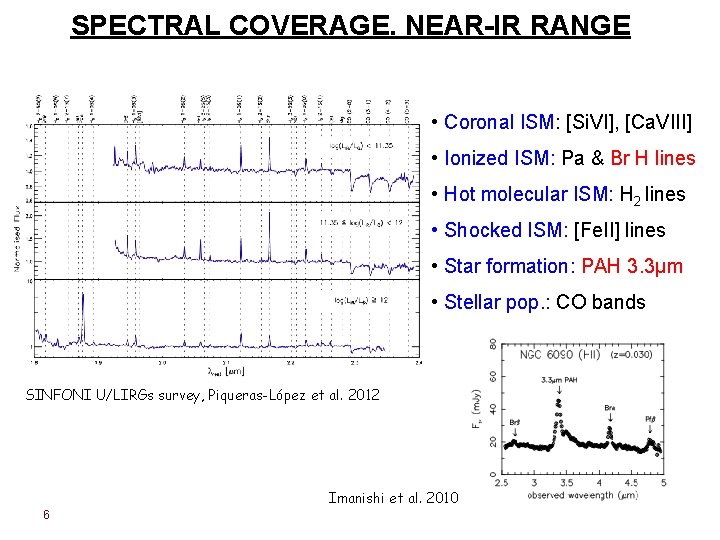
SPECTRAL COVERAGE. NEAR-IR RANGE • Coronal ISM: [Si. VI], [Ca. VIII] • Ionized ISM: Pa & Br H lines • Hot molecular ISM: H 2 lines • Shocked ISM: [Fe. II] lines • Star formation: PAH 3. 3μm • Stellar pop. : CO bands SINFONI U/LIRGs survey, Piqueras-López et al. 2012 Imanishi et al. 2010 6
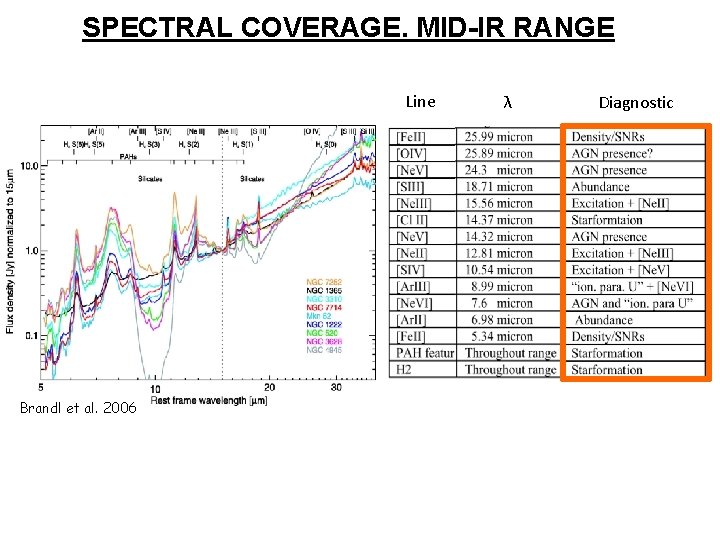
SPECTRAL COVERAGE. MID-IR RANGE Line Brandl et al. 2006 7 λ Diagnostic
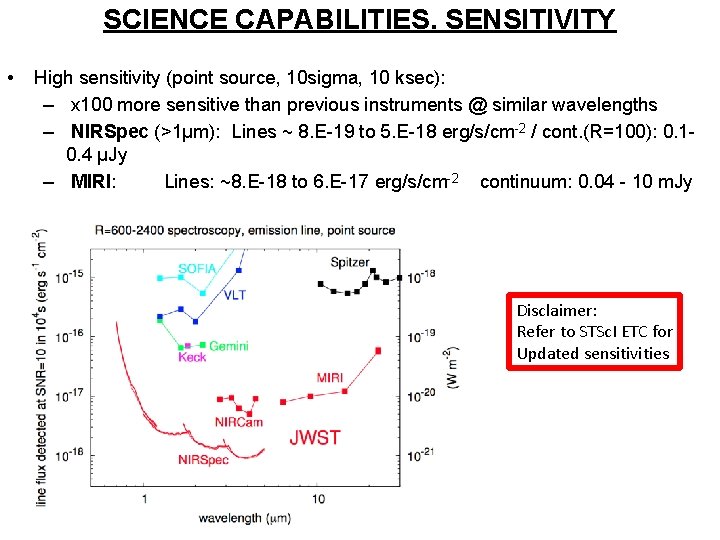
SCIENCE CAPABILITIES. SENSITIVITY • High sensitivity (point source, 10 sigma, 10 ksec): – x 100 more sensitive than previous instruments @ similar wavelengths – NIRSpec (>1μm): Lines ~ 8. E-19 to 5. E-18 erg/s/cm-2 / cont. (R=100): 0. 10. 4 μJy – MIRI: Lines: ~8. E-18 to 6. E-17 erg/s/cm-2 continuum: 0. 04 - 10 m. Jy Disclaimer: Refer to STSc. I ETC for Updated sensitivities
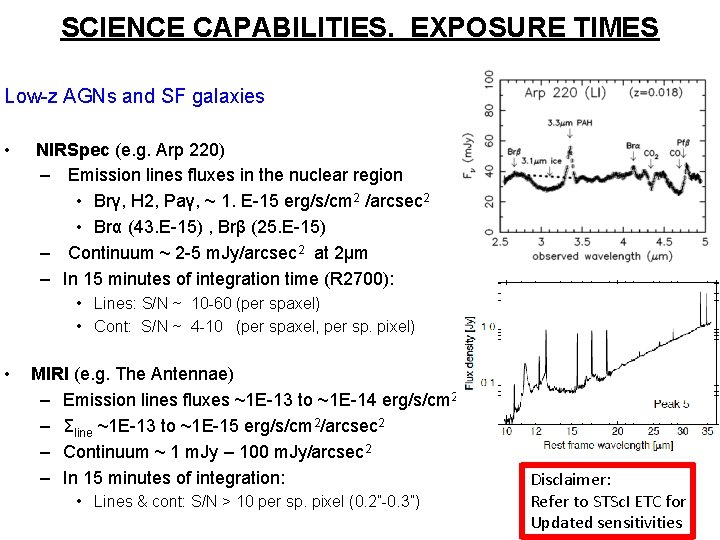
SCIENCE CAPABILITIES. EXPOSURE TIMES Low-z AGNs and SF galaxies • NIRSpec (e. g. Arp 220) – Emission lines fluxes in the nuclear region • Brγ, H 2, Paγ, ~ 1. E-15 erg/s/cm 2 /arcsec 2 • Brα (43. E-15) , Brβ (25. E-15) – Continuum ~ 2 -5 m. Jy/arcsec 2 at 2μm – In 15 minutes of integration time (R 2700): • Lines: S/N ~ 10 -60 (per spaxel) • Cont: S/N ~ 4 -10 (per spaxel, per sp. pixel) • MIRI (e. g. The Antennae) – Emission lines fluxes ~1 E-13 to ~1 E-14 erg/s/cm 2 – Σline ~1 E-13 to ~1 E-15 erg/s/cm 2/arcsec 2 – Continuum ~ 1 m. Jy – 100 m. Jy/arcsec 2 – In 15 minutes of integration: • Lines & cont: S/N > 10 per sp. pixel (0. 2”-0. 3”) Disclaimer: Refer to STSc. I ETC for Updated sensitivities
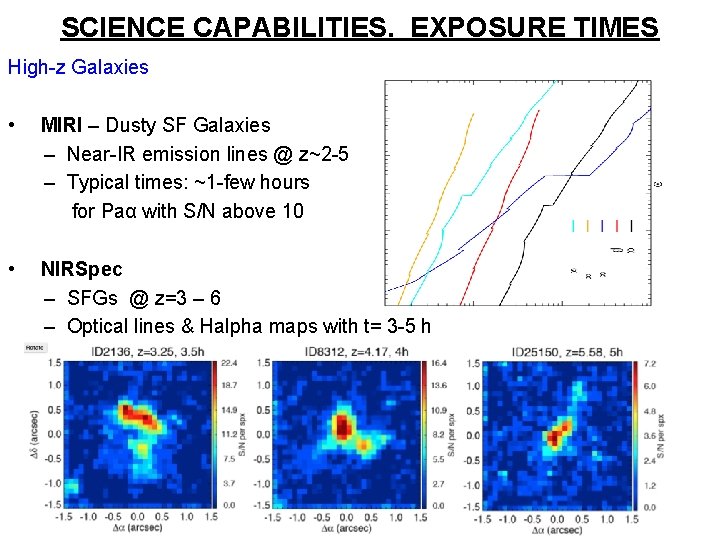
SCIENCE CAPABILITIES. EXPOSURE TIMES High-z Galaxies • MIRI – Dusty SF Galaxies – Near-IR emission lines @ z~2 -5 – Typical times: ~1 -few hours for Paα with S/N above 10 • NIRSpec – SFGs @ z=3 – 6 – Optical lines & Halpha maps with t= 3 -5 h –.
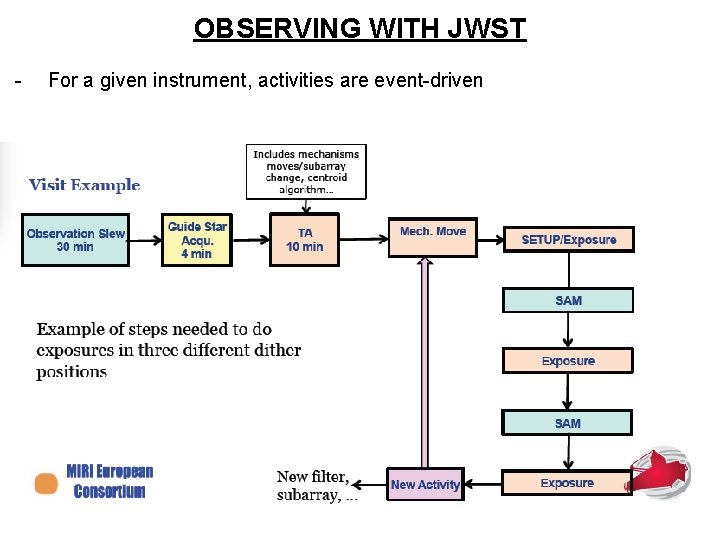
OBSERVING WITH JWST - For a given instrument, activities are event-driven • Spectral Coverage / R • Sampling / dithering • Background
OBSERVING STRATEGIES. MIRI + NIRSPEC IFS JWST very powerful and sensitive … … exposure times likely short… … therefore manouvering and mechanisms overheads can be significant (for weak high-z targets less significant due to the longer exposures) Observer should identify an observational strategy to optimize the efficiency of the proposal, i. e. increase the fraction of clock time that goes into on-target exposure time. In practical terms: • • Pointing and target acquisition Spectral Coverage Spatial sampling / dithering Background … some of this depends on instrument
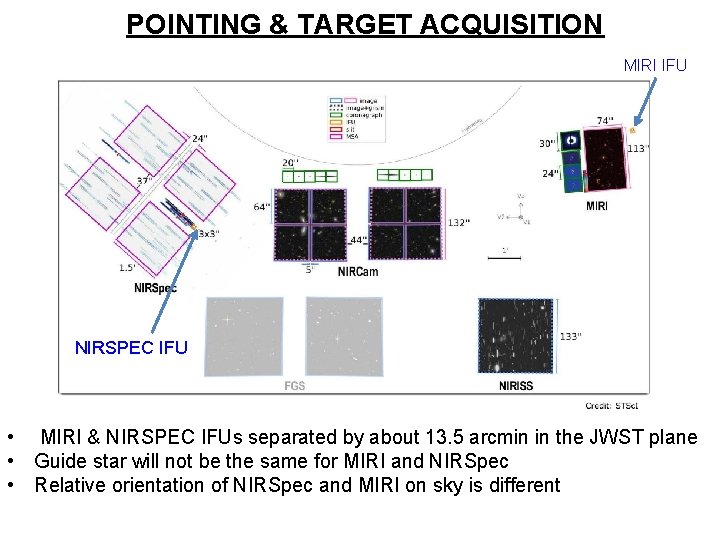
POINTING & TARGET ACQUISITION MIRI IFU NIRSPEC IFU • MIRI & NIRSPEC IFUs separated by about 13. 5 arcmin in the JWST plane • Guide star will not be the same for MIRI and NIRSpec • Relative orientation of NIRSpec and MIRI on sky is different
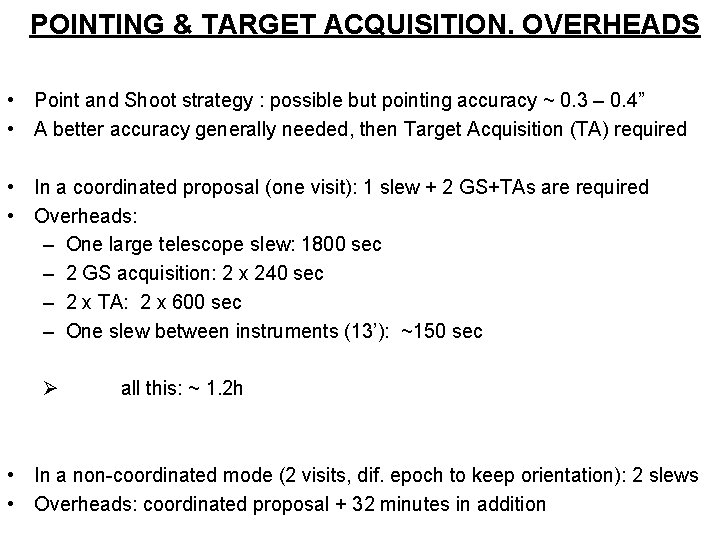
POINTING & TARGET ACQUISITION. OVERHEADS • Point and Shoot strategy : possible but pointing accuracy ~ 0. 3 – 0. 4” • A better accuracy generally needed, then Target Acquisition (TA) required • In a coordinated proposal (one visit): 1 slew + 2 GS+TAs are required • Overheads: – One large telescope slew: 1800 sec – 2 GS acquisition: 2 x 240 sec – 2 x TA: 2 x 600 sec – One slew between instruments (13’): ~150 sec Ø all this: ~ 1. 2 h • In a non-coordinated mode (2 visits, dif. epoch to keep orientation): 2 slews • Overheads: coordinated proposal + 32 minutes in addition
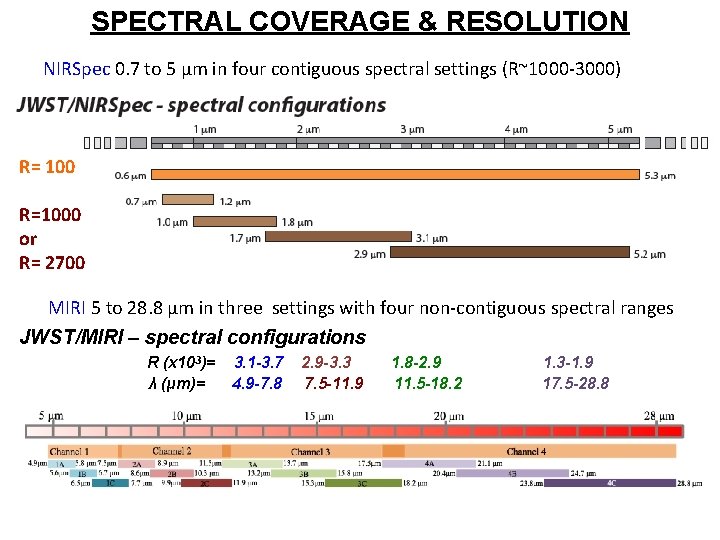
SPECTRAL COVERAGE & RESOLUTION NIRSpec 0. 7 to 5 μm in four contiguous spectral settings (R~1000 -3000) R= 100 R=1000 or R= 2700 MIRI 5 to 28. 8 μm in three settings with four non-contiguous spectral ranges JWST/MIRI – spectral configurations R (x 103)= λ (μm)= 3. 1 -3. 7 4. 9 -7. 8 2. 9 -3. 3 7. 5 -11. 9 1. 8 -2. 9 11. 5 -18. 2 1. 3 -1. 9 17. 5 -28. 8
SPECTRAL COVERAGE & RESOLUTION. STRATEGIES Need to think about location of specific high-priority spectral features, carefully selecting the specific settings needed for your science • Note that full 0. 7 to 28. 8 microns coverage @ R~2 -3 x 10³, is doable but… … in seven spectral settings • Overheads involved in moving spectral settings: MIRI: 60 seconds / setting NIRSpec: 120 seconds / setting Overheads: ~13 minutes for full spectral coverage with intermediate R. not negligible for nearby bright extended targets • Note that there is no option of R~100 to get full 0. 6 to 28. 8 microns IFS – Covers the 0. 6 -5. 3 microns with NIRSpec – Covers the 5 -12 microns with MIRI but only long-slit (0. 5 x 5 arcsec)
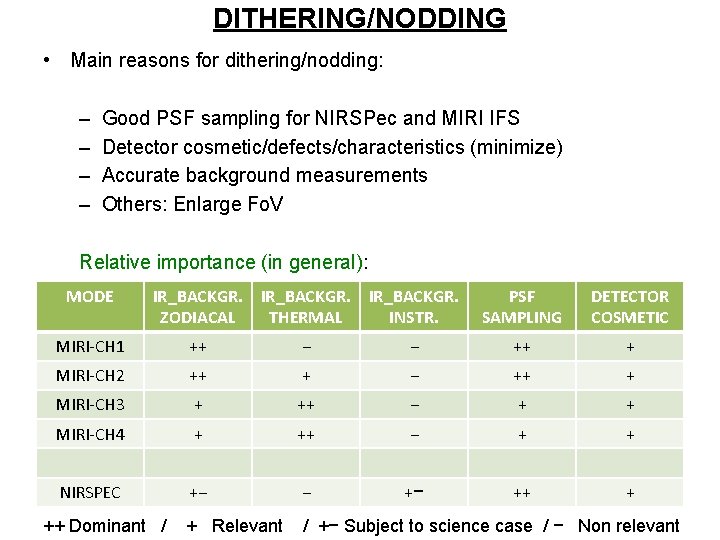
DITHERING/NODDING • Main reasons for dithering/nodding: – – Good PSF sampling for NIRSPec and MIRI IFS Detector cosmetic/defects/characteristics (minimize) Accurate background measurements Others: Enlarge Fo. V Relative importance (in general): MODE IR_BACKGR. ZODIACAL THERMAL INSTR. PSF SAMPLING DETECTOR COSMETIC MIRI-CH 1 ++ − − ++ + MIRI-CH 2 ++ + − ++ + MIRI-CH 3 + ++ − + + MIRI-CH 4 + ++ − + + NIRSPEC +− − +− ++ + + Relevant / +− Subject to science case / − Non relevant ++ Dominant /
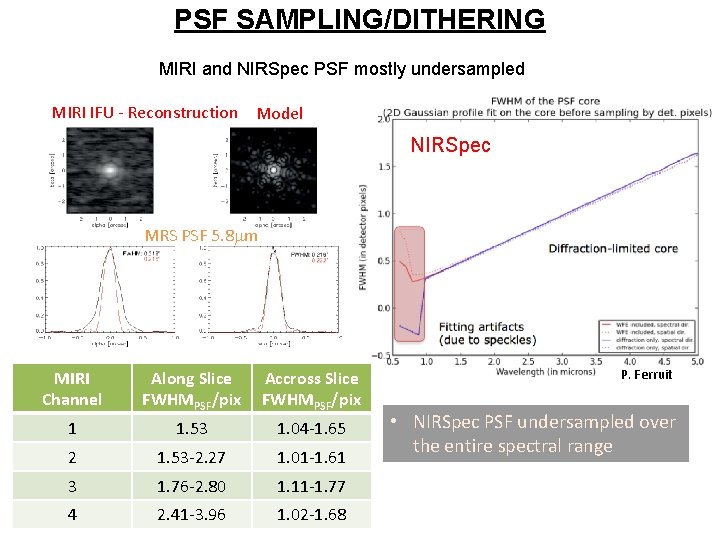
PSF SAMPLING/DITHERING MIRI and NIRSpec PSF mostly undersampled MIRI IFU - Reconstruction Model NIRSpec MRS PSF 5. 8 mm MIRI Channel Along Slice FWHMPSF/pix Accross Slice FWHMPSF/pix 1 1. 53 1. 04 -1. 65 2 1. 53 -2. 27 1. 01 -1. 61 3 1. 76 -2. 80 1. 11 -1. 77 4 2. 41 -3. 96 1. 02 -1. 68 P. Ferruit • NIRSpec PSF undersampled over the entire spectral range
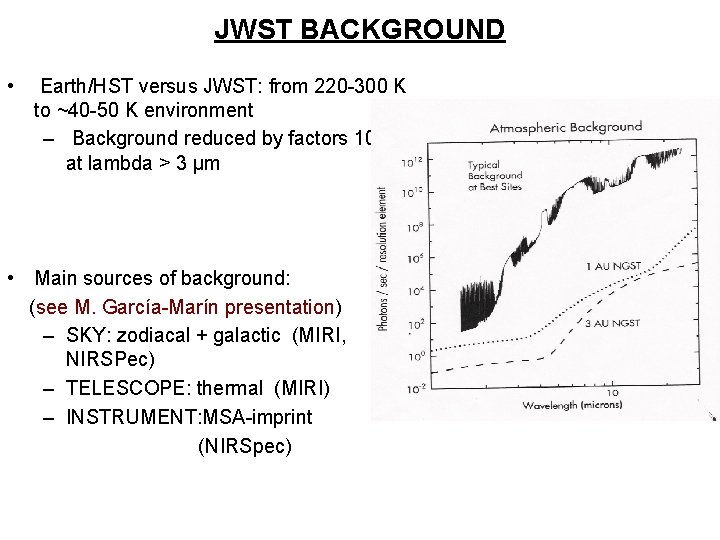
JWST BACKGROUND • Earth/HST versus JWST: from 220 -300 K to ~40 -50 K environment – Background reduced by factors 105 -106 at lambda > 3 μm • Main sources of background: (see M. García-Marín presentation) – SKY: zodiacal + galactic (MIRI, NIRSPec) – TELESCOPE: thermal (MIRI) – INSTRUMENT: MSA-imprint (NIRSpec)
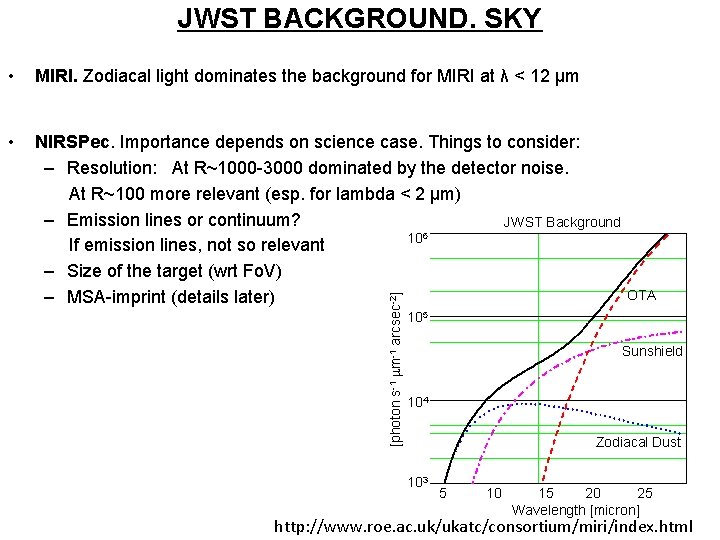
JWST BACKGROUND. SKY MIRI. Zodiacal light dominates the background for MIRI at λ < 12 μm • NIRSPec. Importance depends on science case. Things to consider: – Resolution: At R~1000 -3000 dominated by the detector noise. At R~100 more relevant (esp. for lambda < 2 μm) – Emission lines or continuum? JWST Background 6 10 If emission lines, not so relevant – Size of the target (wrt Fo. V) – MSA-imprint (details later) [photon s-1 mm-1 arcsec-2] • OTA 105 Sunshield 104 Zodiacal Dust 103 5 10 15 20 25 Wavelength [micron] http: //www. roe. ac. uk/ukatc/consortium/miri/index. html
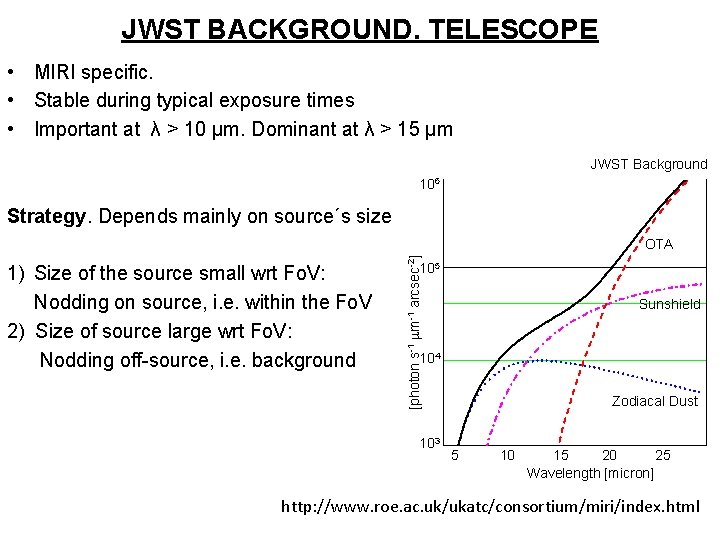
JWST BACKGROUND. TELESCOPE • MIRI specific. • Stable during typical exposure times • Important at λ > 10 μm. Dominant at λ > 15 μm JWST Background 106 Strategy. Depends mainly on source´s size 1) Size of the source small wrt Fo. V: Nodding on source, i. e. within the Fo. V 2) Size of source large wrt Fo. V: Nodding off-source, i. e. background [photon s-1 mm-1 arcsec-2] OTA 105 Sunshield 104 103 Zodiacal Dust 5 10 15 20 25 Wavelength [micron] http: //www. roe. ac. uk/ukatc/consortium/miri/index. html
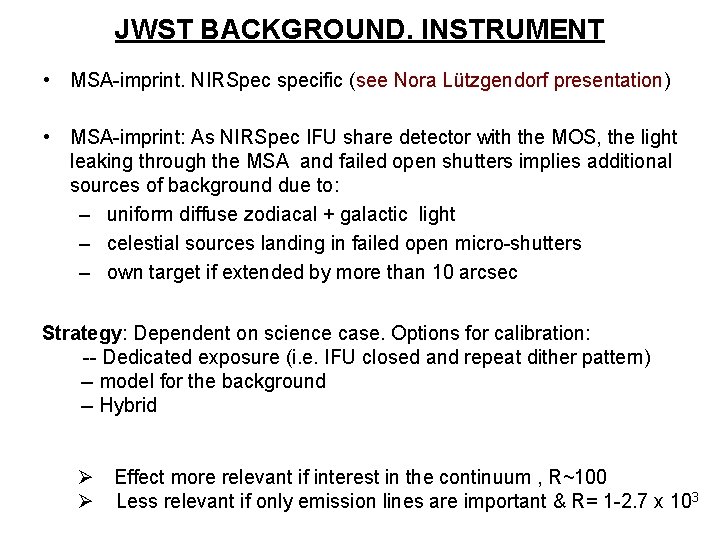
JWST BACKGROUND. INSTRUMENT • MSA-imprint. NIRSpec specific (see Nora Lützgendorf presentation) • MSA-imprint: As NIRSpec IFU share detector with the MOS, the light leaking through the MSA and failed open shutters implies additional sources of background due to: – uniform diffuse zodiacal + galactic light – celestial sources landing in failed open micro-shutters – own target if extended by more than 10 arcsec Strategy: Dependent on science case. Options for calibration: -- Dedicated exposure (i. e. IFU closed and repeat dither pattern) -- model for the background -- Hybrid Ø Effect more relevant if interest in the continuum , R~100 Ø Less relevant if only emission lines are important & R= 1 -2. 7 x 10³
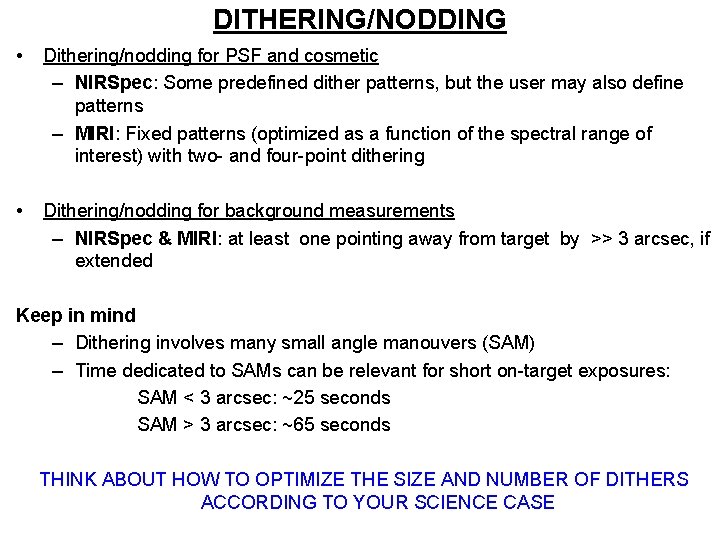
DITHERING/NODDING • Dithering/nodding for PSF and cosmetic – NIRSpec: Some predefined dither patterns, but the user may also define patterns – MIRI: Fixed patterns (optimized as a function of the spectral range of interest) with two- and four-point dithering • Dithering/nodding for background measurements – NIRSpec & MIRI: at least one pointing away from target by >> 3 arcsec, if extended Keep in mind – Dithering involves many small angle manouvers (SAM) – Time dedicated to SAMs can be relevant for short on-target exposures: SAM < 3 arcsec: ~25 seconds SAM > 3 arcsec: ~65 seconds THINK ABOUT HOW TO OPTIMIZE THE SIZE AND NUMBER OF DITHERS ACCORDING TO YOUR SCIENCE CASE
SUMMARY • JWST NIRSpec and MIRI IFS (coordinated) programs extremely powerful. Open a qualitative new window into studies of extended sources because its unique combination of feaures: – Increased sensitivity by factors 100 wrt previous instruments – Wide spectral coverage from the optical (0. 6μm) to the mid-IR (28μm) – Stable sub-arcsec angular resolution over the entire spectral range – Similar intermediate (R~2000 -3000) spectral resolution over spectral range … typical on-target times will be short, minutes to a few hours (for faint cosmological sources), and consequently overhead time can be not negligible. … Therefore we should think our science and observational strategy carefully, keeping in mind the efficiency of our individual programs, and the overall productivity and science return of JWST.
- Slides: 24