
JUSTUSLIEBIGUNIVERSITT GIESSEN Applications of EMA to predict treatment

JUSTUS-LIEBIG-UNIVERSITÄT GIESSEN Applications of EMA to predict treatment response and dropout and support individualized treatment planning Julian Rubel & Wolfgang Lutz
UNIVERSITÄT TRIER JUSTUS-LIEBIG-UNIVERSITÄT GIESSEN Exemplary applications of EMA in Psychotherapy Research 1. The prediction of early response 2. The prediction of treatment dropout 3. Personalized treatment planning 2
UNIVERSITÄT TRIER JUSTUS-LIEBIG-UNIVERSITÄT GIESSEN Data Collection Waiting list: Ecological Momentary Assessment (EMA) § 4 x per day for two weeks, before treatment onset § PANAS: Awake, excited, determined, active, ashamed, anxious, depressed, nervous § Rumination, worry, self-efficacy, social support 4
UNIVERSITÄT TRIER JUSTUS-LIEBIG-UNIVERSITÄT GIESSEN Sample § 58 pat. who started treatment § Screening with M. I. N. I. § Exclusion: acute suicidality, current psychosis, mania or PTSD § Primary Diagnoses with SCID-I (session 2): § Affective disorders (29. 3%) § Anxiety disorders (8. 6%) § Stress and adjustment disorders (19. 0%) § Others (24. 1%) § No SCID-I (19. 0%) [dropout before SCID interview] § 62. 1% female, 19 – 60 years old (M = 35. 7) 5
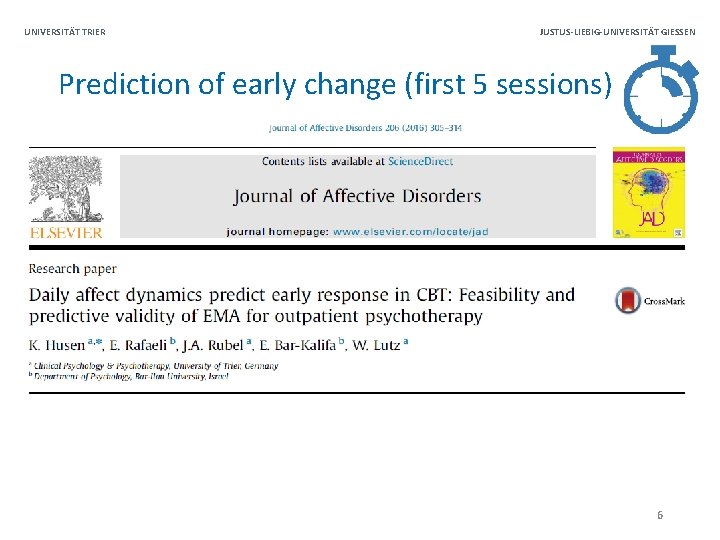
UNIVERSITÄT TRIER JUSTUS-LIEBIG-UNIVERSITÄT GIESSEN Prediction of early change (first 5 sessions) 6
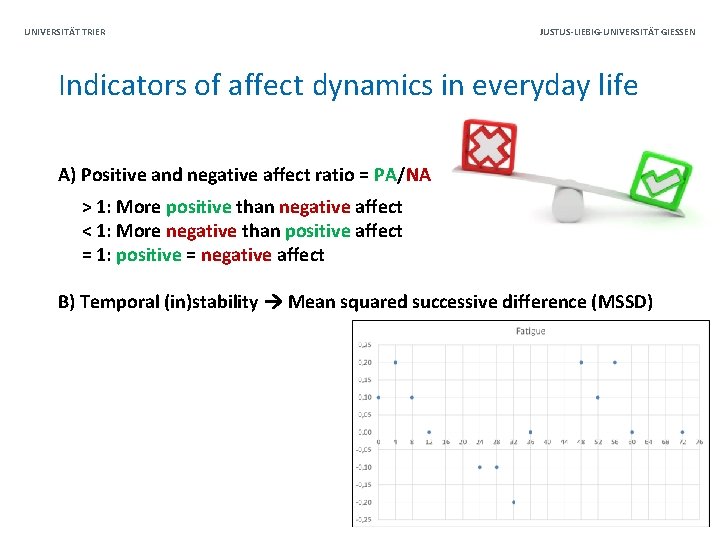
UNIVERSITÄT TRIER JUSTUS-LIEBIG-UNIVERSITÄT GIESSEN Indicators of affect dynamics in everyday life A) Positive and negative affect ratio = PA/NA > 1: More positive than negative affect < 1: More negative than positive affect = 1: positive = negative affect B) Temporal (in)stability Mean squared successive difference (MSSD)
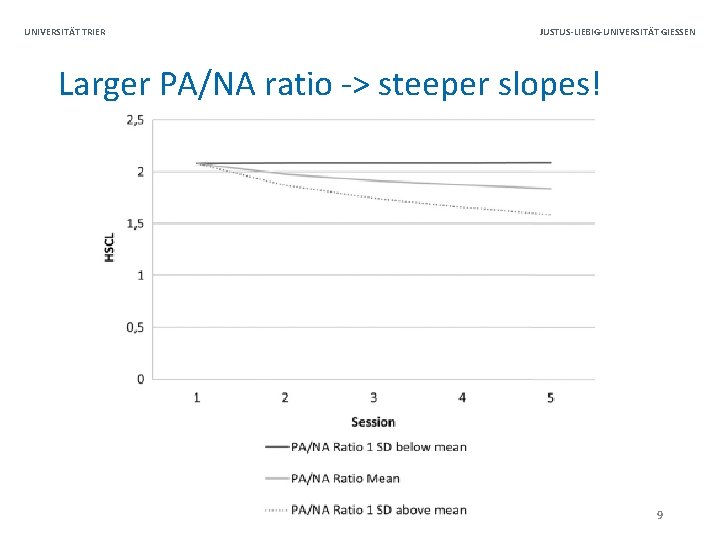
UNIVERSITÄT TRIER JUSTUS-LIEBIG-UNIVERSITÄT GIESSEN Larger PA/NA ratio -> steeper slopes! 9
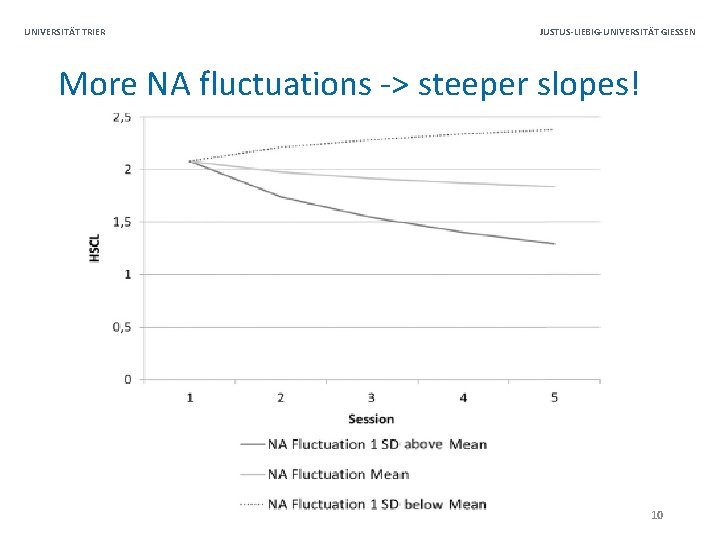
UNIVERSITÄT TRIER JUSTUS-LIEBIG-UNIVERSITÄT GIESSEN More NA fluctuations -> steeper slopes! 10
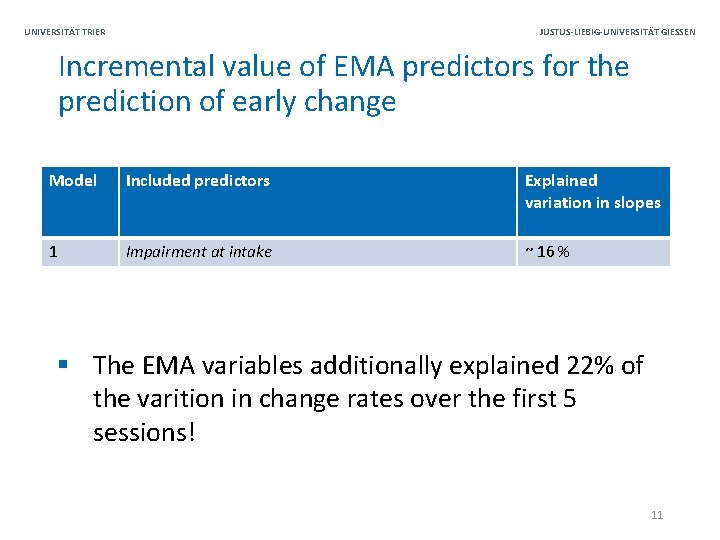
JUSTUS-LIEBIG-UNIVERSITÄT GIESSEN UNIVERSITÄT TRIER Incremental value of EMA predictors for the prediction of early change Model Included predictors Explained variation in slopes 1 Impairment at intake ~ 16 % 2 Model 1 + EMA predictors ~ 38 % § The EMA variables additionally explained 22% of the varition in change rates over the first 5 sessions! 11
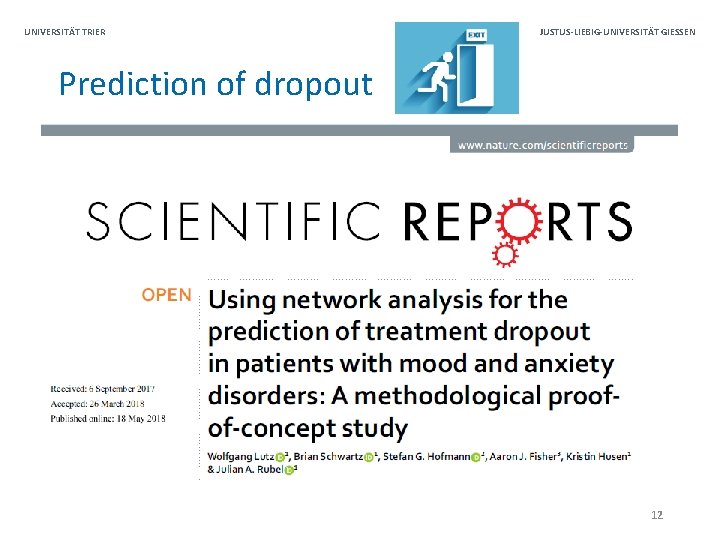
UNIVERSITÄT TRIER JUSTUS-LIEBIG-UNIVERSITÄT GIESSEN Prediction of dropout 12
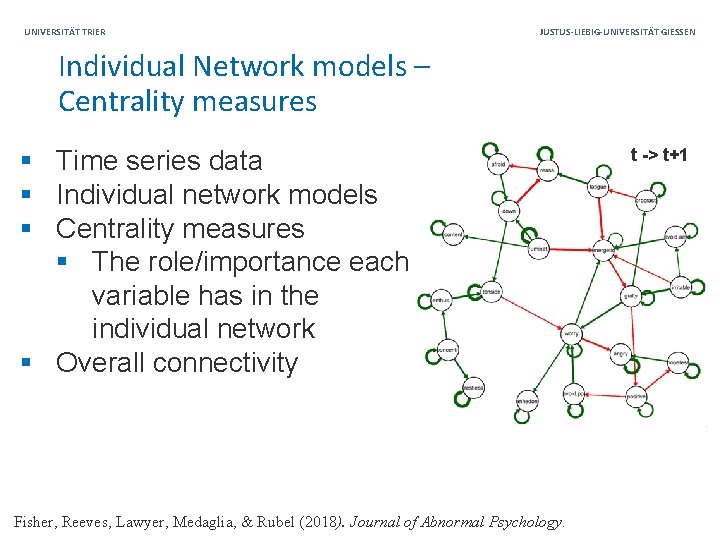
UNIVERSITÄT TRIER JUSTUS-LIEBIG-UNIVERSITÄT GIESSEN Individual Network models – Centrality measures § Time series data § Individual network models § Centrality measures § The role/importance each variable has in the individual network § Overall connectivity Fisher, Reeves, Lawyer, Medaglia, & Rubel (2018). Journal of Abnormal Psychology. t -> t+1
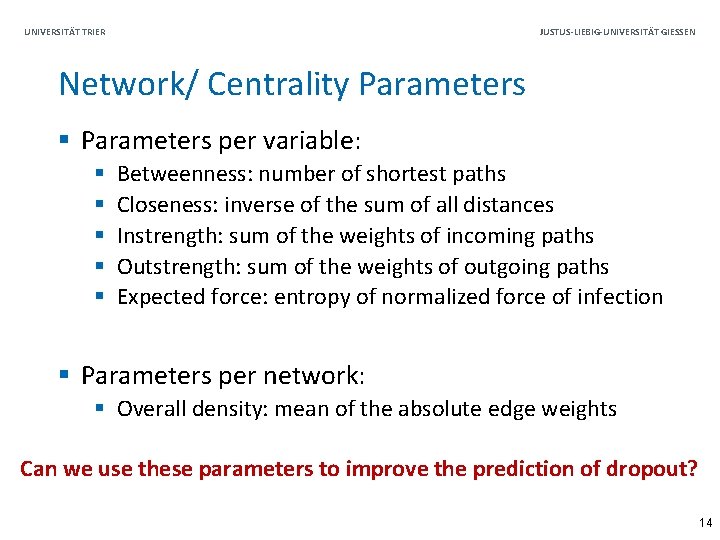
JUSTUS-LIEBIG-UNIVERSITÄT GIESSEN UNIVERSITÄT TRIER Network/ Centrality Parameters § Parameters per variable: § § § Betweenness: number of shortest paths Closeness: inverse of the sum of all distances Instrength: sum of the weights of incoming paths Outstrength: sum of the weights of outgoing paths Expected force: entropy of normalized force of infection § Parameters per network: § Overall density: mean of the absolute edge weights Can we use these parameters to improve the prediction of dropout? 14
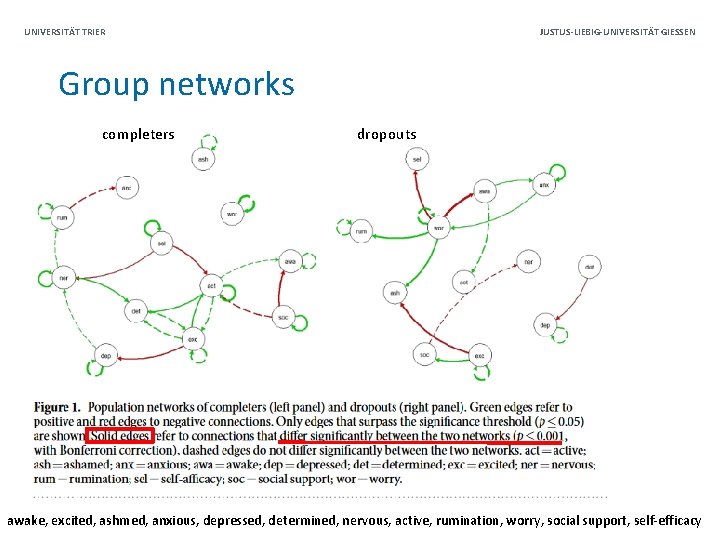
JUSTUS-LIEBIG-UNIVERSITÄT GIESSEN UNIVERSITÄT TRIER Group networks completers dropouts awake, excited, ashmed, anxious, depressed, determined, nervous, active, rumination, worry, social support, self-efficacy
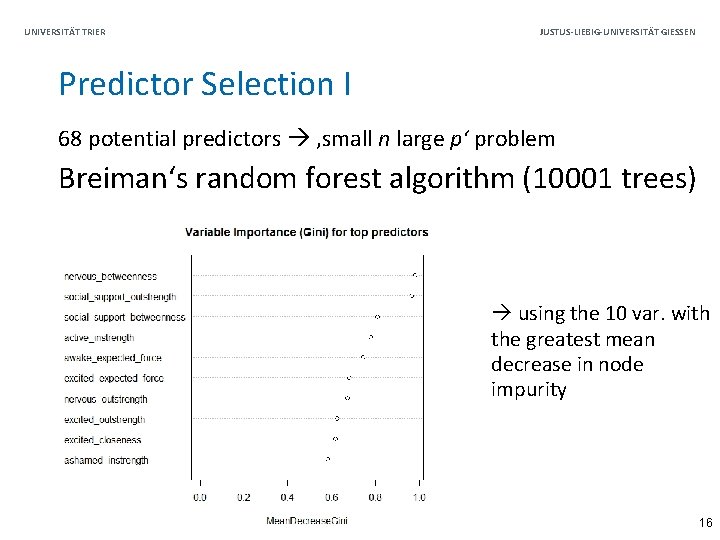
UNIVERSITÄT TRIER JUSTUS-LIEBIG-UNIVERSITÄT GIESSEN Predictor Selection I 68 potential predictors ‚small n large p‘ problem Breiman‘s random forest algorithm (10001 trees) using the 10 var. with the greatest mean decrease in node impurity 16
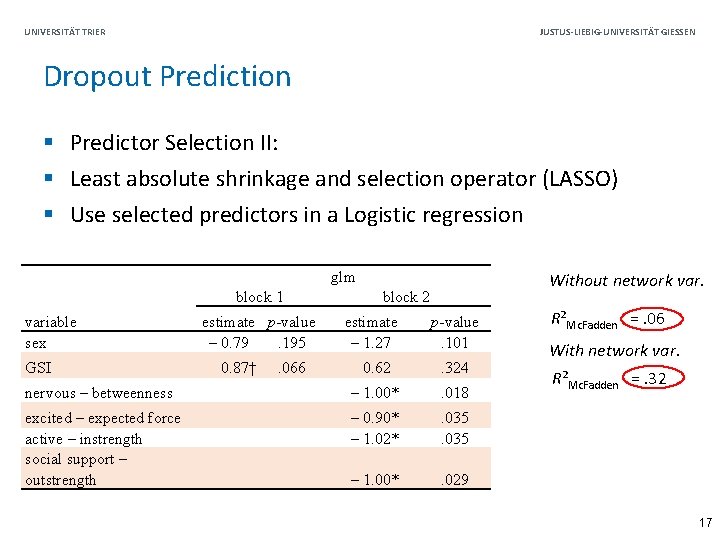
JUSTUS-LIEBIG-UNIVERSITÄT GIESSEN UNIVERSITÄT TRIER Dropout Prediction § Predictor Selection II: § Least absolute shrinkage and selection operator (LASSO) § Use selected predictors in a Logistic regression glm block 1 variable sex estimate p-value – 0. 79. 195 GSI 0. 87† Without network var. block 2 estimate – 1. 27 p-value. 101 0. 62 . 324 nervous – betweenness – 1. 00* . 018 excited – expected force active – instrength social support – outstrength – 0. 90* – 1. 02* . 035 – 1. 00* . 029 . 066 R²Mc. Fadden =. 06 With network var. R²Mc. Fadden =. 32 17

UNIVERSITÄT TRIER JUSTUS-LIEBIG-UNIVERSITÄT GIESSEN Treatment planning 18
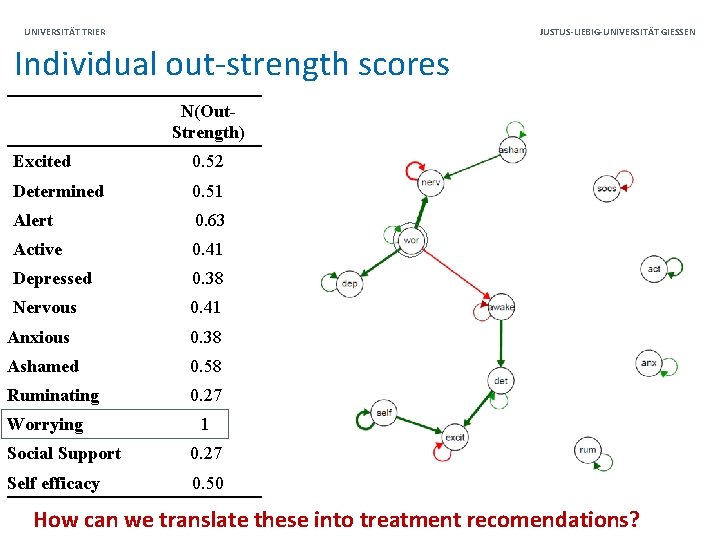
JUSTUS-LIEBIG-UNIVERSITÄT GIESSEN UNIVERSITÄT TRIER Individual out-strength scores N(Out. Strength) Excited 0. 52 Determined 0. 51 Alert 0. 63 Active 0. 41 Depressed 0. 38 Nervous 0. 41 Anxious 0. 38 Ashamed 0. 58 Ruminating 0. 27 Worrying 1 Social Support 0. 27 Self efficacy 0. 50 How can we translate these into treatment recomendations?
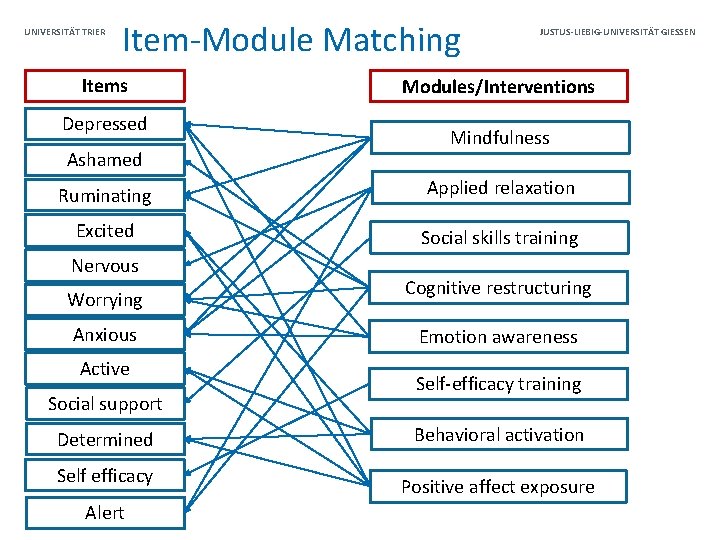
UNIVERSITÄT TRIER Item-Module Matching Items Depressed Ashamed JUSTUS-LIEBIG-UNIVERSITÄT GIESSEN Modules/Interventions Mindfulness Ruminating Applied relaxation Excited Social skills training Nervous Worrying Anxious Active Social support Determined Self efficacy Alert Cognitive restructuring Emotion awareness Self-efficacy training Behavioral activation Positive affect exposure
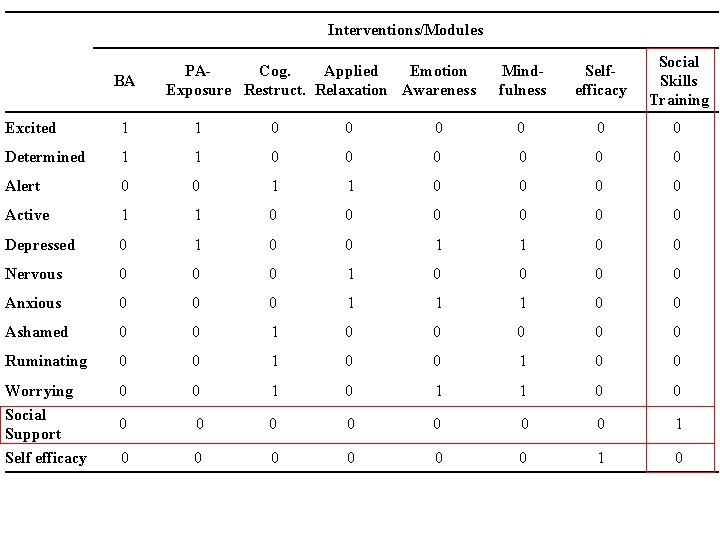
Interventions/Modules UNIVERSITÄT TRIER BA Emotion PACog. Applied Exposure Restruct. Relaxation Awareness JUSTUS-LIEBIG-UNIVERSITÄT GIESSEN Mindfulness Selfefficacy Social Skills Training Excited 1 1 0 0 Determined 1 1 0 0 0 Alert 0 0 1 1 0 0 Active 1 1 0 0 Depressed 0 1 0 0 1 1 0 0 Nervous 0 0 0 1 0 0 Anxious 0 0 0 1 1 1 0 0 Ashamed 0 0 1 0 0 0 Ruminating 0 0 1 0 0 Worrying 0 0 1 1 0 0 Social Support 0 0 0 1 Self efficacy 0 0 0 1 0
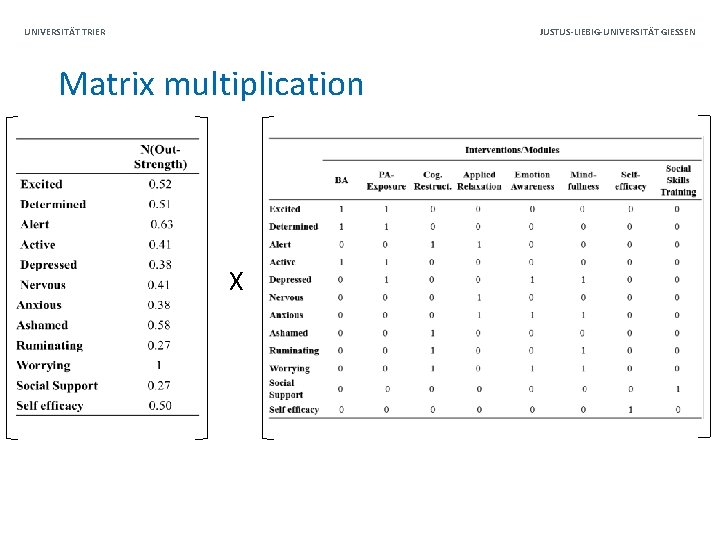
JUSTUS-LIEBIG-UNIVERSITÄT GIESSEN UNIVERSITÄT TRIER Matrix multiplication X
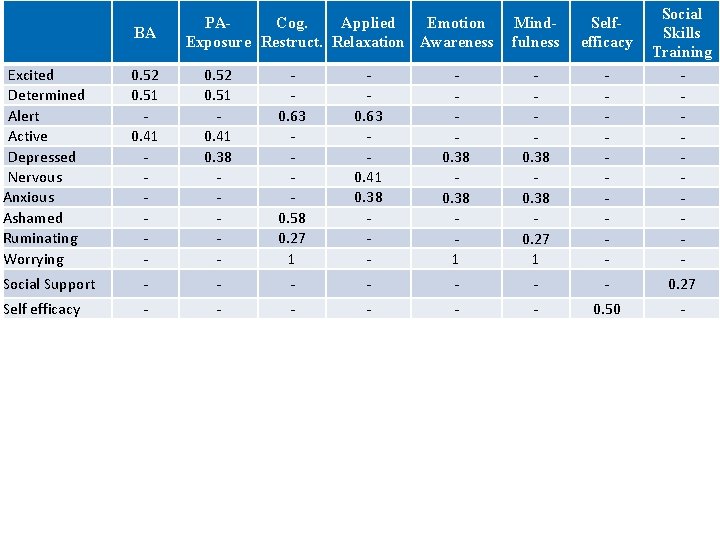
BA UNIVERSITÄT TRIER Emotion PACog. Applied Exposure Restruct. Relaxation Awareness Multiplikation der Matrizen-- Excited Determined Alert Active Depressed Nervous Anxious Ashamed Ruminating Worrying Social Mind. Self. JUSTUS-LIEBIG-UNIVERSITÄT GIESSEN Skills fulness efficacy Training 0. 38 0. 27 1 - 0. 52 0. 51 0. 41 0. 38 - 0. 63 0. 58 0. 27 1 0. 63 0. 41 0. 38 - 0. 38 1 Social Support - - - - 0. 27 Self efficacy - - - 0. 50 -
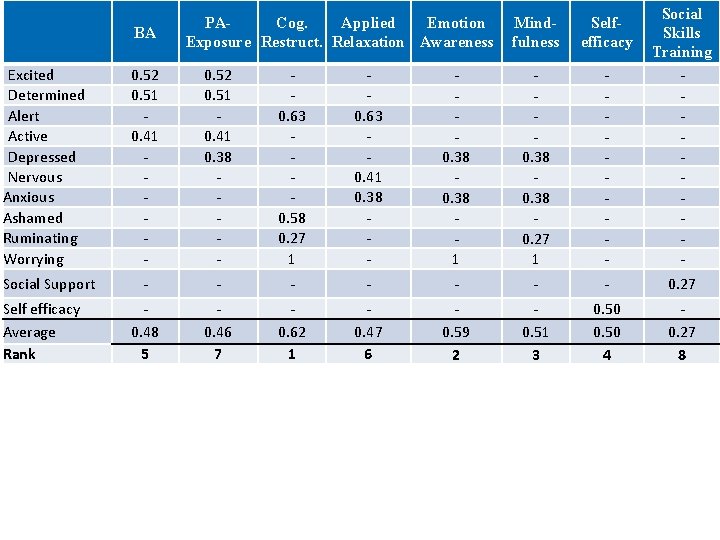
BA UNIVERSITÄT TRIER Emotion PACog. Applied Exposure Restruct. Relaxation Awareness Multiplikation der Matrizen-- Excited Determined Alert Active Depressed Nervous Anxious Ashamed Ruminating Worrying Social Support Self efficacy Average Rank Social Mind. Self. JUSTUS-LIEBIG-UNIVERSITÄT GIESSEN Skills fulness efficacy Training 0. 38 0. 27 1 - 0. 52 0. 51 0. 41 0. 38 - 0. 63 0. 58 0. 27 1 0. 63 0. 41 0. 38 - 0. 38 1 - - - - 0. 27 0. 48 5 0. 46 7 0. 62 1 0. 47 6 0. 59 2 0. 51 3 0. 50 4 0. 27 8
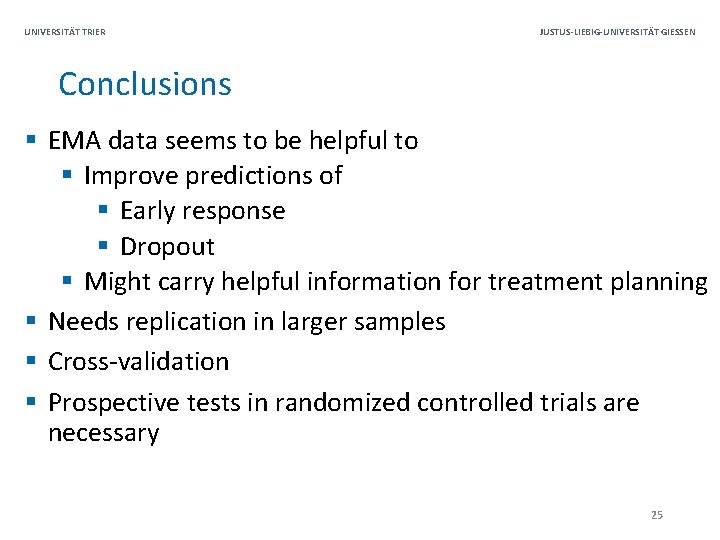
UNIVERSITÄT TRIER JUSTUS-LIEBIG-UNIVERSITÄT GIESSEN Conclusions § EMA data seems to be helpful to § Improve predictions of § Early response § Dropout § Might carry helpful information for treatment planning § Needs replication in larger samples § Cross-validation § Prospective tests in randomized controlled trials are necessary 25

Thank you! 26
- Slides: 24