
JustinTime and Kanban Chapter 11 Lean Six Sigma
Just-in-Time and Kanban Chapter 11 Lean Six Sigma: Process Improvement Tools and Techniques Donna C. Summers © 2011 Pearson Higher Education, Upper Saddle River, NJ 07458. • All Rights Reserved.
Just-in-Time and Kanban • ‘The next process is the customer. ’ Kaoru Ishikawa Lean Six Sigma: Process Improvement Tools and Techniques Donna C. Summers © 2011 Pearson Higher Education, Upper Saddle River, NJ 07458. • All Rights Reserved.
Just-in-Time and Kanban • A JIT system means that incoming goods arrive, proceed directly to equipment for processing, become work-in-process, and through value-added activities become finished goods just-in-time for the customer to pick up. Lean Six Sigma: Process Improvement Tools and Techniques Donna C. Summers © 2011 Pearson Higher Education, Upper Saddle River, NJ 07458. • All Rights Reserved.
Just-in-Time and Kanban • Just-in-time requires three basic components: • A Pull system • Continuous flow processing • Adherence to Takt times Lean Six Sigma: Process Improvement Tools and Techniques Donna C. Summers © 2011 Pearson Higher Education, Upper Saddle River, NJ 07458. • All Rights Reserved.
Just-in-Time and Kanban • Pull systems – Pull systems are manufacturing systems that require that products to be produced only when needed by a customer. Lean Six Sigma: Process Improvement Tools and Techniques Donna C. Summers © 2011 Pearson Higher Education, Upper Saddle River, NJ 07458. • All Rights Reserved.
Just-in-Time and Kanban • Continuous flow processing – Continuous flow processing focuses on onepiece-at-a-time production. – Stagnation of work-in-process inventory in and between processes must be eliminated. Lean Six Sigma: Process Improvement Tools and Techniques Donna C. Summers © 2011 Pearson Higher Education, Upper Saddle River, NJ 07458. • All Rights Reserved.
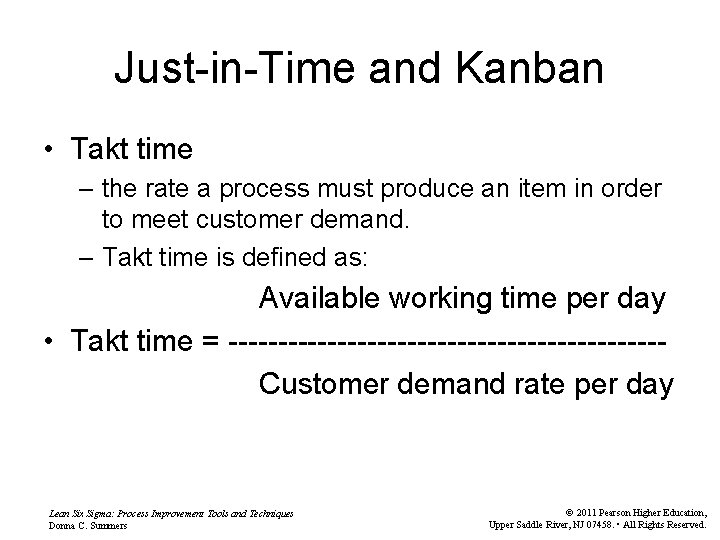
Just-in-Time and Kanban • Takt time – the rate a process must produce an item in order to meet customer demand. – Takt time is defined as: Available working time per day • Takt time = ----------------------Customer demand rate per day Lean Six Sigma: Process Improvement Tools and Techniques Donna C. Summers © 2011 Pearson Higher Education, Upper Saddle River, NJ 07458. • All Rights Reserved.
Just-in-Time and Kanban • Seven sources of waste were identified by Taiichi Ohno, also of Toyota Motor Company: – – – – Waste from overproduction waste from inventory waste in unnecessary transportation waste from producing defects waste in processes waste in waiting time waste in motions. • Some people have modified this list to include intellect waste. Lean Six Sigma: Process Improvement Tools and Techniques Donna C. Summers © 2011 Pearson Higher Education, Upper Saddle River, NJ 07458. • All Rights Reserved.
Just-in-Time and Kanban • Kanban – display card in Japanese – a sign, card, or label, that communicates what is needed and when. Lean Six Sigma: Process Improvement Tools and Techniques Donna C. Summers © 2011 Pearson Higher Education, Upper Saddle River, NJ 07458. • All Rights Reserved.
Just-in-Time and Kanban • Kanban (Pull Inventory Management) – Kanban improves process management by focusing on visual control of the process. – Kanban cards tell the worker what must be produced as well as what has been produced. – Workers can not do more than the Kanban cards tell them to. Lean Six Sigma: Process Improvement Tools and Techniques Donna C. Summers © 2011 Pearson Higher Education, Upper Saddle River, NJ 07458. • All Rights Reserved.
Just-in-Time and Kanban • Jidoka – the Japanese word for autonomation. – Jidoka is one of the two main pillars of the Toyota Production system. – When a Jidoka system is present, machines and equipment are designed to stop automatically when a problem is detected. Any operator on the line also has the power to stop production. Lean Six Sigma: Process Improvement Tools and Techniques Donna C. Summers © 2011 Pearson Higher Education, Upper Saddle River, NJ 07458. • All Rights Reserved.
Just-in-Time and Kanban • Jidoka – Jidoka systems alert the worker to when a defective item is produced or a machine malfunction has occurred. • This allows the problem to be dealt with immediately, preventing the production and passing of defects. • Problems and the defects they cause can be more quickly localized, isolated, and corrected Lean Six Sigma: Process Improvement Tools and Techniques Donna C. Summers © 2011 Pearson Higher Education, Upper Saddle River, NJ 07458. • All Rights Reserved.
- Slides: 12