
Justice in energy transitions Kristian Krieger European Economic
- Slides: 18
Justice in energy transitions Kristian Krieger European Economic and Social Committee Exploratory workshop “Energy sustainability in the Transition to Renewables – Framings from Social Practices and Complex Systems Theory” JRC, Ispra, 20 -21/3/2018
Key take-aways • Deep transition and associated governance have complex distributional consequences that call for legitimate processes • ‘Energy justice’ (EJ) – combined with a system’s perspective – offers conceptual framework and analytical instruments to reveal complexity and develop reflexive governance mechanisms • This perspective seems particularly policy relevant as the European Commission seeks to put “citizens at the core of the Energy Union” (COM(2015) 080 final) • EJ raises important questions for reflexive policymaking but it may be difficult to directly develop specific policy instruments from its analyses
Overview • Context: Emerging debate about the social dimension of Europe’s energy transition • Concept/approach: Energy justice, its origins and application • Systems’ perspective: Making explicit the complexity of the energy transition • Policy relevance: Linking energy justice to current EU policies/proposals
Context 1/2: Blind spot • EU energy policy driven by security of supply concerns, climate & environmental policy, and market integration (Wallace et al. 2015) • Drivers reflected in debate – revolving around, e. g. , – EU leadership in climate negotiations (Copenhagen failure – Paris triumph) – targets for renewables, energy efficiency (national binding – EU targets) – EU solidarity v. bilateral external energy policy (Nord. Stream II) • Limited attention being paid to consequences of energy transition, e. g. no shared definition of energy poverty
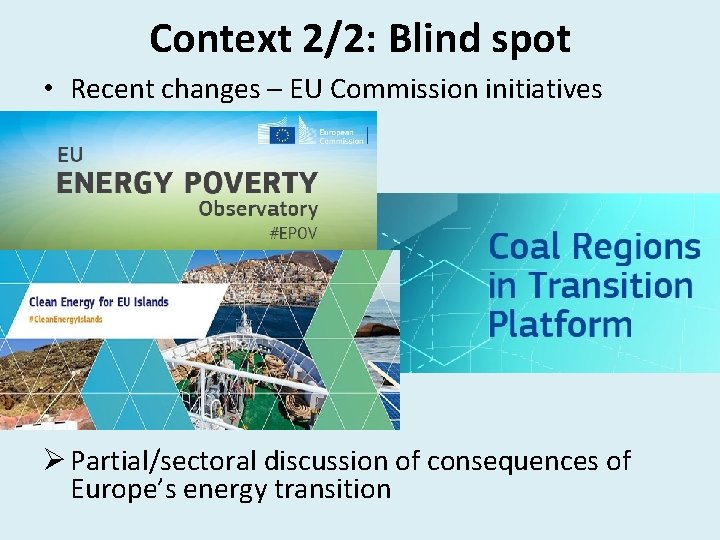
Context 2/2: Blind spot • Recent changes – EU Commission initiatives Ø Partial/sectoral discussion of consequences of Europe’s energy transition
Energy justice 1/3: Concept, origin, use • Point of departure: Energy transition and policies have concrete consequences in terms of distribution of risks and benefits • Origins: Environmental justice approaches focusing on rights of individuals to clean and safe environment – rooted in U. S. civil rights movement • Concept: – Different from social justice and wealth distribution by including procedural aspects and distribution of risk – Focus on access and procedural rights
Energy justice 2/3: Concept, origin, use • Three-dimensional, interlinked reading of energy justice: – Distributive justice: benefits and risks, intra - and intergenerational, etc. – Procedural justice: information, participation, impartiality, access, objectivity, resources – Recognition: Legitimacy as stakeholders and knowledge
Energy justice 3/3: Concept, origin, use • Use in research – Distribution: Siting power plants/installations; unequal effects of policy measures (carbon tax, ETS, Fi. T); ‘energy bourgeoisie’ versus ‘energy underclass’ – Procedure & recognition: Unfair decision-making in siting facilities; public consultation as lipservice; resource imbalances among stakeholders • Challenge: Energy transitions are multidimensional whilst EJ analysis often sectoral/partial
System’s perspectives on EJ 1/3 • Recognizing complexity of the energy transition, EJ scholars have linked their analysis to systems’ perspectives, e. g. – Sustainable transitions (Markard et al. 2012) – Whole systems perspective (Foxon et al. 2010) – Assemblage (Deleuze and Guattari 1987)
System’s perspectives on EJ 2/3 • Illustration of importance of systems’ perspective: – EJ across lifecycle stages: Siting/operation of power plants v. research and development decisions – early decisions lock in development paths with distributional outcomes (Mc. Laren et al. 2013) – Unrecognised social groups: Energy poor are the old and infirm v. exclusion of young urban dwellers – complex assemblages of human and non-human factors render variety of people at risk of becoming energy poor (Bouzarovski et al. 2013) – Multi-dimensional EJ: Different policies and institutional configurations can lead to uneven outcomes in terms of EJ (e. g. good distributional outcomes but poor procedural outcomes) – Case study: Community-based transition projects in UK led by government, forprofit, non-profit sector (Fuller & Bulkeley 2013)
System’s perspectives on EJ 3/3 • Challenge: Given complexity and comprehensiveness of systems’ perspective on EJ, how can we operationalise EJ for evaluative and policy purposes? – EJ indices/scores for policy-making? – EJ impact assessment? – Index for quality of citizen participation?
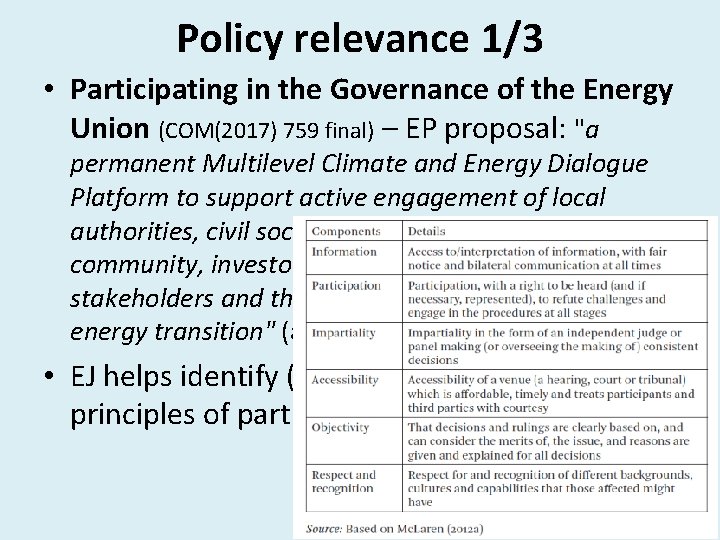
Policy relevance 1/3 • Participating in the Governance of the Energy Union (COM(2017) 759 final) – EP proposal: "a permanent Multilevel Climate and Energy Dialogue Platform to support active engagement of local authorities, civil society organisations, business community, investors, any other relevant stakeholders and the general public in managing the energy transition" (article 10 a(1)) • EJ helps identify (unrecognised) actors and principles of participation
Policy relevance 2/3 • Defining energy communities: Current proposal for revising renewables directive (COM(2017) 767 final) by EC stresses local ownership but trilogue between EP, EUCO and EC is still ongoing • EJ raises awareness for the distinctive distributional and procedural implications of different ownership/governance structures
Policy relevance 3/3 • Defining energy poverty: Composite indicator used at EU level (arrears in utility bills, inadequately heated/cooled, dampness) – policy response normally: Welfare state + transitionally social tariffs • Systemic EJ approaches increase sensitivity towards energy poverty as a result of an assemblage of human and non-human factors, e. g. owners of old houses not covered by welfare state
Conclusions 1/2 • EJ sheds lights on blind spot: It directs attention to the distributional outcomes in terms of risks and benefits of the energy transition and related policies and how these outcomes come about procedurally/politically • EJ as conceptual frame can be combined with various theories and methods, including systems approaches: EJ offers a set of questions (about outcomes) and a normative benchmark (individual rights), and may accommodate/be connected to different approaches to pursue these questions • EJ is policy-relevant: It raises awareness for injustices in the complex process of an energy transition, actors, knowledge, rights and principles that may otherwise go unnoticed
Conclusions 2/2 • EJ’s transition from conceptual and critical analytical realm to policy instruments feasible? – EJ impact assessment instruments – quantifiable scoreboards – comparative quantitative evaluation tools for riskbenefit distribution • Given the complexity of energy transitions and socio-technical energy systems, huge challenge to measure/assess trade-offs across social groups, EJ dimensions, space, and time
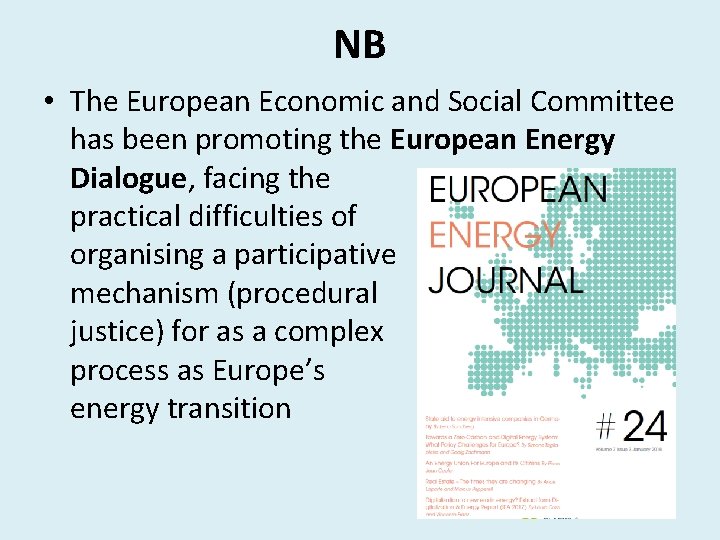
NB • The European Economic and Social Committee has been promoting the European Energy Dialogue, facing the practical difficulties of organising a participative mechanism (procedural justice) for as a complex process as Europe’s energy transition
Thank you! Email: Kristian. Krieger@eesc. europa. eu