
Just and Equitable Transition to a Clean Energy
Just and Equitable Transition to a Clean Energy Future: Transformative Potential Exists, But So Do Challenges Basav Sen Climate Justice Director Institute for Policy Studies www. ips-dc. org
An “Official”Definition of Just Transition Just transition “focuses on jobs, livelihoods and ensuring that no one is left behind as we race to reduce emissions, protect the climate and advance social and economic justice. ” - International Trade Union Confederation • But are we “racing” to reduce emissions, protect the climate, and advance social and economic justice? • Is the emphasis on jobs and livelihoods enough? • What is missing (and who are missing) if we really want to ensure that no one is left behind?
“Racing” To Protect the Climate? • All countries’ current (voluntary, unenforceable) pledges in the Paris agreement (Nationally Determined Contributions, or NDCs) will still result in between 2. 8 – 3. 0⁰C temperature increase. (Climate Action Tracker, 2019) • This is about twice the 1. 5⁰C that the global scientific community recognizes as the upper limit. (IPCC SR 1. 5, 2018) • Global CO 2 emissions reached their highest levels ever this year. (Global Carbon Project, 2019)
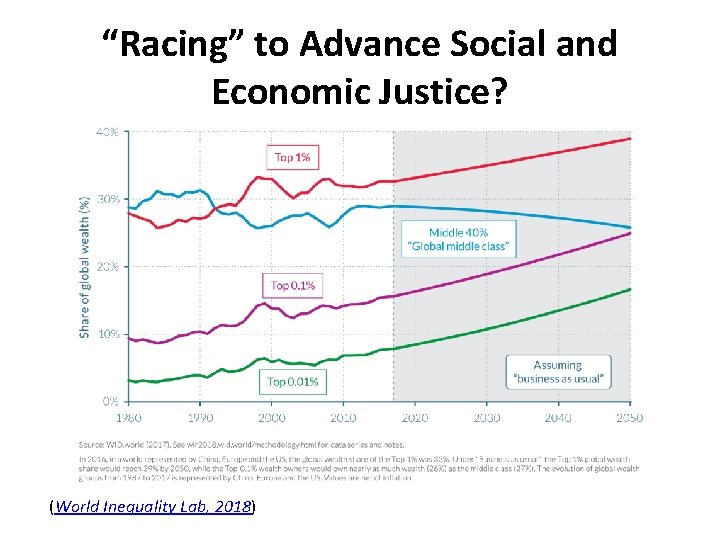
“Racing” to Advance Social and Economic Justice? (World Inequality Lab, 2018)
Is the Emphasis on Jobs and Livelihoods Enough? • Entire communities (local economies, tax base) are dependent on extractive, dirty industries. – Coal severance taxes in Kentucky decreased 40% from 2015 to 2018. (Commonwealth of Kentucky Comprehensive Annual Financial Report, 2018) • What is affected when tax revenues fall? – Public services for vulnerable residents. – Jobs of public workers (teachers, firefighters, etc. ) – A narrow focus on just preserving the livelihoods of workers in fossil fuel and other polluting industries can leave out entire communities, and other affected workers.
What (And Who) Else is Missing? • Who are disproportionately exposed to pollution from fossil fuel and chemical facilities? – Black Americans exposed to particulate matter pollution at 1. 54 times rate for general population. – People in poverty exposed to particulate matter pollution at 1. 35 times rate for general population. (Mikati et. al. , American Journal of Public Health, April 2018) This is just one example of a well-dcoumented pattern of race and class disparities in exposure to pollution.
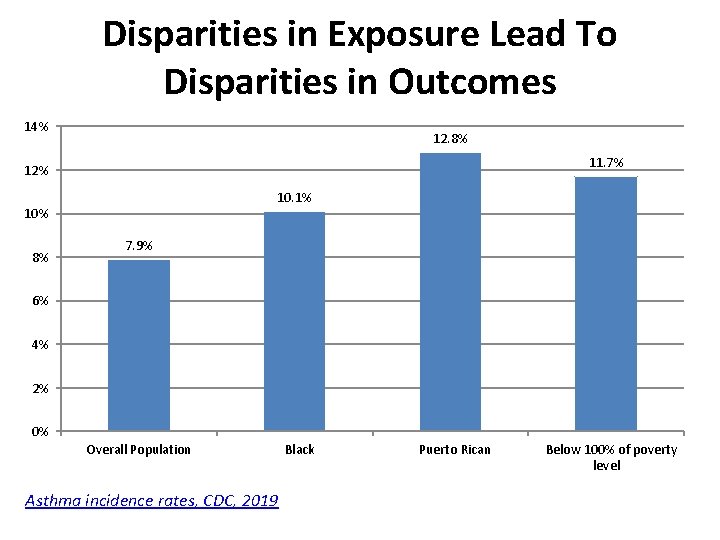
Disparities in Exposure Lead To Disparities in Outcomes 14% 12. 8% 11. 7% 12% 10. 1% 10% 8% 7. 9% 6% 4% 2% 0% Overall Population Asthma incidence rates, CDC, 2019 Black Puerto Rican Below 100% of poverty level
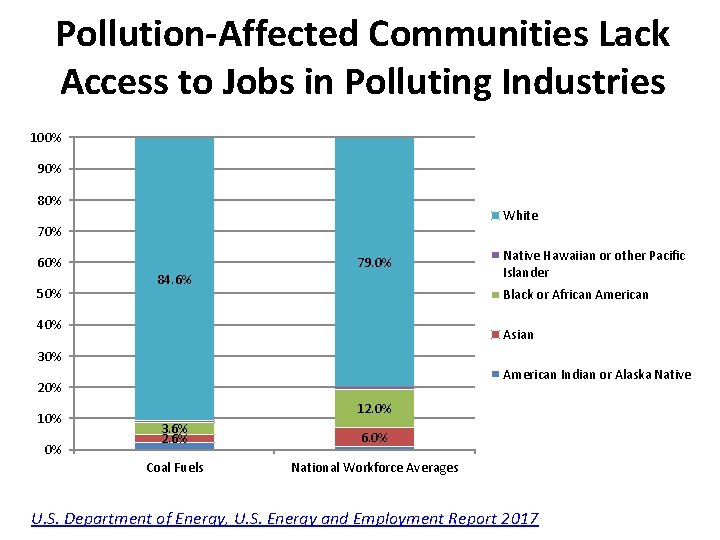
Pollution-Affected Communities Lack Access to Jobs in Polluting Industries 100% 90% 80% White 70% 60% 50% 79. 0% 84. 6% Native Hawaiian or other Pacific Islander Black or African American 40% Asian 30% American Indian or Alaska Native 20% 10% 0% 12. 0% 3. 6% 2. 6% 6. 0% Coal Fuels National Workforce Averages U. S. Department of Energy, U. S. Energy and Employment Report 2017
Just Transition: The Evolving Definition Just Transition is a. . . set of principles, processes, and practices that build economic and political power to shift from an extractive economy to a regenerative economy. (Excerpted from Climate Justice Alliance) • A truly just transition must benefit everyone impacted: – Workers whose livelihoods depend on dirty, harmful industries. – Communities whose local economies depend on these industries. – Communities who are harmed by these industries. • Can complicate the traditional “jobs vs. environment” narrative in unhelpful or helpful ways.
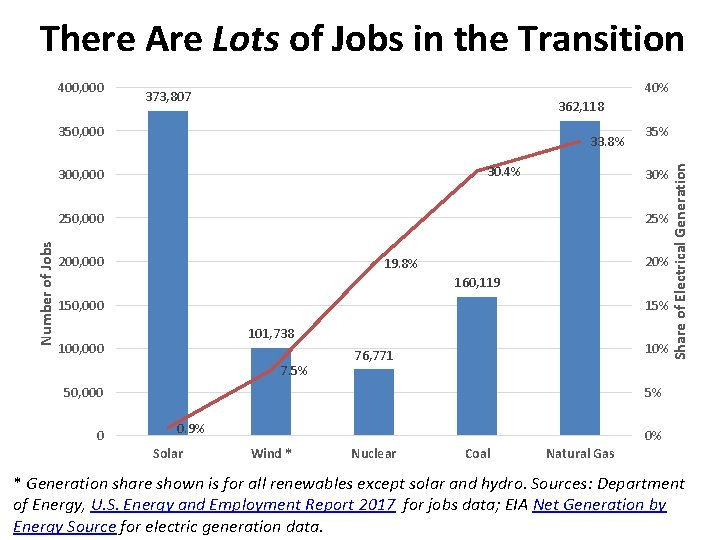
There Are Lots of Jobs in the Transition 40% 373, 807 362, 118 350, 000 33. 8% 30. 4% 300, 000 30% 250, 000 Number of Jobs 35% 200, 000 20% 19. 8% 160, 119 150, 000 15% 101, 738 100, 000 7. 5% 10% 76, 771 50, 000 0 Share of Electrical Generation 400, 000 5% 0. 9% Solar 0% Wind * Nuclear Coal Natural Gas * Generation share shown is for all renewables except solar and hydro. Sources: Department of Energy, U. S. Energy and Employment Report 2017 for jobs data; EIA Net Generation by Energy Source for electric generation data.
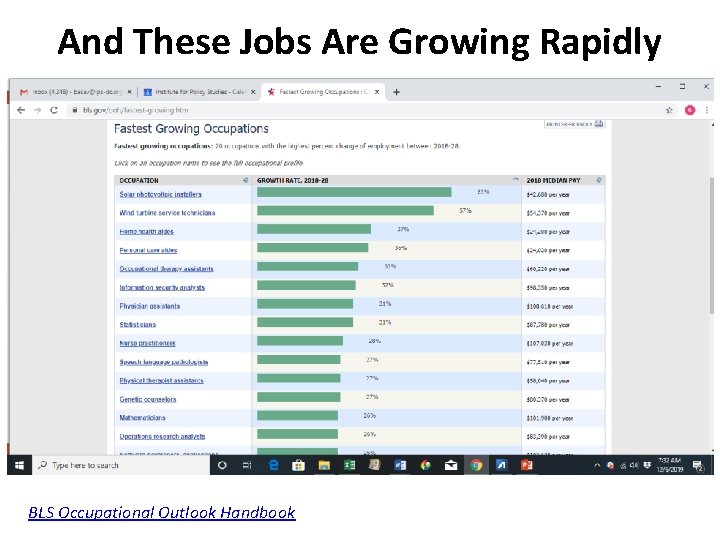
And These Jobs Are Growing Rapidly BLS Occupational Outlook Handbook
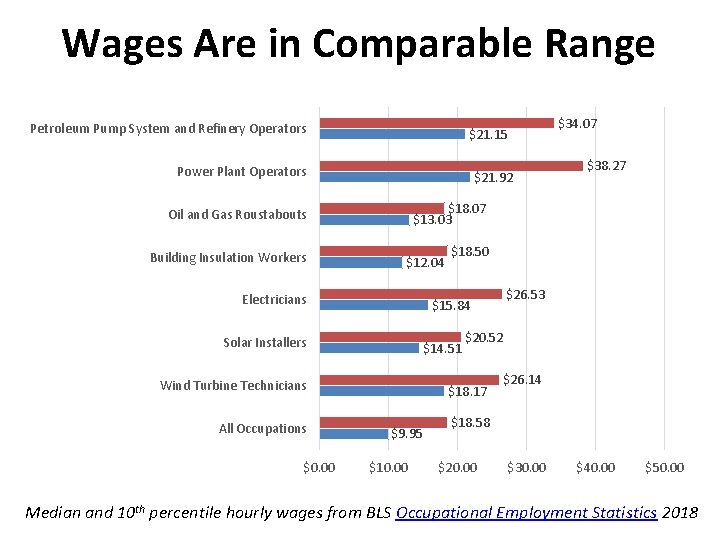
Wages Are in Comparable Range Petroleum Pump System and Refinery Operators $21. 15 Power Plant Operators $21. 92 $12. 04 Electricians $14. 51 Wind Turbine Technicians $0. 00 $18. 50 $26. 53 $15. 84 Solar Installers All Occupations $38. 27 $18. 07 $13. 03 Oil and Gas Roustabouts Building Insulation Workers $34. 07 $20. 52 $18. 17 $9. 95 $10. 00 $26. 14 $18. 58 $20. 00 $30. 00 $40. 00 $50. 00 Median and 10 th percentile hourly wages from BLS Occupational Employment Statistics 2018
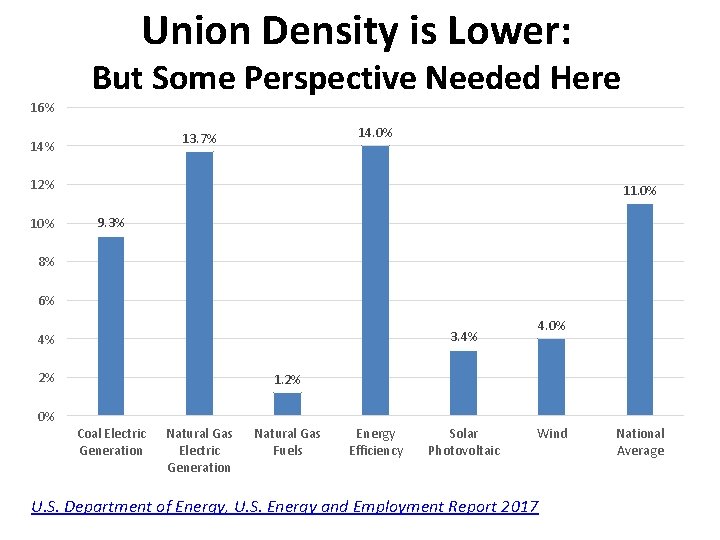
Union Density is Lower: 16% But Some Perspective Needed Here 14. 0% 13. 7% 14% 12% 10% 11. 0% 9. 3% 8% 6% 4. 0% 3. 4% 4% 2% 1. 2% 0% Coal Electric Generation Natural Gas Fuels Energy Efficiency Solar Photovoltaic Wind U. S. Department of Energy, U. S. Energy and Employment Report 2017 National Average
What Productive Conversations Can Focus On • There a lot of jobs in the transition away from fossil fuels. That shouldn’t be in dispute. The critical questions that remain are: – How can we ensure job quality and workers’ rights in the emerging clean energy/climate protection jobs? – Who gets these jobs? Communities hurt by the extractive fossil fuel economy have a right to claim them. So do displaced fossil fuel workers. Can we set up mechanisms for both these populations to have access to these jobs, instead of pitting them against each other?
Success Story: IL Future Energy Jobs Act • Mandates utilities to set aside funding for clean energy job training programs for underserved populations: – economically disadvantaged and environmental justice communities. – youth of color. – formerly incarcerated persons. – individuals who had been in the foster care system as children. Illinois SB 2814, 2016
Success Story: OR Energy Efficiency Jobs • Over 2 -year period surveyed: – 47% of new hires were women and POC. – 55% of hours worked were by women and POC. – Median hourly wage was $18. 46, compared to statewide median of $17. 24. – 81% of prime contractors offered health insurance. • What drove these results? – Setting goals intentionally. – Involving organized labor and affected communities in program design and outreach. City of Portland Bureau of Planning and Sustainability (BPS)
Key Policy Recommendation: Require Job Accessibility, Training, and Quality • Hiring goals for government-funded or mandated energy projects. • Dedicated funding streams for training and placement. • Setting wage standards and benefit requirements. • Involving organizations based in communities of color and low-income communities, unions, etc. in policy design and implementation, including training, hiring, monitoring and evaluation.
- Slides: 17