
Jurisprudence Legal Theories of Law 4 Jurisprudence is
- Slides: 21
Jurisprudence Legal Theories of Law
4 Jurisprudence is the study of law and legal philosophy 4 Mainly deals with legal theories of law
Natural Law 4 This is the oldest theory of law, dating to ancient times. 4 Essential arguments: – There is an ultimate “law” or moral system which transcends (go beyond) humanly created law – This law is eternal and unchanging – Positive (written) law is said to be an imperfect reflection of the natural law – The natural law is understood to be a standard from which to evaluate positive law – When natural and positive law do not correspond, positive law is said to be an “unjust law”
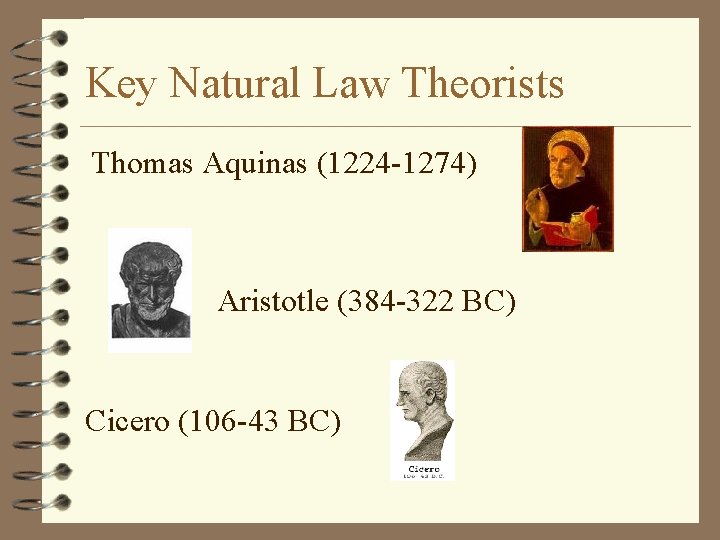
Key Natural Law Theorists Thomas Aquinas (1224 -1274) Aristotle (384 -322 BC) Cicero (106 -43 BC)
Two “Schools” of Natural Law 4 Theological School – Holds that created universe consists not only of material substance, but also a moral order – God is the author of this moral order, or “natural law” 4 Secular School – Product of Englightment – Maintained the idea of transcendent, eternal moral law – Rejected God as creator of law; rather, moral law is simply part of human nature – Moral principles are understood through development of reason
Evaluation of Natural Law 4 Troublesome issues: – How can we verify these moral principles? – How can we know the nature of human nature? – How do we account for wide variation in moral precepts held by different cultures and across time? – Has been argued that natural law theory is inherently conservative 4 Responses from a natural law theorist – Moral principles are not subject to positivistic empirical verification – This does not mean that such a reality does not exist; merely that we are not using the right tools – Wide variation is accounted for by fact that all positive law and custom itself is an imperfect reflection of natural law – Can be argued that natural law actually facilitates radical change
Legal Formalism 4 Focused exclusively on the positive (formal) law 4 Essentially regards the law as “amoral” 4 Law is seen as a closed system of rules 4 Explanation for how or why rules exist is framed within the context of the legal system itself 4 Legal education today is primarily influenced by legal formalism
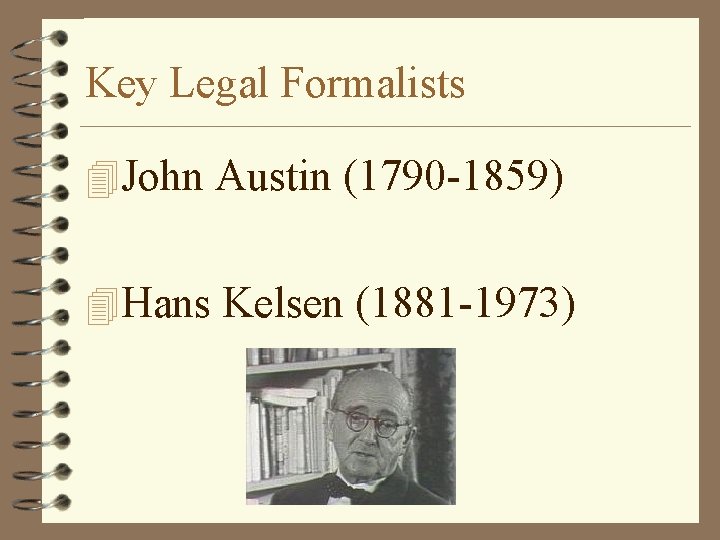
Key Legal Formalists 4 John Austin (1790 -1859) 4 Hans Kelsen (1881 -1973)
Evaluation of Legal Formalism 4 Troubling issues: – No legal system exists in a vacuum; hence cannot fully understand law by focusing only on the law itself – Cannot account for legal change – Inherently conservative 4 Response from a legal formalist – Legal formalism is a practical approach to law – Resulted in consistency in sentencing and other legal decisions
Cultural and Historical Schools 4 Marks the beginning of the recognition of wider social forces operative in law 4 Law is explained in the context of immediate cultural and historical milieu of specific legal systems 4 Typically, law is explained as a formalization of a “common conscience”, which itself developed out of custom and habit 4 Historically, law and legal evolution reflects an evolution taking place in the larger society
Key Cultural and Historical Theorists 4 Frederick Karl von Savigny (1779 -1861) 4 Sir Henry Maine (1822 -1888)
Evaluation of Cultural and Historical Schools 4 Troublesome issues – Is there such a thing as a “common conscience” (especially in modern societies)? – If so, does it shape law or is it shaped by law? 4 Response from a cultural/historical theorist – This is the first school that seeks to look to social and historical milieu to understand law (give us credit!) – This school is first to attempt to account for change in the positive law
Utilitarianism 4 Here, law is seen as a “dependent” variable 4 The question is, “How does the law impact society? ” 4 Utilitarians premise their ideas on the commitment to “the greatest good (happiness) for the greatest number 4 See law (especially criminal law) as inherently evil (or at least restrictive) 4 Hence only justification for criminal law is that it thwarts a greater evil
Key Utilitarians 4 Jeremy Bentham (1748 -1832) 4 Rudolf von Ihering (1818 -1892)
Evaluation of Utilitarianism 4 Troubling Issues – Is “the greatest good for the greatest number” a proper moral basis upon which to formulate a system of law? – This premise assumes that humans are rational decision-making creatures. Can we assume this? 4 Response from a Utilitarian – This approach allows us to quantify and measure effectiveness of law--by quantifying “good” and “number”
Sociological Jurisprudence 4 Sociological jurisprudence focuses on two primary questions: – What is the relationship between the “law in action” or “living law” and the “law on the books” or “positive law? ” – What are the social dynamics which shape and are reflected in positive law? 4 Argue that positive law should reflect the living law. 4 Also interested in what the positive law “says it does” and what it actually does.
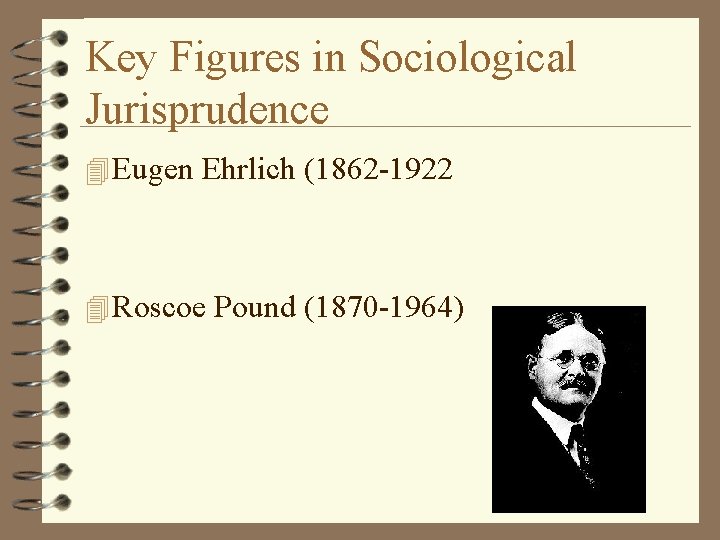
Key Figures in Sociological Jurisprudence 4 Eugen Ehrlich (1862 -1922 4 Roscoe Pound (1870 -1964)
Evaluation of Sociological Jurisprudence 4 Problematic Issues – What are the “living laws” which positive law should reflect? 4 Response from a sociological jurisprudent theorist – This is the first time legal theorists are thinking about the importance of considering “living law” in shaping positive law
Legal Realism 4 Has much in common with sociological jurisprudence – focus on disparity between what the law says it does and what it actually does 4 Legal realists are primarily concerned with the “law in action” as their focus of study 4 Suggest that judges “make law” rather than “find it” in making decisions 4 Tend to focus primarily on the trial courts
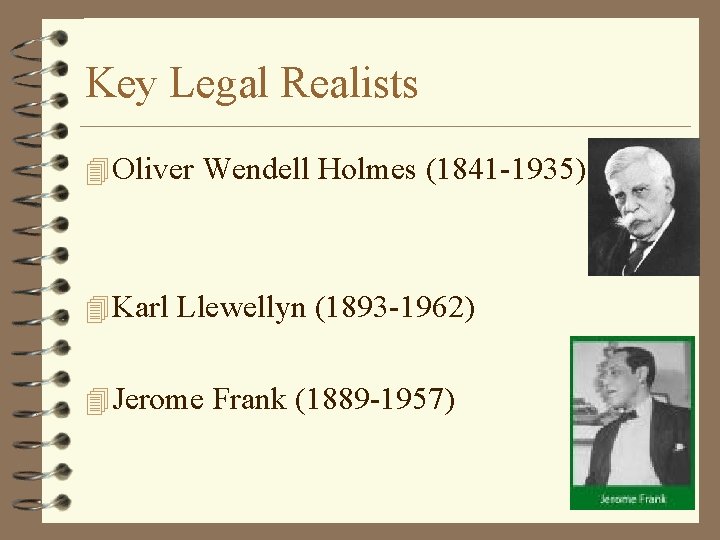
Key Legal Realists 4 Oliver Wendell Holmes (1841 -1935) 4 Karl Llewellyn (1893 -1962) 4 Jerome Frank (1889 -1957)
Evaluation of Legal Realism 4 Troublesome points – Depicts an image of the courts as more fluid than they really are--there are parameters within which judges must operate 4 Response from a legal realist – The human element in the court process has heretofore been ignored – Observation of actual courtroom behavior reveals that the legal process is indeed much more fluid than most recognize