
Jupiter A Failed Star The Solar System with
- Slides: 11
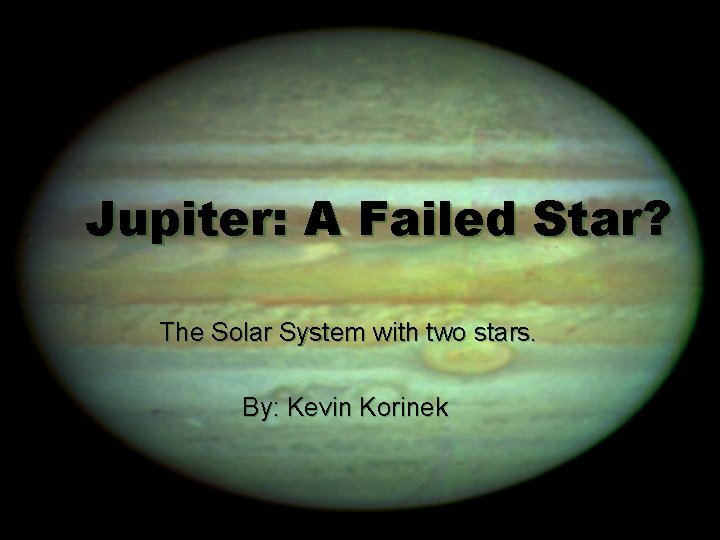
Jupiter: A Failed Star? The Solar System with two stars. By: Kevin Korinek
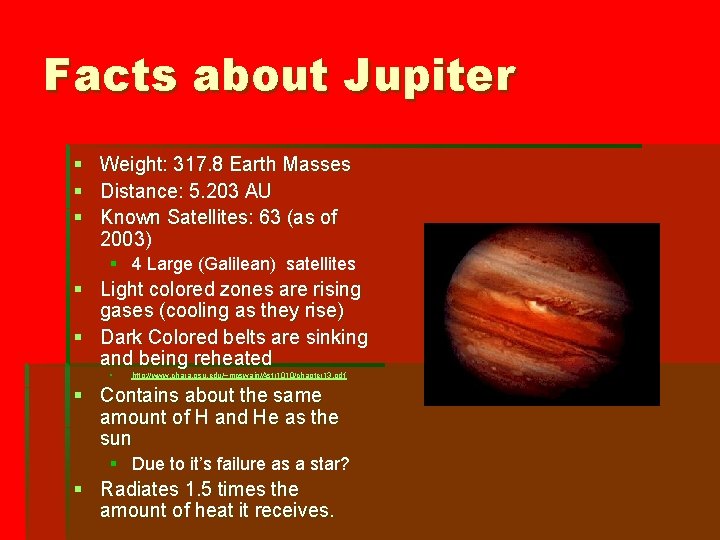
Facts about Jupiter § § § Weight: 317. 8 Earth Masses Distance: 5. 203 AU Known Satellites: 63 (as of 2003) § 4 Large (Galilean) satellites § Light colored zones are rising gases (cooling as they rise) § Dark Colored belts are sinking and being reheated § http: //www. chara. gsu. edu/~mcswain/Astr 1010/chapter 13. pdf § Contains about the same amount of H and He as the sun § Due to it’s failure as a star? § Radiates 1. 5 times the amount of heat it receives.
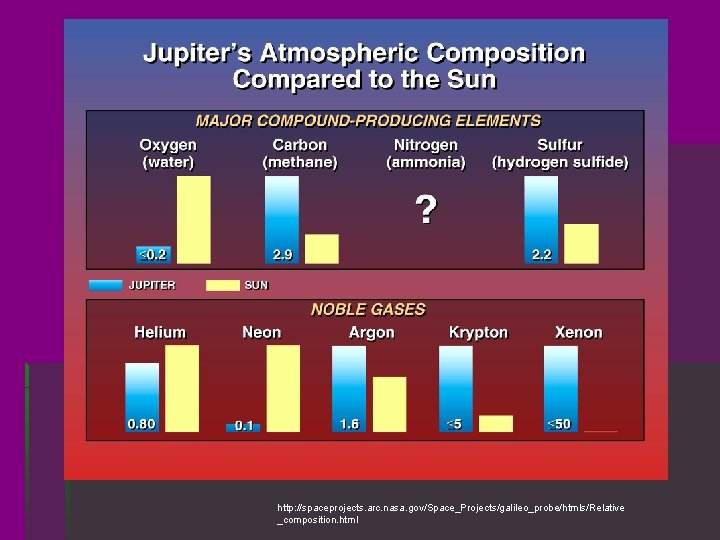
Jupiter vs. The Sun § § Jupiter is. 1% of the Sun’s Mass Both Comprised Mainly of Hydrogen and Helium
http: //spaceprojects. arc. nasa. gov/Space_Projects/galileo_probe/htmls/Relative _composition. html
Jupiter… How close was it to a star? § “If it had been any denser, it might have ignited, like our Sun. Instead, Jupiter has remained a giant storm of hot, swirling gases. “ (http: //www. maxpages. com/masterplanet/JUPITER_PLANET) § If it had been 4 times more massive, it would have been a star. § At this point it would have undergone Thermonuclear fusion and “Ignited” § We can learn from Jupiter to see how Protostars appear, before the fusion processes begin.
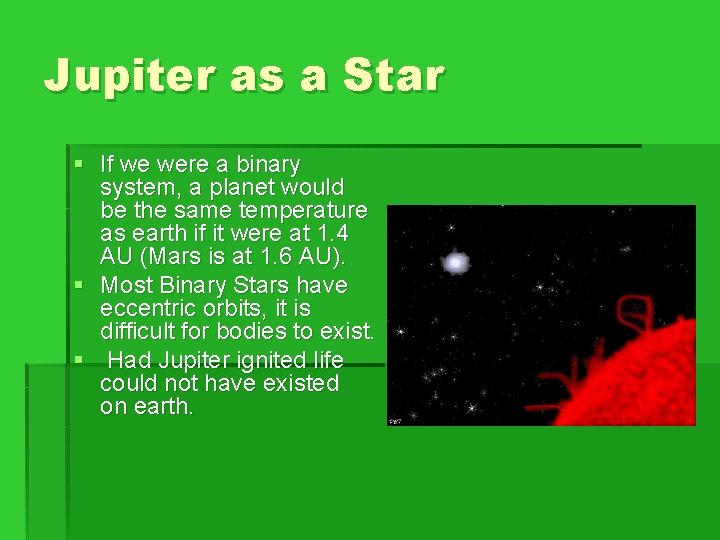
Jupiter as a Star § If we were a binary system, a planet would be the same temperature as earth if it were at 1. 4 AU (Mars is at 1. 6 AU). § Most Binary Stars have eccentric orbits, it is difficult for bodies to exist. § Had Jupiter ignited life could not have existed on earth.
Binary Systems § Alpha Centauri A and B § Average of 23 AU apart (ranges from 11 to 35 AU) § Each star has a safe zone of 3 AU away (planets could survive) § Planets outside the safe zone would be ejected § Approximately 2/3 of all stars are in a binary system § 1/2 of the stars near to the sun are Multiple systems
Types of Binary § Six Main Types: § Apparent § Only appear to be related, normally great distances apart. § Astrometric § Only one of the stars can be seen through a telescope. § Eclipsing § One star eclipses the other temporarily lowering the brightness.
Types of Binary Systems § Spectroscopic § Absence of resolution of any star through a telescope § Spectrum § No star can be resolved § Visual § Both stars can be resolved through a telescope
Extraterrestrial Life § Binary Systems § If Jupiter became a star, no earth. § Smallest change § Strict guidelines for life § Majority Stars, Multiple star system § Stronger Gravity § More Mass taken up
It’s a good thing we aren’t a binary system § We wouldn’t exist § But that doesn’t mean that it’s impossible § Life is very specific § Smallest changes can be harmful § But they can also be beneficial § THE END!