
Junior Year PSAT Interpretation Spring Semester TODAY YOU







- Slides: 45
Junior Year PSAT Interpretation Spring Semester TODAY YOU WILL LEARN ABOUT: • • WHAT DO MY PSAT SCORES MEAN PREPARING FOR THE SAT NEXT STEPS SAT VS. ACT NEXT STEPS EXTRA CURRICULAR ACTIVITIES POST SECONDARY OPTIONS
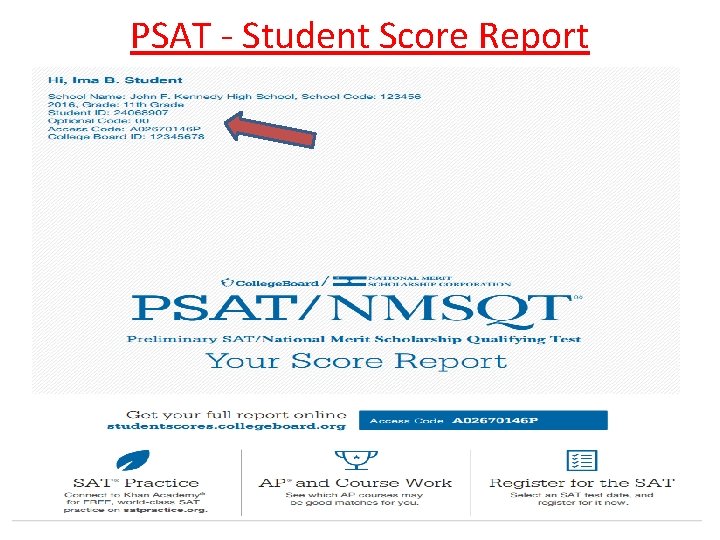
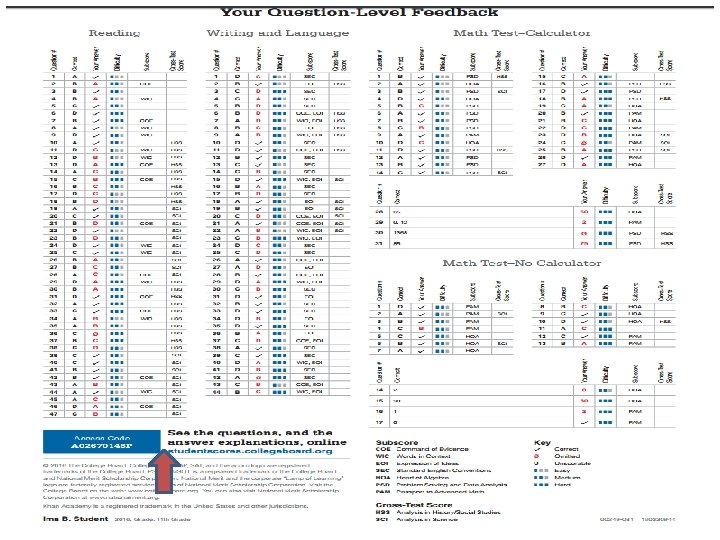
PSAT - Student Score Report Access. Instructions
Logging into the Student Portal 1. Go to studentscores. collegeboard. org. 2. If you already have a College Board account, you should sign in with your username and password and click “Sign In” to be taken to your scores. 3. If you don’t have an account, you can create one by clicking “Sign Up” and entering the required information. Only the information marked with an asterisk (*) is required. Your should now be able to view your scores on all the College Board assessments you’ve taken.
Free Practice at Khan Academy Steps for Linking Student Accounts Step 1: Visit satpractice. org. This is where you can log in or create a Khan Academy account. Step 2: Link accounts. When prompted, you must agree to link your Khan Academy and College Board accounts. Step 3: Send test results. Students must sign in or create an account at collegeboard. org and click “Send” to send your scores to Khan Academy for a personalized practice plan.
• Register for SAT Tier One Prep Course with Ms. Guyer $99 By Friday 1/20/17 – Class starts Wed 2/8/17 & ends 3/8/17 • Register for the SAT Reasoning + Writing and Subject Tests (optional) @ www. collegeboard. com – Next test 3/11/17 Deadline to register Feb. 10, 2017. • Register for ACT + Writing @ www. act. org – Next test 4/8/17 Deadline to register March 3, 2017. • Tests are Saturdays off campus and you choose testing location from list provided during registration
• You can find registration deadlines and test dates on the Katella website • See Ms. Diaz in the College and Career Center for a fee waiver or if you need help with registration for any of these tests
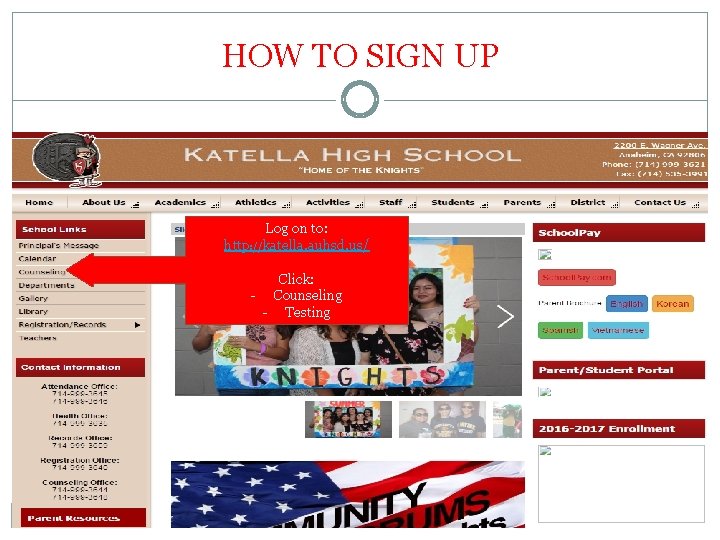
HOW TO SIGN UP Log on to: http: //katella. auhsd. us/ Click: - Counseling - Testing
Why take the SAT or ACT? How Important Are Standardized Tests to admission representatives? *Required by Cal-State, UC & Private Universities *Tie Breaker *Will this student’s score help our college admissions statistics
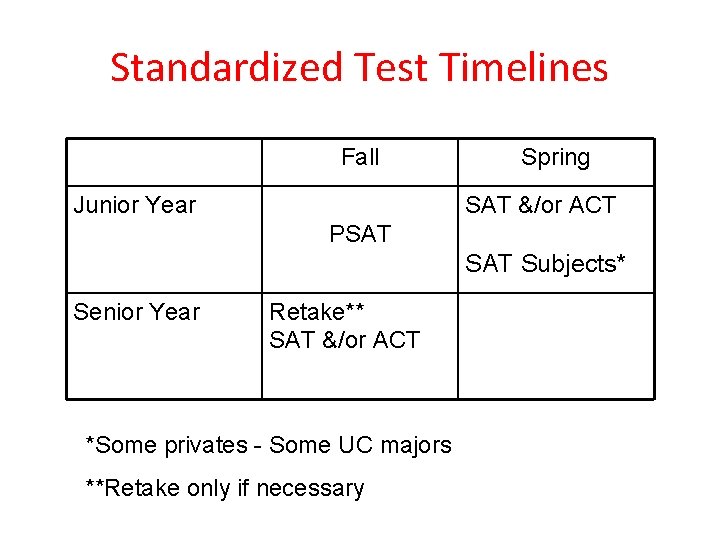
Standardized Test Timelines Fall Junior Year Spring SAT &/or ACT PSAT Subjects* Senior Year Retake** SAT &/or ACT *Some privates - Some UC majors **Retake only if necessary
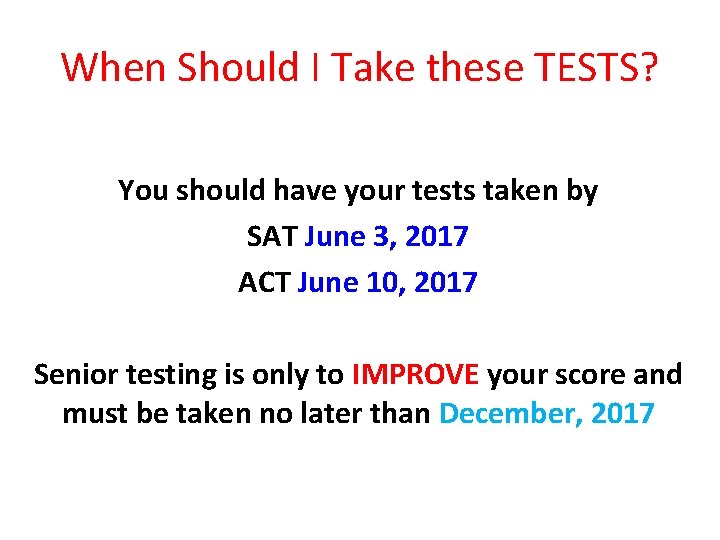
When Should I Take these TESTS? You should have your tests taken by SAT June 3, 2017 ACT June 10, 2017 Senior testing is only to IMPROVE your score and must be taken no later than December, 2017
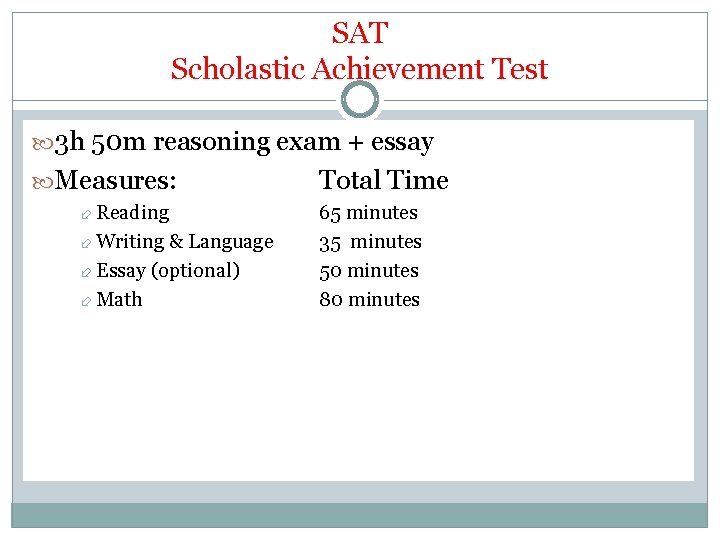
SAT Scholastic Achievement Test 3 h 50 m reasoning exam + essay Measures: Reading Writing & Language Essay (optional) Math Total Time 65 minutes 35 minutes 50 minutes 80 minutes
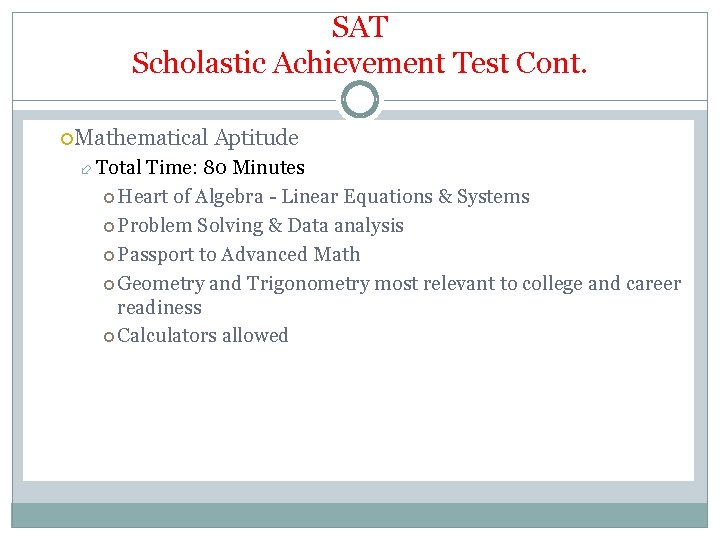
SAT Scholastic Achievement Test Cont. Mathematical Total Aptitude Time: 80 Minutes Heart of Algebra - Linear Equations & Systems Problem Solving & Data analysis Passport to Advanced Math Geometry and Trigonometry most relevant to college and career readiness Calculators allowed
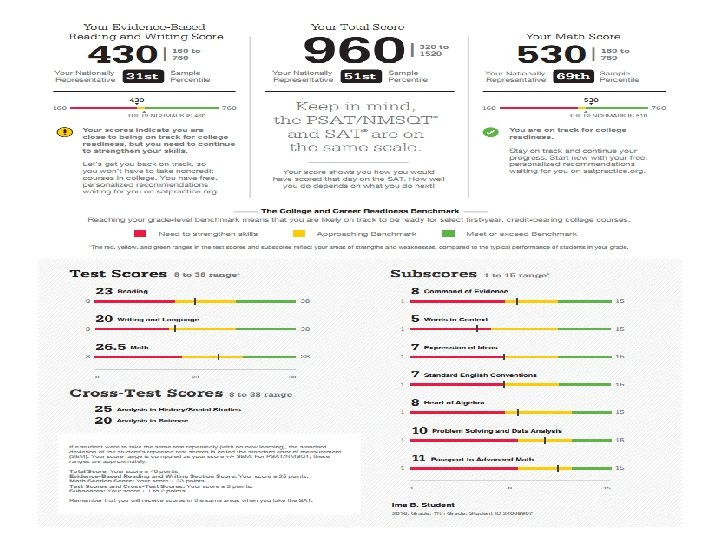
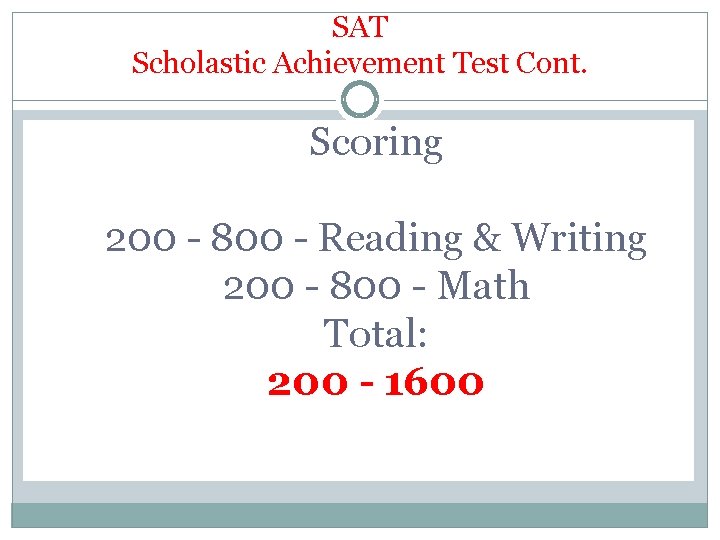
SAT Scholastic Achievement Test Cont. Scoring 200 - 800 - Reading & Writing 200 - 800 - Math Total: 200 - 1600
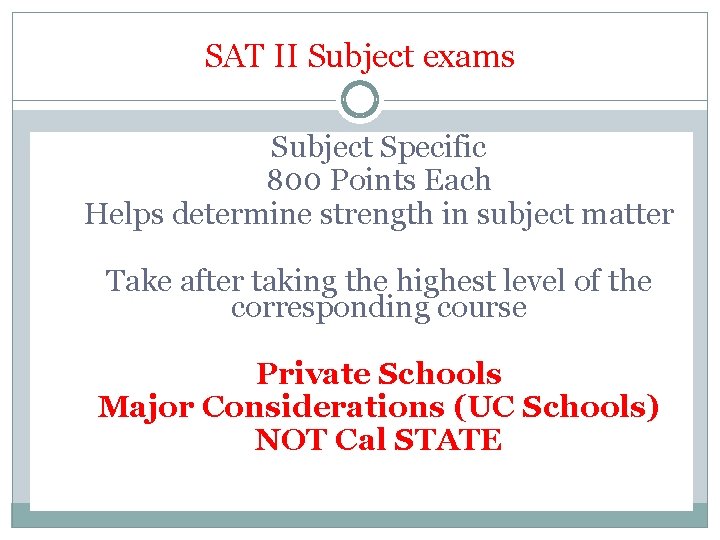
SAT II Subject exams Subject Specific 800 Points Each Helps determine strength in subject matter Take after taking the highest level of the corresponding course Private Schools Major Considerations (UC Schools) NOT Cal STATE
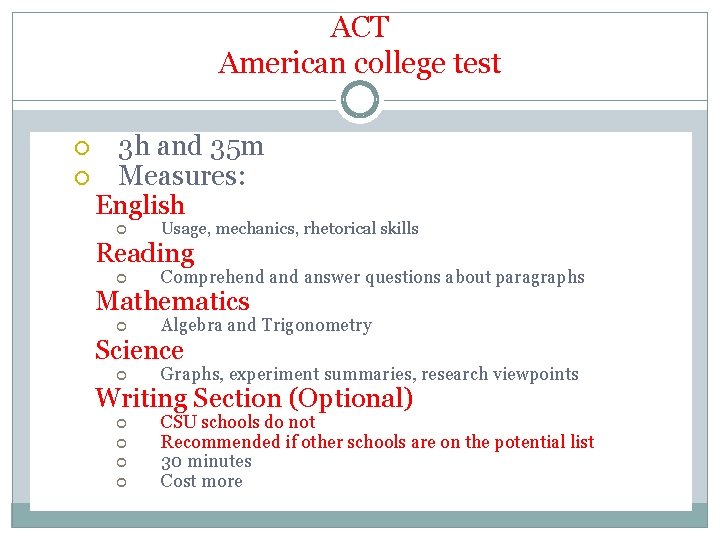
ACT American college test 3 h and 35 m Measures: English Usage, mechanics, rhetorical skills Reading Comprehend answer questions about paragraphs Mathematics Algebra and Trigonometry Science Graphs, experiment summaries, research viewpoints Writing Section (Optional) CSU schools do not Recommended if other schools are on the potential list 30 minutes Cost more
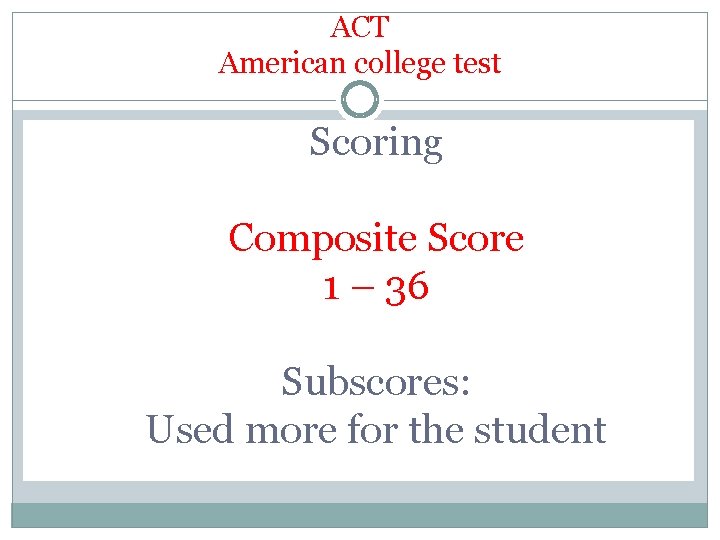
ACT American college test Scoring Composite Score 1 – 36 Subscores: Used more for the student
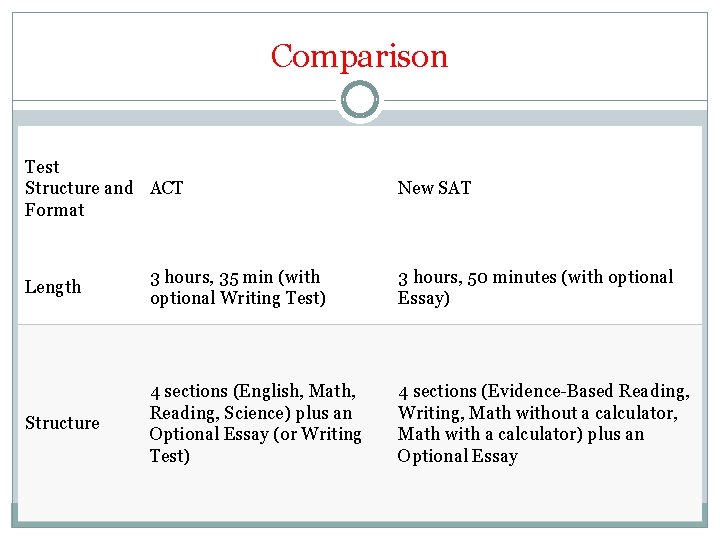
Comparison Test Structure and ACT Format New SAT Length 3 hours, 35 min (with optional Writing Test) 3 hours, 50 minutes (with optional Essay) Structure 4 sections (English, Math, Reading, Science) plus an Optional Essay (or Writing Test) 4 sections (Evidence-Based Reading, Writing, Math without a calculator, Math with a calculator) plus an Optional Essay
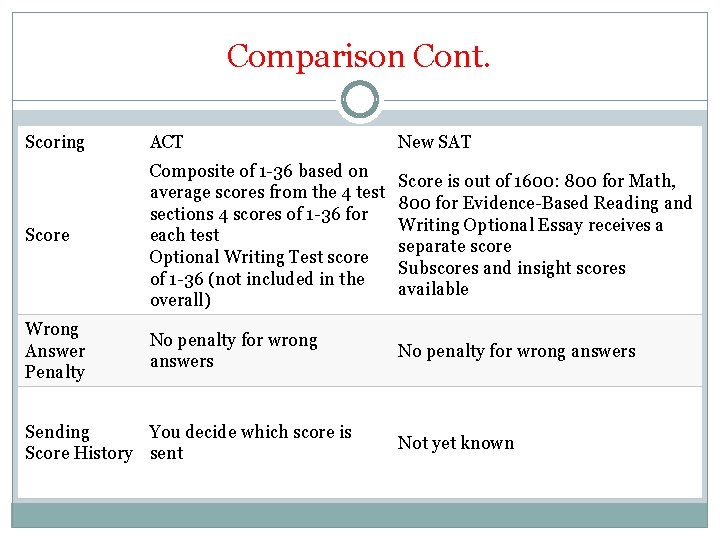
Comparison Cont. Scoring ACT New SAT Score Composite of 1 -36 based on average scores from the 4 test sections 4 scores of 1 -36 for each test Optional Writing Test score of 1 -36 (not included in the overall) Score is out of 1600: 800 for Math, 800 for Evidence-Based Reading and Writing Optional Essay receives a separate score Subscores and insight scores available Wrong Answer Penalty No penalty for wrong answers Sending You decide which score is Score History sent Not yet known
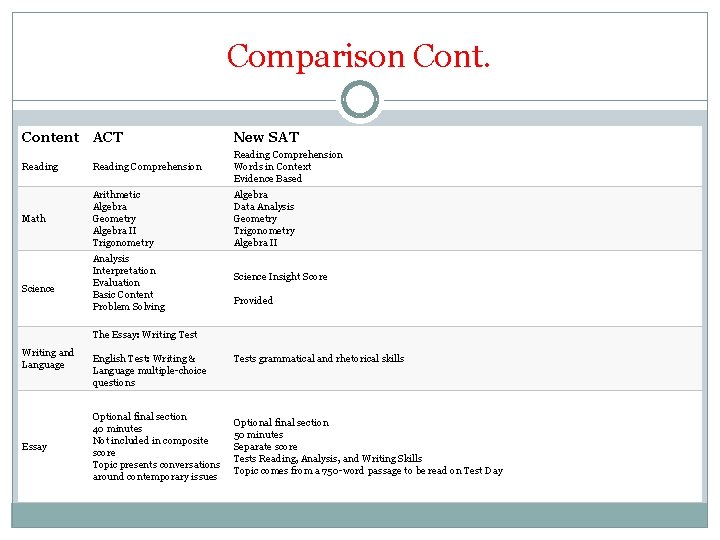
Comparison Content ACT New SAT Reading Comprehension Words in Context Evidence Based Math Arithmetic Algebra Geometry Algebra II Trigonometry Algebra Data Analysis Geometry Trigonometry Algebra II Science Analysis Interpretation Evaluation Basic Content Problem Solving Science Insight Score Provided The Essay: Writing Test Writing and Language Essay English Test: Writing & Language multiple-choice questions Optional final section 40 minutes Not included in composite score Topic presents conversations around contemporary issues Tests grammatical and rhetorical skills Optional final section 50 minutes Separate score Tests Reading, Analysis, and Writing Skills Topic comes from a 750 -word passage to be read on Test Day
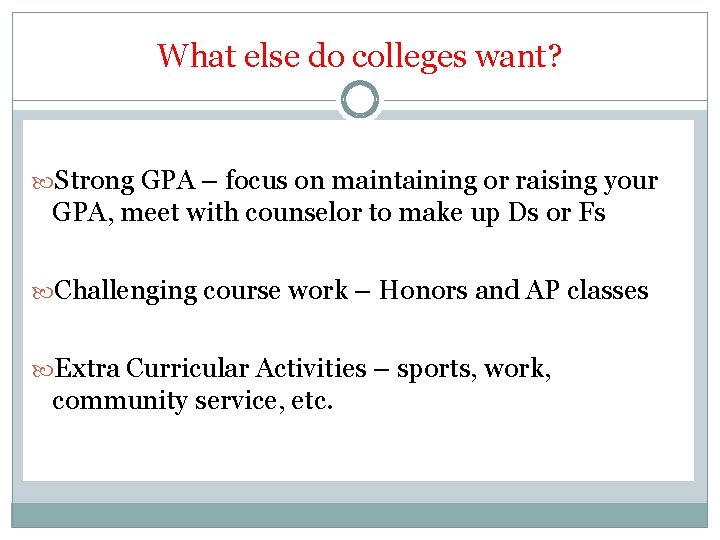
What else do colleges want? Strong GPA – focus on maintaining or raising your GPA, meet with counselor to make up Ds or Fs Challenging course work – Honors and AP classes Extra Curricular Activities – sports, work, community service, etc.
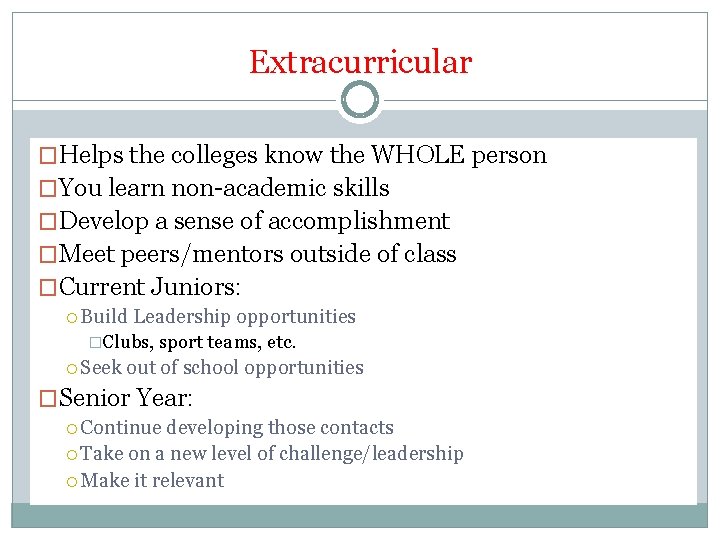
Extracurricular �Helps the colleges know the WHOLE person �You learn non-academic skills �Develop a sense of accomplishment �Meet peers/mentors outside of class �Current Juniors: Build Leadership opportunities �Clubs, Seek sport teams, etc. out of school opportunities �Senior Year: Continue developing those contacts Take on a new level of challenge/leadership Make it relevant
Extracurricular Quality Over Quantity
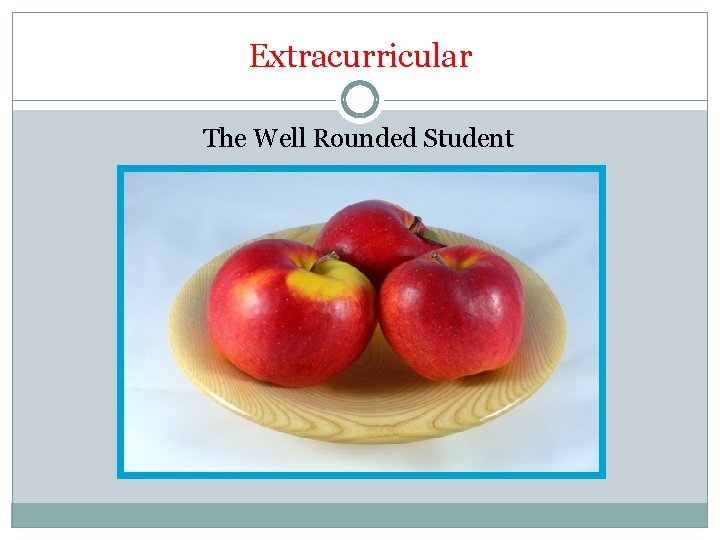
Extracurricular The Well Rounded Student
INSTEAD…. .
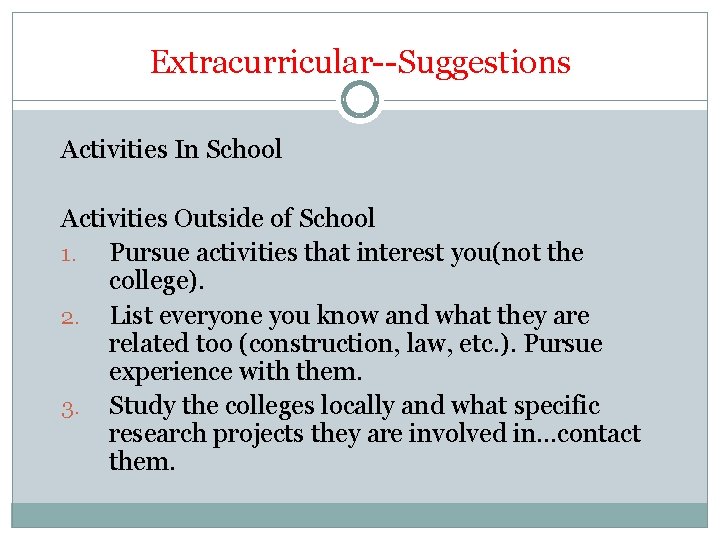
Extracurricular--Suggestions Activities In School Activities Outside of School 1. Pursue activities that interest you(not the college). 2. List everyone you know and what they are related too (construction, law, etc. ). Pursue experience with them. 3. Study the colleges locally and what specific research projects they are involved in…contact them.
Extracurricular Strong Extracurricular Profile 1. 2. 3. 4. 5. Sustained Commitment Increased responsibility over time Creativity Demonstration of student’s strengths Genuine enthusiasm in activities
Extracurricular What should you take away from the activities: 1. What have you learned from the activities 2. What has it taught you about yourself today and how it relates to your future goals 3. Whether you enjoy the experience--and why?
So, what college do you want to attend?
College list building goal Schools Determined: August 2017 Why?
California State Universities CSU’s PUBLIC UNIVERSITY SIMI-SELECTIVE COLLEGE
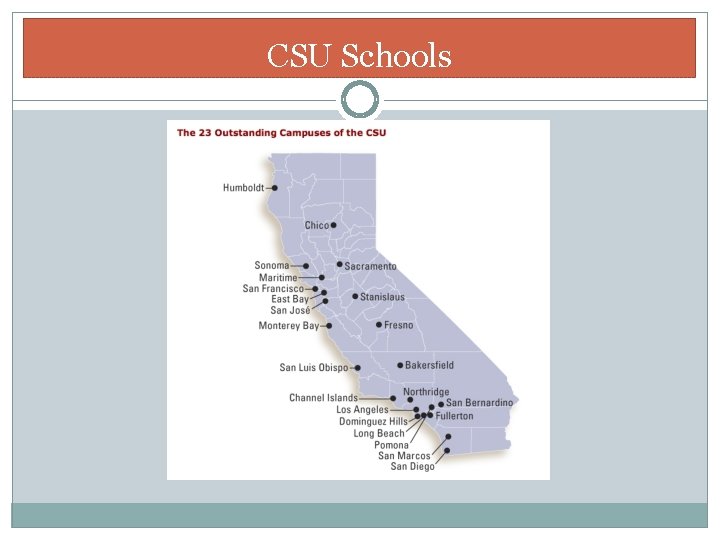
CSU Schools Affordability Cost of Tuition: $5, 472 • Cost of Tuition / Room and Board: $17, 350 (approximate) Accessible • Many financial packages help subsidize the cost • Cal Grant, State University Grant (SUG), EOP • Each Campus has a variety of scholarships Class Size • General Ed courses are higher • Major Courses 25 -40– depends on the school Diverse • Many ethnic and/or racial backgrounds Successful • Many students experience a 5 -year pattern •
CSU Schools
University of California The UC’s PUBLIC UNIVERSITY SELECTIVE COLLEGE
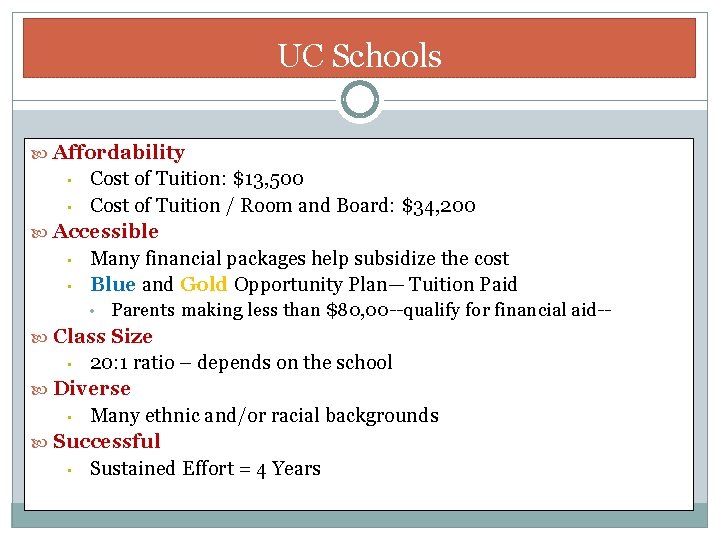
UC Schools Affordability Cost of Tuition: $13, 500 • Cost of Tuition / Room and Board: $34, 200 Accessible • Many financial packages help subsidize the cost • Blue and Gold Opportunity Plan— Tuition Paid • • Parents making less than $80, 00 --qualify for financial aid-- Class Size 20: 1 ratio – depends on the school Diverse • Many ethnic and/or racial backgrounds Successful • Sustained Effort = 4 Years •
UC Schools
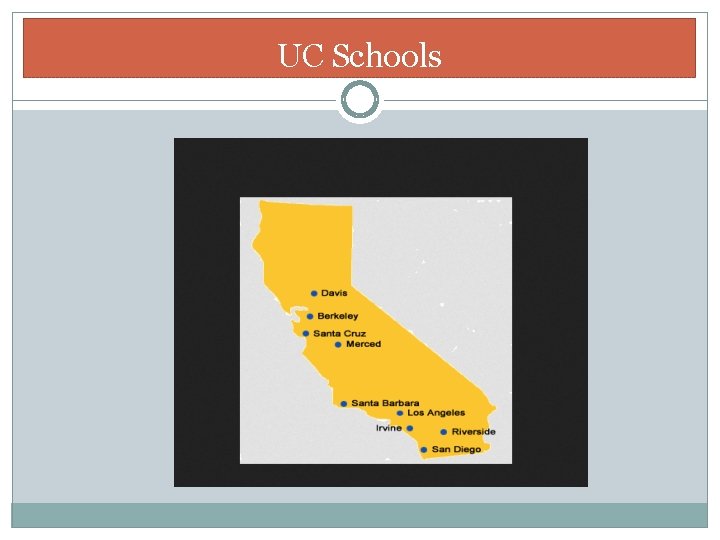
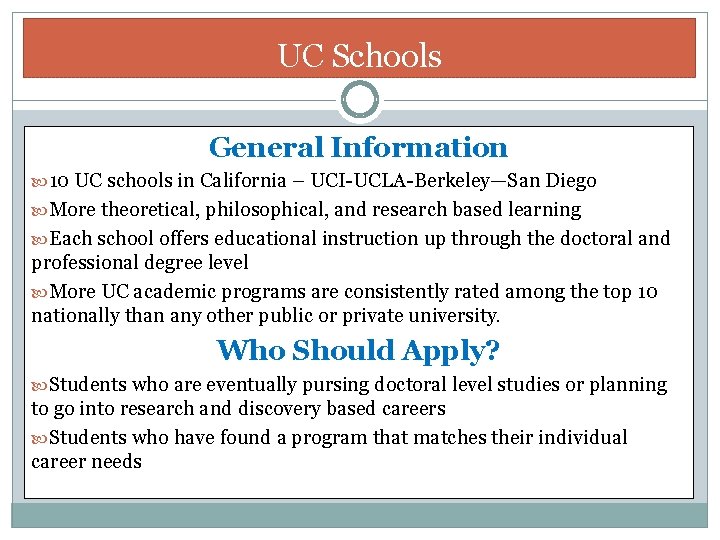
UC Schools General Information 10 UC schools in California – UCI-UCLA-Berkeley—San Diego More theoretical, philosophical, and research based learning Each school offers educational instruction up through the doctoral and professional degree level More UC academic programs are consistently rated among the top 10 nationally than any other public or private university. Who Should Apply? Students who are eventually pursing doctoral level studies or planning to go into research and discovery based careers Students who have found a program that matches their individual career needs
Private Schools/ Independent Colleges COST DOES IT COST MORE?
Private Schools/ Independent Colleges NOT ALWAYS
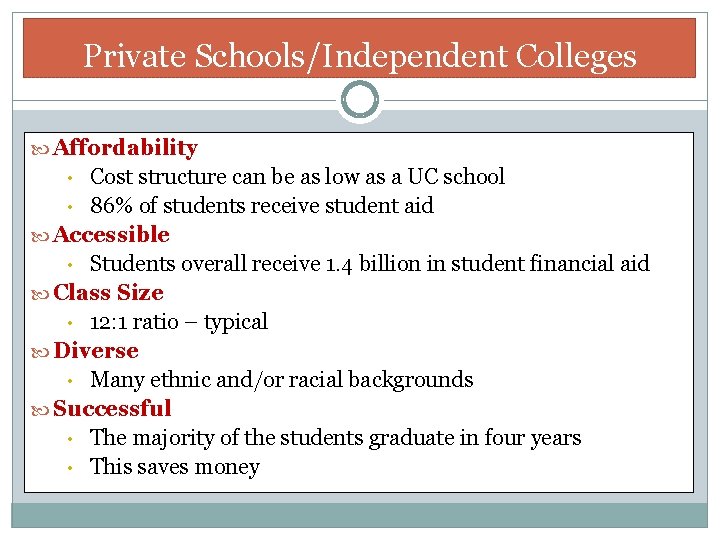
Private Schools/Independent Colleges Affordability Cost structure can be as low as a UC school • 86% of students receive student aid Accessible • Students overall receive 1. 4 billion in student financial aid Class Size • 12: 1 ratio – typical Diverse • Many ethnic and/or racial backgrounds Successful • The majority of the students graduate in four years • This saves money •