
JUNIOR ENGLISH American Literature Romanticism CHARACTERISTICS OF ROMANTICISM

- Slides: 20
JUNIOR ENGLISH American Literature – Romanticism
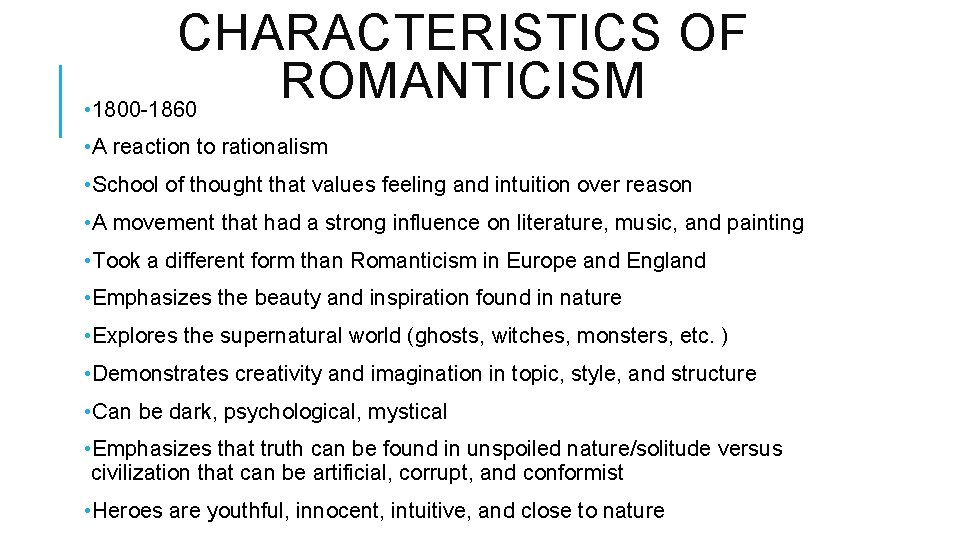
CHARACTERISTICS OF ROMANTICISM • 1800 -1860 • A reaction to rationalism • School of thought that values feeling and intuition over reason • A movement that had a strong influence on literature, music, and painting • Took a different form than Romanticism in Europe and England • Emphasizes the beauty and inspiration found in nature • Explores the supernatural world (ghosts, witches, monsters, etc. ) • Demonstrates creativity and imagination in topic, style, and structure • Can be dark, psychological, mystical • Emphasizes that truth can be found in unspoiled nature/solitude versus civilization that can be artificial, corrupt, and conformist • Heroes are youthful, innocent, intuitive, and close to nature
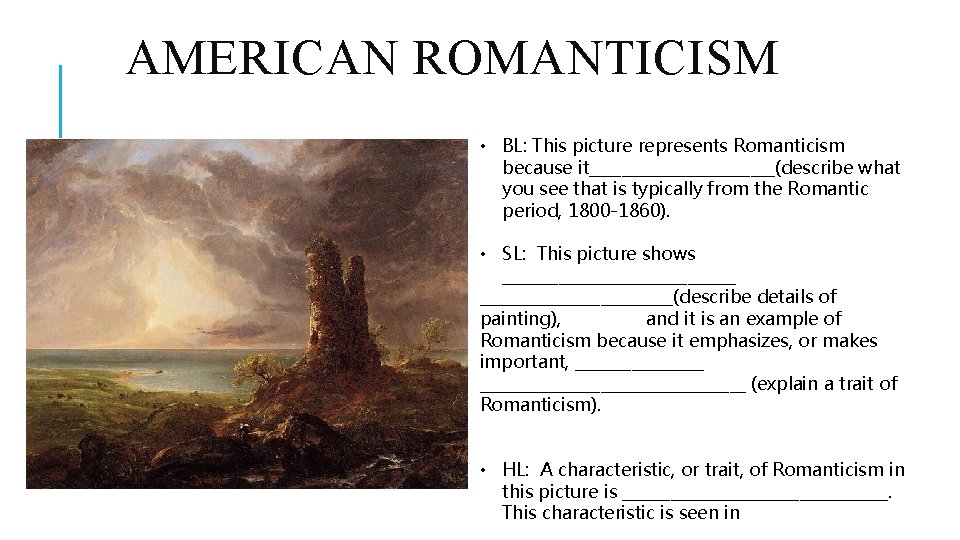
AMERICAN ROMANTICISM • BL: This picture represents Romanticism because it____________(describe what you see that is typically from the Romantic period, 1800 -1860). • SL: This picture shows _______________(describe details of painting), and it is an example of Romanticism because it emphasizes, or makes important, _________________________ (explain a trait of Romanticism). • HL: A characteristic, or trait, of Romanticism in this picture is _________________. This characteristic is seen in
RETELL THE STORY OF “RIP VAN WINKLE” USING THE FOLLOWING WORDS Diedrich Knickerbocker dog Rip Van Winkle little man conflict villagers wife liquor died village inn/tavern loved Catskill Mountains ninepins daughter twenty years American Revolution
FIND TEXTUAL EVIDENCE FOR THE FOLLOWING TRAITS OF AMERICAN ROMANTICISM 1. appreciation or emphasis on nature 2. imaginative and creative 3. supernatural 4. individual freedom or solitude 5. Romantic hero: simple, uneducated, intuitive, escapes from civilization
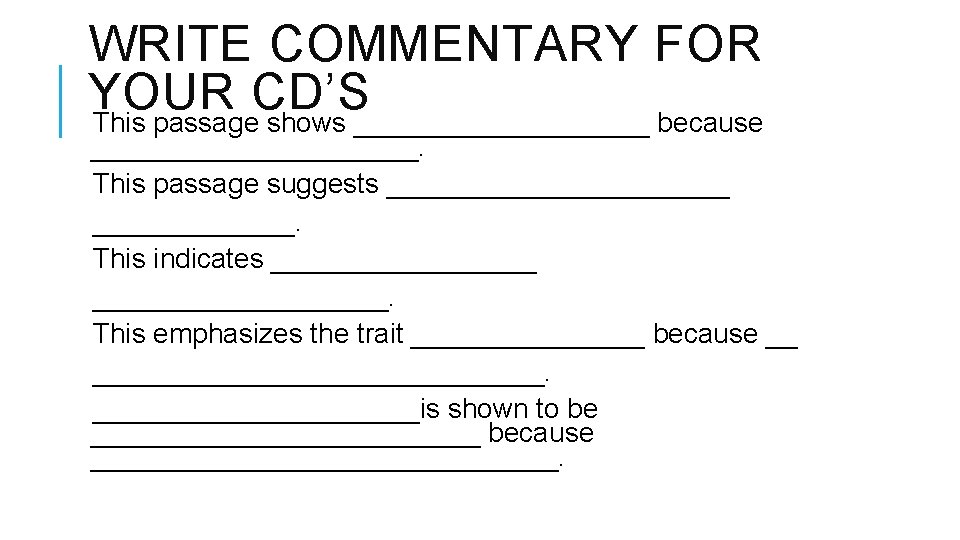
WRITE COMMENTARY FOR YOUR CD’S This passage shows __________ because ___________. This passage suggests ___________. This indicates ___________________. This emphasizes the trait ________ because __ _______________is shown to be _____________ because _______________.
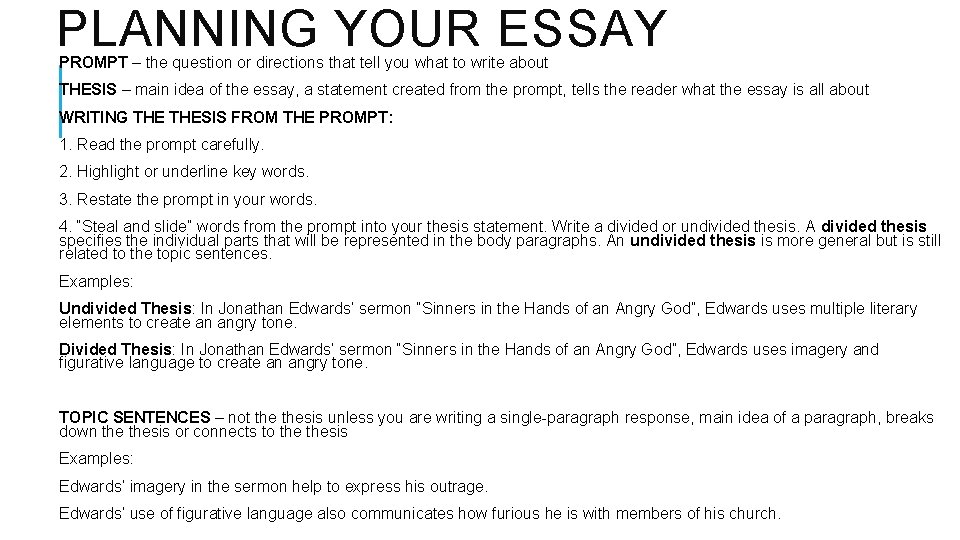
PLANNING YOUR ESSAY PROMPT – the question or directions that tell you what to write about THESIS – main idea of the essay, a statement created from the prompt, tells the reader what the essay is all about WRITING THESIS FROM THE PROMPT: 1. Read the prompt carefully. 2. Highlight or underline key words. 3. Restate the prompt in your words. 4. “Steal and slide” words from the prompt into your thesis statement. Write a divided or undivided thesis. A divided thesis specifies the individual parts that will be represented in the body paragraphs. An undivided thesis is more general but is still related to the topic sentences. Examples: Undivided Thesis: In Jonathan Edwards’ sermon “Sinners in the Hands of an Angry God”, Edwards uses multiple literary elements to create an angry tone. Divided Thesis: In Jonathan Edwards’ sermon “Sinners in the Hands of an Angry God”, Edwards uses imagery and figurative language to create an angry tone. TOPIC SENTENCES – not thesis unless you are writing a single-paragraph response, main idea of a paragraph, breaks down thesis or connects to thesis Examples: Edwards’ imagery in the sermon help to express his outrage. Edwards’ use of figurative language also communicates how furious he is with members of his church.
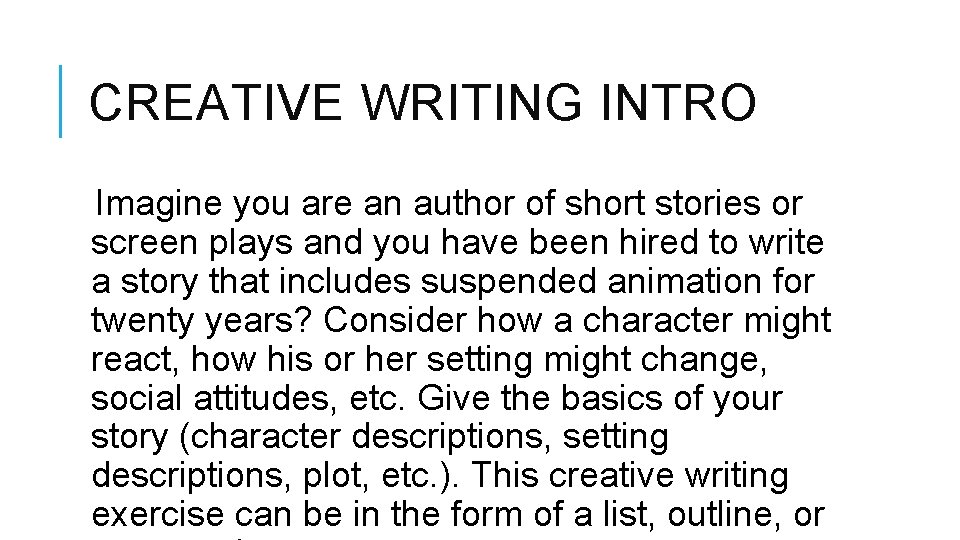
CREATIVE WRITING INTRO Imagine you are an author of short stories or screen plays and you have been hired to write a story that includes suspended animation for twenty years? Consider how a character might react, how his or her setting might change, social attitudes, etc. Give the basics of your story (character descriptions, setting descriptions, plot, etc. ). This creative writing exercise can be in the form of a list, outline, or
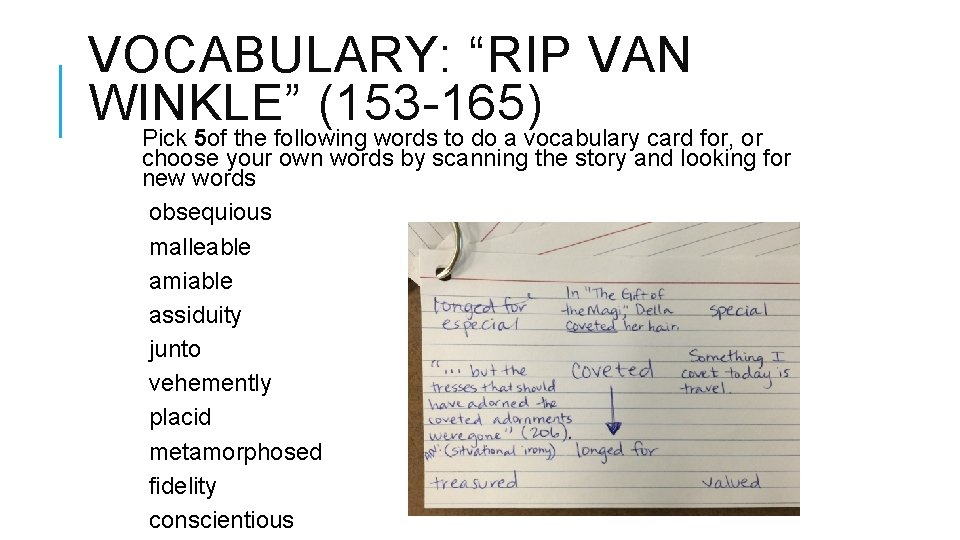
VOCABULARY: “RIP VAN WINKLE” (153 -165) Pick 5 of the following words to do a vocabulary card for, or choose your own words by scanning the story and looking for new words obsequious malleable amiable assiduity junto vehemently placid metamorphosed fidelity conscientious
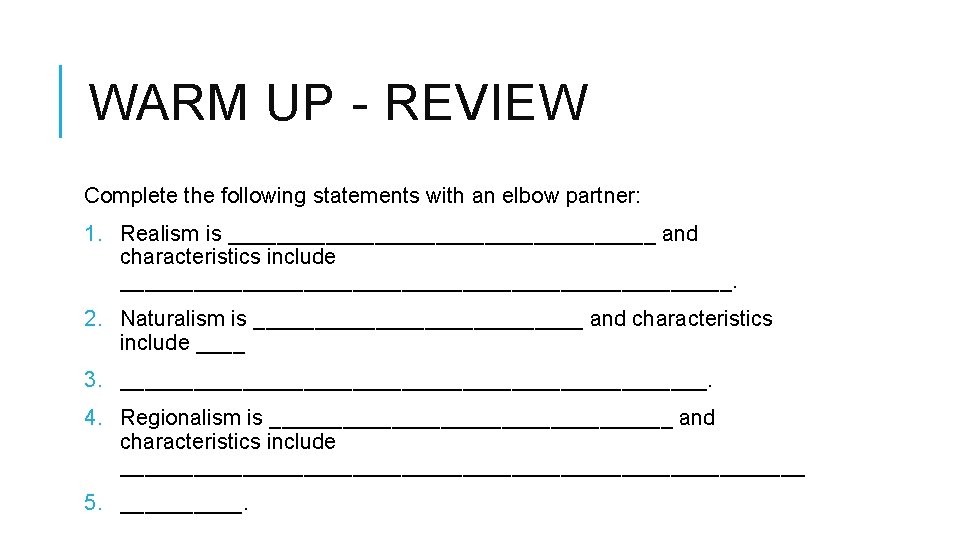
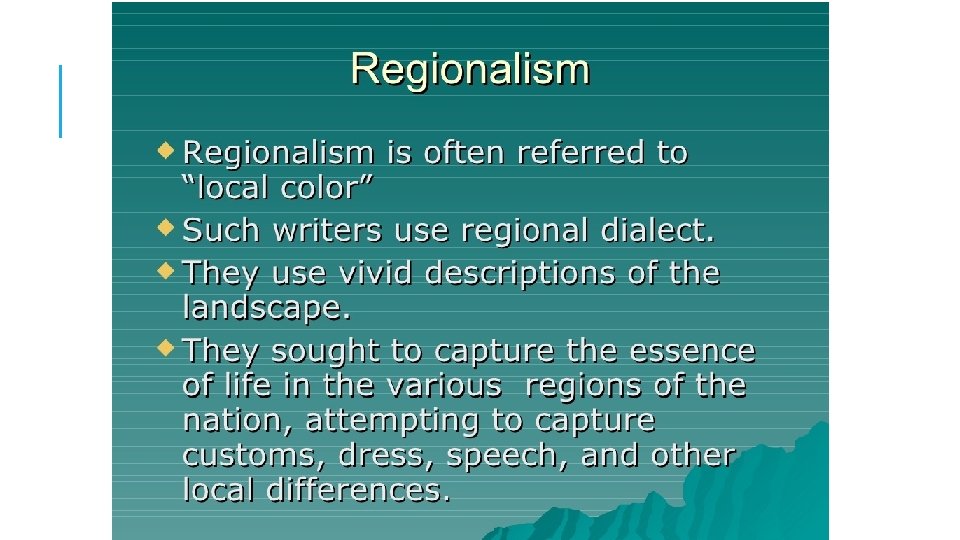
WARM UP - REVIEW Complete the following statements with an elbow partner: 1. Realism is __________________ and characteristics include _________________________. 2. Naturalism is ______________ and characteristics include ____ 3. ________________________. 4. Regionalism is _________________ and characteristics include ____________________________ 5. _____.
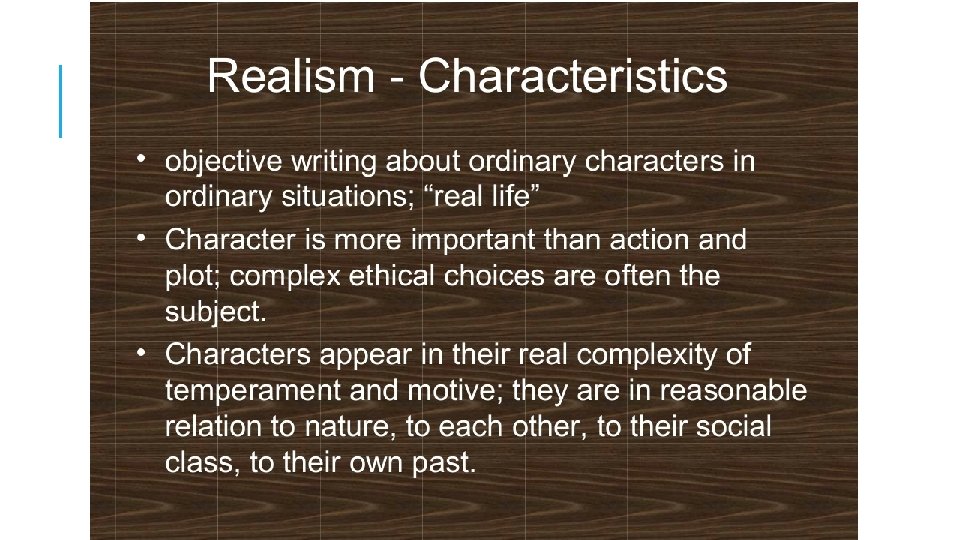
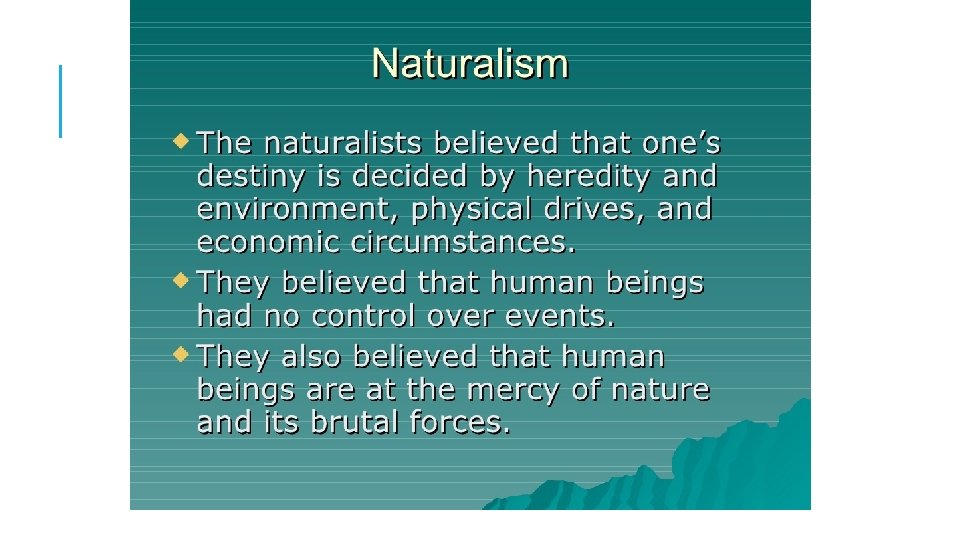
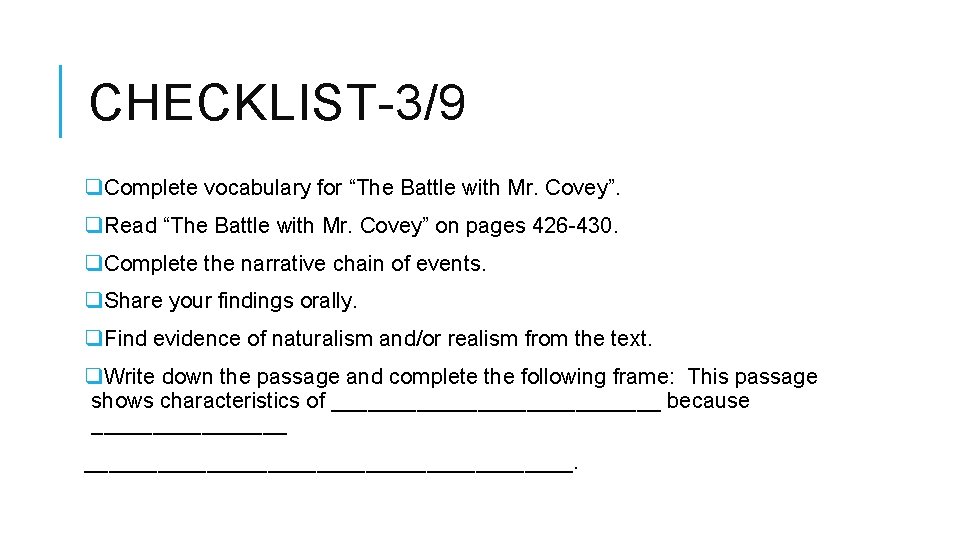
CHECKLIST-3/9 q. Complete vocabulary for “The Battle with Mr. Covey”. q. Read “The Battle with Mr. Covey” on pages 426 -430. q. Complete the narrative chain of events. q. Share your findings orally. q. Find evidence of naturalism and/or realism from the text. q. Write down the passage and complete the following frame: This passage shows characteristics of ______________ because ____________________________.
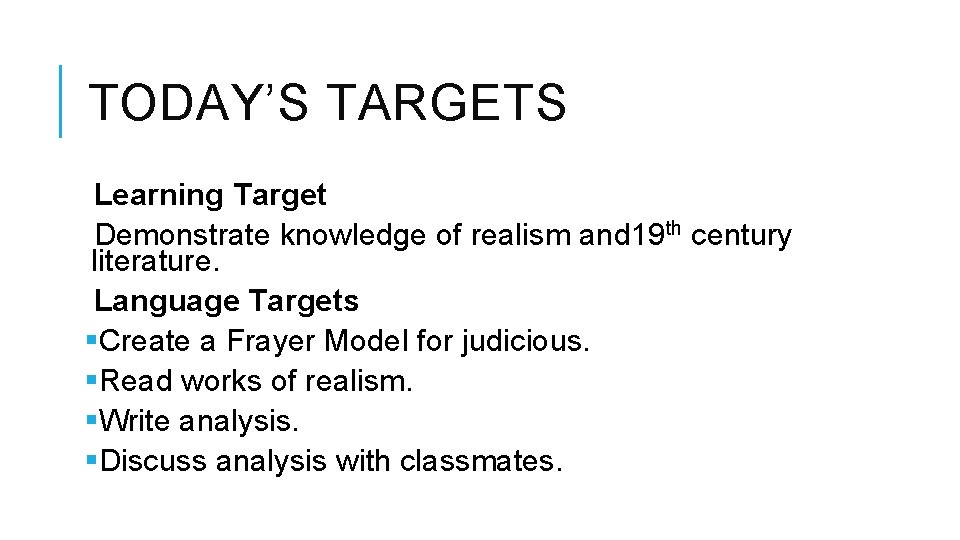
TODAY’S TARGETS Learning Target Demonstrate knowledge of realism and 19 th century literature. Language Targets §Create a Frayer Model for judicious. §Read works of realism. §Write analysis. §Discuss analysis with classmates.
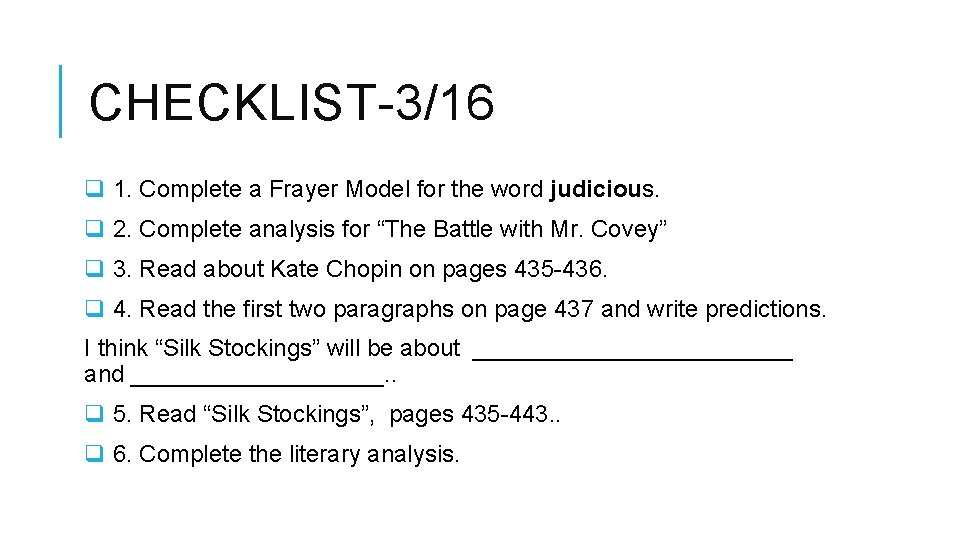
CHECKLIST-3/16 q 1. Complete a Frayer Model for the word judicious. q 2. Complete analysis for “The Battle with Mr. Covey” q 3. Read about Kate Chopin on pages 435 -436. q 4. Read the first two paragraphs on page 437 and write predictions. I think “Silk Stockings” will be about ____________ and __________. . q 5. Read “Silk Stockings”, pages 435 -443. . q 6. Complete the literary analysis.
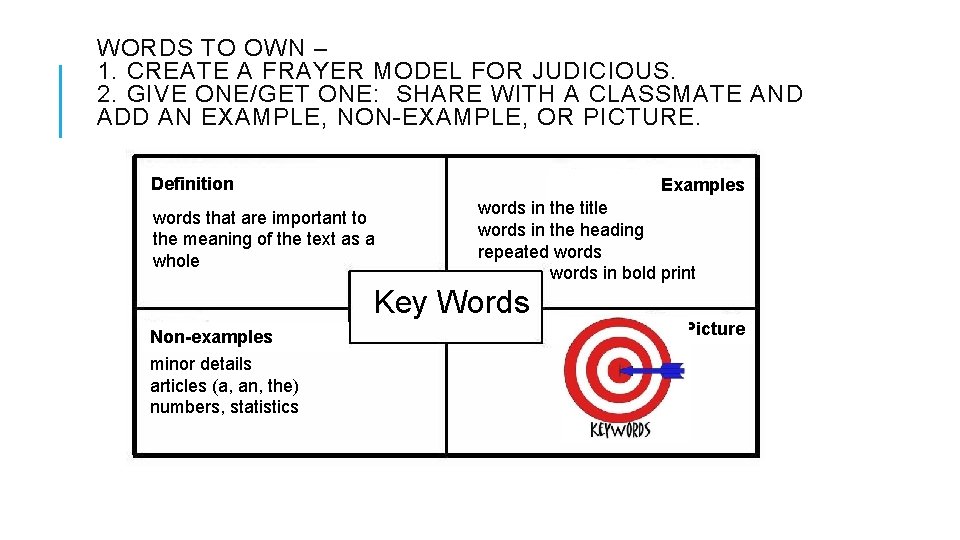
WORDS TO OWN – 1. CREATE A FRAYER MODEL FOR JUDICIOUS. 2. GIVE ONE/GET ONE: SHARE WITH A CLASSMATE AND ADD AN EXAMPLE, NON-EXAMPLE, OR PICTURE. Definition Examples words that are important to the meaning of the text as a whole words in the title words in the heading repeated words in bold print Key Words Non-examples minor details articles (a, an, the) numbers, statistics Picture
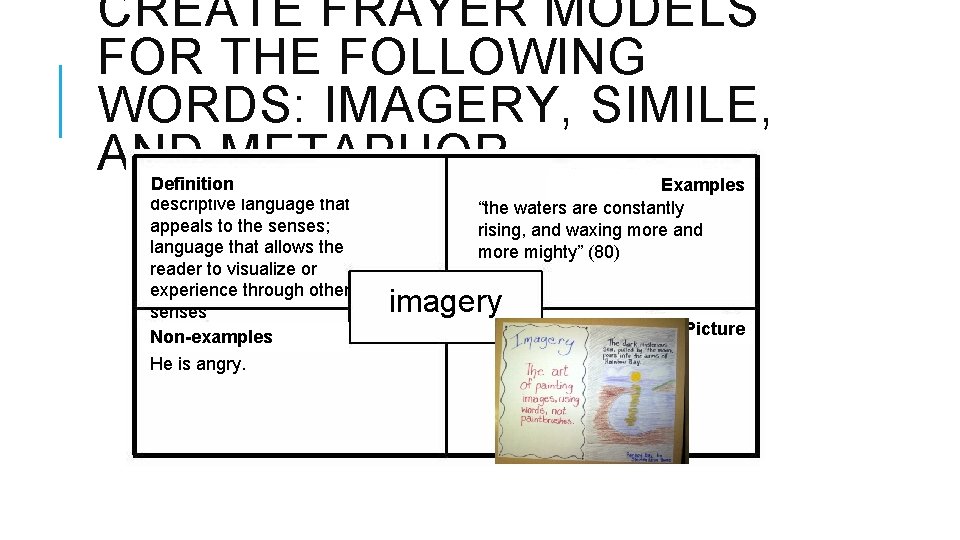
CREATE FRAYER MODELS FOR THE FOLLOWING WORDS: IMAGERY, SIMILE, AND METAPHOR Definition descriptive language that appeals to the senses; language that allows the reader to visualize or experience through other senses Non-examples He is angry. Examples “the waters are constantly rising, and waxing more and more mighty” (80) imagery Picture
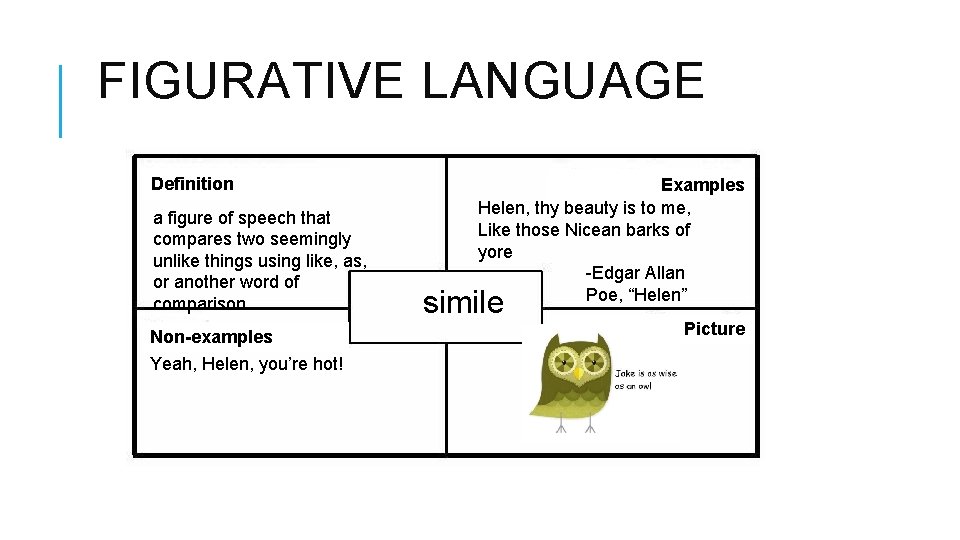
FIGURATIVE LANGUAGE Definition a figure of speech that compares two seemingly unlike things using like, as, or another word of comparison Non-examples Yeah, Helen, you’re hot! Examples Helen, thy beauty is to me, Like those Nicean barks of yore -Edgar Allan Poe, “Helen” simile Picture
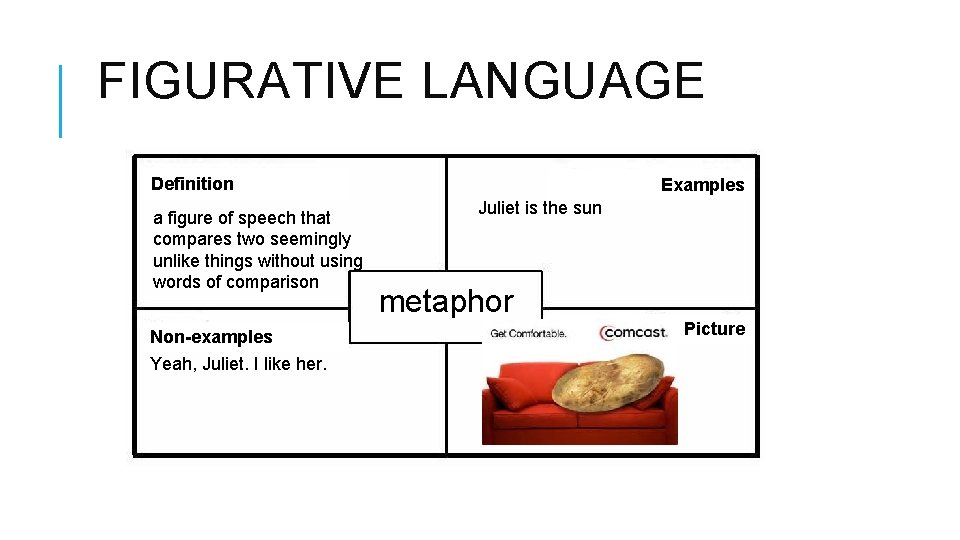
FIGURATIVE LANGUAGE Definition a figure of speech that compares two seemingly unlike things without using words of comparison Non-examples Yeah, Juliet. I like her. Examples Juliet is the sun metaphor Picture