
June th 19 UNIT 3 CELL BIOLOGY Unit
June th 19 UNIT 3 CELL BIOLOGY
Unit 3: Cell Biology • Now we are going to be moving from the atomic/molecular level to the cellular level. • In this unit we will be discussing: 1. Cell structure 2. Cell organelles 3. Types of cells 4. Cellular membranes of cells 5. Passive and active transport 6. More processes that generate ATP from glucose 7. Cellular Respiration 8. Photosynthesis 9. Mitosis which is cell division 10. Cell specialization and differentiation 11. Meiosis which is sex cell division BASICALLY WE ARE TALKING ALL ABOUT CELLS!!!
Unit 3 Lesson 1: The Cell and Life • The cell is the basic unit of life. • Cells are the first level of cellular organization. One of the 7 characteristics of life. (Remember atoms and molecules are not living so they are not part of cellular organization) • Cells are made from only a small number of elements that make up most of the mass of the cells; especially carbon, oxygen, hydrogen, and nitrogen. • All cells arise from existing cells. • They form essentially from the division and union of existing cells.
Cont. • Some organisms have only 1 cell: They are unicellular. • Bacteria is unicellular. • They meet the same challenges faced by all other living things: cellular organization, metabolism, homeostasis, reproduction, growth and development, response, and heredity.
Cont. • Organisms with more than one cell are called multicellular. • Cells in multicellular organisms have specific functions. • Every thing you can see with your eyes is made of many cells. • Each type of cell performs a specific job within the organism. • The cells of multicell organisms are highly organized. • Each cell collectively keeps the entire organism running smoothly.
Cont. • Cells in multicell organisms have a similar structure. • The cells of any multicell organism have the same basic internal structures. • They all contain many of the same parts. • In multicell organisms, cells that work together form tissues. • When cells work together to perform a specific function, that group of cells is called a tissue. • Complex multicell organisms have many different types of tissue, all comprising of 2 or more types of cells.
Cont. • Tissues that work together form organs. • An organ is a group of different tissues working together to form a specific function. • Organs that work together are organ systems, which together make up an organism.
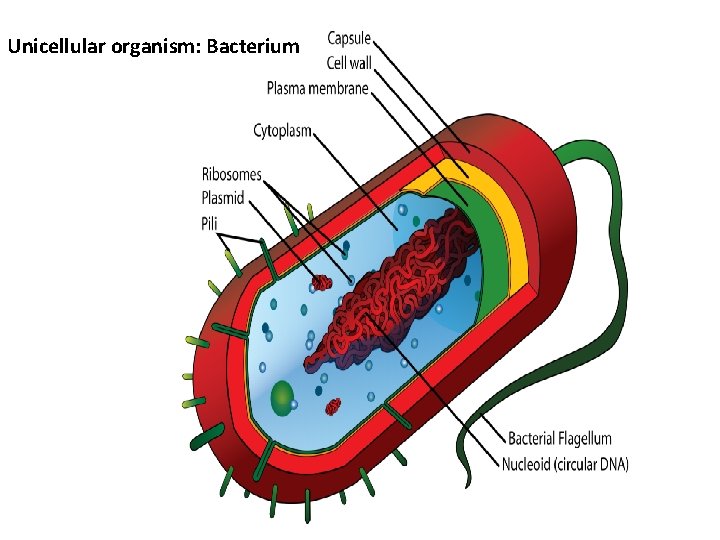
Unicellular organism: Bacterium

• Multicellular organism: Human
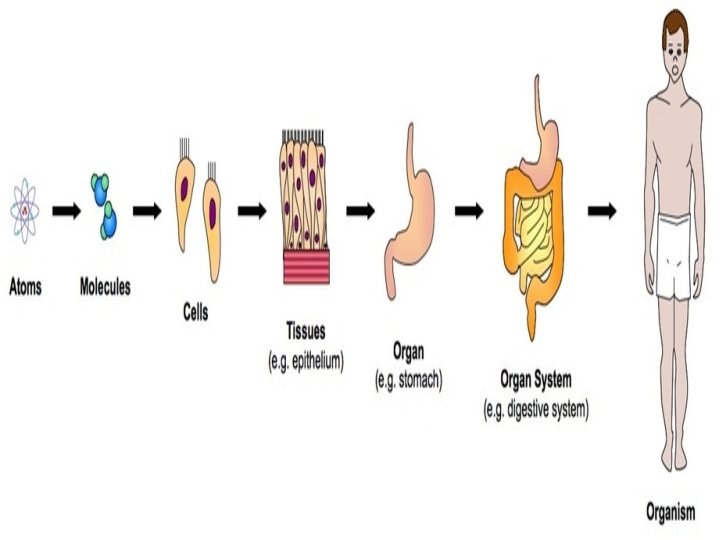
Main Idea of Lesson 1 • Living things are made of cells. • Organisms can be unicellular or multicellular. • Whether unicellular or multicellular, they all have the 7 characteristics of life. • In multicell organisms, the large numbers of individual cells are organized into levels. • The cellular levels are as followed: cell, tissue, organ, and organ system which form the organism.
Unit 3 Lesson 2: Cell Structure • Eukaryotic cells have a similar overall structure. • A eukaryotic cell is a cell with a nucleus (which contains the DNA) and membrane bound organelles. • In 1839, a scientist named Schwann published a book which laid the foundation for the 1 st cell theory. • The first cell theory was that the cell is the basic unit of life and cells come only from existing cells.
Cont. • The cell theory is a critical theme in biology. • Many scientists contributed to the development of the cell theory. • The modern cell theory states the following: 1. All organisms are made of 1 or more cells. 2. The cell is the basic unit of structure and function of living things. 3. All cells come from other living cells. 4. Cells contain genetic info that is passed onto the next generation of cells. 5. Cells are chemically very similar. 6. The flow of energy in living things occurs in cells.
Cont. • All cells have the same general layout, but prokaryotic cells are small and simple. • All cells are surrounded by a structure called the cell membrane. • Eukaryotic cells, which is the basis for all multicell organism, contain a nucleus and many structures called organelles. • Many of the same organelles are present in all eukaryotic cells. • Bacteria are prokaryotic cells, which are different than eukaryotic cells. • Prokaryotic cells have a cell membrane and some interior structures, but they don’t have a nucleus or organelles that are present in eukaryotic cells.
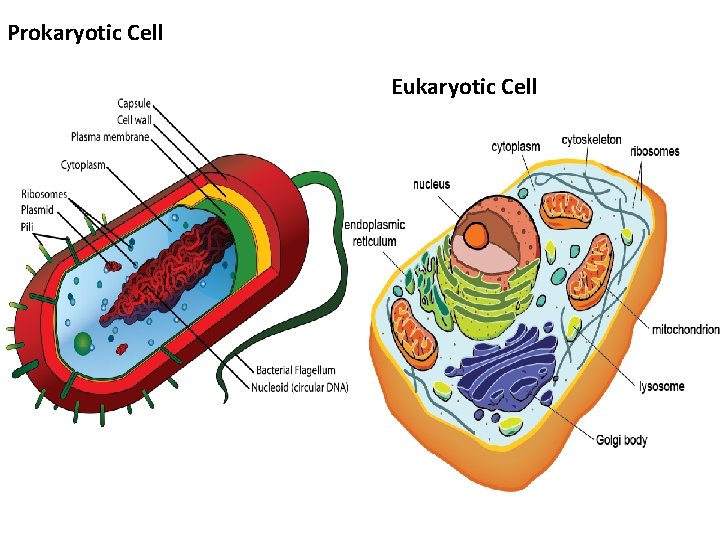
Prokaryotic Cell Eukaryotic Cell
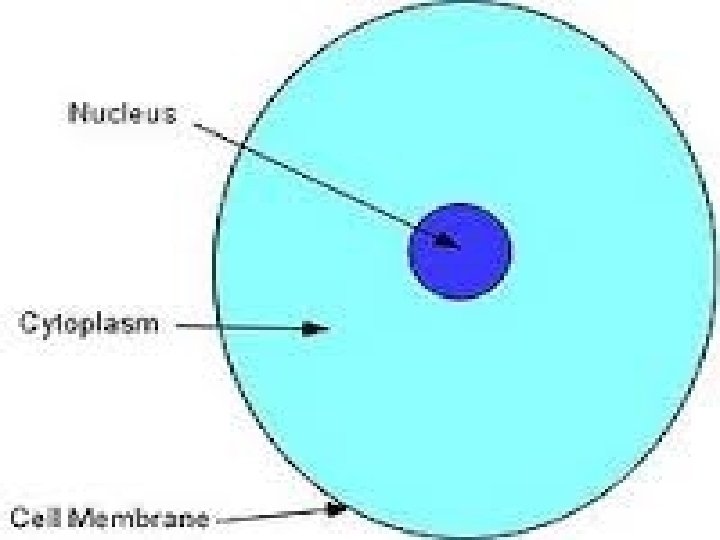
Cont. • Most cellular processes occur in the cytoplasm. • The combined processes of breaking down molecules and making new ones is called metabolism. • With in the boundaries of the cell membrane is a fluid environment called cytosol. • Many metabolic processes take place in the cytosol. • Cytosol provides the right environment for macromolecules to travel and for organelles to function and accomplish the necessary tasks of the cell. • The cytosol and organelles make up the cell’s cytoplasm. • Most cellular activities occur in the cytoplasm- either in the cytosol or organelles.
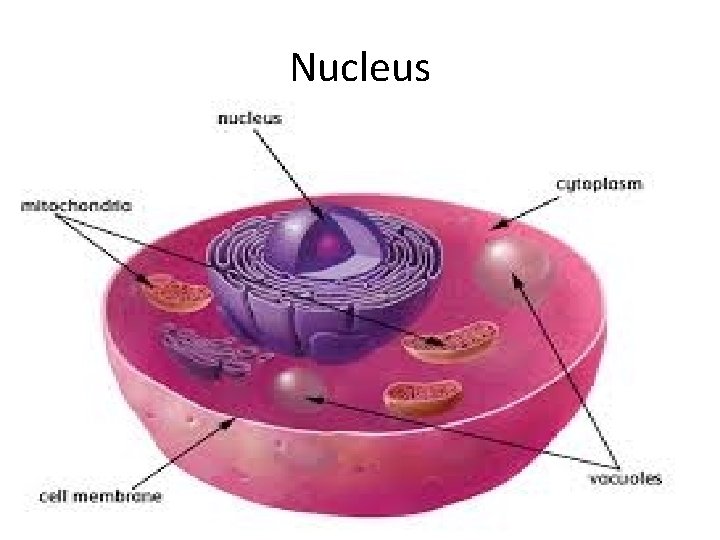
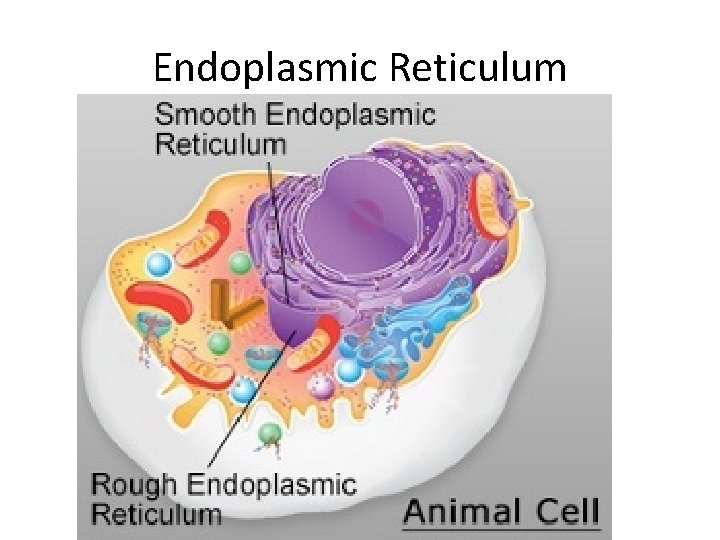
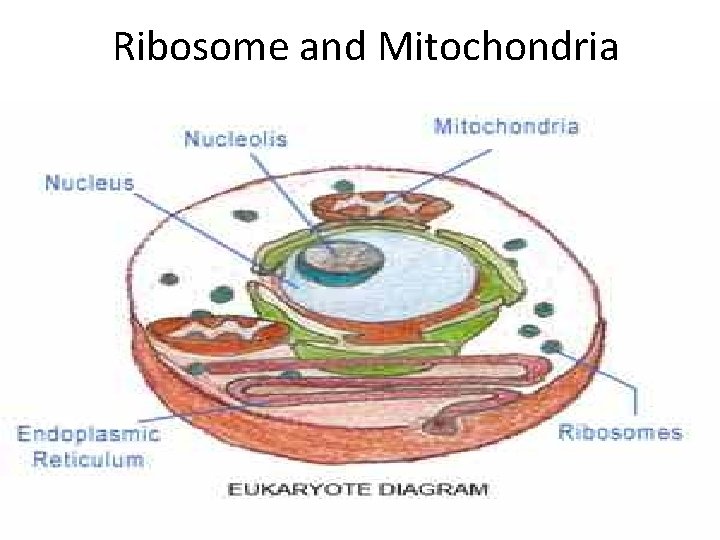
Cont. • Eukaryotic cells have many of the same organelles. • The nucleus is the control center of the cell; the nucleus contains the genetic info or the DNA. • The endoplasmic reticulum and ribosome work together to make 1000 s of types of proteins. • Mitochondria produce usable energy for the cell. • Chloroplasts in a plant cell only are the site of photosynthesis.
Nucleus
Endoplasmic Reticulum
Ribosome and Mitochondria
Cont. • There are many types of cells, each with a specific function. • Eukaryotic cells share the same overall layout and organelles, but they take diverse forms because they are structured to form diverse functions. • This is called differentiation. • For example, a muscle cell is packed with mitochondria because ATP is generated in mitochondria, and a muscle needs lots of ATP to move the body. • But a cell that stores fat has a different function and has few mitochondria. • The same basic layout is there but the 2 cells have different structures because of their diverse function. • Eukaryotic cells have the same general layout.
Unit 3 Lesson 3: Cell Organelles • The cells of eukaryotic organisms contain a nucleus and membrane-bound organelles. • Organelles within cells carry out many of the metabolic tasks important to living things. • Inside each of your cells, small membranebound structures: organelles: play different roles by breaking down food, generating energy, making new, molecules, and producing new cells.
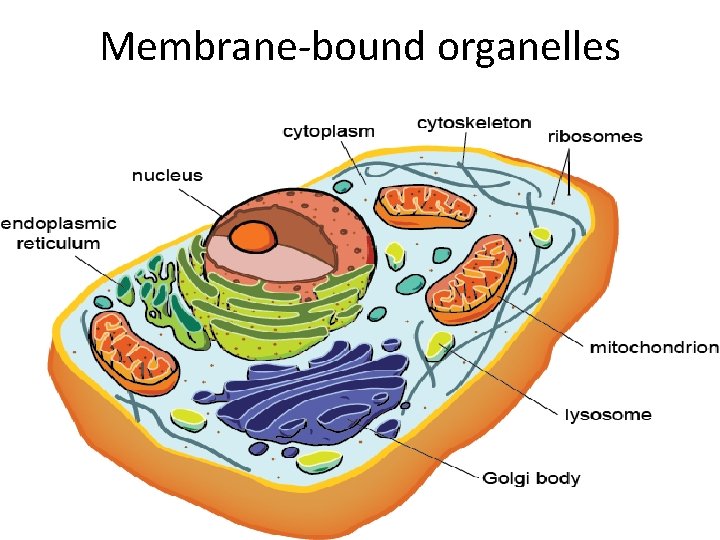
Membrane-bound organelles
Cont. • Only eukaryotic cells contain organelles. • All plants and animals are made of eukaryotic cells; they have a nucleus and membrane-bound organelles. • A different type of cell is a prokaryotic cells: is does not have organelles or a nucleus. • Eukaryotic cells contain a nucleus, in which DNA resides; DNA duplicates itself there. • A region of the nucleus: nucleolus: is where ribosome synthesis begins. • Ribosomes play an important role in protein synthesis. • The nucleus is generally larger than any other organelle.
Cont. • Mitochondria makes useful energy from glucose. • Mitochondria are the site of cellular respiration, the product that converts the energy stored in glucose to ATP, a form of usable energy. • The matrix of each mitochondrion contain some of the enzymes needed in cellular respiration. • Mitochondria have an inner and outer membrane. • Inner membrane consists of many folds, which give membranes surface area. • Proteins in the inner membrane help in the production of ATP and the surface area increases the space available for ATP synthesis.
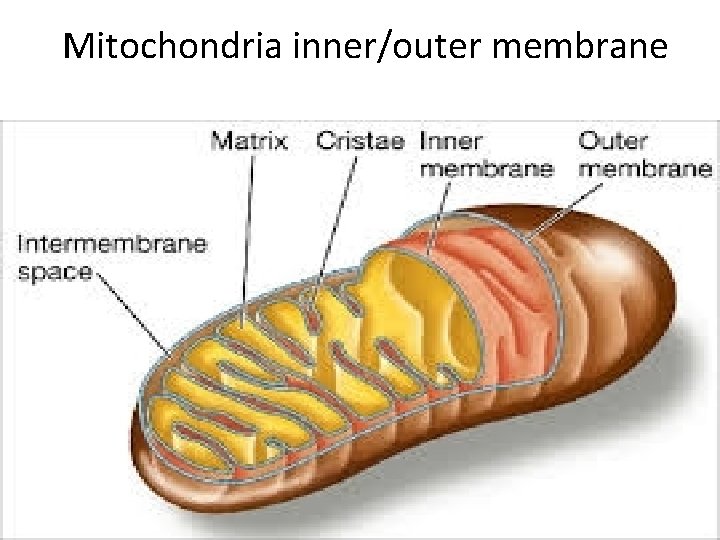
Mitochondria inner/outer membrane
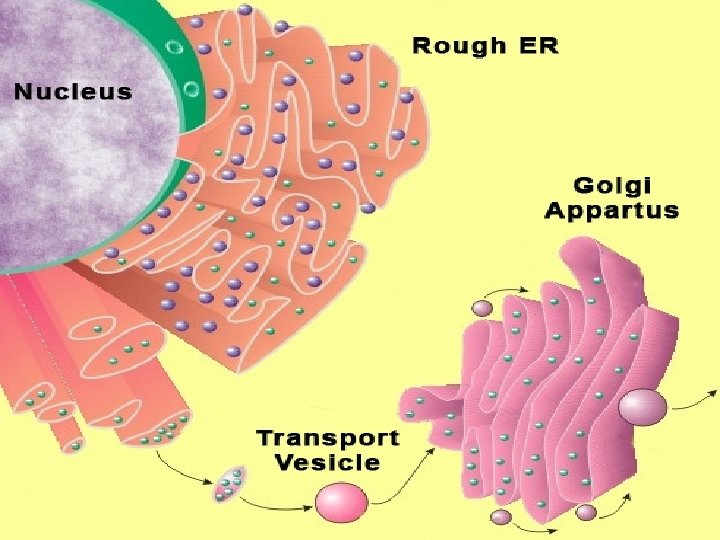
Cont. • Ribosomes are the sites of protein synthesis. • Ribosomes are called the cell’s workbenches. • Some ribosomes float in the cell’s cytoplasm, but most are located on the rough endoplasmic reticulum, which is another organelles. • The endoplasmic reticulum is the site of most protein synthesis. • In eukaryotic cells, most ribosomes are located on the rough endoplasmic reticulum, which is a series of interconnected flattened sacs, tubes, and channels within the cell. • Proteins made on ribosomes or endoplasmic reticulum are packaged inside protective compartments called vesicles. • Vesicles protect proteins when they leave the cell to travel to other body parts.
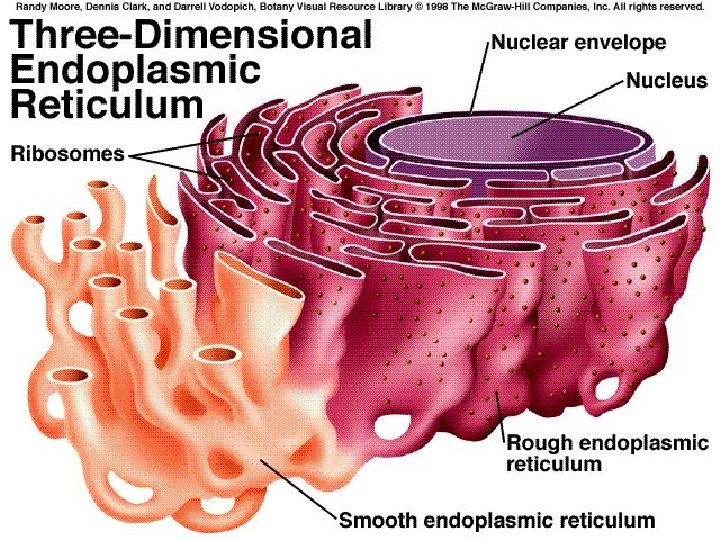
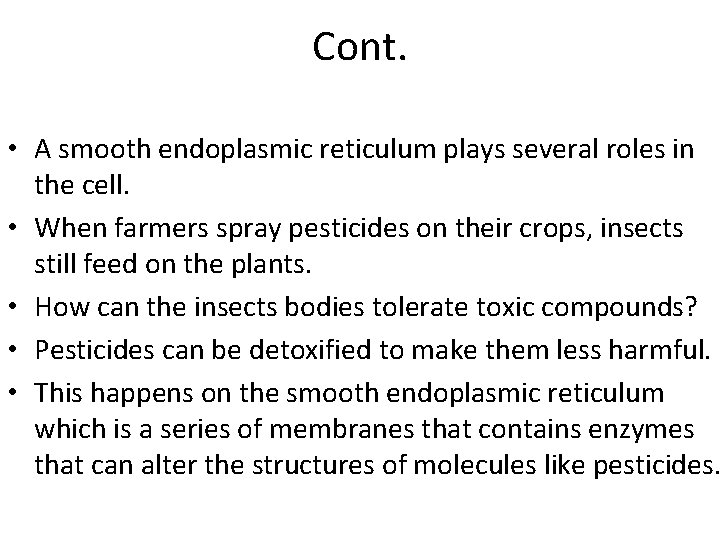
Cont. • A smooth endoplasmic reticulum plays several roles in the cell. • When farmers spray pesticides on their crops, insects still feed on the plants. • How can the insects bodies tolerate toxic compounds? • Pesticides can be detoxified to make them less harmful. • This happens on the smooth endoplasmic reticulum which is a series of membranes that contains enzymes that can alter the structures of molecules like pesticides.
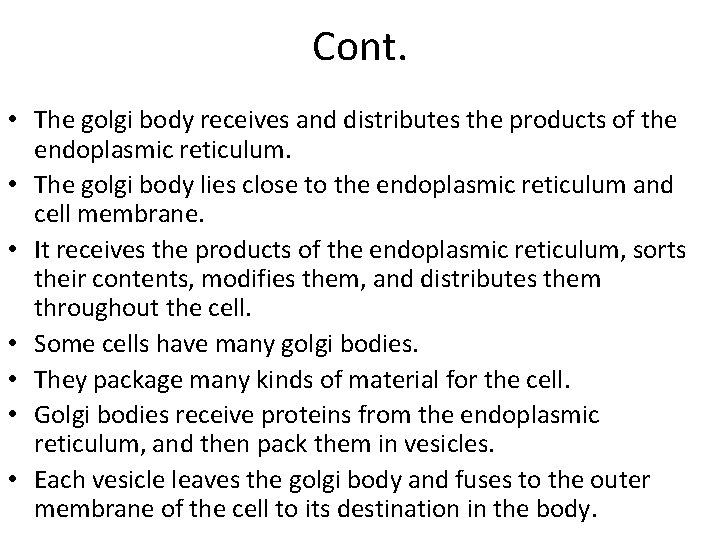
Cont. • The golgi body receives and distributes the products of the endoplasmic reticulum. • The golgi body lies close to the endoplasmic reticulum and cell membrane. • It receives the products of the endoplasmic reticulum, sorts their contents, modifies them, and distributes them throughout the cell. • Some cells have many golgi bodies. • They package many kinds of material for the cell. • Golgi bodies receive proteins from the endoplasmic reticulum, and then pack them in vesicles. • Each vesicle leaves the golgi body and fuses to the outer membrane of the cell to its destination in the body.
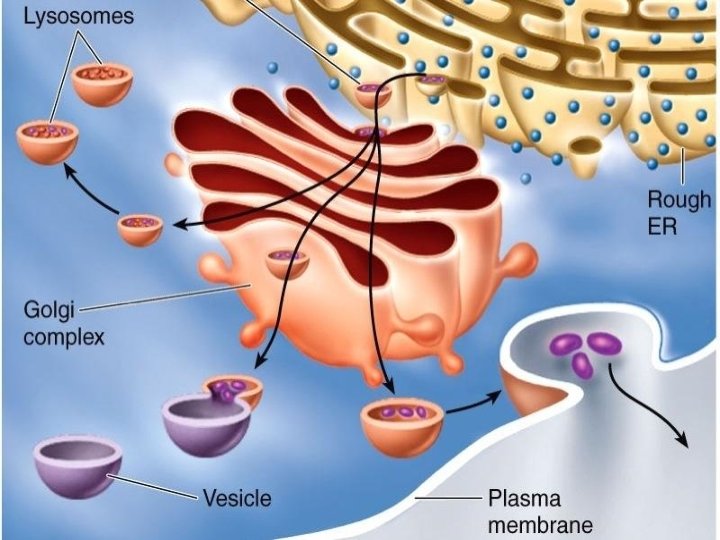
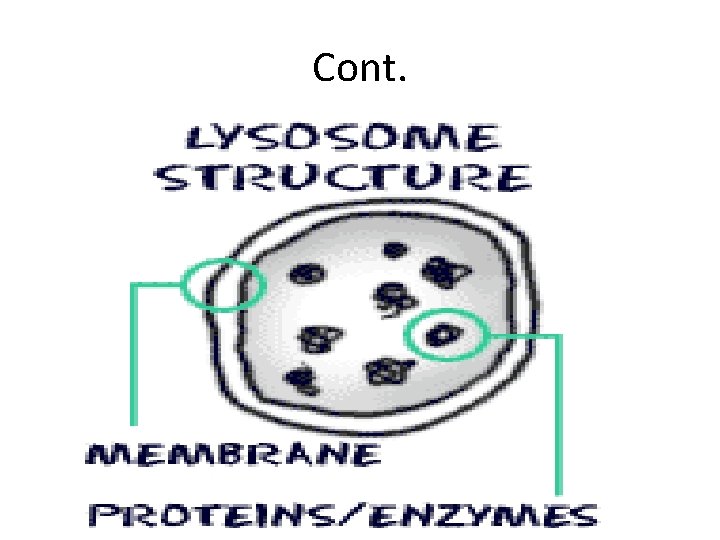
Cont. • Lysosomes are filled with enzymes that break many materials. • The lysosome contains many types of digestive enzymes that break down large organic molecules like macromolecules. • They also break down other organelles in the cell, returning the raw materials to the cell’s interior to enable the cell to reassemble new organelles in a process of renewal. • Lysosomes also play a role in the immune system.
Cont.
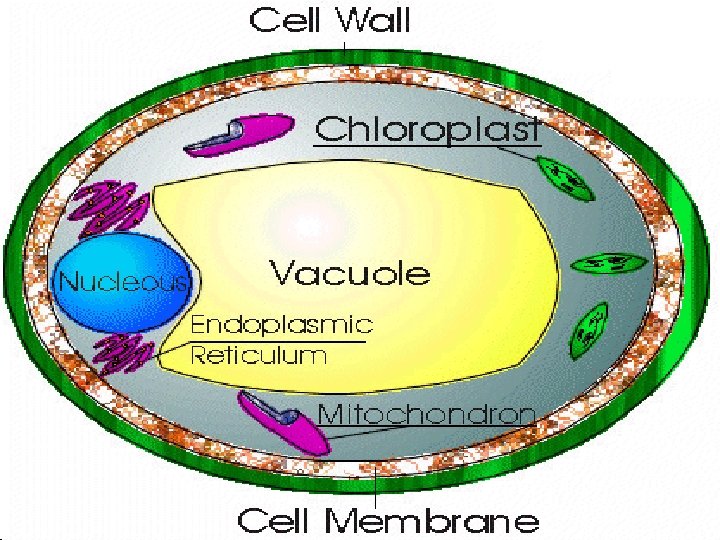
• Plant cells contain some organelles not found in animal cells. • In the leaves of plants, the sun’s energy is being captured by specialized structures in the plant cells. • This energy is used in photosynthesis, which produces glucose from sunlight, water, and carbon dioxide. • Photosynthesis takes place in chloroplasts which are organelles that are present only in plant cells. • Chloroplasts contain a green pigment called chlorophyll, which captures light energy for photosynthesis. (remember that chlorophyll contains magnesium. Chlorophyll is an organic compound with the magnesium atom at the middle of each chlorophyll molecule) • Plants cells also contain a large central compartment called a central vacuole. • The central vacuole stores water, ions, and wastes. • When the vacuole is full, it pushes against the cell wall, making the plant rigid. • Finally, plant cells are surrounded by a rigid cell wall which helps give shape and support to plants that isn’t found in animal cells. • Remember animal cells have a cellular membrane made of what carb? ? And what is the name of the structure? ? ? Instead of the cell wall which is only in the plant cell.
Main Idea of Lesson 3 • The organelles in a cell provide locations and specialized environments for the many metabolic processes essential for life.














Unit 3 Lesson 4: Two Types of Cells • Prokaryotic cells and eukaryotic cells are different in complexity and structure. • Cells are either prokaryotic or eukaryotic. • The earliest life forms on earth were prokaryotic cells/ • Most scientists consider rock deposits called stomatolites, the oldest evidence of life on earth. • These life forms were all single cell organisms, without nucleus and organelles. • They were prokaryotic cells. • It’s from these earliest life forms that life on earth today originated.
Cont. • Prokaryotes are single-celled organisms. • Prokaryotes still carry out all of the functions of life inside a single cell. • The lack of a nucleus and membrane bound organelles is one way in which prokaryotes differ from the cells of multicell organisms-eukaryotes. • The DNA of prokaryotes is also organized differently from that of eukaryotes. • In prokaryotes, DNA exists in a looped molecule.
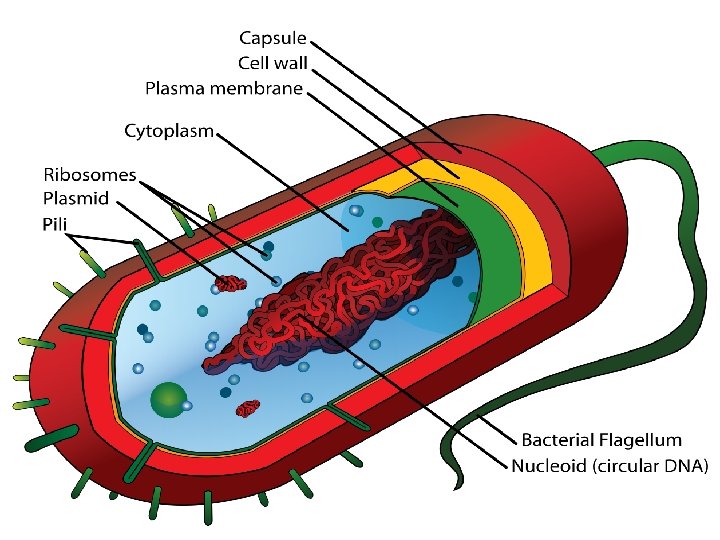
Cont. • Bacteria are the most abundant organisms on earth. • Prokaryotes are divided into two broad categories of life called domains. • One of these domains contains unusual forms of life called Archaeans. • The other domain includes all of the bacteria on earth. • Many human diseases are caused by some types of bacteria. • Disease causing bacteria are only a minority of all the bacteria on earth. • Many types of bacteria carry out photosynthesis and produce atmosphere oxygen. • Others recycle nutrients. • Bacteria live inside the bodies of almost every organism on earth.
Cont. • Archaeans share several uneven characteristics. • The hot springs of Yellowstone Park don’t look like they support any life at all, but they are home to prokaryotes in the domain Archaea. • Archaeans can live in extreme habitats like hot springs, very salty lakes, and high acid environments. • In the domain Archaea, the cell membrane consists of a phospholipid monolayer, only 1 layer of lipid molecules. • This feature sets them apart from bacteria and eukaryotic cells. • They are totally different from bacteria.
Cont. • Eukaryotes are organisms made of cells with a nucleus and membrane bound organelles. • One of the most fundamental divisions of life on earth is the division of prokaryotes and eukaryotes. • Eukaryotes are organisms that have eukaryotic cells that contain a nucleus and membrane bound organelles like mitochondria, chloroplasts, golgi bodies, and lysosomes. • The nucleus contains genetic info which is DNA.
Cont. • Some eukaryotes are single cell organisms. • Yeast is a one celled eukaryotes. • Single celled eukaryotes don’t have specialized cells and tissues. • They carry out all functions of life inside their single cell. • Other single cell eukaryotes include the amoeba, paramecium, and diatom.
Cont. • The eukaryotes you see everyday are multicellular. • Like you, each organism is made of trillions of cells. • All those cells share the characteristics of eukaryotic cells. • They all contain DNA inside a nucleus, and all have membrane bound organelles. • Multicell organisms also contain specialized cells that may function together as tissues and organs. • Specialized cells, tissues, and organs form some of the levels of biological organization: characteristics of multicell life. • For examples, muscle cells, which are eukaryotic, form muscle tissue and muscular systems.
Cont. • Most scientists suggest that eukaryotes arose from prokaryotes • The key difference between them is that eukaryotes have a nucleus and organelles. • About 30 years ago, the idea that organelles originated as independent prokaryotic cells and were engulfed by other prokaryotes cells was discovered. • This is the Endosymbiotic theory: one prokaryotic cell may have engulfed another, forming a union in which both cells worked together. • Over millions of years, that kind of partnership may have evolved, producing the eukaryotic cells we see today. • The mitochondria and chloroplasts have their ancestry in prokaryotic cells years ago. • Genetic evidence supports this. • Mitochondria and chloroplasts contain their own DNA, which is separate from the DNA in the cell’s nucleus. • Organelle DNA shares many more traits with bacterial DNA than with eukaryotic DNA in the nucleus. • This suggests that those organelles did indeed have a prokaryotic ancestor.
Main Idea of Lesson 4 • Prokaryotes and eukaryotes differ at cellular level. (How? ) • All life on earth is either prokaryotic or eukaryotic.
- Slides: 62