
June 2020 update on the time distribution system
June 2020 update on the time distribution system R&D for the Hyper-Kamiokande experiment stefano russo LPNHE Paris, HK meeting 05/06/2020
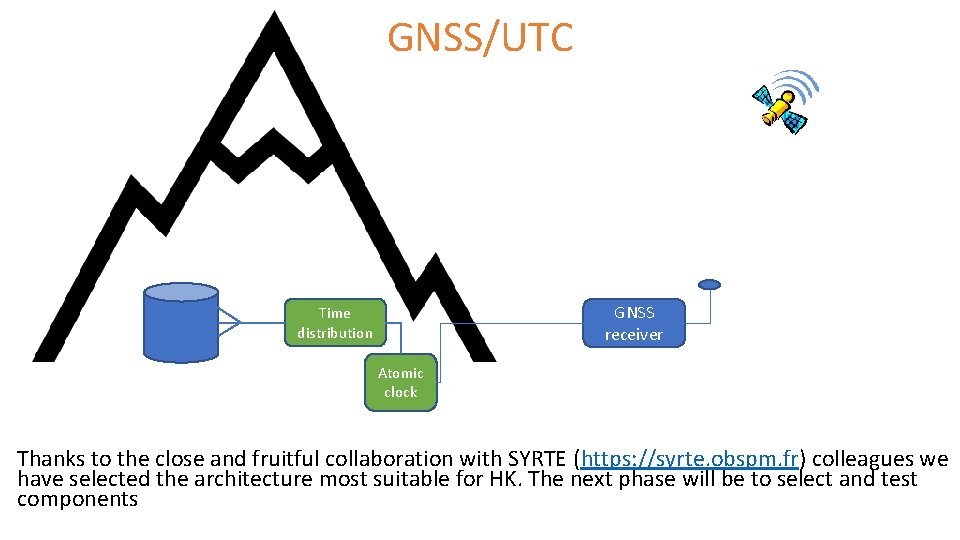
GNSS/UTC GNSS receiver Time distribution Atomic clock Thanks to the close and fruitful collaboration with SYRTE (https: //syrte. obspm. fr) colleagues we have selected the architecture most suitable for HK. The next phase will be to select and test components
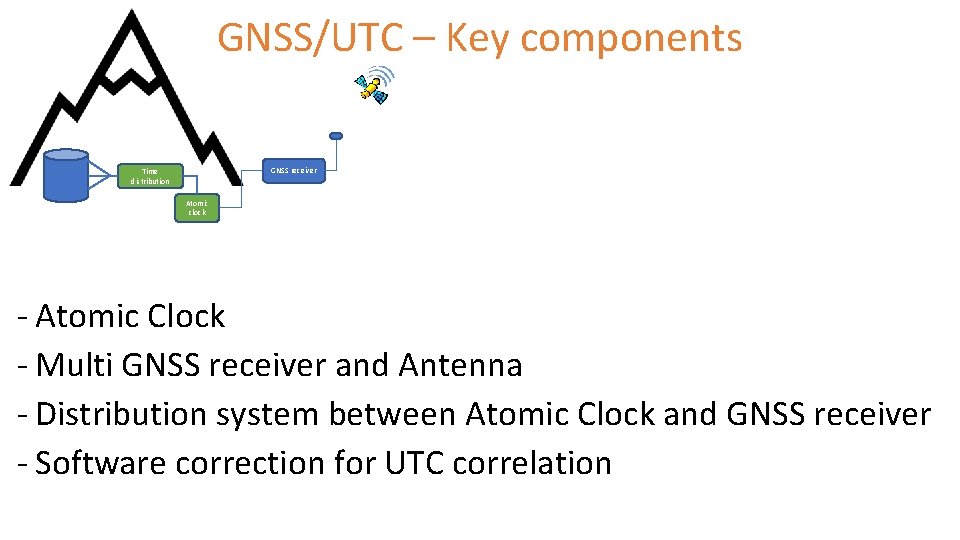
GNSS/UTC – Key components GNSS receiver Time distribution Atomic clock - Atomic Clock - Multi GNSS receiver and Antenna - Distribution system between Atomic Clock and GNSS receiver - Software correction for UTC correlation
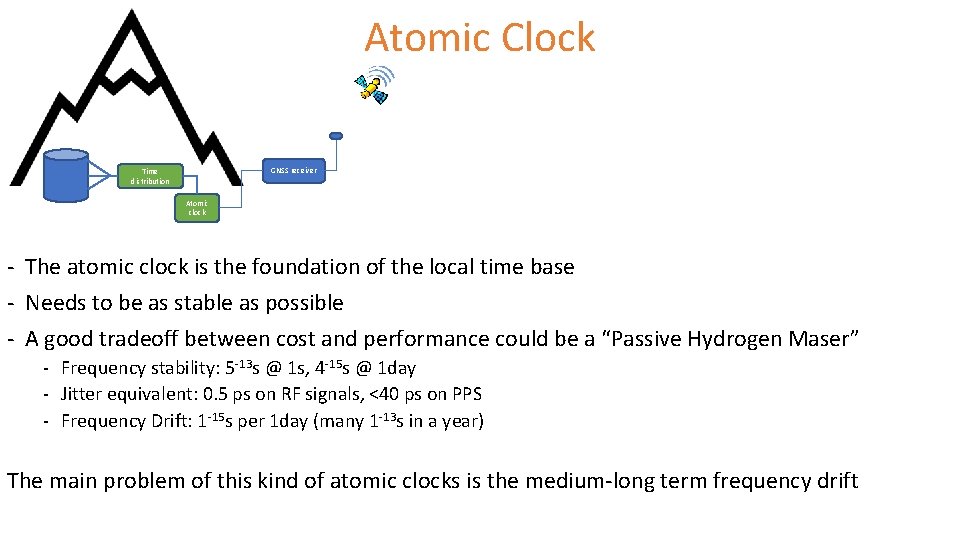
Atomic Clock GNSS receiver Time distribution Atomic clock - The atomic clock is the foundation of the local time base - Needs to be as stable as possible - A good tradeoff between cost and performance could be a “Passive Hydrogen Maser” - Frequency stability: 5 -13 s @ 1 s, 4 -15 s @ 1 day - Jitter equivalent: 0. 5 ps on RF signals, <40 ps on PPS - Frequency Drift: 1 -15 s per 1 day (many 1 -13 s in a year) The main problem of this kind of atomic clocks is the medium-long term frequency drift
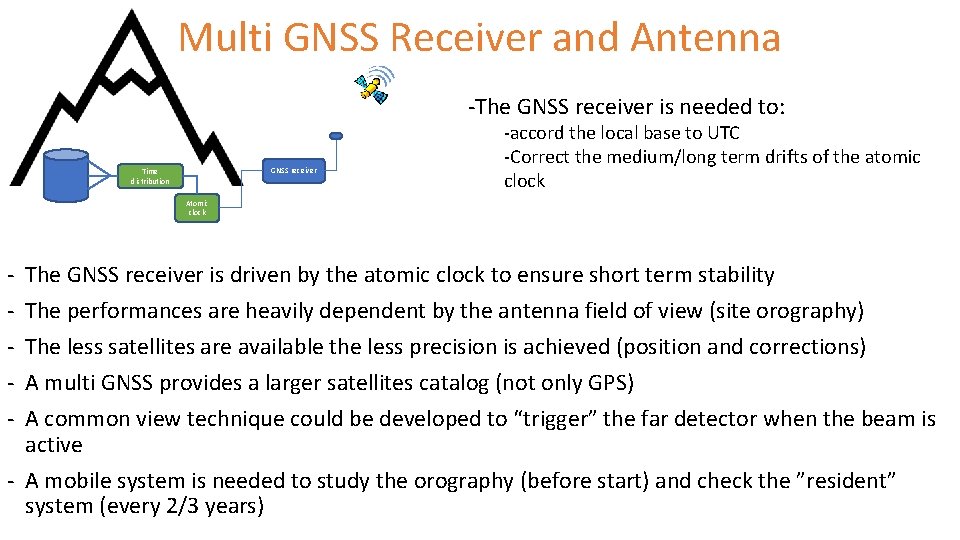
Multi GNSS Receiver and Antenna -The GNSS receiver is needed to: GNSS receiver Time distribution -accord the local base to UTC -Correct the medium/long term drifts of the atomic clock Atomic clock - The GNSS receiver is driven by the atomic clock to ensure short term stability The performances are heavily dependent by the antenna field of view (site orography) The less satellites are available the less precision is achieved (position and corrections) A multi GNSS provides a larger satellites catalog (not only GPS) A common view technique could be developed to “trigger” the far detector when the beam is active - A mobile system is needed to study the orography (before start) and check the ”resident” system (every 2/3 years)

GNSS to local time distribution link GNSS receiver Time distribution Atomic clock - The local atomic clock drives the GNSS receiver with 10 MHz and 1 PPS signals - This link must be synchronous and phase deterministic to have good stability results - A system able to compensate a very long fiber path is needed (same R&D as the local time distribution) - The final choice will be taken once the antenna and receiver location will be decided
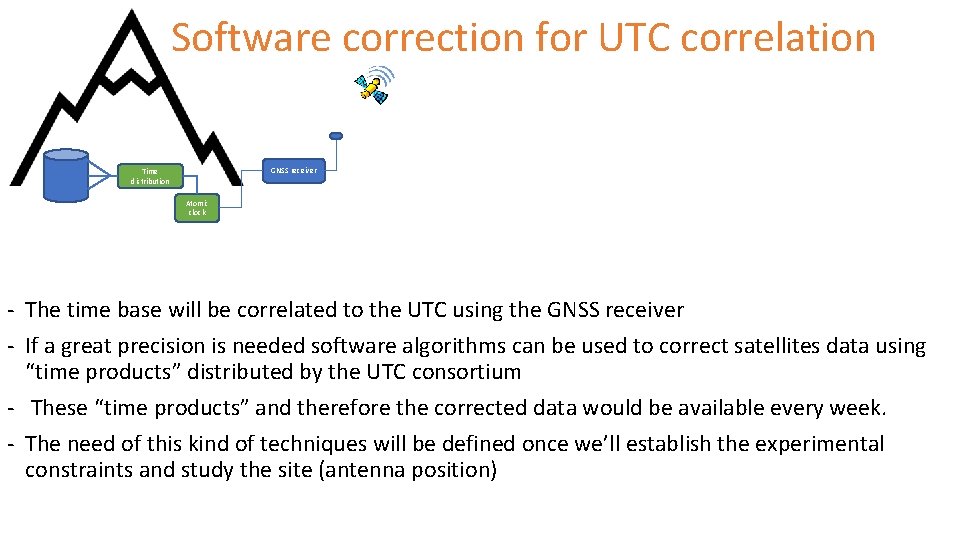
Software correction for UTC correlation GNSS receiver Time distribution Atomic clock - The time base will be correlated to the UTC using the GNSS receiver - If a great precision is needed software algorithms can be used to correct satellites data using “time products” distributed by the UTC consortium - These “time products” and therefore the corrected data would be available every week. - The need of this kind of techniques will be defined once we’ll establish the experimental constraints and study the site (antenna position)
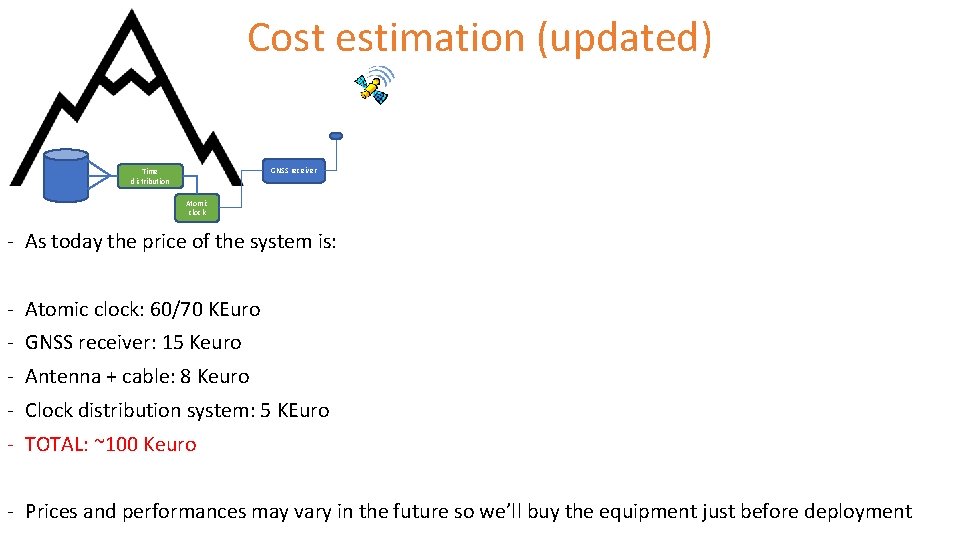
Cost estimation (updated) GNSS receiver Time distribution Atomic clock - As today the price of the system is: - Atomic clock: 60/70 KEuro - GNSS receiver: 15 Keuro - Antenna + cable: 8 Keuro - Clock distribution system: 5 KEuro - TOTAL: ~100 Keuro - Prices and performances may vary in the future so we’ll buy the equipment just before deployment
Summary and next steps • Thanks to our colleagues at SYRTE we have a better idea of the needed architecture • In the near future we’ll keep performing R&D on components and follow technology evolution • To finalize the design, would be very helpful to have: • Well defined experimental constraints (total jitter and UTC resolution) • Early access to the site to study its characteristics and test the satellite signals • Info about the GNSS equipment available and data acquired at the accelerator site
- Slides: 9