
JUNE 2020 HAZARD COMMUNICATION AWARENESS TRAINING Your Right

- Slides: 19
JUNE 2020 HAZARD COMMUNICATION AWARENESS TRAINING Your Right To Know RADIOLOGICAL & ENVIRONMENTAL MANAGEMENT PFW REM
HAZARD COMMUNICATION AWARENESS TRAINING Welcome to Hazard Communication Awareness Training presented by Radiological & Environmental Management or REM at Purdue Fort Wayne! If you have any questions or concerns after viewing this training, please feel free to contact REM. CONTACT US Stephanie Phillips Environmental Health and Safety Manager X 14193 steels@pfw. edu Jenna Biggins Environmental Health and Safety Specialist x 15744 justja 01@pfw. edu Erin Turner Environmental Health and Safety Specialist x 14197 mckien 01@pfw. edu
HAZARD COMMUNICATION AWARENESS TRAINING OVERVIEW • Hazardous materials including chemical, biological and radiological agents are routinely handled on campus and in our research laboratories. • Hazardous chemicals are handled in many, and in fact most areas on campus. • It is essential that individuals handling hazardous materials understand the risk posed by these materials as well as how to protect themselves from these hazards.
HAZARD COMMUNICATION AWARENESS TRAINING WHY DO YOU NEED THIS TRAINING? Working with hazardous materials is not a regular part of your job, however, it is essential that you have some basic information regarding hazardous materials because they may be used in your work area by others or you may enter areas where they are in use.
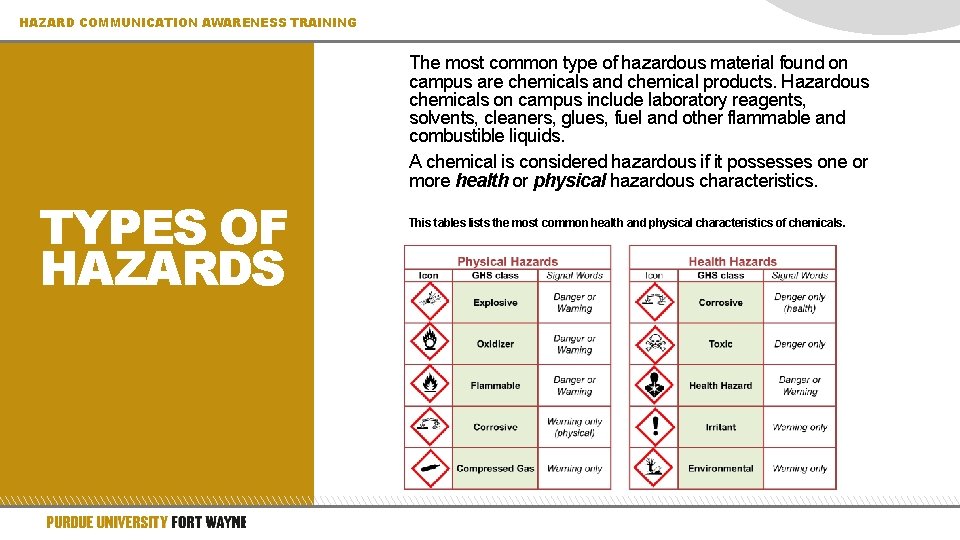
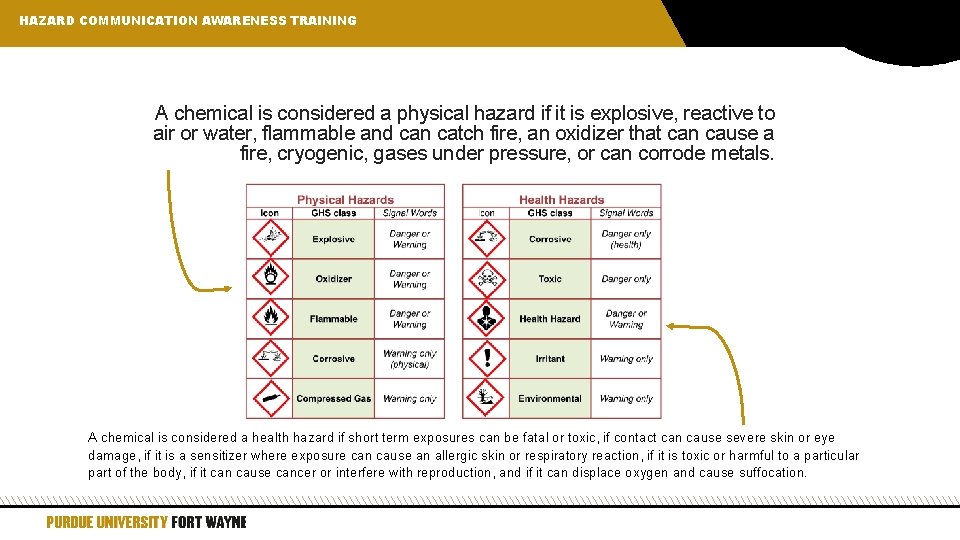
HAZARD COMMUNICATION AWARENESS TRAINING The most common type of hazardous material found on campus are chemicals and chemical products. Hazardous chemicals on campus include laboratory reagents, solvents, cleaners, glues, fuel and other flammable and combustible liquids. A chemical is considered hazardous if it possesses one or more health or physical hazardous characteristics. TYPES OF HAZARDS This tables lists the most common health and physical characteristics of chemicals.
HAZARD COMMUNICATION AWARENESS TRAINING A chemical is considered a physical hazard if it is explosive, reactive to air or water, flammable and can catch fire, an oxidizer that can cause a fire, cryogenic, gases under pressure, or can corrode metals. A chemical is considered a health hazard if short term exposures can be fatal or toxic, if contact can cause severe skin or eye damage, if it is a sensitizer where exposure can cause an allergic skin or respiratory reaction, if it is toxic or harmful to a particular part of the body, if it can cause cancer or interfere with reproduction, and if it can displace oxygen and cause suffocation.
HAZARD COMMUNICATION AWARENESS TRAINING The body may react immediately when exposed to a health hazard, termed an acute health effect or many years following the exposure, termed a chronic health effect. ACUTE VS. CHRONIC The irritation experienced immediately following exposure to ammonia is an example an acute health effect. The development of liver disease or cancer after many years of exposure to a chemical is an example of a chronic health effect.
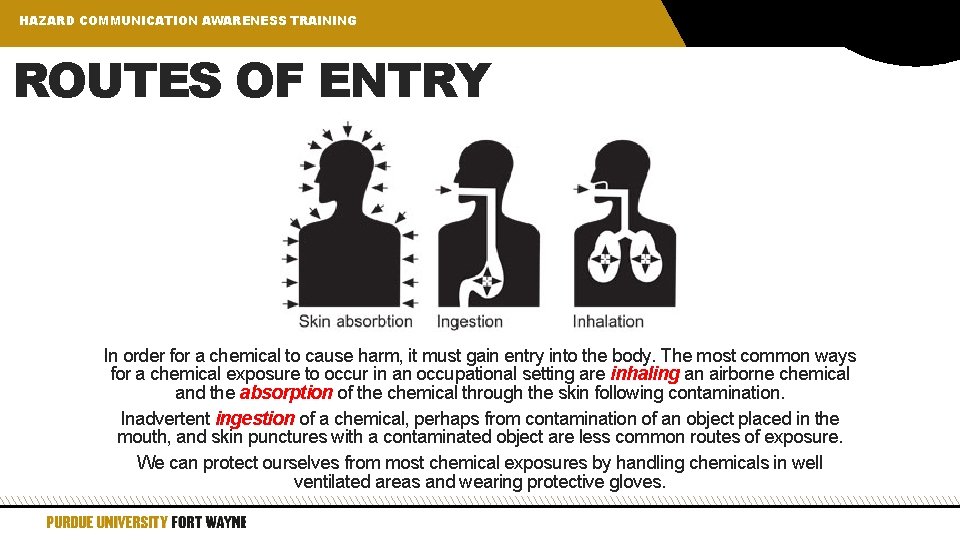
HAZARD COMMUNICATION AWARENESS TRAINING ROUTES OF ENTRY In order for a chemical to cause harm, it must gain entry into the body. The most common ways for a chemical exposure to occur in an occupational setting are inhaling an airborne chemical and the absorption of the chemical through the skin following contamination. Inadvertent ingestion of a chemical, perhaps from contamination of an object placed in the mouth, and skin punctures with a contaminated object are less common routes of exposure. We can protect ourselves from most chemical exposures by handling chemicals in well ventilated areas and wearing protective gloves.
HAZARD COMMUNICATION AWARENESS TRAINING SYMPTOMS OF OVEREXPOSURE Although symptoms of over-exposure vary by chemical, there are some common signs of chemical over-exposure and these include, • Dizziness or light-headedness • Difficultly breathing, coughing or wheezing • Tearing eyes or runny nose • Nausea • Skin reddening, irritation or blistering If chemicals are in use in your area and you develop any of the signs or symptoms of chemical overexposure, you should immediately contact your supervisor or REM will respond and investigate.
HAZARD COMMUNICATION AWARENESS TRAINING It should be noted that the odor threshold of chemicals varies widely and odor is not a good indication of exposure. Some chemicals have a very low odor threshold and their presence in the air can be detected even when a very small quantity of the chemical is actually present, well below the level where any adverse health effects would be experienced. Ethyl Acetate, the solvent found in nail polish remover, is an example of this type of chemical. Other chemicals cannot be detected in the air even when a toxic level is present. We cannot reply on chemical odor detection to determine the safety of an environment.
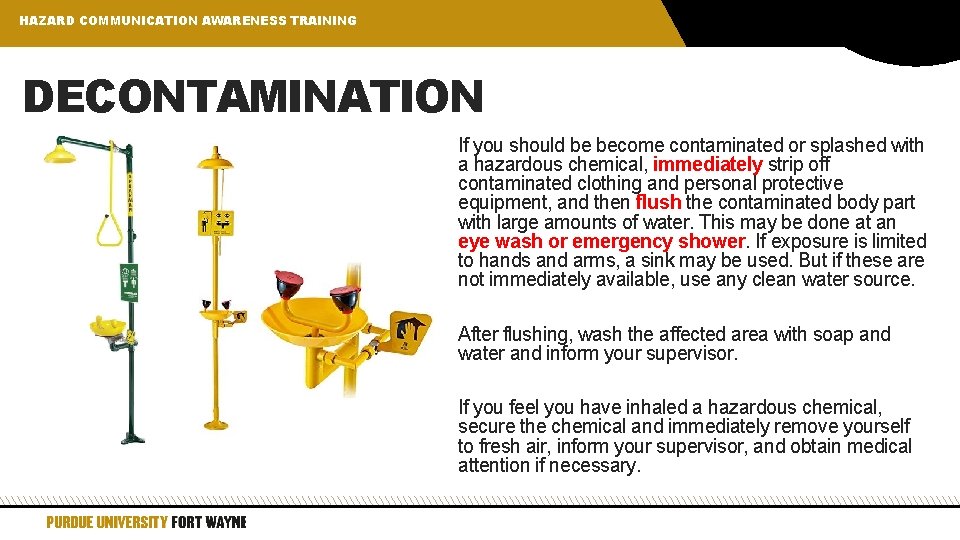
HAZARD COMMUNICATION AWARENESS TRAINING DECONTAMINATION If you should be become contaminated or splashed with a hazardous chemical, immediately strip off contaminated clothing and personal protective equipment, and then flush the contaminated body part with large amounts of water. This may be done at an eye wash or emergency shower. If exposure is limited to hands and arms, a sink may be used. But if these are not immediately available, use any clean water source. After flushing, wash the affected area with soap and water and inform your supervisor. If you feel you have inhaled a hazardous chemical, secure the chemical and immediately remove yourself to fresh air, inform your supervisor, and obtain medical attention if necessary.
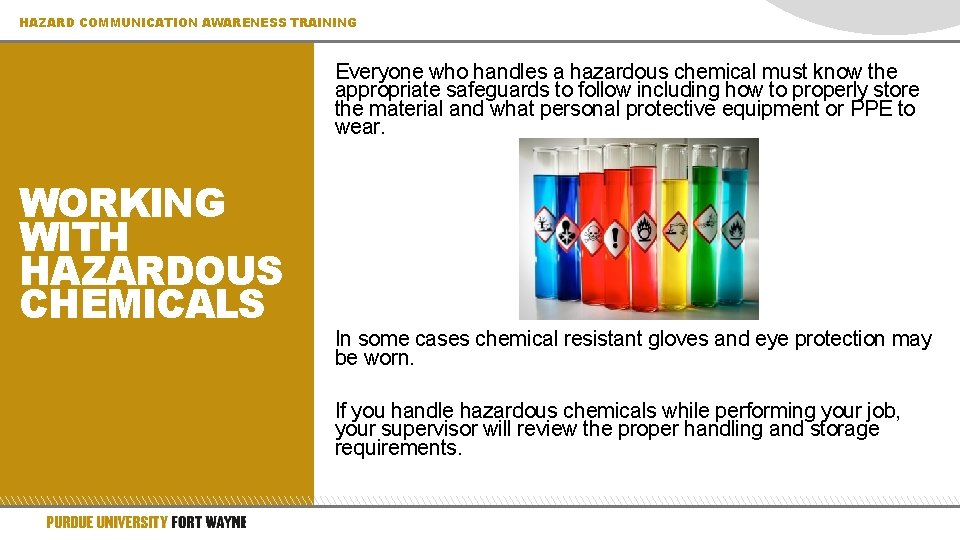
HAZARD COMMUNICATION AWARENESS TRAINING Everyone who handles a hazardous chemical must know the appropriate safeguards to follow including how to properly store the material and what personal protective equipment or PPE to wear. WORKING WITH HAZARDOUS CHEMICALS In some cases chemical resistant gloves and eye protection may be worn. If you handle hazardous chemicals while performing your job, your supervisor will review the proper handling and storage requirements.
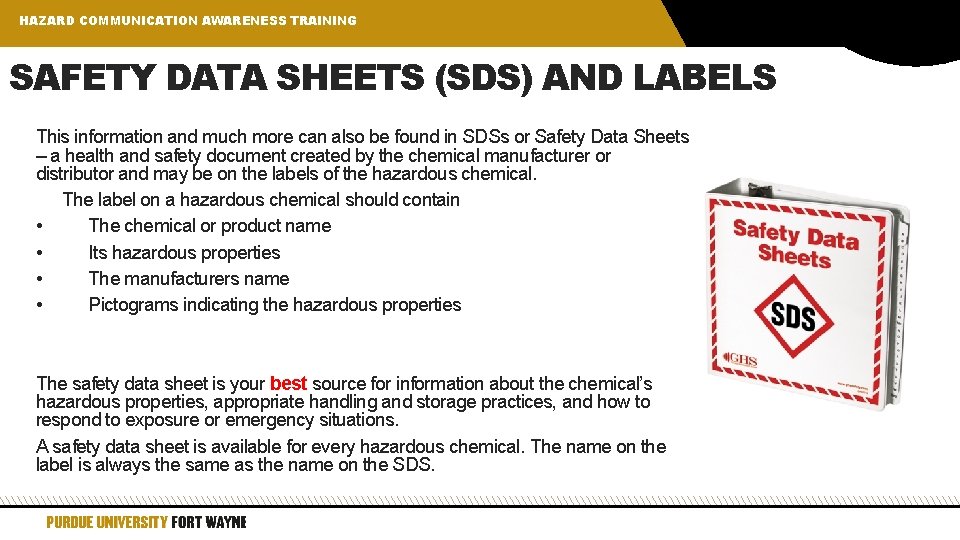
HAZARD COMMUNICATION AWARENESS TRAINING SAFETY DATA SHEETS (SDS) AND LABELS This information and much more can also be found in SDSs or Safety Data Sheets – a health and safety document created by the chemical manufacturer or distributor and may be on the labels of the hazardous chemical. The label on a hazardous chemical should contain • The chemical or product name • Its hazardous properties • The manufacturers name • Pictograms indicating the hazardous properties The safety data sheet is your best source for information about the chemical’s hazardous properties, appropriate handling and storage practices, and how to respond to exposure or emergency situations. A safety data sheet is available for every hazardous chemical. The name on the label is always the same as the name on the SDS.
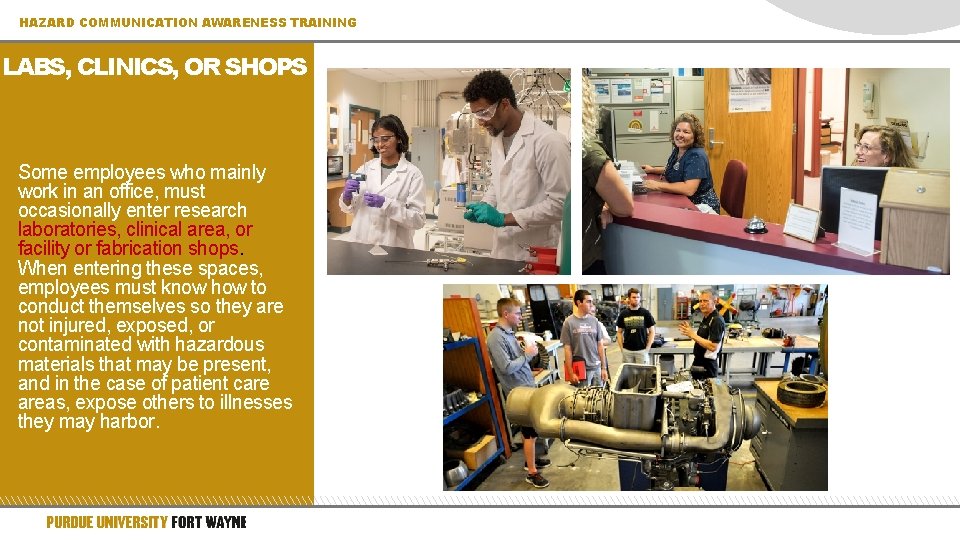
HAZARD COMMUNICATION AWARENESS TRAINING LABS, CLINICS, OR SHOPS Some employees who mainly work in an office, must occasionally enter research laboratories, clinical area, or facility or fabrication shops. When entering these spaces, employees must know how to conduct themselves so they are not injured, exposed, or contaminated with hazardous materials that may be present, and in the case of patient care areas, expose others to illnesses they may harbor.
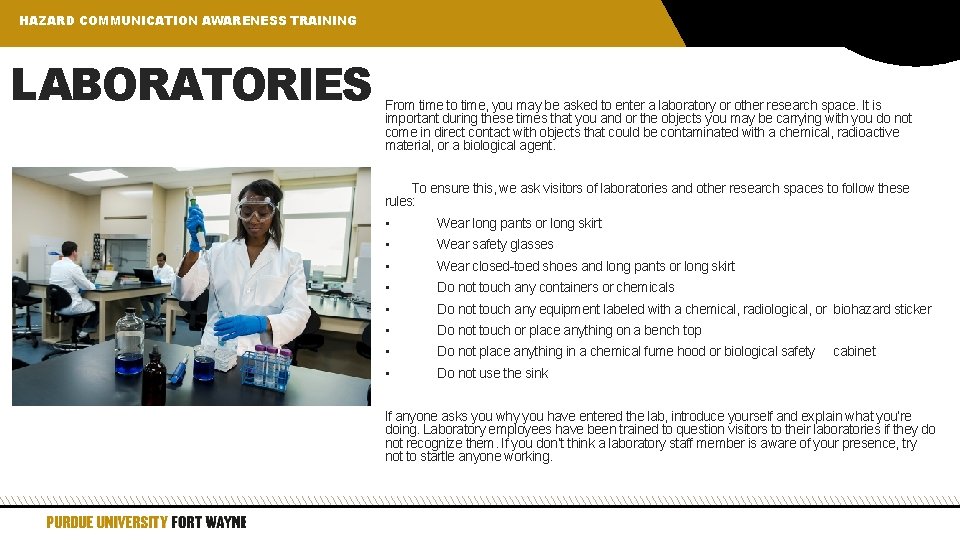
HAZARD COMMUNICATION AWARENESS TRAINING LABORATORIES From time to time, you may be asked to enter a laboratory or other research space. It is important during these times that you and or the objects you may be carrying with you do not come in direct contact with objects that could be contaminated with a chemical, radioactive material, or a biological agent. To ensure this, we ask visitors of laboratories and other research spaces to follow these rules: • • Wear long pants or long skirt Wear safety glasses Wear closed-toed shoes and long pants or long skirt Do not touch any containers or chemicals Do not touch any equipment labeled with a chemical, radiological, or biohazard sticker Do not touch or place anything on a bench top Do not place anything in a chemical fume hood or biological safety cabinet Do not use the sink If anyone asks you why you have entered the lab, introduce yourself and explain what you’re doing. Laboratory employees have been trained to question visitors to their laboratories if they do not recognize them. If you don’t think a laboratory staff member is aware of your presence, try not to startle anyone working.
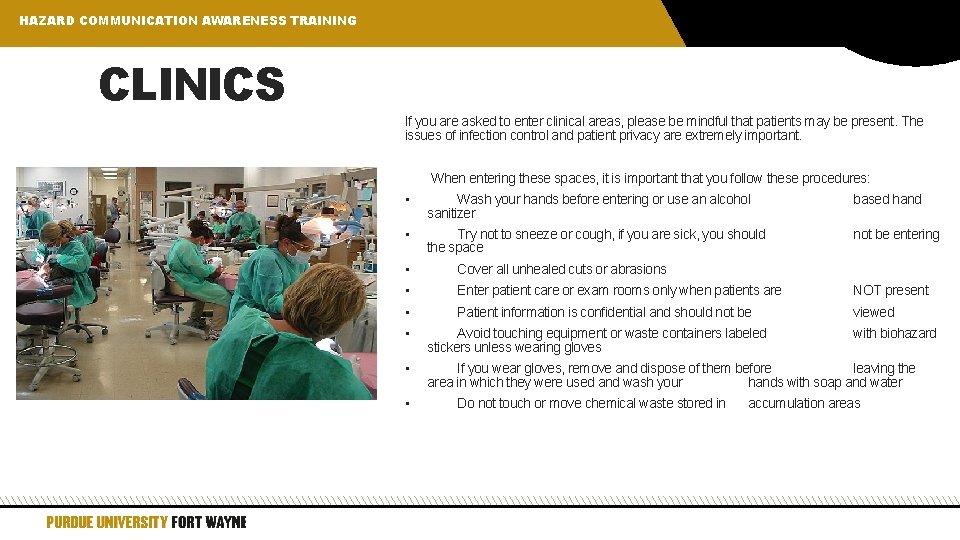
HAZARD COMMUNICATION AWARENESS TRAINING CLINICS If you are asked to enter clinical areas, please be mindful that patients may be present. The issues of infection control and patient privacy are extremely important. When entering these spaces, it is important that you follow these procedures: • Wash your hands before entering or use an alcohol sanitizer based hand • Try not to sneeze or cough, if you are sick, you should the space not be entering • • • Cover all unhealed cuts or abrasions Enter patient care or exam rooms only when patients are NOT present Patient information is confidential and should not be viewed Avoid touching equipment or waste containers labeled stickers unless wearing gloves with biohazard If you wear gloves, remove and dispose of them before leaving the area in which they were used and wash your hands with soap and water Do not touch or move chemical waste stored in accumulation areas
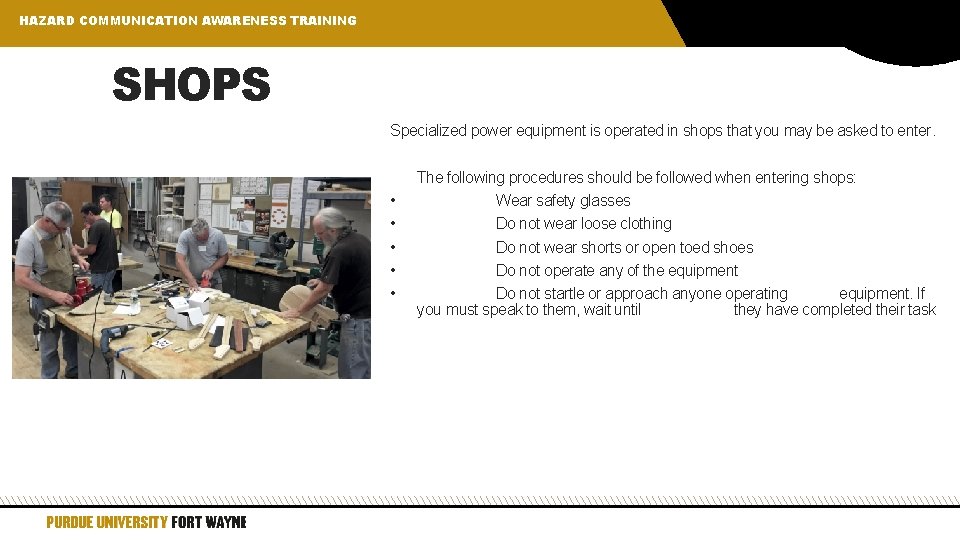
HAZARD COMMUNICATION AWARENESS TRAINING SHOPS Specialized power equipment is operated in shops that you may be asked to enter. • • • The following procedures should be followed when entering shops: Wear safety glasses Do not wear loose clothing Do not wear shorts or open toed shoes Do not operate any of the equipment Do not startle or approach anyone operating equipment. If you must speak to them, wait until they have completed their task
HAZARD COMMUNICATION AWARENESS TRAINING OCCUPATIONAL SAFETY AND HEALTH ADMINISTRATION (OSHA) Hazard Communication Standard In the area of chemical safety, Purdue Fort Wayne follows the requirements of the Occupational Safety and Health Administration’s (OSHA) Hazard Communication Standard. This standard was enacted to ensure that all chemical hazards are evaluated and this information is disseminated to employees by safety data sheets, labels, and employee training. The major requirements of OSHA’s Hazard Communication Standard are: • Identification of chemical hazards by manufacturers and importers • Development of a written program describing an institution’s compliance strategy • All hazardous chemicals are labeled or other form of warning provided • SDSs are available for hazardous chemicals • Training is provided to employees handling hazardous chemicals
HAZARD COMMUNICATION AWARENESS TRAINING THANK YOU! If you have any questions or concerns after viewing this training, please feel free to contact REM. CONTACT US Stephanie Phillips Environmental Health and Safety Manager steels@pfw. edu X 14193 Jenna Biggins Environmental Health and Safety Specialist justja 01@pfw. edu x 15744 Erin Turner Environmental Health and Safety Specialist mckien 01@pfw. edu x 14197