
June 2020 doc IEEE 802 11 201044 r
- Slides: 15
June 2020 doc. : IEEE 802. 11 -20/1044 r 0 MLO: Protocol for TID-to-link negotiation Date: 2020 -02 -26 Name Affiliation Abhishek Patil Qualcomm Inc. Duncan Ho Qualcomm Inc. George Cherian Qualcomm Inc. Alfred Asterjadhi Qualcomm Inc. Submission Address Phone Email appatil@qti. qualcomm. com Slide 1 Abhishek P (Qualcomm), et. al. ,
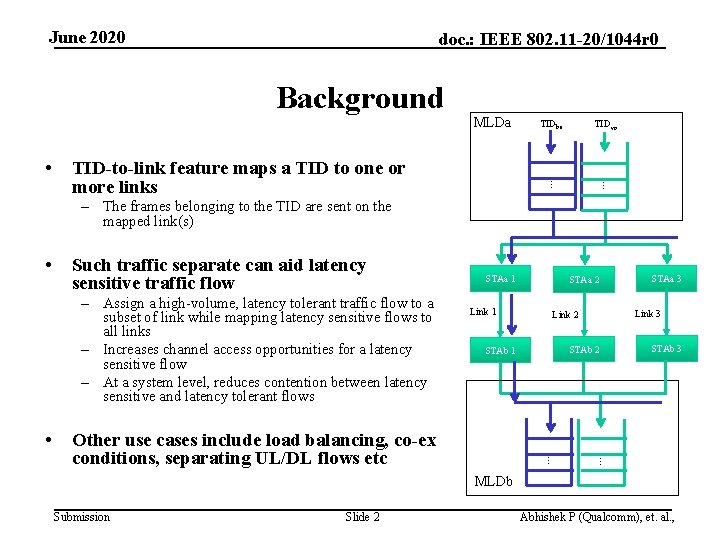
June 2020 doc. : IEEE 802. 11 -20/1044 r 0 Background MLDa TID-to-link feature maps a TID to one or more links TIDvo … … • TIDbe – The frames belonging to the TID are sent on the mapped link(s) – Assign a high-volume, latency tolerant traffic flow to a subset of link while mapping latency sensitive flows to all links – Increases channel access opportunities for a latency sensitive flow – At a system level, reduces contention between latency sensitive and latency tolerant flows • STAa 1 STAa 2 Link 1 Other use cases include load balancing, co-ex conditions, separating UL/DL flows etc Link 3 Link 2 STAb 1 STAa 3 STAb 3 … Such traffic separate can aid latency sensitive traffic flow … • MLDb Submission Slide 2 Abhishek P (Qualcomm), et. al. ,
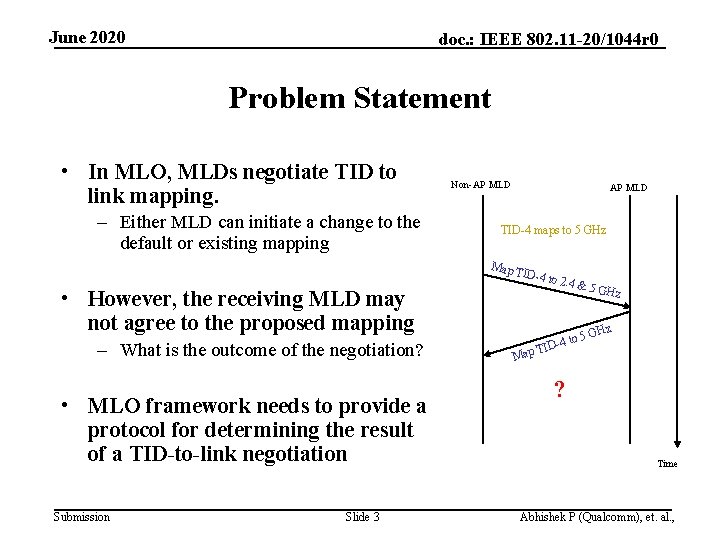
June 2020 doc. : IEEE 802. 11 -20/1044 r 0 Problem Statement • In MLO, MLDs negotiate TID to link mapping. – Either MLD can initiate a change to the default or existing mapping Non-AP MLD TID-4 maps to 5 GHz Map T ID-4 t • However, the receiving MLD may not agree to the proposed mapping – What is the outcome of the negotiation? • MLO framework needs to provide a protocol for determining the result of a TID-to-link negotiation Submission Slide 3 Map o 2. 4 & 4 to TID- 5 GHz z 5 GH ? Time Abhishek P (Qualcomm), et. al. ,
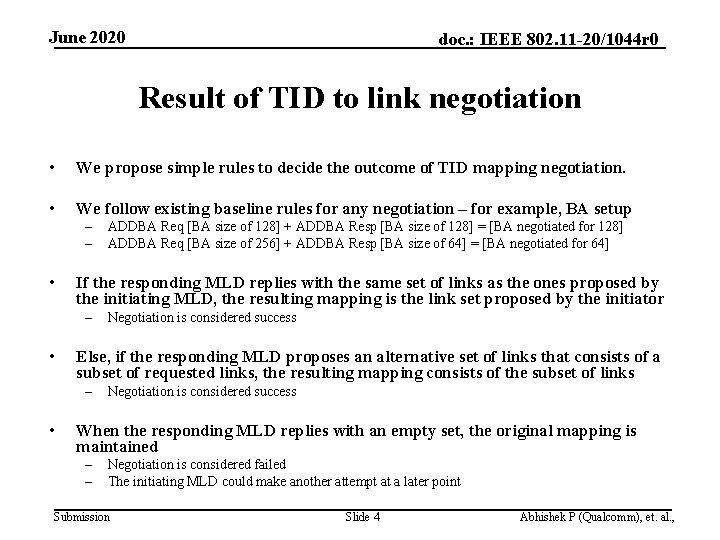
June 2020 doc. : IEEE 802. 11 -20/1044 r 0 Result of TID to link negotiation • We propose simple rules to decide the outcome of TID mapping negotiation. • We follow existing baseline rules for any negotiation – for example, BA setup – – • If the responding MLD replies with the same set of links as the ones proposed by the initiating MLD, the resulting mapping is the link set proposed by the initiator – • Negotiation is considered success Else, if the responding MLD proposes an alternative set of links that consists of a subset of requested links, the resulting mapping consists of the subset of links – • ADDBA Req [BA size of 128] + ADDBA Resp [BA size of 128] = [BA negotiated for 128] ADDBA Req [BA size of 256] + ADDBA Resp [BA size of 64] = [BA negotiated for 64] Negotiation is considered success When the responding MLD replies with an empty set, the original mapping is maintained – – Negotiation is considered failed The initiating MLD could make another attempt at a later point Submission Slide 4 Abhishek P (Qualcomm), et. al. ,
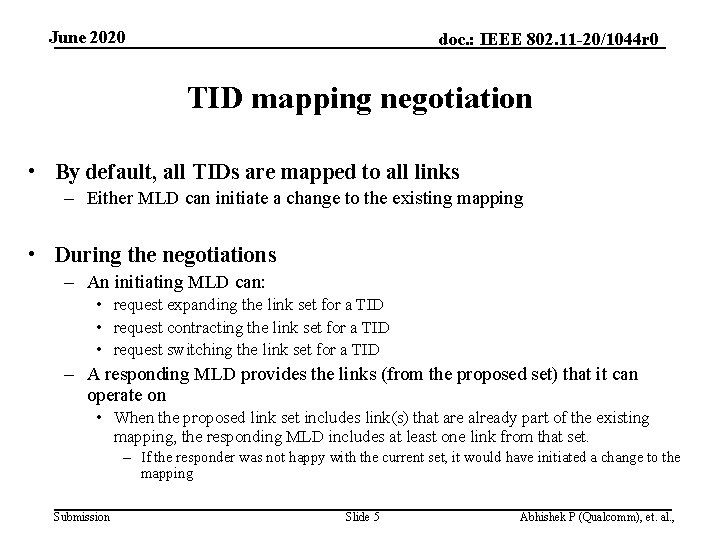
June 2020 doc. : IEEE 802. 11 -20/1044 r 0 TID mapping negotiation • By default, all TIDs are mapped to all links – Either MLD can initiate a change to the existing mapping • During the negotiations – An initiating MLD can: • request expanding the link set for a TID • request contracting the link set for a TID • request switching the link set for a TID – A responding MLD provides the links (from the proposed set) that it can operate on • When the proposed link set includes link(s) that are already part of the existing mapping, the responding MLD includes at least one link from that set. – If the responder was not happy with the current set, it would have initiated a change to the mapping Submission Slide 5 Abhishek P (Qualcomm), et. al. ,
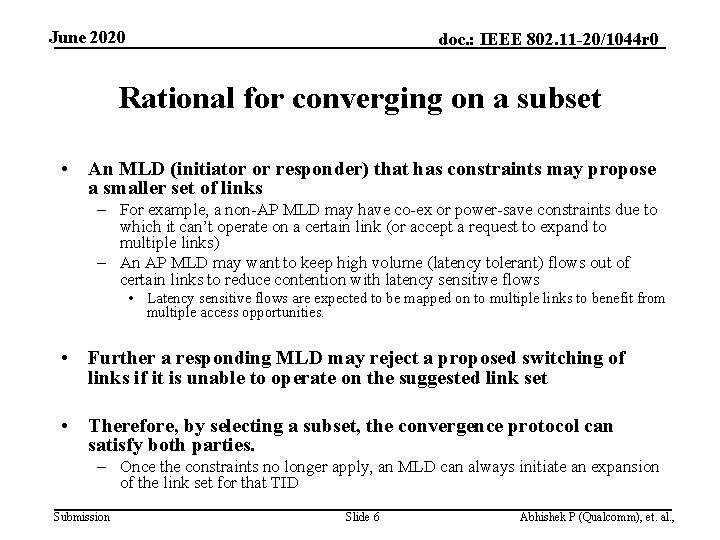
June 2020 doc. : IEEE 802. 11 -20/1044 r 0 Rational for converging on a subset • An MLD (initiator or responder) that has constraints may propose a smaller set of links – For example, a non-AP MLD may have co-ex or power-save constraints due to which it can’t operate on a certain link (or accept a request to expand to multiple links) – An AP MLD may want to keep high volume (latency tolerant) flows out of certain links to reduce contention with latency sensitive flows • Latency sensitive flows are expected to be mapped on to multiple links to benefit from multiple access opportunities. • Further a responding MLD may reject a proposed switching of links if it is unable to operate on the suggested link set • Therefore, by selecting a subset, the convergence protocol can satisfy both parties. – Once the constraints no longer apply, an MLD can always initiate an expansion of the link set for that TID Submission Slide 6 Abhishek P (Qualcomm), et. al. ,
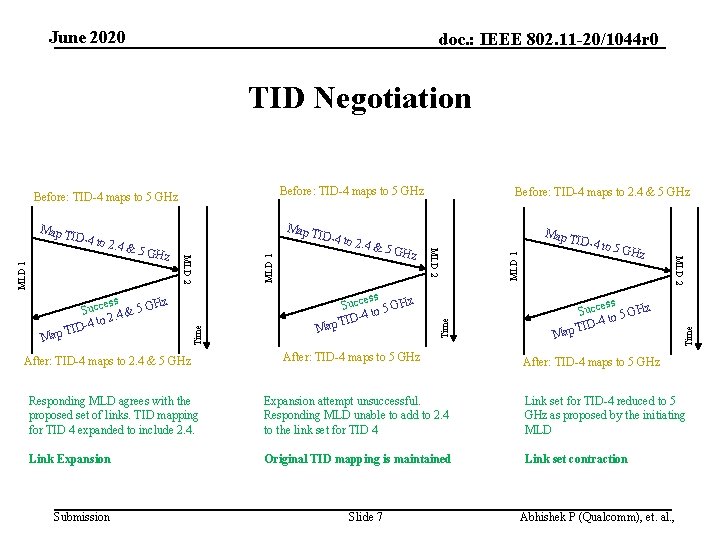
June 2020 doc. : IEEE 802. 11 -20/1044 r 0 TID Negotiation Before: TID-4 maps to 5 GHz After: TID-4 maps to 2. 4 & 5 GHz ess Succ o 5 GHz -4 t p TID Ma After: TID-4 maps to 5 GHz MLD 1 5 GHz Map T ID-4 t o 5 GH z ess Succ o 5 GHz t ID-4 T p Ma Time T Map Time Hz ess Succ. 4 & 5 G to 2 ID-4 o 2. 4 & MLD 2 5 GHz ID-4 t MLD 1 Map T MLD 2 ID-4 t o 2. 4 & MLD 1 Map T Before: TID-4 maps to 2. 4 & 5 GHz Time Before: TID-4 maps to 5 GHz After: TID-4 maps to 5 GHz Responding MLD agrees with the proposed set of links. TID mapping for TID 4 expanded to include 2. 4. Expansion attempt unsuccessful. Responding MLD unable to add to 2. 4 to the link set for TID 4 Link set for TID-4 reduced to 5 GHz as proposed by the initiating MLD Link Expansion Original TID mapping is maintained Link set contraction Submission Slide 7 Abhishek P (Qualcomm), et. al. ,
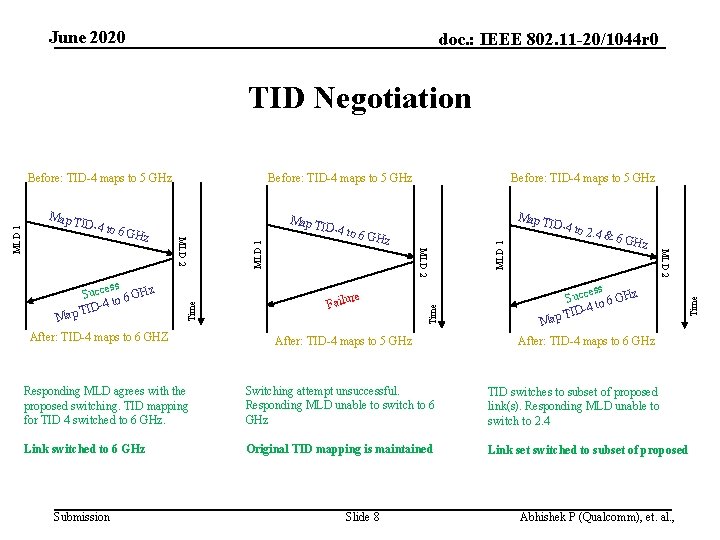
June 2020 doc. : IEEE 802. 11 -20/1044 r 0 TID Negotiation Before: TID-4 maps to 5 GHz After: TID-4 maps to 6 GHZ z e r Failu After: TID-4 maps to 5 GHz o 2. 4 & 6 GHz ess Succ o 6 GHz -4 t p TID Ma Time ID-4 t o 6 GH MLD 2 Ma Map T MLD 2 ess Succ o 6 GHz -4 t p TID ID-4 t MLD 1 z Map T Before: TID-4 maps to 5 GHz Time o 6 GH MLD 1 ID-4 t Time Map T MLD 2 MLD 1 Before: TID-4 maps to 5 GHz After: TID-4 maps to 6 GHz Responding MLD agrees with the proposed switching. TID mapping for TID 4 switched to 6 GHz. Switching attempt unsuccessful. Responding MLD unable to switch to 6 GHz TID switches to subset of proposed link(s). Responding MLD unable to switch to 2. 4 Link switched to 6 GHz Original TID mapping is maintained Link set switched to subset of proposed Submission Slide 8 Abhishek P (Qualcomm), et. al. ,
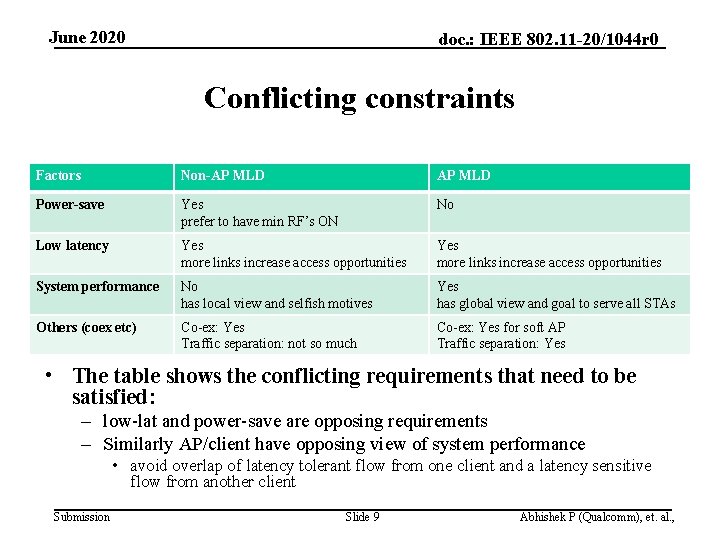
June 2020 doc. : IEEE 802. 11 -20/1044 r 0 Conflicting constraints Factors Non-AP MLD Power-save Yes prefer to have min RF’s ON No Low latency Yes more links increase access opportunities System performance No has local view and selfish motives Yes has global view and goal to serve all STAs Others (coex etc) Co-ex: Yes Traffic separation: not so much Co-ex: Yes for soft AP Traffic separation: Yes • The table shows the conflicting requirements that need to be satisfied: – low-lat and power-save are opposing requirements – Similarly AP/client have opposing view of system performance • avoid overlap of latency tolerant flow from one client and a latency sensitive flow from another client Submission Slide 9 Abhishek P (Qualcomm), et. al. ,
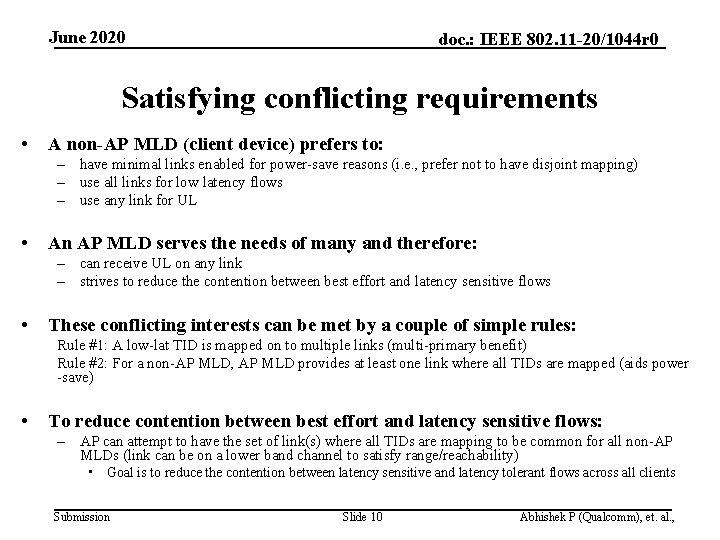
June 2020 doc. : IEEE 802. 11 -20/1044 r 0 Satisfying conflicting requirements • A non-AP MLD (client device) prefers to: – have minimal links enabled for power-save reasons (i. e. , prefer not to have disjoint mapping) – use all links for low latency flows – use any link for UL • An AP MLD serves the needs of many and therefore: – can receive UL on any link – strives to reduce the contention between best effort and latency sensitive flows • These conflicting interests can be met by a couple of simple rules: Rule #1: A low-lat TID is mapped on to multiple links (multi-primary benefit) Rule #2: For a non-AP MLD, AP MLD provides at least one link where all TIDs are mapped (aids power -save) • To reduce contention between best effort and latency sensitive flows: – AP can attempt to have the set of link(s) where all TIDs are mapping to be common for all non-AP MLDs (link can be on a lower band channel to satisfy range/reachability) • Goal is to reduce the contention between latency sensitive and latency tolerant flows across all clients Submission Slide 10 Abhishek P (Qualcomm), et. al. ,
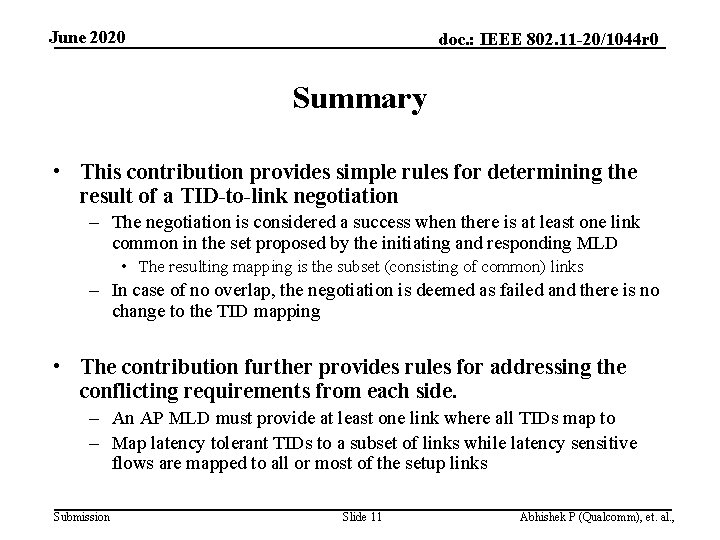
June 2020 doc. : IEEE 802. 11 -20/1044 r 0 Summary • This contribution provides simple rules for determining the result of a TID-to-link negotiation – The negotiation is considered a success when there is at least one link common in the set proposed by the initiating and responding MLD • The resulting mapping is the subset (consisting of common) links – In case of no overlap, the negotiation is deemed as failed and there is no change to the TID mapping • The contribution further provides rules for addressing the conflicting requirements from each side. – An AP MLD must provide at least one link where all TIDs map to – Map latency tolerant TIDs to a subset of links while latency sensitive flows are mapped to all or most of the setup links Submission Slide 11 Abhishek P (Qualcomm), et. al. ,
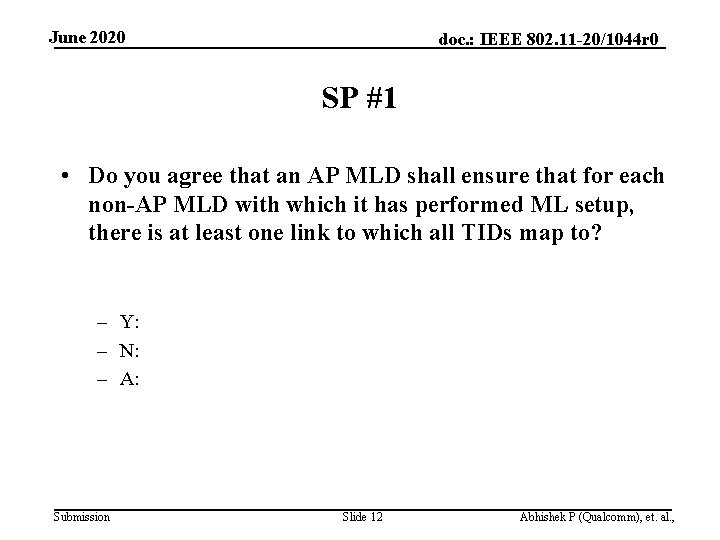
June 2020 doc. : IEEE 802. 11 -20/1044 r 0 SP #1 • Do you agree that an AP MLD shall ensure that for each non-AP MLD with which it has performed ML setup, there is at least one link to which all TIDs map to? – Y: – N: – A: Submission Slide 12 Abhishek P (Qualcomm), et. al. ,
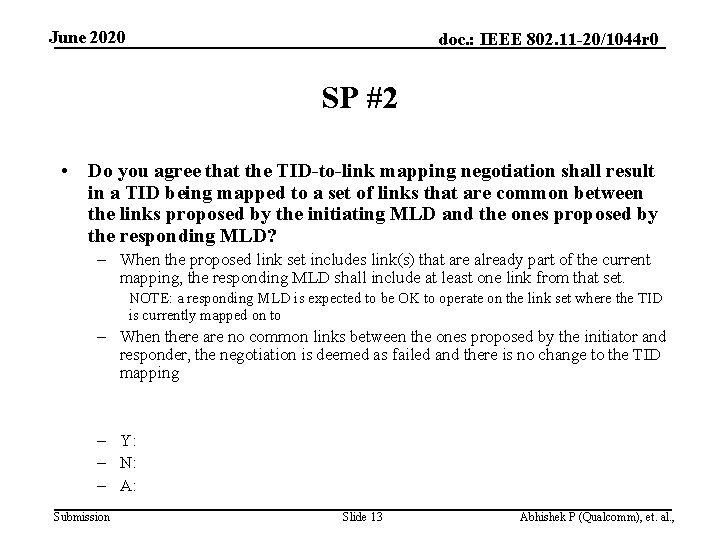
June 2020 doc. : IEEE 802. 11 -20/1044 r 0 SP #2 • Do you agree that the TID-to-link mapping negotiation shall result in a TID being mapped to a set of links that are common between the links proposed by the initiating MLD and the ones proposed by the responding MLD? – When the proposed link set includes link(s) that are already part of the current mapping, the responding MLD shall include at least one link from that set. NOTE: a responding MLD is expected to be OK to operate on the link set where the TID is currently mapped on to – When there are no common links between the ones proposed by the initiator and responder, the negotiation is deemed as failed and there is no change to the TID mapping – Y: – N: – A: Submission Slide 13 Abhishek P (Qualcomm), et. al. ,
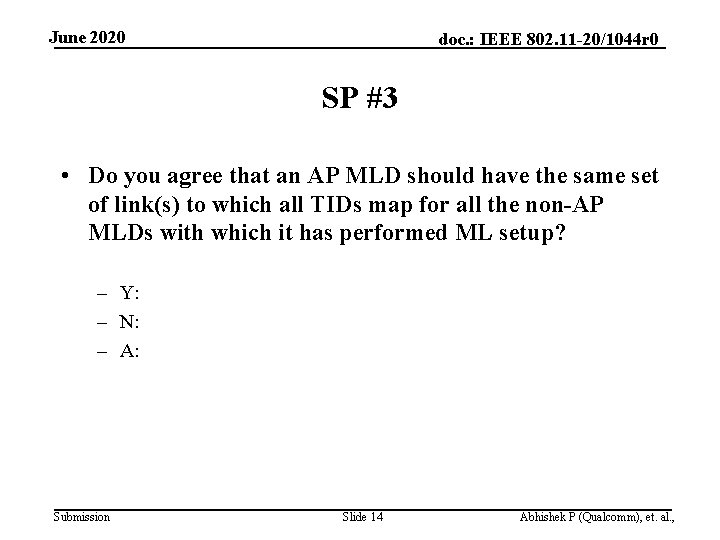
June 2020 doc. : IEEE 802. 11 -20/1044 r 0 SP #3 • Do you agree that an AP MLD should have the same set of link(s) to which all TIDs map for all the non-AP MLDs with which it has performed ML setup? – Y: – N: – A: Submission Slide 14 Abhishek P (Qualcomm), et. al. ,
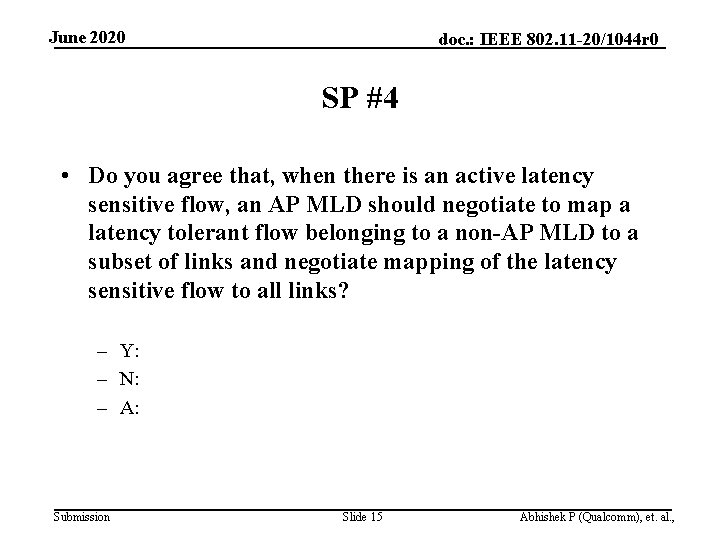
June 2020 doc. : IEEE 802. 11 -20/1044 r 0 SP #4 • Do you agree that, when there is an active latency sensitive flow, an AP MLD should negotiate to map a latency tolerant flow belonging to a non-AP MLD to a subset of links and negotiate mapping of the latency sensitive flow to all links? – Y: – N: – A: Submission Slide 15 Abhishek P (Qualcomm), et. al. ,