
June 2020 doc IEEE 802 11 200908 r
- Slides: 20
June 2020 doc: IEEE 802. 11 -20/0908 r 1 Multilink Traffic Stream (TS) Operation Date: 2020 -06 -29 Authors: Rev 1: Incl. Q&A on the July 15 th confcall (P. 14) and comparison between TS and SCS (P. 15); SPs are amended as well; Submission Slide 1 Harry Wang et al (Tencent)
June 2020 doc: IEEE 802. 11 -20/0908 r 1 Single Link TS Operation Overview • Traffic Stream (TS) is established between SMEs by using ADDTS request and response frames • MSDUs within a TS should be delivered subject to the Qo. S parameter values provided to the MAC in a particular TSPEC. – TSPEC is a result of negotiation, based on actual requirements from one or more applications as well as actual MAC and PHY capabilities – MAC entities determine the TSPEC applicable for delivery of MSDUs belonging to a particular TS using the priority parameter provided with those MSDUs at the MAC SAP. • TSPEC is accountable to enable scheduling and admission control for MAC data services – Admission control can be applied to both EDCA and HCCA; • Traffic Classification (TCLAS) is used to associate a Layer-2 traffic stream to a higher layer application, or a category of applications • TID (8 -15) = TSID comes from the ‘priority’ parameter at the MAC-SAP along with an MSDU; Submission Slide 2 Harry Wang et al (Tencent)
June 2020 doc: IEEE 802. 11 -20/0908 r 1 . 11 Amendments on TS Operation • Firstly introduced by 802. 11 e • In support of Fast BSS transition by 802. 11 r • In support of Service Provider Interface (SSPN) and Expedited Bandwidth Request (EBR) by 802. 11 u • U-APSD Coexistence by 802. 11 v • Higher layer stream ID and AP-initiated ADDTS by 802. 11 aa • DMG extensions by 802. 11 ad for SP allocation • In support of MU transmission by 802. 11 ax Submission Slide 3 Harry Wang et al (Tencent)
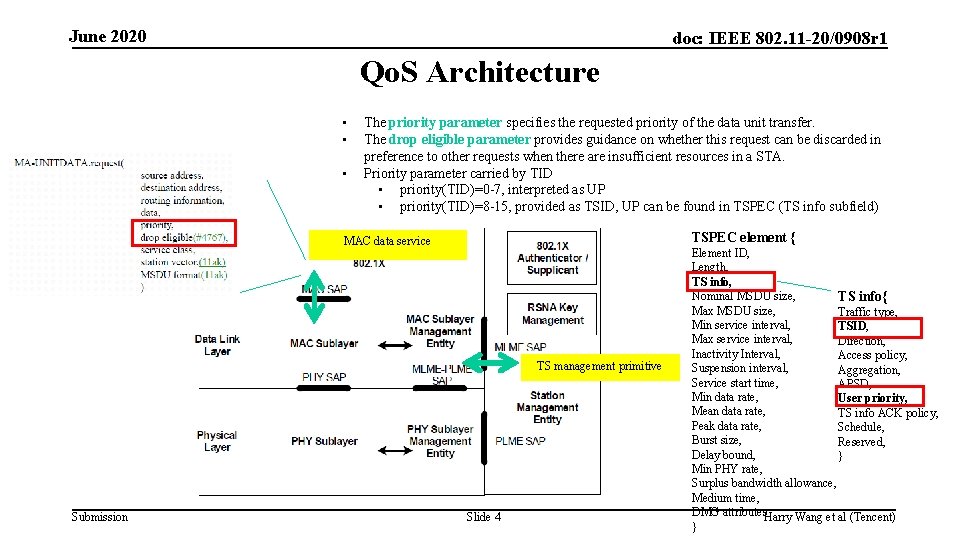
June 2020 doc: IEEE 802. 11 -20/0908 r 1 Qo. S Architecture • • • The priority parameter specifies the requested priority of the data unit transfer. The drop eligible parameter provides guidance on whether this request can be discarded in preference to other requests when there are insufficient resources in a STA. Priority parameter carried by TID • priority(TID)=0 -7, interpreted as UP • priority(TID)=8 -15, provided as TSID, UP can be found in TSPEC (TS info subfield) TSPEC element { MAC data service TS management primitive Submission Slide 4 Element ID, Length, TS info, Nominal MSDU size, TS info{ Max MSDU size, Traffic type, Min service interval, TSID, Max service interval, Direction, Inactivity Interval, Access policy, Suspension interval, Aggregation, Service start time, APSD, Min data rate, User priority, Mean data rate, TS info ACK policy, Peak data rate, Schedule, Burst size, Reserved, Delay bound, } Min PHY rate, Surplus bandwidth allowance, Medium time, DMG attributes. Harry Wang et al (Tencent) }
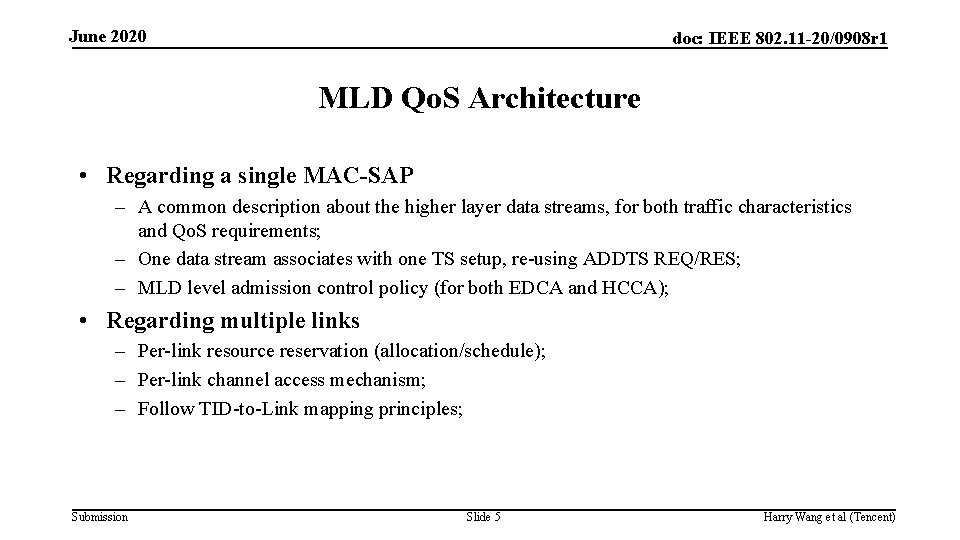
June 2020 doc: IEEE 802. 11 -20/0908 r 1 MLD Qo. S Architecture • Regarding a single MAC-SAP – A common description about the higher layer data streams, for both traffic characteristics and Qo. S requirements; – One data stream associates with one TS setup, re-using ADDTS REQ/RES; – MLD level admission control policy (for both EDCA and HCCA); • Regarding multiple links – Per-link resource reservation (allocation/schedule); – Per-link channel access mechanism; – Follow TID-to-Link mapping principles; Submission Slide 5 Harry Wang et al (Tencent)
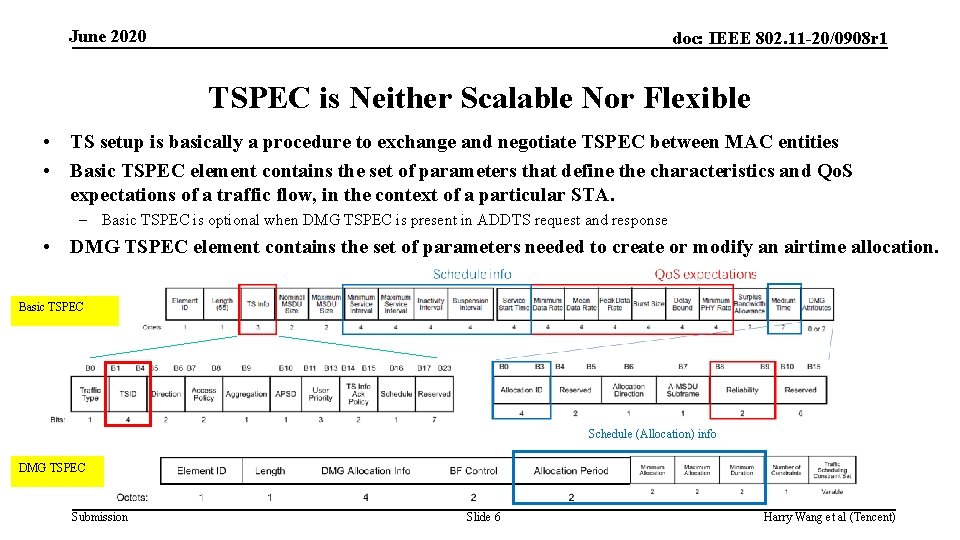
June 2020 doc: IEEE 802. 11 -20/0908 r 1 TSPEC is Neither Scalable Nor Flexible • TS setup is basically a procedure to exchange and negotiate TSPEC between MAC entities • Basic TSPEC element contains the set of parameters that define the characteristics and Qo. S expectations of a traffic flow, in the context of a particular STA. – Basic TSPEC is optional when DMG TSPEC is present in ADDTS request and response • DMG TSPEC element contains the set of parameters needed to create or modify an airtime allocation. Basic TSPEC Schedule (Allocation) info DMG TSPEC Submission Slide 6 Harry Wang et al (Tencent)
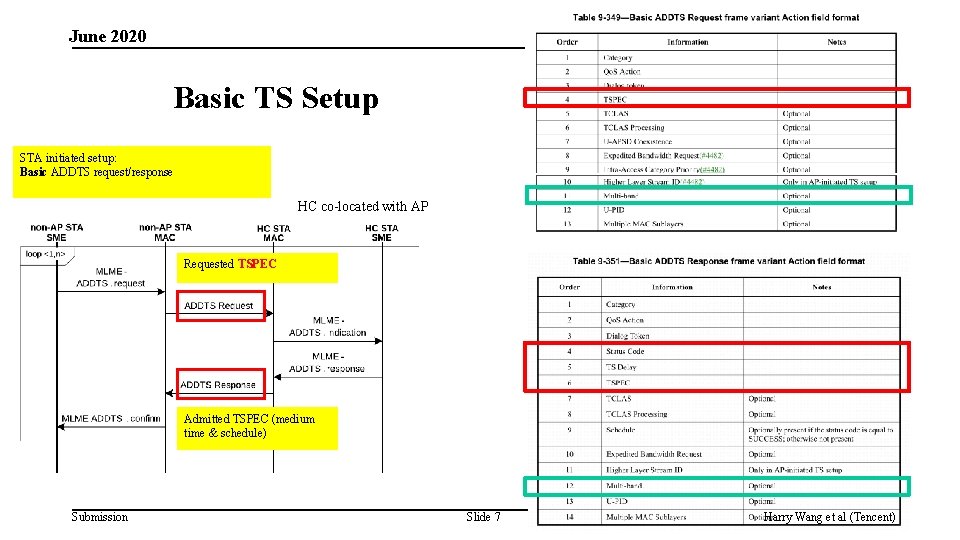
June 2020 doc: IEEE 802. 11 -20/0908 r 1 Basic TS Setup STA initiated setup: Basic ADDTS request/response HC co-located with AP Requested TSPEC Admitted TSPEC (medium time & schedule) Submission Slide 7 Harry Wang et al (Tencent)
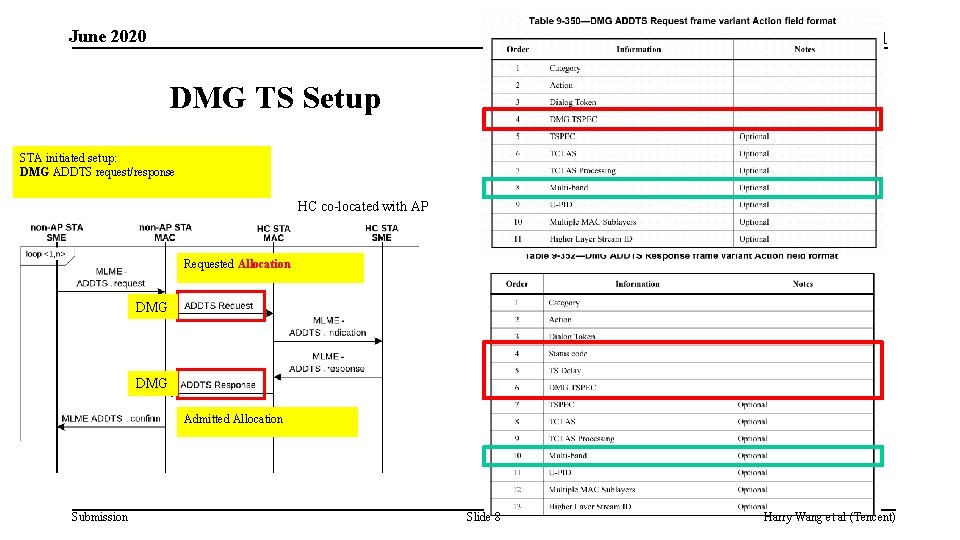
June 2020 doc: IEEE 802. 11 -20/0908 r 1 DMG TS Setup STA initiated setup: DMG ADDTS request/response HC co-located with AP Requested Allocation DMG Admitted Allocation Submission Slide 8 Harry Wang et al (Tencent)
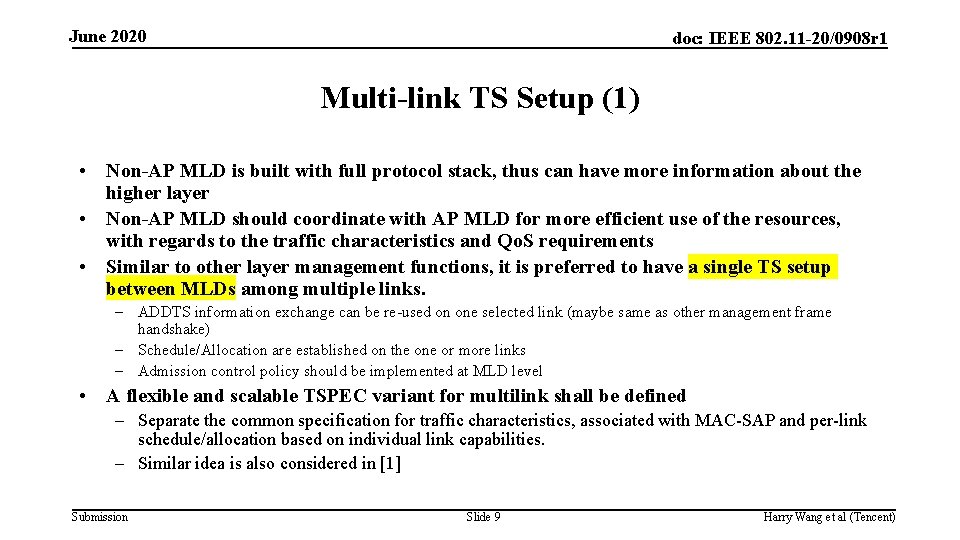
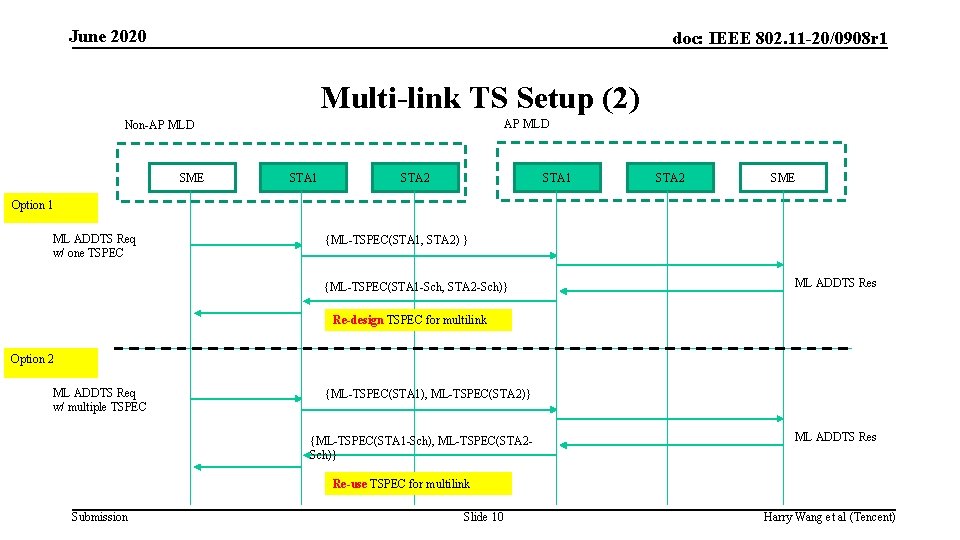
June 2020 doc: IEEE 802. 11 -20/0908 r 1 Multi-link TS Setup (1) • Non-AP MLD is built with full protocol stack, thus can have more information about the higher layer • Non-AP MLD should coordinate with AP MLD for more efficient use of the resources, with regards to the traffic characteristics and Qo. S requirements • Similar to other layer management functions, it is preferred to have a single TS setup between MLDs among multiple links. – ADDTS information exchange can be re-used on one selected link (maybe same as other management frame handshake) – Schedule/Allocation are established on the one or more links – Admission control policy should be implemented at MLD level • A flexible and scalable TSPEC variant for multilink shall be defined – Separate the common specification for traffic characteristics, associated with MAC-SAP and per-link schedule/allocation based on individual link capabilities. – Similar idea is also considered in [1] Submission Slide 9 Harry Wang et al (Tencent)
June 2020 doc: IEEE 802. 11 -20/0908 r 1 Multi-link TS Setup (2) AP MLD Non-AP MLD SME STA 1 STA 2 SME Option 1 ML ADDTS Req w/ one TSPEC {ML-TSPEC(STA 1, STA 2) } {ML-TSPEC(STA 1 -Sch, STA 2 -Sch)} ML ADDTS Res Re-design TSPEC for multilink Option 2 ML ADDTS Req w/ multiple TSPEC {ML-TSPEC(STA 1), ML-TSPEC(STA 2)} {ML-TSPEC(STA 1 -Sch), ML-TSPEC(STA 2 Sch)} ML ADDTS Res Re-use TSPEC for multilink Submission Slide 10 Harry Wang et al (Tencent)
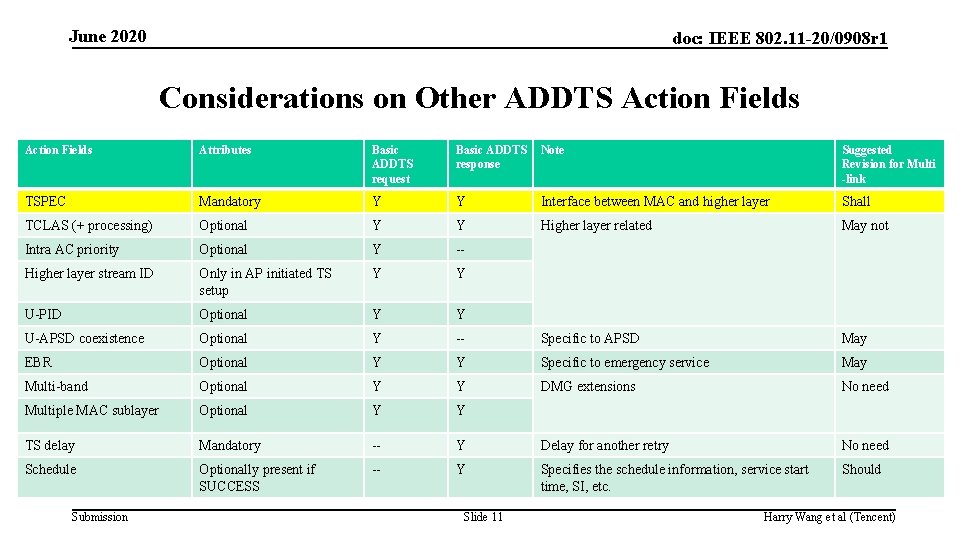
June 2020 doc: IEEE 802. 11 -20/0908 r 1 Considerations on Other ADDTS Action Fields Attributes Basic ADDTS request Basic ADDTS response Note Suggested Revision for Multi -link TSPEC Mandatory Y Y Interface between MAC and higher layer Shall TCLAS (+ processing) Optional Y Y Higher layer related May not Intra AC priority Optional Y -- Higher layer stream ID Only in AP initiated TS setup Y Y U-PID Optional Y Y U-APSD coexistence Optional Y -- Specific to APSD May EBR Optional Y Y Specific to emergency service May Multi-band Optional Y Y DMG extensions No need Multiple MAC sublayer Optional Y Y TS delay Mandatory -- Y Delay for another retry No need Schedule Optionally present if SUCCESS -- Y Specifies the schedule information, service start time, SI, etc. Should Submission Slide 11 Harry Wang et al (Tencent)
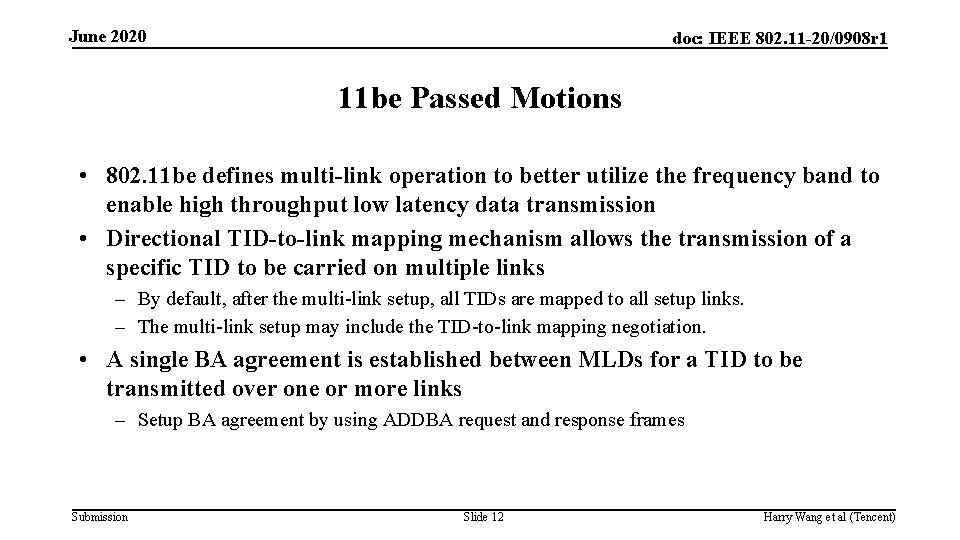
June 2020 doc: IEEE 802. 11 -20/0908 r 1 11 be Passed Motions • 802. 11 be defines multi-link operation to better utilize the frequency band to enable high throughput low latency data transmission • Directional TID-to-link mapping mechanism allows the transmission of a specific TID to be carried on multiple links – By default, after the multi-link setup, all TIDs are mapped to all setup links. – The multi-link setup may include the TID-to-link mapping negotiation. • A single BA agreement is established between MLDs for a TID to be transmitted over one or more links – Setup BA agreement by using ADDBA request and response frames Submission Slide 12 Harry Wang et al (Tencent)
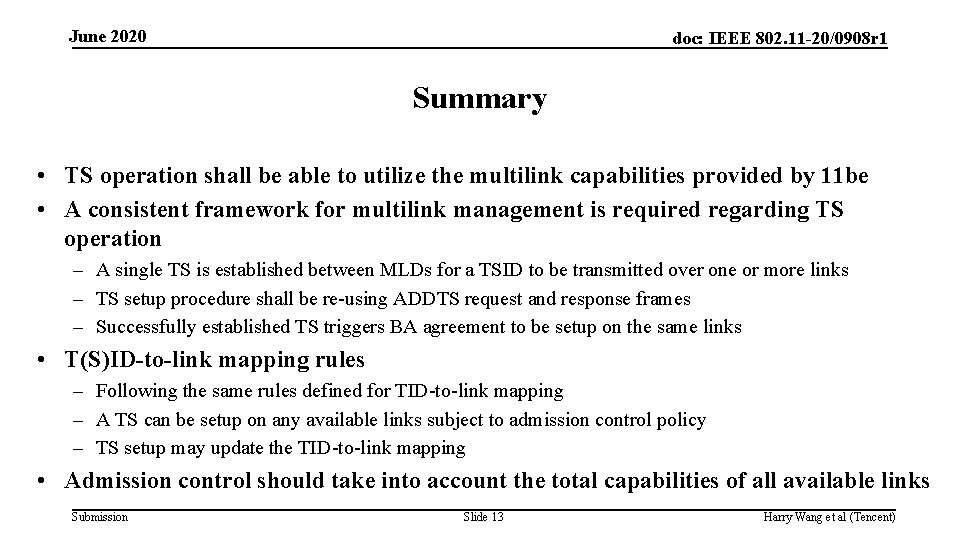
June 2020 doc: IEEE 802. 11 -20/0908 r 1 Summary • TS operation shall be able to utilize the multilink capabilities provided by 11 be • A consistent framework for multilink management is required regarding TS operation – A single TS is established between MLDs for a TSID to be transmitted over one or more links – TS setup procedure shall be re-using ADDTS request and response frames – Successfully established TS triggers BA agreement to be setup on the same links • T(S)ID-to-link mapping rules – Following the same rules defined for TID-to-link mapping – A TS can be setup on any available links subject to admission control policy – TS setup may update the TID-to-link mapping • Admission control should take into account the total capabilities of all available links Submission Slide 13 Harry Wang et al (Tencent)
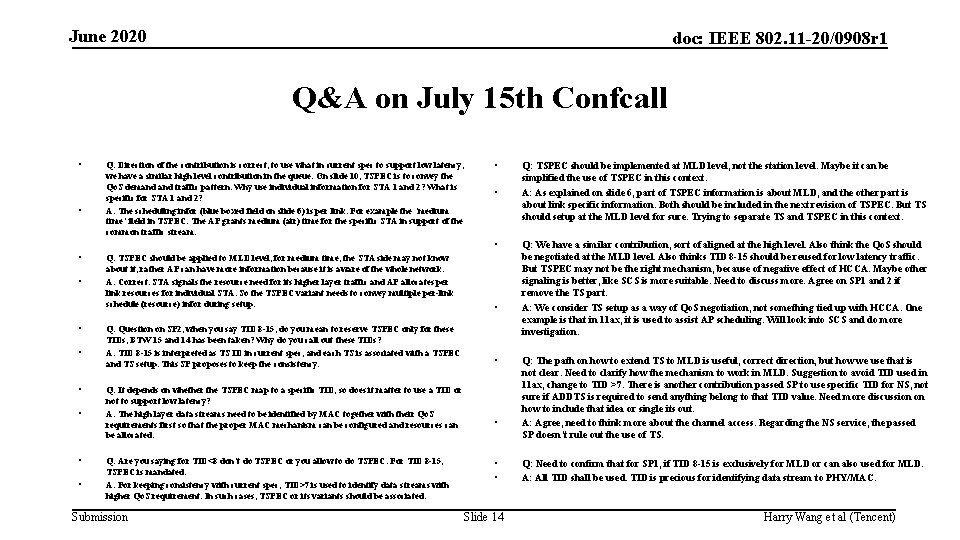
June 2020 doc: IEEE 802. 11 -20/0908 r 1 Q&A on July 15 th Confcall • • Q: Direction of the contribution is correct, to use what in current spec to support low latency, we have a similar high level contribution in the queue. On slide 10, TSPEC is to convey the Qo. S demand traffic pattern. Why use individual information for STA 1 and 2? What is specific for STA 1 and 2? A: The scheduling infor (blue boxed field on slide 6) is per link. For example the ‘medium time’ field in TSPEC. The AP grants medium (air) time for the specific STA in support of the common traffic stream. • • • Q: TSPEC should be applied to MLD level, for medium time, the STA side may not know about it, rather AP can have more information because it is aware of the whole network. A: Correct. STA signals the resource need for its higher layer traffic and AP allocates per link resources for individual STA. So the TSPEC variant needs to convey multiple per-link schedule (resource) infor during setup. Q: Question on SP 2, when you say TID 8 -15, do you mean to reserve TSPEC only for these TIDs, BTW 15 and 14 has been taken? Why do you call out these TIDs? A: TID 8 -15 is interpreted as TS ID in current spec, and each TS is associated with a TSPEC and TS setup. This SP proposes to keep the consistency. Q: It depends on whether the TSPEC map to a specific TID, so does it matter to use a TID or not to support low latency? A: The high layer data streams need to be identified by MAC together with their Qo. S requirements first so that the proper MAC mechanism can be configured and resources can be allocated. Q: Are you saying for TID<8 don’t do TSPEC or you allow to do TSPEC. For TID 8 -15, TSPEC is mandated. A: For keeping consistency with current spec, TID>7 is used to identify data streams with higher Qo. S requirement. In such cases, TSPEC or its variants should be associated. Submission • • • Slide 14 Q: TSPEC should be implemented at MLD level, not the station level. Maybe it can be simplified the use of TSPEC in this context. A: As explained on slide 6, part of TSPEC information is about MLD, and the other part is about link specific information. Both should be included in the next revision of TSPEC. But TS should setup at the MLD level for sure. Trying to separate TS and TSPEC in this context. Q: We have a similar contribution, sort of aligned at the high level. Also think the Qo. S should be negotiated at the MLD level. Also thinks TID 8 -15 should be reused for low latency traffic. But TSPEC may not be the right mechanism, because of negative effect of HCCA. Maybe other signaling is better, like SCS is more suitable. Need to discuss more. Agree on SP 1 and 2 if remove the TS part. A: We consider TS setup as a way of Qo. S negotiation, not something tied up with HCCA. One example is that in 11 ax, it is used to assist AP scheduling. Will look into SCS and do more investigation. Q: The path on how to extend TS to MLD is useful, correct direction, but how we use that is not clear. Need to clarify how the mechanism to work in MLD. Suggestion to avoid TID used in 11 ax, change to TID >7. There is another contribution passed SP to use specific TID for NS, not sure if ADDTS is required to send anything belong to that TID value. Need more discussion on how to include that idea or single its out. A: Agree, need to think more about the channel access. Regarding the NS service, the passed SP doesn’t rule out the use of TS. Q: Need to confirm that for SP 1, if TID 8 -15 is exclusively for MLD or can also used for MLD. A: All TID shall be used. TID is precious for identifying data stream to PHY/MAC. Harry Wang et al (Tencent)
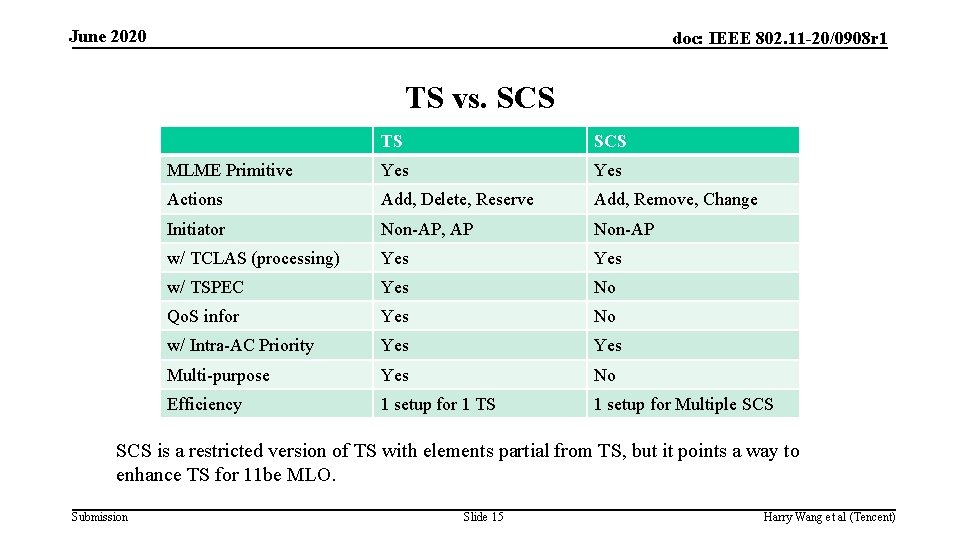
June 2020 doc: IEEE 802. 11 -20/0908 r 1 TS vs. SCS TS SCS MLME Primitive Yes Actions Add, Delete, Reserve Add, Remove, Change Initiator Non-AP, AP Non-AP w/ TCLAS (processing) Yes w/ TSPEC Yes No Qo. S infor Yes No w/ Intra-AC Priority Yes Multi-purpose Yes No Efficiency 1 setup for 1 TS 1 setup for Multiple SCS is a restricted version of TS with elements partial from TS, but it points a way to enhance TS for 11 be MLO. Submission Slide 15 Harry Wang et al (Tencent)
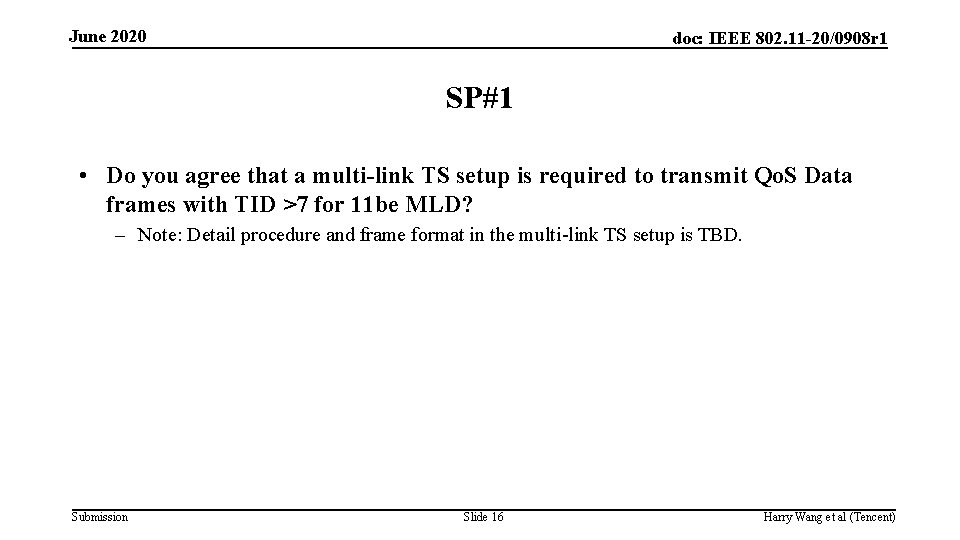
June 2020 doc: IEEE 802. 11 -20/0908 r 1 SP#1 • Do you agree that a multi-link TS setup is required to transmit Qo. S Data frames with TID >7 for 11 be MLD? – Note: Detail procedure and frame format in the multi-link TS setup is TBD. Submission Slide 16 Harry Wang et al (Tencent)
June 2020 doc: IEEE 802. 11 -20/0908 r 1 SP#2 • Do you agree that a single TS that is negotiated between two MLDs for a TID > 7 that may be transmitted over one or more links? Submission Slide 17 Harry Wang et al (Tencent)
June 2020 doc: IEEE 802. 11 -20/0908 r 1 SP#3 • Do you agree to use the container ADDTS Request and Response, TSPEC or their variants to setup or update a TS for the 11 be MLD? – Note: Detail format of frames and information elements are TBD. Submission Slide 18 Harry Wang et al (Tencent)
June 2020 doc: IEEE 802. 11 -20/0908 r 1 SP#4 • Do you support to define the admission control policy to be implemented at the MLD level? Submission Slide 19 Harry Wang et al (Tencent)
June 2020 doc: IEEE 802. 11 -20/0908 r 1 Reference • 20 -0418 r 1, Low latency service in 802. 11 be • 20 -0408 r 4, Prioritized EDCA Channel Access Over Latency Sensitive Links in MLO • 20 -0566 r 30, Compendium of straw polls and potential changes to the Specification Framework Document Submission Slide 20 Harry Wang et al (Tencent)