
Jumping Into Your Gene Pool Understanding Genetic Test
- Slides: 37
Jumping Into Your Gene Pool: Understanding Genetic Test Results Susan A. Berry, MD Professor and Director Division of Genetics and Metabolism Department of Pediatrics University of Minnesota
Acknowledgment • American Society of Clinical Oncologists Curriculum - educational materials used for this session (plus a few of my own!) Look for ASCO • Understanding Gene Testing - National Cancer Institute, 1996
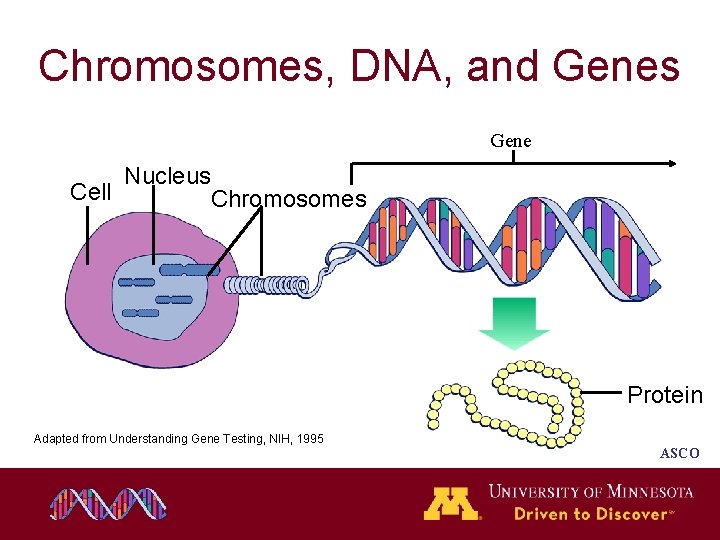
Chromosomes, DNA, and Genes Gene Nucleus Cell Chromosomes Protein Adapted from Understanding Gene Testing, NIH, 1995 ASCO
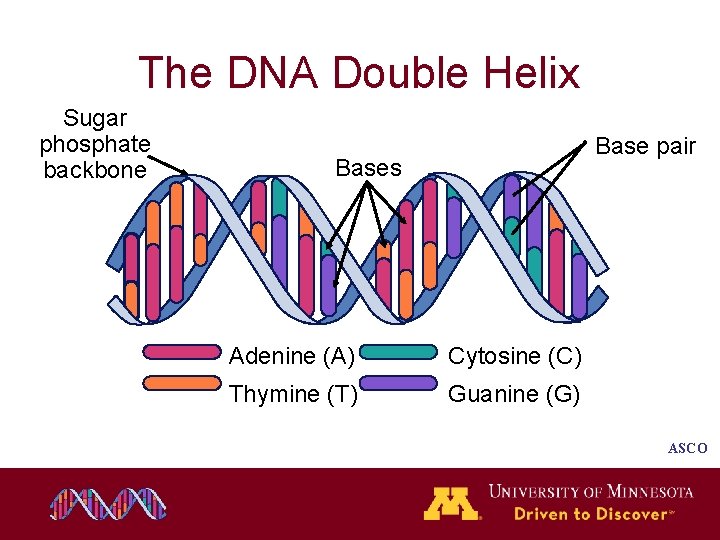
The DNA Double Helix Sugar phosphate backbone Base pair Bases Adenine (A) Cytosine (C) Thymine (T) Guanine (G) ASCO
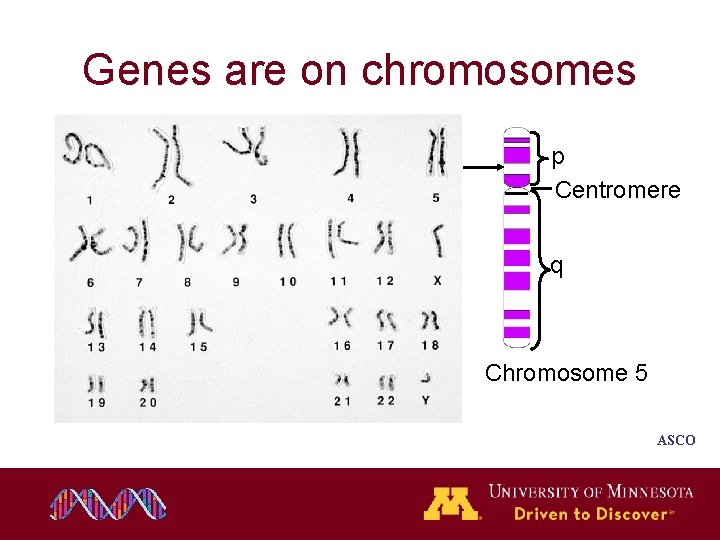
Genes are on chromosomes p Centromere q Chromosome 5 ASCO
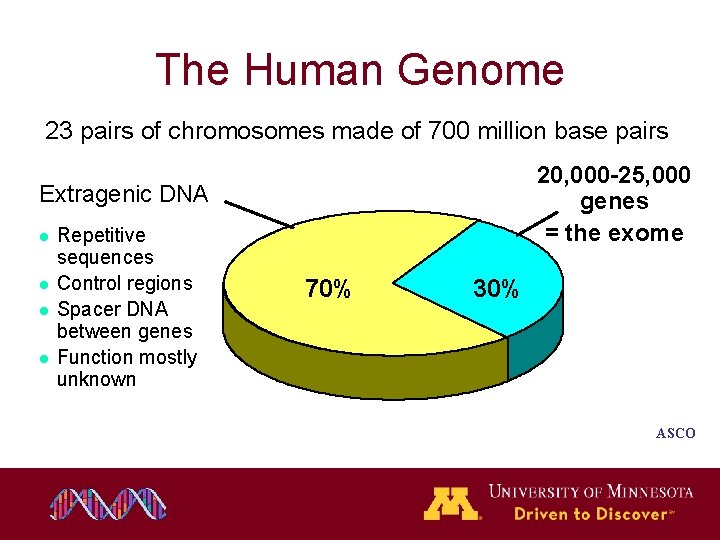
The Human Genome 23 pairs of chromosomes made of 700 million base pairs 20, 000 -25, 000 genes = the exome Extragenic DNA l l Repetitive sequences Control regions Spacer DNA between genes Function mostly unknown 70% 30% ASCO
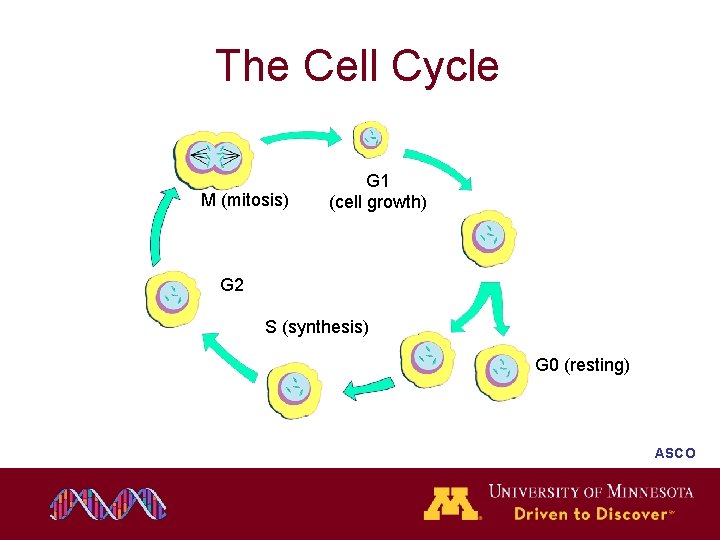
The Cell Cycle M (mitosis) G 1 (cell growth) G 2 S (synthesis) G 0 (resting) ASCO
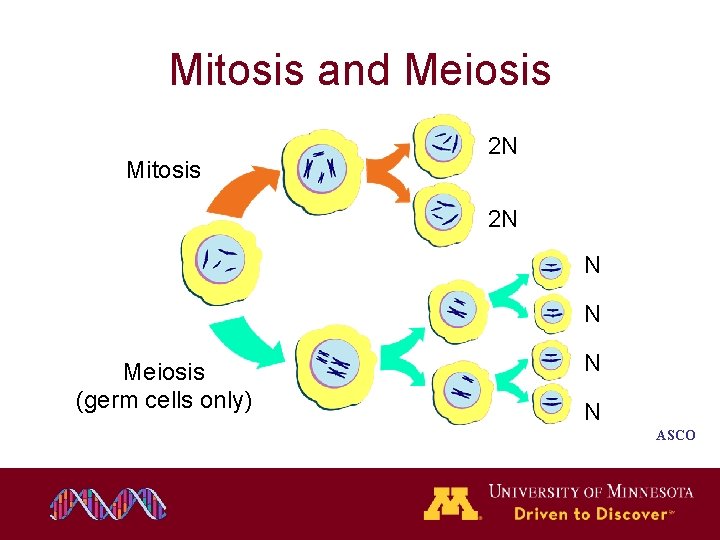
Mitosis and Meiosis Mitosis 2 N 2 N N N Meiosis (germ cells only) N N ASCO
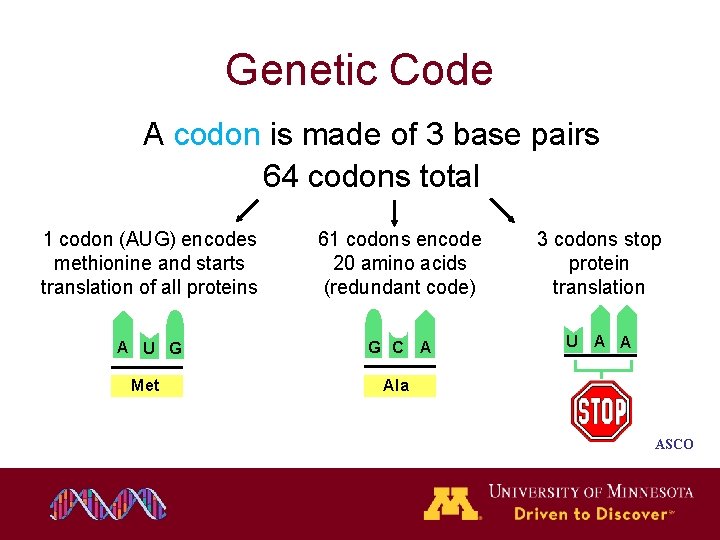
Genetic Code A codon is made of 3 base pairs 64 codons total 1 codon (AUG) encodes methionine and starts translation of all proteins 61 codons encode 20 amino acids (redundant code) 3 codons stop protein translation A U G G C A U A A Met Ala ASCO
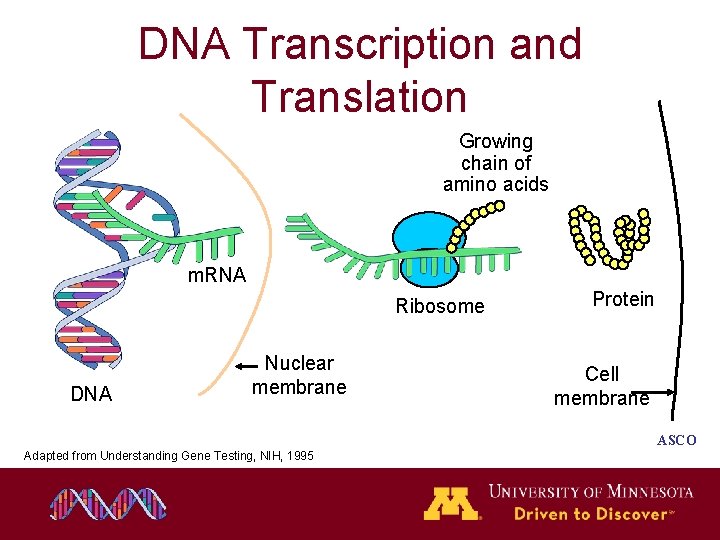
DNA Transcription and Translation Growing chain of amino acids m. RNA Ribosome DNA Nuclear membrane Protein Cell membrane ASCO Adapted from Understanding Gene Testing, NIH, 1995
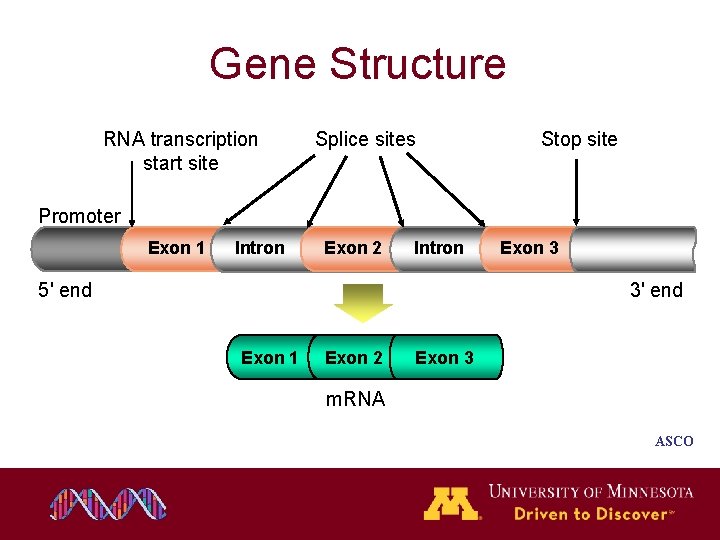
Gene Structure RNA transcription start site Splice sites Stop site Promoter Exon 1 Intron Exon 2 Intron 5' end Exon 3 3' end Exon 1 Exon 2 Exon 3 m. RNA ASCO
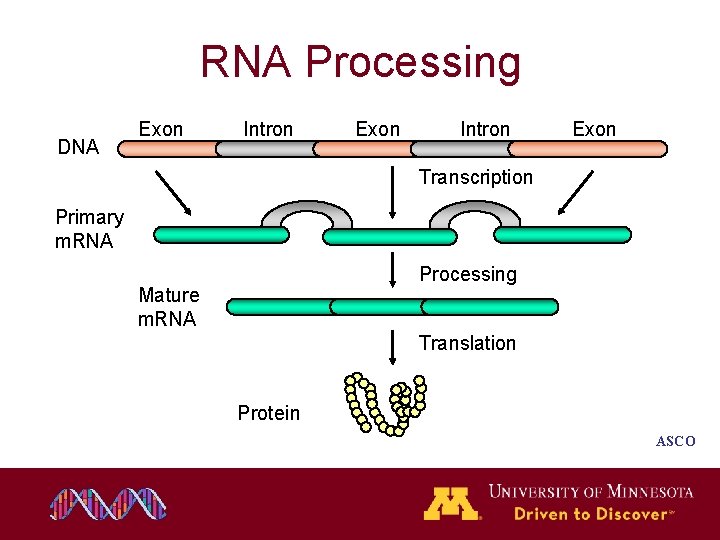
RNA Processing DNA Exon Intron Exon Transcription Primary m. RNA Processing Mature m. RNA Translation Protein ASCO
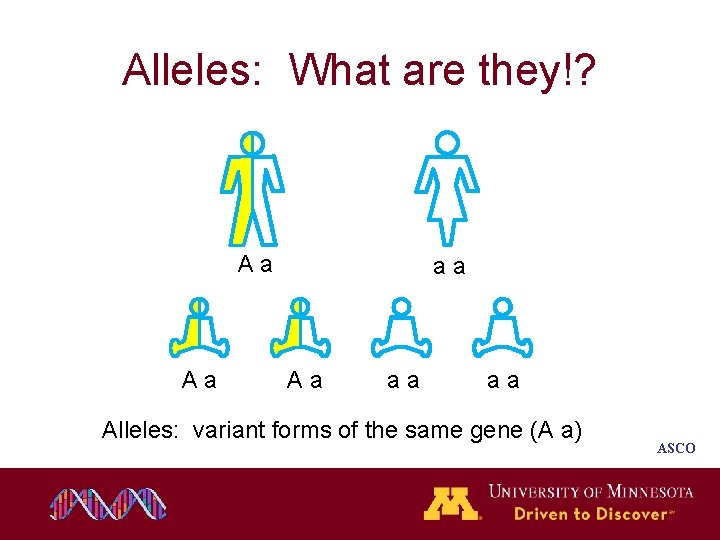
Alleles: What are they!? Aa Aa aa aa Alleles: variant forms of the same gene (A a) ASCO
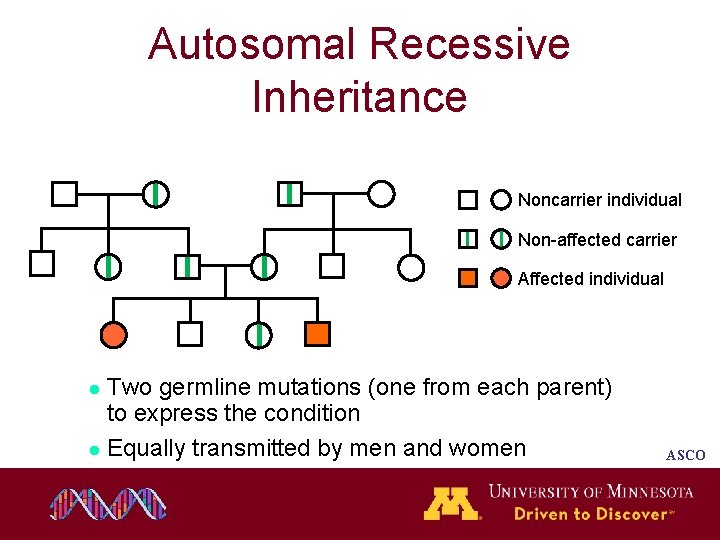
Autosomal Recessive Inheritance Noncarrier individual Non-affected carrier Affected individual Two germline mutations (one from each parent) to express the condition l Equally transmitted by men and women l ASCO
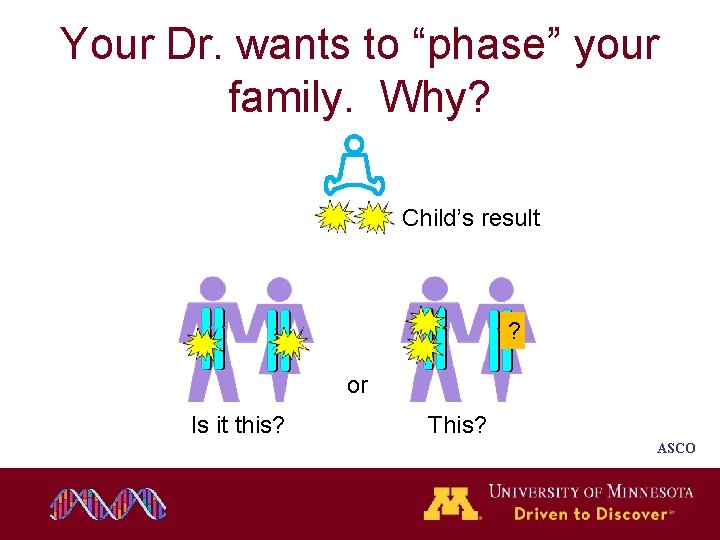
Your Dr. wants to “phase” your family. Why? Child’s result ? or Is it this? This? ASCO
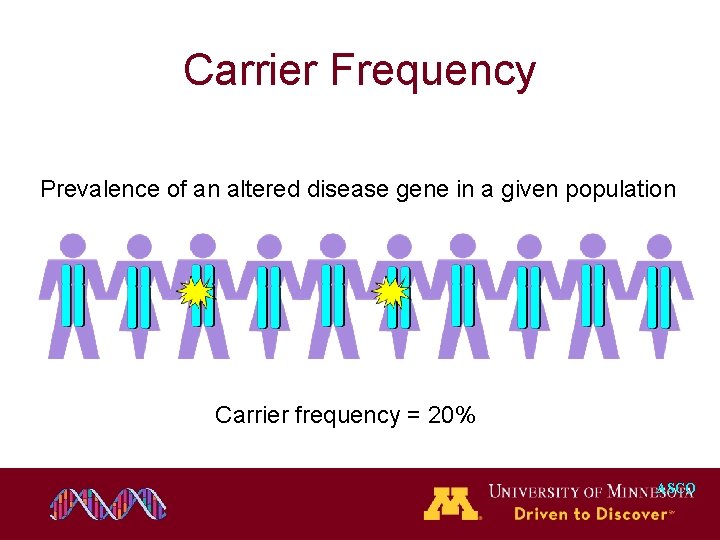
Carrier Frequency Prevalence of an altered disease gene in a given population Carrier frequency = 20% ASCO
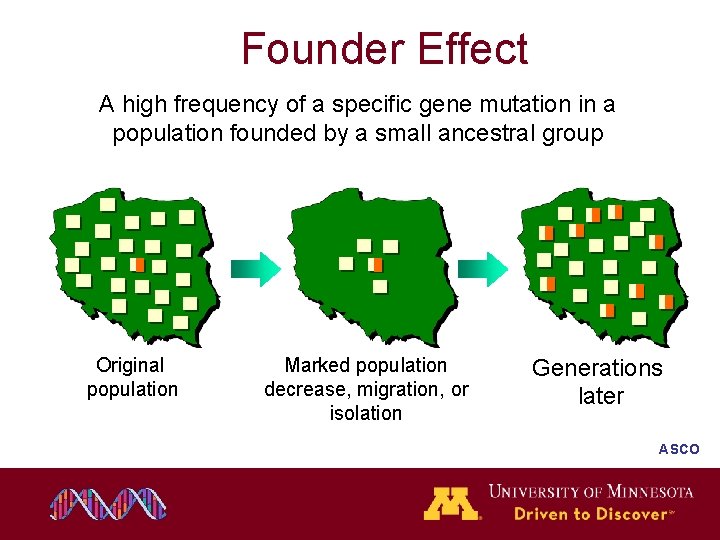
Founder Effect A high frequency of a specific gene mutation in a population founded by a small ancestral group Original population Marked population decrease, migration, or isolation Generations later ASCO
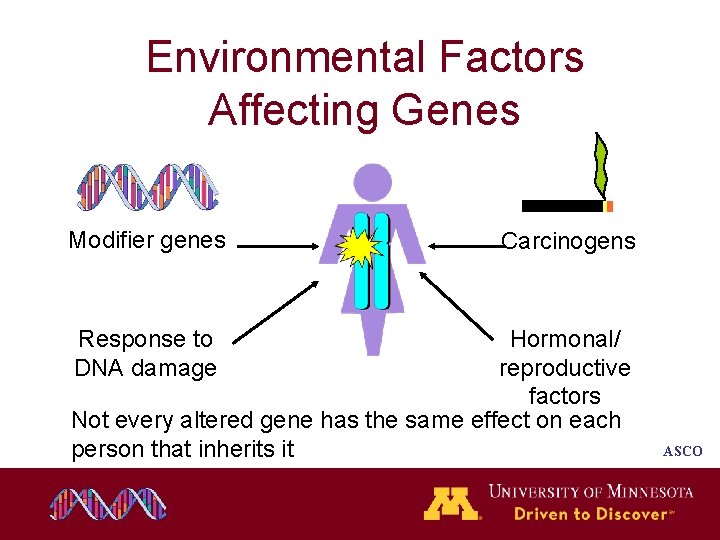
Environmental Factors Affecting Genes Modifier genes Carcinogens Response to DNA damage Hormonal/ reproductive factors Not every altered gene has the same effect on each person that inherits it ASCO
Genotype/Phenotype Correlation Different mutations in the same gene cause different effects • Where is the genetic change in the sequence? • What kind of change is it? ASCO
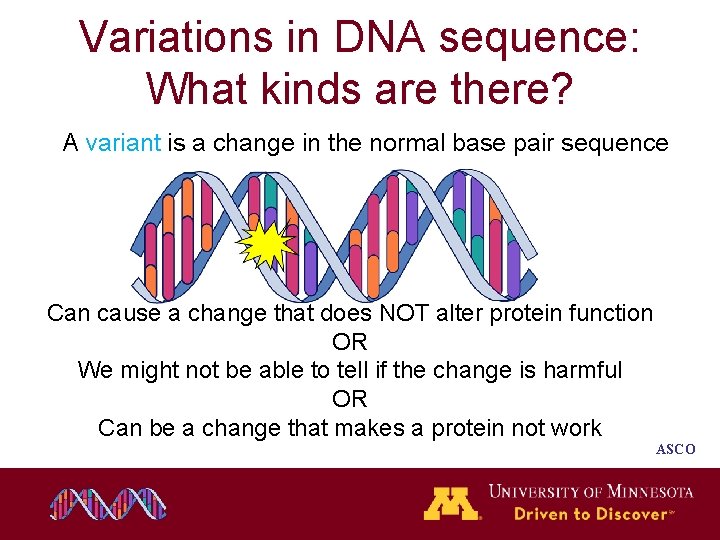
Variations in DNA sequence: What kinds are there? A variant is a change in the normal base pair sequence Can cause a change that does NOT alter protein function OR We might not be able to tell if the change is harmful OR Can be a change that makes a protein not work ASCO
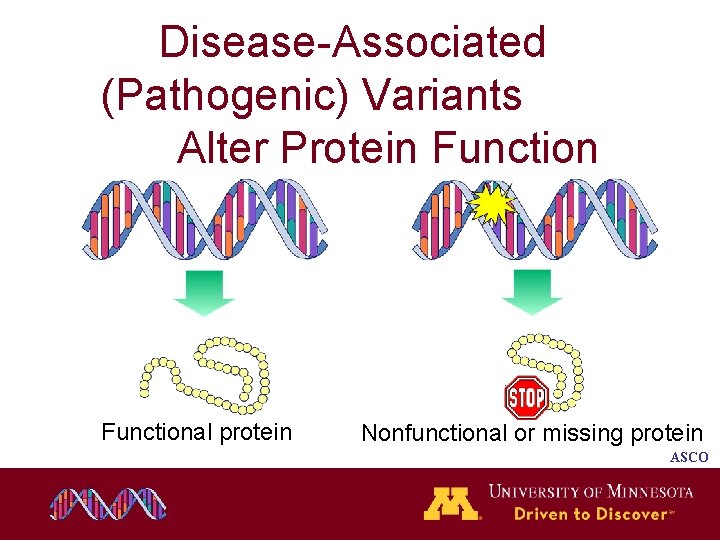
Disease-Associated (Pathogenic) Variants Alter Protein Functional protein Nonfunctional or missing protein ASCO
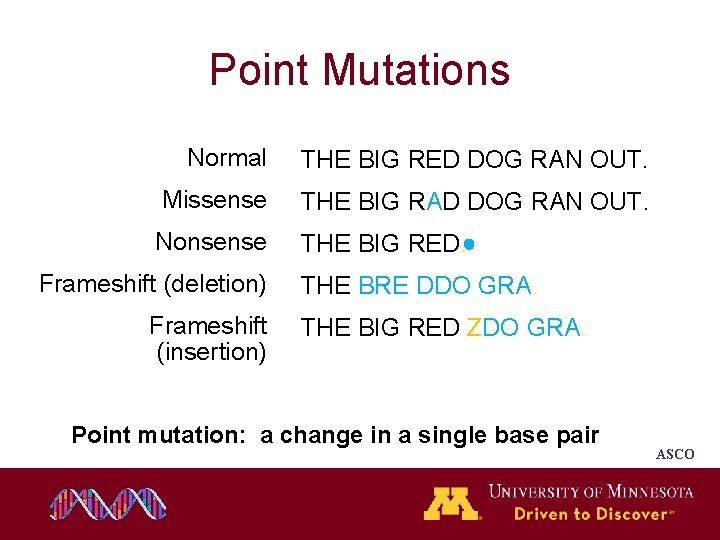
Point Mutations Normal THE BIG RED DOG RAN OUT. Missense THE BIG RAD DOG RAN OUT. Nonsense THE BIG RED. Frameshift (deletion) Frameshift (insertion) THE BRE DDO GRA. THE BIG RED ZDO GRA. Point mutation: a change in a single base pair ASCO
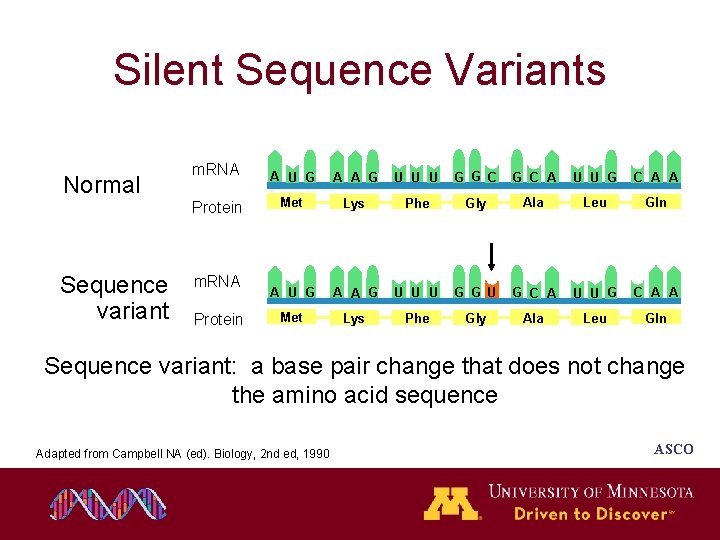
Silent Sequence Variants Normal m. RNA Protein Sequence variant m. RNA Protein A U G A A G U U U G G C A U U G C A A Met Lys Phe Gly Ala Leu Gln A U G A A G U U U G G U G C A U U G C A A Met Lys Phe Gly Ala Leu Gln Sequence variant: a base pair change that does not change the amino acid sequence Adapted from Campbell NA (ed). Biology, 2 nd ed, 1990 ASCO
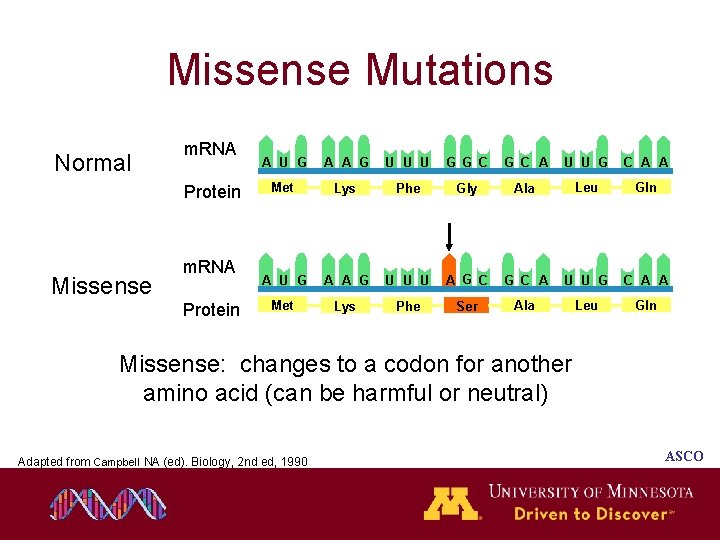
Missense Mutations Normal m. RNA Protein Missense m. RNA Protein A U G A A G U U U G G C A U U G C A A Met Lys Phe Gly Ala Leu Gln A U G A A G U U U A G C A U U G C A A Met Lys Phe Ser Ala Leu Gln Missense: changes to a codon for another amino acid (can be harmful or neutral) Adapted from Campbell NA (ed). Biology, 2 nd ed, 1990 ASCO
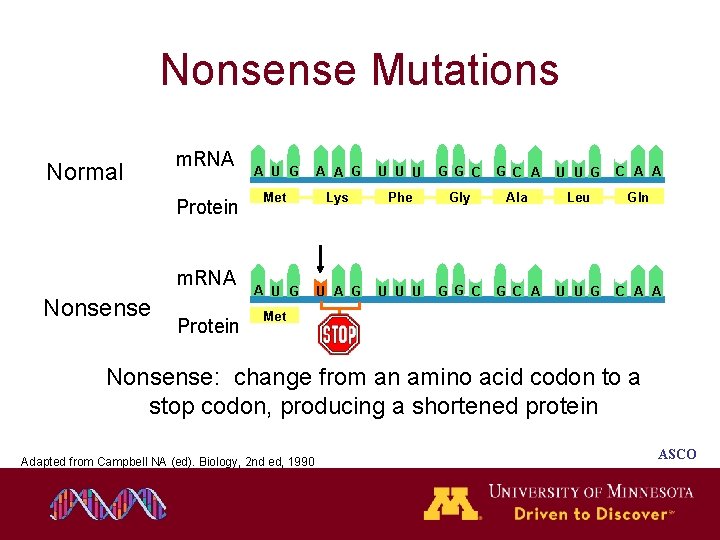
Nonsense Mutations Normal m. RNA Protein m. RNA Nonsense Protein A U G A A G U U U G G C A U U G C A A Met Lys Phe Gly Ala Leu Gln A U G U A G U U U G G C A U U G C A A Met Nonsense: change from an amino acid codon to a stop codon, producing a shortened protein Adapted from Campbell NA (ed). Biology, 2 nd ed, 1990 ASCO
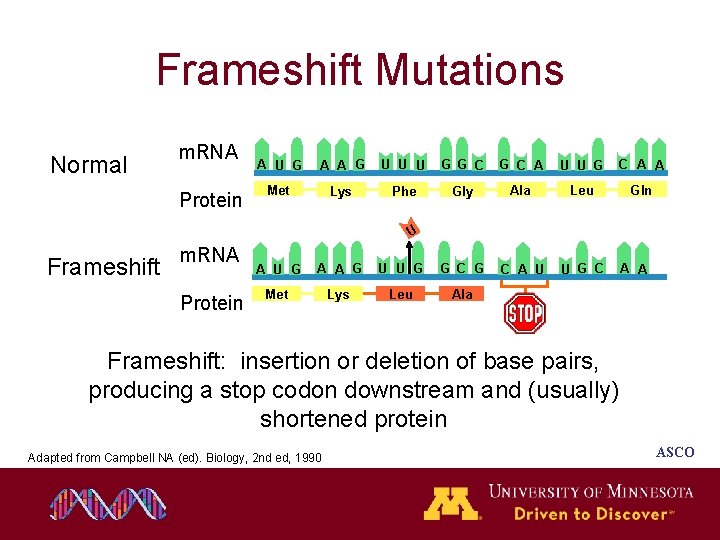
Frameshift Mutations Normal m. RNA Protein A U G A A G U U U G G C A U U G C A A Met Lys Phe Gly Ala Leu Gln C A U U G C U Frameshift m. RNA Protein A U G A A G U U G G C G Met Lys Leu Ala A A Frameshift: insertion or deletion of base pairs, producing a stop codon downstream and (usually) shortened protein Adapted from Campbell NA (ed). Biology, 2 nd ed, 1990 ASCO
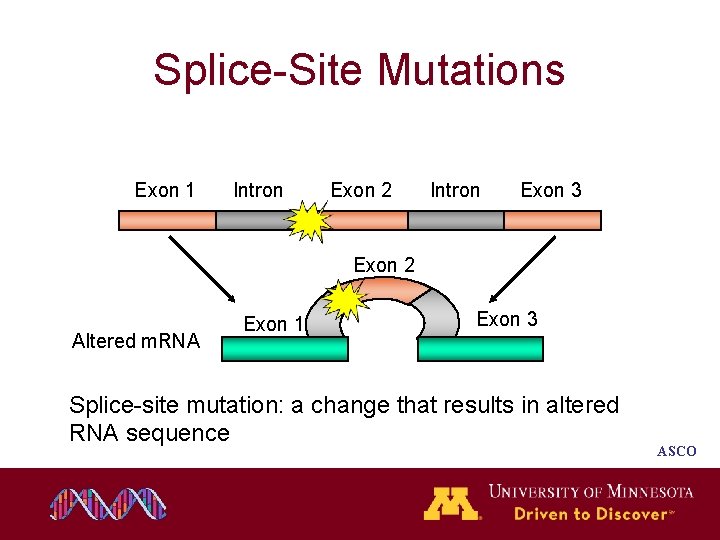
Splice-Site Mutations Exon 1 Intron Exon 2 Intron Exon 3 Exon 2 Altered m. RNA Exon 1 Exon 3 Splice-site mutation: a change that results in altered RNA sequence ASCO
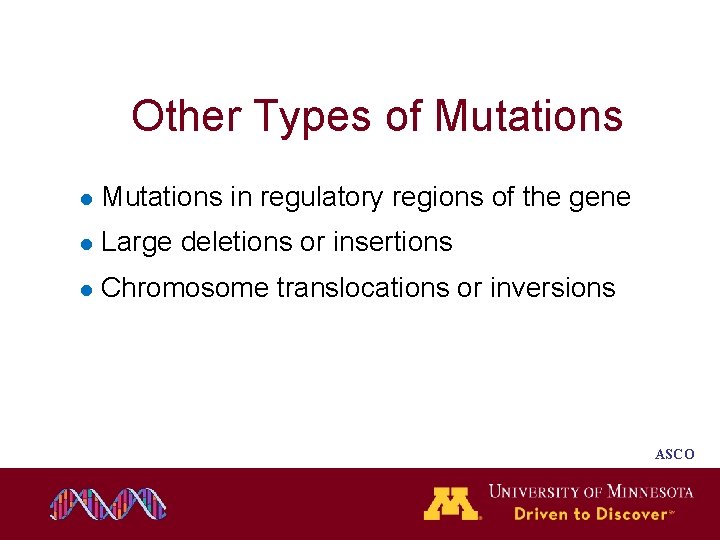
Other Types of Mutations l Mutations in regulatory regions of the gene l Large deletions or insertions l Chromosome translocations or inversions ASCO
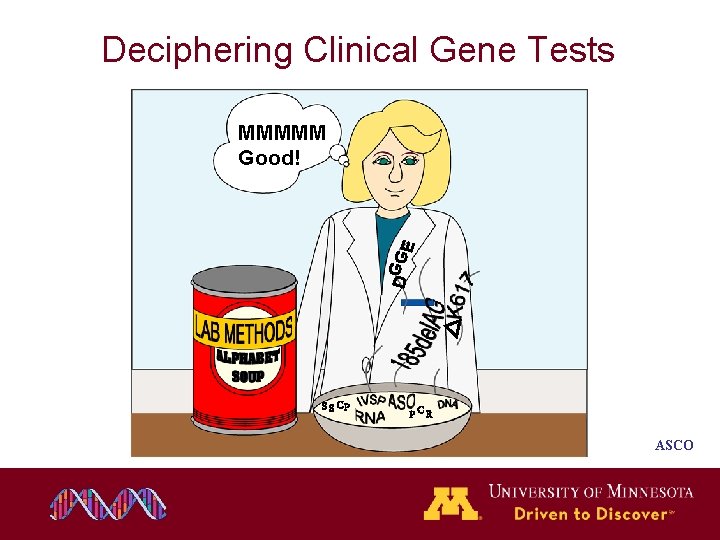
Deciphering Clinical Gene Tests DGGE MMMMM Good! S S CP P CR ASCO
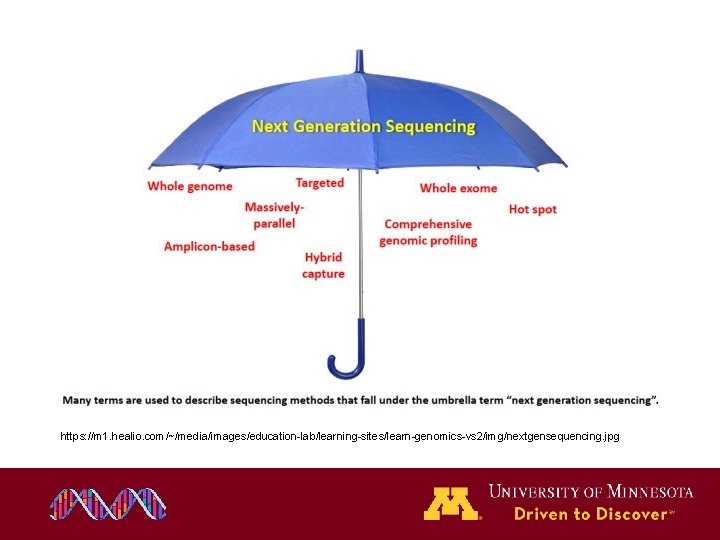
https: //m 1. healio. com/~/media/images/education-lab/learning-sites/learn-genomics-vs 2/img/nextgensequencing. jpg
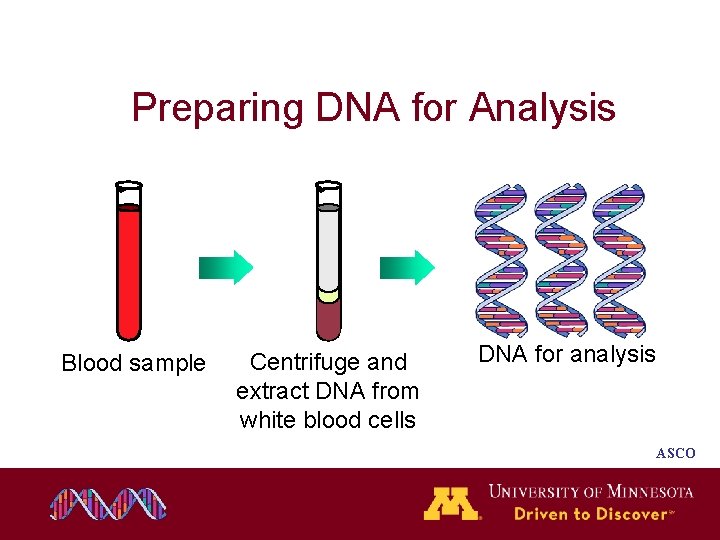
Preparing DNA for Analysis Blood sample Centrifuge and extract DNA from white blood cells DNA for analysis ASCO
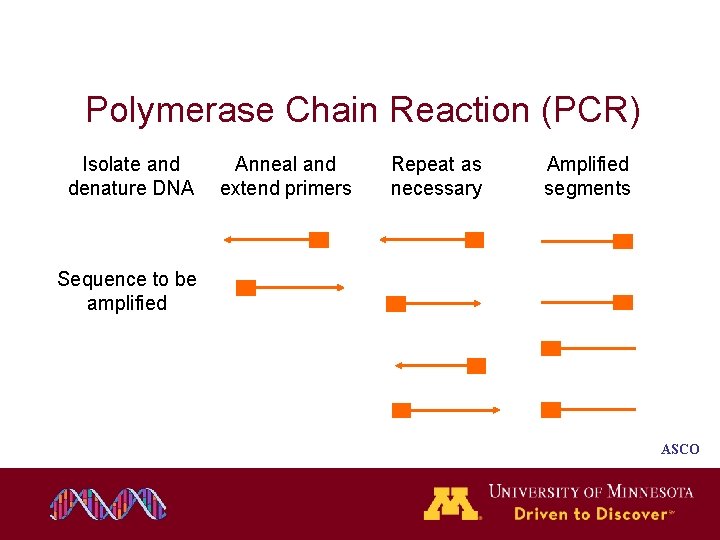
Polymerase Chain Reaction (PCR) Isolate and denature DNA Anneal and extend primers Repeat as necessary Amplified segments Sequence to be amplified ASCO
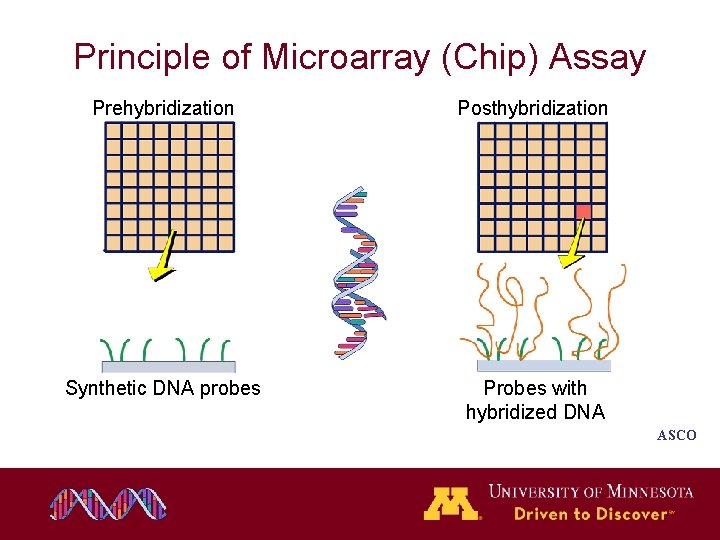
Principle of Microarray (Chip) Assay Prehybridization Posthybridization Synthetic DNA probes Probes with hybridized DNA ASCO
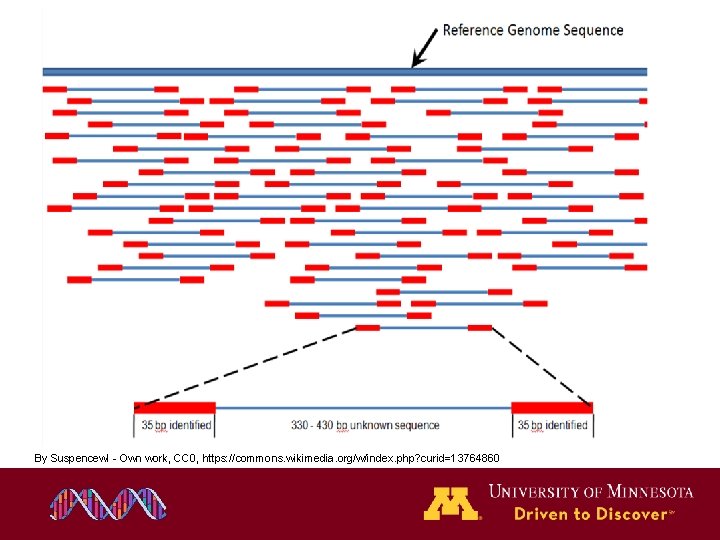
By Suspencewl - Own work, CC 0, https: //commons. wikimedia. org/w/index. php? curid=13764860
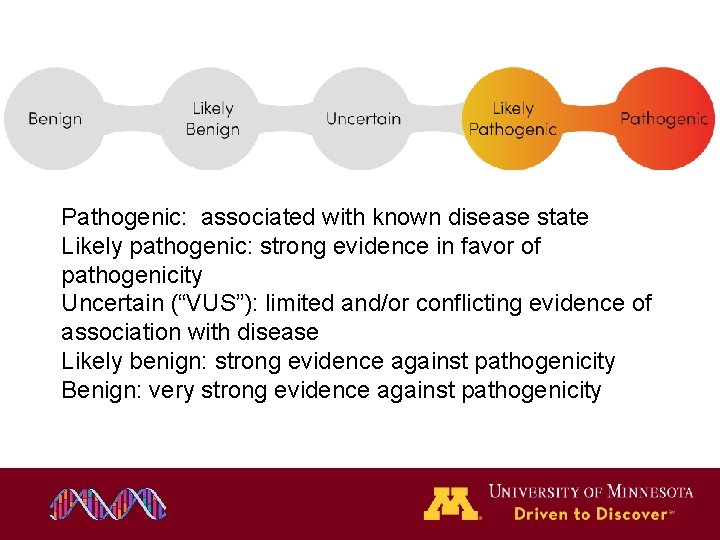
Pathogenic: associated with known disease state Likely pathogenic: strong evidence in favor of pathogenicity Uncertain (“VUS”): limited and/or conflicting evidence of association with disease Likely benign: strong evidence against pathogenicity Benign: very strong evidence against pathogenicity
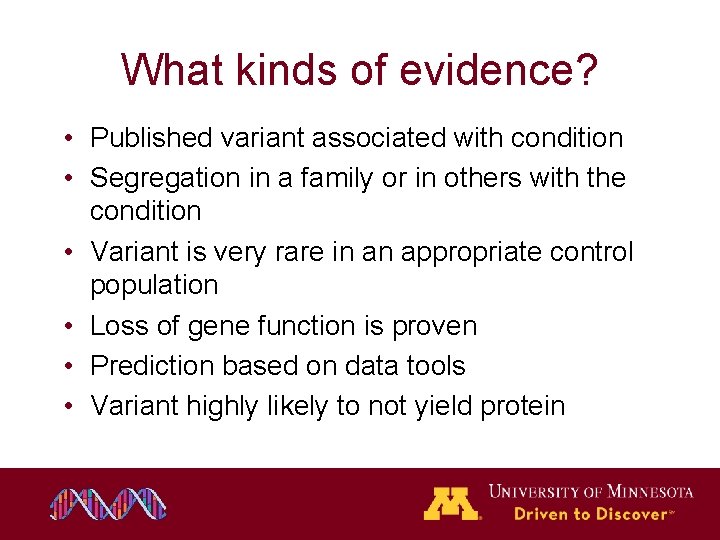
What kinds of evidence? • Published variant associated with condition • Segregation in a family or in others with the condition • Variant is very rare in an appropriate control population • Loss of gene function is proven • Prediction based on data tools • Variant highly likely to not yield protein
Summary • FAOD conditions follow an autosomal recessive pattern of inheritance • Parental testing is needed to “phase” the child’s result • Results can be ambiguous (VUS) but often can be clarified by assessment of phenotype (how the child presented biochemically)