
July 2016 Ontario Palliative Care Network WHAT IS
- Slides: 15
July 2016 Ontario Palliative Care Network
WHAT IS HOSPICE PALLIATIVE CARE? Hospice palliative care aims to relieve suffering and improve the quality of living and dying. It strives to help individuals and families to: Address physical, psychological, social, spiritual and practical issues, and their associated expectations, needs, hopes and fears Prepare for and manage end-of-life choices and the dying process Cope with loss and grief Treat all active issues and prevent new issues from occurring Promote opportunities for meaningful and valuable experiences, and personal and spiritual growth. 2
CURRENT STATE OF HOSPICE PALLIATIVE CARE IN CANADA • Only 16 -30% of Canadians have access to formalized hospice palliative/end-of-life care services • At least 25% of the total cost of hospice palliative care is borne by families • Approximately 70% of deaths occur in hospital • 40% of terminally ill cancer patients visit the emergency department within the last 2 weeks of life • 41% of long term care home residents have at least one hospital admission in their last 6 months of life • 96% of Canadians believe it is important to have conversations with their loved ones about their wishes for care • 34% have actually had a discussion • 13% have completed an Advanced Care Plan 3
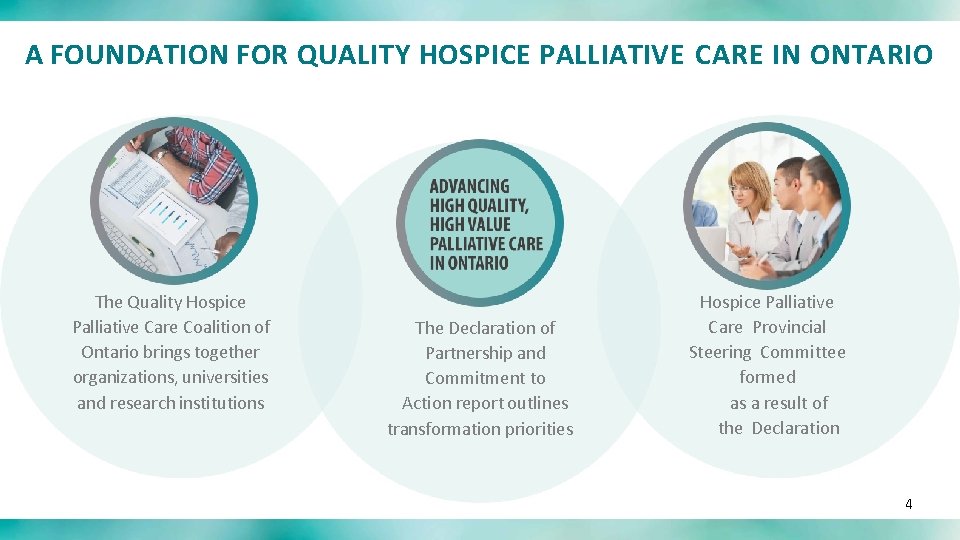
A FOUNDATION FOR QUALITY HOSPICE PALLIATIVE CARE IN ONTARIO The Quality Hospice Palliative Care Coalition of Ontario brings together organizations, universities and research institutions The Declaration of Partnership and Commitment to Action report outlines transformation priorities Hospice Palliative Care Provincial Steering Committee formed as a result of the Declaration 4
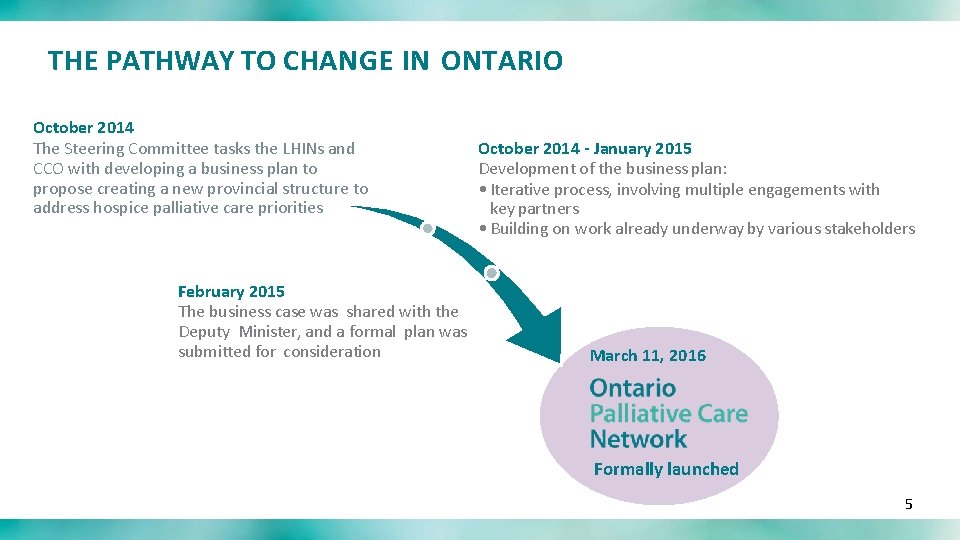
THE PATHWAY TO CHANGE IN ONTARIO October 2014 The Steering Committee tasks the LHINs and CCO with developing a business plan to propose creating a new provincial structure to address hospice palliative care priorities February 2015 The business case was shared with the Deputy Minister, and a formal plan was submitted for consideration October 2014 - January 2015 Development of the business plan: • Iterative process, involving multiple engagements with key partners • Building on work already underway by various stakeholders March 11, 2016 Formally launched 5
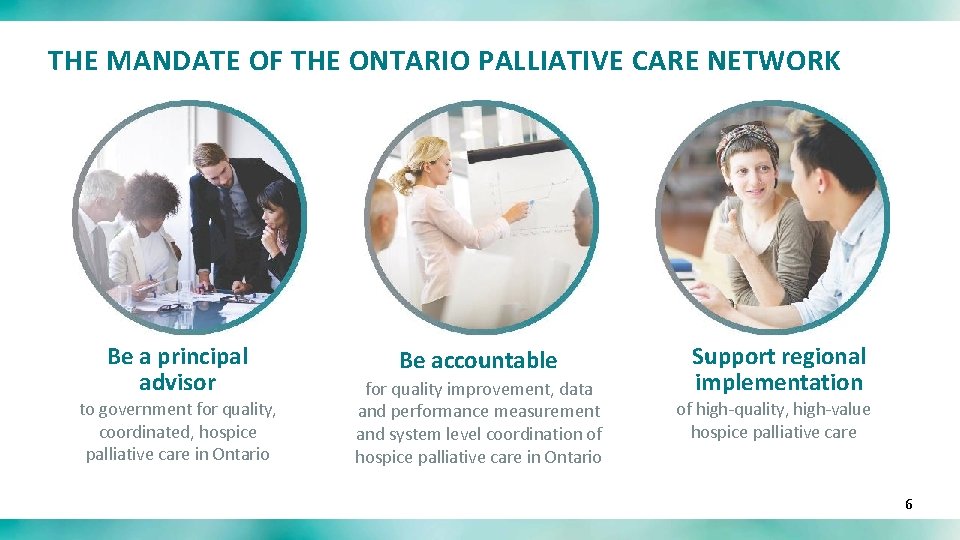
THE MANDATE OF THE ONTARIO PALLIATIVE CARE NETWORK Be a principal advisor to government for quality, coordinated, hospice palliative care in Ontario Be accountable for quality improvement, data and performance measurement and system level coordination of hospice palliative care in Ontario Support regional implementation of high-quality, high-value hospice palliative care 6
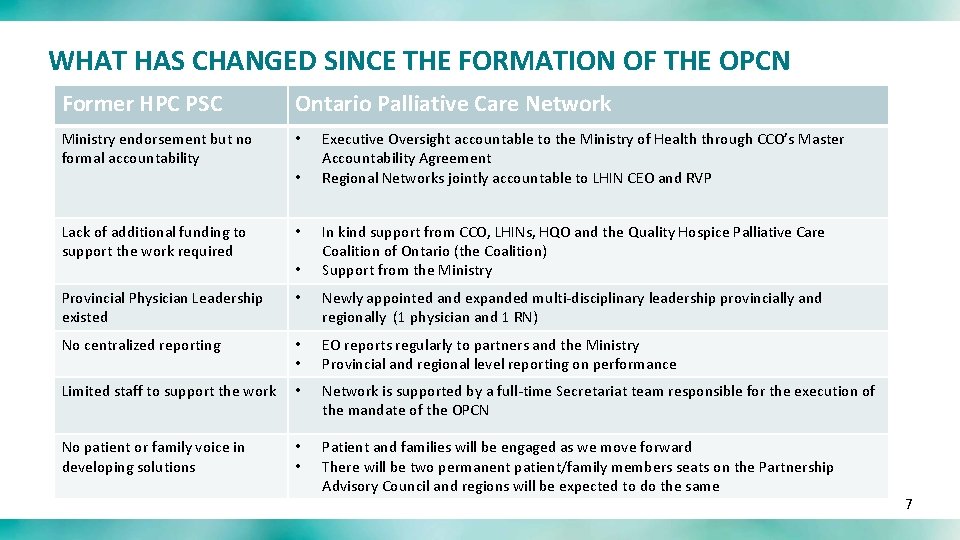
WHAT HAS CHANGED SINCE THE FORMATION OF THE OPCN Former HPC PSC Ontario Palliative Care Network Ministry endorsement but no formal accountability • Lack of additional funding to support the work required • Provincial Physician Leadership existed • Newly appointed and expanded multi-disciplinary leadership provincially and regionally (1 physician and 1 RN) No centralized reporting • • EO reports regularly to partners and the Ministry Provincial and regional level reporting on performance Limited staff to support the work • Network is supported by a full-time Secretariat team responsible for the execution of the mandate of the OPCN No patient or family voice in developing solutions • • Patient and families will be engaged as we move forward There will be two permanent patient/family members seats on the Partnership Advisory Council and regions will be expected to do the same • • Executive Oversight accountable to the Ministry of Health through CCO’s Master Accountability Agreement Regional Networks jointly accountable to LHIN CEO and RVP In kind support from CCO, LHINs, HQO and the Quality Hospice Palliative Care Coalition of Ontario (the Coalition) Support from the Ministry 7
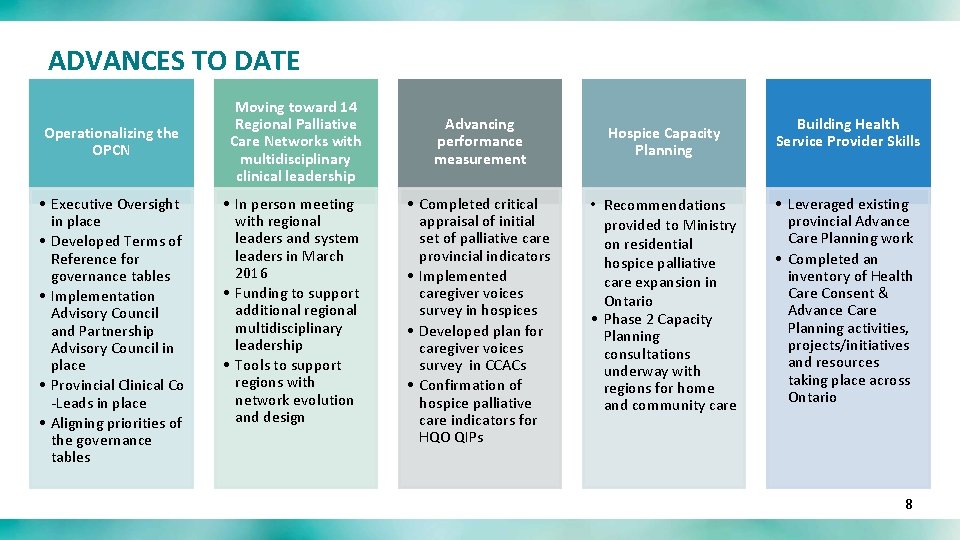
ADVANCES TO DATE Operationalizing the OPCN • Executive Oversight in place • Developed Terms of Reference for governance tables • Implementation Advisory Council and Partnership Advisory Council in place • Provincial Clinical Co -Leads in place • Aligning priorities of the governance tables Moving toward 14 Regional Palliative Care Networks with multidisciplinary clinical leadership • In person meeting with regional leaders and system leaders in March 2016 • Funding to support additional regional multidisciplinary leadership • Tools to support regions with network evolution and design Advancing performance measurement • Completed critical appraisal of initial set of palliative care provincial indicators • Implemented caregiver voices survey in hospices • Developed plan for caregiver voices survey in CCACs • Confirmation of hospice palliative care indicators for HQO QIPs Hospice Capacity Planning • Recommendations provided to Ministry on residential hospice palliative care expansion in Ontario • Phase 2 Capacity Planning consultations underway with regions for home and community care Building Health Service Provider Skills • Leveraged existing provincial Advance Care Planning work • Completed an inventory of Health Care Consent & Advance Care Planning activities, projects/initiatives and resources taking place across Ontario 8
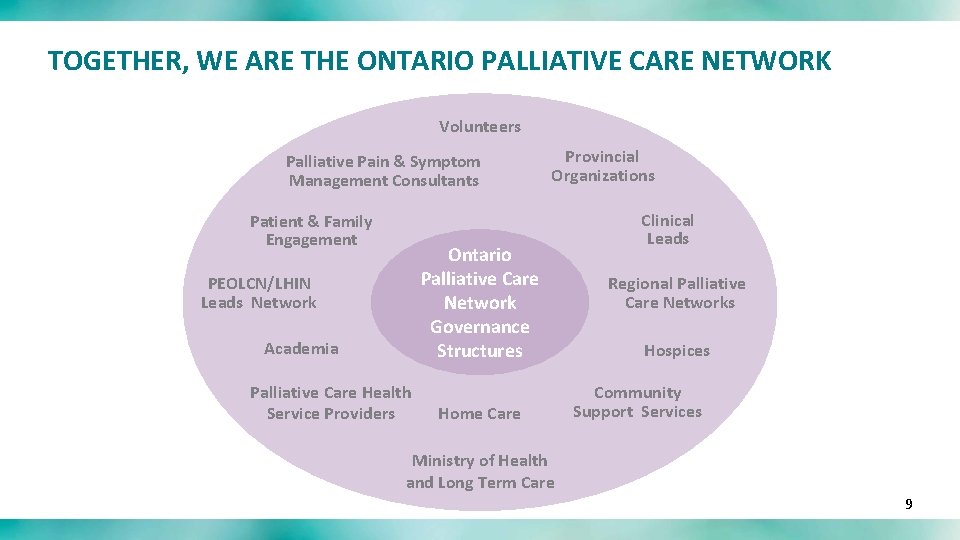
TOGETHER, WE ARE THE ONTARIO PALLIATIVE CARE NETWORK Volunteers Palliative Pain & Symptom Management Consultants Patient & Family Engagement Provincial Organizations Ontario Palliative Care Network Governance Structures PEOLCN/LHIN Leads Network Academia Palliative Care Health Service Providers Home Care Clinical Leads Regional Palliative Care Networks Hospices Community Support Services Ministry of Health and Long Term Care 9
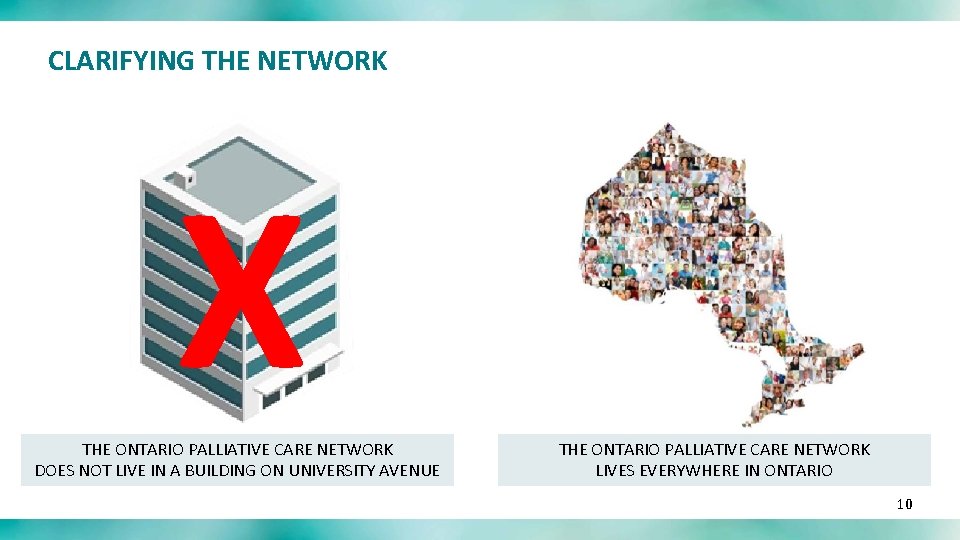
CLARIFYING THE NETWORK X THE ONTARIO PALLIATIVE CARE NETWORK DOES NOT LIVE IN A BUILDING ON UNIVERSITY AVENUE THE ONTARIO PALLIATIVE CARE NETWORK LIVES EVERYWHERE IN ONTARIO 10
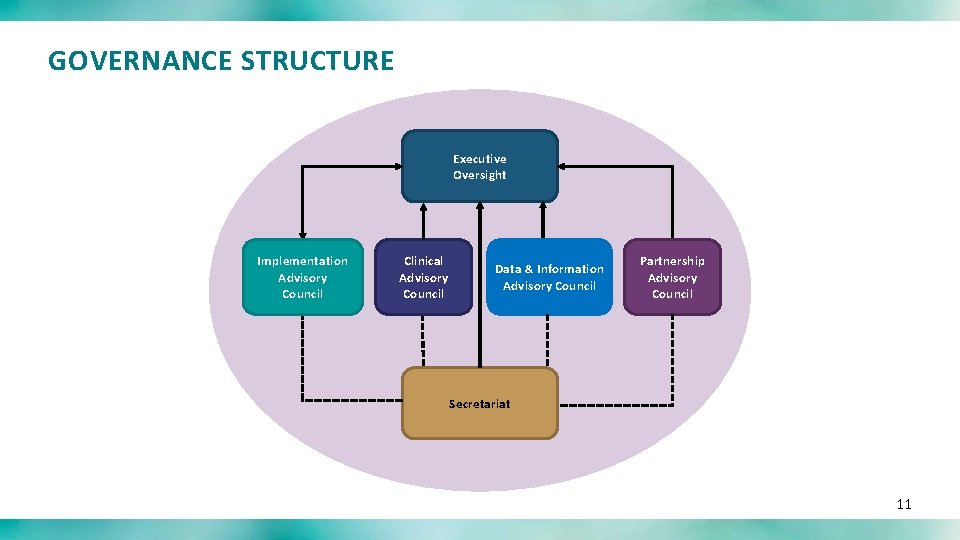
GOVERNANCE STRUCTURE Executive Oversight Implementation Advisory Council Clinical Advisory Council Data & Information Advisory Council Partnership Advisory Council Secretariat 11
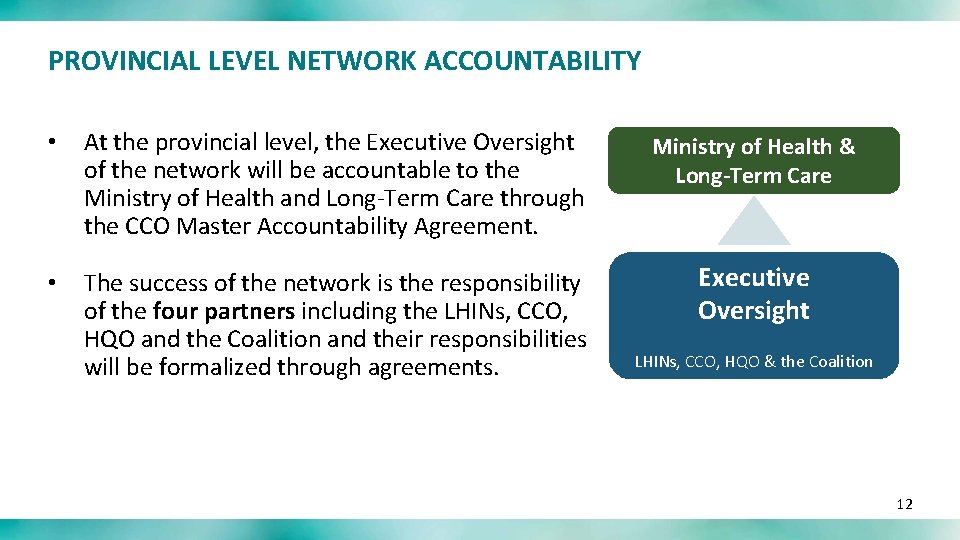
PROVINCIAL LEVEL NETWORK ACCOUNTABILITY • At the provincial level, the Executive Oversight of the network will be accountable to the Ministry of Health and Long-Term Care through the CCO Master Accountability Agreement. Ministry of Health & Long-Term Care • The success of the network is the responsibility of the four partners including the LHINs, CCO, HQO and the Coalition and their responsibilities will be formalized through agreements. Executive Oversight LHINs, CCO, HQO & the Coalition 12
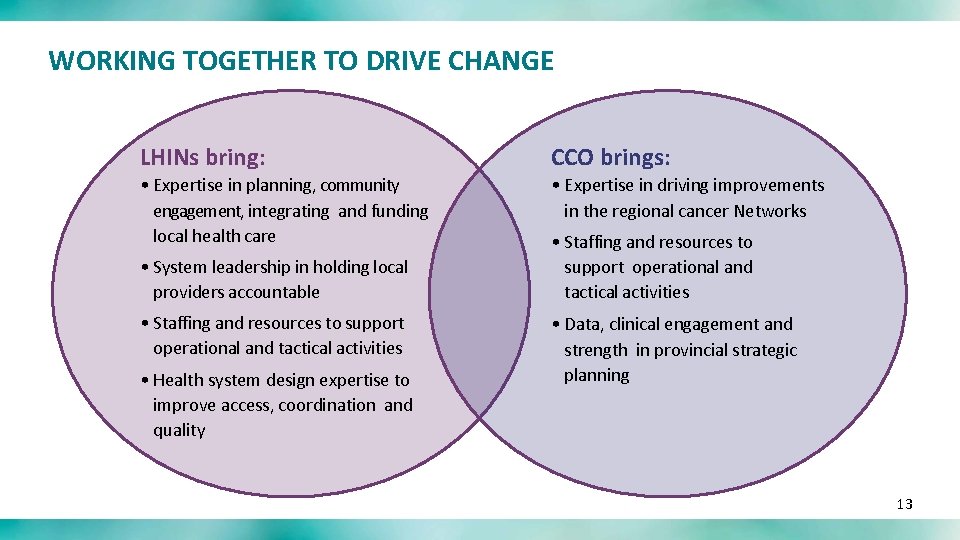
WORKING TOGETHER TO DRIVE CHANGE LHINs bring: CCO brings: • Expertise in planning, community engagement, integrating and funding local health care • Expertise in driving improvements in the regional cancer Networks • System leadership in holding local providers accountable • Staffing and resources to support operational and tactical activities • Health system design expertise to improve access, coordination and quality • Staffing and resources to support operational and tactical activities • Data, clinical engagement and strength in provincial strategic planning 13
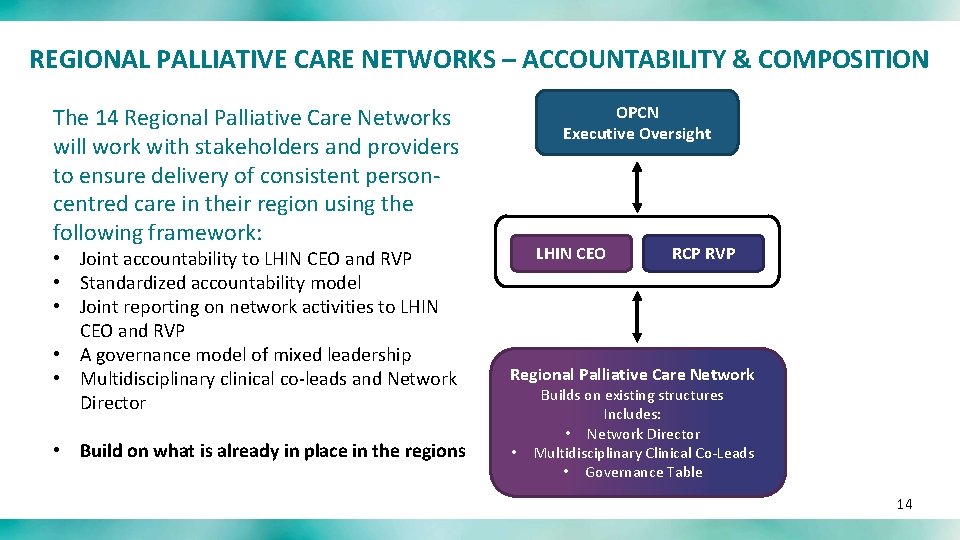
REGIONAL PALLIATIVE CARE NETWORKS – ACCOUNTABILITY & COMPOSITION OPCN Executive Oversight The 14 Regional Palliative Care Networks will work with stakeholders and providers to ensure delivery of consistent personcentred care in their region using the following framework: • Joint accountability to LHIN CEO and RVP • Standardized accountability model • Joint reporting on network activities to LHIN CEO and RVP • A governance model of mixed leadership • Multidisciplinary clinical co-leads and Network Director • Build on what is already in place in the regions LHIN CEO RCP RVP Regional Palliative Care Network • Builds on existing structures Includes: • Network Director Multidisciplinary Clinical Co-Leads • Governance Table 14
Thank You