
Julius Caesar 102 B C 44 B C

Julius Caesar, (102 B. C. - 44 B. C. ) Attività proposta da Francesca Ripamonti - Docente Lingua Inglese Scuola Secondaria II grado
Description: English prefixes, suffixes, and roots are shown in relationship to the Latin language and how current English words can be analyzed for meaning.
VERSOUN UNCURRICULUMPLURILINGUE: VERSO CLASSICAL MODERN LANGUAGES CLASSICAL vsvs MODERN LANGUAGES • Lesson Plan Title: LATIN vs ENGLISH! • Target group: Secondary school – age 15 -16 • Level B 1 of the Common European Framework
General aims: • To help students: • develop a plurilingual setting in the classroom • develop a deeper understanding of Wordformation • develop lexical competence, grammatical competence, phonological competence • develop a Plurilingual Attitude melting classical and modern languages, es. LATIN+ENGLISH
Specific aims: • to help students develop the following skills: • Recognising words and phrases in English related to ancient Latin origins • Using one’s own knowledge of Latin language to interpret and decipher new English words • Deducing the meaning and use of unknown words, detecting their prefixes/ affixes/ suffixes/ root words • Understanding the meaning and implications of prefixes/ affixes/suffixes/root words • Connecting this information to the other written and oral skills in order to engage the students in more confident interactions
Materials: • Power point presentation of the activities • Authentic reading texts • Photocopies • Pictures/ Students’ drawings • Internet connections/ Internet sites
“Old, old, I’ve been told, has some value, worthy of gold!” Now, let’s see the gifts of the ancient world and find out how their gifts have influenced us.
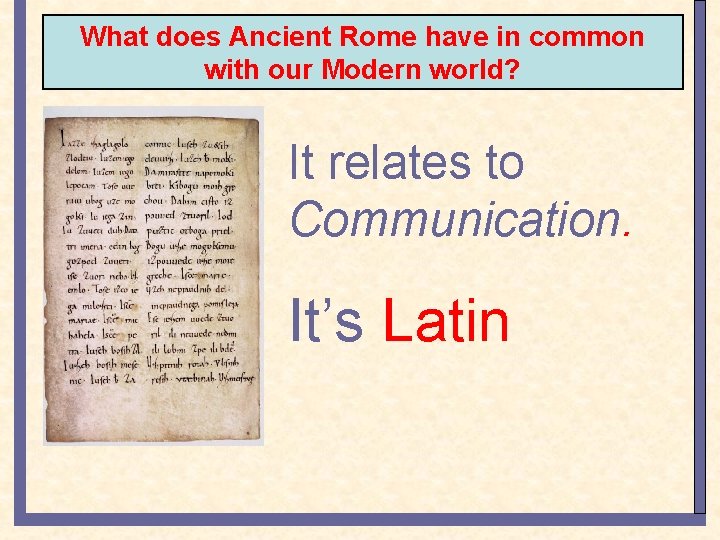
What does Ancient Rome have in common you know what with our Modern world? it is? Do It relates to Communication. It’s Latin
60% of the words in English are derived from Latin! Latin
• Latin helps us understand words. • Latin helps us understand English, Spanish & French grammars. • Literature, Medicine, & Law, all use Latin words.
By the end of this lesson we should be able to: break words into elements, analyze the parts, guess the meaning of the words.
This lesson will cover: Learning English word-elements such as affixes, prefixes, suffixes, and roots. Learning what these word elements mean Learning how to break words into elements ④Learning how to decipher word elements to understand the meaning of the word. ⑤ Learning how to apply this procedure to understand new words
First things first: do you know the definition of: -ROOT WORD -AFFIX -PREFIX -SUFFIX ?
Definitions: Affix: A word element, such as a prefix or suffix, that can only occur attached to a base, stem, or root. Prefix: A word element that is attached to the front of a root. Suffix: A word element that is attached to the end of the root.
Both Prefixes and Suffixes: Suffixes -Usually cannot stand alone as a word. -Give new meaning to the root to which they are attached to. Root: A word element that can sometimes stand alone as a word and the meaning is altered by a prefix and/or suffix.
Examples for a root word: word Ex. We have a mission to do well on our vocabulary Test! The Latin root miss means “to send”. send All the words below relate to the word send
EXERCISE: Match the words to the definitions 1. Commissioner (n. ); 2. Admissible (adj. ); 3. submissive (adj. ) 4. missionary (n); 5. missile (n. ) 6. missive (n). ___ a rocket or weapon sent through the air. ___ a person sent for a special task, usually religious. ___ a message sent through the mail. ___ yielding; obedient. ___ a person sent to meet with others to plan & make official decisions. ___ to allow to authorize
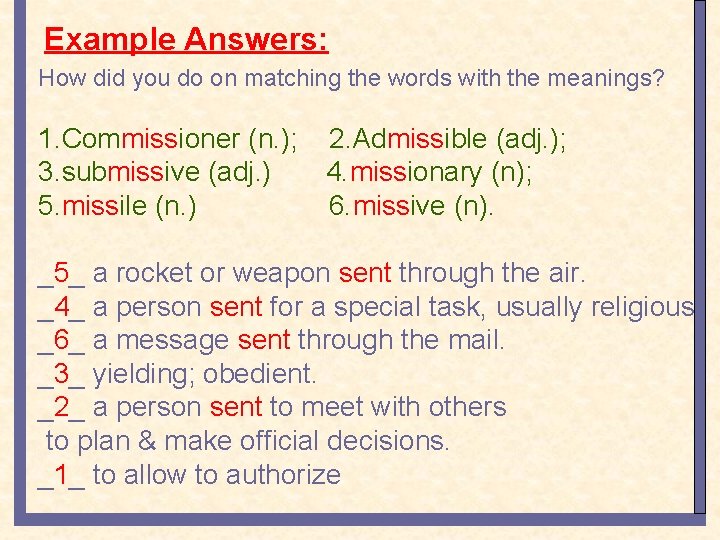
Example Answers: How did you do on matching the words with the meanings? 1. Commissioner (n. ); 2. Admissible (adj. ); 3. submissive (adj. ) 4. missionary (n); 5. missile (n. ) 6. missive (n). _5_ a rocket or weapon sent through the air. _4_ a person sent for a special task, usually religious. _6_ a message sent through the mail. _3_ yielding; obedient. _2_ a person sent to meet with others to plan & make official decisions. _1_ to allow to authorize
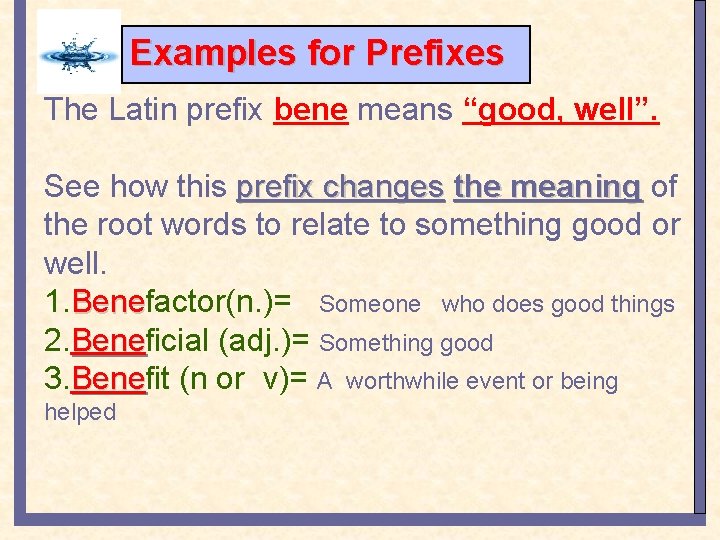
: Examples for Prefixes The Latin prefix bene means “good, well”. See how this prefix changes the meaning of the root words to relate to something good or well. 1. Benefactor(n. )= Someone who does good things Bene 2. Beneficial (adj. )= Something good Bene 3. Benefit Bene (n or v)= A worthwhile event or being helped
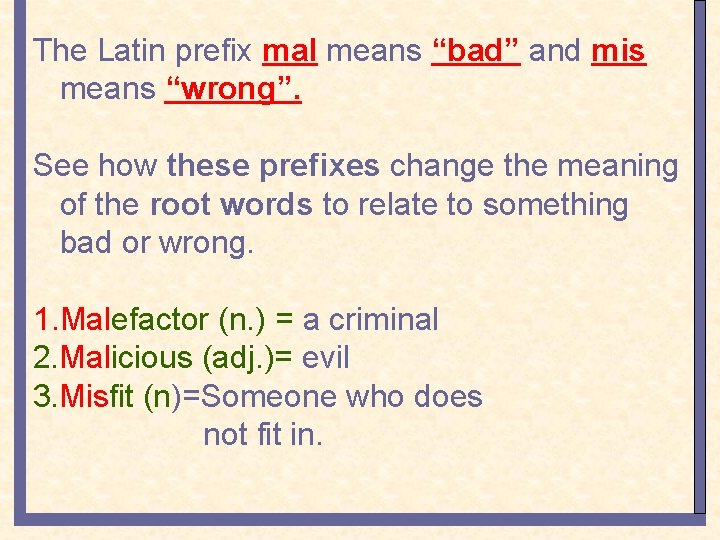
The Latin prefix mal means “bad” and mis means “wrong”. See how these prefixes change the meaning of the root words to relate to something bad or wrong. 1. Malefactor (n. ) = a criminal 2. Malicious (adj. )= evil 3. Misfit (n)=Someone who does not fit in.
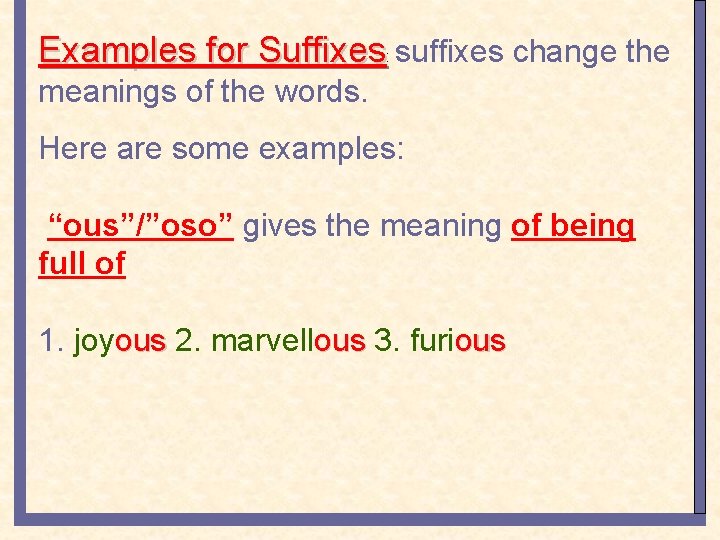
Examples for Suffixes: suffixes change the meanings of the words. Here are some examples: “ous”/”oso” gives the meaning of being full of 1. joyous 2. marvellous 3. furious
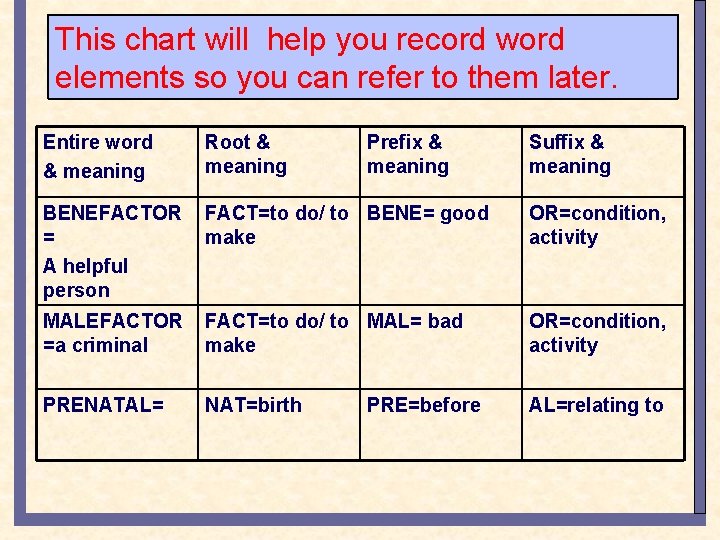
This chart will help you record word elements so you can refer to them later. Entire word & meaning Root & meaning Prefix & meaning BENEFACTOR = A helpful person FACT=to do/ to BENE= good make OR=condition, activity MALEFACTOR =a criminal FACT=to do/ to MAL= bad make OR=condition, activity PRENATAL= NAT=birth AL=relating to PRE=before Suffix & meaning
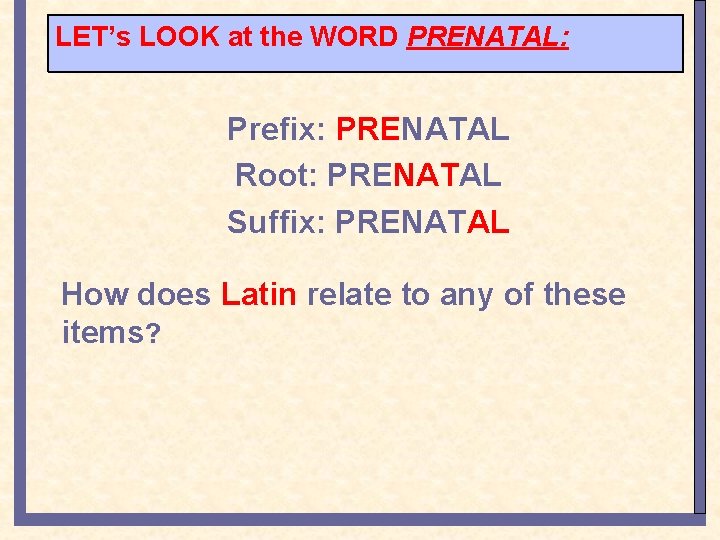
LET’s LOOK at the WORD PRENATAL: Prefix: PRENATAL Root: PRENATAL Suffix: PRENATAL How does Latin relate to any of these items?
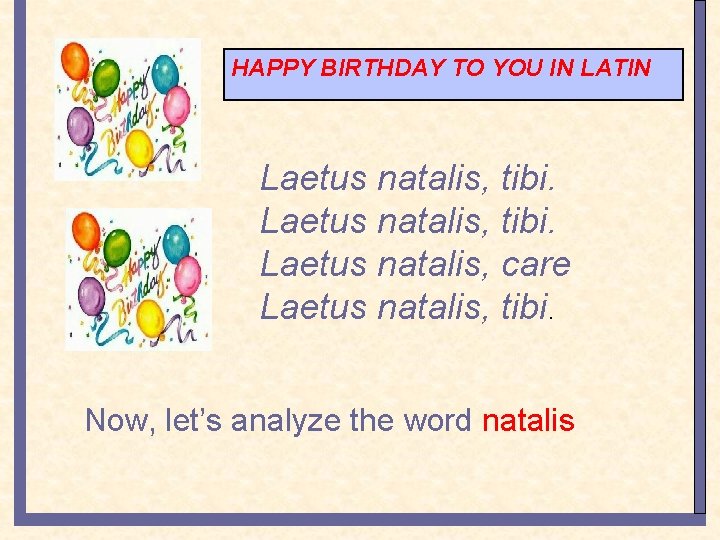
HAPPY BIRTHDAY TO YOU IN LATIN Laetus natalis, tibi. Laetus natalis, care Laetus natalis, tibi. Now, let’s analyze the word natalis
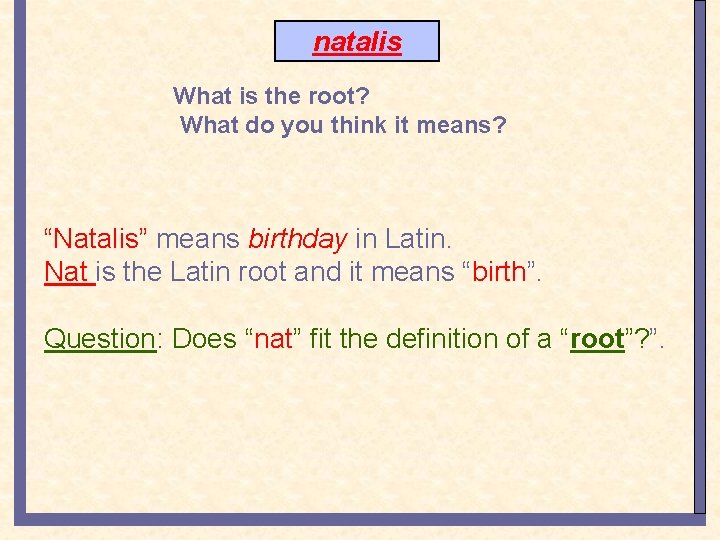
natalis What is the root? What do you think it means? “Natalis” means birthday in Latin. Nat is the Latin root and it means “birth”. Question: Does “nat” fit the definition of a “root”? ”.
Let’s be creative: Let’s put some elements together and see what we have. Add the prefix “pre” meaning “before” to “nat”. Now add the suffix “al” meaning “relating to” to “nat”. What is the new word? Pre + nat + al (Prenatal) What does it mean? It means “before birth”.
Now let’s see some more words Here’s a new one: Add the prefix “neo” meaning “new” to “nat”. neo + nat The actual spelling of the word is neonate. And it means new birth such as a newborn!
Now let’s add the suffix “ive”, meaning “directed towards” to the root “nat”. Nat + ive 1)Write down your prediction of the definition of this word. 2)Now look “native” up in the dictionary & write the definition. Were you correct? ? ?
You’re on your way to being a great Roman thinker! Now investigate these new words : INNATE, NATALITY, NATUROPATHY TENACIOUS, SUPERFLUOUS REMEMBER: Prefix: in = not Suffixes: al = relating to ity = state of pathy = to experience, suffer Decode the meanings by connecting the definitions of the prefixes and suffixes to the root word. Then analyze in what way the meaning has changed.
How close did you come in your predictions? Write down your predictions of what each word means or relates to. Explain your reasoning. Look up the words in the dictionary and write down the definition of each
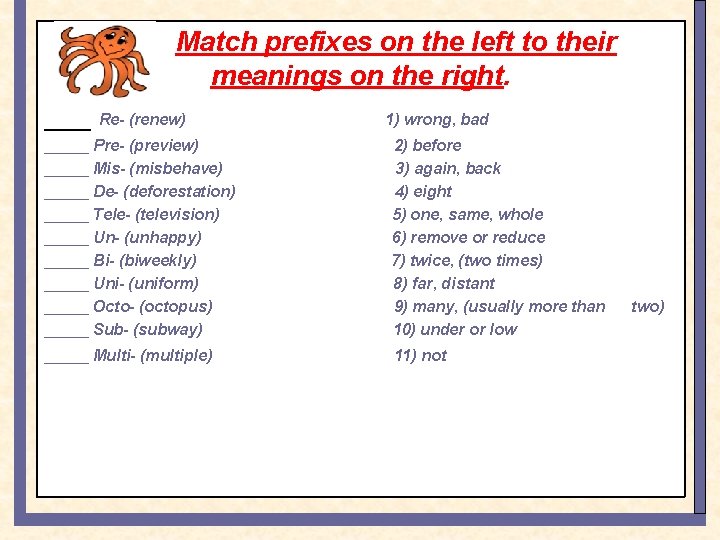
Match prefixes on the left to their meanings on the right. ___ Re- (renew) 1) wrong, bad _____ Pre- (preview) _____ Mis- (misbehave) _____ De- (deforestation) _____ Tele- (television) _____ Un- (unhappy) _____ Bi- (biweekly) _____ Uni- (uniform) _____ Octo- (octopus) _____ Sub- (subway) 2) before 3) again, back 4) eight 5) one, same, whole 6) remove or reduce 7) twice, (two times) 8) far, distant 9) many, (usually more than 10) under or low _____ Multi- (multiple) 11) not two)
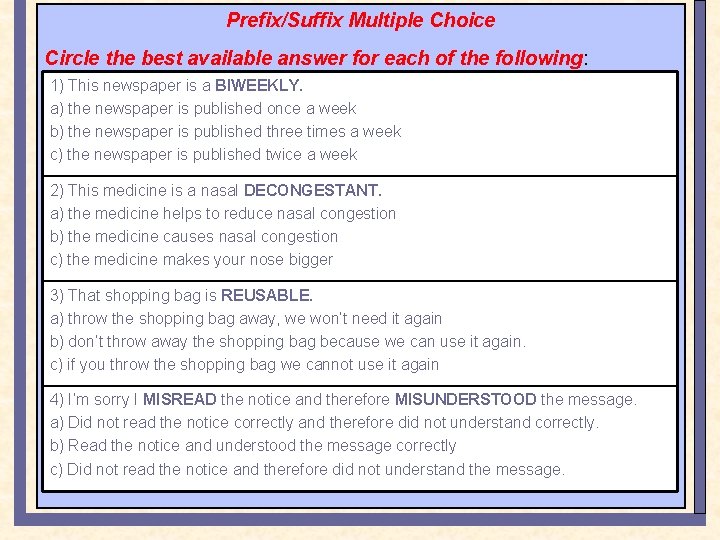
Prefix/Suffix Multiple Choice Circle the best available answer for each of the following: 1) This newspaper is a BIWEEKLY. a) the newspaper is published once a week b) the newspaper is published three times a week c) the newspaper is published twice a week 2) This medicine is a nasal DECONGESTANT. a) the medicine helps to reduce nasal congestion b) the medicine causes nasal congestion c) the medicine makes your nose bigger 3) That shopping bag is REUSABLE. a) throw the shopping bag away, we won’t need it again b) don’t throw away the shopping bag because we can use it again. c) if you throw the shopping bag we cannot use it again 4) I’m sorry I MISREAD the notice and therefore MISUNDERSTOOD the message. a) Did not read the notice correctly and therefore did not understand correctly. b) Read the notice and understood the message correctly c) Did not read the notice and therefore did not understand the message.
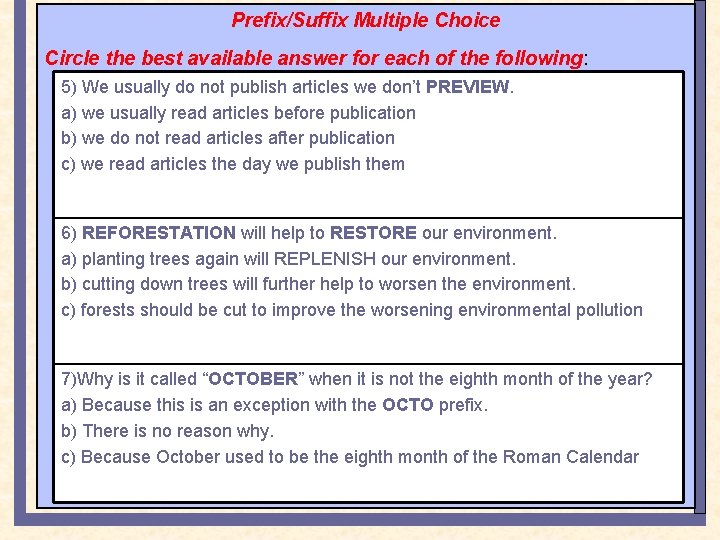
Prefix/Suffix Multiple Choice Circle the best available answer for each of the following: 5) We usually do not publish articles we don’t PREVIEW. a) we usually read articles before publication b) we do not read articles after publication c) we read articles the day we publish them 6) REFORESTATION will help to RESTORE our environment. a) planting trees again will REPLENISH our environment. b) cutting down trees will further help to worsen the environment. c) forests should be cut to improve the worsening environmental pollution 7)Why is it called “OCTOBER” when it is not the eighth month of the year? a) Because this is an exception with the OCTO prefix. b) There is no reason why. c) Because October used to be the eighth month of the Roman Calendar
Congratulations! You have learned how to predict what familiar/unfamiliar words mean by applying the definitions of affixes. You’ve entered the exciting world of word discovery and higher understanding of literature. Now you’re a great English Latin thinker!
References: -The Merriam-Webster Unabridged Dictionary of the English Language, 1976, G. &M. Merriam Co. -Pennock, R. T. , Tower of Babel: The Evidence Against the New Creationism, MIT Press, Cambridge MA, USA, 1999. -Walshe, M. O. C. , A Concise German Etymological Dictionary, Routledge & Kegan, London, 2003.
- Slides: 35