
Julien Gobeill 1 Emilie Pasche 2 Douglas Teodoro
Julien Gobeill 1, Emilie Pasche 2, Douglas Teodoro 2, Anne-Lise Veuthey 3, Patrick Ruch 1 University of Applied Sciences, Information Sciences, Geneva 2 Hospitals and University of Geneva, Geneva 3 Swiss-Prot group, Swiss Institute of Bioinformatics, Geneva 1 Answering Gene Ontology terms to proteomics questions by supervised macro reading in MEDLINE
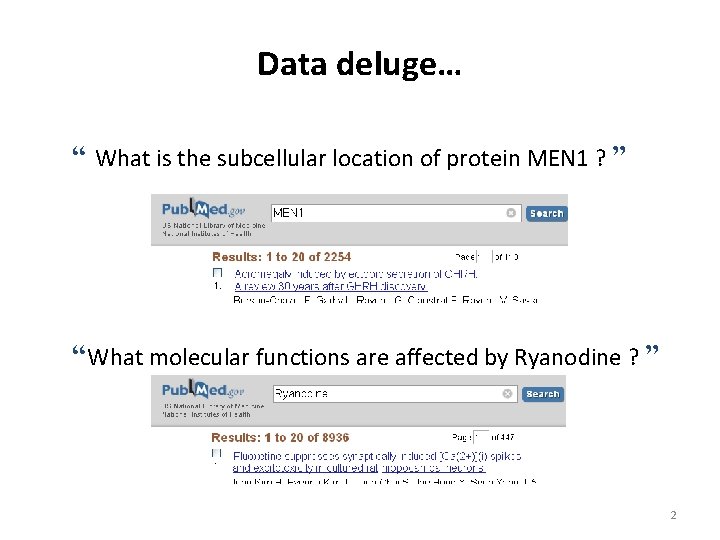
Data deluge… “ What is the subcellular location of protein MEN 1 ? ” “What molecular functions are affected by Ryanodine ? ” 2
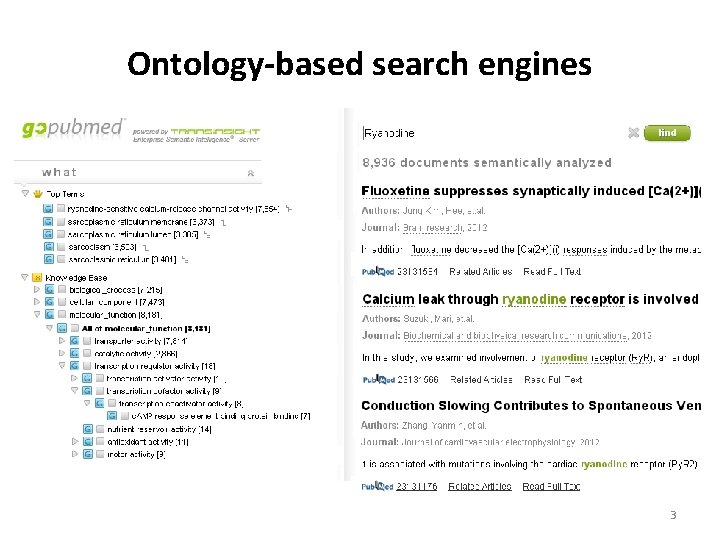
Ontology-based search engines 3
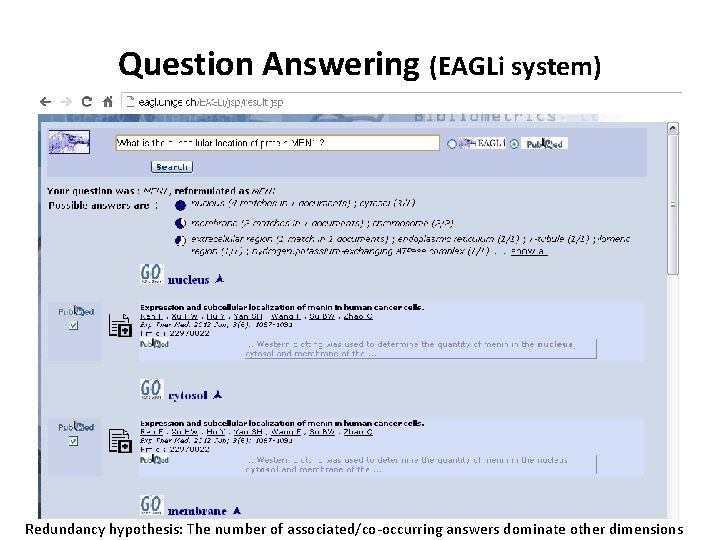
Question Answering (EAGLi system) Redundancy hypothesis: The number of associated/co-occurring answers dominate other dimensions
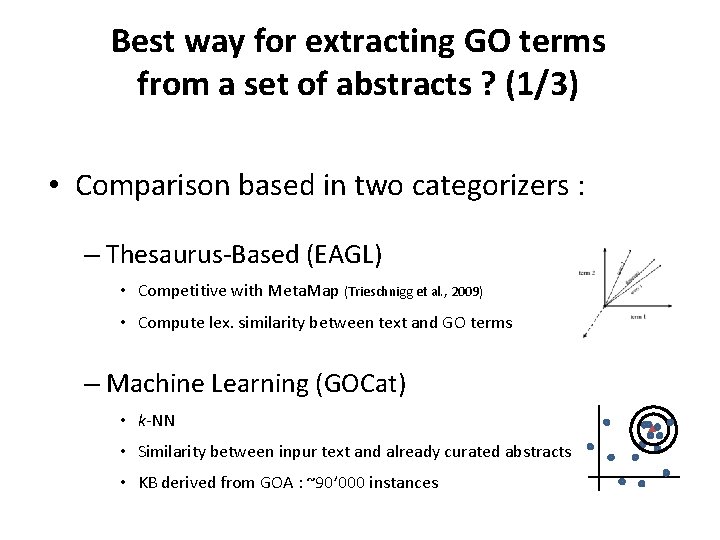
Best way for extracting GO terms from a set of abstracts ? (1/3) • Comparison based in two categorizers : – Thesaurus-Based (EAGL) • Competitive with Meta. Map (Trieschnigg et al. , 2009) • Compute lex. similarity between text and GO terms – Machine Learning (GOCat) • k-NN • Similarity between inpur text and already curated abstracts • KB derived from GOA : ~90’ 000 instances
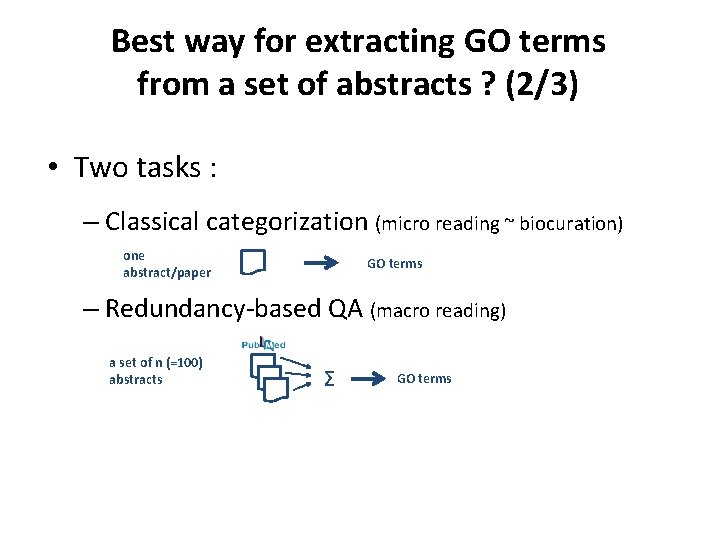
Best way for extracting GO terms from a set of abstracts ? (2/3) • Two tasks : – Classical categorization (micro reading ~ biocuration) one abstract/paper GO terms – Redundancy-based QA (macro reading) a set of n (=100) abstracts Σ GO terms
Best way for extracting GO terms from a set of abstracts ? (3/3) • One benchmark for micro reading evaluation – 1’ 000 abstracts and GO descriptors from GOA • Two benchmarks for macro reading evaluation – 50 questions derived from a set of biological databases: What molecular functions are affected by [chemical] ? What cellular component is the location of [protein] ?
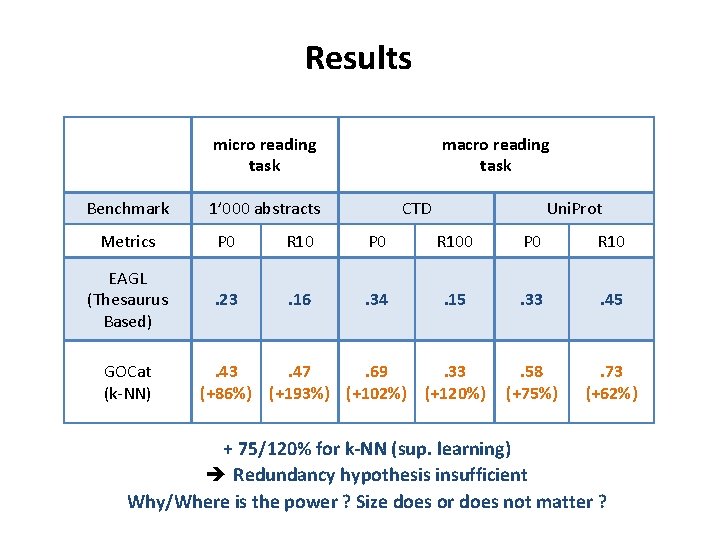
Results micro reading task Benchmark macro reading task 1’ 000 abstracts CTD Uni. Prot Metrics P 0 R 100 P 0 R 10 EAGL (Thesaurus Based) . 23 . 16 . 34 . 15 . 33 . 45 . 58 (+75%) . 73 (+62%) GOCat (k-NN) . 43. 47. 69. 33 (+86%) (+193%) (+102%) (+120%) + 75/120% for k-NN (sup. learning) è Redundancy hypothesis insufficient Why/Where is the power ? Size does or does not matter ?
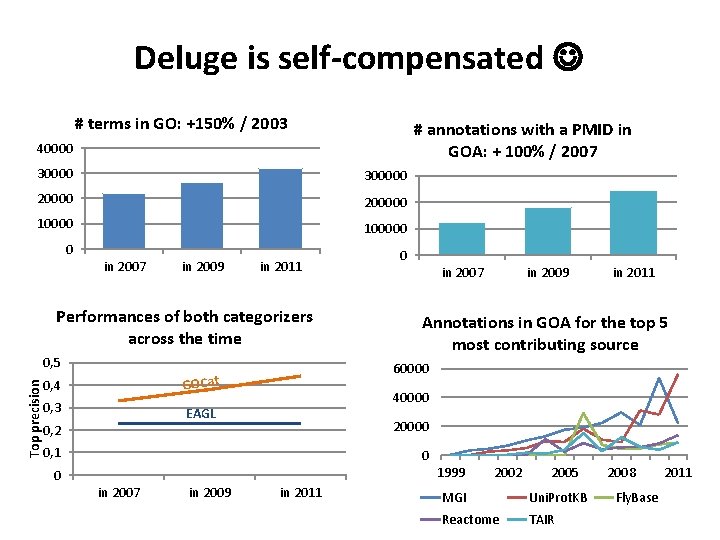
Deluge is self-compensated # terms in GO: +150% / 2003 # annotations with a PMID in GOA: + 100% / 2007 40000 300000 200000 100000 0 in 2007 in 2009 in 2011 Performances of both categorizers across the time Top precision 0, 5 0, 4 GOCat 0, 3 EAGL 0, 2 0 in 2007 in 2009 in 2011 Annotations in GOA for the top 5 most contributing source 60000 40000 20000 0, 1 0 1999 0 in 2007 in 2009 in 2011 2002 2005 MGI Uni. Prot. KB Reactome TAIR 2008 Fly. Base 2011
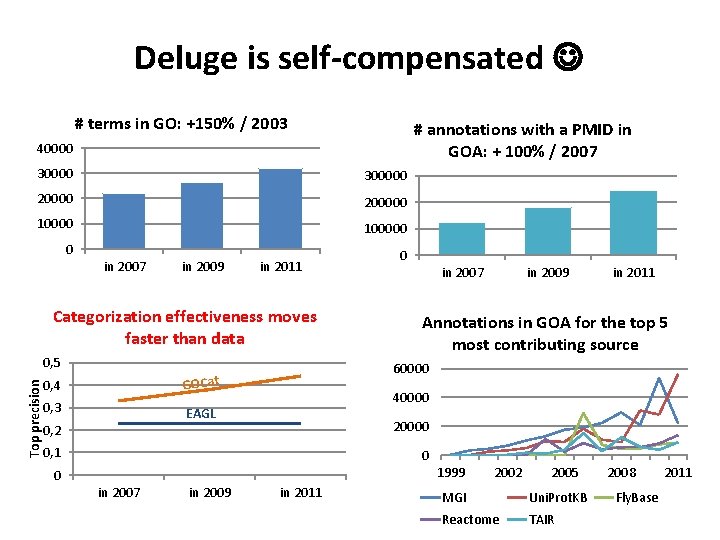
Deluge is self-compensated # terms in GO: +150% / 2003 # annotations with a PMID in GOA: + 100% / 2007 40000 300000 200000 100000 0 in 2007 in 2009 in 2011 Categorization effectiveness moves faster than data Top precision 0, 5 0, 4 GOCat 0, 3 EAGL 0, 2 0 in 2007 in 2009 in 2011 Annotations in GOA for the top 5 most contributing source 60000 40000 20000 0, 1 0 1999 0 in 2007 in 2009 in 2011 2002 2005 MGI Uni. Prot. KB Reactome TAIR 2008 Fly. Base 2011
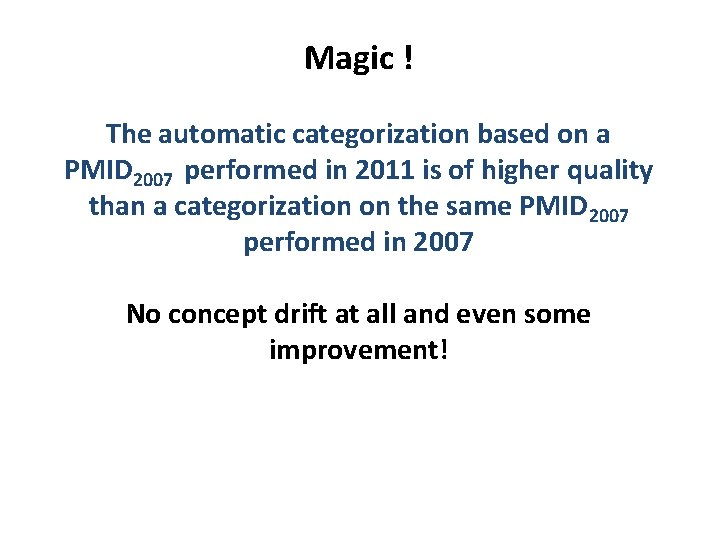
Magic ! The automatic categorization based on a PMID 2007 performed in 2011 is of higher quality than a categorization on the same PMID 2007 performed in 2007 No concept drift at all and even some improvement!
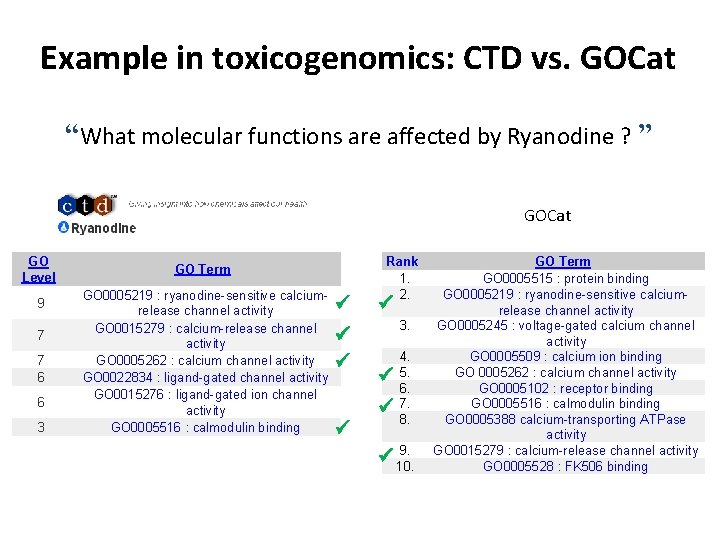
Example in toxicogenomics: CTD vs. GOCat “What molecular functions are affected by Ryanodine ? ” GOCat GO Level 9 7 7 6 6 3 GO Term GO 0005219 : ryanodine-sensitive calciumrelease channel activity GO 0015279 : calcium-release channel activity GO 0005262 : calcium channel activity GO 0022834 : ligand-gated channel activity GO 0015276 : ligand-gated ion channel activity GO 0005516 : calmodulin binding Rank 1. 2. 3. 4. 5. 6. 7. 8. 9. 10. GO Term GO 0005515 : protein binding GO 0005219 : ryanodine-sensitive calciumrelease channel activity GO 0005245 : voltage-gated calcium channel activity GO 0005509 : calcium ion binding GO 0005262 : calcium channel activity GO 0005102 : receptor binding GO 0005516 : calmodulin binding GO 0005388 calcium-transporting ATPase activity GO 0015279 : calcium-release channel activity GO 0005528 : FK 506 binding
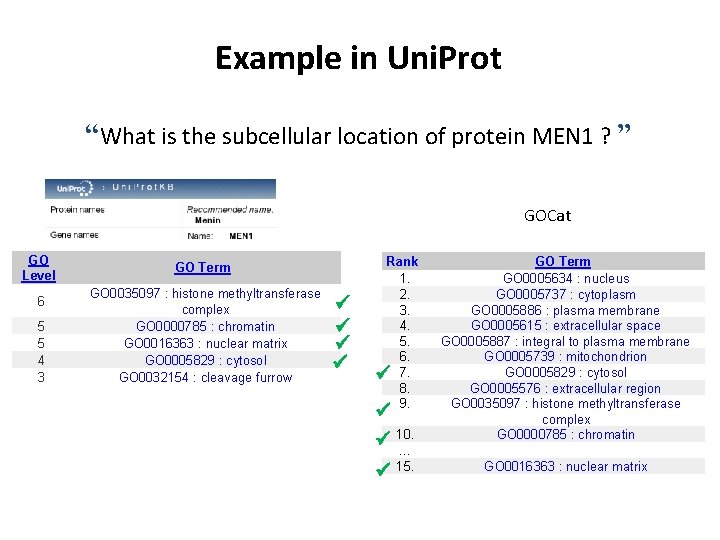
Example in Uni. Prot “What is the subcellular location of protein MEN 1 ? ” GOCat GO Level 6 5 5 4 3 GO Term GO 0035097 : histone methyltransferase complex GO 0000785 : chromatin GO 0016363 : nuclear matrix GO 0005829 : cytosol GO 0032154 : cleavage furrow Rank 1. 2. 3. 4. 5. 6. 7. 8. 9. GO Term GO 0005634 : nucleus GO 0005737 : cytoplasm GO 0005886 : plasma membrane GO 0005615 : extracellular space GO 0005887 : integral to plasma membrane GO 0005739 : mitochondrion GO 0005829 : cytosol GO 0005576 : extracellular region GO 0035097 : histone methyltransferase complex GO 0000785 : chromatin 15. GO 0016363 : nuclear matrix 10. …
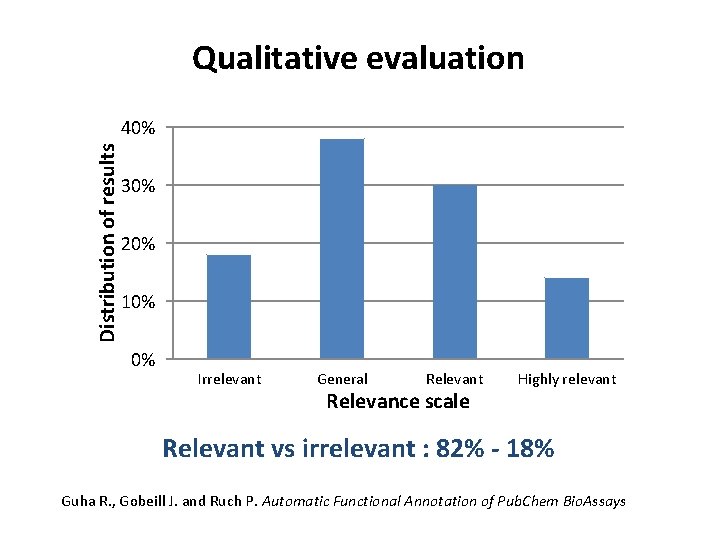
Qualitative evaluation Distribution of results 40% 30% 20% 10% 0% Irrelevant General Relevant Relevance scale Highly relevant Relevant vs irrelevant : 82% - 18% Guha R. , Gobeill J. and Ruch P. Automatic Functional Annotation of Pub. Chem Bio. Assays
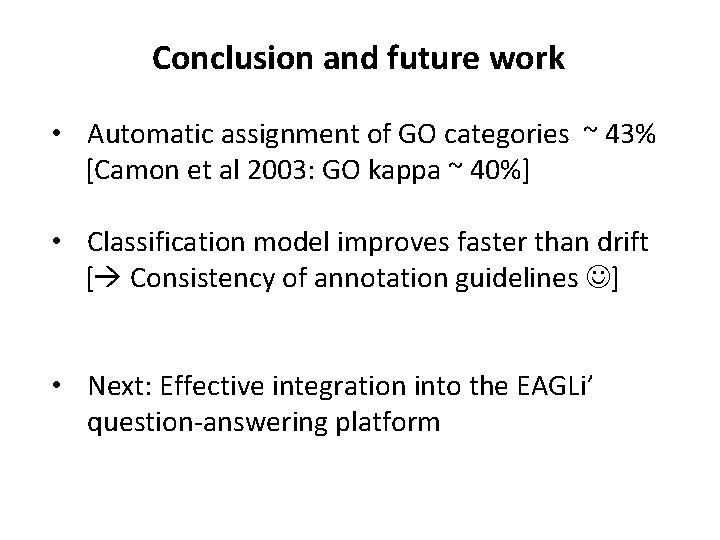
Conclusion and future work • Automatic assignment of GO categories ~ 43% [Camon et al 2003: GO kappa ~ 40%] • Classification model improves faster than drift [ Consistency of annotation guidelines ] • Next: Effective integration into the EAGLi’ question-answering platform
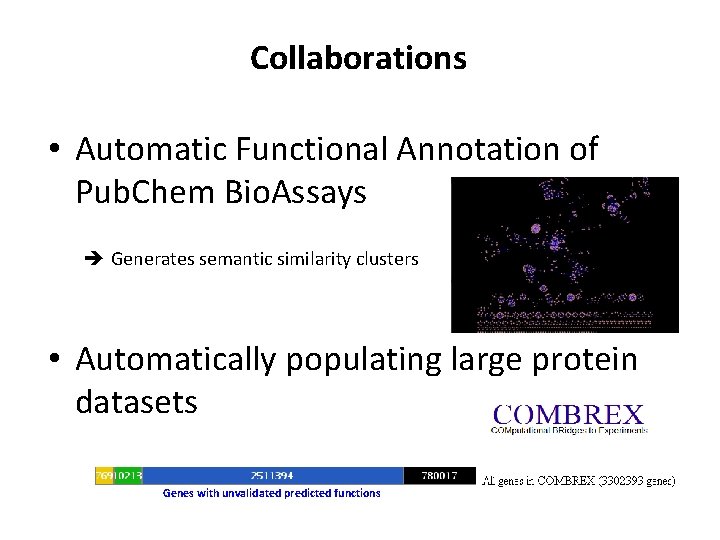
Collaborations • Automatic Functional Annotation of Pub. Chem Bio. Assays è Generates semantic similarity clusters • Automatically populating large protein datasets Genes with unvalidated predicted functions
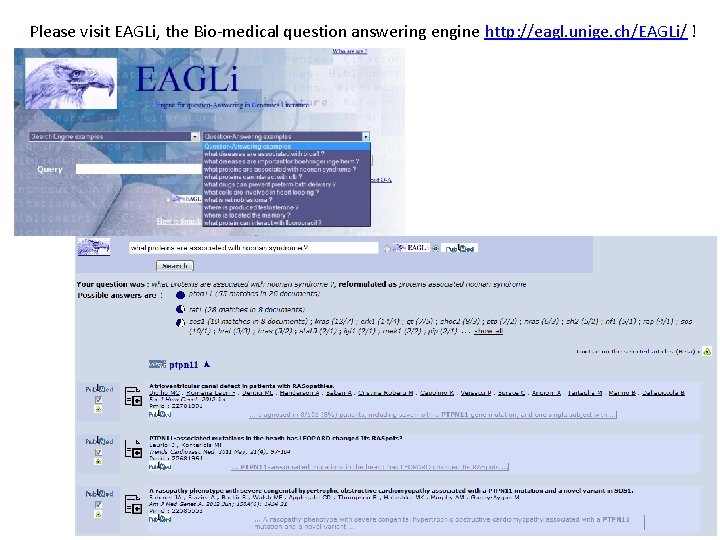
Please visit EAGLi, the Bio-medical question answering engine http: //eagl. unige. ch/EAGLi/ !
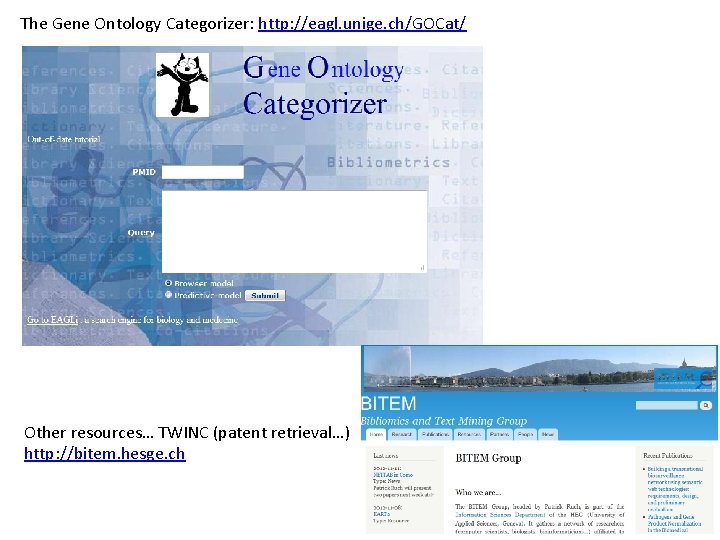
The Gene Ontology Categorizer: http: //eagl. unige. ch/GOCat/ Other resources… TWINC (patent retrieval…) http: //bitem. hesge. ch
Acknowledgments • Swiss-prot group (SIB): Anne-Lise Veuthey, Yoannis Yenarios • U. Indiana/SCRIPPS: Rajarshi Guha / Stephan Schurer • The COMBREX project: Martin Steffen • Next. Prot: Pascale Gaudet • SNF Grant: EAGL # 120758 • EU FP 7: www. KHRESMOI. eu # 257528
- Slides: 19