
Juho Lhteenmaa The Effect of Foreign Actors Gambling
© Juho Lähteenmaa The Effect of Foreign Actors' Gambling Games on Finnish Gambling Market JUHO LÄHT EENMAA UNIVERS ITY OF HELS INKI FA CULTY OF SOCIAL SCI ENCES ECONOMICS SEMIN AR ESS AY 2018
INTRODUCTION © Juho Lähteenmaa Ø In many countries gambling markets have changed significantly due to increase of the internet gambling during the first two decades of the 21 th century Ø E. g. In Denmark gambling market was opened for competition in 2010 aim to increase domestic gambling revenue (C. Jensen, 2017) Ø Also Sweden is going to move from monopoly gambling market to the system where market is partly opened to competitive market (based on licences) and partly kept under the national companies (H. Hallstedt et al. , 2017) The rapid increasement of internet gaming’s market share has a major effect in this change
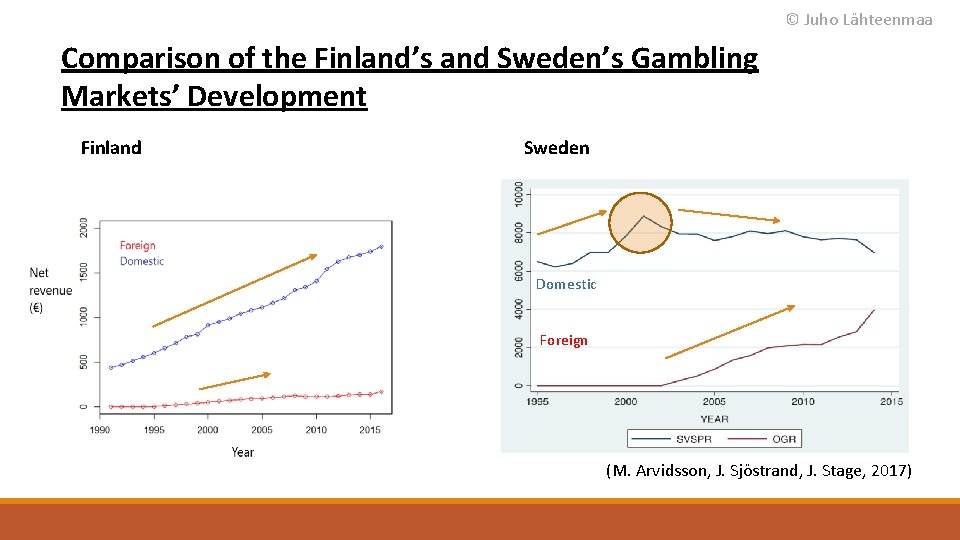
© Juho Lähteenmaa Comparison of the Finland’s and Sweden’s Gambling Markets’ Development Finland Sweden Domestic Foreign (M. Arvidsson, J. Sjöstrand, J. Stage, 2017)
Comparison of the Finland’s and Sweden’s Gambling Markets’ Development © Juho Lähteenmaa Ø Veikkaus (national monopoly company) had 90 % market share in 2017 (V. Nummikoski, Veikkaus, 2017) Ø Foreign actors market share from Sweden’s gambling market was ~ 25 % in 2016 (H. Hallstedt et al. , 2017) Ø In 2016 domestic actors’ net revenue increased 2 % in Sweden, when foreign actors’ net revenue increased 16% Government lost gambling and tax revenues in abroad. Also increasing part of gambling happens outside of domestic regulation
© Juho Lähteenmaa Development of Finnish Gambling Markets between 2005 -2016 Relative changes in foreign and domestic actors’ net revenues in Finland from 2005 to 2016. Ø Also in Finland foreign actors’ net revenue has increased faster than domestic actors net revenue (on average) between 2005 and 2016 Ø On average, foreign actors’ net revenue growth rate has been 5. 9 % and for domestic actors 4. 3 % between 2005 and 2016 Ø Domestic gambling revenue has a significant role in government’s whole revenues in Finland. In 2014 government got ~ 1. 2 billion € revenue from gambling (including revenues from gambling and taxes)
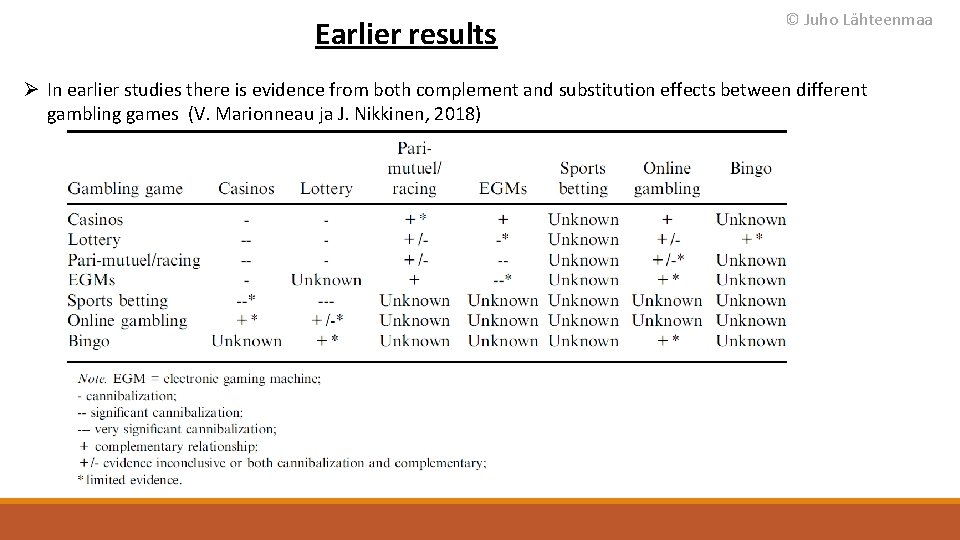
Earlier results © Juho Lähteenmaa Ø In earlier studies there is evidence from both complement and substitution effects between different gambling games (V. Marionneau ja J. Nikkinen, 2018)
© Juho Lähteenmaa Internet Gambling and Commercial Casinos in USA in 1988 -2006 (K. Philander, 2011) Ø Using TSLS (Two-Stage Least-Squares) time series regression model Ø Dependent variable total commercial casino gross gaming revenue in period t Ø As regressor estimate of online gaming revenue in period t, which is estimated with the instrument internet subscription rates per 100 people in period t-1 Ø TSLS model is used to ensure regressors exogeneity § Simultaneous and omitted variable bias
© Juho Lähteenmaa Internet Gambling and Commercial Casinos in USA in 1988 -2006 (K. Philander, 2011) Ø Maximum likelihood estimation for coefficient between internet gambling revenues and commercial gambling revenues is -0. 28 Ø 95 % confidence interval -0. 52 ‒ -0. 03 Slight substitution effect Ø Different player groups? Ø Study has really small sampling size (n = 19)
Foreign Internet Gambling Actors’ Revenues vs. Domestic Gambling Actors’ Revenues in Sweden 1995‒ 2014 (M. Arvidsson, J. Sjöstrand ja J. Stage, 2017) © Juho Lähteenmaa Ø Using TSLS (Two-Stage Least-Squares) time series regression model Ø Dependent variable domestic gambling revenues in period t Ø As regressor foreign gambling revenues in period t, which is estimated with the instrument foreign gambling revenues in period t-1 Ø TSLS model is used to ensure regressors exogeneity § It can be assumed that instrument doesn’t have simultaneous bias
© Juho Lähteenmaa Foreign Internet Gambling Actors’ Revenues vs. Domestic Gambling Actors’ Revenues in Sweden 1995‒ 2014 (M. Arvidsson, J. Sjöstrand ja J. Stage, 2017) Ø Maximum likelihood estimation for coefficient between foreign gambling net revenues and domestic gambling net revenues -0. 272 Ø 95 % confidence interval -0. 51 ‒ -0. 04 Slight substitution effect Ø Different player groups? Ø Once again extremely small sampling size (n = 19)
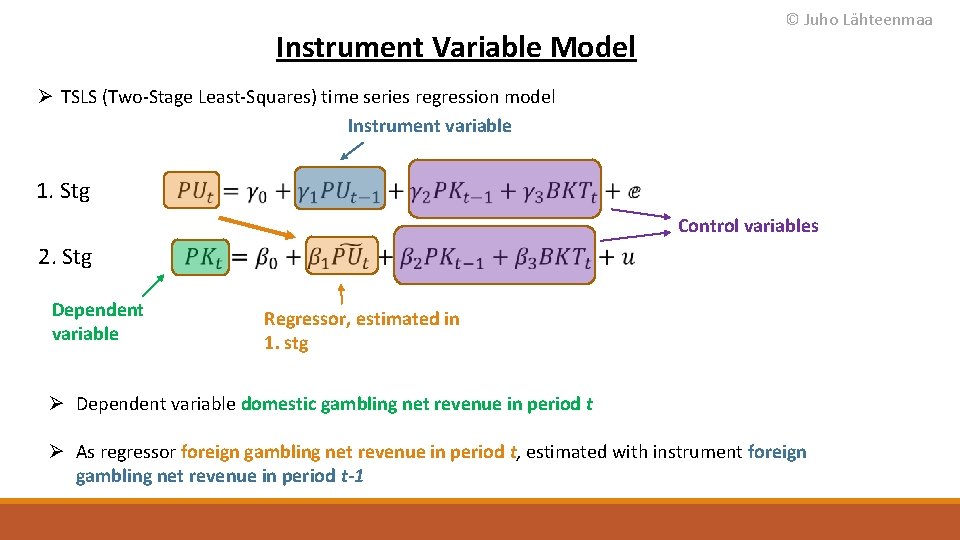
Instrument Variable Model © Juho Lähteenmaa Ø TSLS (Two-Stage Least-Squares) time series regression model Instrument variable 1. Stg Control variables 2. Stg Dependent variable Regressor, estimated in 1. stg Ø Dependent variable domestic gambling net revenue in period t Ø As regressor foreign gambling net revenue in period t, estimated with instrument foreign gambling net revenue in period t-1
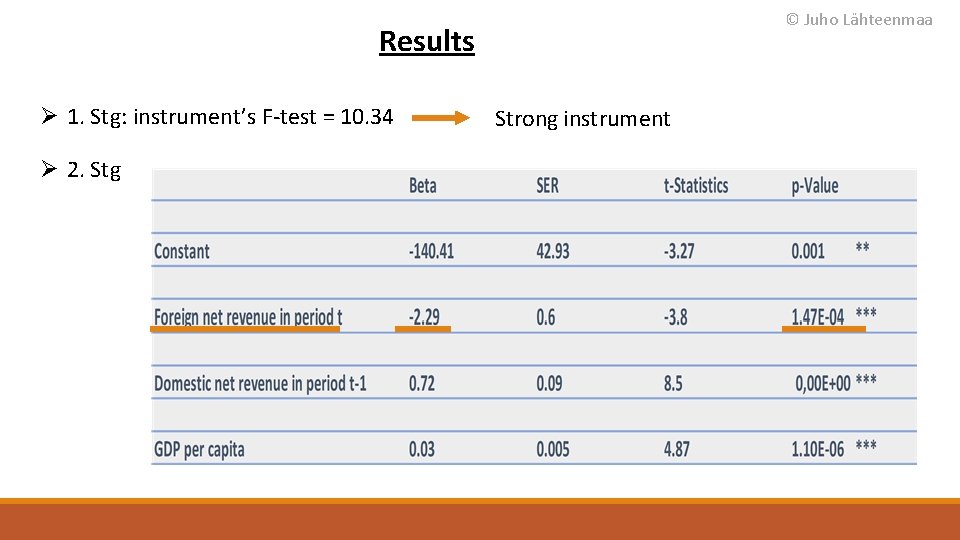
© Juho Lähteenmaa Results Ø 1. Stg: instrument’s F-test = 10. 34 Ø 2. Stg Strong instrument
Results © Juho Lähteenmaa Ø Maximum likelihood estimation for coefficient between foreign gambling net revenues and domestic gambling net revenues -2, 29 Ø 95 % confidence interval -3. 47 ‒ -1. 11 Ø Compared to Sweden, Finland has bigger estimated coefficient Same player groups? Ø The estimate for the short-run income elasticity was 0. 60 and for the long-run 2. 16 § Both estimates are inside the range which has been estimated earlier. Shortrun and long-run estimates has been in range 0, 22‒ 2, 29 counted with U. S. data (M. W. Nichols ja M. S. Tosun, 2007)
Critique for the model © Juho Lähteenmaa Ø Sample size (n=29) § Small sample size causes wider standard errors and may break asymptotic assumptions such as the Law of large numbers This problem will be resolved in the future when there is more data available or by using more frequently collected data Ø Foreign actors’ net revenues for the years 2004‒ 2016 are estimates and before 2004 only linearly estimated values (do not include seasonal variance)
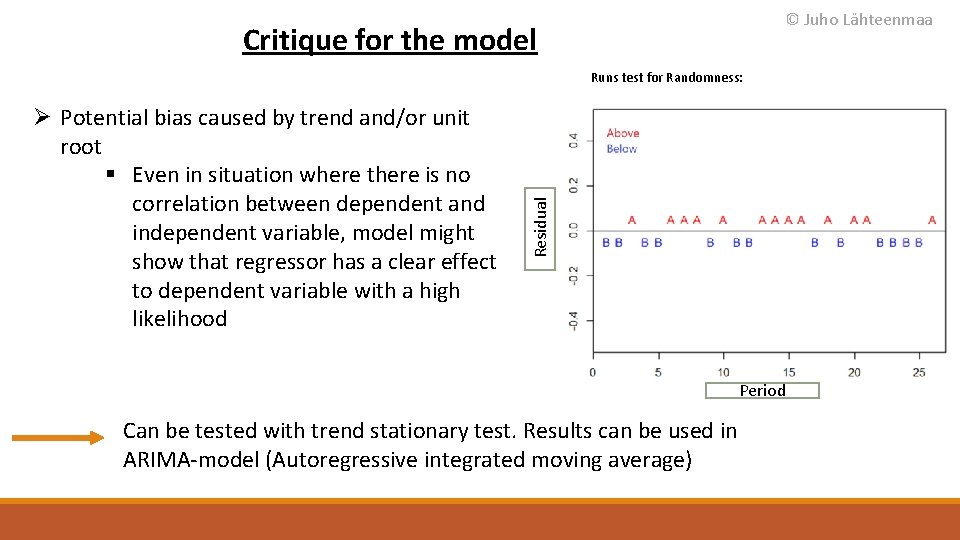
© Juho Lähteenmaa Critique for the model Ø Potential bias caused by trend and/or unit root § Even in situation where there is no correlation between dependent and independent variable, model might show that regressor has a clear effect to dependent variable with a high likelihood Residual Runs test for Randomness: Period Can be tested with trend stationary test. Results can be used in ARIMA-model (Autoregressive integrated moving average)
Summary © Juho Lähteenmaa Ø Result of the model used in essay is that foreign gambling games are substitutes for domestic games Ø Substitution coefficient estimated with Finnish data is greater than coefficients in other studies Ø The results from the seminar essay can be criticised because of small sample size and potentially unstationary Ø It is probable that foreign gambling actors’ market share will increase from the level of 2016
Summary © Juho Lähteenmaa Ø Due to substitution relation between foreign and domestic gambling games it looks likely that increase of level of playing foreign gambling games will for it’s part limit the growth of the gaming revenues of Veikkaus Implicates smaller growth of shareable and taxable revenues May lead to situation where bigger part of gambling will happen outside of Finnish regulation system Ø Will Finland keep the national monopoly system or will it move towards more open gambling market structure as Sweden and Denmark?

© Juho Lähteenmaa
- Slides: 18